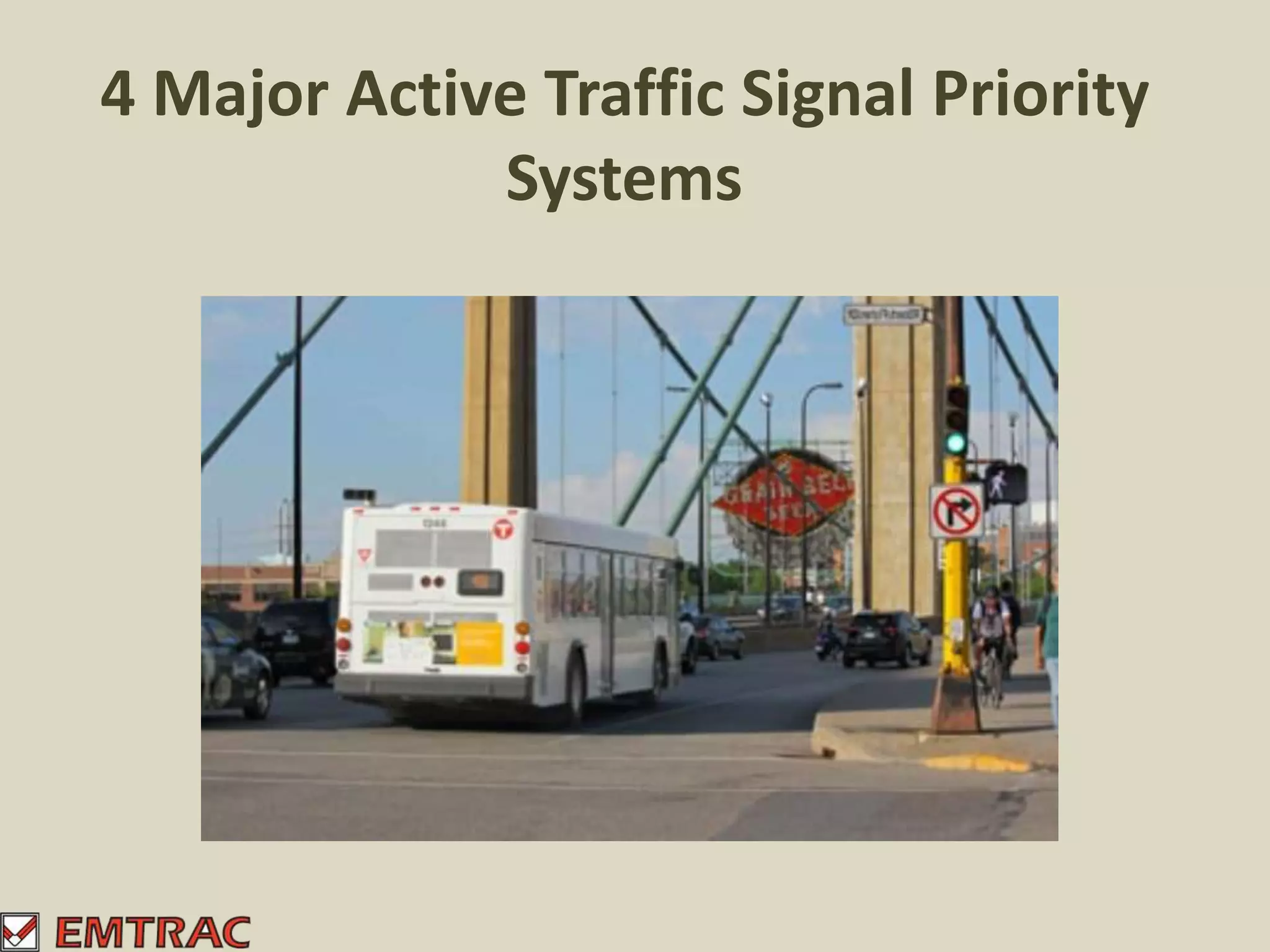
4 Major Active Traffic Signal Priority
Systems
An Introduction
Providing Priority for public transport at intersections of signals is an
excellent way to lessen public transport travel time and helps in
increasing schedule reliability, to help public transport be more
convenient for customers and less expensive to operate. Transit
signal priority (TSP) is the technical name for public transport
vehicles with Priority at traffic signals.
Types of Traffic Signal Priority (TSP)
• Passive Traffic Signal Priority – In these systems, the traffic signals
are placed to turn green based on an average public transport
vehicle speed.
• Active Traffic Signal Priority – In an active TSP system, the bus or
tram gives the traffic signal controller a signal.
4 Active Traffic Signal Priority Systems
• Dedicated Priority – phasing changes:- This is the simplest traffic
signal priority system that turns the signal green for public
transport when the vehicle approaches.
• Longer Green Time – timing changes; To solve the issue of the
problem of traffic congestion that is caused by dedicated priority
systems, the Longer Green time approach is there to adjust the
traffic signal ‘timing’ – the amount of time given to the traffic signal
‘phase’ for the bus or tram.
4 Active Traffic Signal Priority Systems
• Phase & Timing Change: – Zurich approach; The Zurich system is a
combination of an automatic prediction of when buses and trams
will appear at a traffic signal with an adjustable approach to traffic
signal ‘phasing’ and ‘timing.
• Intelligent Transport Systems (ITS):- Intelligent Transport Systems
(ITS) describes the application of technology that helps improve the
operation of all transportation networks and services.
Contact Us:
• Location: Manufactured By STC, Inc. 1201 W. Randolph St,
McLeansboro, IL 62859
• phone: Richard D'Alessandro: (214) 607–0100
• Fax: (214) 607–0105
• Email: info@emtracsystems.com
• Web: emtracsystems.com

4 Major Active Traffic Signal Priority Systems.pptx

  • 1.
    4 Major ActiveTraffic Signal Priority Systems
  • 2.
    An Introduction Providing Priorityfor public transport at intersections of signals is an excellent way to lessen public transport travel time and helps in increasing schedule reliability, to help public transport be more convenient for customers and less expensive to operate. Transit signal priority (TSP) is the technical name for public transport vehicles with Priority at traffic signals.
  • 3.
    Types of TrafficSignal Priority (TSP) • Passive Traffic Signal Priority – In these systems, the traffic signals are placed to turn green based on an average public transport vehicle speed. • Active Traffic Signal Priority – In an active TSP system, the bus or tram gives the traffic signal controller a signal.
  • 4.
    4 Active TrafficSignal Priority Systems • Dedicated Priority – phasing changes:- This is the simplest traffic signal priority system that turns the signal green for public transport when the vehicle approaches. • Longer Green Time – timing changes; To solve the issue of the problem of traffic congestion that is caused by dedicated priority systems, the Longer Green time approach is there to adjust the traffic signal ‘timing’ – the amount of time given to the traffic signal ‘phase’ for the bus or tram.
  • 5.
    4 Active TrafficSignal Priority Systems • Phase & Timing Change: – Zurich approach; The Zurich system is a combination of an automatic prediction of when buses and trams will appear at a traffic signal with an adjustable approach to traffic signal ‘phasing’ and ‘timing. • Intelligent Transport Systems (ITS):- Intelligent Transport Systems (ITS) describes the application of technology that helps improve the operation of all transportation networks and services.
  • 6.
    Contact Us: • Location:Manufactured By STC, Inc. 1201 W. Randolph St, McLeansboro, IL 62859 • phone: Richard D'Alessandro: (214) 607–0100 • Fax: (214) 607–0105 • Email: info@emtracsystems.com • Web: emtracsystems.com