ACKNOWLEDGEMENT
• I would like to express my special thanks of
gratitude to our Dean Ag. Professor.
SAMSHER SINGH, H.O.D. Professor. S.K.
BHATNAGAR sir, Dr. PURUSHOTTAM sir,
and Dr. ARCHANA BHATNAGAR mam ,
OIC OF BASIC SCIENCE AND
HUMANITY, who gave me the golden
opportunity to do this wonderful project on
the topic (TRANSGENIC PLANTS),
Secondly i would also like to thank my
instructor Ms. AASTHA MAM and Ms.
SWARNA MAM for their support and
Presented by:
SHAHBAZ HUSAIN
contents
Introduction
Transgenic plants are the results of modern
biotechnology.
An organism containing a transgene
introduced by technological (not breeding)
methods is called transgenic.
Transgenes are the genetically engineered
gene added to a species.
The process of producing transgenic
organism is called transgenesis.
PLANT TRANSFORMATION METHODS
Transfer of DNA via a vector:
»Agrobacterium
Direct transfer of DNA:
»gene guns
»electroporation
»microinjection
Agrobacterium mediatedmethod
• Agrobacterium-mediated transformation
is most commonly used method for
transgenesis.
• A.tumefaciens is a rod shaped Gram
negative soil bacterium found in the
rhizosphere.
• It contains Ti plasmid(tumor-inducing)
which causes crown gall disease in dicot
plants.
• It mainly infect the wound site and
causes disease symptoms.
Gene gun method
The method was first used by Klein et
al.(1987) to transform epidermal cell of
Allium cepa.
This method is mainly used for cereals
transformation.
Good for plants that cannot be transformed
by Agrobacterium, e.g. most monocot
DNA is bound to tiny particles of gold or
tungsten which are subsequently shot into
plant tissue or single plant cells under high
pressure.The particles penetrate both
the cellwall and membranes.
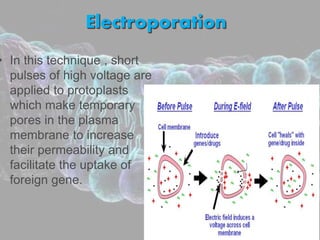
Electroporation
• In this technique , short
pulses of high voltage are
applied to protoplasts
which make temporary
pores in the plasma
membrane to increase
their permeability and
facilitate the uptake of
foreign gene.
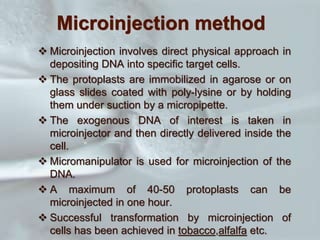
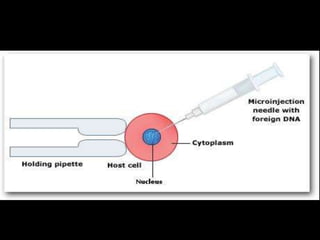
Microinjection method
 Microinjection involves direct physical approach in
depositing DNA into specific target cells.
 The protoplasts are immobilized in agarose or on
glass slides coated with poly-lysine or by holding
them under suction by a micropipette.
 The exogenous DNA of interest is taken in
microinjector and then directly delivered inside the
cell.
 Micromanipulator is used for microinjection of the
DNA.
 A maximum of 40-50 protoplasts can be
microinjected in one hour.
 Successful transformation by microinjection of
cells has been achieved in tobacco,alfalfa etc.
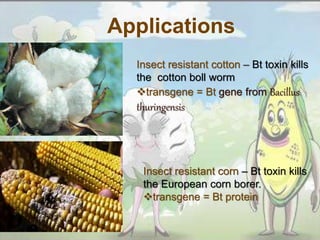
Applications
Insect resistant cotton – Bt toxin kills
the cotton boll worm
transgene = Bt gene from Bacillus
thuringensis
Insect resistant corn – Bt toxin kills
the European corn borer.
transgene = Bt protein
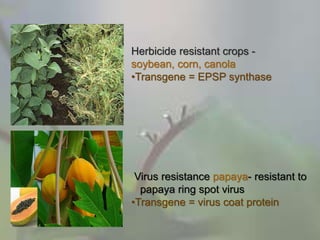
Herbicide resistant crops -
soybean, corn, canola
•Transgene = EPSP synthase
Virus resistance papaya- resistant to
papaya ring spot virus
•Transgene = virus coat protein
Transgenic plants in India
India cultivated its first transgenic Bt cotton crop,
which was developed in the private sector, on 0.05
million hectares in the year 2002.
In 2009, transgenic Bt cotton was cultivated by 5.6
million farmers on 8.6 million hectares.
India now occupies second position in terms of
global cotton production by turning out 35 million
bales of cotton in 2010.
ADVANTAGES AND
DISADVANTAGES OF
G.M CROPS
DISADVANTAGES OF
G.M CROPS
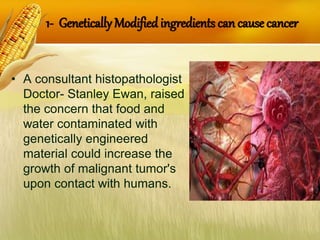
1- Genetically Modifiedingredients can cause cancer
• A consultant histopathologist
Doctor- Stanley Ewan, raised
the concern that food and
water contaminated with
genetically engineered
material could increase the
growth of malignant tumor's
upon contact with humans.
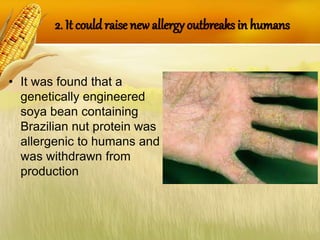
2. It couldraise new allergy outbreaks in humans
• It was found that a
genetically engineered
soya bean containing
Brazilian nut protein was
allergenic to humans and
was withdrawn from
production
3. Adverse effects on the immune system
• A study in 2008 showed that
feeding mice engineered food for
30 days caused an immune
reaction and altered the number
of cells that regulated the immune
functions in the body
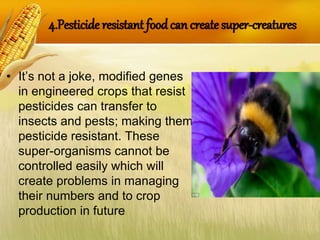
4.Pesticide resistant foodcan create super-creatures
• It’s not a joke, modified genes
in engineered crops that resist
pesticides can transfer to
insects and pests; making them
pesticide resistant. These
super-organisms cannot be
controlled easily which will
create problems in managing
their numbers and to crop
production in future
CONCLUSION
Transgenic plants have the potential to
solve many of the world's hunger and
malnutrition problems, and to help
protect and preserve the environment
by increasing yield and reducing
reliance upon chemical pesticides and
herbicides.
trnsgenic plants and animls

trnsgenic plants and animls

  • 3.
    ACKNOWLEDGEMENT • I wouldlike to express my special thanks of gratitude to our Dean Ag. Professor. SAMSHER SINGH, H.O.D. Professor. S.K. BHATNAGAR sir, Dr. PURUSHOTTAM sir, and Dr. ARCHANA BHATNAGAR mam , OIC OF BASIC SCIENCE AND HUMANITY, who gave me the golden opportunity to do this wonderful project on the topic (TRANSGENIC PLANTS), Secondly i would also like to thank my instructor Ms. AASTHA MAM and Ms. SWARNA MAM for their support and
  • 4.
  • 5.
  • 6.
    Introduction Transgenic plants arethe results of modern biotechnology. An organism containing a transgene introduced by technological (not breeding) methods is called transgenic. Transgenes are the genetically engineered gene added to a species. The process of producing transgenic organism is called transgenesis.
  • 7.
    PLANT TRANSFORMATION METHODS Transferof DNA via a vector: »Agrobacterium Direct transfer of DNA: »gene guns »electroporation »microinjection
  • 8.
    Agrobacterium mediatedmethod • Agrobacterium-mediatedtransformation is most commonly used method for transgenesis. • A.tumefaciens is a rod shaped Gram negative soil bacterium found in the rhizosphere. • It contains Ti plasmid(tumor-inducing) which causes crown gall disease in dicot plants. • It mainly infect the wound site and causes disease symptoms.
  • 9.
    Gene gun method Themethod was first used by Klein et al.(1987) to transform epidermal cell of Allium cepa. This method is mainly used for cereals transformation. Good for plants that cannot be transformed by Agrobacterium, e.g. most monocot DNA is bound to tiny particles of gold or tungsten which are subsequently shot into plant tissue or single plant cells under high pressure.The particles penetrate both the cellwall and membranes.
  • 10.
    Electroporation • In thistechnique , short pulses of high voltage are applied to protoplasts which make temporary pores in the plasma membrane to increase their permeability and facilitate the uptake of foreign gene.
  • 11.
    Microinjection method  Microinjectioninvolves direct physical approach in depositing DNA into specific target cells.  The protoplasts are immobilized in agarose or on glass slides coated with poly-lysine or by holding them under suction by a micropipette.  The exogenous DNA of interest is taken in microinjector and then directly delivered inside the cell.  Micromanipulator is used for microinjection of the DNA.  A maximum of 40-50 protoplasts can be microinjected in one hour.  Successful transformation by microinjection of cells has been achieved in tobacco,alfalfa etc.
  • 13.
    Applications Insect resistant cotton– Bt toxin kills the cotton boll worm transgene = Bt gene from Bacillus thuringensis Insect resistant corn – Bt toxin kills the European corn borer. transgene = Bt protein
  • 14.
    Herbicide resistant crops- soybean, corn, canola •Transgene = EPSP synthase Virus resistance papaya- resistant to papaya ring spot virus •Transgene = virus coat protein
  • 15.
    Transgenic plants inIndia India cultivated its first transgenic Bt cotton crop, which was developed in the private sector, on 0.05 million hectares in the year 2002. In 2009, transgenic Bt cotton was cultivated by 5.6 million farmers on 8.6 million hectares. India now occupies second position in terms of global cotton production by turning out 35 million bales of cotton in 2010.
  • 16.
  • 20.
  • 21.
    1- Genetically Modifiedingredientscan cause cancer • A consultant histopathologist Doctor- Stanley Ewan, raised the concern that food and water contaminated with genetically engineered material could increase the growth of malignant tumor's upon contact with humans.
  • 22.
    2. It couldraisenew allergy outbreaks in humans • It was found that a genetically engineered soya bean containing Brazilian nut protein was allergenic to humans and was withdrawn from production
  • 23.
    3. Adverse effectson the immune system • A study in 2008 showed that feeding mice engineered food for 30 days caused an immune reaction and altered the number of cells that regulated the immune functions in the body
  • 24.
    4.Pesticide resistant foodcancreate super-creatures • It’s not a joke, modified genes in engineered crops that resist pesticides can transfer to insects and pests; making them pesticide resistant. These super-organisms cannot be controlled easily which will create problems in managing their numbers and to crop production in future
  • 25.
    CONCLUSION Transgenic plants havethe potential to solve many of the world's hunger and malnutrition problems, and to help protect and preserve the environment by increasing yield and reducing reliance upon chemical pesticides and herbicides.