Transformation
Efficiency
Katisangla aier
16RSST4014
Garden city College
Definitions
• Transformation is the genetic alteration of a cell resulting from the
direct uptake and incorporation of exogenous genetic material from its
surroundings through the cell membrane(s).
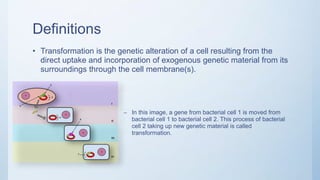
– In this image, a gene from bacterial cell 1 is moved from
bacterial cell 1 to bacterial cell 2. This process of bacterial
cell 2 taking up new genetic material is called
transformation.
Definitions
• Transformation efficiency is the efficiency by which cells can take up
extracellular DNA and express genes encoded by it.
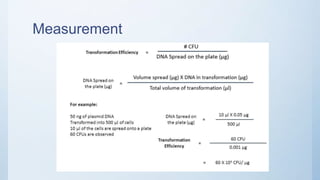
• This is based on the competence of the cells. It can be calculated by
dividing the number of successful transformants by the amount of DNA
used during a transformation procedure.
• Transformants or colony forming units (cfu) are cells that have taken
up DNA (foreign, artificial or modified) and which can express genes on
the introduced DNA.
Measurement
• Transformation efficiency can be measured in transformants or colony
forming unit (cfu) per μg DNA used.
• A transformation efficiency of 1×10⁸ cfu/μg for a small plasmid
like pUC19 is roughly equivalent to 1 in 2000 molecules of the plasmid
used being transformed.
• In E. coli, the theoretical limit of transformation efficiency for most
commonly used plasmids would be over 1×10¹¹ cfu/μg. In practice the
best achievable result may be around 2–4×10¹⁰ cfu/μg for a small
plasmid like pUC19, and considerably lower for large plasmids.
Measurement
Factors affecting Transformation
efficiency
• Plasmid size: larger plasmids transform less well than smaller
plasmids.
• Forms of DNA: Single-stranded DNAs are transformed at 104 lower
efficiency than double-stranded ones.
• Damage to DNA: Exposure of DNA to UV radiation in standard
preparative agarose gel electrophoresis procedure for as little as 45
seconds can damage the DNA, and this can significantly reduce the
transformation efficiency.
THANK YOU!
----------------------------------
----------------------------------

Transformation efficiency

  • 1.
  • 2.
    Definitions • Transformation isthe genetic alteration of a cell resulting from the direct uptake and incorporation of exogenous genetic material from its surroundings through the cell membrane(s). – In this image, a gene from bacterial cell 1 is moved from bacterial cell 1 to bacterial cell 2. This process of bacterial cell 2 taking up new genetic material is called transformation.
  • 3.
    Definitions • Transformation efficiencyis the efficiency by which cells can take up extracellular DNA and express genes encoded by it. • This is based on the competence of the cells. It can be calculated by dividing the number of successful transformants by the amount of DNA used during a transformation procedure. • Transformants or colony forming units (cfu) are cells that have taken up DNA (foreign, artificial or modified) and which can express genes on the introduced DNA.
  • 4.
    Measurement • Transformation efficiencycan be measured in transformants or colony forming unit (cfu) per μg DNA used. • A transformation efficiency of 1×10⁸ cfu/μg for a small plasmid like pUC19 is roughly equivalent to 1 in 2000 molecules of the plasmid used being transformed. • In E. coli, the theoretical limit of transformation efficiency for most commonly used plasmids would be over 1×10¹¹ cfu/μg. In practice the best achievable result may be around 2–4×10¹⁰ cfu/μg for a small plasmid like pUC19, and considerably lower for large plasmids.
  • 5.
  • 6.
    Factors affecting Transformation efficiency •Plasmid size: larger plasmids transform less well than smaller plasmids. • Forms of DNA: Single-stranded DNAs are transformed at 104 lower efficiency than double-stranded ones. • Damage to DNA: Exposure of DNA to UV radiation in standard preparative agarose gel electrophoresis procedure for as little as 45 seconds can damage the DNA, and this can significantly reduce the transformation efficiency.
  • 7.