1
Topic- Transferrin
Session - 2020
Presented By: Chanderhash
"Structure and its effect on function of proteins’’
Course code: BSBT-411
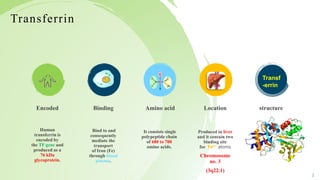
Encoded
Human
transferrin is
encoded by
the TF gene and
produced as a
76 kDa
glycoprotein.
Binding
Bind to and
consequently
mediate the
transport
of Iron (Fe)
through blood
plasma.
Amino acid
It consists single
polypeptide chain
of 680 to 700
amino acids.
Location
Produced in liver
and it contain two
binding site
for Fe3+ atoms
Chromosome
no. 3
(3q22.1)
structure
2
Transf
-errin
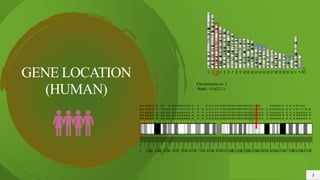
GENE LOCATION
(HUMAN)
3
Chromosome no. 3
Band ---(3q22.1)
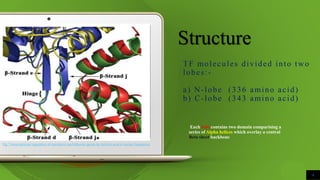
TF molecules divided into two
lobes:-
a) N-lobe (336 amino acid)
b) C-lobe (343 amino acid)
Each lobe contains two domain comparising a
series of Alpha helices which overlay a central
Beta sheet backbone
4
Structure
Fig."Transcriptional regulation of transferrin and albumin genes by retinoic acid in human hepatoma
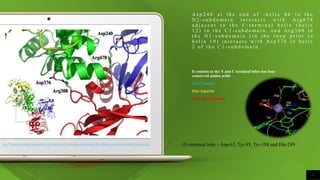
A s p 2 4 0 a t t h e e n d o f - h e l i x 8 b i n t h e
N 2 - s u b d o m a i n i n t e r a c t s w i t h A r g 6 7 8
a d j a c e n t t o t h e C - t e r m i n a l h e l i x ( h e l i x
1 2 ) i n t h e C 1 - s u b d o m a i n , a n d A r g 3 0 8 i n
t h e N 1 - s u b d o m a i n ( i n t h e l o o p p r i o r t o
h e l i x 1 0 ) i n t e r a c t s w i t h A s p 3 7 6 i n h e l i x
2 o f t h e C 1 - s u b d o m a i n .
It consists at the N and C terminal lobes has four
conserved amino acids
Two Tyrosine
One Aspartic
And One Histadine
5
(N-terminal lobe – Asp-63, Tyr-95, Tyr-188 and His-249Fig."Transcriptional regulation of transferrin and albumin genes by retinoic acid in human hepatoma
6
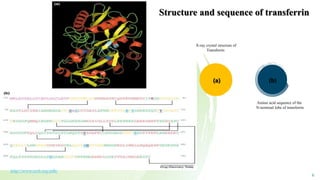
Structure and sequence of transferrin
http://www.rcsb.org/pdb/
(a)
X-ray crystal structure of
Transferrin
(b)
Amino acid sequence of the
N-terminal lobe of transferrin
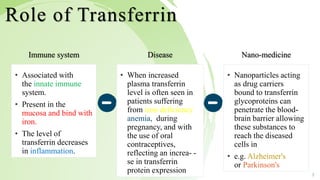
Immune system
•
innate immune
•
mucosa and bind with
iron.
•
inflammation
Disease
•
iron deficiency
anemia,
Nano-medicine
•
• Alzheimer's
Parkinson's
7
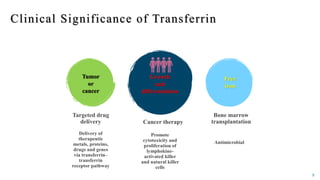
Targeted drug
delivery
Delivery of
therapeutic
metals, proteins,
drugs and genes
via transferrin–
transferrin
receptor pathway
Cancer therapy
Promote
cytotoxicity and
proliferation of
lymphokine-
activated killer
and natural killer
cells
Bone marrow
transplantation
Antimicrobial
9
Tumor
or
cancer
Growth
and
differentiation
Free
iron
Reference
Hirose, M. (2000) The structural mechanism for iron uptake and release by transferrins. Biosci.
Biotechnol. Biochem. 64, 1328–1336
https://biologydictionary.net/transferrin/
He, Q.Y. et al. (2000) The chloride effect is related to anion binding in determining the rate of iron
release from the human transferrin N-lobe. Biochem. J. 350, 909–915
s
http://www.bmj.com/permissions
http://www.rcsb.org/pdb/
Dewan JC, Mikami B, Hirose M, Sacchettini JC (November 1993). "Structural evidence for a pH-
sensitive dilysine trigger in the hen ovotransferrin N-lobe: implications for transferrin iron
release". Biochemistry. 32 (45): 11963–8. doi:10.1021/bi00096a004. PMID 8218271.
THANK
YOU
11

Transferrin protein protein design & engineering ppt (transferrin)

  • 1.
    1 Topic- Transferrin Session -2020 Presented By: Chanderhash "Structure and its effect on function of proteins’’ Course code: BSBT-411
  • 2.
    Encoded Human transferrin is encoded by theTF gene and produced as a 76 kDa glycoprotein. Binding Bind to and consequently mediate the transport of Iron (Fe) through blood plasma. Amino acid It consists single polypeptide chain of 680 to 700 amino acids. Location Produced in liver and it contain two binding site for Fe3+ atoms Chromosome no. 3 (3q22.1) structure 2 Transf -errin
  • 3.
  • 4.
    TF molecules dividedinto two lobes:- a) N-lobe (336 amino acid) b) C-lobe (343 amino acid) Each lobe contains two domain comparising a series of Alpha helices which overlay a central Beta sheet backbone 4 Structure Fig."Transcriptional regulation of transferrin and albumin genes by retinoic acid in human hepatoma
  • 5.
    A s p2 4 0 a t t h e e n d o f - h e l i x 8 b i n t h e N 2 - s u b d o m a i n i n t e r a c t s w i t h A r g 6 7 8 a d j a c e n t t o t h e C - t e r m i n a l h e l i x ( h e l i x 1 2 ) i n t h e C 1 - s u b d o m a i n , a n d A r g 3 0 8 i n t h e N 1 - s u b d o m a i n ( i n t h e l o o p p r i o r t o h e l i x 1 0 ) i n t e r a c t s w i t h A s p 3 7 6 i n h e l i x 2 o f t h e C 1 - s u b d o m a i n . It consists at the N and C terminal lobes has four conserved amino acids Two Tyrosine One Aspartic And One Histadine 5 (N-terminal lobe – Asp-63, Tyr-95, Tyr-188 and His-249Fig."Transcriptional regulation of transferrin and albumin genes by retinoic acid in human hepatoma
  • 6.
    6 Structure and sequenceof transferrin http://www.rcsb.org/pdb/ (a) X-ray crystal structure of Transferrin (b) Amino acid sequence of the N-terminal lobe of transferrin
  • 7.
    Immune system • innate immune • mucosaand bind with iron. • inflammation Disease • iron deficiency anemia, Nano-medicine • • Alzheimer's Parkinson's 7
  • 9.
    Targeted drug delivery Delivery of therapeutic metals,proteins, drugs and genes via transferrin– transferrin receptor pathway Cancer therapy Promote cytotoxicity and proliferation of lymphokine- activated killer and natural killer cells Bone marrow transplantation Antimicrobial 9 Tumor or cancer Growth and differentiation Free iron
  • 10.
    Reference Hirose, M. (2000)The structural mechanism for iron uptake and release by transferrins. Biosci. Biotechnol. Biochem. 64, 1328–1336 https://biologydictionary.net/transferrin/ He, Q.Y. et al. (2000) The chloride effect is related to anion binding in determining the rate of iron release from the human transferrin N-lobe. Biochem. J. 350, 909–915 s http://www.bmj.com/permissions http://www.rcsb.org/pdb/ Dewan JC, Mikami B, Hirose M, Sacchettini JC (November 1993). "Structural evidence for a pH- sensitive dilysine trigger in the hen ovotransferrin N-lobe: implications for transferrin iron release". Biochemistry. 32 (45): 11963–8. doi:10.1021/bi00096a004. PMID 8218271.
  • 11.

Editor's Notes

  • #6 Iron bind to the protein via tyr, Asp and His.