R. RUPPA MERCY
M.Sc NURSING 1ST YEAR
PROMOTING SELF
ESTEEM
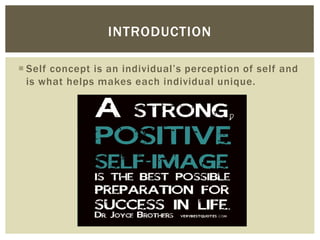
 Self concept is an individual’s perception of self and
is what helps makes each individual unique.
INTRODUCTION
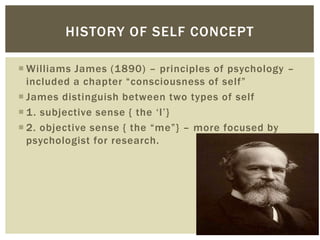
 Williams James (1890) – principles of psychology –
included a chapter “consciousness of self”
 James distinguish between two types of self
 1. subjective sense { the ‘I’}
 2. objective sense { the “me”} – more focused by
psychologist for research.
HISTORY OF SELF CONCEPT
“The totality of the individual’s thoughts and feelings
having reference to himself as an object”(Rosenberg,
1979)
 The self concept includes
 1. cognitive
 2. behavioral
 3. affective component.
DEFINITION
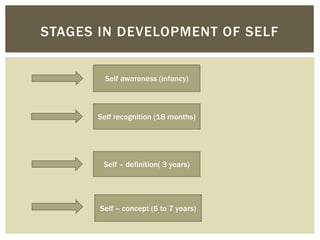
STAGES IN DEVELOPMENT OF SELF
Self awareness (infancy)
Self recognition (18 months)
Self – definition( 3 years)
Self – concept (6 to 7 years)
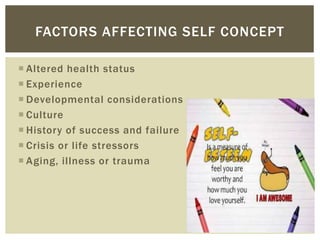
 Altered health status
 Experience
 Developmental considerations
 Culture
 History of success and failure
 Crisis or life stressors
 Aging, illness or trauma
FACTORS AFFECTING SELF CONCEPT
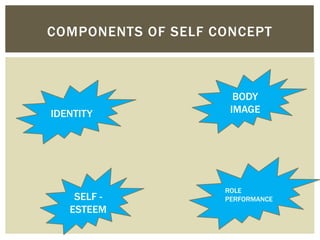
COMPONENTS OF SELF CONCEPT
IDENTITY
SELF -
ESTEEM
BODY
IMAGE
ROLE
PERFORMANCE
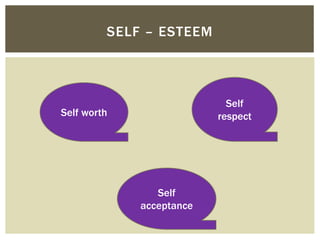
SELF – ESTEEM
Self worth
Self
respect
Self
acceptance
 Self – esteem is the
; the affective judgments
placed on the self – concept consisting of feelings of
worth and acceptance which are developed and
maintained as a consequence of awareness of
competence and feedback from the external world”
- Guidon, 2002
DEFINITION OF SELF - ESTEEM
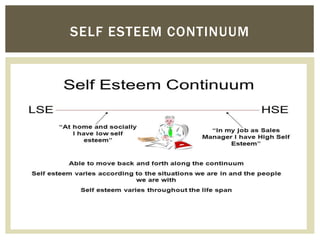
SELF ESTEEM CONTINUUM
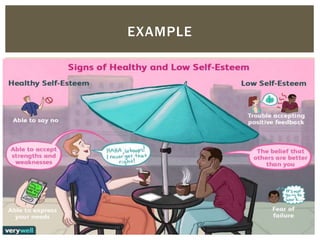
EXAMPLE
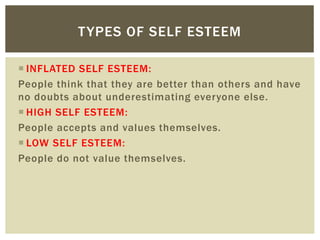
 INFLATED SELF ESTEEM:
People think that they are better than others and have
no doubts about underestimating everyone else.
 HIGH SELF ESTEEM:
People accepts and values themselves.
 LOW SELF ESTEEM:
People do not value themselves.
TYPES OF SELF ESTEEM
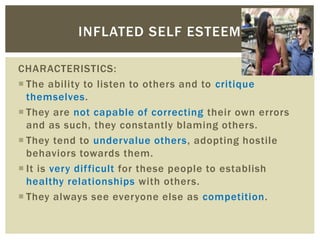
CHARACTERISTICS:
 The ability to listen to others and to critique
themselves.
 They are not capable of correcting their own errors
and as such, they constantly blaming others.
 They tend to undervalue others, adopting hostile
behaviors towards them.
 It is very difficult for these people to establish
healthy relationships with others.
 They always see everyone else as competition.
INFLATED SELF ESTEEM
CHARACTERISTICS:
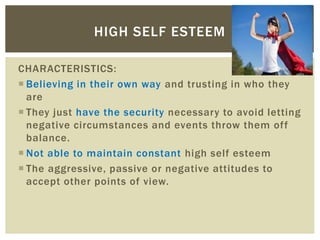
 Believing in their own way and trusting in who they
are
 They just have the security necessary to avoid letting
negative circumstances and events throw them off
balance.
 Not able to maintain constant high self esteem
 The aggressive, passive or negative attitudes to
accept other points of view.
HIGH SELF ESTEEM
CHARACTERISTICS:
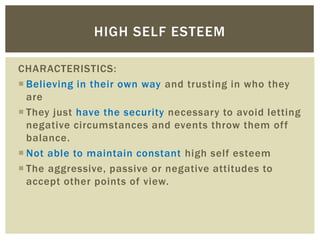
 Believing in their own way and trusting in who they
are
 They just have the security necessary to avoid letting
negative circumstances and events throw them off
balance.
 Not able to maintain constant high self esteem
 The aggressive, passive or negative attitudes to
accept other points of view.
HIGH SELF ESTEEM
CHARACTERISTICS:
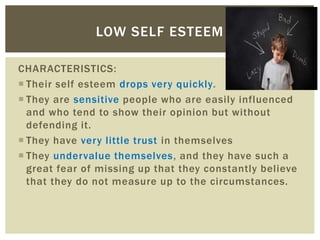
 Their self esteem drops very quickly.
 They are sensitive people who are easily influenced
and who tend to show their opinion but without
defending it.
 They have very little trust in themselves
 They undervalue themselves, and they have such a
great fear of missing up that they constantly believe
that they do not measure up to the circumstances.
LOW SELF ESTEEM
Age
Gender
Body image
Health and illness
Experiences
Relationships
FACTORS INFLUENCING SELF ESTEEM
 9+
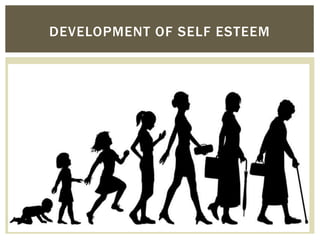
DEVELOPMENT OF SELF ESTEEM
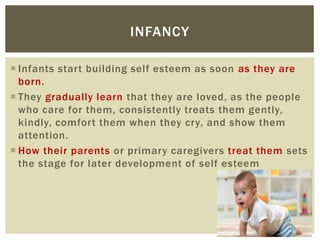
 Infants start building self esteem as soon as they are
born.
 They gradually learn that they are loved, as the people
who care for them, consistently treats them gently,
kindly, comfort them when they cry, and show them
attention.
 How their parents or primary caregivers treat them sets
the stage for later development of self esteem
INFANCY
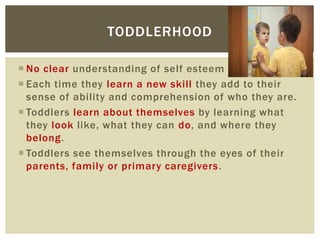
 No clear understanding of self esteem
 Each time they learn a new skill they add to their
sense of ability and comprehension of who they are.
 Toddlers learn about themselves by learning what
they look like, what they can do, and where they
belong.
 Toddlers see themselves through the eyes of their
parents, family or primary caregivers.
TODDLERHOOD
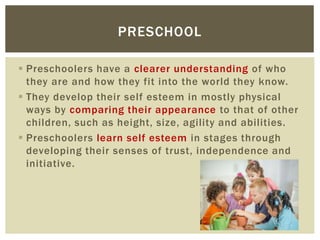
 Preschoolers have a clearer understanding of who
they are and how they fit into the world they know.
 They develop their self esteem in mostly physical
ways by comparing their appearance to that of other
children, such as height, size, agility and abilities.
 Preschoolers learn self esteem in stages through
developing their senses of trust, independence and
initiative.
PRESCHOOL
 A critical point in a child’s development of self
esteem occurs when they start school.
 In the early school age years self esteem depends on
their physical appearance and characteristics and
their ability to make friends with other children in
their own age.
 Stresses at home such as parents arguing a lot, and
problems at school, such as difficult lessons, being
bullied or not having friends, can have a negative
impact on a child’s self esteem.
SCHOOL AGE
 Positive self esteem is promoted through this
capacity for giving of oneself to another.
 Failure to intimacy causes withdrawal, social
isolation, aloneness.
 Teenagers self esteem is often affected by the
physical and hormonal changes they experience
especially during puberty.
 Body image is a major component in teenagers self
esteem.
 Peer acceptance and relationships are important to
children’s social and emotional development and to
their development of self – esteem.
ADOLESCENCE
 By adulthood self esteem has changed from a
mostly reactive phenomenon to one that can be
consciously acted upon to either increase or
decrease feelings of self worth.
 Adults are confronted by many situations that affect
levels of self esteem.
 Success – failure experiences.
 Acceptance – rejection situations
 Romantic relationships, peer relationships and
relationships with family members can affect self
esteem.
ADULTHOOD
 Self esteem declines in old age(around age 70)
 It may also reflect a shift toward a more modest,
humble and balance view of the self in old age.
OLD AGE
ANTECEDANT CONDITIONS:
Cooper smith(1981) identified the following antecedent
conditions of positive self esteem:
1. POWER: It is important for individuals to have a
feeling of control over their own life situations and
ability to claim some measure of influence over the
behaviors of others.
2. SIGNIFICANCE: Self esteem is enhanced when
individuals feel loved, respected and cared for by
significant others.
STEPS OF DEVELOPING A POSITIVE SELF
ESTEEM
3. VIRTUE: Individuals feel good about themselves
when their actions a set of personal, moral and ethical
values.
4. COMPETENCE: Positive self esteem develops out of
one’s ability to perform successfully or archive self
expectations and the expectations of others.
5. CONSISTENTLY SET LIMITS: A structured lifestyle
demonstrates acceptance and caring and provides a
feeling of security.
CONTD..
 WARREN (1991) outlined the following focus areas to
be emphasized by parents and others who work with
children when encouraging the growth and
development of positive self esteem.
 1. a sense of competence
 2. unconditional love
 3. sense of survival
 4. realistic goals
 5. a sense of responsibility.
 6. reality orientation
FOCUS AREAS TO BE EMPHASIZED..
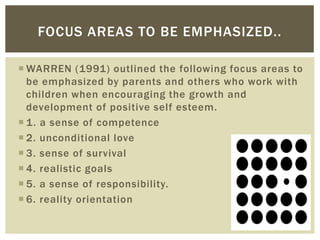
Self esteem comes from every experience of your life.
How you view yourself affects everything you do in life.
High self esteem gives you a good feeling about
yourself. Low self esteem distorts your view of
yourself.
CONCLUSION
THANK YOU…..

Self concept and self esteem

  • 1.
    R. RUPPA MERCY M.ScNURSING 1ST YEAR PROMOTING SELF ESTEEM
  • 2.
     Self conceptis an individual’s perception of self and is what helps makes each individual unique. INTRODUCTION
  • 3.
     Williams James(1890) – principles of psychology – included a chapter “consciousness of self”  James distinguish between two types of self  1. subjective sense { the ‘I’}  2. objective sense { the “me”} – more focused by psychologist for research. HISTORY OF SELF CONCEPT
  • 4.
    “The totality ofthe individual’s thoughts and feelings having reference to himself as an object”(Rosenberg, 1979)  The self concept includes  1. cognitive  2. behavioral  3. affective component. DEFINITION
  • 5.
    STAGES IN DEVELOPMENTOF SELF Self awareness (infancy) Self recognition (18 months) Self – definition( 3 years) Self – concept (6 to 7 years)
  • 6.
     Altered healthstatus  Experience  Developmental considerations  Culture  History of success and failure  Crisis or life stressors  Aging, illness or trauma FACTORS AFFECTING SELF CONCEPT
  • 7.
    COMPONENTS OF SELFCONCEPT IDENTITY SELF - ESTEEM BODY IMAGE ROLE PERFORMANCE
  • 8.
    SELF – ESTEEM Selfworth Self respect Self acceptance
  • 9.
     Self –esteem is the ; the affective judgments placed on the self – concept consisting of feelings of worth and acceptance which are developed and maintained as a consequence of awareness of competence and feedback from the external world” - Guidon, 2002 DEFINITION OF SELF - ESTEEM
  • 10.
  • 11.
  • 12.
     INFLATED SELFESTEEM: People think that they are better than others and have no doubts about underestimating everyone else.  HIGH SELF ESTEEM: People accepts and values themselves.  LOW SELF ESTEEM: People do not value themselves. TYPES OF SELF ESTEEM

  • 13.
    CHARACTERISTICS:  The abilityto listen to others and to critique themselves.  They are not capable of correcting their own errors and as such, they constantly blaming others.  They tend to undervalue others, adopting hostile behaviors towards them.  It is very difficult for these people to establish healthy relationships with others.  They always see everyone else as competition. INFLATED SELF ESTEEM
  • 14.
    CHARACTERISTICS:  Believing intheir own way and trusting in who they are  They just have the security necessary to avoid letting negative circumstances and events throw them off balance.  Not able to maintain constant high self esteem  The aggressive, passive or negative attitudes to accept other points of view. HIGH SELF ESTEEM
  • 15.
    CHARACTERISTICS:  Believing intheir own way and trusting in who they are  They just have the security necessary to avoid letting negative circumstances and events throw them off balance.  Not able to maintain constant high self esteem  The aggressive, passive or negative attitudes to accept other points of view. HIGH SELF ESTEEM
  • 16.
    CHARACTERISTICS:  Their selfesteem drops very quickly.  They are sensitive people who are easily influenced and who tend to show their opinion but without defending it.  They have very little trust in themselves  They undervalue themselves, and they have such a great fear of missing up that they constantly believe that they do not measure up to the circumstances. LOW SELF ESTEEM
  • 17.
    Age Gender Body image Health andillness Experiences Relationships FACTORS INFLUENCING SELF ESTEEM
  • 18.
  • 19.
     Infants startbuilding self esteem as soon as they are born.  They gradually learn that they are loved, as the people who care for them, consistently treats them gently, kindly, comfort them when they cry, and show them attention.  How their parents or primary caregivers treat them sets the stage for later development of self esteem INFANCY
  • 20.
     No clearunderstanding of self esteem  Each time they learn a new skill they add to their sense of ability and comprehension of who they are.  Toddlers learn about themselves by learning what they look like, what they can do, and where they belong.  Toddlers see themselves through the eyes of their parents, family or primary caregivers. TODDLERHOOD
  • 21.
     Preschoolers havea clearer understanding of who they are and how they fit into the world they know.  They develop their self esteem in mostly physical ways by comparing their appearance to that of other children, such as height, size, agility and abilities.  Preschoolers learn self esteem in stages through developing their senses of trust, independence and initiative. PRESCHOOL
  • 22.
     A criticalpoint in a child’s development of self esteem occurs when they start school.  In the early school age years self esteem depends on their physical appearance and characteristics and their ability to make friends with other children in their own age.  Stresses at home such as parents arguing a lot, and problems at school, such as difficult lessons, being bullied or not having friends, can have a negative impact on a child’s self esteem. SCHOOL AGE
  • 23.
     Positive selfesteem is promoted through this capacity for giving of oneself to another.  Failure to intimacy causes withdrawal, social isolation, aloneness.  Teenagers self esteem is often affected by the physical and hormonal changes they experience especially during puberty.  Body image is a major component in teenagers self esteem.  Peer acceptance and relationships are important to children’s social and emotional development and to their development of self – esteem. ADOLESCENCE
  • 24.
     By adulthoodself esteem has changed from a mostly reactive phenomenon to one that can be consciously acted upon to either increase or decrease feelings of self worth.  Adults are confronted by many situations that affect levels of self esteem.  Success – failure experiences.  Acceptance – rejection situations  Romantic relationships, peer relationships and relationships with family members can affect self esteem. ADULTHOOD
  • 25.
     Self esteemdeclines in old age(around age 70)  It may also reflect a shift toward a more modest, humble and balance view of the self in old age. OLD AGE
  • 26.
    ANTECEDANT CONDITIONS: Cooper smith(1981)identified the following antecedent conditions of positive self esteem: 1. POWER: It is important for individuals to have a feeling of control over their own life situations and ability to claim some measure of influence over the behaviors of others. 2. SIGNIFICANCE: Self esteem is enhanced when individuals feel loved, respected and cared for by significant others. STEPS OF DEVELOPING A POSITIVE SELF ESTEEM
  • 27.
    3. VIRTUE: Individualsfeel good about themselves when their actions a set of personal, moral and ethical values. 4. COMPETENCE: Positive self esteem develops out of one’s ability to perform successfully or archive self expectations and the expectations of others. 5. CONSISTENTLY SET LIMITS: A structured lifestyle demonstrates acceptance and caring and provides a feeling of security. CONTD..
  • 28.
     WARREN (1991)outlined the following focus areas to be emphasized by parents and others who work with children when encouraging the growth and development of positive self esteem.  1. a sense of competence  2. unconditional love  3. sense of survival  4. realistic goals  5. a sense of responsibility.  6. reality orientation FOCUS AREAS TO BE EMPHASIZED..
  • 29.
    Self esteem comesfrom every experience of your life. How you view yourself affects everything you do in life. High self esteem gives you a good feeling about yourself. Low self esteem distorts your view of yourself. CONCLUSION
  • 30.