Transaction Management –
Concurrency Control
Presented by,
T. Janani,
I- M.Sc(CS&IT),
Nadar Saraswathi College of Arts &Science,
Vadapudupatti, Theni.
Concurrency Control:
The fundamental properties of a transaction is
isolation. When several transactions execute concurrently
in the database, the isolation property may no longer be
preserved.
It is necessary for the system to control the
interaction among the concurrent transactions. This
control is achieved through one of a variety of mechanisms
called concurrency-control schemes.
Protocols:
In a multiprogramming environment where
multiple transactions can be executed simultaneously, it is
highly important to control the concurrency of
transactions.
We have concurrency control protocols to
ensure atomicity, isolation, and serializability of
concurrent transactions.
Concurrency control protocols can be broadly divided into
two categories −
1. Lock based protocols
2. Time stamp based protocols
1. Lock-based Protocols:
Database systems equipped with lock-based
protocols use a mechanism by which any transaction
cannot read or write data until it acquires an appropriate
lock on it.
Locks are of two kinds :
Binary Locks − A lock on a data item can be in two states;
it is either locked or unlocked
Shared/exclusive − This type of locking mechanism
differentiates the locks based on their uses. If a lock is
acquired on a data item to perform a write operation, it is
an exclusive lock.
Allowing more than one transaction to write
on the same data item would lead the database into an
inconsistent state.
Read locks are shared because no data value
is being changed.
There are four types of lock protocols
available:
a) Simplistic Lock Protocol
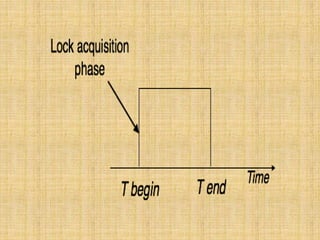
b) Pre-claiming Lock Protocol
c) Two-Phase Locking 2PL
d) Strict Two-Phase Locking
a) Simplistic Lock Protocol:
Simplistic lock-based protocols allow
transactions to obtain a lock on every object before a 'write'
operation is performed.
Transactions may unlock the data item after
completing the ‘write’ operation.
b) Pre-claiming Lock Protocol:
Pre-claiming protocols evaluate their operations
and create a list of data items on Which they need locks
Before initiating an execution, the transaction
requests the system for all the locks it needs beforehand.
If all the locks are granted, the transaction
executes and releases all the locks when all its operations are
over.
If all the locks are not granted, the transaction
rolls back and waits until all the locks are granted.
c) Two-Phase Locking 2PL
This locking protocols divides the execution
phase of a transaction into three parts.
In the first part, when the transaction starts
executing, it seeks permission for the locks it requires.
The second part is where the transaction
acquires all the locks.
As soon as the transaction releases its first lock,
the third phase starts. In this phase, the transaction cannot
demand any new locks; it only releases the acquired locks.
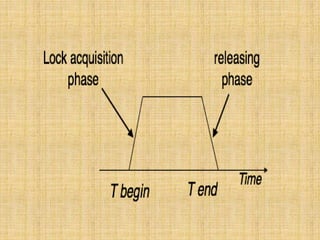
Two-phase locking has two phases, one is
growing, where all the locks are being acquired by the
transaction; and the second phase is shrinking, where the
locks held by the transaction are being released.
To claim an exclusive (write) lock, a transaction
must first acquire a shared (read) lock and then
upgrade it to an exclusive locks.
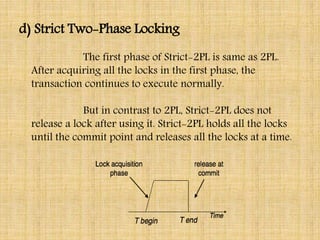
d) Strict Two-Phase Locking
The first phase of Strict-2PL is same as 2PL.
After acquiring all the locks in the first phase, the
transaction continues to execute normally.
But in contrast to 2PL, Strict-2PL does not
release a lock after using it. Strict-2PL holds all the locks
until the commit point and releases all the locks at a time.
2. Timestamp-based Protocols:
The most commonly used concurrency protocol
is the timestamp based protocol.
This protocol uses either system time or logical
counter as a timestamp.
Lock-based protocols manage the order
between the conflicting pairs among transactions at the
time of execution, whereas timestamp-based protocols
start working as soon as a transaction is created.
Every transaction has a timestamp associated
with it, and the ordering is determined by the age of the
transaction.
A transaction created at 0002 clock time would
be older than all other transactions that come after it.
For example, any transaction 'y' entering the
system at 0004 is two seconds younger and the priority
would be given to the older one.
In addition, every data item is given the latest
read and write-time stamp.
Timestamp Ordering Protocol:
The time stamp-ordering protocol ensures
serializability among transactions in their conflicting read
and write operations.
This is the responsibility of the protocol system
that the conflicting pair of tasks should be executed
according to the timestamp values of the transactions.
This is the responsibility of the protocol
system that the conflicting pair of tasks should be
executed according to the timestamp values of the
transaction.
The timestamp of transaction Ti is denoted as
TS(Ti).
Read time-stamp of data-item X is denoted by R
timestamp(X).
Write time-stamp of data-item X is denoted by W-
timestamp(X).
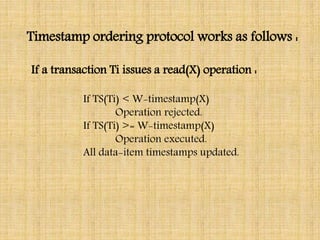
Timestamp ordering protocol works as follows :
If a transaction Ti issues a read(X) operation :
If TS(Ti) < W-timestamp(X)
Operation rejected.
If TS(Ti) >= W-timestamp(X)
Operation executed.
All data-item timestamps updated.
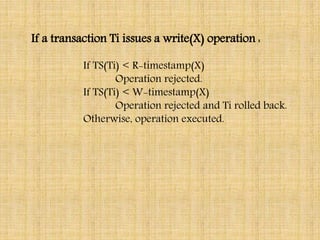
If a transaction Ti issues a write(X) operation :
If TS(Ti) < R-timestamp(X)
Operation rejected.
If TS(Ti) < W-timestamp(X)
Operation rejected and Ti rolled back.
Otherwise, operation executed.
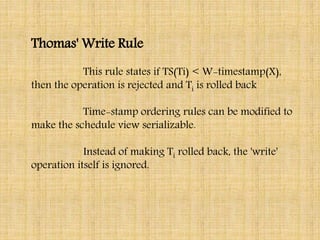
Thomas' Write Rule
This rule states if TS(Ti) < W-timestamp(X),
then the operation is rejected and Ti is rolled back
Time-stamp ordering rules can be modified to
make the schedule view serializable.
Instead of making Ti rolled back, the 'write'
operation itself is ignored.
Thank You

Transaction management

  • 1.
    Transaction Management – ConcurrencyControl Presented by, T. Janani, I- M.Sc(CS&IT), Nadar Saraswathi College of Arts &Science, Vadapudupatti, Theni.
  • 2.
    Concurrency Control: The fundamentalproperties of a transaction is isolation. When several transactions execute concurrently in the database, the isolation property may no longer be preserved. It is necessary for the system to control the interaction among the concurrent transactions. This control is achieved through one of a variety of mechanisms called concurrency-control schemes.
  • 3.
    Protocols: In a multiprogrammingenvironment where multiple transactions can be executed simultaneously, it is highly important to control the concurrency of transactions. We have concurrency control protocols to ensure atomicity, isolation, and serializability of concurrent transactions.
  • 4.
    Concurrency control protocolscan be broadly divided into two categories − 1. Lock based protocols 2. Time stamp based protocols 1. Lock-based Protocols: Database systems equipped with lock-based protocols use a mechanism by which any transaction cannot read or write data until it acquires an appropriate lock on it.
  • 5.
    Locks are oftwo kinds : Binary Locks − A lock on a data item can be in two states; it is either locked or unlocked Shared/exclusive − This type of locking mechanism differentiates the locks based on their uses. If a lock is acquired on a data item to perform a write operation, it is an exclusive lock.
  • 6.
    Allowing more thanone transaction to write on the same data item would lead the database into an inconsistent state. Read locks are shared because no data value is being changed. There are four types of lock protocols available: a) Simplistic Lock Protocol b) Pre-claiming Lock Protocol c) Two-Phase Locking 2PL d) Strict Two-Phase Locking
  • 7.
    a) Simplistic LockProtocol: Simplistic lock-based protocols allow transactions to obtain a lock on every object before a 'write' operation is performed. Transactions may unlock the data item after completing the ‘write’ operation.
  • 8.
    b) Pre-claiming LockProtocol: Pre-claiming protocols evaluate their operations and create a list of data items on Which they need locks Before initiating an execution, the transaction requests the system for all the locks it needs beforehand. If all the locks are granted, the transaction executes and releases all the locks when all its operations are over. If all the locks are not granted, the transaction rolls back and waits until all the locks are granted.
  • 10.
    c) Two-Phase Locking2PL This locking protocols divides the execution phase of a transaction into three parts. In the first part, when the transaction starts executing, it seeks permission for the locks it requires. The second part is where the transaction acquires all the locks.
  • 11.
    As soon asthe transaction releases its first lock, the third phase starts. In this phase, the transaction cannot demand any new locks; it only releases the acquired locks. Two-phase locking has two phases, one is growing, where all the locks are being acquired by the transaction; and the second phase is shrinking, where the locks held by the transaction are being released. To claim an exclusive (write) lock, a transaction must first acquire a shared (read) lock and then upgrade it to an exclusive locks.
  • 13.
    d) Strict Two-PhaseLocking The first phase of Strict-2PL is same as 2PL. After acquiring all the locks in the first phase, the transaction continues to execute normally. But in contrast to 2PL, Strict-2PL does not release a lock after using it. Strict-2PL holds all the locks until the commit point and releases all the locks at a time.
  • 14.
    2. Timestamp-based Protocols: Themost commonly used concurrency protocol is the timestamp based protocol. This protocol uses either system time or logical counter as a timestamp. Lock-based protocols manage the order between the conflicting pairs among transactions at the time of execution, whereas timestamp-based protocols start working as soon as a transaction is created.
  • 15.
    Every transaction hasa timestamp associated with it, and the ordering is determined by the age of the transaction. A transaction created at 0002 clock time would be older than all other transactions that come after it. For example, any transaction 'y' entering the system at 0004 is two seconds younger and the priority would be given to the older one. In addition, every data item is given the latest read and write-time stamp.
  • 16.
    Timestamp Ordering Protocol: Thetime stamp-ordering protocol ensures serializability among transactions in their conflicting read and write operations. This is the responsibility of the protocol system that the conflicting pair of tasks should be executed according to the timestamp values of the transactions.
  • 17.
    This is theresponsibility of the protocol system that the conflicting pair of tasks should be executed according to the timestamp values of the transaction. The timestamp of transaction Ti is denoted as TS(Ti). Read time-stamp of data-item X is denoted by R timestamp(X). Write time-stamp of data-item X is denoted by W- timestamp(X).
  • 18.
    Timestamp ordering protocolworks as follows : If a transaction Ti issues a read(X) operation : If TS(Ti) < W-timestamp(X) Operation rejected. If TS(Ti) >= W-timestamp(X) Operation executed. All data-item timestamps updated.
  • 19.
    If a transactionTi issues a write(X) operation : If TS(Ti) < R-timestamp(X) Operation rejected. If TS(Ti) < W-timestamp(X) Operation rejected and Ti rolled back. Otherwise, operation executed.
  • 20.
    Thomas' Write Rule Thisrule states if TS(Ti) < W-timestamp(X), then the operation is rejected and Ti is rolled back Time-stamp ordering rules can be modified to make the schedule view serializable. Instead of making Ti rolled back, the 'write' operation itself is ignored.
  • 21.