



Training of ANMs on HIV/AIDSDr. PoojaPassi
Training project carried out by ASTRON Hospital & Healthcare Consultants Pvt. Ltd. New Delhi
LayoutEvolution & Role of ANMsConcept of capacity building of ANMsMethodology Coverage of the North East districtAnalysis of Pre & Post test QuestionnairesComparative responses of ANMs- Pre-test and      Post- test evaluation.Responses related to specific issues related to HIV/AIDSRecommendations
EvolutionMidwifery existent ever since medical services have been available to the masses.In India Bhore Committee  placed foremost emphasis on preventive healthcare services right from the grass root and defined a cadre of healthcare workers called the midwives .These are selected from among the community   Act as the point of  FIRST contact towards access of health services .Eventually came to be known as Auxiliary Nurse & Midwives.
Contd.In the ‘50s and ‘60s, training courses for ANMs focused on Midwifery and Maternal and Child Health (MCH).1973, Kartar Singh Committee integrated the various functions of the health services thereby changing the role of ANMs (, 1973).1975, Srivastava Committee required the ANMs to provide child health services and Primary Curative care to villagers.Second Five-Year Plan described the role of auxiliary health workers as those activities that supplemented the contributions made by doctors for promoting preventive and curative health activities (GOI, 1986).
Job ResponsibilitiesThe Primary Health Center (PHC) through its Auxiliary Nurse Midwives (ANMs) and Multipurpose Workers (MPWs) at the sub center level carry out the RCH program. They deliver these preventive and promotive health services and health education.Maternal & Child Health Care in the village / community. Conducts deliveries in S/C and Home on call.
Contd.Identify the beneficiaries and complete necessary formalities for benefits under JananiSurakshaYojana (JSY) scheme and timely disbursement JSY benefits to eligible BPL mothers and submit utilization certificate every month for further release of funds. Family Planning motivation and activities. Identify the women, requiring help for Medical Termination of Pregnancy (MTP). Nutritional Care such as weekly IFA supplementation & Bi-annual vitamin A supplementation.
Contd.Organization of Health & Nutrition day in Anganwadi centre. Full coverage of routine immunization to children in time. Treatment of minor ailments and timely referral. Record of Vital events in the village. Implementation of all National Health Programmes in the community. Training for ASHA / Anganwadi Worker / Dais of respective areas.
Contd.Work in cooperation with PRIs/ NGOs in the village. Proper maintenance of record of Untied fund for SC development and their submission to MO I/cPHC/CHC.
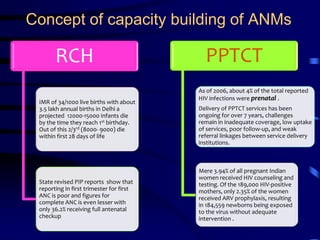
Concept of capacity building of ANMs
INTEGRATIONSIMILAR GOAL: RCH and PPTCT both working on improving the IMR and MMR.The same workforce can be utilized to provide PPTCT services because of similar objectives, activities, areas, target population and deliverables in both programs.DSACS has launched an initiative in collaboration with the Delhi State Health Mission (DSHM) to create and implement HIV/AIDS training programs for Auxiliary Nurse Midwives (ANMs)
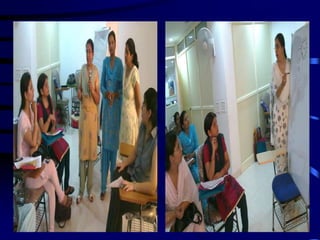
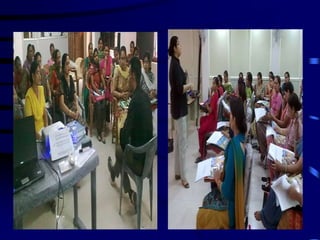
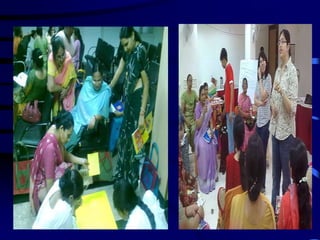
Methodology Training sessions undertaken for the ANMs covering all the 8 districts of Delhi. Sessions guided by a core team comprising of experts from the fields of HIV/AIDS and Public Health.The approach to training was highly participatory in nature, employing innovative means
Training MaterialHandouts, leaflets, flip chart, flip book and material which was easy to understand and assimilate.
Training SessionsSession 1: Introduction, Expectations, Pre test.Session 2: Basics of HIV/ AIDS, Myths and                       MisconceptionsSession 3: STIs and there management Session 4: HIV and Women, Pediatrics HIV and                       Care of New BornSession 5: High Risk Groups and Targeted                        InterventionsSession 6: Overview about Service availability
Training SessionsSession 7: Facilitation and Communication skillsSession 8: Session with a PLHA to discuss about                         issue of Stigma and Discrimination with                                     PLHAs and their Rights. Sharing                        perspective of PLHAsSession 9: Role of ANMs in Integration of HIV with RCH servicesSession 10: Practice SessionSession 11: Post Test Evaluation and Training Feed                         back
Additional Topics CoveredIntegration of PPTCT with safe motherhood practices
Integration of “JananiSurakshaYojana” with PPTCT services
Developing communication & Counseling skills among the ANMs
Pediatric HIV/AIDS and service availability including care of new born & HIV positive mother
Follow up, referral and linkages with the existing healthcare services under the Public Healthcare Delivery system
Care & support services and linkages with safe motherhood services.
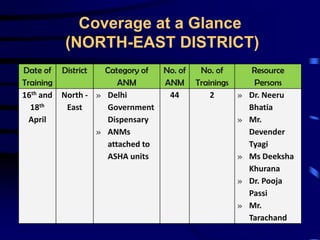
Coverage at a Glance (NORTH-EAST DISTRICT)
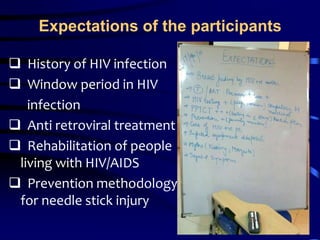
Expectations of the participants  History of HIV infection
  Window period in HIV        infection  Anti retroviral treatment
  Rehabilitation of people living with HIV/AIDS
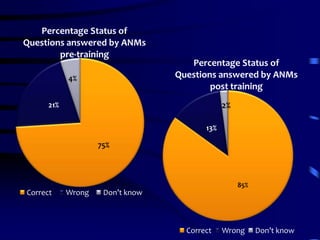
  Prevention methodology for needle stick injuryAnalysis of Pre & Post test Questionnaires
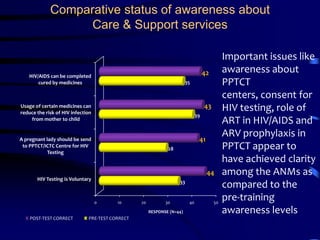
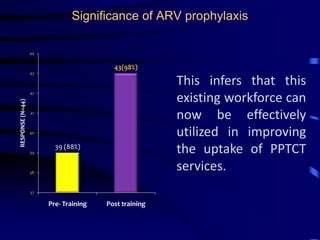
Comparative status of awareness about Care & Support servicesImportant issues like awareness about PPTCT centers, consent for HIV testing, role of ART in HIV/AIDS and ARV prophylaxis in PPTCT appear to have achieved clarity among the ANMs as compared to the pre-training awareness levels
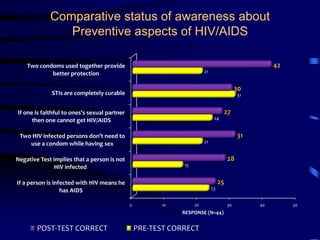
Comparative status of awareness about Preventive aspects of HIV/AIDS
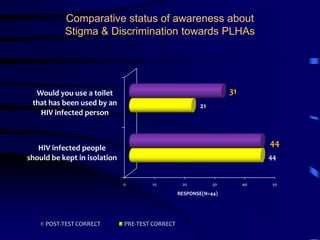
Comparative status of awareness about Stigma & Discrimination towards PLHAs
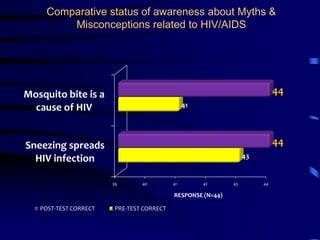
Comparative status of awareness about Myths & Misconceptions related to HIV/AIDS
Specific issues related to HIV/AIDS
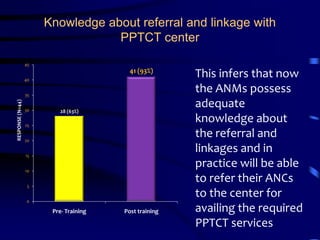
Knowledge about referral and linkage with PPTCT centerThis infers that now the ANMs possess adequate knowledge about the referral and linkages and in practice will be able to refer their ANCs to the center for availing the required PPTCT services
Significance of ARV prophylaxisThis infers that this existing workforce can now be effectively utilized in improving the uptake of PPTCT services.
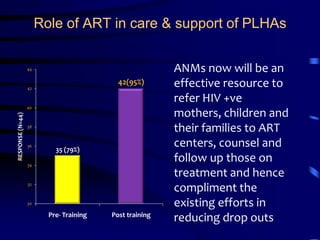
Role of ART in care & support of PLHAsANMs now will be an effective resource to refer HIV +ve mothers, children and their families to ART centers, counsel and follow up those on treatment and hence compliment the existing efforts in reducing drop outs

Training of ANMs-India

  • 1.
    Training of ANMson HIV/AIDSDr. PoojaPassi
  • 2.
    Training project carriedout by ASTRON Hospital & Healthcare Consultants Pvt. Ltd. New Delhi
  • 3.
    LayoutEvolution & Roleof ANMsConcept of capacity building of ANMsMethodology Coverage of the North East districtAnalysis of Pre & Post test QuestionnairesComparative responses of ANMs- Pre-test and Post- test evaluation.Responses related to specific issues related to HIV/AIDSRecommendations
  • 4.
    EvolutionMidwifery existent eversince medical services have been available to the masses.In India Bhore Committee placed foremost emphasis on preventive healthcare services right from the grass root and defined a cadre of healthcare workers called the midwives .These are selected from among the community Act as the point of FIRST contact towards access of health services .Eventually came to be known as Auxiliary Nurse & Midwives.
  • 5.
    Contd.In the ‘50sand ‘60s, training courses for ANMs focused on Midwifery and Maternal and Child Health (MCH).1973, Kartar Singh Committee integrated the various functions of the health services thereby changing the role of ANMs (, 1973).1975, Srivastava Committee required the ANMs to provide child health services and Primary Curative care to villagers.Second Five-Year Plan described the role of auxiliary health workers as those activities that supplemented the contributions made by doctors for promoting preventive and curative health activities (GOI, 1986).
  • 6.
    Job ResponsibilitiesThe PrimaryHealth Center (PHC) through its Auxiliary Nurse Midwives (ANMs) and Multipurpose Workers (MPWs) at the sub center level carry out the RCH program. They deliver these preventive and promotive health services and health education.Maternal & Child Health Care in the village / community. Conducts deliveries in S/C and Home on call.
  • 7.
    Contd.Identify the beneficiariesand complete necessary formalities for benefits under JananiSurakshaYojana (JSY) scheme and timely disbursement JSY benefits to eligible BPL mothers and submit utilization certificate every month for further release of funds. Family Planning motivation and activities. Identify the women, requiring help for Medical Termination of Pregnancy (MTP). Nutritional Care such as weekly IFA supplementation & Bi-annual vitamin A supplementation.
  • 8.
    Contd.Organization of Health& Nutrition day in Anganwadi centre. Full coverage of routine immunization to children in time. Treatment of minor ailments and timely referral. Record of Vital events in the village. Implementation of all National Health Programmes in the community. Training for ASHA / Anganwadi Worker / Dais of respective areas.
  • 9.
    Contd.Work in cooperationwith PRIs/ NGOs in the village. Proper maintenance of record of Untied fund for SC development and their submission to MO I/cPHC/CHC.
  • 10.
    Concept of capacitybuilding of ANMs
  • 11.
    INTEGRATIONSIMILAR GOAL: RCHand PPTCT both working on improving the IMR and MMR.The same workforce can be utilized to provide PPTCT services because of similar objectives, activities, areas, target population and deliverables in both programs.DSACS has launched an initiative in collaboration with the Delhi State Health Mission (DSHM) to create and implement HIV/AIDS training programs for Auxiliary Nurse Midwives (ANMs)
  • 12.
    Methodology Training sessionsundertaken for the ANMs covering all the 8 districts of Delhi. Sessions guided by a core team comprising of experts from the fields of HIV/AIDS and Public Health.The approach to training was highly participatory in nature, employing innovative means
  • 13.
    Training MaterialHandouts, leaflets,flip chart, flip book and material which was easy to understand and assimilate.
  • 16.
    Training SessionsSession 1:Introduction, Expectations, Pre test.Session 2: Basics of HIV/ AIDS, Myths and MisconceptionsSession 3: STIs and there management Session 4: HIV and Women, Pediatrics HIV and Care of New BornSession 5: High Risk Groups and Targeted InterventionsSession 6: Overview about Service availability
  • 18.
    Training SessionsSession 7:Facilitation and Communication skillsSession 8: Session with a PLHA to discuss about issue of Stigma and Discrimination with PLHAs and their Rights. Sharing perspective of PLHAsSession 9: Role of ANMs in Integration of HIV with RCH servicesSession 10: Practice SessionSession 11: Post Test Evaluation and Training Feed back
  • 20.
    Additional Topics CoveredIntegrationof PPTCT with safe motherhood practices
  • 21.
  • 22.
    Developing communication &Counseling skills among the ANMs
  • 23.
    Pediatric HIV/AIDS andservice availability including care of new born & HIV positive mother
  • 24.
    Follow up, referraland linkages with the existing healthcare services under the Public Healthcare Delivery system
  • 25.
    Care & supportservices and linkages with safe motherhood services.
  • 26.
    Coverage at aGlance (NORTH-EAST DISTRICT)
  • 27.
    Expectations of theparticipants History of HIV infection
  • 28.
    Windowperiod in HIV infection Anti retroviral treatment
  • 29.
    Rehabilitationof people living with HIV/AIDS
  • 30.
    Preventionmethodology for needle stick injuryAnalysis of Pre & Post test Questionnaires
  • 32.
    Comparative status ofawareness about Care & Support servicesImportant issues like awareness about PPTCT centers, consent for HIV testing, role of ART in HIV/AIDS and ARV prophylaxis in PPTCT appear to have achieved clarity among the ANMs as compared to the pre-training awareness levels
  • 33.
    Comparative status ofawareness about Preventive aspects of HIV/AIDS
  • 34.
    Comparative status ofawareness about Stigma & Discrimination towards PLHAs
  • 35.
    Comparative status ofawareness about Myths & Misconceptions related to HIV/AIDS
  • 36.
  • 37.
    Knowledge about referraland linkage with PPTCT centerThis infers that now the ANMs possess adequate knowledge about the referral and linkages and in practice will be able to refer their ANCs to the center for availing the required PPTCT services
  • 38.
    Significance of ARVprophylaxisThis infers that this existing workforce can now be effectively utilized in improving the uptake of PPTCT services.
  • 39.
    Role of ARTin care & support of PLHAsANMs now will be an effective resource to refer HIV +ve mothers, children and their families to ART centers, counsel and follow up those on treatment and hence compliment the existing efforts in reducing drop outs