 Review the clinical facts about
HIV/AIDS
 Magnitude of the problem of
HIV/Aids
 Milestones of NACP in India
 Goals and objectives of NACP III
 National aids prevention and control
policy
 Activities under NACP III
 STD control programme in India
 Organogram of NACP III
 Roles and responsibilities of
community health nurse in National
Aids Control Programme
Review…….
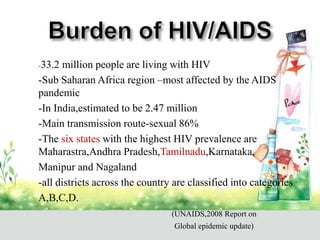
- -33.2 million people are living with HIV
- -Sub Saharan Africa region –most affected by the AIDS
pandemic
- -In India,estimated to be 2.47 million
- -Main transmission route-sexual 86%
- -The six states with the highest HIV prevalence are
Maharastra,Andhra Pradesh,Tamilnadu,Karnataka,
- Manipur and Nagaland
- -all districts across the country are classified into categories
- A,B,C,D.
- (UNAIDS,2008 Report on
- Global epidemic update)
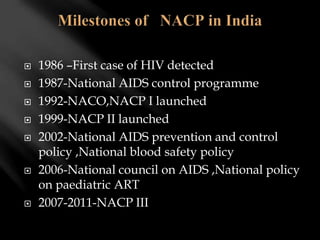
 1986 –First case of HIV detected
 1987-National AIDS control programme
 1992-NACO,NACP I launched
 1999-NACP II launched
 2002-National AIDS prevention and control
policy ,National blood safety policy
 2006-National council on AIDS ,National policy
on paediatric ART
 2007-2011-NACP III
 Coverage of high risk groups
 Greater care,support and treatment to large
number of PLHA
 Strengthen the infrastructure,system and
human resource
 Strengthen the nation wide strategic
information management system
 Reduce the incidence rate by 60 % in the high
prevalence states to obtain the reversal of the
epidemic and by 40 % in the vulnerable to
stabilize the epidemic
 Launched in the year????????
 Objectives
-Government’s firm commitment
-Generate a feeling of ownership at government
and non governmental levels
-Enabling social environment for prevention
-Decentralize HIV/AIDS control program
-Prevent women, children and other socially weak
groups from getting infected
 Adequate and equitable provision of health
care
 Overcome stigmatization ,discrimination and
seclusion in the society
 International and bilateral colloboration for
research in vaccines and drugs
 Ensure availability of safe blood and blood
products
 Promote better understanding of HIV infection
among population
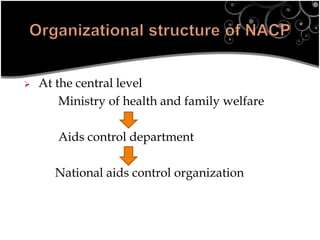
 At the central level
Ministry of health and family welfare
Aids control department
National aids control organization
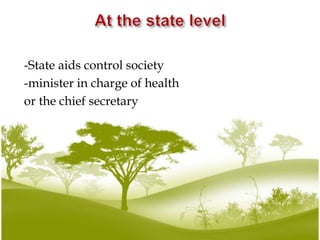
-State aids control society
-minister in charge of health
or the chief secretary
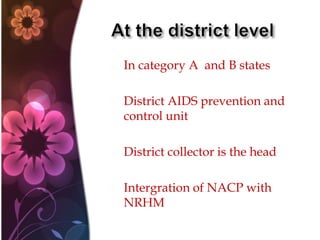
 In category A and B states
 District AIDS prevention and
control unit
 District collector is the head
 Intergration of NACP with
NRHM
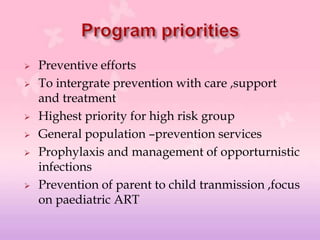
 Preventive efforts
 To intergrate prevention with care ,support
and treatment
 Highest priority for high risk group
 General population –prevention services
 Prophylaxis and management of opporturnistic
infections
 Prevention of parent to child tranmission ,focus
on paediatric ART
 Nutritional support and opporturnities
for income generation
 Community care centres to provide
psychosocial support, outreach
services,referrals and palliative care
 Intergrate HIV prevention into the
activities of women’s group,youth
groups and trade unions
 Creating awareness about symptoms, spread,
prevention and services available through a
strong IEC campaign
 Condom promotion
 Promotion of voluntary blood donation and
access to safe blood
 Integrated Counseling and Testing (ICT)
 Prevention of Parent To Child Transmission
 Management of Sexually Transmitted infection
and Reproductive Tract infections
 Targeted intervention for High Risk Group and
Bridge population
 Care, support and treatment services for
People Living with HIV/AIDS
 Post Exposure Prophylaxis (PEP)
 Promotion of safe practices and
infection control
 Intersectoral coordination and
mainstreaming
 Formulated for the rural areas of 187 highly
vulnerable districts
 Aims at capacitating the rural community and
equipping them with HIV related knowledge
to combat the epidemic
 Of 100 babies born to HIV infected mothers 33
may get HIV either during pregnancy,birth or
by breast feeding
 Disseminate correct non judgemental
information on PPTCT
 Counsel all HIV positive mothers on ways to
reduce the transmission to the baby
 Administer ART to lower mother’s viral load
and act as prophylaxis for the baby
 Modify the obstetric practises to minimise
baby’s exposure to HIV
 Support safe infant feeding practices
 Develop links for follow up of mother and
baby
 Educate and counsel HIV mothers
-monitoring for signs of infection
-practicing safe sex
-using family planning methods
-assessing for eligibility for ART for both her and
baby if appropriate
 Launched in 2006
 Care and support to children infected with
HIV
 Guideline for paediatric ART including
diagnosis of HIV in children has been
developed
 Paediatric drugs are provided in all ART
centres
 Free CD4 monitoring
 Free DNA-PCR test for children upto 18
months
 Liquid formulations for babies weighing less
than 5 kg
 Diagnosis and treatment of OI’s
 Micronutrient supplementation
 Introducing Dried Blood Spot system to
transport dried blood samples
 In 2006,Voluntary Counselling and Testing and
PPTCT merged to form ICTC
 Have been established at medical
colleges,district hospitals,sub district level
hospitals,community health centres
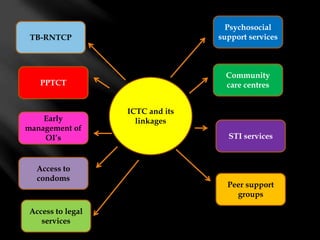
ICTC and its
linkages
Access to
condoms
Early
management of
OI’s
PPTCT
TB-RNTCP
Psychosocial
support services
Community
care centres
STI services
Access to legal
services
Peer support
groups
 TB –most common cause of death in people
with HIV
 TB is treatable.Standard DOTS regimens are to
be followed (RNTCP programme)
 If the patient needs ART then to consider
-when to start ART
-Which regimen to use to avoid hepatotoxicity
-NACO reccomends category I or II in HIV
infected
 Red Ribbon Express (RRE) phase-II and follow
up plan
 Multi-media campaigns in the States of North-
East‘’Red Ribbon Super Stars’’
 Long format Radio & TV programs-Eg. Kyonki
Jina Isi ka Naam Hai in Doordharshan
 Folk Media and IEC vans
 Adolescence Education Programme (AEP)
 The surveillance system would
include:-
 (a) HIV Sentinel Surveillance
 (b) AIDS Case Surveillance
 (c) STDs Surveillance
 (d) Behavioral Surveillance.
 GOI
 World bank
 GFATM
 DFID-UK aid
 USAID
 Sita 20 year old woman received a positive
HIV test 2 weeks ago.During your home visit,
You check her lab investigations that was done
recently Finds it is all within normal limits and
her CD4 count is 475.She asks “What should I
do to stay healthy?......
 Ramu ,a 28 year old man was recently
diagnosed with advanced HIV and wasting
syndrome.He is depressed and suicidal.He has
disclosed his status only to his wife and really
does not know much about HIV.He is sure that
he is going to die…
 A women who is 24 years ,HIV positive
,delivered her baby asks you about feeding her
baby.You have not seen her in the past ,during
her prenatal period.What points you should
keep in mind while counselling her to reduce
MTCT?
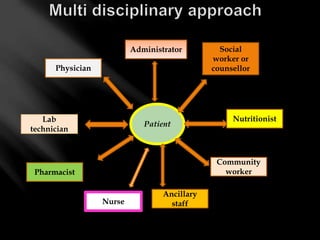
 Key approaches to nursing care of PLHAs
A.Family centered approach
B.Multidisciplinary approach
 Engage family in supportive care of PLHAs
 Helps in the following
-PLHA able to manage own care
-help in adherence to treatment
-Increase the capacity for home based care
Patient
Social
worker or
counsellor
Lab
technician
Pharmacist
Ancillary
staff
Nutritionist
Community
worker
Administrator
Physician
Nurse
 Basic care :physical ,psychosocial and
spiritual
 Psychosocial :Stigma and discrimination
 Education and counselling
 Prevention: primary and secondary
 Palliative care
 Referral linkages
 Treatment ,care and support(ART adherence )
 Management of symptoms: OI’s,respiratory
infections,skin infections,STD’s etc
 Management of drug side
effects
 Infection control
 Diet and nutrition
 Psychological problem
 Issues related to children
,women and pregnancy
 Patient advocacy/patient
privacy
 Healthy life style practices
 Maintainence of records
and documentation
 1.Perform baseline assessment
 -medical,social,sexual history
 -patient’s self evaluation of how s/he is doing
 -physical examination
 -lab findings
 2.Plan care utilizing the various
approaches to care
 - develop comprehensive plan of
care including all relevant
medical and nursing issues for
the particular case study
 Primary prevention
-to prevent acquiring infection
-to prevent transmitting infection to others
-rational and safe use of blood
-offering pre and post test counselling to the
people at risk
-ANC women ,patients attending STI clinics
-Harm reduction strategies for IDU’s
 Secondary prevention
-educate and counsel PLHA’s on
• Safe sex practices
• Facilitate positive living
 Low socio economic status
 Lack of disclosure
 Lack of positive social support
 Barriers to medical care
 Exposure to violence at home and in the
community
 Gender differences
 Stigma and discrimination
 To improve patient care and to delegate care ,nurse
should refer patients to
 Other health centre’s such as PHC’s,ART centres,STI
clinics,PPTCT,ICTC and higher level hospitals
 Other sources of support for patient like
-NGO’s & CBO’s
-positive network
-financial resources
-DOTS clinic
-Religious group
 Dispensing ARV drugs
 Counselling of patients
 Record keeping and maintainence of patient
documents
 Coordinating and tracking the referrals and
establishing linkages with various departments
 Nursing care and follow up of patients
 The candidate should be a diploma in
nursing from a recognized nursing
school/college with experience of providing
nursing care and preferably 2 years in a
public or private health institution
 Vital signs
 Follow up,medication administration
 Watch out for any changes in condition
and report promptly
 Counselling
 Antenatal,postnatal care
 Nutritional supplements as required
 Maintenence of records
 Referrals
 Report on stocks of medicines and other
consumables
 Maintain drug dispensed register
 Case manager who provides intergrated
care of the PLHA’s case
 Incharge of coordinating the outreach
workers to follow the treatment as
decided by the clinical team
 Practice universal precaution principles
 Participate in the staff meetings and provide
feedback
 Depends on the following
 Knowlegde
 Understanding : Be aware of the challenges and
psycho social needs of
-YOUR patient
-YOURSELF
 Confidence :Your patient will look to you for
advice ,information and support
 So be CONFIDENT!!!!!

aids control pgram.pptNurses students jn

  • 2.
     Review theclinical facts about HIV/AIDS  Magnitude of the problem of HIV/Aids  Milestones of NACP in India  Goals and objectives of NACP III  National aids prevention and control policy  Activities under NACP III  STD control programme in India  Organogram of NACP III  Roles and responsibilities of community health nurse in National Aids Control Programme
  • 3.
  • 4.
    - -33.2 millionpeople are living with HIV - -Sub Saharan Africa region –most affected by the AIDS pandemic - -In India,estimated to be 2.47 million - -Main transmission route-sexual 86% - -The six states with the highest HIV prevalence are Maharastra,Andhra Pradesh,Tamilnadu,Karnataka, - Manipur and Nagaland - -all districts across the country are classified into categories - A,B,C,D. - (UNAIDS,2008 Report on - Global epidemic update)
  • 5.
     1986 –Firstcase of HIV detected  1987-National AIDS control programme  1992-NACO,NACP I launched  1999-NACP II launched  2002-National AIDS prevention and control policy ,National blood safety policy  2006-National council on AIDS ,National policy on paediatric ART  2007-2011-NACP III
  • 6.
     Coverage ofhigh risk groups  Greater care,support and treatment to large number of PLHA  Strengthen the infrastructure,system and human resource  Strengthen the nation wide strategic information management system
  • 7.
     Reduce theincidence rate by 60 % in the high prevalence states to obtain the reversal of the epidemic and by 40 % in the vulnerable to stabilize the epidemic
  • 8.
     Launched inthe year????????  Objectives -Government’s firm commitment -Generate a feeling of ownership at government and non governmental levels -Enabling social environment for prevention -Decentralize HIV/AIDS control program -Prevent women, children and other socially weak groups from getting infected
  • 9.
     Adequate andequitable provision of health care  Overcome stigmatization ,discrimination and seclusion in the society  International and bilateral colloboration for research in vaccines and drugs  Ensure availability of safe blood and blood products  Promote better understanding of HIV infection among population
  • 10.
     At thecentral level Ministry of health and family welfare Aids control department National aids control organization
  • 11.
    -State aids controlsociety -minister in charge of health or the chief secretary
  • 12.
     In categoryA and B states  District AIDS prevention and control unit  District collector is the head  Intergration of NACP with NRHM
  • 13.
     Preventive efforts To intergrate prevention with care ,support and treatment  Highest priority for high risk group  General population –prevention services  Prophylaxis and management of opporturnistic infections  Prevention of parent to child tranmission ,focus on paediatric ART
  • 14.
     Nutritional supportand opporturnities for income generation  Community care centres to provide psychosocial support, outreach services,referrals and palliative care  Intergrate HIV prevention into the activities of women’s group,youth groups and trade unions
  • 15.
     Creating awarenessabout symptoms, spread, prevention and services available through a strong IEC campaign  Condom promotion  Promotion of voluntary blood donation and access to safe blood  Integrated Counseling and Testing (ICT)  Prevention of Parent To Child Transmission
  • 16.
     Management ofSexually Transmitted infection and Reproductive Tract infections  Targeted intervention for High Risk Group and Bridge population  Care, support and treatment services for People Living with HIV/AIDS
  • 17.
     Post ExposureProphylaxis (PEP)  Promotion of safe practices and infection control  Intersectoral coordination and mainstreaming
  • 18.
     Formulated forthe rural areas of 187 highly vulnerable districts  Aims at capacitating the rural community and equipping them with HIV related knowledge to combat the epidemic
  • 19.
     Of 100babies born to HIV infected mothers 33 may get HIV either during pregnancy,birth or by breast feeding  Disseminate correct non judgemental information on PPTCT  Counsel all HIV positive mothers on ways to reduce the transmission to the baby  Administer ART to lower mother’s viral load and act as prophylaxis for the baby  Modify the obstetric practises to minimise baby’s exposure to HIV
  • 20.
     Support safeinfant feeding practices  Develop links for follow up of mother and baby  Educate and counsel HIV mothers -monitoring for signs of infection -practicing safe sex -using family planning methods -assessing for eligibility for ART for both her and baby if appropriate
  • 21.
     Launched in2006  Care and support to children infected with HIV  Guideline for paediatric ART including diagnosis of HIV in children has been developed  Paediatric drugs are provided in all ART centres  Free CD4 monitoring
  • 22.
     Free DNA-PCRtest for children upto 18 months  Liquid formulations for babies weighing less than 5 kg  Diagnosis and treatment of OI’s  Micronutrient supplementation  Introducing Dried Blood Spot system to transport dried blood samples
  • 23.
     In 2006,VoluntaryCounselling and Testing and PPTCT merged to form ICTC  Have been established at medical colleges,district hospitals,sub district level hospitals,community health centres
  • 24.
    ICTC and its linkages Accessto condoms Early management of OI’s PPTCT TB-RNTCP Psychosocial support services Community care centres STI services Access to legal services Peer support groups
  • 25.
     TB –mostcommon cause of death in people with HIV  TB is treatable.Standard DOTS regimens are to be followed (RNTCP programme)  If the patient needs ART then to consider -when to start ART -Which regimen to use to avoid hepatotoxicity -NACO reccomends category I or II in HIV infected
  • 26.
     Red RibbonExpress (RRE) phase-II and follow up plan  Multi-media campaigns in the States of North- East‘’Red Ribbon Super Stars’’  Long format Radio & TV programs-Eg. Kyonki Jina Isi ka Naam Hai in Doordharshan  Folk Media and IEC vans  Adolescence Education Programme (AEP)
  • 27.
     The surveillancesystem would include:-  (a) HIV Sentinel Surveillance  (b) AIDS Case Surveillance  (c) STDs Surveillance  (d) Behavioral Surveillance.
  • 28.
     GOI  Worldbank  GFATM  DFID-UK aid  USAID
  • 29.
     Sita 20year old woman received a positive HIV test 2 weeks ago.During your home visit, You check her lab investigations that was done recently Finds it is all within normal limits and her CD4 count is 475.She asks “What should I do to stay healthy?......
  • 30.
     Ramu ,a28 year old man was recently diagnosed with advanced HIV and wasting syndrome.He is depressed and suicidal.He has disclosed his status only to his wife and really does not know much about HIV.He is sure that he is going to die…
  • 31.
     A womenwho is 24 years ,HIV positive ,delivered her baby asks you about feeding her baby.You have not seen her in the past ,during her prenatal period.What points you should keep in mind while counselling her to reduce MTCT?
  • 32.
     Key approachesto nursing care of PLHAs A.Family centered approach B.Multidisciplinary approach
  • 33.
     Engage familyin supportive care of PLHAs  Helps in the following -PLHA able to manage own care -help in adherence to treatment -Increase the capacity for home based care
  • 34.
  • 35.
     Basic care:physical ,psychosocial and spiritual  Psychosocial :Stigma and discrimination  Education and counselling  Prevention: primary and secondary  Palliative care  Referral linkages  Treatment ,care and support(ART adherence )  Management of symptoms: OI’s,respiratory infections,skin infections,STD’s etc
  • 36.
     Management ofdrug side effects  Infection control  Diet and nutrition  Psychological problem  Issues related to children ,women and pregnancy  Patient advocacy/patient privacy  Healthy life style practices  Maintainence of records and documentation
  • 37.
     1.Perform baselineassessment  -medical,social,sexual history  -patient’s self evaluation of how s/he is doing  -physical examination  -lab findings
  • 38.
     2.Plan careutilizing the various approaches to care  - develop comprehensive plan of care including all relevant medical and nursing issues for the particular case study
  • 39.
     Primary prevention -toprevent acquiring infection -to prevent transmitting infection to others -rational and safe use of blood -offering pre and post test counselling to the people at risk -ANC women ,patients attending STI clinics -Harm reduction strategies for IDU’s
  • 40.
     Secondary prevention -educateand counsel PLHA’s on • Safe sex practices • Facilitate positive living
  • 41.
     Low socioeconomic status  Lack of disclosure  Lack of positive social support  Barriers to medical care  Exposure to violence at home and in the community  Gender differences  Stigma and discrimination
  • 42.
     To improvepatient care and to delegate care ,nurse should refer patients to  Other health centre’s such as PHC’s,ART centres,STI clinics,PPTCT,ICTC and higher level hospitals  Other sources of support for patient like -NGO’s & CBO’s -positive network -financial resources -DOTS clinic -Religious group
  • 43.
     Dispensing ARVdrugs  Counselling of patients  Record keeping and maintainence of patient documents  Coordinating and tracking the referrals and establishing linkages with various departments  Nursing care and follow up of patients
  • 44.
     The candidateshould be a diploma in nursing from a recognized nursing school/college with experience of providing nursing care and preferably 2 years in a public or private health institution
  • 45.
     Vital signs Follow up,medication administration  Watch out for any changes in condition and report promptly  Counselling  Antenatal,postnatal care  Nutritional supplements as required  Maintenence of records
  • 46.
     Referrals  Reporton stocks of medicines and other consumables  Maintain drug dispensed register  Case manager who provides intergrated care of the PLHA’s case  Incharge of coordinating the outreach workers to follow the treatment as decided by the clinical team
  • 47.
     Practice universalprecaution principles  Participate in the staff meetings and provide feedback
  • 48.
     Depends onthe following  Knowlegde  Understanding : Be aware of the challenges and psycho social needs of -YOUR patient -YOURSELF  Confidence :Your patient will look to you for advice ,information and support  So be CONFIDENT!!!!!