Planning, Implementation and Evaluation of
education program on HIV/AIDS
Sanjay Chaudhary
(BPH 3RD Batch)
INTRODUCTION
• HIV stands for Human immunodeficiency virus . It is a virus spread
through certain, body fluids that attacks the body immune system,
specially the CD4 cells, often called T cells.
• HIV can be transmitted via the exchange of a variety of body fluid
from infected people such as blood, breast milk, semen, vaginal
secretion and some of the behaviour and conditions such as
having unprotected anal or vaginal sex, shearing contaminated
needles and syringe.
• In the first week after initial infection people may experience no
symptoms or an influenza like illness including fever, headache,
rash or sore throat and later may develop the sign and symptoms
such as swollen nodes, weight loss, fever, diarrhoea & cough.
• No effective cure currently exist but with proper medical care, HIV
can be controlled. The medicine used to treat HIV is called Anti
retro viral therapy or ART.
• The government of Nepal is running National HIV strategy plan
(2016-2021) which has adopted 90-90-90 goal by 2020.
PROBLEM STATEMENT
• HIV continuous to be a major global public health issues, however
with increasing access to effective HIV prevention, diagnosis,
treatment including for opportunistic infection .
• HIV infection has become a manageable chronic health condition,
enabling people living with HIV to lead long and healthy lives.
• The prevalence of HIV among adult population age 15 and
above is estimated to be 0.20% although the prevalence of HIV
is very low among the general population.
• The prevalence of HIV positive cases are higher in province 2
and 3, which account for 1.1% and 0.7% respectively.
• The prevalence of HIV positive cases among pregnant women
were highest in province 2, then national .
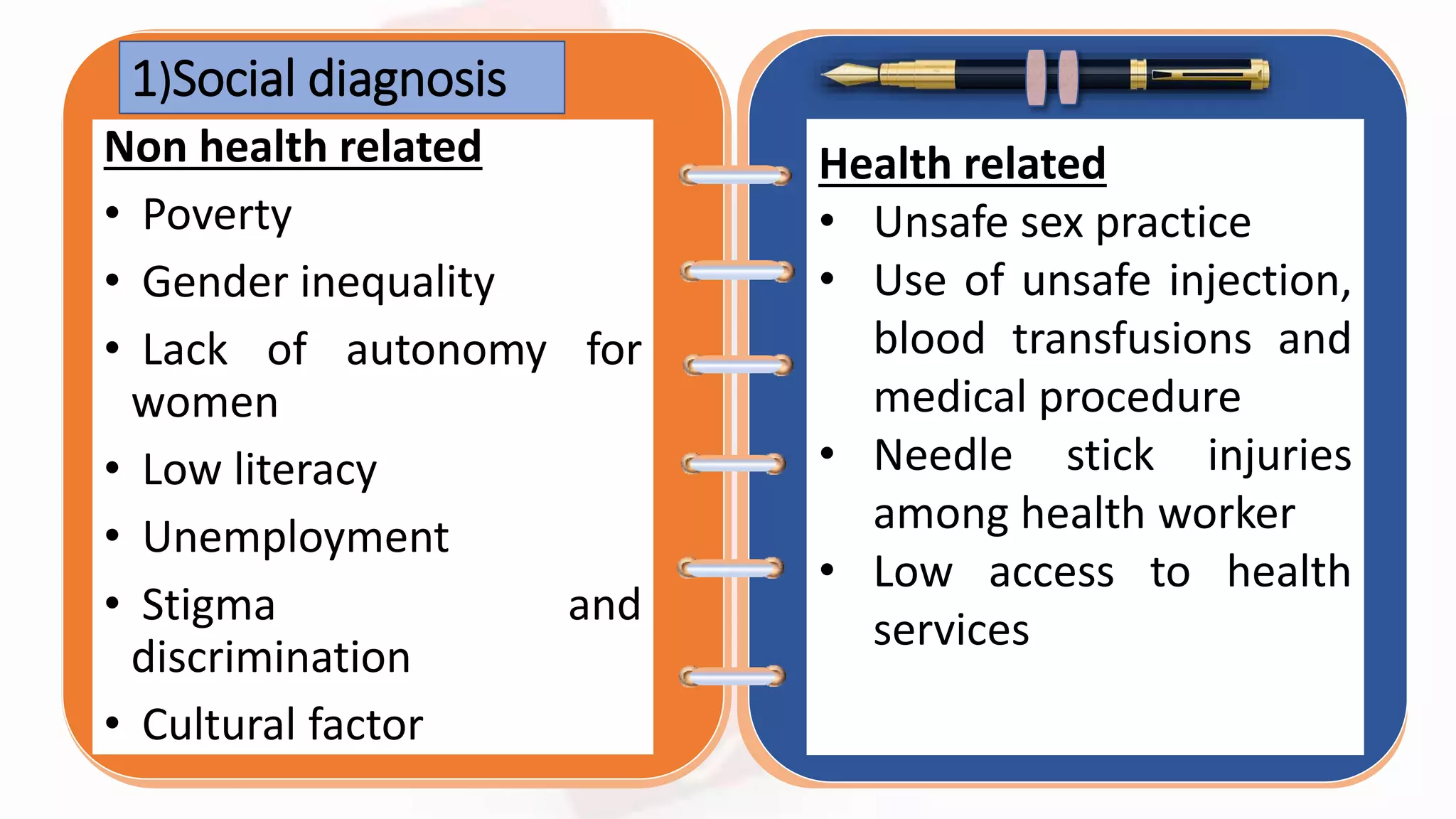
SANJAY CHAUDHARYHealth related
• Unsafe sex practice
• Use of unsafe injection,
blood transfusions and
medical procedure
• Needle stick injuries
among health worker
• Low access to health
services
Non health related
• Poverty
• Gender inequality
• Lack of autonomy for
women
• Low literacy
• Unemployment
• Stigma and
discrimination
• Cultural factor
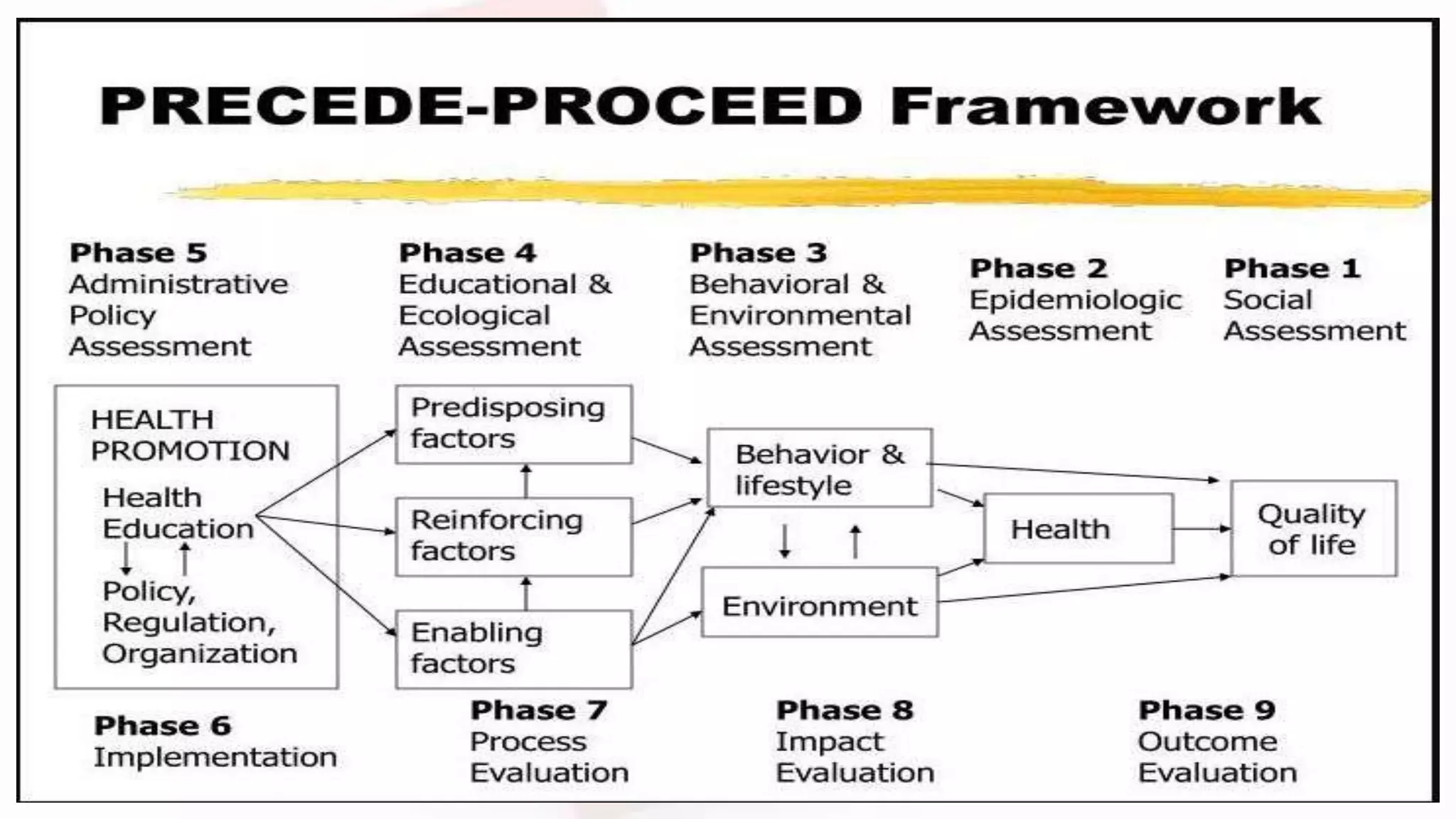
1)Social diagnosis
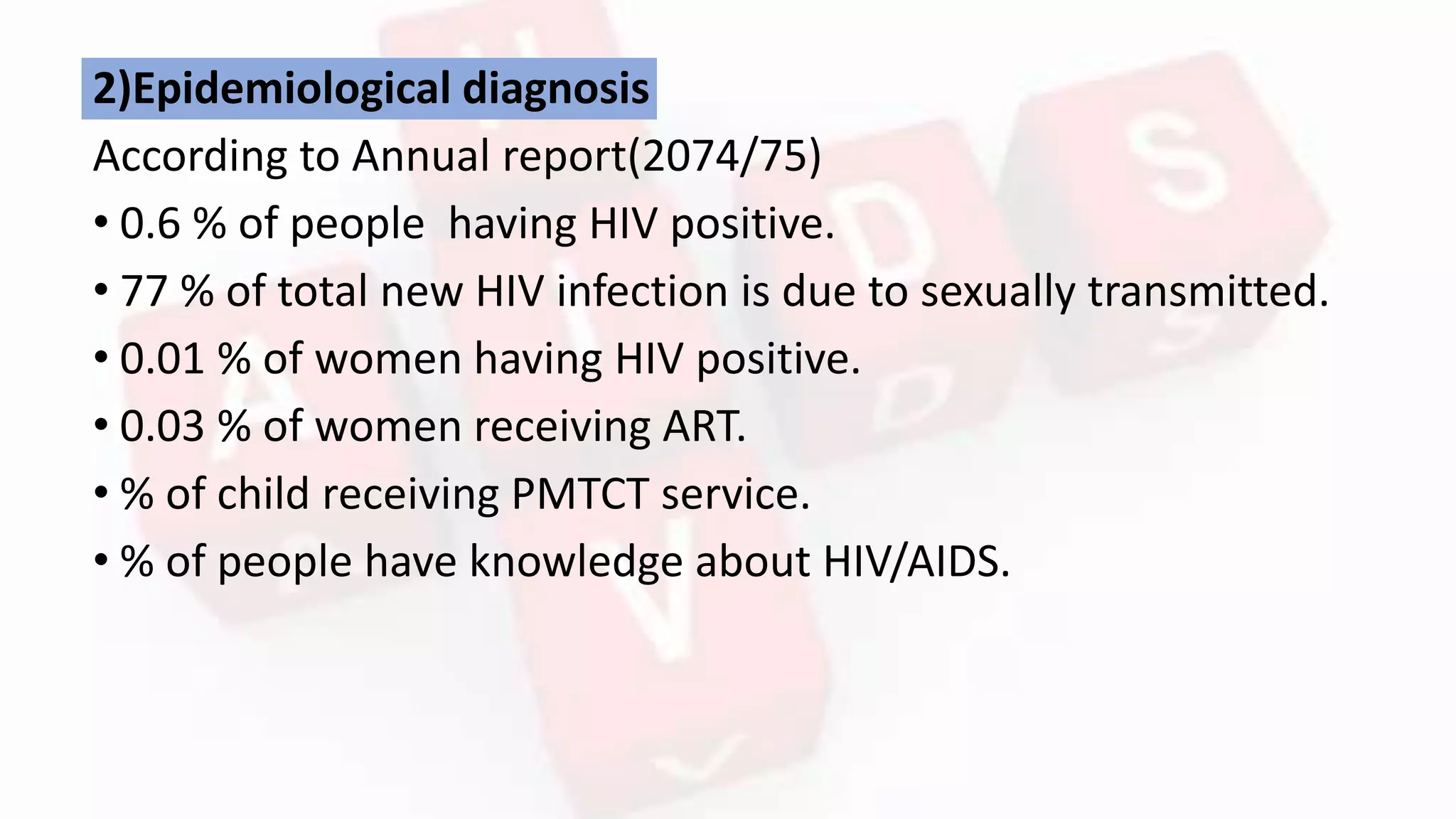
2)Epidemiological diagnosis
According to Annual report(2074/75)
• 0.6 % of people having HIV positive.
• 77 % of total new HIV infection is due to sexually transmitted.
• 0.01 % of women having HIV positive.
• 0.03 % of women receiving ART.
• % of child receiving PMTCT service.
• % of people have knowledge about HIV/AIDS.
3)Behavioral and environmental diagnosis
Behaviour
• Sex orientation(Homosexual, Heterosexual, Bisexual)
• Sexual experience.
• Type of sexual experience.
• Number of sexual partner to date.
• Condom used during intercourse .
• Habits of using drug and shearing same syringe.
• Communication with parents and peers about sex.
• Seeking health care.
Environmental
• unsafe sex practise.
• Lack of early access to effective medical care (including ART,
treatment of opportunistic infection, preventive therapy for
tuberculosis and other OIS & STIs).
• Lack of provision of HIV control among mother to child.
• Poor emotional support/care to an individual, couple and family.
• No social support and peer support.
• No proper counselling services for coping and planning for the
future.
• Stigma and discrimination among HIV patients.
continue……..
• No provision of family planning and contraceptive services.
• No proper management TB/HIV co-infection.
• Lack of information.
• Rude behaviours of health workers in health facilities.
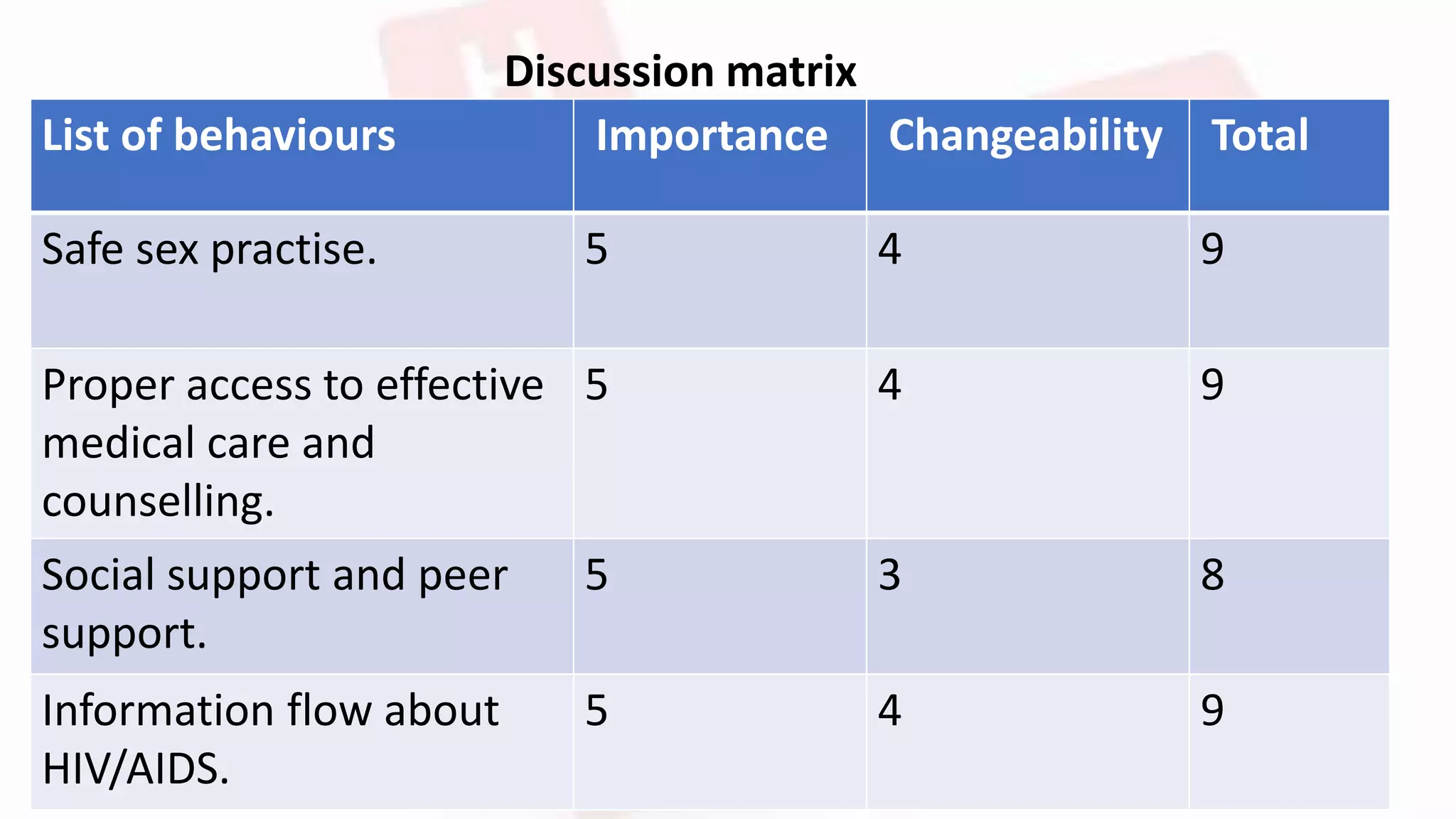
Discussion matrix
List of behaviours Importance Changeability Total
Safe sex practise. 5 4 9
Proper access to effective
medical care and
counselling.
5 4 9
Social support and peer
support.
5 3 8
Information flow about
HIV/AIDS.
5 4 9
4)Educational diagnosis
Predisposing
• % have knowledge of HIV/AIDS.
• % have comprehensive knowledge about HIV.
• % know that using condom and limiting sexual intercourse to one
uninfected person is a way to prevent HIV transmission.
• % have knowledge of prevention of mother to child transmission.
• % have the discriminatory attitude towards people living with
HIV.
• % know where to get an HIV test.
• % know where to get free ART service.
Reinforcing factors
• Support from the family and peers.
• Support from the health care providers.
• HIV related secession conducted by health workers.
Enabling factors
• Motivation for the safe sex practise.
• Availability of condom from the health post as well as FCHVs.
• NGO/INGO working for improving knowledge about the mode of
transmission and prevention.
• HIV testing and counselling services.
5)Policy and administrative diagnosis
Policy diagnosis
• National center for AIDS and STI control.
• National AIDS council for the policy co-ordination.
• Quality control and strategic information.
• Civil society network.
• Co-ordination of public and private partnership.
• Awareness program for IEC/BCC.
Administrative diagnosis
• MoHP
• District health office
• District hospital
• Primary health care
• Health post
• FCHV
• NGO/INGO
• Private hospitals
Goal
1) To reduce HIV infection.
2) Increase access to health care and improve health outcome for
people living with HIV.
3) Reduce HIV-related health disparities and health inequalities.
4) Achieve a more co-ordinated national response to HIV
epidemic.
General objective
• To reduce the prevalence of HIV/AIDS in abc ward of xyz
municipality by providing the education on various mode of
transmission ,stigma attached with diseases and free anti
retroviral therapy.
Specific objective
• To prevent the HIV transmission.
• To reduce the sexually transmitted diseases transmission.
• To prevent the vertical transmission of HIV.
• To reduce the stigma attached with diseases.
• To create an enabling environment.
• To provide HIV infected people with life-saving ART.
• To reduce TB death in people living with HIV.
• To eliminate new HIV infection among children and reduce
AIDS related maternal death.
Target group
• Among key population (people who inject drug, female sex
worker, men who sex with male and transgender ).
Method and media
Method :Brainstorming, group discussion, counselling, role play.
Media :flip chart, poster, pamphlets, TV, radio etc.
Content of health education
• HIV/AIDS and its importance.
• Risk factors for HIV/AIDS.
• Unsafe sexual practise in community and its effect.
• Preventive measure for HIV/AIDS
• Available treatment services/sites as per the government of Nepal .
5)Implementation of program
• Detail plan of action regarding health education program in
HIV/AIDS will be made and implemented.
Work plan
Evaluation of health education program
7)Process evaluation
• Brainstorming at the beginning and the end of the class.
• Regular monitoring and supervision of all the program activities.
• Question/Answer session can be done at the middle/end of the session.
8)Outcome evaluation
• Increase knowledge about the safe sex and sex education.
• Increase use of condom and avoiding multi sexual partner.
• Decrease use of drug and sharing same syringe.
• Increase access to ART and PMTCT services.
• Decreased stigma and discrimination among HIV patient.
• Increase no of ART suppressed patient.
9)Impact evaluation
• Reduction in morbidity and mortality rate due to HIV/AIDS.
• Increase provision of HIV test services.
• Provision of ART and PMTCT services.
• Strengthen HIV-TB collaboration between NCASC and NTP at
all levels.
10)Follow up
For the better result of any program proper follow up is most
important ,which can be done every month for 2 year by the help
of ART sites where we can have better counselling and treatment
services.
Reference
Annual report (2074/75)
NDHS (2016)
THANK YOU

Planning, implementation and evaluation of education program on HIV/AIDS. .

  • 1.
    Planning, Implementation andEvaluation of education program on HIV/AIDS Sanjay Chaudhary (BPH 3RD Batch)
  • 2.
    INTRODUCTION • HIV standsfor Human immunodeficiency virus . It is a virus spread through certain, body fluids that attacks the body immune system, specially the CD4 cells, often called T cells. • HIV can be transmitted via the exchange of a variety of body fluid from infected people such as blood, breast milk, semen, vaginal secretion and some of the behaviour and conditions such as having unprotected anal or vaginal sex, shearing contaminated needles and syringe.
  • 3.
    • In thefirst week after initial infection people may experience no symptoms or an influenza like illness including fever, headache, rash or sore throat and later may develop the sign and symptoms such as swollen nodes, weight loss, fever, diarrhoea & cough. • No effective cure currently exist but with proper medical care, HIV can be controlled. The medicine used to treat HIV is called Anti retro viral therapy or ART. • The government of Nepal is running National HIV strategy plan (2016-2021) which has adopted 90-90-90 goal by 2020.
  • 4.
    PROBLEM STATEMENT • HIVcontinuous to be a major global public health issues, however with increasing access to effective HIV prevention, diagnosis, treatment including for opportunistic infection . • HIV infection has become a manageable chronic health condition, enabling people living with HIV to lead long and healthy lives.
  • 5.
    • The prevalenceof HIV among adult population age 15 and above is estimated to be 0.20% although the prevalence of HIV is very low among the general population. • The prevalence of HIV positive cases are higher in province 2 and 3, which account for 1.1% and 0.7% respectively. • The prevalence of HIV positive cases among pregnant women were highest in province 2, then national .
  • 7.
    SANJAY CHAUDHARYHealth related •Unsafe sex practice • Use of unsafe injection, blood transfusions and medical procedure • Needle stick injuries among health worker • Low access to health services Non health related • Poverty • Gender inequality • Lack of autonomy for women • Low literacy • Unemployment • Stigma and discrimination • Cultural factor 1)Social diagnosis
  • 8.
    2)Epidemiological diagnosis According toAnnual report(2074/75) • 0.6 % of people having HIV positive. • 77 % of total new HIV infection is due to sexually transmitted. • 0.01 % of women having HIV positive. • 0.03 % of women receiving ART. • % of child receiving PMTCT service. • % of people have knowledge about HIV/AIDS.
  • 9.
    3)Behavioral and environmentaldiagnosis Behaviour • Sex orientation(Homosexual, Heterosexual, Bisexual) • Sexual experience. • Type of sexual experience. • Number of sexual partner to date. • Condom used during intercourse . • Habits of using drug and shearing same syringe. • Communication with parents and peers about sex. • Seeking health care.
  • 10.
    Environmental • unsafe sexpractise. • Lack of early access to effective medical care (including ART, treatment of opportunistic infection, preventive therapy for tuberculosis and other OIS & STIs). • Lack of provision of HIV control among mother to child. • Poor emotional support/care to an individual, couple and family. • No social support and peer support. • No proper counselling services for coping and planning for the future. • Stigma and discrimination among HIV patients.
  • 11.
    continue…….. • No provisionof family planning and contraceptive services. • No proper management TB/HIV co-infection. • Lack of information. • Rude behaviours of health workers in health facilities.
  • 12.
    Discussion matrix List ofbehaviours Importance Changeability Total Safe sex practise. 5 4 9 Proper access to effective medical care and counselling. 5 4 9 Social support and peer support. 5 3 8 Information flow about HIV/AIDS. 5 4 9
  • 13.
    4)Educational diagnosis Predisposing • %have knowledge of HIV/AIDS. • % have comprehensive knowledge about HIV. • % know that using condom and limiting sexual intercourse to one uninfected person is a way to prevent HIV transmission. • % have knowledge of prevention of mother to child transmission. • % have the discriminatory attitude towards people living with HIV. • % know where to get an HIV test. • % know where to get free ART service.
  • 14.
    Reinforcing factors • Supportfrom the family and peers. • Support from the health care providers. • HIV related secession conducted by health workers. Enabling factors • Motivation for the safe sex practise. • Availability of condom from the health post as well as FCHVs. • NGO/INGO working for improving knowledge about the mode of transmission and prevention. • HIV testing and counselling services.
  • 15.
    5)Policy and administrativediagnosis Policy diagnosis • National center for AIDS and STI control. • National AIDS council for the policy co-ordination. • Quality control and strategic information. • Civil society network. • Co-ordination of public and private partnership. • Awareness program for IEC/BCC.
  • 16.
    Administrative diagnosis • MoHP •District health office • District hospital • Primary health care • Health post • FCHV • NGO/INGO • Private hospitals
  • 17.
    Goal 1) To reduceHIV infection. 2) Increase access to health care and improve health outcome for people living with HIV. 3) Reduce HIV-related health disparities and health inequalities. 4) Achieve a more co-ordinated national response to HIV epidemic.
  • 18.
    General objective • Toreduce the prevalence of HIV/AIDS in abc ward of xyz municipality by providing the education on various mode of transmission ,stigma attached with diseases and free anti retroviral therapy.
  • 19.
    Specific objective • Toprevent the HIV transmission. • To reduce the sexually transmitted diseases transmission. • To prevent the vertical transmission of HIV. • To reduce the stigma attached with diseases. • To create an enabling environment. • To provide HIV infected people with life-saving ART. • To reduce TB death in people living with HIV. • To eliminate new HIV infection among children and reduce AIDS related maternal death.
  • 20.
    Target group • Amongkey population (people who inject drug, female sex worker, men who sex with male and transgender ). Method and media Method :Brainstorming, group discussion, counselling, role play. Media :flip chart, poster, pamphlets, TV, radio etc.
  • 21.
    Content of healtheducation • HIV/AIDS and its importance. • Risk factors for HIV/AIDS. • Unsafe sexual practise in community and its effect. • Preventive measure for HIV/AIDS • Available treatment services/sites as per the government of Nepal .
  • 22.
    5)Implementation of program •Detail plan of action regarding health education program in HIV/AIDS will be made and implemented. Work plan
  • 23.
    Evaluation of healtheducation program 7)Process evaluation • Brainstorming at the beginning and the end of the class. • Regular monitoring and supervision of all the program activities. • Question/Answer session can be done at the middle/end of the session. 8)Outcome evaluation • Increase knowledge about the safe sex and sex education. • Increase use of condom and avoiding multi sexual partner. • Decrease use of drug and sharing same syringe. • Increase access to ART and PMTCT services. • Decreased stigma and discrimination among HIV patient. • Increase no of ART suppressed patient.
  • 24.
    9)Impact evaluation • Reductionin morbidity and mortality rate due to HIV/AIDS. • Increase provision of HIV test services. • Provision of ART and PMTCT services. • Strengthen HIV-TB collaboration between NCASC and NTP at all levels.
  • 25.
    10)Follow up For thebetter result of any program proper follow up is most important ,which can be done every month for 2 year by the help of ART sites where we can have better counselling and treatment services.
  • 26.
  • 27.