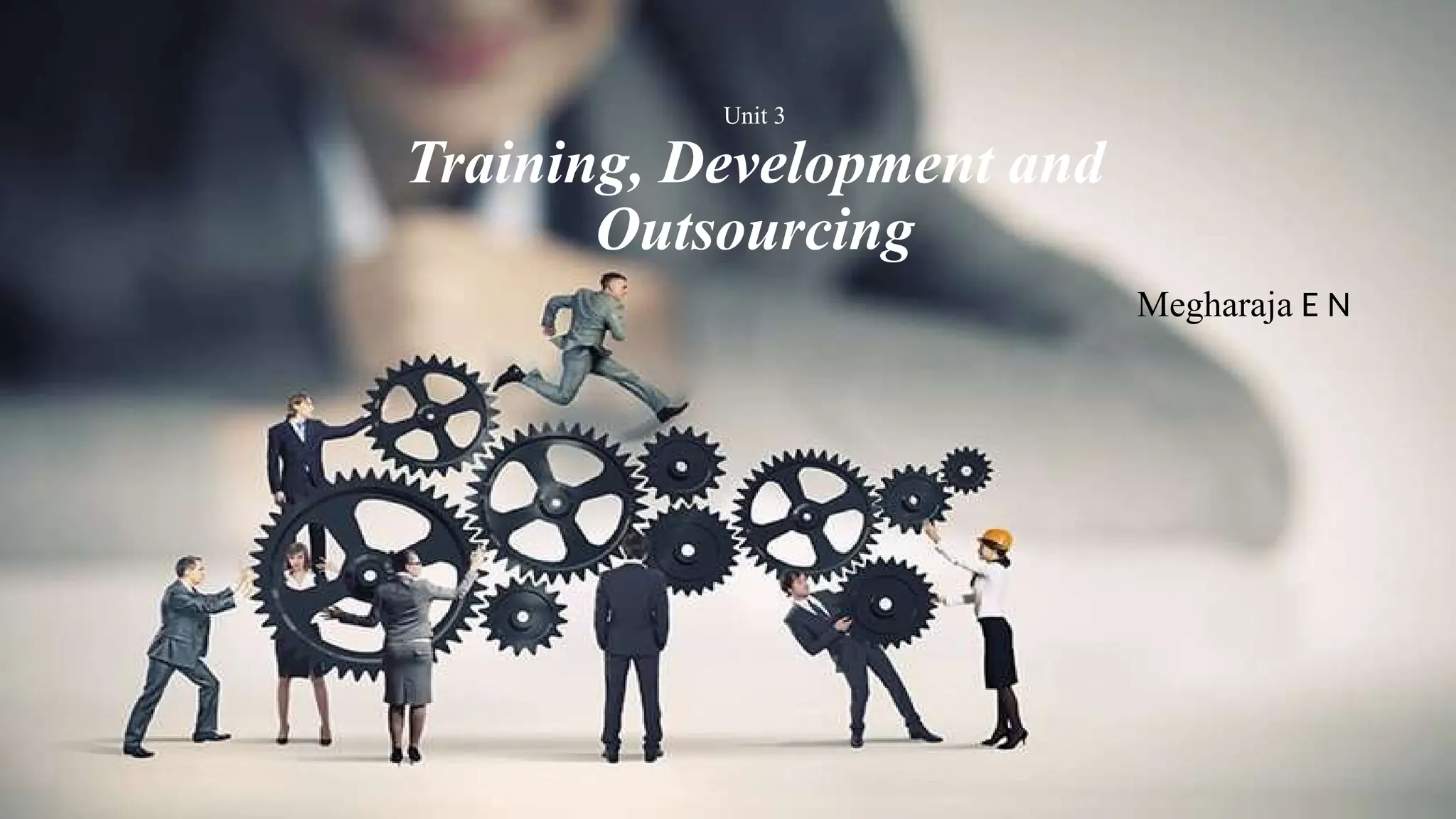
Unit 3
Training, Development and
Outsourcing
Megharaja E N
Training
 Training is a process of learning a sequence of programmed behavior. It is the application of
knowledge & gives people an awareness of rules & procedures to guide their behavior. It helps in
bringing about positive change in the knowledge, skills & attitudes of employees.
 Providing educational opportunities for all employees. These educational opportunities may include
training programs, but they also include support for taking courses offered outside the company, self-
study, and learning through job rotation.
 The term training refers to the acquisition of knowledge, skills, and competencies as a result of the
teaching of vocational or practical skills and knowledge that relate to specific useful competencies.
“Training is the act of increasing the knowledge and skills of an employee for
doing a particular job.” — Edwin B. Flippo
According to Michael J Jucius, “The term training is used here to indicate only
process by which the aptitudes, skills and abilities of employees to performs
specifics jobs are increased
According to Dales S Beach, “Training is an organised procedure by which
people learn knowledge and/or skills for a definite purpose”.
Definitions
Need of Training
 New candidates who join an organization are given training. This training familiarizes them with the
organizational mission, vision, rules and regulations and the working conditions.
 The existing employees are trained to refresh and enhance their knowledge
 If any updating and amendments take place in technology, training is given to cope up with those changes.
 When promotion and career growth becomes important. Training is given so that employees are prepared to
share the responsibilities of the higher level job.
 Reduction in poor quality and defective products and services
 Reduced waste
 Reduction in absenteeism
 Reduction in staff turnover
 Reduction in customer complaints and customer turnover
 Increased staff loyalty/feelings of obligation
 A more flexible, empowered and adaptable workforce
 Enhanced company image
Importance of Training
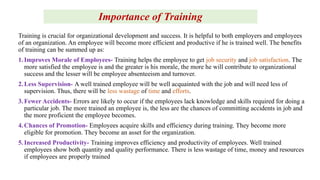
Training is crucial for organizational development and success. It is helpful to both employers and employees
of an organization. An employee will become more efficient and productive if he is trained well. The benefits
of training can be summed up as:
1. Improves Morale of Employees- Training helps the employee to get job security and job satisfaction. The
more satisfied the employee is and the greater is his morale, the more he will contribute to organizational
success and the lesser will be employee absenteeism and turnover.
2. Less Supervision- A well trained employee will be well acquainted with the job and will need less of
supervision. Thus, there will be less wastage of time and efforts.
3. Fewer Accidents- Errors are likely to occur if the employees lack knowledge and skills required for doing a
particular job. The more trained an employee is, the less are the chances of committing accidents in job and
the more proficient the employee becomes.
4. Chances of Promotion- Employees acquire skills and efficiency during training. They become more
eligible for promotion. They become an asset for the organization.
5. Increased Productivity- Training improves efficiency and productivity of employees. Well trained
employees show both quantity and quality performance. There is less wastage of time, money and resources
if employees are properly trained
Objectives of Training
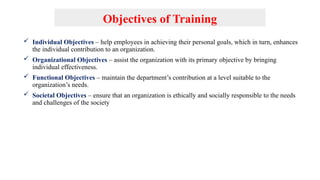
 Individual Objectives – help employees in achieving their personal goals, which in turn, enhances
the individual contribution to an organization.
 Organizational Objectives – assist the organization with its primary objective by bringing
individual effectiveness.
 Functional Objectives – maintain the department’s contribution at a level suitable to the
organization’s needs.
 Societal Objectives – ensure that an organization is ethically and socially responsible to the needs
and challenges of the society
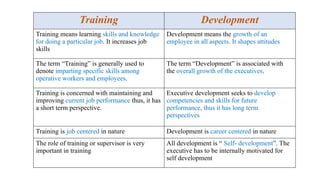
Training Development
Training means learning skills and knowledge
for doing a particular job. It increases job
skills
Development means the growth of an
employee in all aspects. It shapes attitudes
The term “Training” is generally used to
denote imparting specific skills among
operative workers and employees.
The term “Development” is associated with
the overall growth of the executives.
Training is concerned with maintaining and
improving current job performance thus, it has
a short term perspective.
Executive development seeks to develop
competencies and skills for future
performance, thus it has long term
perspectives
Training is job centered in nature Development is career centered in nature
The role of training or supervisor is very
important in training
All development is “ Self- development”. The
executive has to be internally motivated for
self development
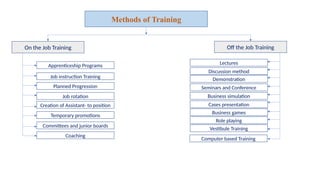
Methods of Training
On the Job Training Off the Job Training
Apprenticeship Programs
Job instruction Training
Planned Progression
Job rotation
Creation of Assistant- to position
Temporary promotions
Committees and junior boards
Coaching
Lectures
Discussion method
Demonstration
Seminars and Conference
Business simulation
Cases presentation
Business games
Role playing
Vestibule Training
Computer based Training
On-The-Job Training Methods For The Employees
(Internal Training Methods)
• These methods are generally applied in the workplace while employees are working.
• This form helps develop the occupational skills necessary to manage an organization
and fully understand its products and services and how they are designed and carried
out.
Apprenticeship programs
• Apprenticeships are a work-based learning model where apprentices have
supervised on-the-job training
• People seeking to enter the skilled trades to become, for example, plumbers,
electricians, and Ironworkers are often required to undergo apprenticeship training
before they are accepted to journeyman status.
• Typically this apprenticeship period is from two to five years. During this period,
the trainee is paid less than a qualified worker.
• These programs put the trainee under the guidance of a master worker.
Job instruction training (JIT)
JIT consists of four basic steps;
1. preparing the trainees by telling them about the job and overcoming their
uncertainties;
2. presenting the instruction, clearly giving essential information;
3. having the trainees try out the job to demonstrate their understanding; and
4. On their own, placing the workers into the job with a designated resource
person is ready to provide the required assistance.
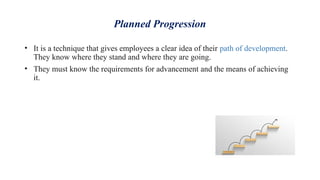
Planned Progression
• It is a technique that gives employees a clear idea of their path of development.
They know where they stand and where they are going.
• They must know the requirements for advancement and the means of achieving
it.
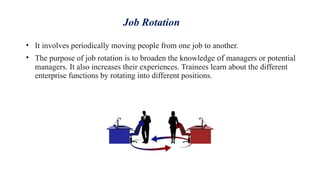
Job Rotation
• It involves periodically moving people from one job to another.
• The purpose of job rotation is to broaden the knowledge of managers or potential
managers. It also increases their experiences. Trainees learn about the different
enterprise functions by rotating into different positions.
Creation of Assistant- Position
• Assistant-to positions are frequently created to broaden the viewpoints of trainees
by allowing them to work closely with experienced managers who can give special
attention to the development needs of trainees.
• Managers can provide selected assignments to test the judgment of trainees.
• This approach can be efficient when superiors are also qualified trainers who can
guide and develop trainees until they are ready to assume full responsibilities as
managers.
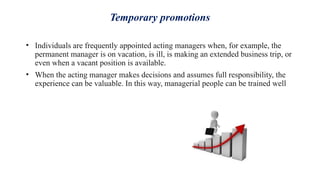
Temporary promotions
• Individuals are frequently appointed acting managers when, for example, the
permanent manager is on vacation, is ill, is making an extended business trip, or
even when a vacant position is available.
• When the acting manager makes decisions and assumes full responsibility, the
experience can be valuable. In this way, managerial people can be trained well
Committees and junior Boards
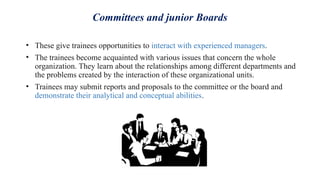
• These give trainees opportunities to interact with experienced managers.
• The trainees become acquainted with various issues that concern the whole
organization. They learn about the relationships among different departments and
the problems created by the interaction of these organizational units.
• Trainees may submit reports and proposals to the committee or the board and
demonstrate their analytical and conceptual abilities.
Coaching
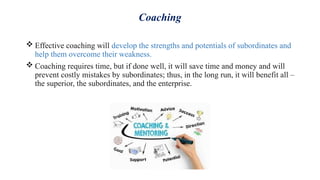
 Effective coaching will develop the strengths and potentials of subordinates and
help them overcome their weakness.
 Coaching requires time, but if done well, it will save time and money and will
prevent costly mistakes by subordinates; thus, in the long run, it will benefit all –
the superior, the subordinates, and the enterprise.
Off-The-Job Training (External Training
Methods)
 Off-the-job training is sometimes necessary to get people away from the work
environment to where the frustrations and buzz of work are eliminated.
 Training is generally given through lectures, discussions, case studies,
demonstrations etc.. This enables the trainee to study theoretical information or
be exposed to new and innovative ideas.
Lectures
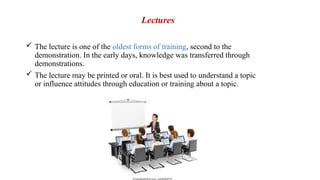
 The lecture is one of the oldest forms of training, second to the
demonstration. In the early days, knowledge was transferred through
demonstrations.
 The lecture may be printed or oral. It is best used to understand a topic
or influence attitudes through education or training about a topic.
Discussion method
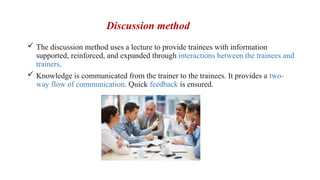
 The discussion method uses a lecture to provide trainees with information
supported, reinforced, and expanded through interactions between the trainees and
trainers.
 Knowledge is communicated from the trainer to the trainees. It provides a two-
way flow of communication. Quick feedback is ensured.
Demonstrations
 A demonstration is a visual display of how to do something or how something
works. To be effective, a demonstration should, at a minimum, be accompanied
by a lecture and preferably by a discussion.
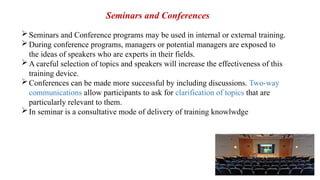
Seminars and Conference programs may be used in internal or external training.
During conference programs, managers or potential managers are exposed to
the ideas of speakers who are experts in their fields.
A careful selection of topics and speakers will increase the effectiveness of this
training device.
Conferences can be made more successful by including discussions. Two-way
communications allow participants to ask for clarification of topics that are
particularly relevant to them.
In seminar is a consultative mode of delivery of training knowlwdge
Seminars and Conferences
 Any training activity that explicitly places the trainee in an artificial
environment that closely mirrors actual working conditions can be
considered a simulation.
 Training games and simulations are designed to reproduce or simulate
processes, events, and circumstances in the trainee’s job.
 Trainees can experience these events in a controlled setting to develop their
skills or discover concepts that will improve their performance. Simulation
activities include case exercises,
 equipment simulators, experiential exercises, complex computer modeling,
role play, and vestibule training.
Business simulation
 Case studies attempt to simulate decision-making situations that trainees
might find on the job. The trainee presents a written history, key elements,
and a real or imaginary organization or subunit problem. A series of
questions usually appears at the end of the case.
Cases Presentation
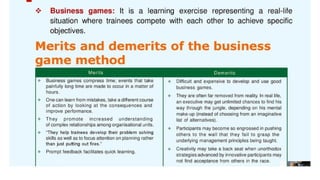
 Business Games are simulations that attempt to represent the way industry,
company, and a subunit of a company function. They are based on
relationships, rules, and principles derived from theory or research.
For example, suppose the focus is on the financial state of a company. In that
case, the game might end when the company reaches a specified profitability
level or when the company must declare bankruptcy.
Business games involve an element of competition, either against other
players or against the game itself.
Business Games
 Role-playing is a training technique in which trainees act out roles or parts in a
realistic management situation.
 The aim is to develop trainees’ skills in leadership and delegating. It is an enactment
or simulation of a scenario in which each participant is given a part to act out.
 In vestibule training, employees learn their jobs with the requirement they will be
using, but the training is conducted away from the workplace.
 While expensive, vestibule training allows employees to get a full feel for tasks
without real-world pressures. It minimized transferring learning to the job since
vestibule training uses the same equipment the trainee will use on the job.
Role playing
Vestibule Training
Many companies are implementing computer-based training as an alternative
to classroom training to accomplish the goal. Some of the reasons for this shift
are demonstrated in the following beliefs many companies hold about CBT:
 Reduces trainee learning time
 Reduces the cost of training
 Provides instructional consistency
 Affords privacy of learning
 Allows the trainee to master learning
 In a safe method for learning hazardous tasks
 Increases access to training.
Computer Based Training
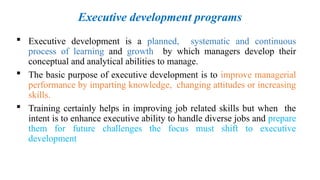
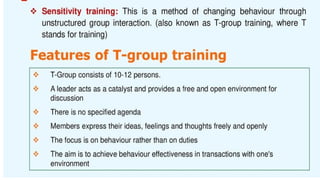
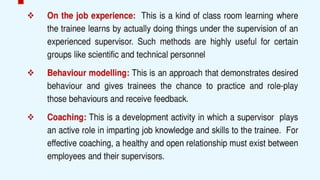
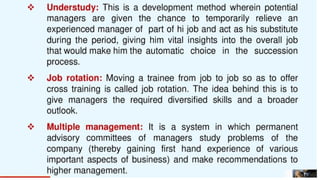
Executive development programs
 Executive development is a planned, systematic and continuous
process of learning and growth by which managers develop their
conceptual and analytical abilities to manage.
 The basic purpose of executive development is to improve managerial
performance by imparting knowledge, changing attitudes or increasing
skills.
 Training certainly helps in improving job related skills but when the
intent is to enhance executive ability to handle diverse jobs and prepare
them for future challenges the focus must shift to executive
development
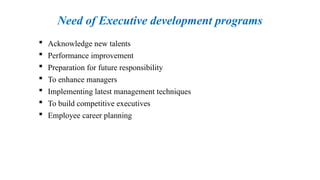
Need of Executive development programs
 Acknowledge new talents
 Performance improvement
 Preparation for future responsibility
 To enhance managers
 Implementing latest management techniques
 To build competitive executives
 Employee career planning
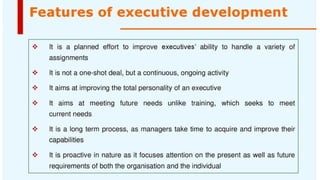
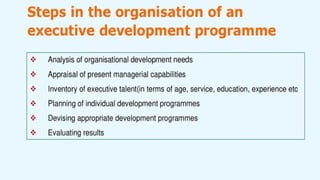
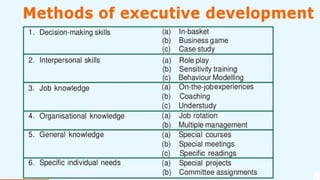
Techniques or methods of Executive development
programs
Outsourcing
 Outsourcing is a business practice in which a company hires a third party
to perform tasks, handle operations or provide services for the company.
 Outsourcing is defined as the contracting of one or more company’s
business processes to an outside service provider to help increase
shareholders value, by primarily reducing operating cost and focusing on
core business
Evolutions of outsourcing
1. First stage competencies
From early 1980’s- “traditional outsourcing” – non core activities widely used to reduce
costs
• Transaction cost approach, Comparative advantages
• Reduce costs and maximize profits
2. Second stage
1990’s to 2000- strategic outsourcing
• Assessing external Expertise
• Utilizing external resource, talents.
• Adopt new technologies
3. Outsourcing at 21st
century
1. Tech industry- AI
2. Health care industry – demand for quality health care
3. Finance industry- banking services, Financial services etc.
Reasons for outsourcing
• Reduced Administration burden
• Focus on strategic areas
• Reduce costs
• Focus on core functions
• Acquire new skills
• Acquire better management
• Assist a fast growth situation
• Avoid labour problem
• Focus on strategy
• Avoid major investment
Criteria for outsourcing
 Consistent Quality of Service
 Communication
 Experience
 Expertise
 Up-to-date technology
 Financial Stability
 Organisation size
 Company Culture
Types of Outsourcing
Mainly 4 types of outsourcing in India
1. Professional service outsourcing
2. IT outsourcing
3. Manufacturing outsourcing
4. Project based outsourcing
Types of Outsourcing
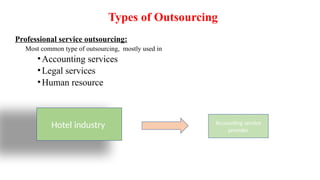
Professional service outsourcing:
Most common type of outsourcing, mostly used in
•Accounting services
•Legal services
•Human resource
Hotel industry Accounting service
provider
Types of Outsourcing
IT outsourcing
• Technology plays s huge role in the success of small business. However, with limited
resource and manpower a majority of SMEs can not produce the software they need
necessary IT infrastructure. Small business can outsource their software needs to
developers.
Examples: Google, Microsoft, IBM etc.
• Small business can engage with tech companies to provide them with access to cloud
infrastructure
Manufacturing outsourcing
 The cost of making your own products locally is significantly high. Paying
factory workers and cost is massive. However if you outsource your
manufacturing to different locations like china
Examples-
iPhone and iPad are both designed in California but the components are built and
assembled in different location across the world
Types of Outsourcing
Project based outsourcing
 It is a multi role type of outsourcing concerned with the completion of
a project contracting to third party professionals comes in handy,
especially if you only need their services for a specific time frame
 This is a common in large corporation and Government entities
Problems of Outsourcing
 Overdependence on suppliers
 Lack of suppliers flexibility
 Lack of communication with suppliers
 Lack of coordination
 Lack of management skills and control
 Quality of service issue
 Poor cost estimates
 Data security risk
 Time zone difference
 Launguage and cultural barriers etc.
Remedial Measures of Outsourcing
 Access to Latest/Niche Technology
 Access to Specialized vender
 Set clear project requirements
 Drive Flexibility & Speed
 Leverage Professional & Well-established Procedures
 Improve Risk management
 Focus on Core Business
 Lower Operational & Labour Costs
 Get Expertise knowledge
 Time savings
Future Outsourcing in India
 India is the biggest outsourcing hub in the world at the moment. In a recent survey,
India was ranked as the number one outsourcing destination for nearly 80% of the
outsourcing firms in the US and Europe
 Most of the Forbes 500 companies choose to outsource their web development to Indian
firms
 Primarily because of huge population and skilled and talented labour at lower salaries
are in India
 Introduction of “ Digital India initiatives”
 Innovation and advancement of technology are increasing in business and IT
outsourcing solutions- Technical Support, Software development, Website and mobile
app development
 Knowledge Process Outsourcing- financial and investment research, research and
development, analysis and interpretation
 Remote working
Hunan resource management, training development and outsourcing pptx

Hunan resource management, training development and outsourcing pptx

  • 1.
    Unit 3 Training, Developmentand Outsourcing Megharaja E N
  • 2.
    Training  Training isa process of learning a sequence of programmed behavior. It is the application of knowledge & gives people an awareness of rules & procedures to guide their behavior. It helps in bringing about positive change in the knowledge, skills & attitudes of employees.  Providing educational opportunities for all employees. These educational opportunities may include training programs, but they also include support for taking courses offered outside the company, self- study, and learning through job rotation.  The term training refers to the acquisition of knowledge, skills, and competencies as a result of the teaching of vocational or practical skills and knowledge that relate to specific useful competencies.
  • 3.
    “Training is theact of increasing the knowledge and skills of an employee for doing a particular job.” — Edwin B. Flippo According to Michael J Jucius, “The term training is used here to indicate only process by which the aptitudes, skills and abilities of employees to performs specifics jobs are increased According to Dales S Beach, “Training is an organised procedure by which people learn knowledge and/or skills for a definite purpose”. Definitions
  • 4.
    Need of Training New candidates who join an organization are given training. This training familiarizes them with the organizational mission, vision, rules and regulations and the working conditions.  The existing employees are trained to refresh and enhance their knowledge  If any updating and amendments take place in technology, training is given to cope up with those changes.  When promotion and career growth becomes important. Training is given so that employees are prepared to share the responsibilities of the higher level job.  Reduction in poor quality and defective products and services  Reduced waste  Reduction in absenteeism  Reduction in staff turnover  Reduction in customer complaints and customer turnover  Increased staff loyalty/feelings of obligation  A more flexible, empowered and adaptable workforce  Enhanced company image
  • 5.
    Importance of Training Trainingis crucial for organizational development and success. It is helpful to both employers and employees of an organization. An employee will become more efficient and productive if he is trained well. The benefits of training can be summed up as: 1. Improves Morale of Employees- Training helps the employee to get job security and job satisfaction. The more satisfied the employee is and the greater is his morale, the more he will contribute to organizational success and the lesser will be employee absenteeism and turnover. 2. Less Supervision- A well trained employee will be well acquainted with the job and will need less of supervision. Thus, there will be less wastage of time and efforts. 3. Fewer Accidents- Errors are likely to occur if the employees lack knowledge and skills required for doing a particular job. The more trained an employee is, the less are the chances of committing accidents in job and the more proficient the employee becomes. 4. Chances of Promotion- Employees acquire skills and efficiency during training. They become more eligible for promotion. They become an asset for the organization. 5. Increased Productivity- Training improves efficiency and productivity of employees. Well trained employees show both quantity and quality performance. There is less wastage of time, money and resources if employees are properly trained
  • 6.
    Objectives of Training Individual Objectives – help employees in achieving their personal goals, which in turn, enhances the individual contribution to an organization.  Organizational Objectives – assist the organization with its primary objective by bringing individual effectiveness.  Functional Objectives – maintain the department’s contribution at a level suitable to the organization’s needs.  Societal Objectives – ensure that an organization is ethically and socially responsible to the needs and challenges of the society
  • 8.
    Training Development Training meanslearning skills and knowledge for doing a particular job. It increases job skills Development means the growth of an employee in all aspects. It shapes attitudes The term “Training” is generally used to denote imparting specific skills among operative workers and employees. The term “Development” is associated with the overall growth of the executives. Training is concerned with maintaining and improving current job performance thus, it has a short term perspective. Executive development seeks to develop competencies and skills for future performance, thus it has long term perspectives Training is job centered in nature Development is career centered in nature The role of training or supervisor is very important in training All development is “ Self- development”. The executive has to be internally motivated for self development
  • 9.
    Methods of Training Onthe Job Training Off the Job Training Apprenticeship Programs Job instruction Training Planned Progression Job rotation Creation of Assistant- to position Temporary promotions Committees and junior boards Coaching Lectures Discussion method Demonstration Seminars and Conference Business simulation Cases presentation Business games Role playing Vestibule Training Computer based Training
  • 10.
    On-The-Job Training MethodsFor The Employees (Internal Training Methods) • These methods are generally applied in the workplace while employees are working. • This form helps develop the occupational skills necessary to manage an organization and fully understand its products and services and how they are designed and carried out.
  • 11.
    Apprenticeship programs • Apprenticeshipsare a work-based learning model where apprentices have supervised on-the-job training • People seeking to enter the skilled trades to become, for example, plumbers, electricians, and Ironworkers are often required to undergo apprenticeship training before they are accepted to journeyman status. • Typically this apprenticeship period is from two to five years. During this period, the trainee is paid less than a qualified worker. • These programs put the trainee under the guidance of a master worker.
  • 12.
    Job instruction training(JIT) JIT consists of four basic steps; 1. preparing the trainees by telling them about the job and overcoming their uncertainties; 2. presenting the instruction, clearly giving essential information; 3. having the trainees try out the job to demonstrate their understanding; and 4. On their own, placing the workers into the job with a designated resource person is ready to provide the required assistance.
  • 13.
    Planned Progression • Itis a technique that gives employees a clear idea of their path of development. They know where they stand and where they are going. • They must know the requirements for advancement and the means of achieving it.
  • 14.
    Job Rotation • Itinvolves periodically moving people from one job to another. • The purpose of job rotation is to broaden the knowledge of managers or potential managers. It also increases their experiences. Trainees learn about the different enterprise functions by rotating into different positions.
  • 15.
    Creation of Assistant-Position • Assistant-to positions are frequently created to broaden the viewpoints of trainees by allowing them to work closely with experienced managers who can give special attention to the development needs of trainees. • Managers can provide selected assignments to test the judgment of trainees. • This approach can be efficient when superiors are also qualified trainers who can guide and develop trainees until they are ready to assume full responsibilities as managers.
  • 16.
    Temporary promotions • Individualsare frequently appointed acting managers when, for example, the permanent manager is on vacation, is ill, is making an extended business trip, or even when a vacant position is available. • When the acting manager makes decisions and assumes full responsibility, the experience can be valuable. In this way, managerial people can be trained well
  • 17.
    Committees and juniorBoards • These give trainees opportunities to interact with experienced managers. • The trainees become acquainted with various issues that concern the whole organization. They learn about the relationships among different departments and the problems created by the interaction of these organizational units. • Trainees may submit reports and proposals to the committee or the board and demonstrate their analytical and conceptual abilities.
  • 18.
    Coaching  Effective coachingwill develop the strengths and potentials of subordinates and help them overcome their weakness.  Coaching requires time, but if done well, it will save time and money and will prevent costly mistakes by subordinates; thus, in the long run, it will benefit all – the superior, the subordinates, and the enterprise.
  • 19.
    Off-The-Job Training (ExternalTraining Methods)  Off-the-job training is sometimes necessary to get people away from the work environment to where the frustrations and buzz of work are eliminated.  Training is generally given through lectures, discussions, case studies, demonstrations etc.. This enables the trainee to study theoretical information or be exposed to new and innovative ideas.
  • 20.
    Lectures  The lectureis one of the oldest forms of training, second to the demonstration. In the early days, knowledge was transferred through demonstrations.  The lecture may be printed or oral. It is best used to understand a topic or influence attitudes through education or training about a topic.
  • 21.
    Discussion method  Thediscussion method uses a lecture to provide trainees with information supported, reinforced, and expanded through interactions between the trainees and trainers.  Knowledge is communicated from the trainer to the trainees. It provides a two- way flow of communication. Quick feedback is ensured.
  • 22.
    Demonstrations  A demonstrationis a visual display of how to do something or how something works. To be effective, a demonstration should, at a minimum, be accompanied by a lecture and preferably by a discussion.
  • 23.
    Seminars and Conferenceprograms may be used in internal or external training. During conference programs, managers or potential managers are exposed to the ideas of speakers who are experts in their fields. A careful selection of topics and speakers will increase the effectiveness of this training device. Conferences can be made more successful by including discussions. Two-way communications allow participants to ask for clarification of topics that are particularly relevant to them. In seminar is a consultative mode of delivery of training knowlwdge Seminars and Conferences
  • 24.
     Any trainingactivity that explicitly places the trainee in an artificial environment that closely mirrors actual working conditions can be considered a simulation.  Training games and simulations are designed to reproduce or simulate processes, events, and circumstances in the trainee’s job.  Trainees can experience these events in a controlled setting to develop their skills or discover concepts that will improve their performance. Simulation activities include case exercises,  equipment simulators, experiential exercises, complex computer modeling, role play, and vestibule training. Business simulation
  • 25.
     Case studiesattempt to simulate decision-making situations that trainees might find on the job. The trainee presents a written history, key elements, and a real or imaginary organization or subunit problem. A series of questions usually appears at the end of the case. Cases Presentation
  • 26.
     Business Gamesare simulations that attempt to represent the way industry, company, and a subunit of a company function. They are based on relationships, rules, and principles derived from theory or research. For example, suppose the focus is on the financial state of a company. In that case, the game might end when the company reaches a specified profitability level or when the company must declare bankruptcy. Business games involve an element of competition, either against other players or against the game itself. Business Games
  • 27.
     Role-playing isa training technique in which trainees act out roles or parts in a realistic management situation.  The aim is to develop trainees’ skills in leadership and delegating. It is an enactment or simulation of a scenario in which each participant is given a part to act out.  In vestibule training, employees learn their jobs with the requirement they will be using, but the training is conducted away from the workplace.  While expensive, vestibule training allows employees to get a full feel for tasks without real-world pressures. It minimized transferring learning to the job since vestibule training uses the same equipment the trainee will use on the job. Role playing Vestibule Training
  • 28.
    Many companies areimplementing computer-based training as an alternative to classroom training to accomplish the goal. Some of the reasons for this shift are demonstrated in the following beliefs many companies hold about CBT:  Reduces trainee learning time  Reduces the cost of training  Provides instructional consistency  Affords privacy of learning  Allows the trainee to master learning  In a safe method for learning hazardous tasks  Increases access to training. Computer Based Training
  • 29.
    Executive development programs Executive development is a planned, systematic and continuous process of learning and growth by which managers develop their conceptual and analytical abilities to manage.  The basic purpose of executive development is to improve managerial performance by imparting knowledge, changing attitudes or increasing skills.  Training certainly helps in improving job related skills but when the intent is to enhance executive ability to handle diverse jobs and prepare them for future challenges the focus must shift to executive development
  • 31.
    Need of Executivedevelopment programs  Acknowledge new talents  Performance improvement  Preparation for future responsibility  To enhance managers  Implementing latest management techniques  To build competitive executives  Employee career planning
  • 33.
    Techniques or methodsof Executive development programs
  • 45.
    Outsourcing  Outsourcing isa business practice in which a company hires a third party to perform tasks, handle operations or provide services for the company.  Outsourcing is defined as the contracting of one or more company’s business processes to an outside service provider to help increase shareholders value, by primarily reducing operating cost and focusing on core business
  • 46.
    Evolutions of outsourcing 1.First stage competencies From early 1980’s- “traditional outsourcing” – non core activities widely used to reduce costs • Transaction cost approach, Comparative advantages • Reduce costs and maximize profits 2. Second stage 1990’s to 2000- strategic outsourcing • Assessing external Expertise • Utilizing external resource, talents. • Adopt new technologies 3. Outsourcing at 21st century 1. Tech industry- AI 2. Health care industry – demand for quality health care 3. Finance industry- banking services, Financial services etc.
  • 47.
    Reasons for outsourcing •Reduced Administration burden • Focus on strategic areas • Reduce costs • Focus on core functions • Acquire new skills • Acquire better management • Assist a fast growth situation • Avoid labour problem • Focus on strategy • Avoid major investment
  • 48.
    Criteria for outsourcing Consistent Quality of Service  Communication  Experience  Expertise  Up-to-date technology  Financial Stability  Organisation size  Company Culture
  • 49.
    Types of Outsourcing Mainly4 types of outsourcing in India 1. Professional service outsourcing 2. IT outsourcing 3. Manufacturing outsourcing 4. Project based outsourcing
  • 50.
    Types of Outsourcing Professionalservice outsourcing: Most common type of outsourcing, mostly used in •Accounting services •Legal services •Human resource Hotel industry Accounting service provider
  • 51.
    Types of Outsourcing IToutsourcing • Technology plays s huge role in the success of small business. However, with limited resource and manpower a majority of SMEs can not produce the software they need necessary IT infrastructure. Small business can outsource their software needs to developers. Examples: Google, Microsoft, IBM etc. • Small business can engage with tech companies to provide them with access to cloud infrastructure
  • 52.
    Manufacturing outsourcing  Thecost of making your own products locally is significantly high. Paying factory workers and cost is massive. However if you outsource your manufacturing to different locations like china Examples- iPhone and iPad are both designed in California but the components are built and assembled in different location across the world Types of Outsourcing
  • 53.
    Types of Outsourcing Projectbased outsourcing  It is a multi role type of outsourcing concerned with the completion of a project contracting to third party professionals comes in handy, especially if you only need their services for a specific time frame  This is a common in large corporation and Government entities
  • 54.
    Problems of Outsourcing Overdependence on suppliers  Lack of suppliers flexibility  Lack of communication with suppliers  Lack of coordination  Lack of management skills and control  Quality of service issue  Poor cost estimates  Data security risk  Time zone difference  Launguage and cultural barriers etc.
  • 55.
    Remedial Measures ofOutsourcing  Access to Latest/Niche Technology  Access to Specialized vender  Set clear project requirements  Drive Flexibility & Speed  Leverage Professional & Well-established Procedures  Improve Risk management  Focus on Core Business  Lower Operational & Labour Costs  Get Expertise knowledge  Time savings
  • 56.
    Future Outsourcing inIndia  India is the biggest outsourcing hub in the world at the moment. In a recent survey, India was ranked as the number one outsourcing destination for nearly 80% of the outsourcing firms in the US and Europe  Most of the Forbes 500 companies choose to outsource their web development to Indian firms  Primarily because of huge population and skilled and talented labour at lower salaries are in India  Introduction of “ Digital India initiatives”  Innovation and advancement of technology are increasing in business and IT outsourcing solutions- Technical Support, Software development, Website and mobile app development  Knowledge Process Outsourcing- financial and investment research, research and development, analysis and interpretation  Remote working