• Training refersto a planned effort by a company to
facilitate employee’s learning of job related
competencies.
• The goal of training is for employees to master the
knowledge, skill, and behaviors emphasized in
training programs and to apply them to their day to
day activities.
• The principal objective of training and development
division is to make sure the availability of a skilled
and willing workforce to an organization.
3.
Objectives
• Individual Objectives– help employees in achieving their
personal goals, which in turn, enhances the individual
contribution to an organization.
• Organizational Objectives – assist the organization with its
primary objective by bringing individual effectiveness.
• Functional Objectives – maintain the department’s
contribution at a level suitable to the organization’s needs.
• Societal Objectives – ensure that an organization is
ethically and socially responsible to the needs and
challenges of the society.
4.
Need for EmployeeTraining
1.Onboarding Training – New employees learn about the
organization's mission, vision, rules, and work environment.
2.Skill Enhancement – Existing employees refresh and
upgrade their knowledge.
3.Technology & Process Updates – Training helps employees
adapt to new equipment, production techniques, or
software.
4.Career Growth & Promotions – Prepares employees for
higher responsibilities.
5.
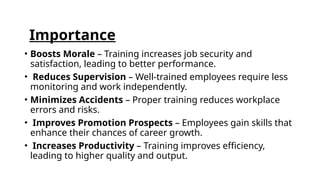
Importance
• Boosts Morale– Training increases job security and
satisfaction, leading to better performance.
• Reduces Supervision – Well-trained employees require less
monitoring and work independently.
• Minimizes Accidents – Proper training reduces workplace
errors and risks.
• Improves Promotion Prospects – Employees gain skills that
enhance their chances of career growth.
• Increases Productivity – Training improves efficiency,
leading to higher quality and output.
6.
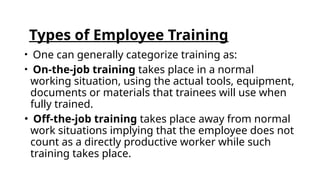
Types of EmployeeTraining
• One can generally categorize training as:
• On-the-job training takes place in a normal
working situation, using the actual tools, equipment,
documents or materials that trainees will use when
fully trained.
• Off-the-job training takes place away from normal
work situations implying that the employee does not
count as a directly productive worker while such
training takes place.
7.
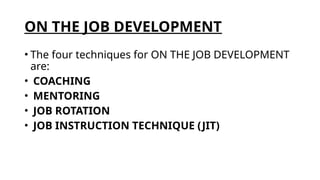
ON THE JOBDEVELOPMENT
• The four techniques for ON THE JOB DEVELOPMENT
are:
• COACHING
• MENTORING
• JOB ROTATION
• JOB INSTRUCTION TECHNIQUE (JIT)
8.
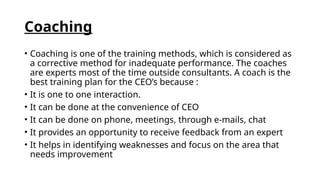
Coaching
• Coaching isone of the training methods, which is considered as
a corrective method for inadequate performance. The coaches
are experts most of the time outside consultants. A coach is the
best training plan for the CEO’s because :
• It is one to one interaction.
• It can be done at the convenience of CEO
• It can be done on phone, meetings, through e-mails, chat
• It provides an opportunity to receive feedback from an expert
• It helps in identifying weaknesses and focus on the area that
needs improvement
9.
Procedure of theCoaching
• Understand the participant’s job, the knowledge, skills, and
attitudes, and resources required to meet the desired
expectation
• Meet the participant and mutually agree on the objective
that has to be achieved
• Mutually arrive at a plan and schedule
• At the job, show the participant how to achieve the
objectives, observe the performance and then provide
feedback
10.
Mentoring
• A senioremployee provides guidance to a junior, helping them
understand organizational goals.
• It is a flexible, ongoing relationship, usually led by someone
within the company.
• Mentors enhance their management skills by working with
diverse backgrounds and personalities.
• Mentoring focus on attitude development
• Conducted for management-level employees
• Mentoring is done by someone inside the company
• It helps in identifying weaknesses and focus on the area that
needs improvement
11.
JOB ROTATION
• Jobrotation expands employees' knowledge, skills, and
abilities by exposing them to different roles and locations.
• Identification of Knowledge, skills, and attitudes required
• It determines the areas where improvement is required
• Assessment of the employees who have the potential and
caliber for filling the position
Job rotation is a training method where employees are moved
across different roles or departments to gain diverse skills
and experience. It helps employees understand various
functions, enhances their skills, and prepares them for higher
responsibilities.
12.
Job Instruction Technique(JIT)
• Plan: This step includes a written breakdown of the work to be done
because the trainer and the trainee must understand that documentation
is must and important for the familiarity of work.
• Present : Trainer provides the synopsis of the job while presenting the
participants the different aspects of the work. When the trainer finished,
the trainee demonstrates how to do the job and why is that done in that
specific manner.
• Trial In this step, the focus is on improving the method of instruction
because a trainer considers that any error if occurring may be a function
of training not the trainee.
• Follow-up: In this step, the trainer checks the trainee’s job frequently after
the training program is over to prevent bad work habits from developing.
13.
OFF THE JOBTRAINING
• The few popular methods are:
• Sensitivity Training
• Transactional Analysis
• Straight Lectures/ Lectures
• Simulation Exercises
14.
Sensitivity Training
• SensitivityTraining is about making people understand
about themselves and others reasonably, which is done by
developing in them social sensitivity and behavioral
flexibility.
• Social sensitivity in one word is empathy. It is ability of an
individual to sense what others feel and think from their
own point of view.
• Behavioral flexibility is ability to behave suitably in light of
understanding.
15.
Transactional Analysis
• providestrainees with a realistic and useful method for
analyzing and understanding the behavior of others. In
every social interaction, there is a motivation provided by
one person and a reaction to that motivation given by
another person. This motivation reaction relationship
between two persons is a transaction.
• Transactional analysis can be done by the ego states of an
individual. An ego state is a system of feelings accompanied
by a related set of behaviors.
16.
Lecture
• Lecture istelling someone about something. Lecture is given to
enhance the knowledge of listener or to give him the theoretical aspect
of a topic.
• Straight Lecture: Straight lecture method consists of presenting
information, which the trainee attempts to absorb. A good lecture
consists of introduction of the topic, purpose of the lecture, and
priorities and preferences of the order in which the topic will be
covered.
• Inability to identify and correct misunderstandings
• Less expensive
• Can be reached large number of people at once
• Knowledge building exercise
• Less effective because lectures require long periods of trainee inactivity
17.
Games and Simulations
•are structured and sometimes unstructured, that are usually
played for enjoyment sometimes are used for training
purposes as an educational tool. Training games and
simulations are different from work as they are designed to
reproduce or simulate events, circumstances, processes that
take place in trainees’ job.
• A Training Game is defined as spirited activity or exercise in
which trainees compete with each other according to the
defined set of rules.
• Training games and simulations are now seen as an
effective tool for training because its key components are:
Challenge, Rules, Interactivity,