EXPERIENTIAL
LEARNING
CYCLE
YD6201
Dr Fiona Beals & Arden Perrot
LECTURE OUTCOMES
 Understand a key component of learning
 How we run the BYD
 What happens when we learn through doing
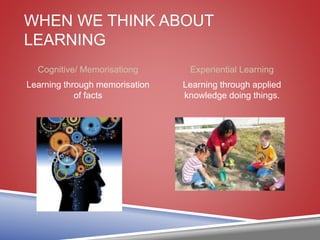
WHEN WE THINK ABOUT
LEARNING
Cognitive/ Memorisationg Experiential Learning
Learning through memorisation
of facts
Learning through applied
knowledge doing things.
Tell me and I will forget,
Show me and I will remember,
Involve me and I will understand
- Confucius 450 BC
WHAT IS EXPERIENTIAL LEARNING
 Engage in some activity, Reflect on that activity (critically), Derive from
that some useful insight and analysis, and incorporate the result
through change in understanding and/or behavior
 Learner is a participant
 Actively engaged (question asking, curious, problem solving,
responsible, creative and constructing.
 Engaged intellectually, physically, emotionally, socially
 Experience success, failure, adventure, risk taking and uncertainly no
outcomes are predictable.
 Education and learning = educator facilitating
 Educator must encourage spontaneous learning
 The design of the experience include possible learning outcomes from
natural consequences both success and failure/mistakes
WHAT IS EXPERIENTIAL LEARNING
 See theory into practice
 Learning is personal and foundation to build upon future learning
 Increased awareness of self (Belief system, potential)
 Relationships are also developed and nurtured – learns to self,
learner to other and learner to the world at large
 Educators aware of themselves and impacts they have on learners
– biases, fears, judgments, stereotypes and beliefs.
 Educators use a multi dimensional approach to the study of real life
problems
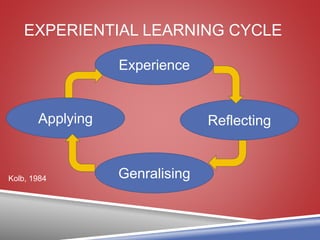
EXPERIENTIAL LEARNING CYCLE
Experience
ReflectingApplying
GenralisingKolb, 1984

Experiential learning cycle

  • 1.
  • 2.
    LECTURE OUTCOMES  Understanda key component of learning  How we run the BYD  What happens when we learn through doing
  • 3.
    WHEN WE THINKABOUT LEARNING Cognitive/ Memorisationg Experiential Learning Learning through memorisation of facts Learning through applied knowledge doing things.
  • 4.
    Tell me andI will forget, Show me and I will remember, Involve me and I will understand - Confucius 450 BC
  • 5.
    WHAT IS EXPERIENTIALLEARNING  Engage in some activity, Reflect on that activity (critically), Derive from that some useful insight and analysis, and incorporate the result through change in understanding and/or behavior  Learner is a participant  Actively engaged (question asking, curious, problem solving, responsible, creative and constructing.  Engaged intellectually, physically, emotionally, socially  Experience success, failure, adventure, risk taking and uncertainly no outcomes are predictable.  Education and learning = educator facilitating  Educator must encourage spontaneous learning  The design of the experience include possible learning outcomes from natural consequences both success and failure/mistakes
  • 6.
    WHAT IS EXPERIENTIALLEARNING  See theory into practice  Learning is personal and foundation to build upon future learning  Increased awareness of self (Belief system, potential)  Relationships are also developed and nurtured – learns to self, learner to other and learner to the world at large  Educators aware of themselves and impacts they have on learners – biases, fears, judgments, stereotypes and beliefs.  Educators use a multi dimensional approach to the study of real life problems
  • 7.

Editor's Notes

  • #4 When we think about learning what do we know Throw back to YD 5101 (piaget, vigotsky) what were those theorists interested in. How we make sense of the world how we learn. Learning is a relationship between what we already know (schemas + we are always building on previous knowledge bases and what we don’t know) – and if you can some how link what you already know to what you don’t you can learn anything – when you can’t (Like when someone speaks at you in a different language your brain will scan all these files in here “ but if it can’t process it you can’t learn it – slowly over time you have sounds – but learning language by book and full emersion – you need both. Riding a bike – you can read about it or you can actually do it what do you think will work best?? Also you cannot really separate both either – as when you are learning through doing you are memorising things in a different way
  • #6 EL – starts with the philosophy that all learning starts with the person and their relationship to the topic. From the Maxim – nothing is more relevant to us than ourselves EL – Philosophical orientation towards teaching and learning wichin encourages the collaboration of concrete educational activities and abstract lessons to maximise learning (Sakofs, 1986) gives power and ownership to the learner – they accept responsibility for their own behavior and learning not someone else
  • #7 These are just some of the benefits of using experiential based learning,
  • #8 This is why we really hammer home reflection – on the BYD because the experience is not enough – to get the maximum out our activities we need the next steps of the cycle. Reflective journal example (critically reflect) How can we apply what we are learning from theory into practice. This cycle keeps going this why after many years on certain task people become experts at certain tasks after a while like driving or riding a bilelearning compounding on their previous experience. Think about a time in your life where you can see this happening.