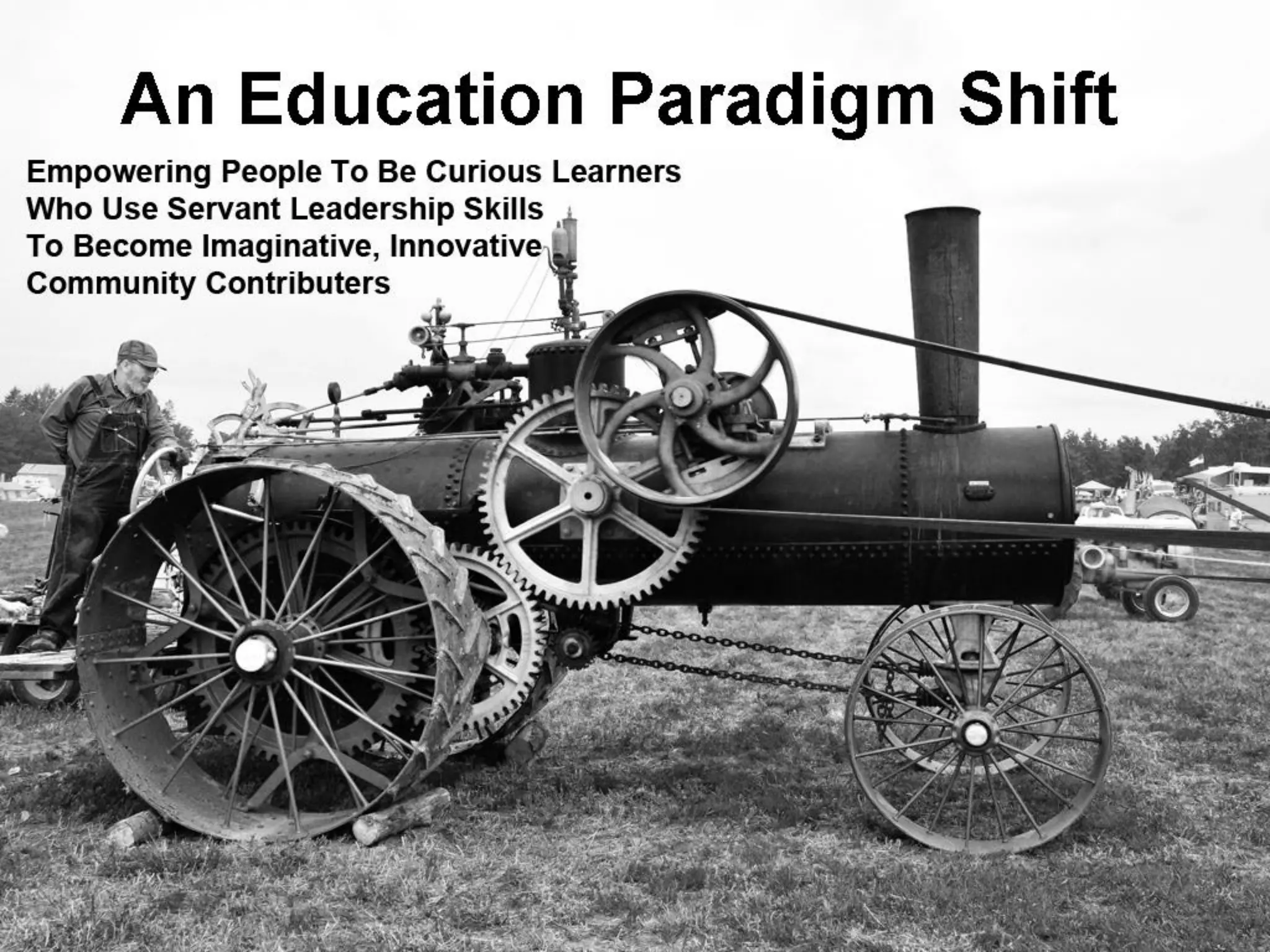
An Education Paradigm Shift
      Why do we need a paradigm shift?
• Current learning environments are based on a
  “one size fits all” model.
• The curriculum is disconnected
• The educational system is “Educentric” not
  learner centered
• The organizational structure prevents innovation
  from educators, administrators, and learners
An Educationa Paradigm Shift
      Why do we need paradigm shift?

• The system’s performance is based on false
  metrics – Standardized tests do not indicate
  the ability of learners to apply what has been
  learned to new and unique situations
• Real learning/understanding is rare
• The system doesn’t take advantage of what
  has been learned about the brain and how
  learning occurs
An Why do we need a paradigm shift?

• Many schools are too large for the proper
  educational development of learners
• State and National standards have caused
  standardization
• The system is not taking advantage of the
  current technology available in the world
• The system is not producing citizens that our
  country needs
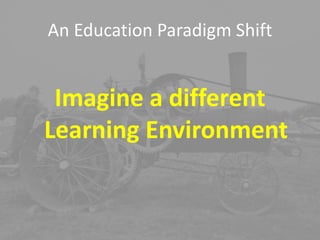
An Education Paradigm Shift


 Imagine a different
Learning Environment
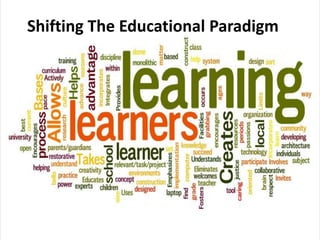
Shifting The Educational Paradigm
Shifting The Educational Paradigm To One That:

   Understands how learning occurs in individuals
   Helps learners find their way of learning
   Helps learners understand themselves
   Creates a learning community
   Creates learning environments based on learner passions
   Does not grade and sort learners
   Creates a culture of caring and respect
   Uses technology as a learning tool
   Integrates subject matter
   Has no bells or set class periods
   Failure is part of learning
Shifting The Educational Paradigm To One That:

  Takes advantage of local resources
  Allows learners to advance at their own pace
  Fosters and encourages creativity
  Allows local experts to help in the learning process
  Encourages and welcomes collaborative learning
  Involves the learner in developing their own curriculum
  Bases learning on current brain research and best practice
  Invites learners of all ages to participate
  Allows learners to construct their own knowledge
  Helps learners become servant leaders
Shifting The Educational Paradigm To One That:

Design, implementation, and building are part of learning
Bases school discipline on a restorative justice system
Integrates university teacher training
Provides technology for each learner
Emphasizes learning how to learn
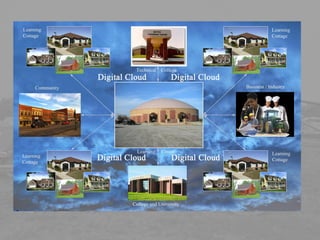
Facilities are designed with open architecture (monolithic dome concept)
Is relevant/task/project oriented
Eliminates “power grabbing” within the organization
Educates parents/guardians on helping their children succeed
Contributes to the community it resides in
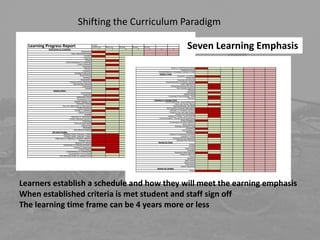
Shifting the Curriculum Paradigm

                                            Seven Learning Emphasis


Learners establish a schedule and how they will meet the earning emphasis
When established criteria is met student and staff sign off
The learning time frame can be 4 years more or less
Shifting the Curriculum Paradigm

Math Science & Technology

· Measurement
· Data Collection/Processing
· Geometry
· Chemistry
· Physics
· Home Maintenance & Technology
· Tools & Machines
· Electronics
· Robotics
· Hydraulics
· Building/Construction
· Wood Working
· Mechanics
· Transportation
· Communications Technology
· Man-Machine Interfaces
· Architecture
· Systems
Shifting the Curriculum Paradigm
 Human Culture

 · Social Studies
 · Servant Leadership
 · Mathematics (Pure)
 · Government/Civics
 · English Language Arts
 · Historical Thinking
 · Fine Arts Appreciation & Participation
 · Conflict Resolution
 · Serving A Community
 · Cultural Diversity
 · Empathy
 · Teamwork & Collaboration
 · Foreign Language/Linguistics
 · Psychology
 · Law/Law Enforcement
 · Anthropology
 · Philosophy
 · Innovations in thinking
Shifting the Curriculum Paradigm
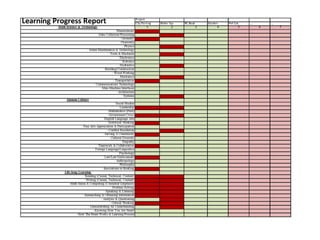
Life-long Learning

· Reading (Casual, Technical, Content)
· Writing (Casual, Technical, Content)
· Math Sense & Computing (Consumer Emphasis)
· Problem Solving
· Speaking & Listening
· Researching & Obtaining Information
· Analysis & Questioning
· Critical Thinking
· Demonstrating An Understanding
· Knowing How You Are Smart
· How The Brain Works & Learning Process
· Initiative & Self Directed Learning
· Intellectual Honesty
· Personal Reflection - Developing A Mission & Goals
Shifting the Curriculum Paradigm
 Making a Living

 · Economics - Local/World
 · World Trade
 · Becoming Self Sufficient
 · Being Responsible & Productive (Quality)
 · Career Opportunities
 · Entrepreneurs/Business Incubation
 · Basic Business Operations
 · Marketing
 · Negotiating
 · Apprenticeships
 · Accounting & Record Keeping - Taxes
 · Futuristics
Shifting the Curriculum Paradigm
 Maturing in a Changing World

 · Use Of Leisure Time - Sports/Hobbies/Play
 · Ethics And Decision Making
 · Physical Education And Health
 · Self Discipline & Personal Responsibility
 · Optimism Vs. Pessimism And Stress
 · Caring For Own And Others Property
 · Honesty And Trust Building
 · Adapting To Change - Social/Technical
 · Child Development - Personal Growth Rate/Patterns
 · Money Management
 · Housekeeping And Meal Preparation
 · Drivers Education
 · Parenting And Family Living
 · Management
 · Time Management
 · Multitasking
 · Influence Of Advertising And Media
 · Insurance Coverage
 · Self Image/Personal Appearance
 · Knowing Your Own Story
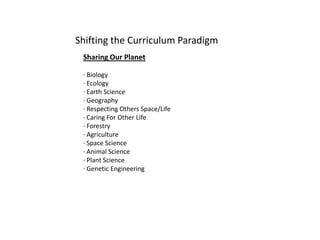
Shifting the Curriculum Paradigm
 Sharing Our Planet

 · Biology
 · Ecology
 · Earth Science
 · Geography
 · Respecting Others Space/Life
 · Caring For Other Life
 · Forestry
 · Agriculture
 · Space Science
 · Animal Science
 · Plant Science
 · Genetic Engineering
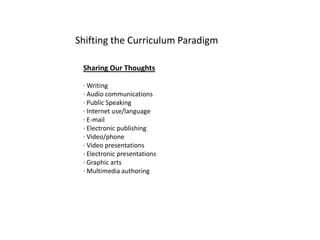
Shifting the Curriculum Paradigm

 Sharing Our Thoughts

 · Writing
 · Audio communications
 · Public Speaking
 · Internet use/language
 · E-mail
 · Electronic publishing
 · Video/phone
 · Video presentations
 · Electronic presentations
 · Graphic arts
 · Multimedia authoring
Should We Pack Our
Bags and Go Home???
An Educational Paradigm Shift
     The Delivery System
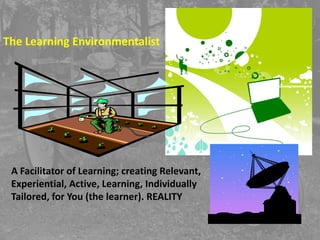
The Learning Environmentalist


 A Facilitator of Learning; creating Relevant,
 Experiential, Active, Learning, Individually
 Tailored, for You (the learner). REALITY
Assumptions regarding the Educational Paradigm Shift

Servant Leaders who are Learning Environmentalists
are needed by all organizations/businesses
A new learning environment is necessary to satisfy
the needs of all students in all intelligences.
There is a need for people who have the skills/knowledge
to lead and create individual learning plans and
environments for students and workers.
Assumptions regarding the Educational Paradigm Shift

People, schools, institutions will pay a premium for
people with learning environmentalist skills.
A way needs to be found to use technology to get
learners away from technology – away from the screen
and into the real world – using hands/mind and
creativity
Sorting and grading of students will continue in the
name of data collection and school performance ratings.
Assumptions regarding the Educational Paradigm Shift
People periodically need rejuvenation in their careers and
personal lives – Learning Environmentalists are
continuously learning and interacting with their peers and
students.
Personal development is as important, or even more
important, than professional development.
Businesses can profit from having Learning
Environmentalists on staff to help create personal and
professional growth within the business culture.
Assumptions regarding the Educational Paradigm Shift

Many parents will pay a premium for their children to
experience learner centered learning.

Many districts will pay a premium for people who can
create integrated learning environments for all
students using digital and face-to-face delivery
methods.
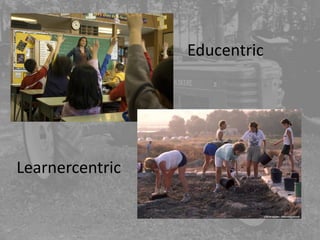
Educentric


Learnercentric
Administrators
            Support Staff
            Teachers/Instructors
            Students
            Political Officials
            Citizens
            Parents
            Business People
Give the group the charter of creating a new design
      Give the group the power to implement
Create A Learning Community
Learner centered professional development
        Understanding learners/workers
        Researching best practices
        Project based learning
        Integrated learning techniques
        Collaborative learning techniques/research methods
        Rejuvenation
        Strands of learning
             Community Building
             Strengths
             Technology
             Projects
             Best Practices
A Learning Community Framework

Student centered learning environment
Collaborative, personal, professional, goal-centered,
Everyone ensuring the success of all
Energizing experience for all members
Networking in advisory, work-a-like, and
   interest-a-like groups
Facilitation Process

No constant lecturing
Responsive to the needs of the community
We look at local and global educational and social issues
Restorative Justice
Visitation of local business and industry
Visitation of local Technical College
Facilitation Process
Academic Growth

Readings chosen by learners
Research techniques applied to classroom projects/applications
Community Building – techniques for classroom leadership
Technology Applications – Apply technology in professional and personal life
Multiple choices in demonstration of learning from projects/research
Project Oriented – Something you can use in the classroom – has life after program
Classroom Centered – if what is learned does not apply directly to the classroom we
don’t do it.

Personal and Professional growth

Personal and professional visioning
Professional growth planning
Leadership opportunities within community environment
Learning Environmentalists Use Technology
             Digital Still and video photography
                Audio recording techniques
              Screen video capture and editing
                     Digital photo editing
                     Digital video editing
        Web page design using interactive techniques
                    Graphic design basics
“Smart” technology such as smart boards, smart phones, tablets


Learning on demand to use technology
Software applications for Learning Environmentalists

             Adobe Photo Shop Elements
             Adobe Premier video editor
               Web page editor/creator
                  Camtasia Studio 7
                       Moodle
                     Spread sheets
              Simple data base – Works
              Advanced word processing
           Planners, emailing, and e-buying

         Much free software is available
Through the Process Learning Environmentalists:
     Understand the learners
     Understand the learning process
     Understand themselves
     Become servant leaders

  Create a portrait of a graduate
  Create appropriate learner centered
  learning environments
Learning Environmentalist preparation and getting the
first semester ready is done during the summer months
Should we pack up
and go home???
An Educational Paradigm Shift


      A new choice for future collegiate learners
First sessions for New Paradigm Learners

New Paradigm Learners (NPL) are taken through a process designed by
the staff and is similar to that experienced during the summer preparation

       First steps for NPL are:

       Establish community and values

       Learn about how learning occurs, MI, brain function, etc.

       Learn about self and best way to learn

       Begin laying out an overall learning plan that fulfills the
       portrait of a graduate
First sessions for New Paradigm Learners
            Help NPL’s become:
              Self controlled
                Self reliant
              Self motivated
               Self assessed
               Self learners
               Self managed
             Knowledge sharers
NPL’s are continuously:

Assessing their work
Working on their projects
Giving demonstrations of learning
Supporting each other in the community
In touch with their facilitators
Meeting their own schedules and making adjustments
Searching for and participating in learning resources
Building their electronic portfolio
Common threads through out NPL participation
Community: building community, recognizing stages of
community, getting in and out of different stages, issues
in building community

Strengths based learning: understanding the strengths
based philosophy, taking the strengths assessment, applying
strengths to individual development, looking at strengths
based leadership

Constructing personal knowledge: by curiously questioning, systematically
investigating, sensibly understanding, creatively
applying, accurately assessing, and simply sharing

Using technology as a problem solving tool: finding resources,
Internet usage, social networking, productivity tools, file structure, applying
technologies to leadership/local environments
Common threads through out NPL participation

  Leadership techniques: facilitation, having fun, creating a
  collaborative environment, conflict resolution, getting things
  done in a timely manner, teams and teamwork, coaching,
  flexibility, networking environments, legal issues/constraints
  /requirements, universal human values
  Personal and professional growth: empathy, personal and
  Professional PDP, attitudes, appreciating others, working with peers
  Futuristic thinking: using demographics, finding futuristic
  information, people trends, transportation trends, communication
  trends, education trends, standard of living trends, applying
  futuristic thinking to current situations
Common threads through out NPL participation
 Understanding learning and the learning process: what is
 learning, brain based learning, multiple intelligence, emotional
 intelligence, intellectual honesty, creating learning environments,
 facilitating learning

 Understanding learners: personality types, how to change minds,
 poverty to wealth, assessing learning styles, individualizing learning
 environments

 Project management: budgeting, time-lines, problem definition,
 researching, data collection, implementation, assessment, sharing
 results
What would the portrait of a graduate of this system look like?


May be savings to college because:
No large classroom demands
May take less dedicated teachers
Use of technology may reduce travelling
Subscribing to e-learning sites might be cheaper than hiring professors
Many universities offering free courses
Large number of adults over age of 26 need to return to education

Pass on savings to NPL’s
Less costly education may draw in more learners
Less costly education may draw in non-traditional students

Paradigm change

  • 3.
    An Education ParadigmShift Why do we need a paradigm shift? • Current learning environments are based on a “one size fits all” model. • The curriculum is disconnected • The educational system is “Educentric” not learner centered • The organizational structure prevents innovation from educators, administrators, and learners
  • 4.
    An Educationa ParadigmShift Why do we need paradigm shift? • The system’s performance is based on false metrics – Standardized tests do not indicate the ability of learners to apply what has been learned to new and unique situations • Real learning/understanding is rare • The system doesn’t take advantage of what has been learned about the brain and how learning occurs
  • 5.
    An Why dowe need a paradigm shift? • Many schools are too large for the proper educational development of learners • State and National standards have caused standardization • The system is not taking advantage of the current technology available in the world • The system is not producing citizens that our country needs
  • 6.
    An Education ParadigmShift Imagine a different Learning Environment
  • 7.
  • 9.
    Shifting The EducationalParadigm To One That: Understands how learning occurs in individuals Helps learners find their way of learning Helps learners understand themselves Creates a learning community Creates learning environments based on learner passions Does not grade and sort learners Creates a culture of caring and respect Uses technology as a learning tool Integrates subject matter Has no bells or set class periods Failure is part of learning
  • 10.
    Shifting The EducationalParadigm To One That: Takes advantage of local resources Allows learners to advance at their own pace Fosters and encourages creativity Allows local experts to help in the learning process Encourages and welcomes collaborative learning Involves the learner in developing their own curriculum Bases learning on current brain research and best practice Invites learners of all ages to participate Allows learners to construct their own knowledge Helps learners become servant leaders
  • 11.
    Shifting The EducationalParadigm To One That: Design, implementation, and building are part of learning Bases school discipline on a restorative justice system Integrates university teacher training Provides technology for each learner Emphasizes learning how to learn Facilities are designed with open architecture (monolithic dome concept) Is relevant/task/project oriented Eliminates “power grabbing” within the organization Educates parents/guardians on helping their children succeed Contributes to the community it resides in
  • 12.
    Shifting the CurriculumParadigm Seven Learning Emphasis Learners establish a schedule and how they will meet the earning emphasis When established criteria is met student and staff sign off The learning time frame can be 4 years more or less
  • 14.
    Shifting the CurriculumParadigm Math Science & Technology · Measurement · Data Collection/Processing · Geometry · Chemistry · Physics · Home Maintenance & Technology · Tools & Machines · Electronics · Robotics · Hydraulics · Building/Construction · Wood Working · Mechanics · Transportation · Communications Technology · Man-Machine Interfaces · Architecture · Systems
  • 15.
    Shifting the CurriculumParadigm Human Culture · Social Studies · Servant Leadership · Mathematics (Pure) · Government/Civics · English Language Arts · Historical Thinking · Fine Arts Appreciation & Participation · Conflict Resolution · Serving A Community · Cultural Diversity · Empathy · Teamwork & Collaboration · Foreign Language/Linguistics · Psychology · Law/Law Enforcement · Anthropology · Philosophy · Innovations in thinking
  • 16.
    Shifting the CurriculumParadigm Life-long Learning · Reading (Casual, Technical, Content) · Writing (Casual, Technical, Content) · Math Sense & Computing (Consumer Emphasis) · Problem Solving · Speaking & Listening · Researching & Obtaining Information · Analysis & Questioning · Critical Thinking · Demonstrating An Understanding · Knowing How You Are Smart · How The Brain Works & Learning Process · Initiative & Self Directed Learning · Intellectual Honesty · Personal Reflection - Developing A Mission & Goals
  • 17.
    Shifting the CurriculumParadigm Making a Living · Economics - Local/World · World Trade · Becoming Self Sufficient · Being Responsible & Productive (Quality) · Career Opportunities · Entrepreneurs/Business Incubation · Basic Business Operations · Marketing · Negotiating · Apprenticeships · Accounting & Record Keeping - Taxes · Futuristics
  • 18.
    Shifting the CurriculumParadigm Maturing in a Changing World · Use Of Leisure Time - Sports/Hobbies/Play · Ethics And Decision Making · Physical Education And Health · Self Discipline & Personal Responsibility · Optimism Vs. Pessimism And Stress · Caring For Own And Others Property · Honesty And Trust Building · Adapting To Change - Social/Technical · Child Development - Personal Growth Rate/Patterns · Money Management · Housekeeping And Meal Preparation · Drivers Education · Parenting And Family Living · Management · Time Management · Multitasking · Influence Of Advertising And Media · Insurance Coverage · Self Image/Personal Appearance · Knowing Your Own Story
  • 19.
    Shifting the CurriculumParadigm Sharing Our Planet · Biology · Ecology · Earth Science · Geography · Respecting Others Space/Life · Caring For Other Life · Forestry · Agriculture · Space Science · Animal Science · Plant Science · Genetic Engineering
  • 20.
    Shifting the CurriculumParadigm Sharing Our Thoughts · Writing · Audio communications · Public Speaking · Internet use/language · E-mail · Electronic publishing · Video/phone · Video presentations · Electronic presentations · Graphic arts · Multimedia authoring
  • 24.
    Should We PackOur Bags and Go Home???
  • 25.
    An Educational ParadigmShift The Delivery System
  • 26.
    The Learning Environmentalist A Facilitator of Learning; creating Relevant, Experiential, Active, Learning, Individually Tailored, for You (the learner). REALITY
  • 28.
    Assumptions regarding theEducational Paradigm Shift Servant Leaders who are Learning Environmentalists are needed by all organizations/businesses A new learning environment is necessary to satisfy the needs of all students in all intelligences. There is a need for people who have the skills/knowledge to lead and create individual learning plans and environments for students and workers.
  • 29.
    Assumptions regarding theEducational Paradigm Shift People, schools, institutions will pay a premium for people with learning environmentalist skills. A way needs to be found to use technology to get learners away from technology – away from the screen and into the real world – using hands/mind and creativity Sorting and grading of students will continue in the name of data collection and school performance ratings.
  • 30.
    Assumptions regarding theEducational Paradigm Shift People periodically need rejuvenation in their careers and personal lives – Learning Environmentalists are continuously learning and interacting with their peers and students. Personal development is as important, or even more important, than professional development. Businesses can profit from having Learning Environmentalists on staff to help create personal and professional growth within the business culture.
  • 31.
    Assumptions regarding theEducational Paradigm Shift Many parents will pay a premium for their children to experience learner centered learning. Many districts will pay a premium for people who can create integrated learning environments for all students using digital and face-to-face delivery methods.
  • 32.
  • 33.
    Administrators Support Staff Teachers/Instructors Students Political Officials Citizens Parents Business People Give the group the charter of creating a new design Give the group the power to implement
  • 34.
    Create A LearningCommunity Learner centered professional development Understanding learners/workers Researching best practices Project based learning Integrated learning techniques Collaborative learning techniques/research methods Rejuvenation Strands of learning Community Building Strengths Technology Projects Best Practices
  • 35.
    A Learning CommunityFramework Student centered learning environment Collaborative, personal, professional, goal-centered, Everyone ensuring the success of all Energizing experience for all members Networking in advisory, work-a-like, and interest-a-like groups
  • 36.
    Facilitation Process No constantlecturing Responsive to the needs of the community We look at local and global educational and social issues Restorative Justice Visitation of local business and industry Visitation of local Technical College
  • 37.
    Facilitation Process Academic Growth Readingschosen by learners Research techniques applied to classroom projects/applications Community Building – techniques for classroom leadership Technology Applications – Apply technology in professional and personal life Multiple choices in demonstration of learning from projects/research Project Oriented – Something you can use in the classroom – has life after program Classroom Centered – if what is learned does not apply directly to the classroom we don’t do it. Personal and Professional growth Personal and professional visioning Professional growth planning Leadership opportunities within community environment
  • 38.
    Learning Environmentalists UseTechnology Digital Still and video photography Audio recording techniques Screen video capture and editing Digital photo editing Digital video editing Web page design using interactive techniques Graphic design basics “Smart” technology such as smart boards, smart phones, tablets Learning on demand to use technology
  • 39.
    Software applications forLearning Environmentalists Adobe Photo Shop Elements Adobe Premier video editor Web page editor/creator Camtasia Studio 7 Moodle Spread sheets Simple data base – Works Advanced word processing Planners, emailing, and e-buying Much free software is available
  • 40.
    Through the ProcessLearning Environmentalists: Understand the learners Understand the learning process Understand themselves Become servant leaders Create a portrait of a graduate Create appropriate learner centered learning environments Learning Environmentalist preparation and getting the first semester ready is done during the summer months
  • 41.
    Should we packup and go home???
  • 42.
    An Educational ParadigmShift A new choice for future collegiate learners
  • 43.
    First sessions forNew Paradigm Learners New Paradigm Learners (NPL) are taken through a process designed by the staff and is similar to that experienced during the summer preparation First steps for NPL are: Establish community and values Learn about how learning occurs, MI, brain function, etc. Learn about self and best way to learn Begin laying out an overall learning plan that fulfills the portrait of a graduate
  • 45.
    First sessions forNew Paradigm Learners Help NPL’s become: Self controlled Self reliant Self motivated Self assessed Self learners Self managed Knowledge sharers
  • 46.
    NPL’s are continuously: Assessingtheir work Working on their projects Giving demonstrations of learning Supporting each other in the community In touch with their facilitators Meeting their own schedules and making adjustments Searching for and participating in learning resources Building their electronic portfolio
  • 47.
    Common threads throughout NPL participation Community: building community, recognizing stages of community, getting in and out of different stages, issues in building community Strengths based learning: understanding the strengths based philosophy, taking the strengths assessment, applying strengths to individual development, looking at strengths based leadership Constructing personal knowledge: by curiously questioning, systematically investigating, sensibly understanding, creatively applying, accurately assessing, and simply sharing Using technology as a problem solving tool: finding resources, Internet usage, social networking, productivity tools, file structure, applying technologies to leadership/local environments
  • 48.
    Common threads throughout NPL participation Leadership techniques: facilitation, having fun, creating a collaborative environment, conflict resolution, getting things done in a timely manner, teams and teamwork, coaching, flexibility, networking environments, legal issues/constraints /requirements, universal human values Personal and professional growth: empathy, personal and Professional PDP, attitudes, appreciating others, working with peers Futuristic thinking: using demographics, finding futuristic information, people trends, transportation trends, communication trends, education trends, standard of living trends, applying futuristic thinking to current situations
  • 49.
    Common threads throughout NPL participation Understanding learning and the learning process: what is learning, brain based learning, multiple intelligence, emotional intelligence, intellectual honesty, creating learning environments, facilitating learning Understanding learners: personality types, how to change minds, poverty to wealth, assessing learning styles, individualizing learning environments Project management: budgeting, time-lines, problem definition, researching, data collection, implementation, assessment, sharing results
  • 50.
    What would theportrait of a graduate of this system look like? May be savings to college because: No large classroom demands May take less dedicated teachers Use of technology may reduce travelling Subscribing to e-learning sites might be cheaper than hiring professors Many universities offering free courses Large number of adults over age of 26 need to return to education Pass on savings to NPL’s Less costly education may draw in more learners Less costly education may draw in non-traditional students