

POTENTIAL  APPRAISAL                       &    CAREER  DEVELOPMENT  Presented by,                  Manju.N.Premanand                 III sem  MBA
POTENTIAL  APPRAISAL
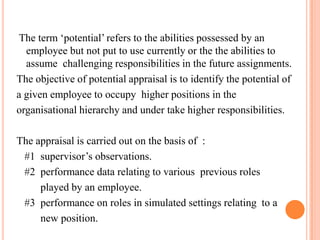
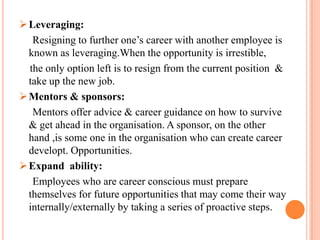
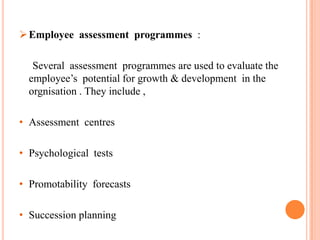
 The term ‘potential’ refers to the abilities possessed by an employee but not put to use currently or the the abilities to assume  challenging responsibilities in the future assignments.The objective of potential appraisal is to identify the potential of a given employee to occupy  higher positions in the organisational hierarchy and under take higher responsibilities.The appraisal is carried out on the basis of  :   #1  supervisor’s observations.   #2  performance data relating to various  previous roles         played by an employee.   #3  performance on roles in simulated settings relating  to a            new position.
NEEDS OF POTENTAL APPRAISALTo  inform the  employees about  their future prospects;
To help the organisation chalk  out  a suitable succession plan;
To update training  efforts from time to time;
To advice  employees  about  what  they must to do improve their  career  prospects. STEPS TO BE  FOLLOWED  IN  A  GOOD                  POTENTIAL   APPRAISAL  SYSTEMRole Descriptions:      Organisational roles & functions must be defined clearly.     Job descriptions must be prepared for each job.Qualities needed to perform the  roles:     Based on job descriptions ,the roles to be played by         people  must be prepared.
Rating  mechanisms:       Besides listing the functions & qualities, the potential appraisal system  must list mechanisms of judging the qualities of  employees such as:   Rating  by  others
    Tests
    Games
    RecordsOrganising the system:After  covering the above preliminaries, the  HR manager must set up a system that will allow the introduction of  the scheme smoothly  incorporating answers to some complex Qns such as:How much weightage to accord to merit in place of  seniority promotions?
How much  weightage to accord to each of the performance dimensions?
What are the mechanisms of assessing the individual on different indicators of his potential,& with what  degree of reliability?Feedback:    The system must provide an opportunity for every employee to know the results of his assessment.He should be helped to understand  the qualities actually required for performing the role for which he thinks he has potential,the mechanisms used by the organisations to appraise his potential & the results of such appraisal.
CAREER  DEVELOPMENT
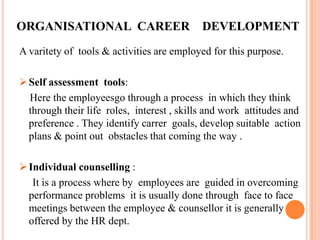
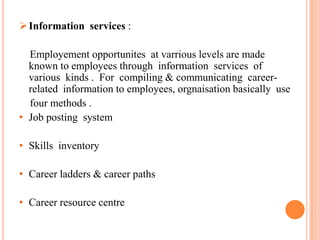
Career development  means  the  process of  increasing  an  employee’s  potential for advancement & career change.  It is a  process of  planning the series of possible  jobs  which  an individual  may  hold  in  the  organisation  over time  &  developing  strategies designed to provide necessary job  skills . It is a systematic process of  guiding the movement of people   in an org. through different hierarchical positions.
     OBJECTIVESTo  attract  & retain effective persons in an org.
To utilise human resources optimally.
To improve morale & motivation level of employees.
To reduce employee turn over.
To maintain harmonious industrial relations.
To make make employees adaptable to changes.
To increase employees’ loyality & commitment to org.STEPS  IN  CAREER  DEVELOPT. SYSTEMStep 1: NeedsThis step involves in conducting  a  needs assessment  as a  training  programme.Step 2: Vision   The needs of  the  career system must be linked  with  the       interventions.An ideal career developt. system known  as   the  vision, links needs with the interventions.
Step 3: Action plan   An action plan should be formulated in order to achieve the  vision.The support  of  the  top  mgt should be  obtained in the  process.Step 4:  Results    Career developt. progrmme  should  be  integrated with the  organisation’s  on going  employee  training  &  mgt   developt.  Programmes.The  programme  should  be  eval   uated  from  time  to time  in order to revise the programme.
SIGNIFICANCE  &  ADVANTAGESIt  reduces  employee turn over.

Pc

  • 1.
    POTENTIAL APPRAISAL & CAREER DEVELOPMENT Presented by, Manju.N.Premanand III sem MBA
  • 2.
  • 3.
    The term‘potential’ refers to the abilities possessed by an employee but not put to use currently or the the abilities to assume challenging responsibilities in the future assignments.The objective of potential appraisal is to identify the potential of a given employee to occupy higher positions in the organisational hierarchy and under take higher responsibilities.The appraisal is carried out on the basis of : #1 supervisor’s observations. #2 performance data relating to various previous roles played by an employee. #3 performance on roles in simulated settings relating to a new position.
  • 4.
    NEEDS OF POTENTALAPPRAISALTo inform the employees about their future prospects;
  • 5.
    To help theorganisation chalk out a suitable succession plan;
  • 6.
    To update training efforts from time to time;
  • 7.
    To advice employees about what they must to do improve their career prospects. STEPS TO BE FOLLOWED IN A GOOD POTENTIAL APPRAISAL SYSTEMRole Descriptions: Organisational roles & functions must be defined clearly. Job descriptions must be prepared for each job.Qualities needed to perform the roles: Based on job descriptions ,the roles to be played by people must be prepared.
  • 8.
    Rating mechanisms: Besides listing the functions & qualities, the potential appraisal system must list mechanisms of judging the qualities of employees such as: Rating by others
  • 9.
    Tests
  • 10.
    Games
  • 11.
    RecordsOrganising the system:After covering the above preliminaries, the HR manager must set up a system that will allow the introduction of the scheme smoothly incorporating answers to some complex Qns such as:How much weightage to accord to merit in place of seniority promotions?
  • 12.
    How much weightage to accord to each of the performance dimensions?
  • 13.
    What are themechanisms of assessing the individual on different indicators of his potential,& with what degree of reliability?Feedback: The system must provide an opportunity for every employee to know the results of his assessment.He should be helped to understand the qualities actually required for performing the role for which he thinks he has potential,the mechanisms used by the organisations to appraise his potential & the results of such appraisal.
  • 14.
  • 15.
    Career development means the process of increasing an employee’s potential for advancement & career change. It is a process of planning the series of possible jobs which an individual may hold in the organisation over time & developing strategies designed to provide necessary job skills . It is a systematic process of guiding the movement of people in an org. through different hierarchical positions.
  • 16.
    OBJECTIVESTo attract & retain effective persons in an org.
  • 17.
    To utilise humanresources optimally.
  • 18.
    To improve morale& motivation level of employees.
  • 19.
  • 20.
    To maintain harmoniousindustrial relations.
  • 21.
    To make makeemployees adaptable to changes.
  • 22.
    To increase employees’loyality & commitment to org.STEPS IN CAREER DEVELOPT. SYSTEMStep 1: NeedsThis step involves in conducting a needs assessment as a training programme.Step 2: Vision The needs of the career system must be linked with the interventions.An ideal career developt. system known as the vision, links needs with the interventions.
  • 23.
    Step 3: Actionplan An action plan should be formulated in order to achieve the vision.The support of the top mgt should be obtained in the process.Step 4: Results Career developt. progrmme should be integrated with the organisation’s on going employee training & mgt developt. Programmes.The programme should be eval uated from time to time in order to revise the programme.
  • 24.
    SIGNIFICANCE & ADVANTAGESIt reduces employee turn over.