Staffing
Presented by: Ms. Erica V. Salisod
Staffing
The managerial function of staffing is defined
as filling ,and keeping filled, positions in the
organizational structure. Staffing refers to the
process of filling an open position by hiring new
employees or by reassigning persons already
employed.
Nature of Staffing
Staffing is an important managerial
function
most important managerial act along with
planning, organizing, leading and controlling.
The operations of these four functions depend
upon the manpower which is available
through staffing function.
Staffing is a pervasive activity
As staffing function is carried out
by all mangers and in all types of
concerns where business activities
are carried out.
Staffing is a continuous activity
This is because staffing
function continues throughout the
life of an organization due to the
transfers and promotions that
take place.
The basis of staffing function is
efficient management of personnel’s
Human resources can be efficiently
managed by a system or proper
procedure, that is, recruitment, selection,
placement, training and development,
providing remuneration, etc.
Staffing helps in placing right men
at the right job
It can be done effectively through
proper recruitment procedures and
then finally selecting the most
suitable candidate as per the job
requirements.
Staffing is performed by all
managers
Depending upon the nature of
business, size of the company,
qualifications and skills of managers, etc.
In small companies, the top management
generally performs this function.
Recruitment
Hiring the right sales person is
critical. Done well, sales managers are
able to focus their time and energy on
development and coaching. Done poorly,
you spend time dealing with problems.
John Dieseth of Business Performance
Group shared these nine steps for the
sales person recruitment and selection
process during an EcSell Institute Sales
Coaching Summit.
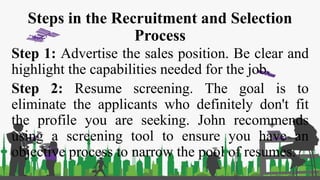
Steps in the Recruitment and Selection
Process
Step 1: Advertise the sales position. Be clear and
highlight the capabilities needed for the job.
Step 2: Resume screening. The goal is to
eliminate the applicants who definitely don't fit
the profile you are seeking. John recommends
using a screening tool to ensure you have an
objective process to narrow the pool of resumes.
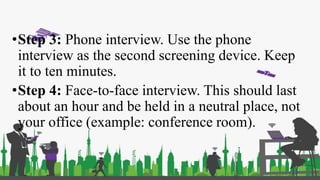
•Step 3: Phone interview. Use the phone
interview as the second screening device. Keep
it to ten minutes.
•Step 4: Face-to-face interview. This should last
about an hour and be held in a neutral place, not
your office (example: conference room).
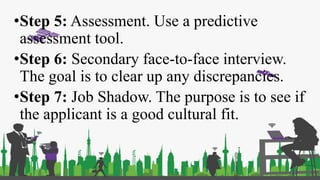
•Step 5: Assessment. Use a predictive
assessment tool.
•Step 6: Secondary face-to-face interview.
The goal is to clear up any discrepancies.
•Step 7: Job Shadow. The purpose is to see if
the applicant is a good cultural fit.
•Step 8: Reference Check. Ask
about their capabilities as it
relates to the job.
•Step 9: Job Offer. Make sure the
compensation plan offered is
clear and unambiguous.
Selection
Selection means the taking up the
different workers by various acts
from the application forms invited
through different sources of internal
and externals.
Selection Producer
1. Receiving and screening the
application: After receiving the
applications have to be screened. In this
process the applications of candidates
without the requisite qualification are
rejected.
2.Sending the Blank application form: After
preparing the list of candidates suitable for
job, blank application forms will be sent to
the candidates.
3. Preliminary Interview
4. Administering Tests: Different types of
test may be undertaken.
5. Checking References on Investigation
of Previous History: Applicants are
generally asked to give names of at least
two persons to whom the firm may make
a reference.
6. Interviewing: Interview is the most
important step in the selection procedure.
Training and development
Training is an instrument of developing
the employees by increasing their skills and
improving their behavior. According to
Flippo: “Training is an act of increasing the
knowledge and skill of an employee for doing
a particular job.”
Different Types of Training:
Basic literacy training - Organizations
increasingly need to provide basic literacy training
in the areas of reading and math skills to their
employees.
Technical training - New technology and
structural designs have increased the need to
upgrade and improve employees' technical skills
in both white‐collar and blue‐collar jobs.
Interpersonal skills training - Most
employees belong to a work team, and their
work performance depends on their abilities
to effectively interact with their coworkers.
Problem‐solving training - Today's
employees often work as members of
self‐managed teams who are responsible for
solving their own problems.
Diversity training - As one of the
fastest growing areas of training, diversity
training increases awareness and builds
cultural sensitivity skills.
Compensation/wages and performance
evaluation/appraisal
Performance appraisal is one of the oldest
and most accepted universal principles of
management. It refers to all the formal
procedures used in working organizations to
evaluate the personalities, contributions and
potentials of group members.
Employee relations
Maintaining a strong employer-
employee relationship can be the key to
the ultimate success of an organization;
the results are advantageous.
Employee movements
Transfer implies movement of an
employee from one job to another without
any increase in pay, status and
responsibilities.
Employee Transfer – Is a change in job
assignment. It may involve a promotion or
demotion or no change at all in status and
responsibility.
Employees Promotion – Refers from
upward movement from current job to
another that is higher in pay, responsibility
and organizational level.
Employee Demotion – Is an
downward movement of an employee in
an organizational hierarchy with lower
status and pay.
Employee Separation – Occur when
employees cease to be member of an
organization.
Rewards Systems
Every company needs a strategic
reward system for employees that
addresses these four areas: compensation,
benefits, recognition and appreciation.
Intrinsic Rewards
Intrinsic motivation is internal to the
person in that it is something that you
have to offer yourself and is driven by
personal interest or enjoyment ion the
work itself.

Staffing (Organizational Management)

  • 1.
  • 2.
    Staffing The managerial functionof staffing is defined as filling ,and keeping filled, positions in the organizational structure. Staffing refers to the process of filling an open position by hiring new employees or by reassigning persons already employed.
  • 3.
    Nature of Staffing Staffingis an important managerial function most important managerial act along with planning, organizing, leading and controlling. The operations of these four functions depend upon the manpower which is available through staffing function.
  • 4.
    Staffing is apervasive activity As staffing function is carried out by all mangers and in all types of concerns where business activities are carried out.
  • 5.
    Staffing is acontinuous activity This is because staffing function continues throughout the life of an organization due to the transfers and promotions that take place.
  • 6.
    The basis ofstaffing function is efficient management of personnel’s Human resources can be efficiently managed by a system or proper procedure, that is, recruitment, selection, placement, training and development, providing remuneration, etc.
  • 7.
    Staffing helps inplacing right men at the right job It can be done effectively through proper recruitment procedures and then finally selecting the most suitable candidate as per the job requirements.
  • 8.
    Staffing is performedby all managers Depending upon the nature of business, size of the company, qualifications and skills of managers, etc. In small companies, the top management generally performs this function.
  • 9.
    Recruitment Hiring the rightsales person is critical. Done well, sales managers are able to focus their time and energy on development and coaching. Done poorly, you spend time dealing with problems.
  • 10.
    John Dieseth ofBusiness Performance Group shared these nine steps for the sales person recruitment and selection process during an EcSell Institute Sales Coaching Summit.
  • 11.
    Steps in theRecruitment and Selection Process Step 1: Advertise the sales position. Be clear and highlight the capabilities needed for the job. Step 2: Resume screening. The goal is to eliminate the applicants who definitely don't fit the profile you are seeking. John recommends using a screening tool to ensure you have an objective process to narrow the pool of resumes.
  • 12.
    •Step 3: Phoneinterview. Use the phone interview as the second screening device. Keep it to ten minutes. •Step 4: Face-to-face interview. This should last about an hour and be held in a neutral place, not your office (example: conference room).
  • 13.
    •Step 5: Assessment.Use a predictive assessment tool. •Step 6: Secondary face-to-face interview. The goal is to clear up any discrepancies. •Step 7: Job Shadow. The purpose is to see if the applicant is a good cultural fit.
  • 14.
    •Step 8: ReferenceCheck. Ask about their capabilities as it relates to the job. •Step 9: Job Offer. Make sure the compensation plan offered is clear and unambiguous.
  • 15.
    Selection Selection means thetaking up the different workers by various acts from the application forms invited through different sources of internal and externals.
  • 16.
    Selection Producer 1. Receivingand screening the application: After receiving the applications have to be screened. In this process the applications of candidates without the requisite qualification are rejected.
  • 17.
    2.Sending the Blankapplication form: After preparing the list of candidates suitable for job, blank application forms will be sent to the candidates. 3. Preliminary Interview 4. Administering Tests: Different types of test may be undertaken.
  • 18.
    5. Checking Referenceson Investigation of Previous History: Applicants are generally asked to give names of at least two persons to whom the firm may make a reference. 6. Interviewing: Interview is the most important step in the selection procedure.
  • 19.
    Training and development Trainingis an instrument of developing the employees by increasing their skills and improving their behavior. According to Flippo: “Training is an act of increasing the knowledge and skill of an employee for doing a particular job.”
  • 20.
    Different Types ofTraining: Basic literacy training - Organizations increasingly need to provide basic literacy training in the areas of reading and math skills to their employees. Technical training - New technology and structural designs have increased the need to upgrade and improve employees' technical skills in both white‐collar and blue‐collar jobs.
  • 21.
    Interpersonal skills training- Most employees belong to a work team, and their work performance depends on their abilities to effectively interact with their coworkers. Problem‐solving training - Today's employees often work as members of self‐managed teams who are responsible for solving their own problems.
  • 22.
    Diversity training -As one of the fastest growing areas of training, diversity training increases awareness and builds cultural sensitivity skills.
  • 23.
    Compensation/wages and performance evaluation/appraisal Performanceappraisal is one of the oldest and most accepted universal principles of management. It refers to all the formal procedures used in working organizations to evaluate the personalities, contributions and potentials of group members.
  • 24.
    Employee relations Maintaining astrong employer- employee relationship can be the key to the ultimate success of an organization; the results are advantageous.
  • 25.
    Employee movements Transfer impliesmovement of an employee from one job to another without any increase in pay, status and responsibilities.
  • 26.
    Employee Transfer –Is a change in job assignment. It may involve a promotion or demotion or no change at all in status and responsibility. Employees Promotion – Refers from upward movement from current job to another that is higher in pay, responsibility and organizational level.
  • 27.
    Employee Demotion –Is an downward movement of an employee in an organizational hierarchy with lower status and pay. Employee Separation – Occur when employees cease to be member of an organization.
  • 28.
    Rewards Systems Every companyneeds a strategic reward system for employees that addresses these four areas: compensation, benefits, recognition and appreciation.
  • 29.
    Intrinsic Rewards Intrinsic motivationis internal to the person in that it is something that you have to offer yourself and is driven by personal interest or enjoyment ion the work itself.