
TRINITY INSTITUTE OF PROFESSIONAL STUDIES
Sector – 9, Dwarka Institutional Area, New Delhi-75
Affiliated Institution of G.G.S.IP.U, Delhi
HUMAN RESOURCE
MANAGEMENT
PERFORMANCE
MANAGEMENT
By : Sakshi Goel
( Management )
TRINITY INSTITUTE OF PROFESSIONAL STUDIES
Sector – 9, Dwarka Institutional Area, New Delhi-75
DEFINITION
Performance management is the process of planning performance ,
appraising performance, giving its feedback and counseling of an
employee to improve his performance. Thus, performance management
involves different activities – planning performance , that is what an
employee is expected to achieve with a set of given resources and within a
time frame , appraisal of whether the given result has been received or not,
and then giving feedback to the employer concerned about where he
lacks, its reason and counseling him how he can improve his performance.
TRINITY INSTITUTE OF PROFESSIONAL STUDIES
Sector – 9, Dwarka Institutional Area, New Delhi-75
Features Of Performance
Management
• Performance measure is based on the critical success
factors derived directly from the corporate and
business strategy.
• It is a continuous process of monitoring and feedback
rather than one-off annual event.
• It involves effective use of technology in conveying
desired competencies and in monitoring , collecting
and giving feedback
• It emphasizes on comprehensive training of managers
not just their own development
• It is a dynamic system that is suitable for changing
workplace realities.
TRINITY INSTITUTE OF PROFESSIONAL STUDIES
Sector – 9, Dwarka Institutional Area, New Delhi-75
PERFORMANCE PLANNING
Its is first step to performance management. It is
the process of determining what and how a jb is
to be done in such a manner that both the
employee and his superior understand what is
expected from employee and how success is
defined and measured.
TRINITY INSTITUTE OF PROFESSIONAL STUDIES
Sector – 9, Dwarka Institutional Area, New Delhi-75
PERFORMANCE APPRAISAL
It is the process of evaluating the performance and qualifications
of the employees in terms of the requirement of the job for
which he is employed., for the purposes o administration
including placements, selection for promotion, providing
financial rewards and other actions which require differential
treatments among the members of a group as distinguished
from actions affecting all members equally.
12/17/2015
Performance appraisal is the systematic evaluation of
the individual with regards to his or her performance on
the job and his potential for development.
Appraisal is the evaluation of worth, quality or merit. In
the organization context, performance appraisal is a
systematic evaluation of personnel by superiors or
others familiar with their performance.
TRINITY INSTITUTE OF PROFESSIONAL STUDIES
Sector – 9, Dwarka Institutional Area, New Delhi-75
Objectives Of Performance
Appraisal
• Salary increase
• Promotion
• Training and development
• Feedback
• Pressure on employees
TRINITY INSTITUTE OF PROFESSIONAL STUDIES
Sector – 9, Dwarka Institutional Area, New Delhi-75
Process Of Performance Appraisal
• Defining objectives of appraisal
• Defining appraisal norms
• Designing appraisal programme
• Implementing appraisal programme
• Appraisal feedback
• Post appraisal actions
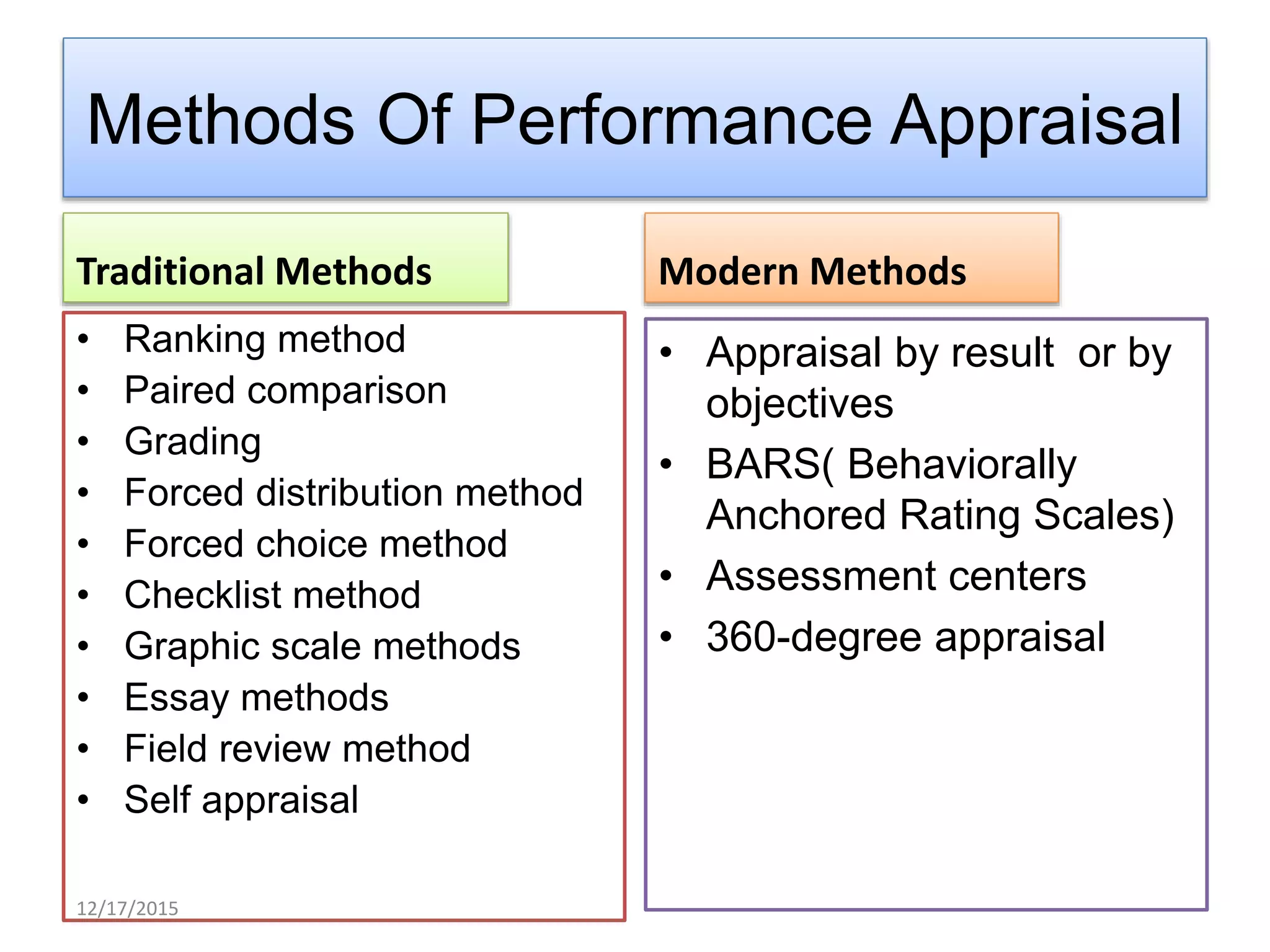
Methods Of Performance Appraisal
Traditional Methods
• Ranking method
• Paired comparison
• Grading
• Forced distribution method
• Forced choice method
• Checklist method
• Graphic scale methods
• Essay methods
• Field review method
• Self appraisal
Modern Methods
• Appraisal by result or by
objectives
• BARS( Behaviorally
Anchored Rating Scales)
• Assessment centers
• 360-degree appraisal
12/17/2015
TRINITY INSTITUTE OF PROFESSIONAL STUDIES
Sector – 9, Dwarka Institutional Area, New Delhi-75
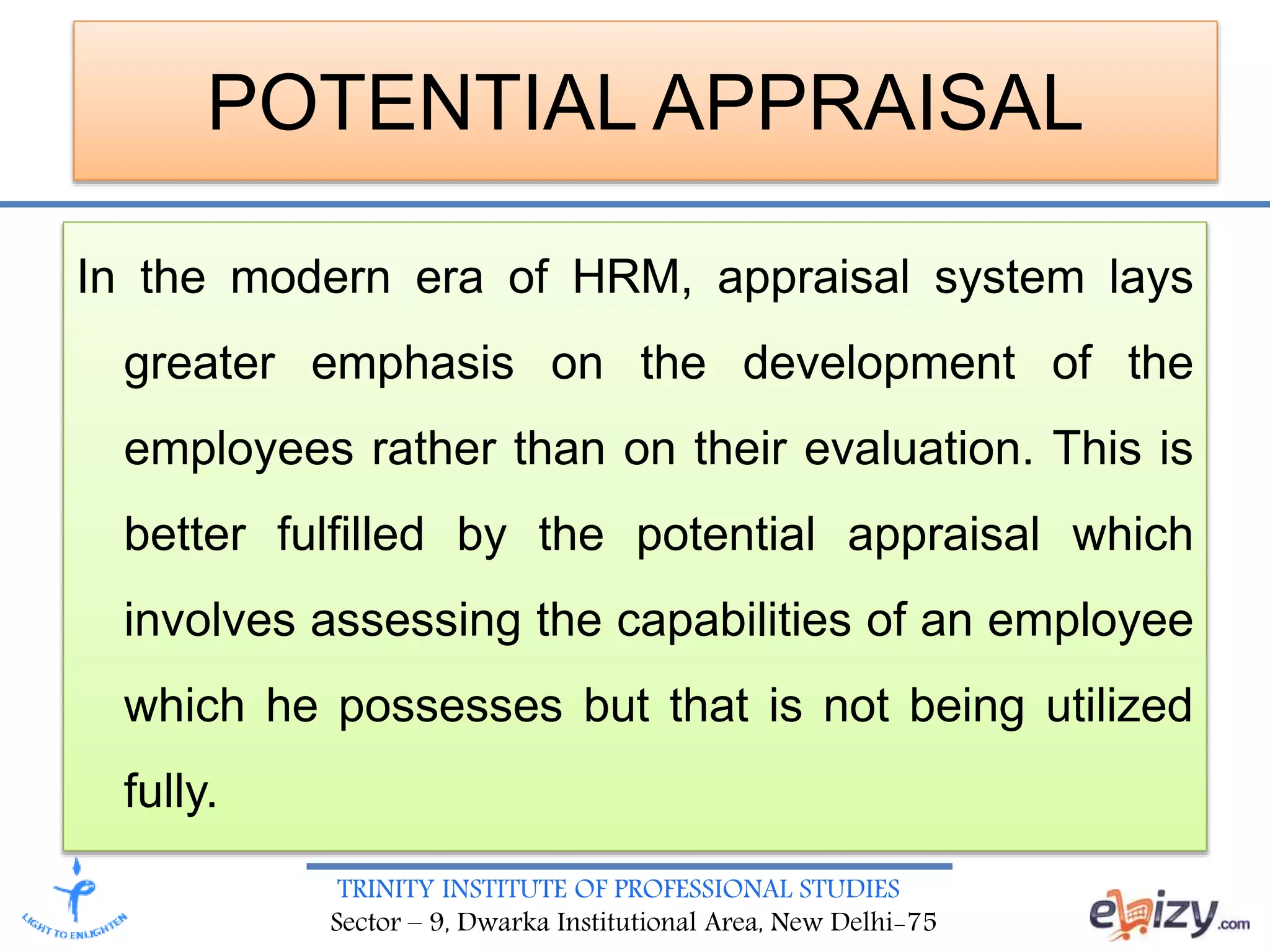
POTENTIAL APPRAISAL
In the modern era of HRM, appraisal system lays
greater emphasis on the development of the
employees rather than on their evaluation. This is
better fulfilled by the potential appraisal which
involves assessing the capabilities of an employee
which he possesses but that is not being utilized
fully.
12/17/2015
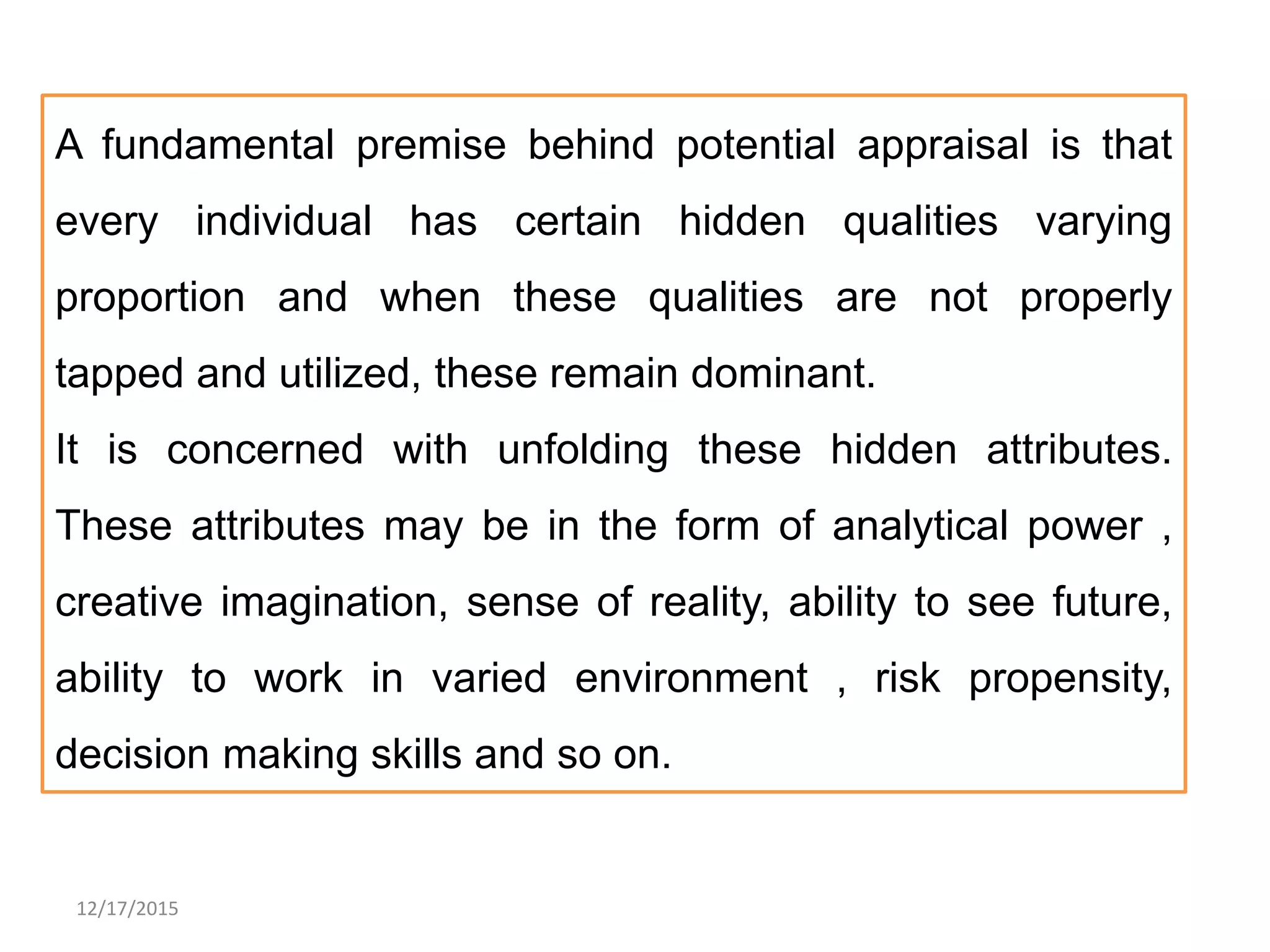
A fundamental premise behind potential appraisal is that
every individual has certain hidden qualities varying
proportion and when these qualities are not properly
tapped and utilized, these remain dominant.
It is concerned with unfolding these hidden attributes.
These attributes may be in the form of analytical power ,
creative imagination, sense of reality, ability to see future,
ability to work in varied environment , risk propensity,
decision making skills and so on.
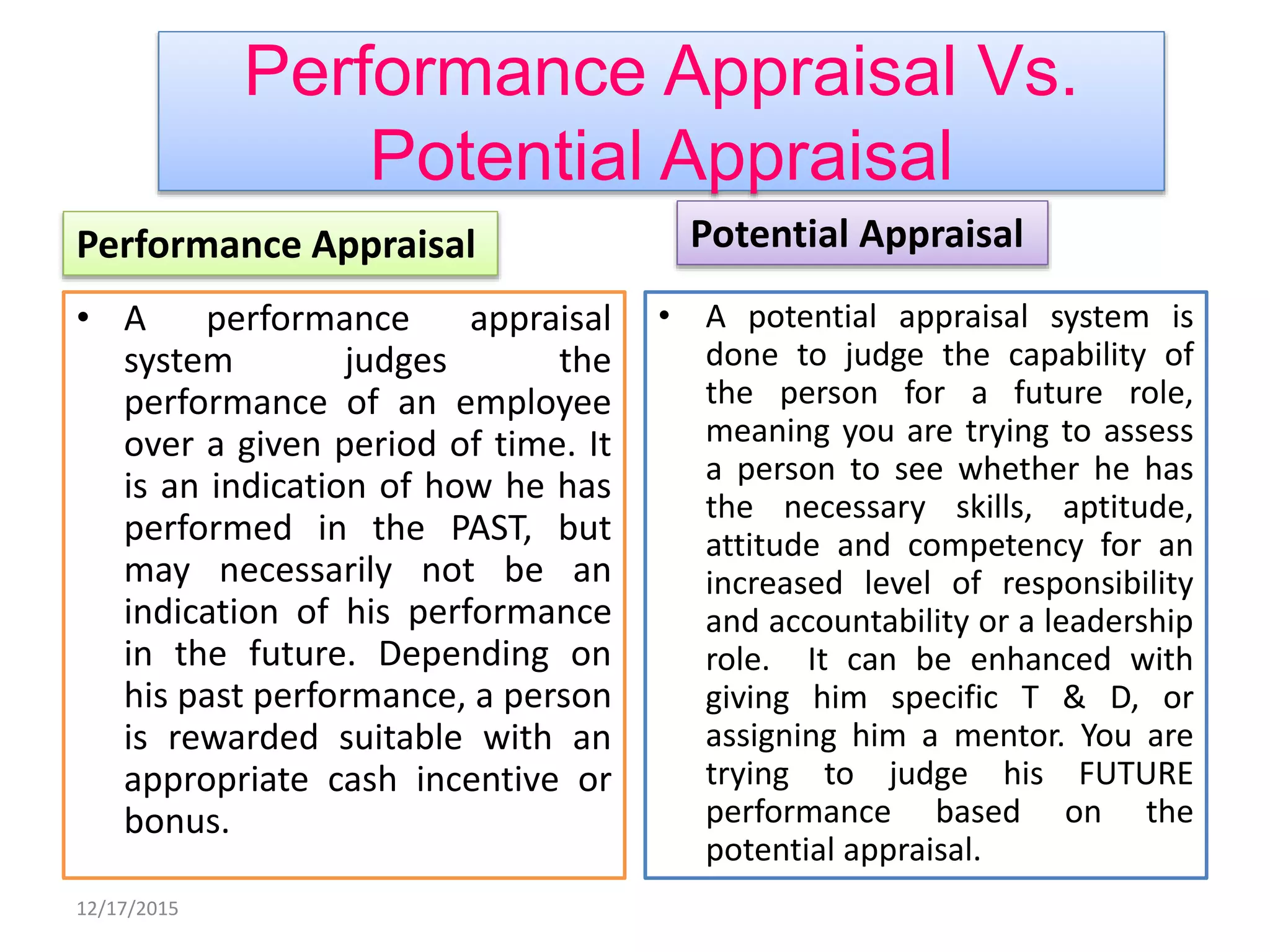
Performance Appraisal Vs.
Potential Appraisal
Performance Appraisal
• A performance appraisal
system judges the
performance of an employee
over a given period of time. It
is an indication of how he has
performed in the PAST, but
may necessarily not be an
indication of his performance
in the future. Depending on
his past performance, a person
is rewarded suitable with an
appropriate cash incentive or
bonus.
Potential Appraisal
• A potential appraisal system is
done to judge the capability of
the person for a future role,
meaning you are trying to assess
a person to see whether he has
the necessary skills, aptitude,
attitude and competency for an
increased level of responsibility
and accountability or a leadership
role. It can be enhanced with
giving him specific T & D, or
assigning him a mentor. You are
trying to judge his FUTURE
performance based on the
potential appraisal.
12/17/2015
TRINITY INSTITUTE OF PROFESSIONAL STUDIES
Sector – 9, Dwarka Institutional Area, New Delhi-75
Barriers To Effective Performance
Appraisal
• Faulty Assumptions
• Psychological Blocks
• Technical Pitfalls
TRINITY INSTITUTE OF PROFESSIONAL STUDIES
Sector – 9, Dwarka Institutional Area, New Delhi-75
Overcoming Barriers
• Adoption of contemporary appraisal
system
• Objectivity in appraisal and feedback
12/17/2015

HUMAN RESOURCE MANAGEMENT- PERFORMANCE MANAGEMENT

  • 1.
    TRINITY INSTITUTE OFPROFESSIONAL STUDIES Sector – 9, Dwarka Institutional Area, New Delhi-75 Affiliated Institution of G.G.S.IP.U, Delhi HUMAN RESOURCE MANAGEMENT PERFORMANCE MANAGEMENT By : Sakshi Goel ( Management )
  • 2.
    TRINITY INSTITUTE OFPROFESSIONAL STUDIES Sector – 9, Dwarka Institutional Area, New Delhi-75 DEFINITION Performance management is the process of planning performance , appraising performance, giving its feedback and counseling of an employee to improve his performance. Thus, performance management involves different activities – planning performance , that is what an employee is expected to achieve with a set of given resources and within a time frame , appraisal of whether the given result has been received or not, and then giving feedback to the employer concerned about where he lacks, its reason and counseling him how he can improve his performance.
  • 3.
    TRINITY INSTITUTE OFPROFESSIONAL STUDIES Sector – 9, Dwarka Institutional Area, New Delhi-75 Features Of Performance Management • Performance measure is based on the critical success factors derived directly from the corporate and business strategy. • It is a continuous process of monitoring and feedback rather than one-off annual event. • It involves effective use of technology in conveying desired competencies and in monitoring , collecting and giving feedback • It emphasizes on comprehensive training of managers not just their own development • It is a dynamic system that is suitable for changing workplace realities.
  • 4.
    TRINITY INSTITUTE OFPROFESSIONAL STUDIES Sector – 9, Dwarka Institutional Area, New Delhi-75 PERFORMANCE PLANNING Its is first step to performance management. It is the process of determining what and how a jb is to be done in such a manner that both the employee and his superior understand what is expected from employee and how success is defined and measured.
  • 5.
    TRINITY INSTITUTE OFPROFESSIONAL STUDIES Sector – 9, Dwarka Institutional Area, New Delhi-75 PERFORMANCE APPRAISAL It is the process of evaluating the performance and qualifications of the employees in terms of the requirement of the job for which he is employed., for the purposes o administration including placements, selection for promotion, providing financial rewards and other actions which require differential treatments among the members of a group as distinguished from actions affecting all members equally.
  • 6.
    12/17/2015 Performance appraisal isthe systematic evaluation of the individual with regards to his or her performance on the job and his potential for development. Appraisal is the evaluation of worth, quality or merit. In the organization context, performance appraisal is a systematic evaluation of personnel by superiors or others familiar with their performance.
  • 7.
    TRINITY INSTITUTE OFPROFESSIONAL STUDIES Sector – 9, Dwarka Institutional Area, New Delhi-75 Objectives Of Performance Appraisal • Salary increase • Promotion • Training and development • Feedback • Pressure on employees
  • 8.
    TRINITY INSTITUTE OFPROFESSIONAL STUDIES Sector – 9, Dwarka Institutional Area, New Delhi-75 Process Of Performance Appraisal • Defining objectives of appraisal • Defining appraisal norms • Designing appraisal programme • Implementing appraisal programme • Appraisal feedback • Post appraisal actions
  • 9.
    Methods Of PerformanceAppraisal Traditional Methods • Ranking method • Paired comparison • Grading • Forced distribution method • Forced choice method • Checklist method • Graphic scale methods • Essay methods • Field review method • Self appraisal Modern Methods • Appraisal by result or by objectives • BARS( Behaviorally Anchored Rating Scales) • Assessment centers • 360-degree appraisal 12/17/2015
  • 10.
    TRINITY INSTITUTE OFPROFESSIONAL STUDIES Sector – 9, Dwarka Institutional Area, New Delhi-75 POTENTIAL APPRAISAL In the modern era of HRM, appraisal system lays greater emphasis on the development of the employees rather than on their evaluation. This is better fulfilled by the potential appraisal which involves assessing the capabilities of an employee which he possesses but that is not being utilized fully.
  • 11.
    12/17/2015 A fundamental premisebehind potential appraisal is that every individual has certain hidden qualities varying proportion and when these qualities are not properly tapped and utilized, these remain dominant. It is concerned with unfolding these hidden attributes. These attributes may be in the form of analytical power , creative imagination, sense of reality, ability to see future, ability to work in varied environment , risk propensity, decision making skills and so on.
  • 12.
    Performance Appraisal Vs. PotentialAppraisal Performance Appraisal • A performance appraisal system judges the performance of an employee over a given period of time. It is an indication of how he has performed in the PAST, but may necessarily not be an indication of his performance in the future. Depending on his past performance, a person is rewarded suitable with an appropriate cash incentive or bonus. Potential Appraisal • A potential appraisal system is done to judge the capability of the person for a future role, meaning you are trying to assess a person to see whether he has the necessary skills, aptitude, attitude and competency for an increased level of responsibility and accountability or a leadership role. It can be enhanced with giving him specific T & D, or assigning him a mentor. You are trying to judge his FUTURE performance based on the potential appraisal. 12/17/2015
  • 13.
    TRINITY INSTITUTE OFPROFESSIONAL STUDIES Sector – 9, Dwarka Institutional Area, New Delhi-75 Barriers To Effective Performance Appraisal • Faulty Assumptions • Psychological Blocks • Technical Pitfalls
  • 14.
    TRINITY INSTITUTE OFPROFESSIONAL STUDIES Sector – 9, Dwarka Institutional Area, New Delhi-75 Overcoming Barriers • Adoption of contemporary appraisal system • Objectivity in appraisal and feedback
  • 15.