CAP6135: Malware and Software
Vulnerability Analysis
Network Traffic Monitoring Using Wireshark
Cliff Zou
Spring 2013
Acknowledgement
 http://ilta.ebiz.uapps.net/ProductFiles/prod
uctfiles/672/wireshark.ppt
 UC Berkley course “EE 122: Intro to
Communication Networks”
 http://www.eecs.berkeley.edu/~jortiz/courses/
ee122/presentations/Wireshark.ppt
 Other resources:
 http://openmaniak.com/wireshark_filters.php
2
Motivation for Network Monitoring
 Essential for Network Management
 Router and Firewall policy
 Detecting abnormal/error in networking
 Access control
 Security Management
 Detecting abnormal traffic
 Traffic log for future forensic analysis
3
4
Tools Overview
 Tcpdump
 Unix-based command-line tool used to intercept
packets
 Including filtering to just the packets of interest
 Reads “live traffic” from interface specified using -i
option …
 … or from a previously recorded trace file specified
using -r option
 You create these when capturing live traffic using -w option
 Tshark
 Tcpdump-like capture program that comes w/
Wireshark
 Very similar behavior & flags to tcpdump
 Wireshark
 GUI for displaying tcpdump/tshark packet traces
5
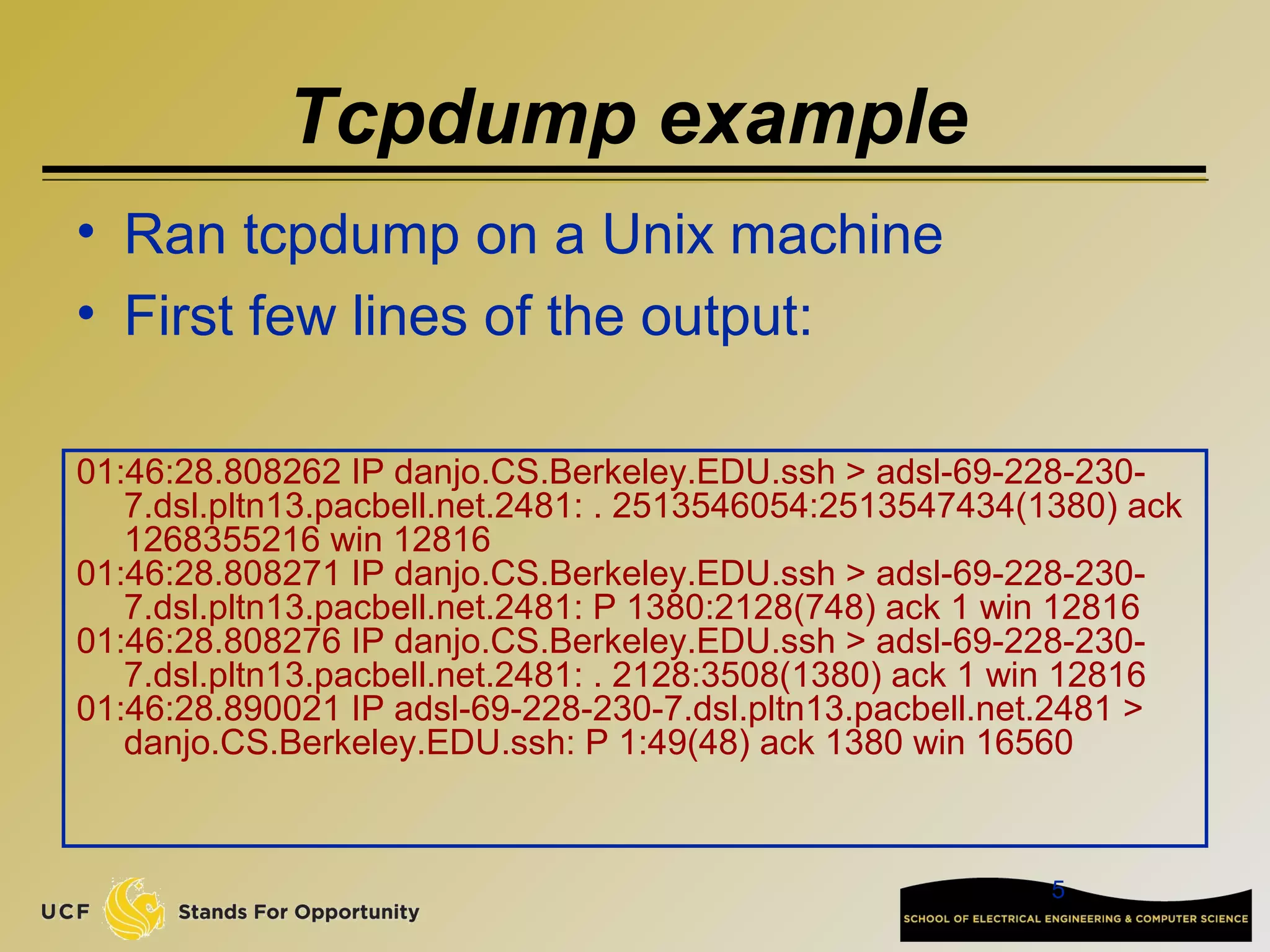
Tcpdump example
01:46:28.808262 IP danjo.CS.Berkeley.EDU.ssh > adsl-69-228-230-
7.dsl.pltn13.pacbell.net.2481: . 2513546054:2513547434(1380) ack
1268355216 win 12816
01:46:28.808271 IP danjo.CS.Berkeley.EDU.ssh > adsl-69-228-230-
7.dsl.pltn13.pacbell.net.2481: P 1380:2128(748) ack 1 win 12816
01:46:28.808276 IP danjo.CS.Berkeley.EDU.ssh > adsl-69-228-230-
7.dsl.pltn13.pacbell.net.2481: . 2128:3508(1380) ack 1 win 12816
01:46:28.890021 IP adsl-69-228-230-7.dsl.pltn13.pacbell.net.2481 >
danjo.CS.Berkeley.EDU.ssh: P 1:49(48) ack 1380 win 16560
• Ran tcpdump on a Unix machine
• First few lines of the output:
6
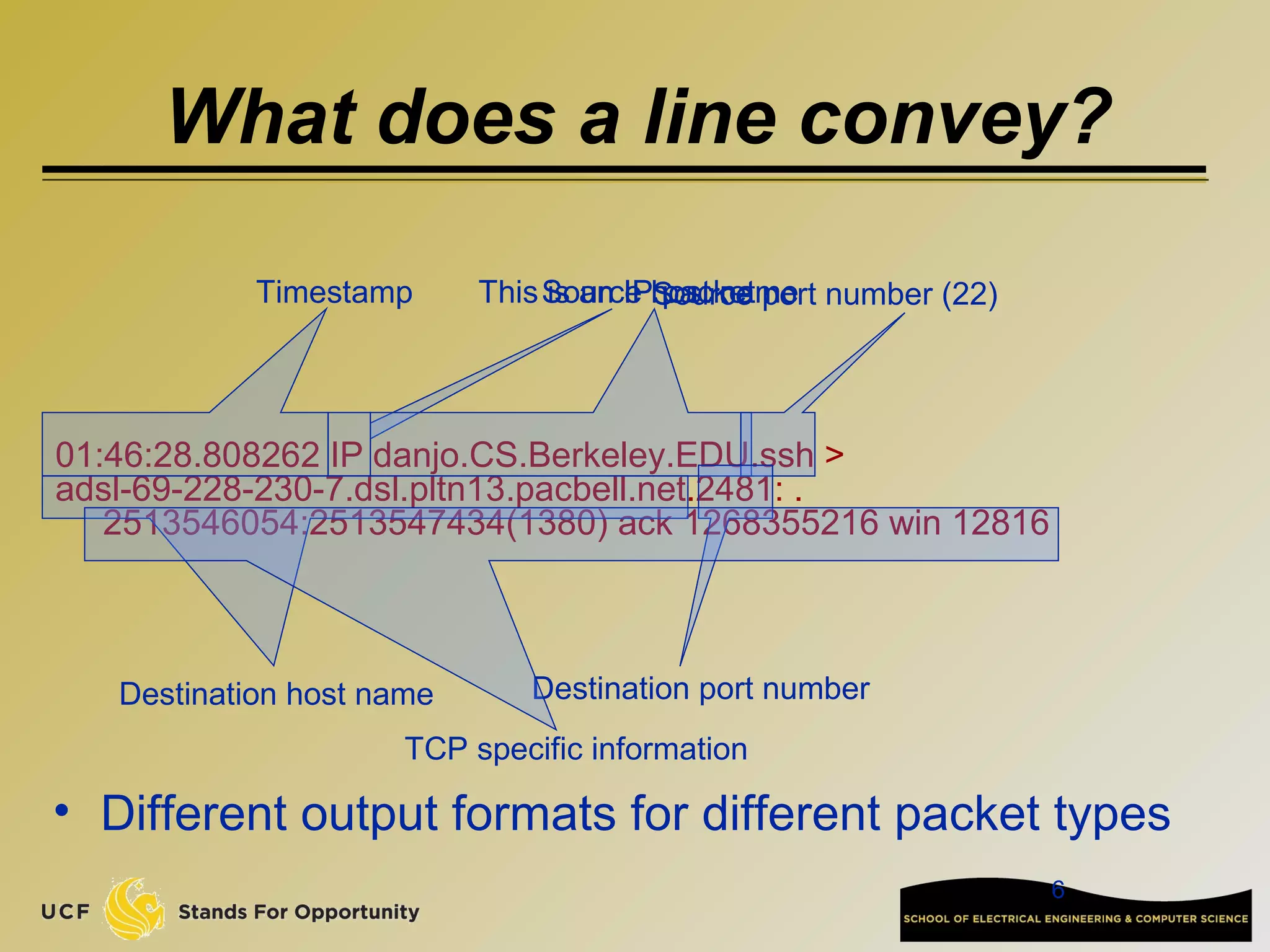
01:46:28.808262 IP danjo.CS.Berkeley.EDU.ssh >
adsl-69-228-230-7.dsl.pltn13.pacbell.net.2481: .
2513546054:2513547434(1380) ack 1268355216 win 12816
Timestamp This is an IP packetSource host nameSource port number (22)
Destination host name Destination port number
TCP specific information
• Different output formats for different packet types
What does a line convey?
7
Similar Output from Tshark
1190003744.940437 61.184.241.230 -> 128.32.48.169
SSH Encrypted request packet len=48
1190003744.940916 128.32.48.169 -> 61.184.241.230
SSH Encrypted response packet len=48
1190003744.955764 61.184.241.230 -> 128.32.48.169
TCP 6943 > ssh [ACK] Seq=48 Ack=48 Win=65514
Len=0 TSV=445871583 TSER=632535493
1190003745.035678 61.184.241.230 -> 128.32.48.169
SSH Encrypted request packet len=48
1190003745.036004 128.32.48.169 -> 61.184.241.230
SSH Encrypted response packet len=48
1190003745.050970 61.184.241.230 -> 128.32.48.169
TCP 6943 > ssh [ACK] Seq=96 Ack=96 Win=65514
Len=0 TSV=445871583 TSER=632535502
8
Demo 1 – Basic Run
 Syntax:
tcpdump [options] [filter expression]
 Unfortunately, Eustis machine does not
allow normal users to run tcpdump
 I will demonstrate it on my group’s Unix
machine: cnsserver.eecs.ucf.edu
 $ sudo tcpdump –i eth0
 On your own Unix machine, you can run it
using “sudo” or directly run “tcpdump”
 Observe the output
9
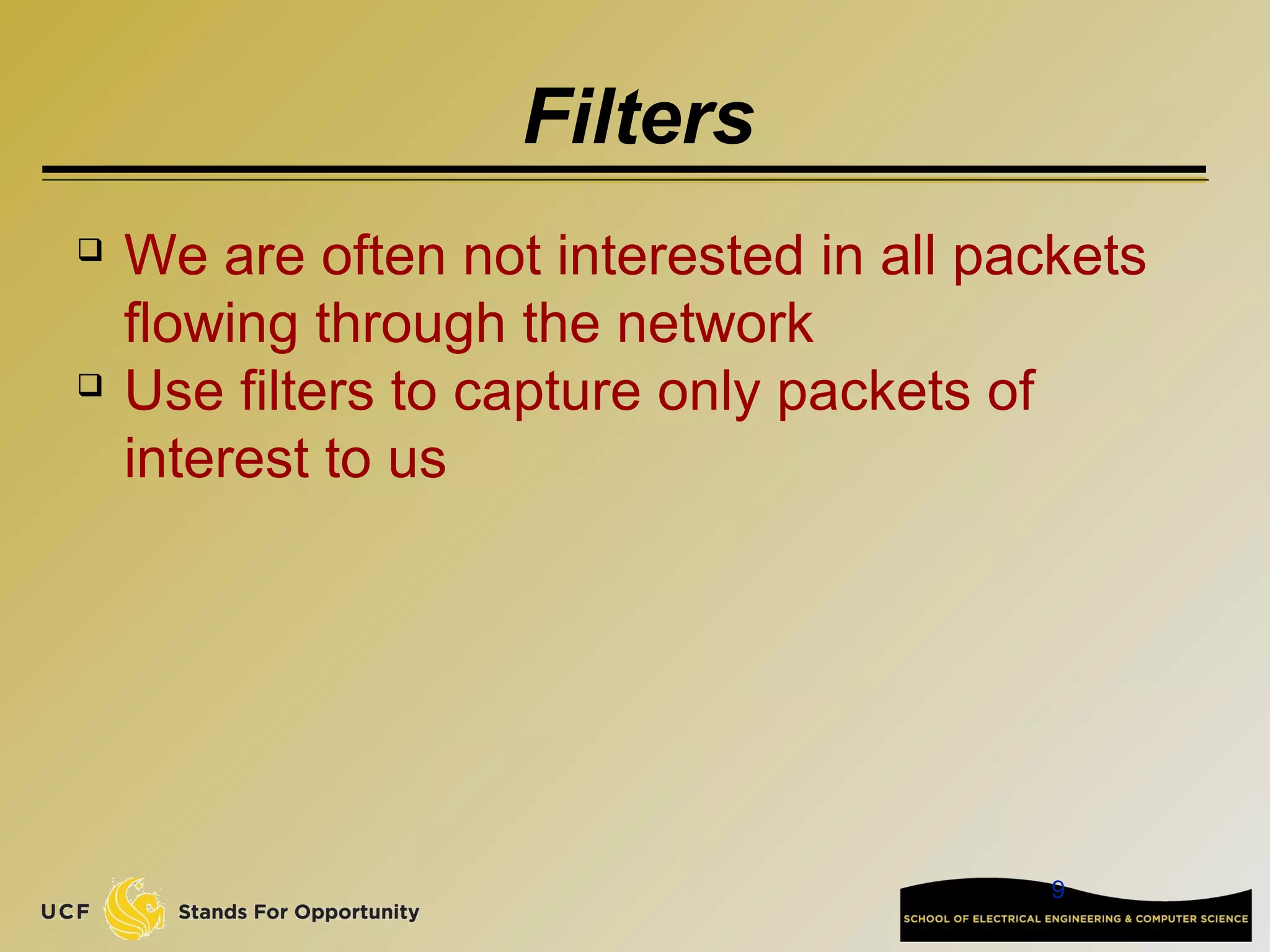
Filters
 We are often not interested in all packets
flowing through the network
 Use filters to capture only packets of
interest to us
10
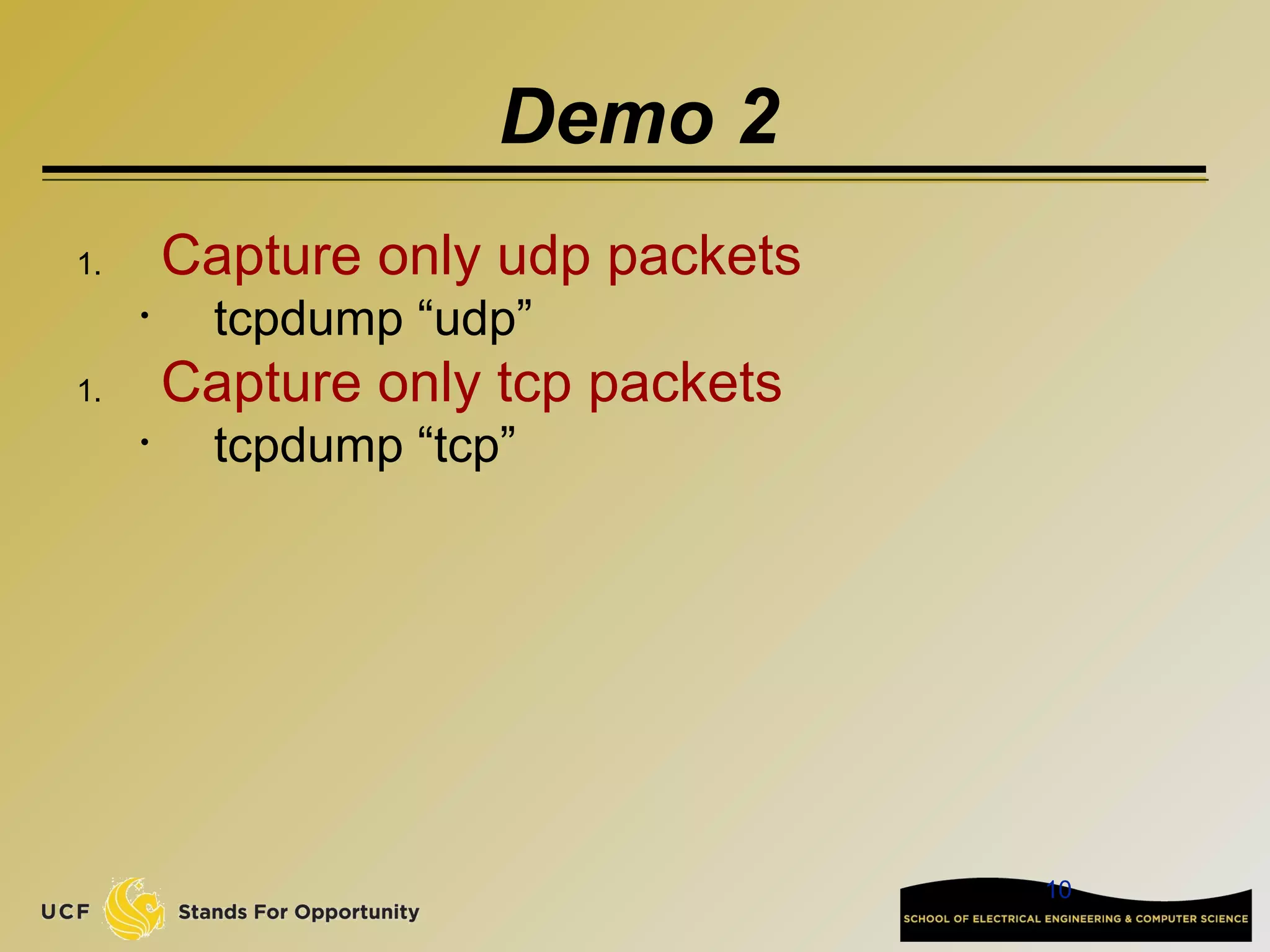
Demo 2
1. Capture only udp packets
• tcpdump “udp”
1. Capture only tcp packets
• tcpdump “tcp”
11
Demo 2 (contd.)
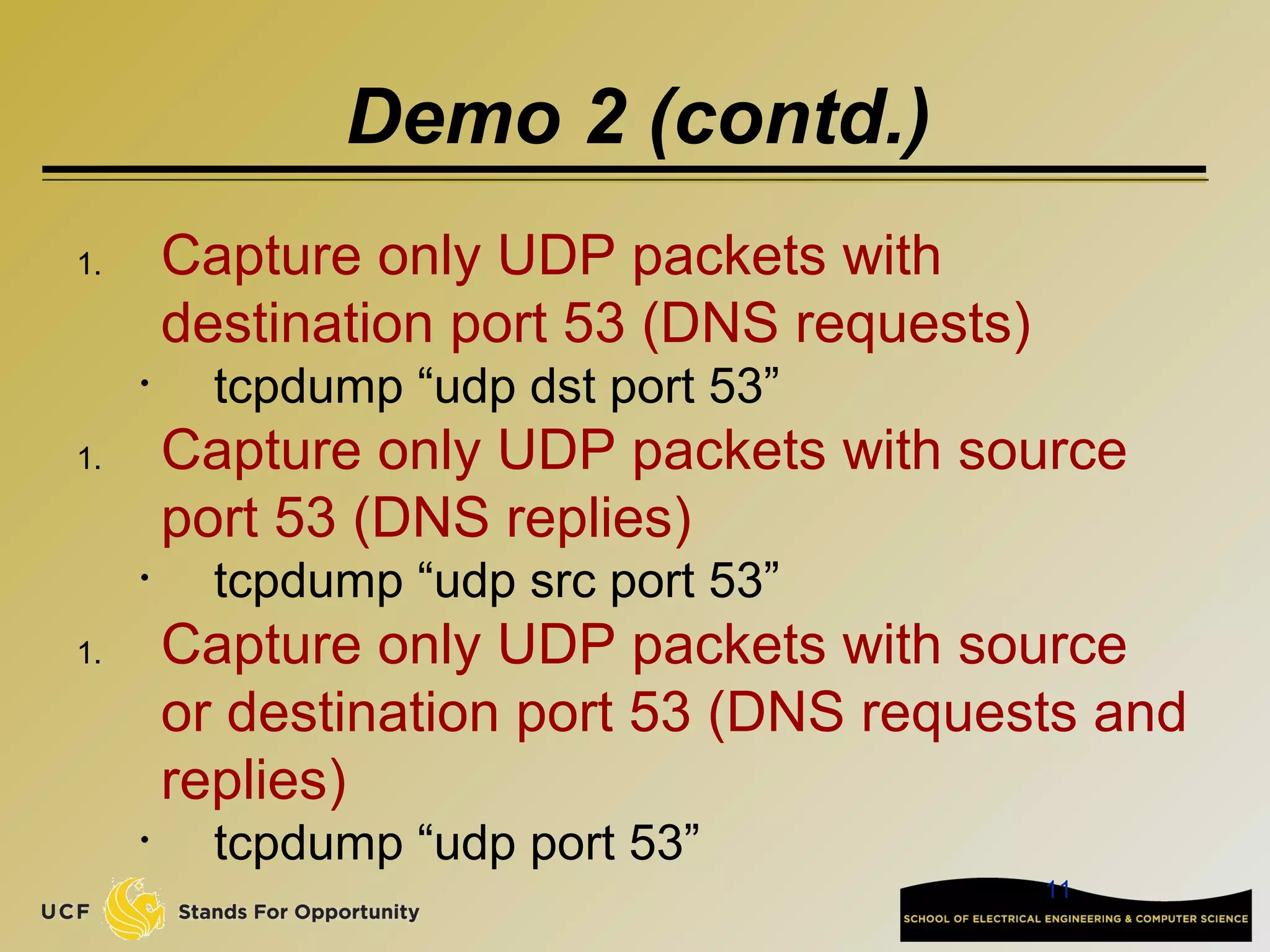
1. Capture only UDP packets with
destination port 53 (DNS requests)
• tcpdump “udp dst port 53”
1. Capture only UDP packets with source
port 53 (DNS replies)
• tcpdump “udp src port 53”
1. Capture only UDP packets with source
or destination port 53 (DNS requests and
replies)
• tcpdump “udp port 53”
12
Demo 2 (contd.)
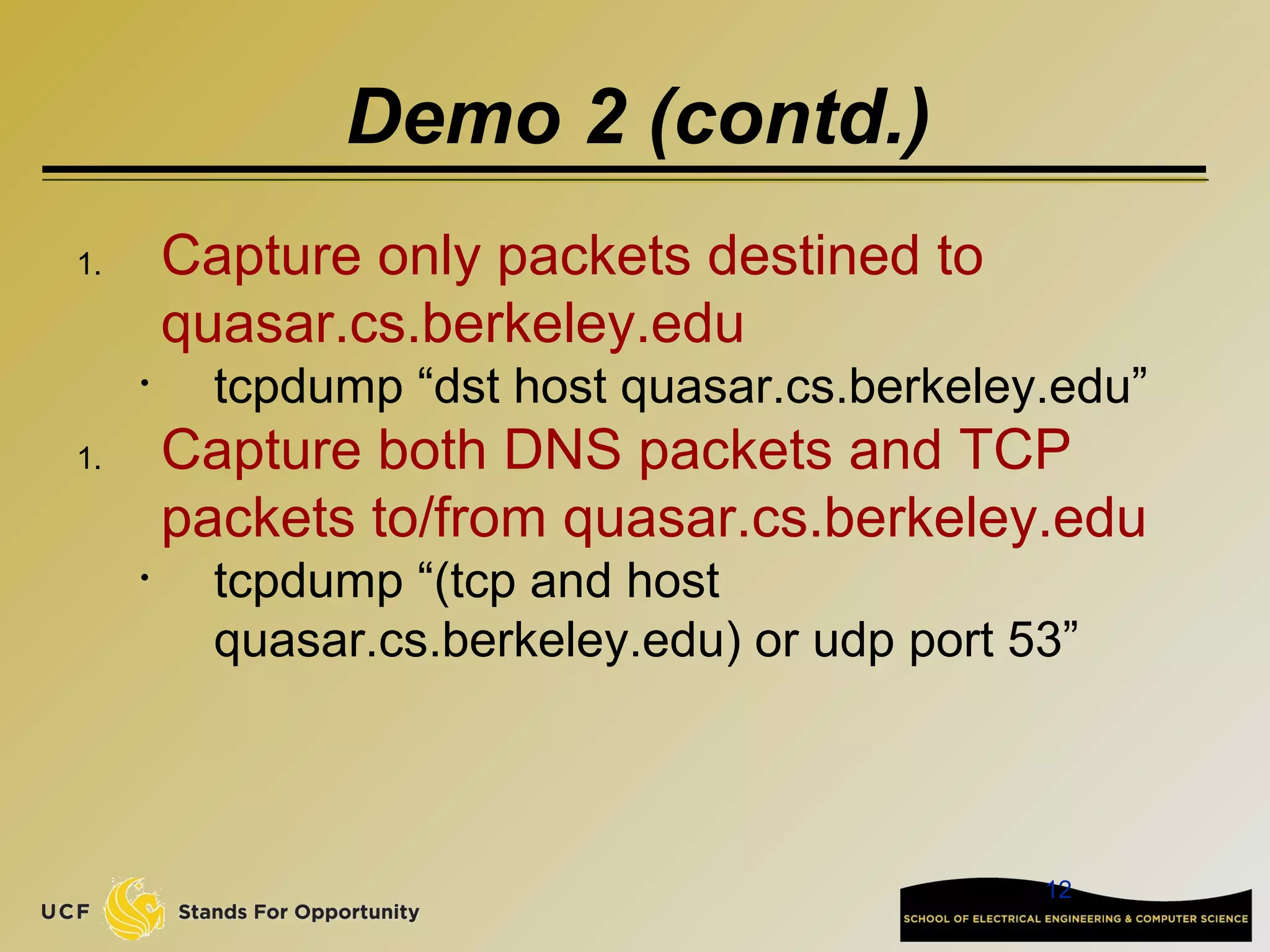
1. Capture only packets destined to
quasar.cs.berkeley.edu
• tcpdump “dst host quasar.cs.berkeley.edu”
1. Capture both DNS packets and TCP
packets to/from quasar.cs.berkeley.edu
• tcpdump “(tcp and host
quasar.cs.berkeley.edu) or udp port 53”
13
How to write filters
 Refer the tcpdump/tshark man page
 Many example webpages on the Internet
14
Running tcpdump
 Requires superuser/administrator privileges on
Unix
 http://www.tcpdump.org/
 You can do it on your own Unix machine
 You can install a Linux OS in Vmware on your
machine
 Tcpdump for Windows
 WinDump: http://www.winpcap.org/windump/
 Free software
So What is WireShark?
 Packet sniffer/protocol analyzer
 Open Source Network Tool
 Latest version of the ethereal tool
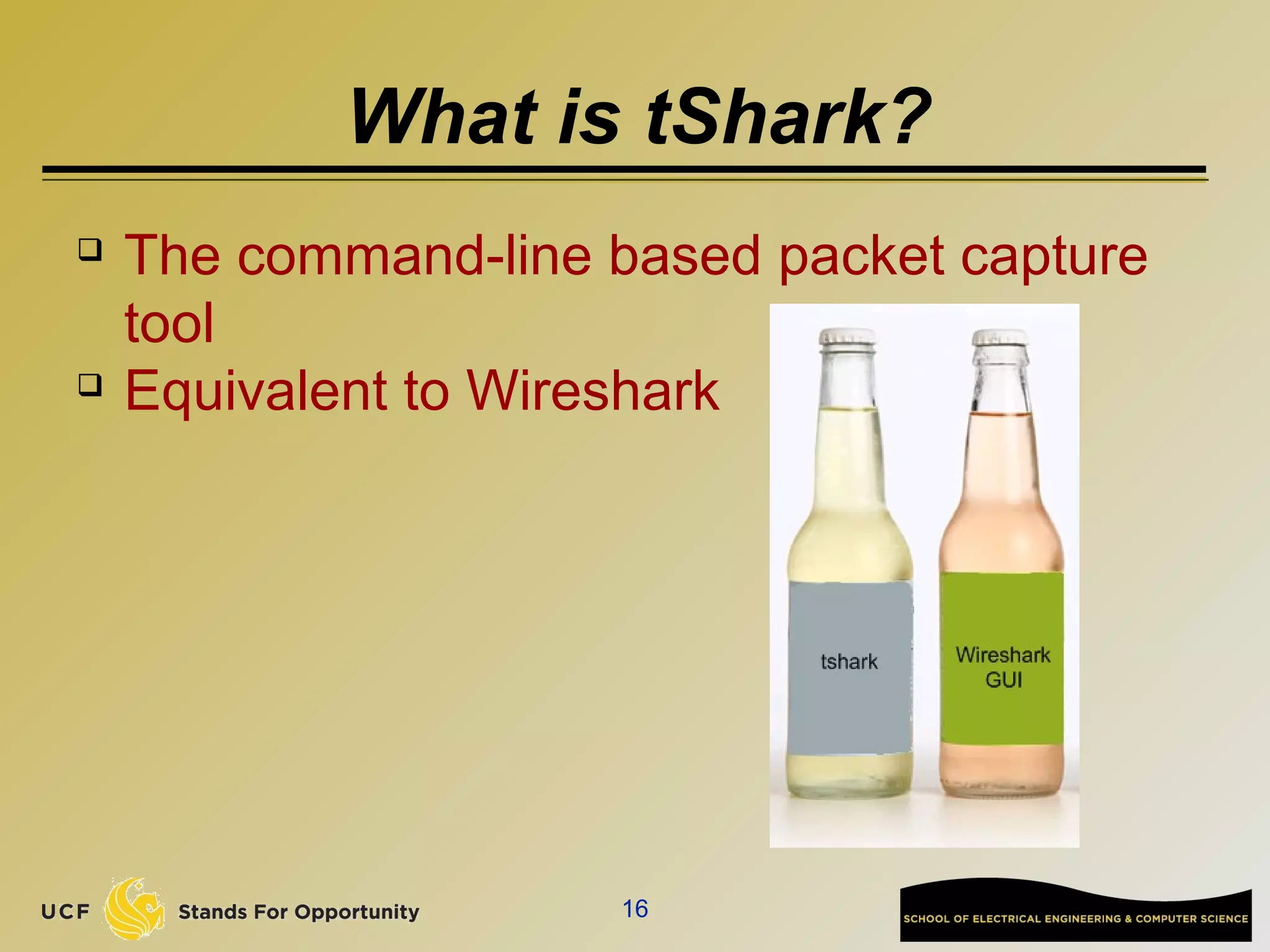
What is tShark?
 The command-line based packet capture
tool
 Equivalent to Wireshark
16
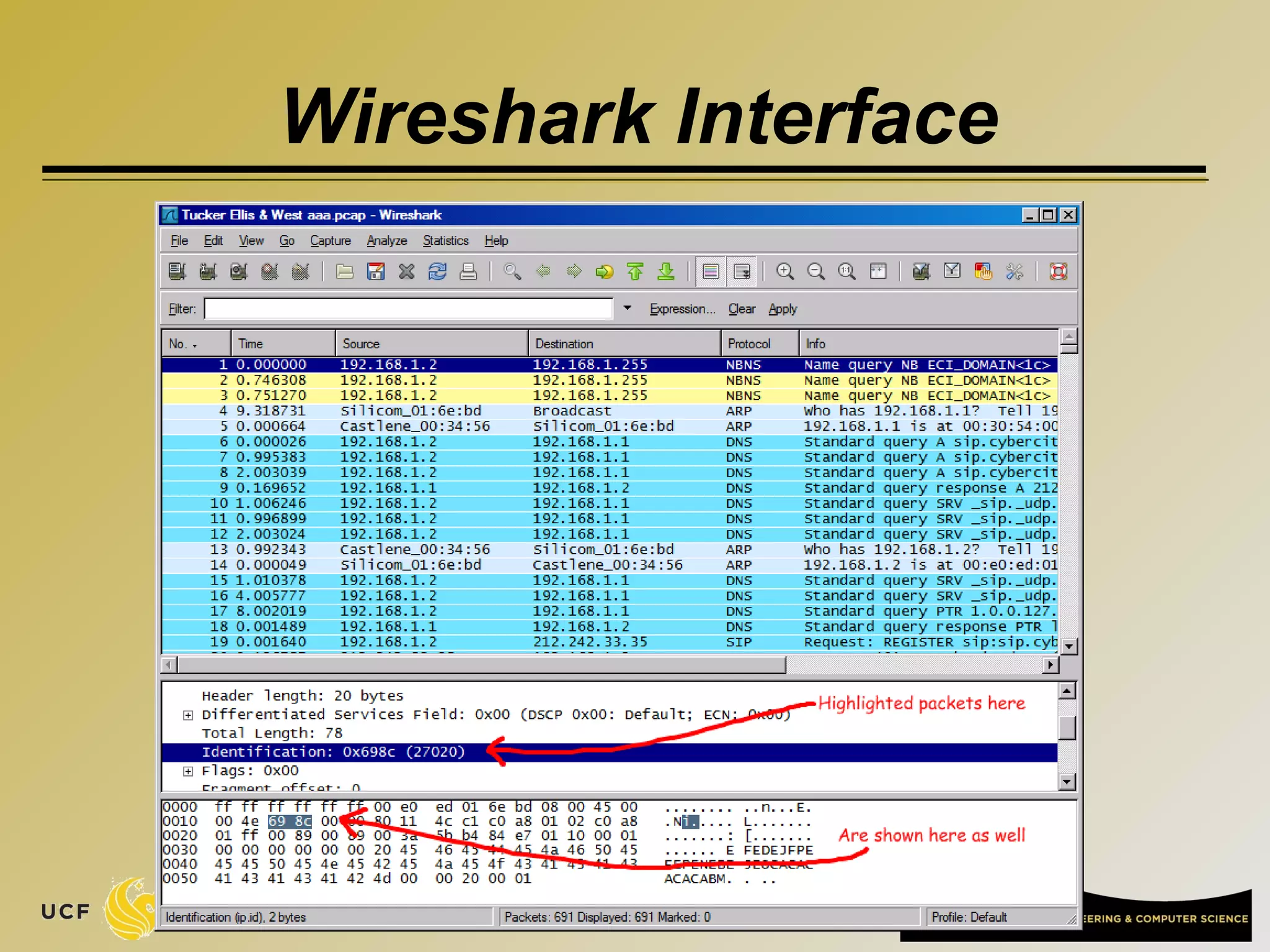
Wireshark Interface
17
18
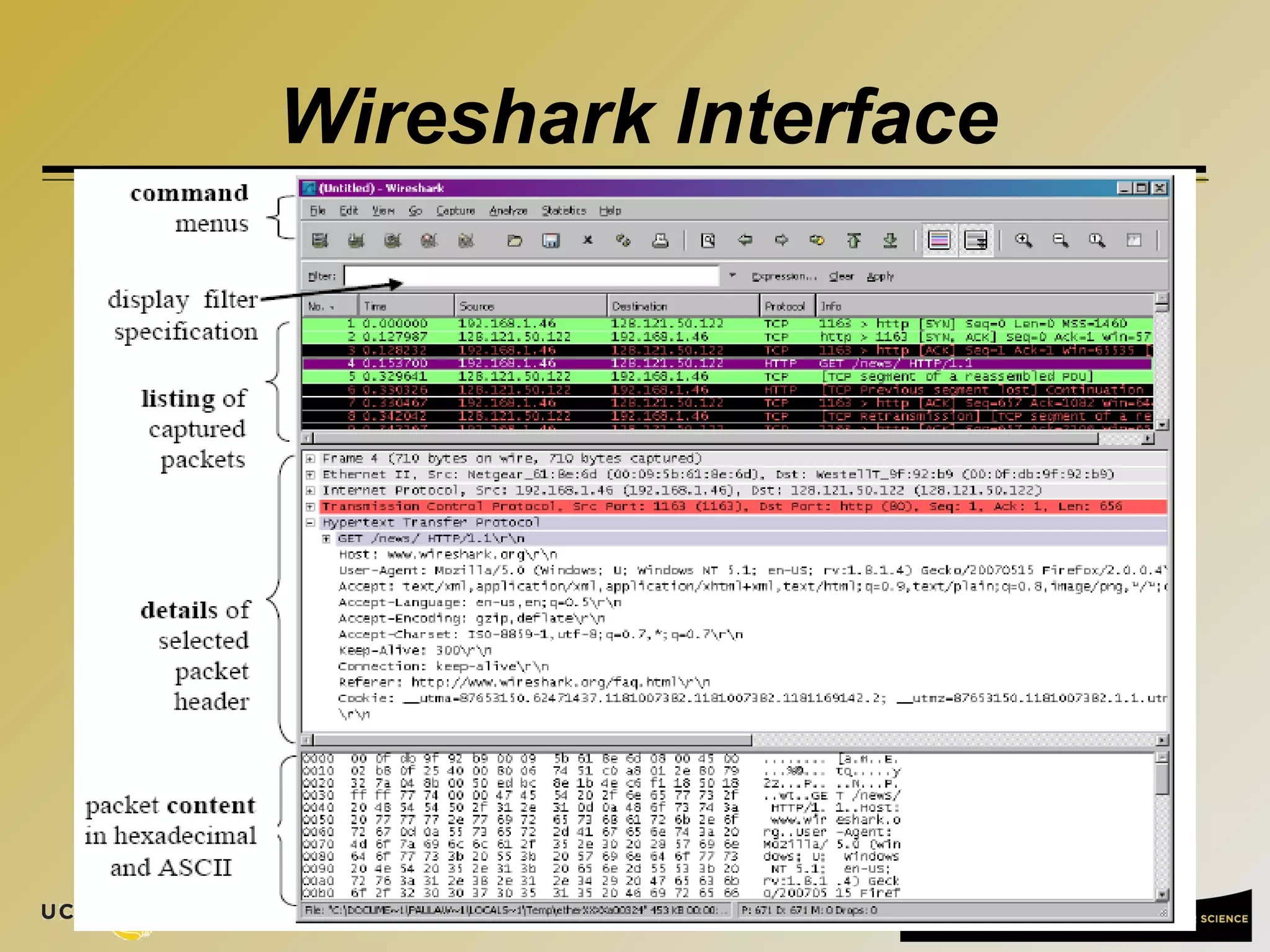
Wireshark Interface
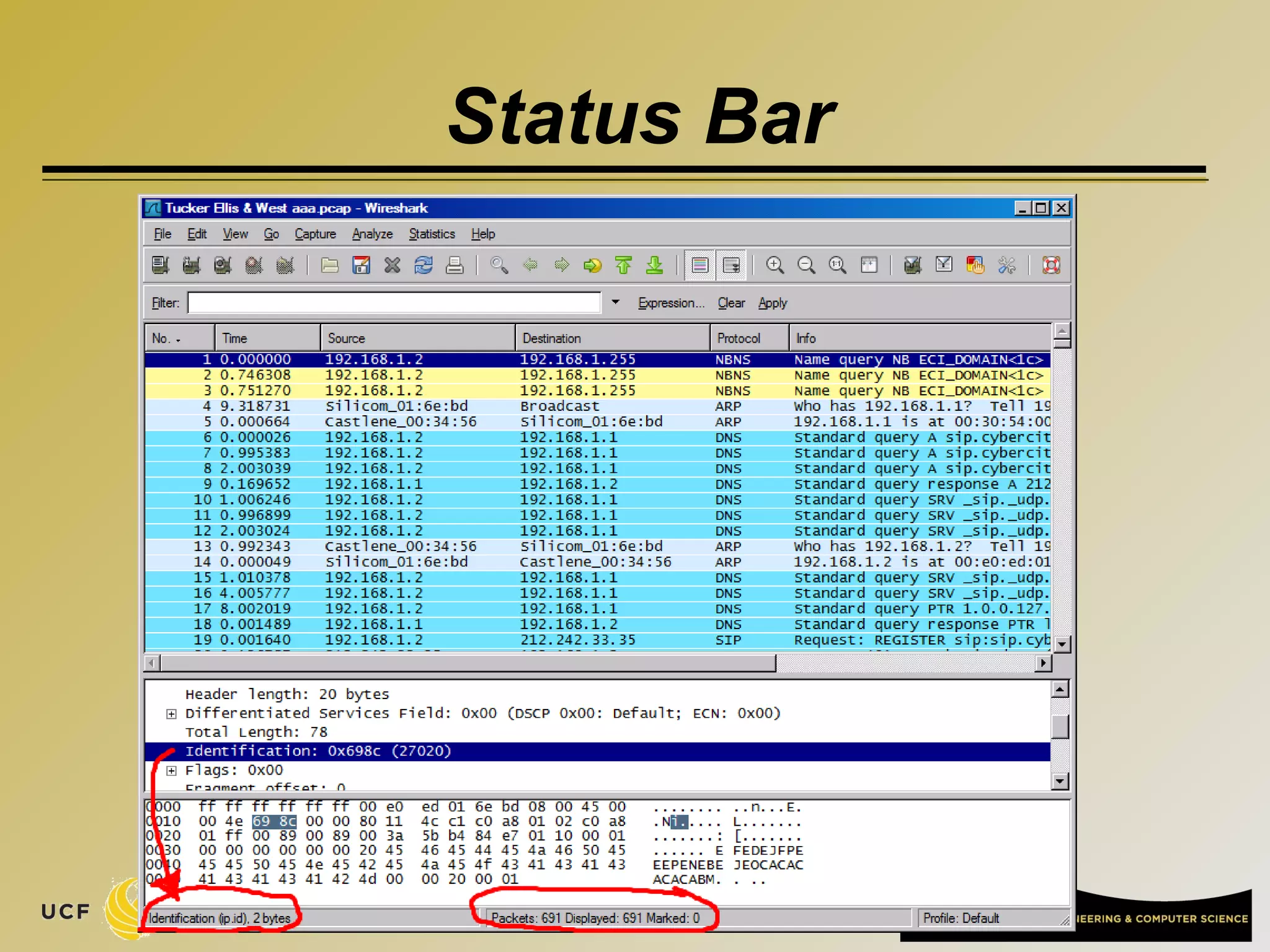
Status Bar
19
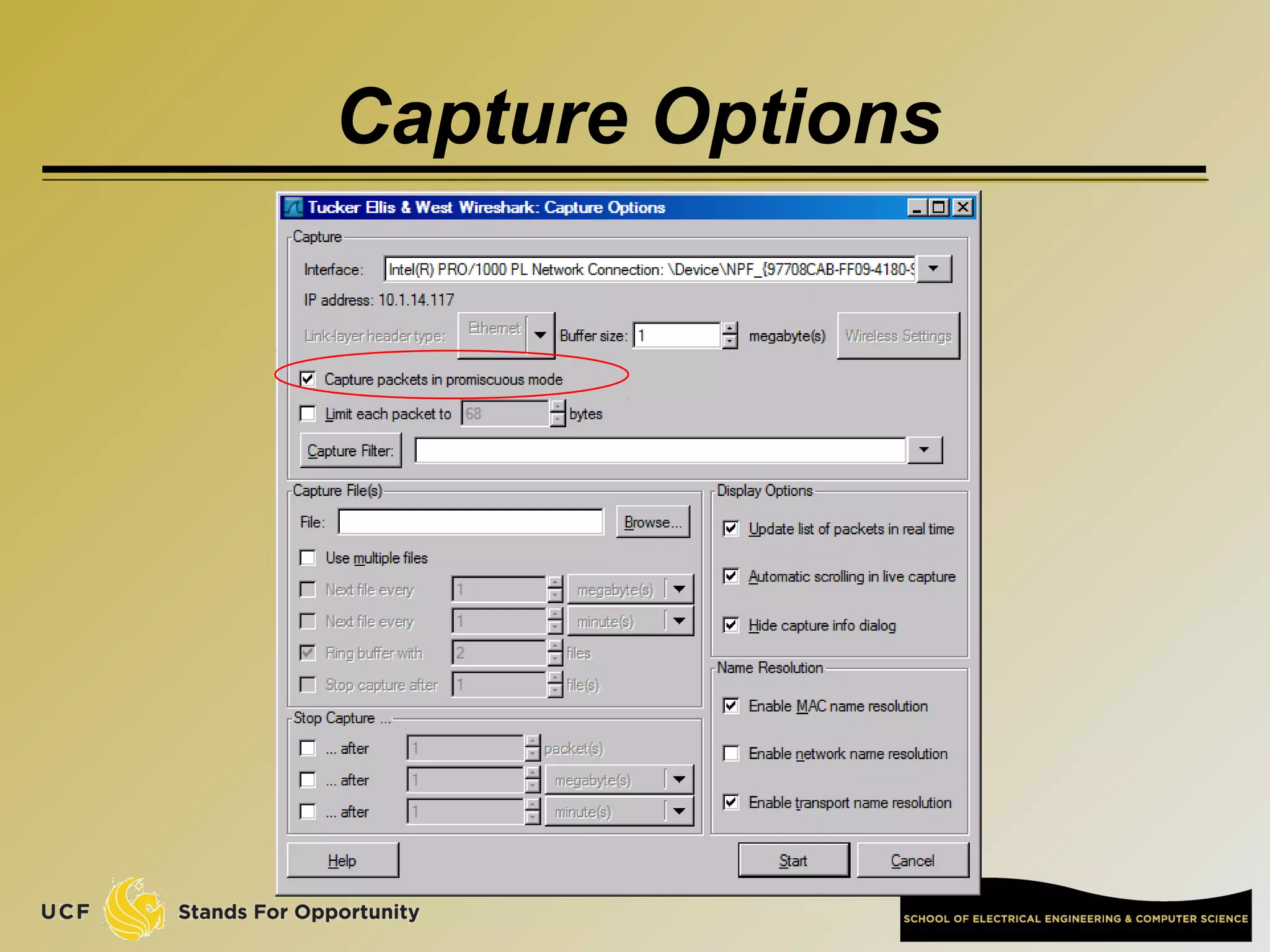
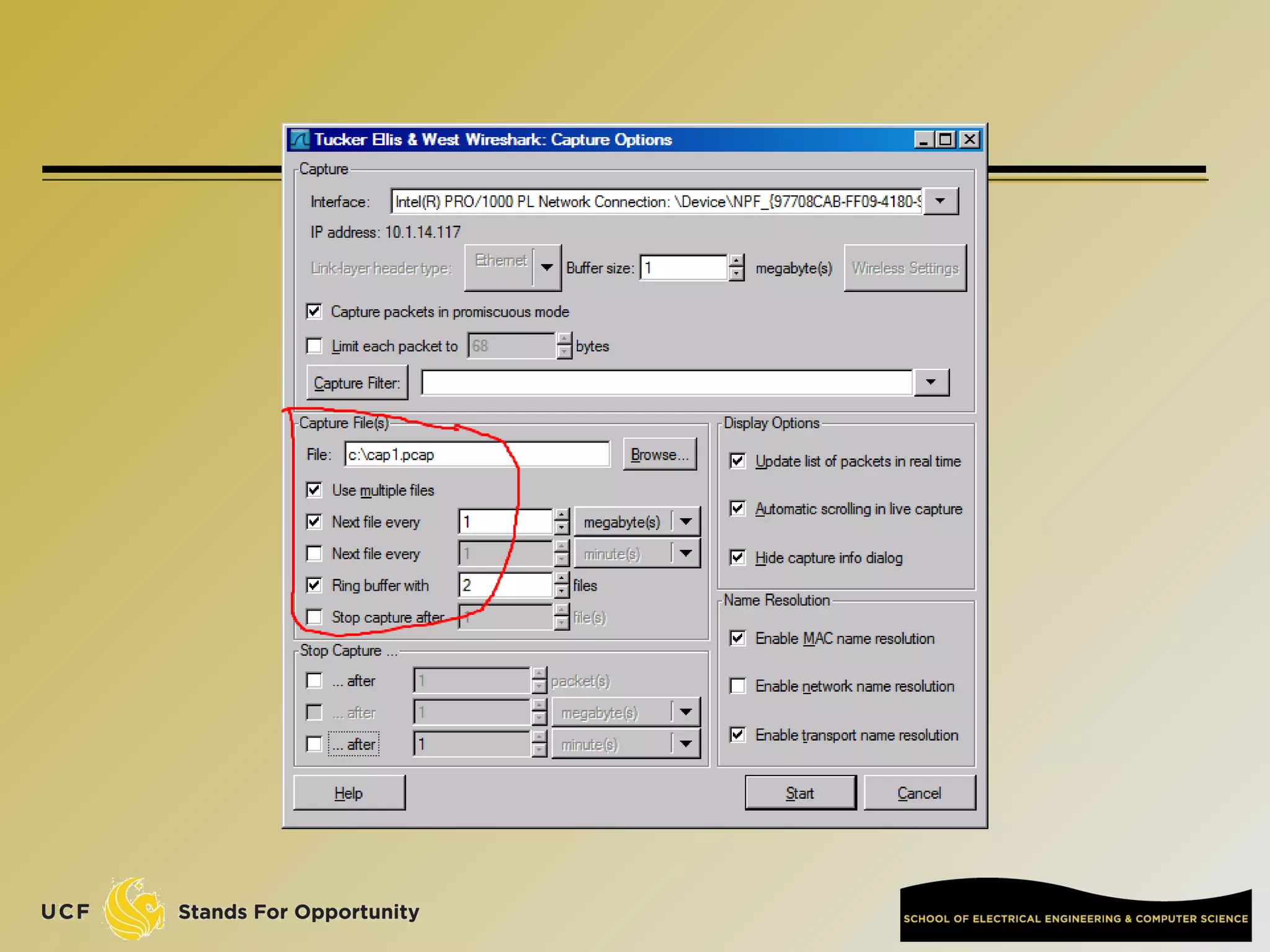
Capture Options
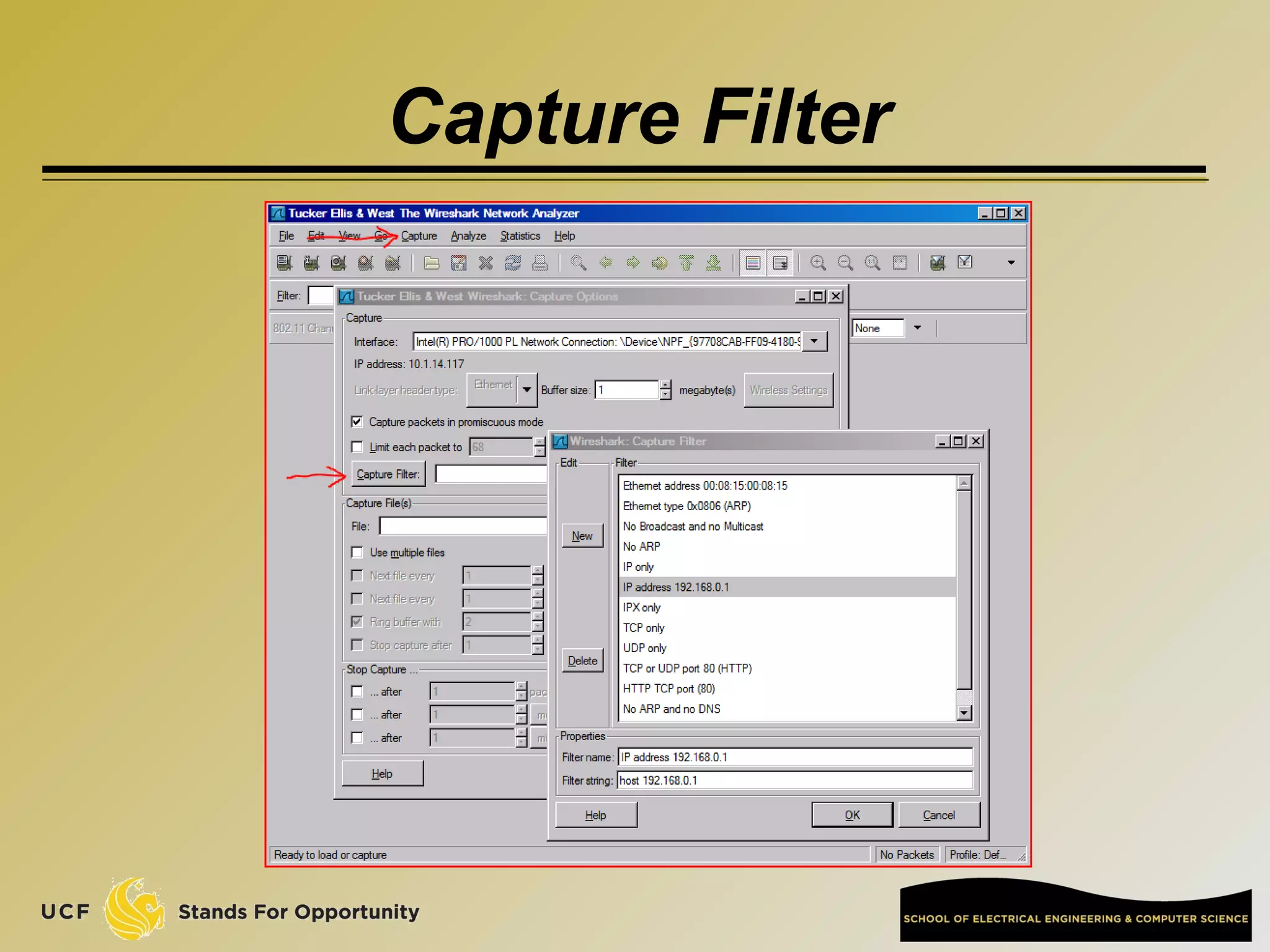
Capture Filter
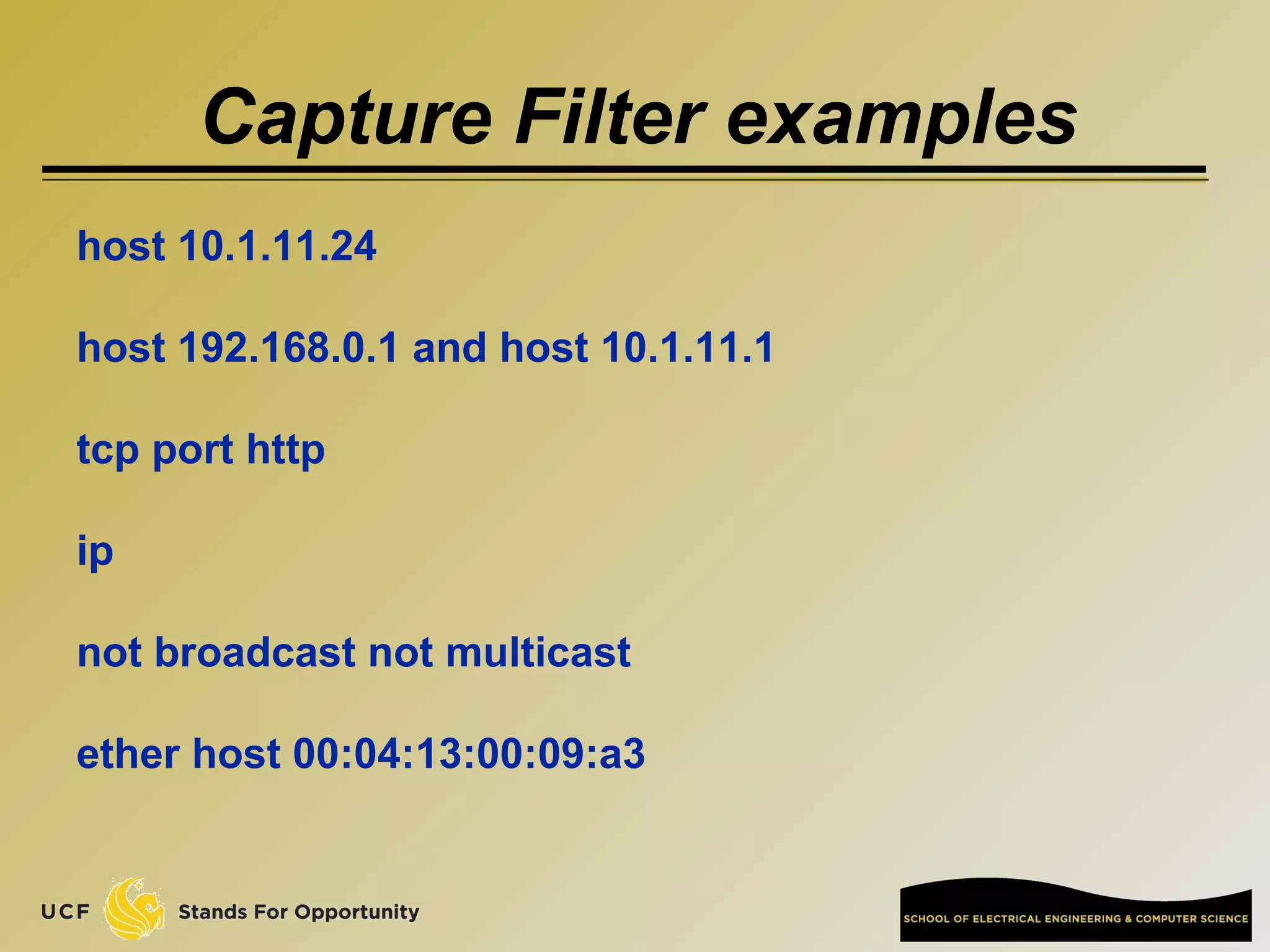
Capture Filter examples
host 10.1.11.24
host 192.168.0.1 and host 10.1.11.1
tcp port http
ip
not broadcast not multicast
ether host 00:04:13:00:09:a3
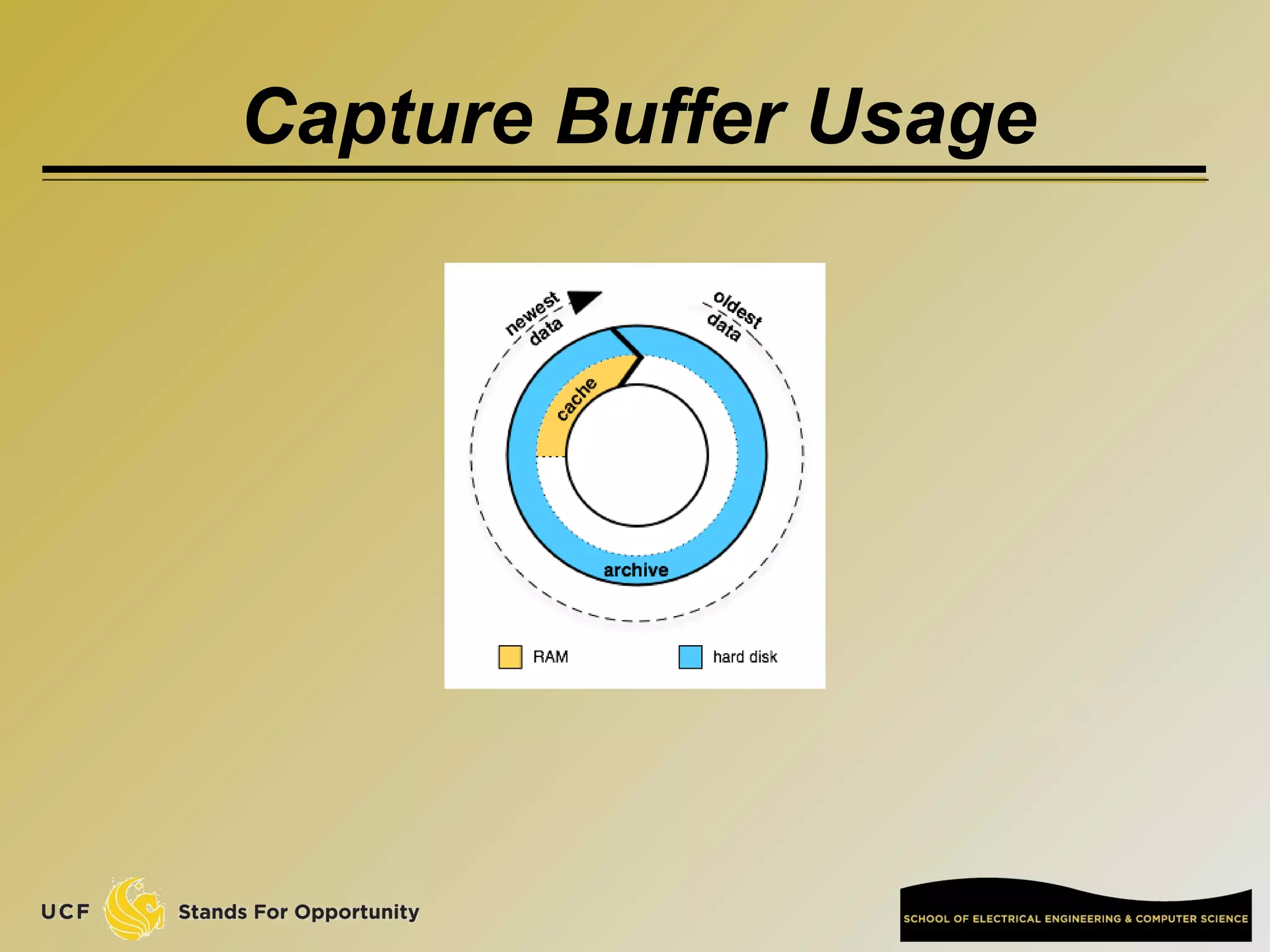
Capture Buffer Usage
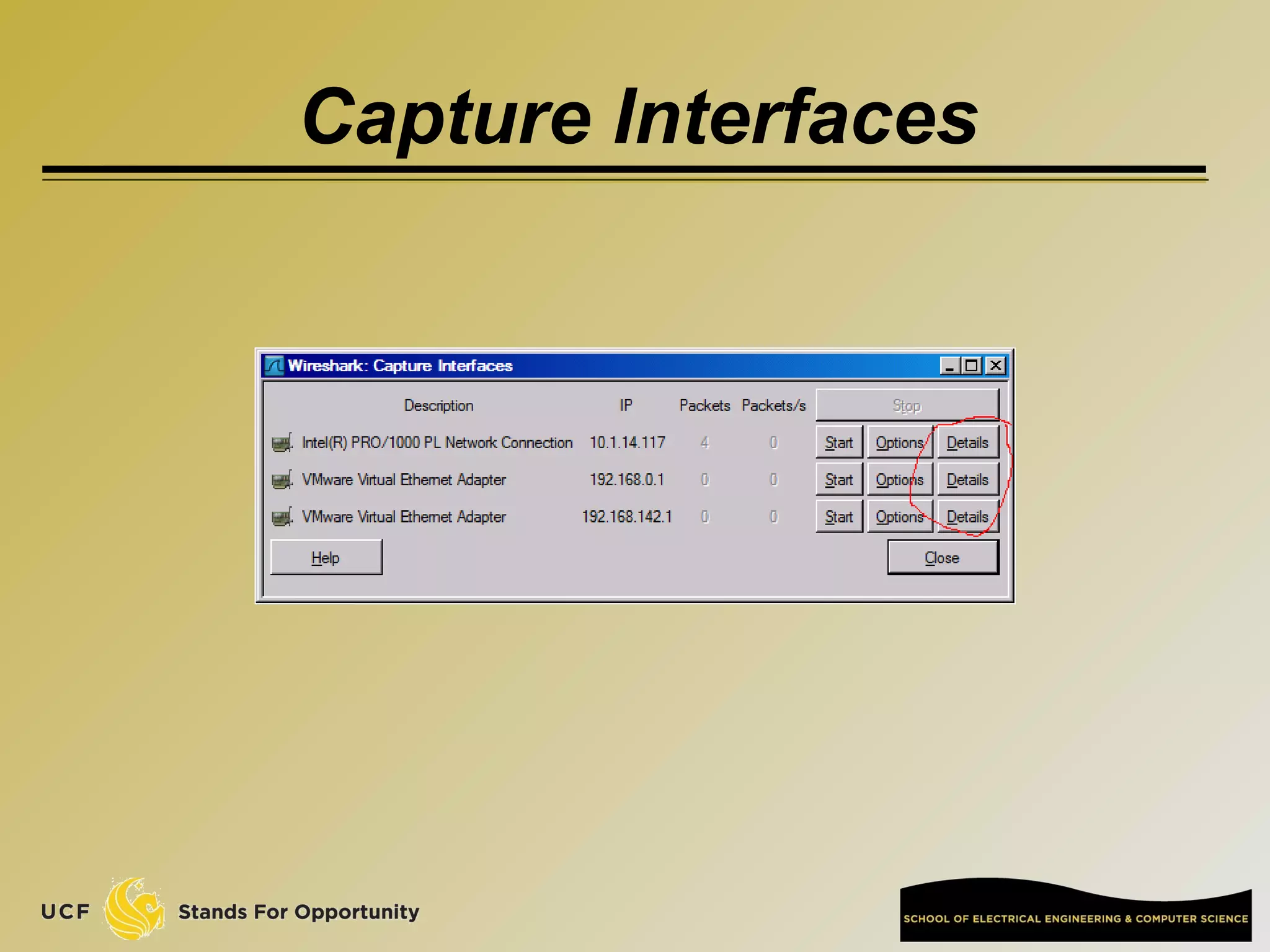
Capture Interfaces
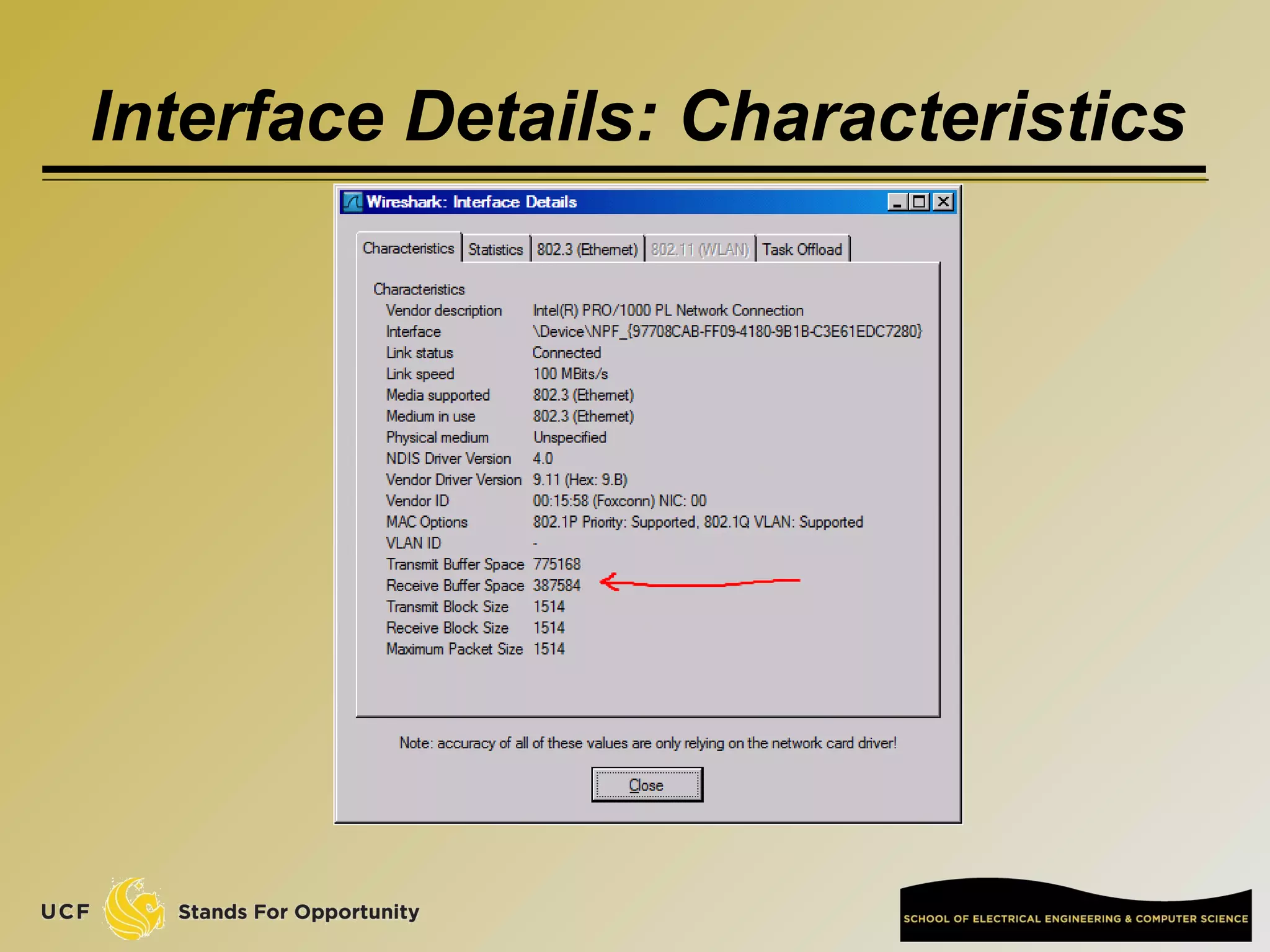
Interface Details: Characteristics
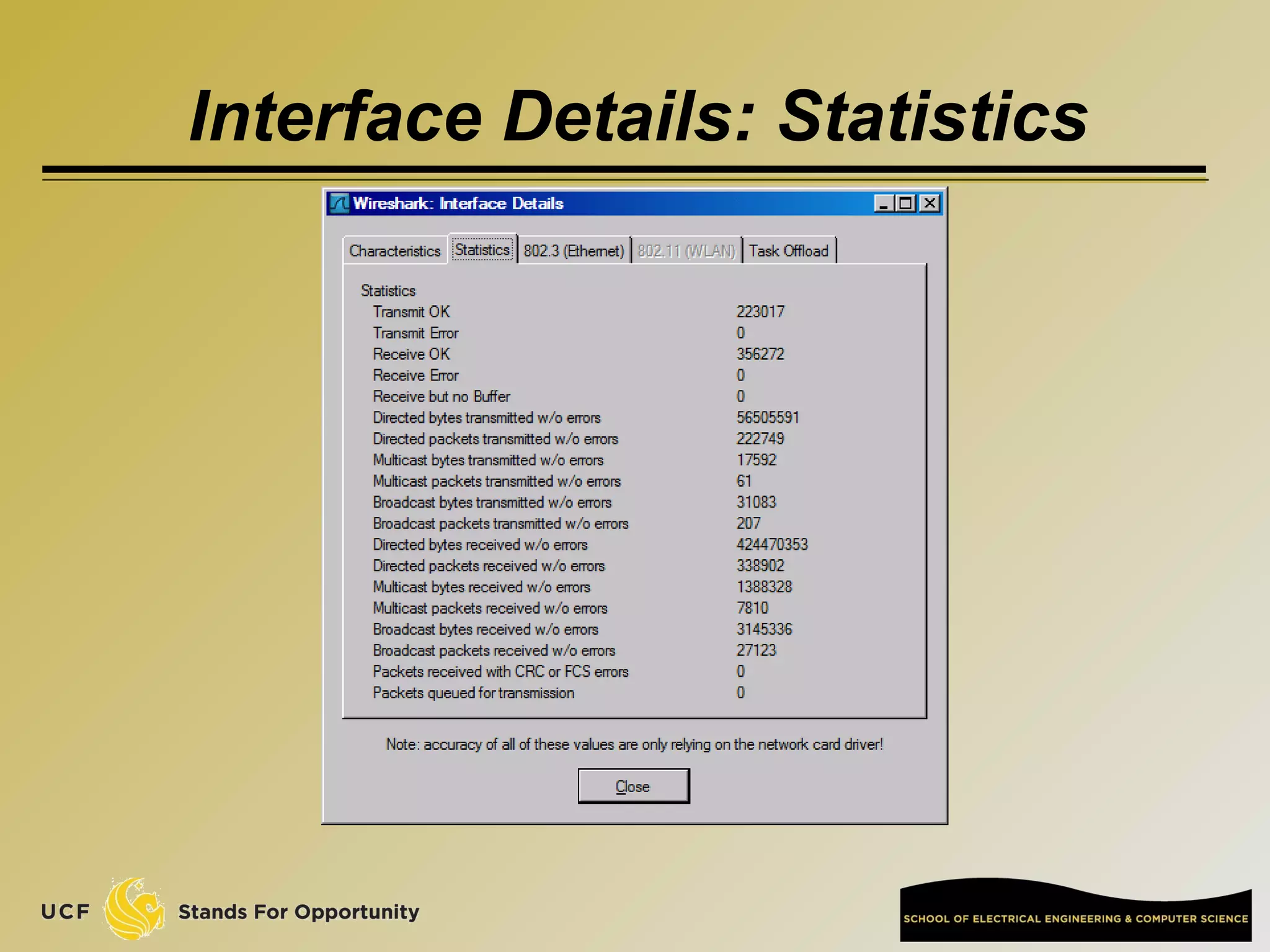
Interface Details: Statistics
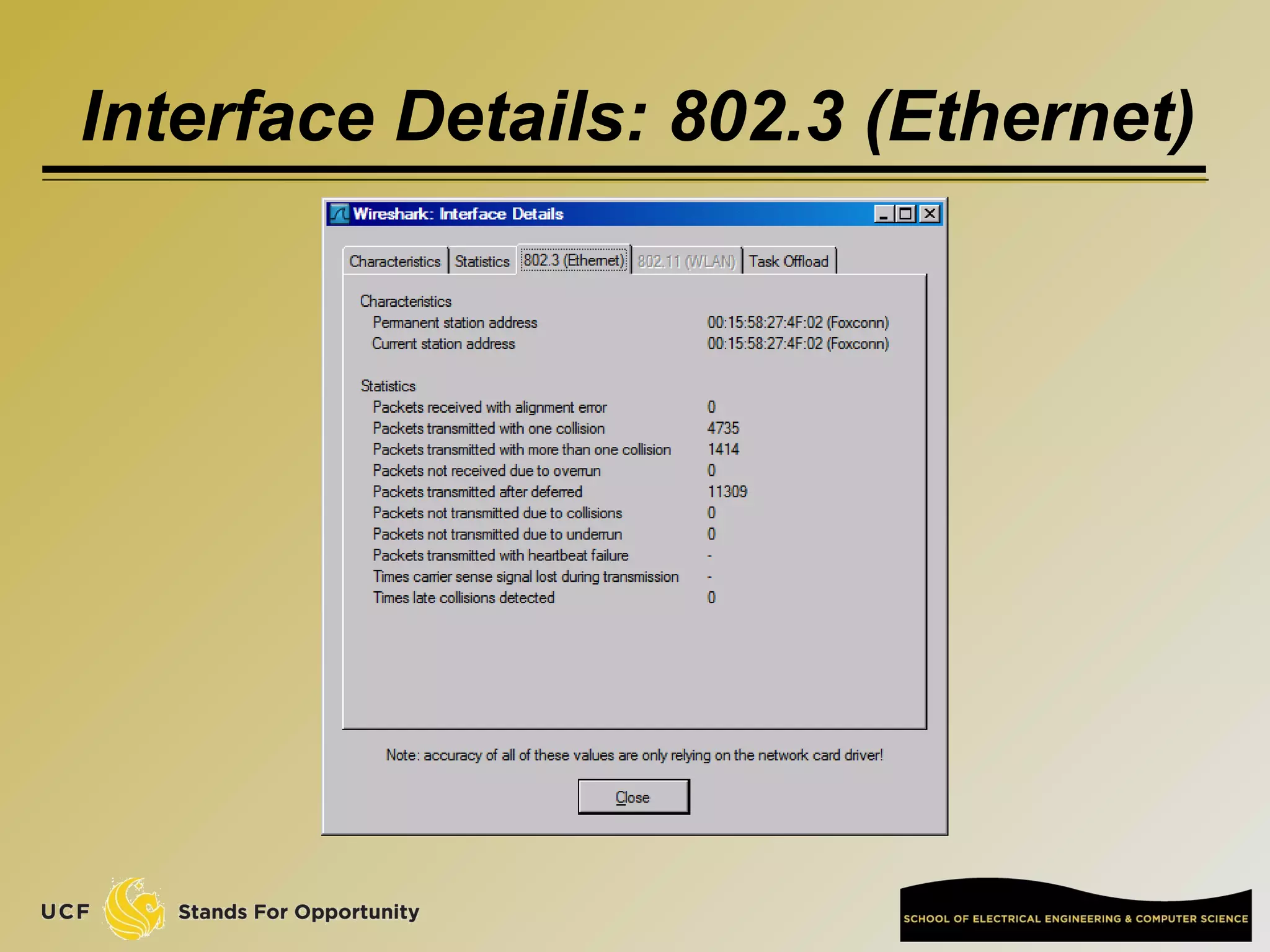
Interface Details: 802.3 (Ethernet)
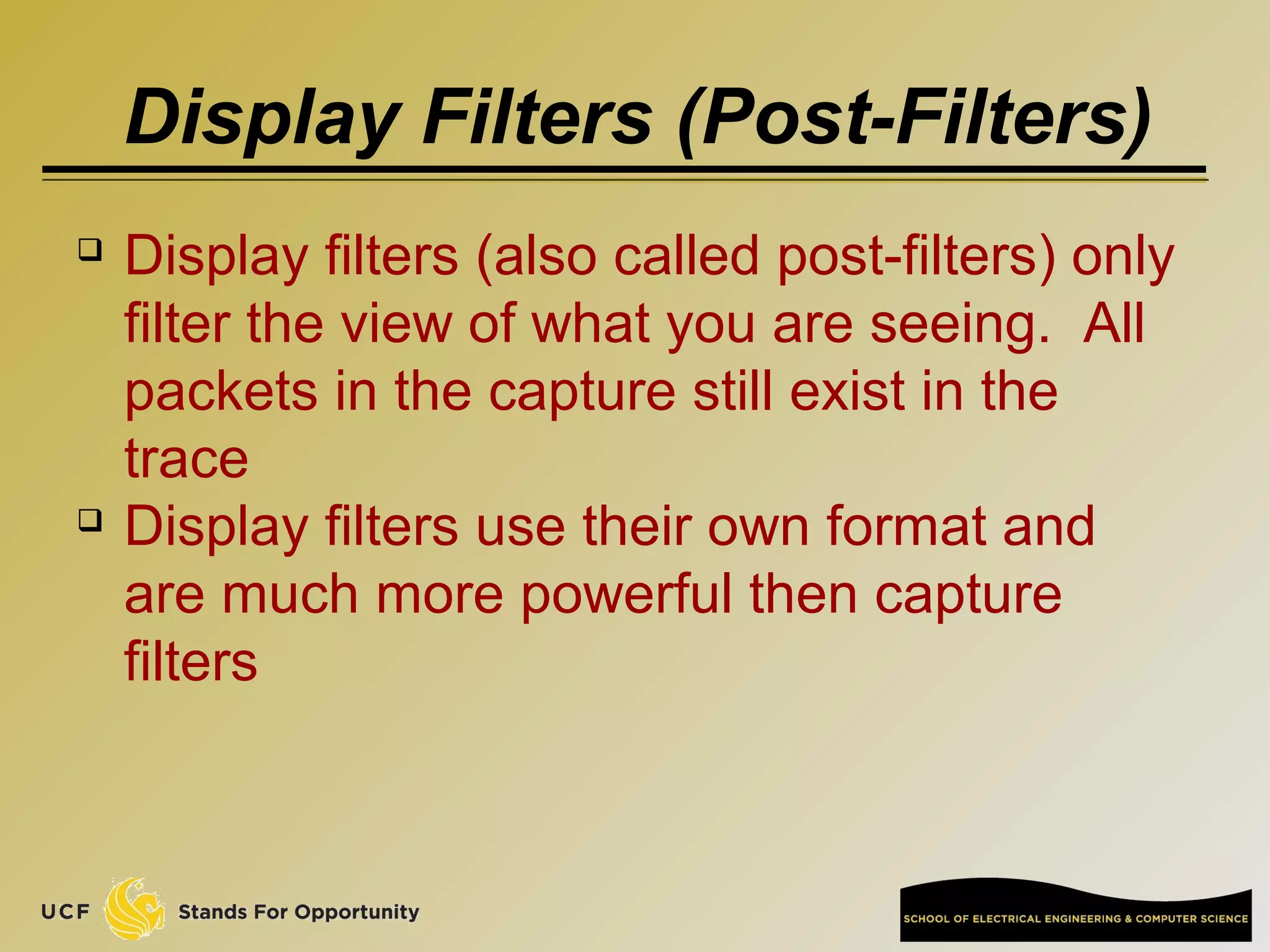
Display Filters (Post-Filters)
 Display filters (also called post-filters) only
filter the view of what you are seeing. All
packets in the capture still exist in the
trace
 Display filters use their own format and
are much more powerful then capture
filters
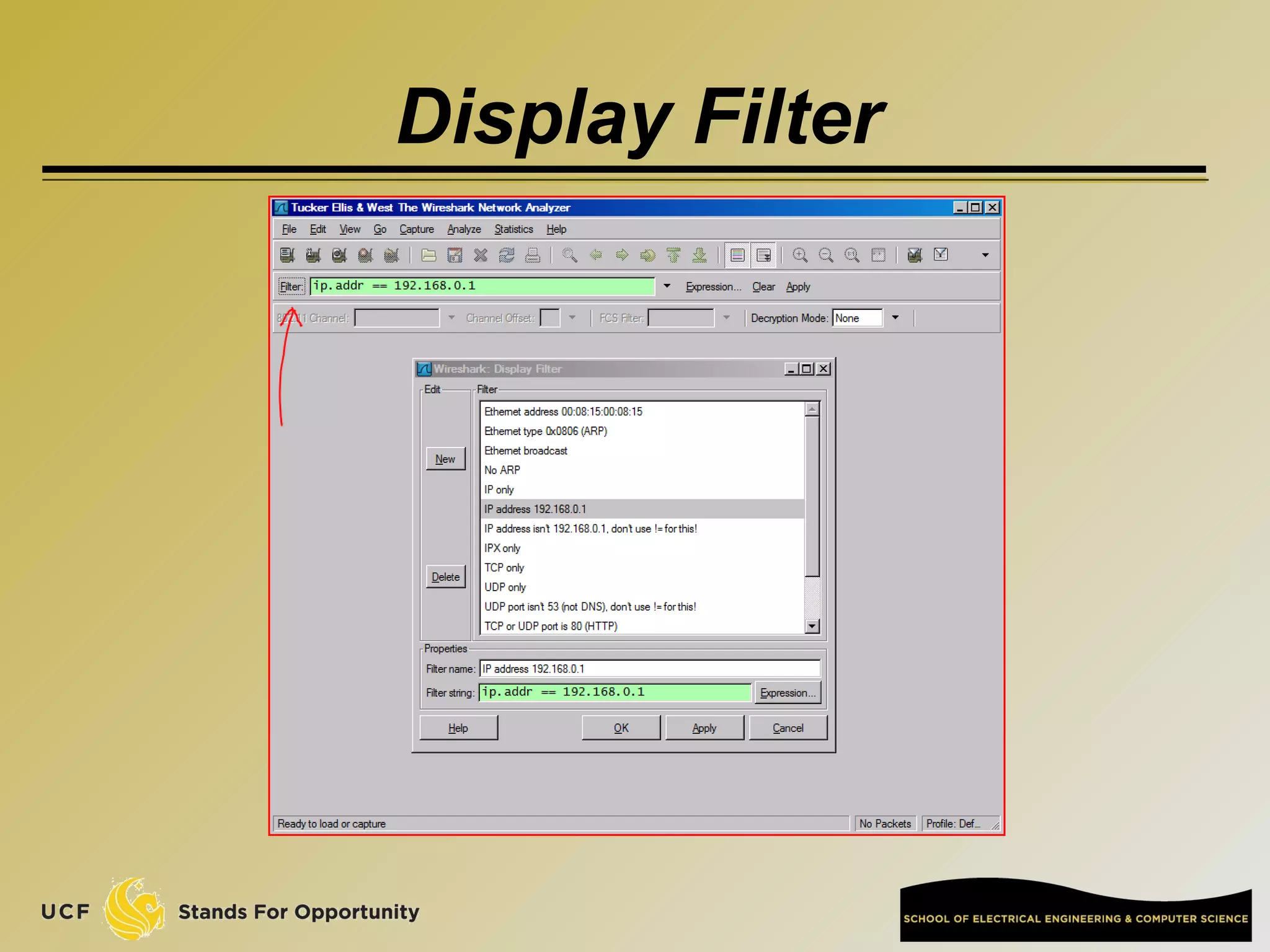
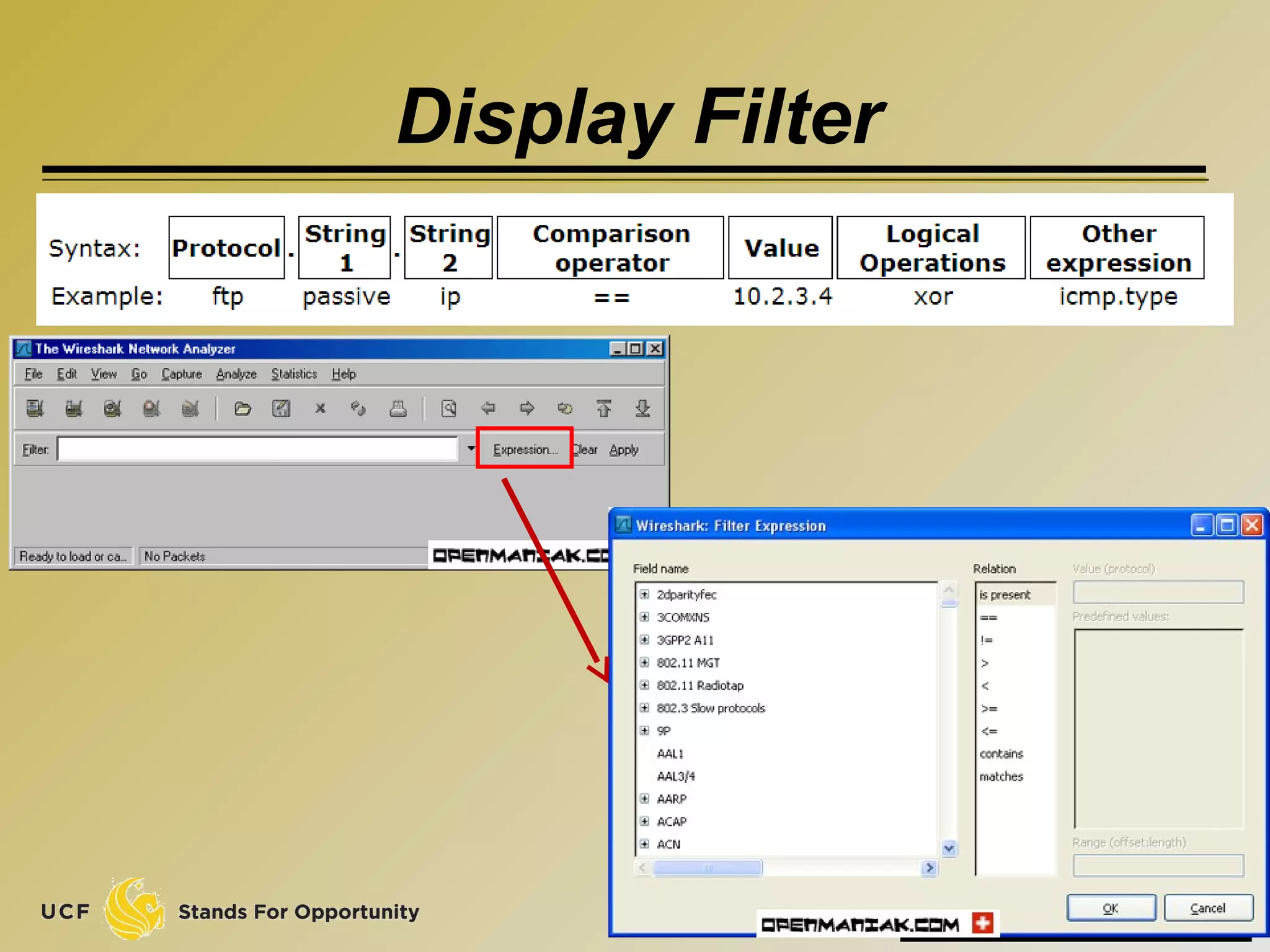
Display Filter
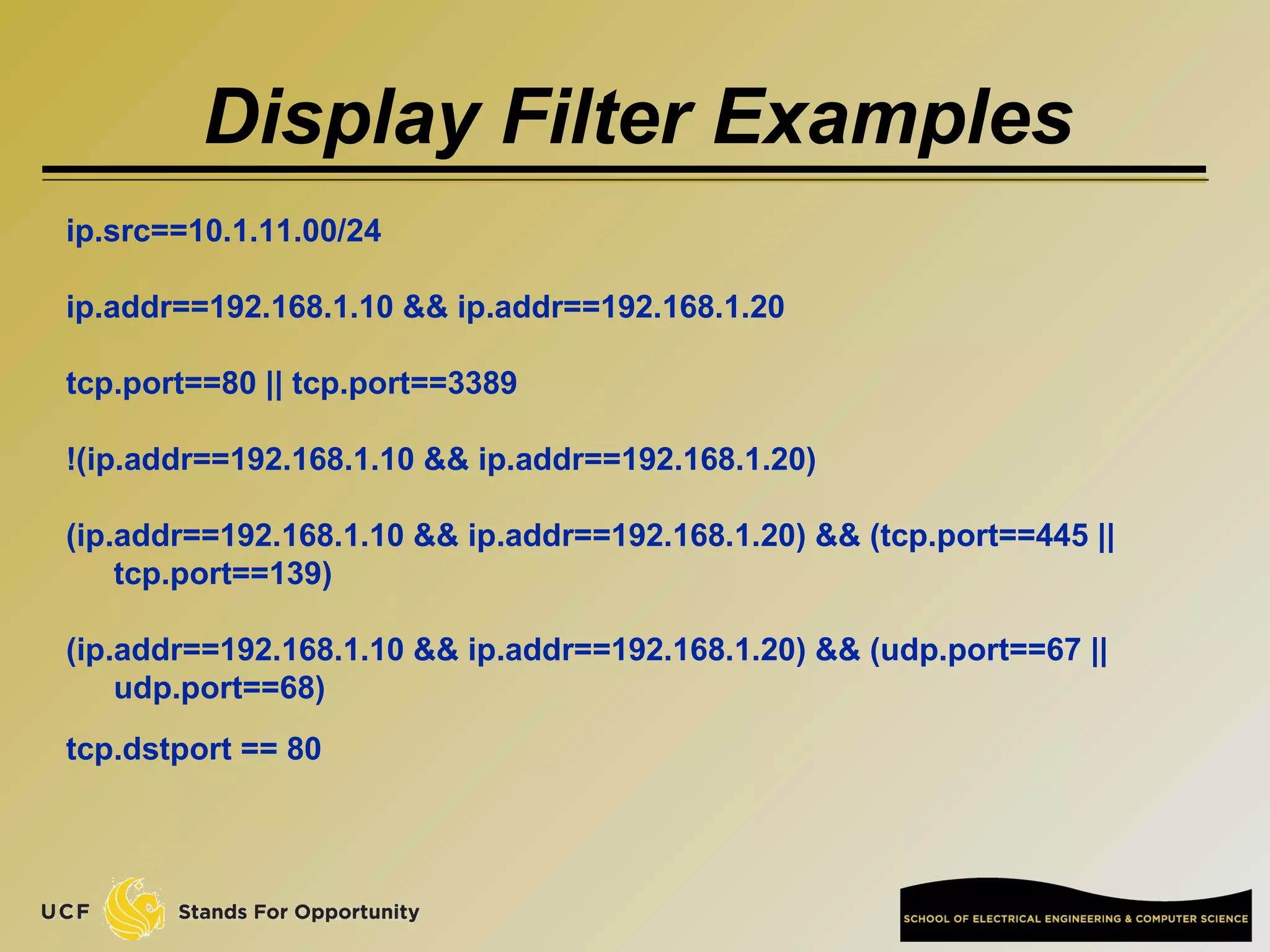
Display Filter Examples
ip.src==10.1.11.00/24
  
ip.addr==192.168.1.10 && ip.addr==192.168.1.20
  
tcp.port==80 || tcp.port==3389
  
!(ip.addr==192.168.1.10 && ip.addr==192.168.1.20) 
  
(ip.addr==192.168.1.10 && ip.addr==192.168.1.20) && (tcp.port==445 || 
tcp.port==139)
 
(ip.addr==192.168.1.10 && ip.addr==192.168.1.20) && (udp.port==67 || 
udp.port==68)
 
tcp.dstport == 80
Display Filter
32
Display Filter
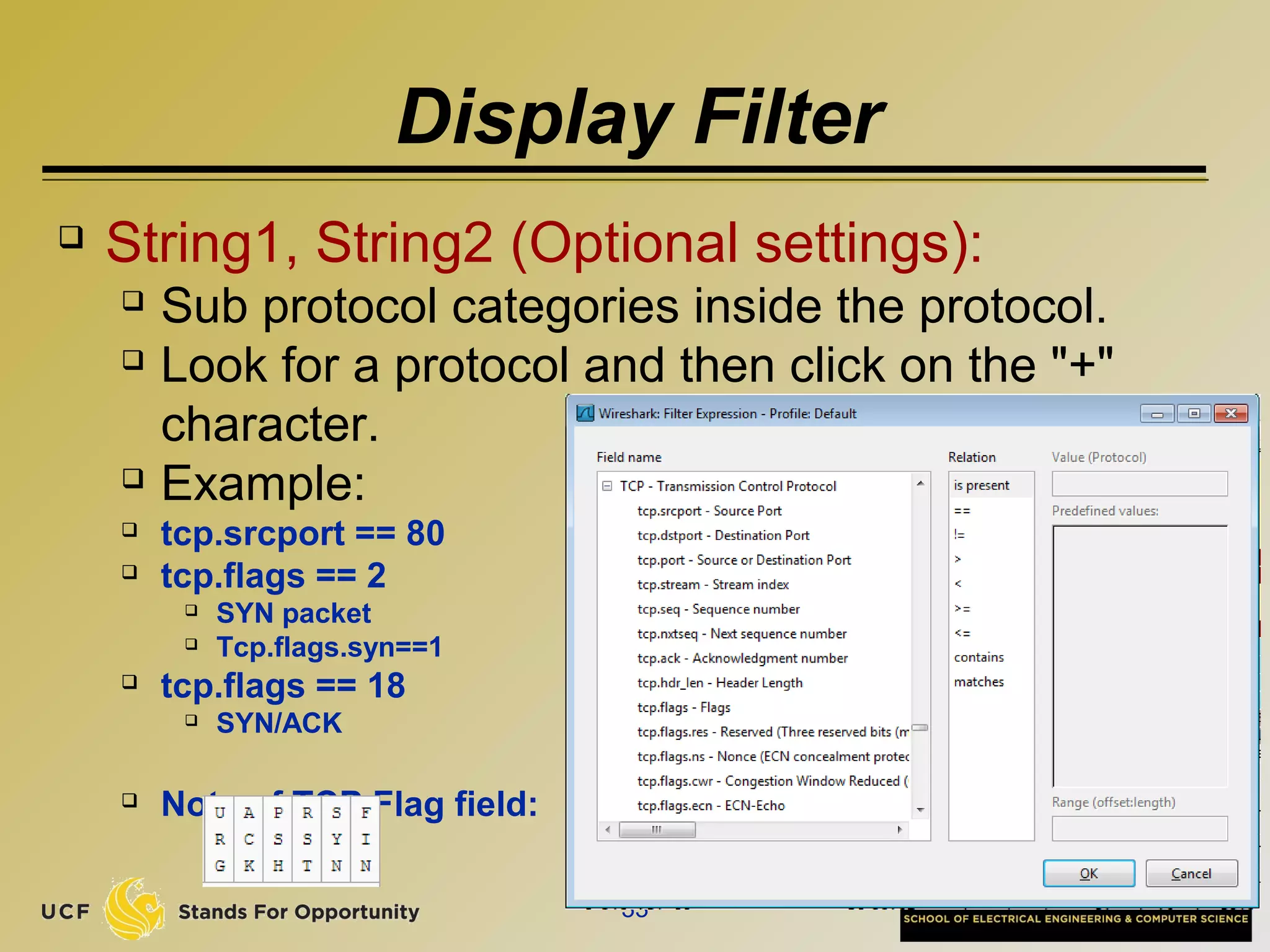
 String1, String2 (Optional settings):
 Sub protocol categories inside the protocol.
 Look for a protocol and then click on the "+"
character.
 Example:
 tcp.srcport == 80
 tcp.flags == 2
 SYN packet
 Tcp.flags.syn==1
 tcp.flags == 18
 SYN/ACK
 Note of TCP Flag field:
33
Display Filter Expressions
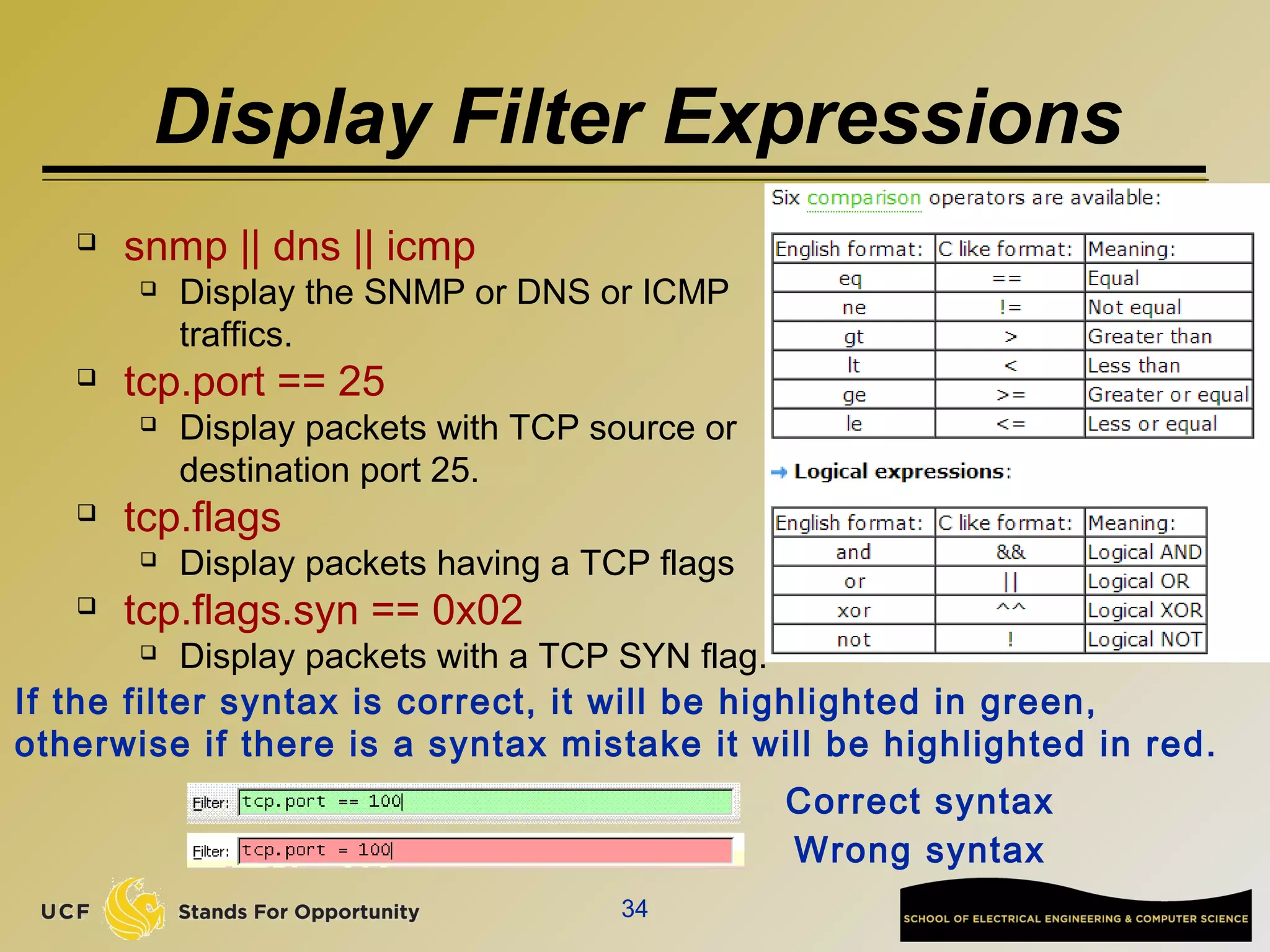
 snmp || dns || icmp
 Display the SNMP or DNS or ICMP
traffics.
 tcp.port == 25
 Display packets with TCP source or
destination port 25.
 tcp.flags
 Display packets having a TCP flags
 tcp.flags.syn == 0x02
 Display packets with a TCP SYN flag.
34
If the filter syntax is correct, it will be highlighted in green,
otherwise if there is a syntax mistake it will be highlighted in red.
Correct syntax
Wrong syntax
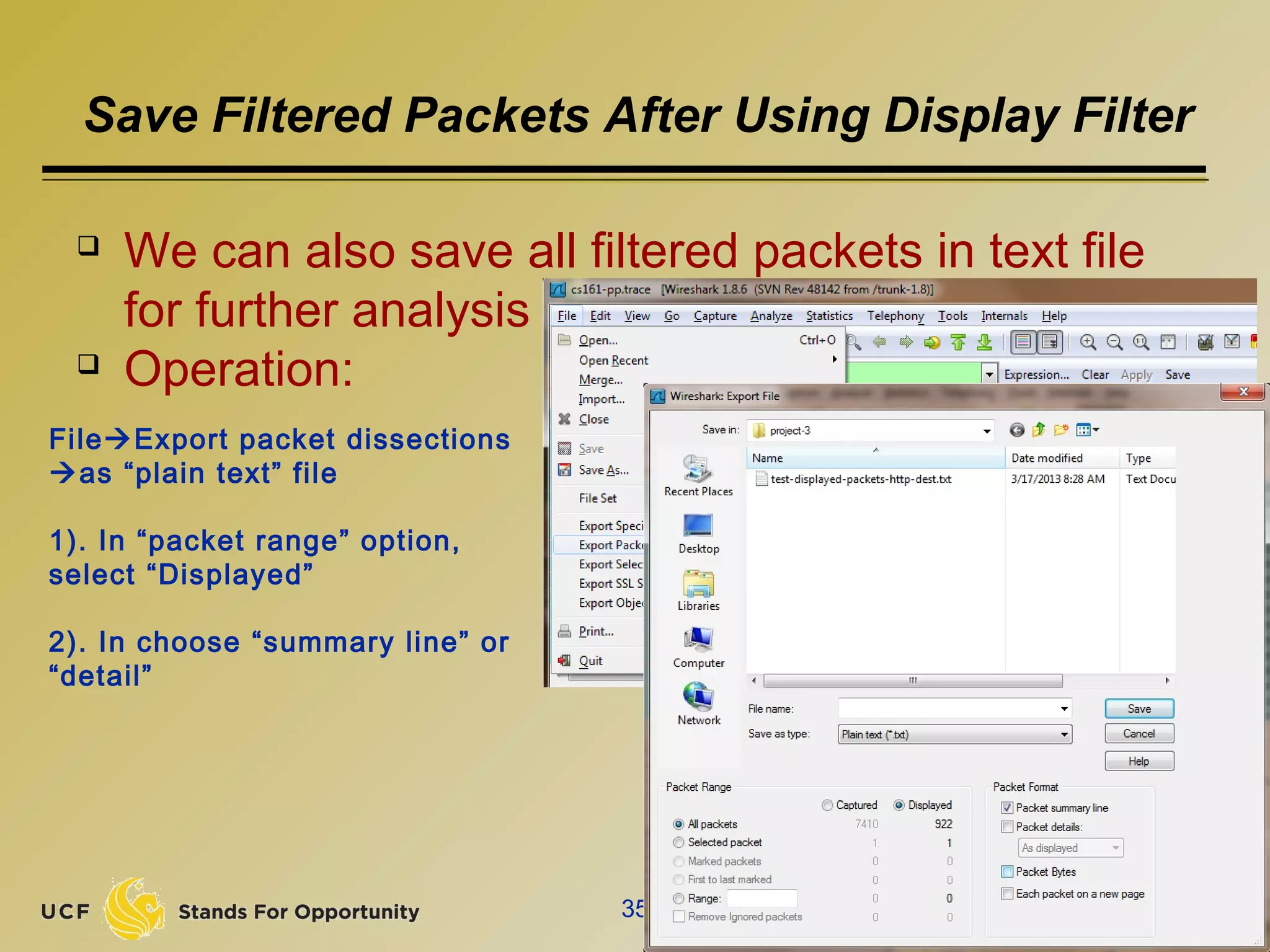
Save Filtered Packets After Using Display Filter
 We can also save all filtered packets in text file
for further analysis
 Operation:
35
FileExport packet dissections
as “plain text” file
1). In “packet range” option,
select “Displayed”
2). In choose “summary line” or
“detail”
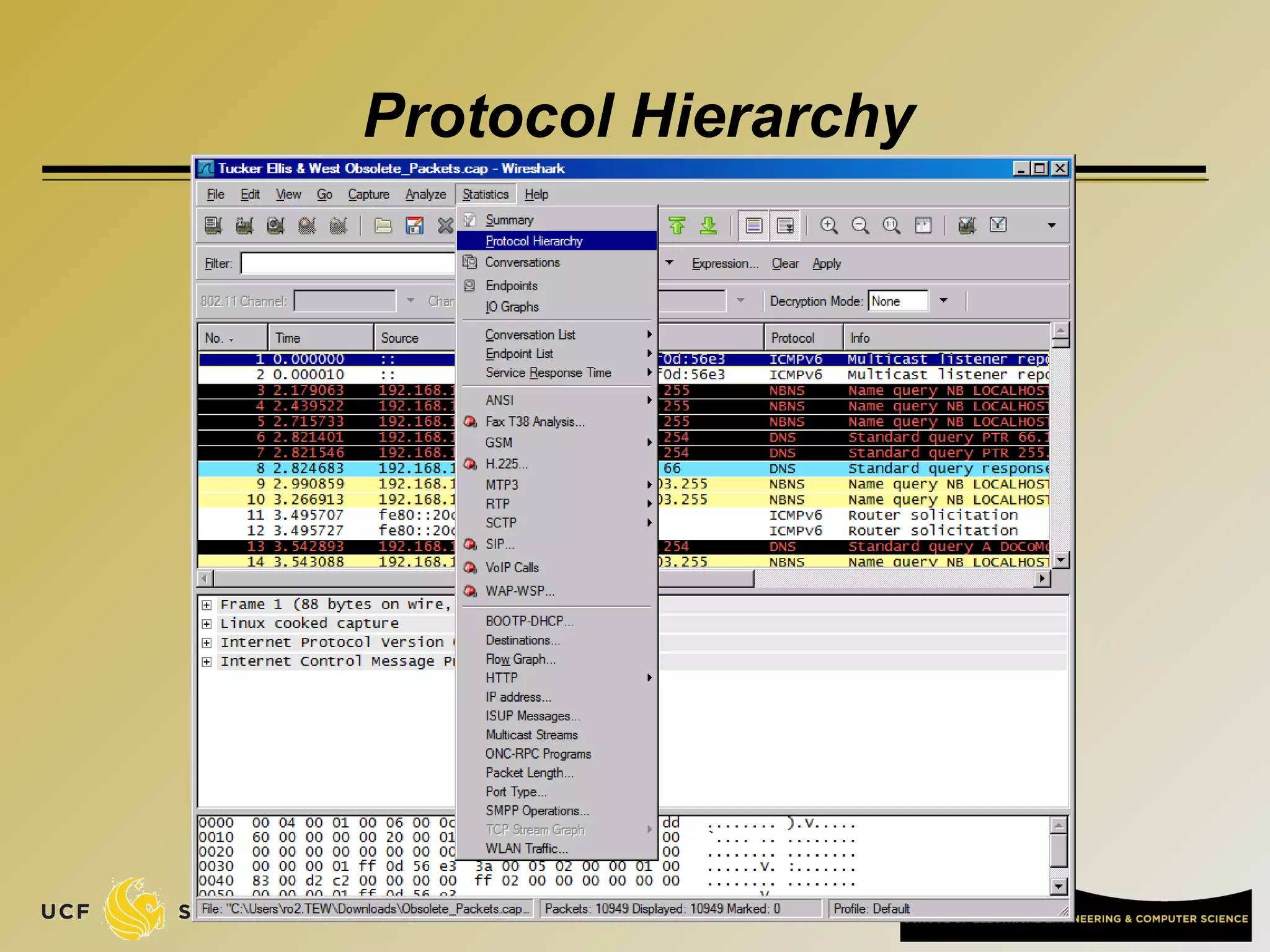
Protocol Hierarchy
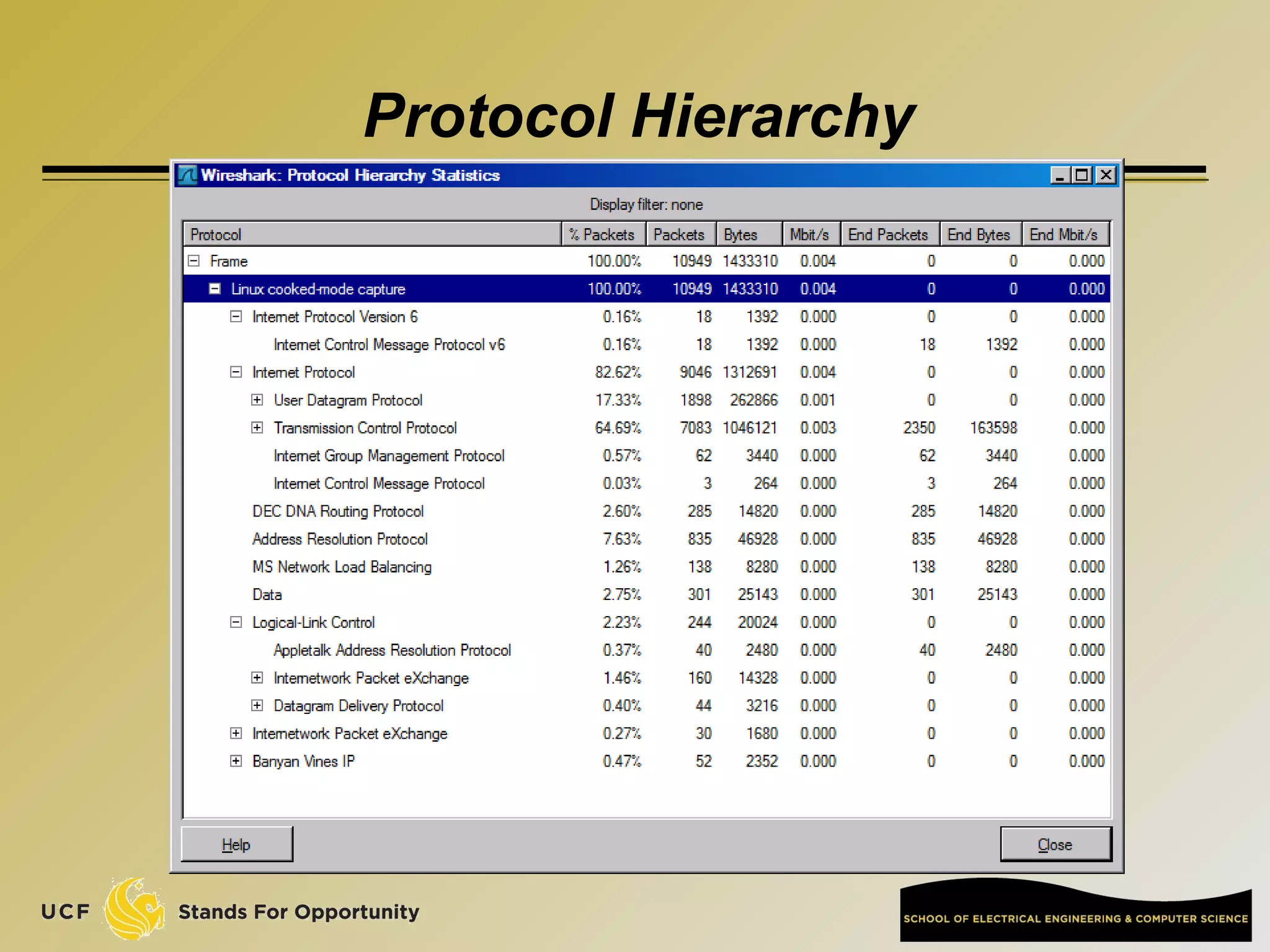
Protocol Hierarchy
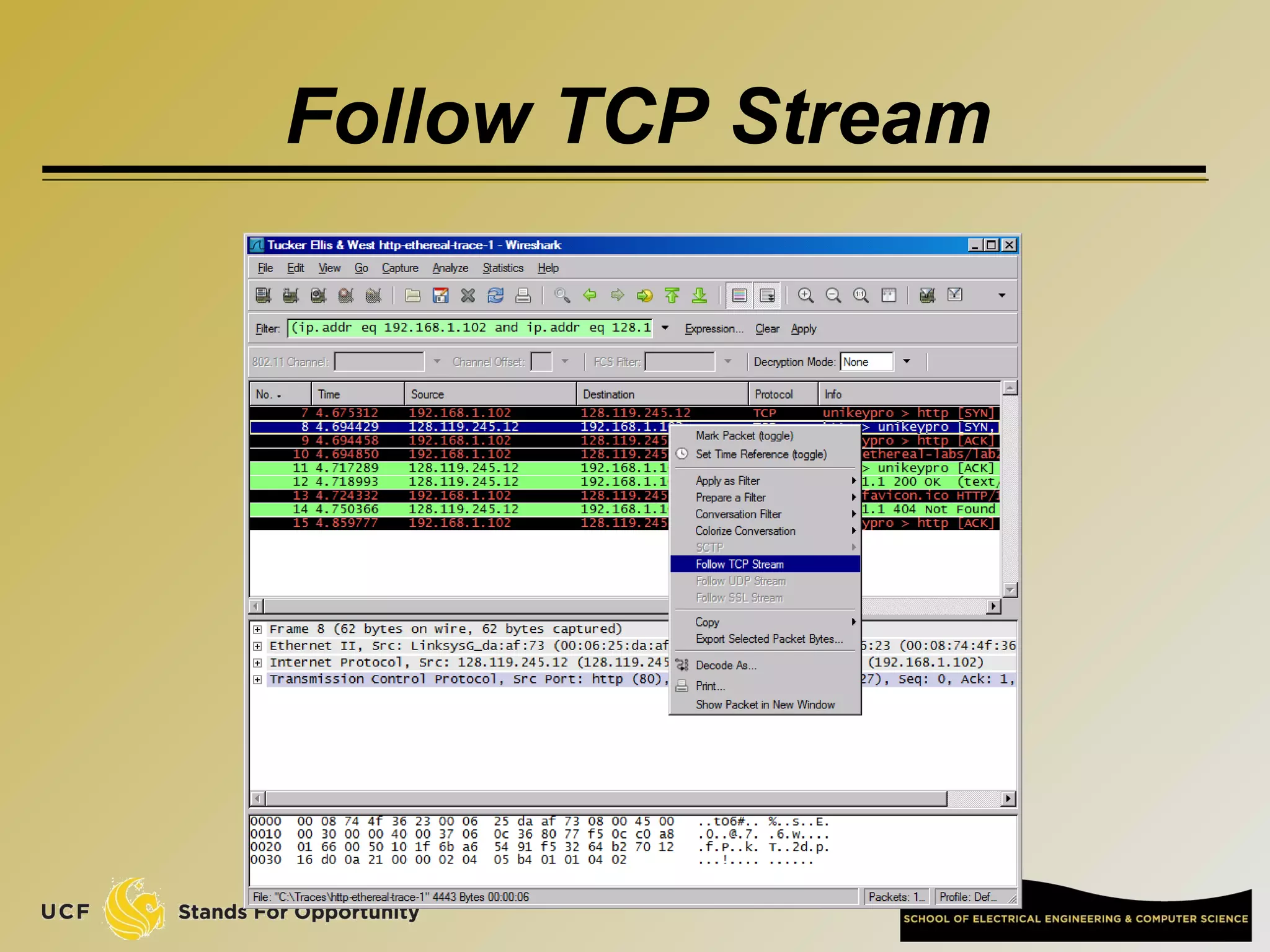
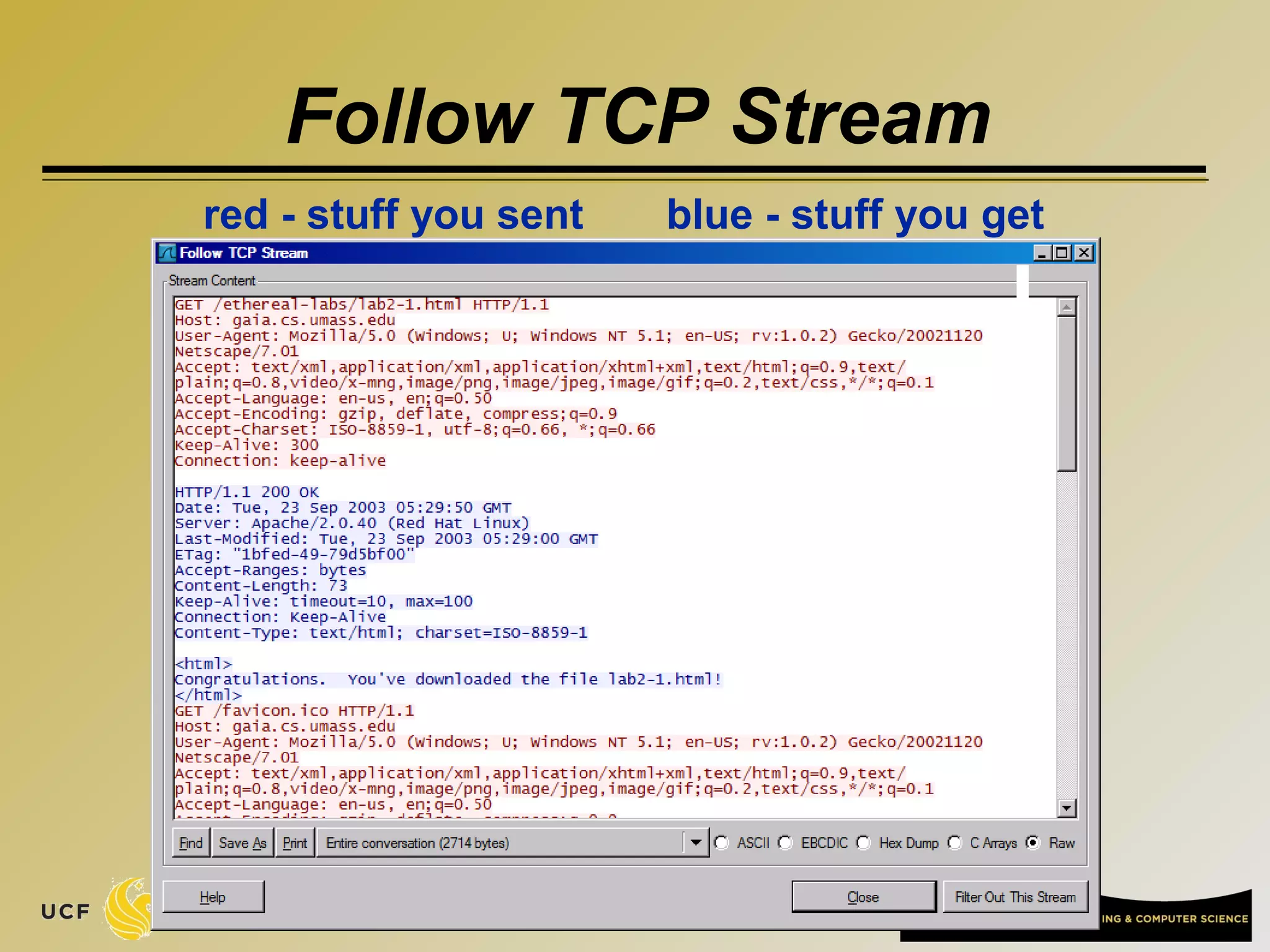
Follow TCP Stream
Follow TCP Stream
red - stuff you sent       blue - stuff you get
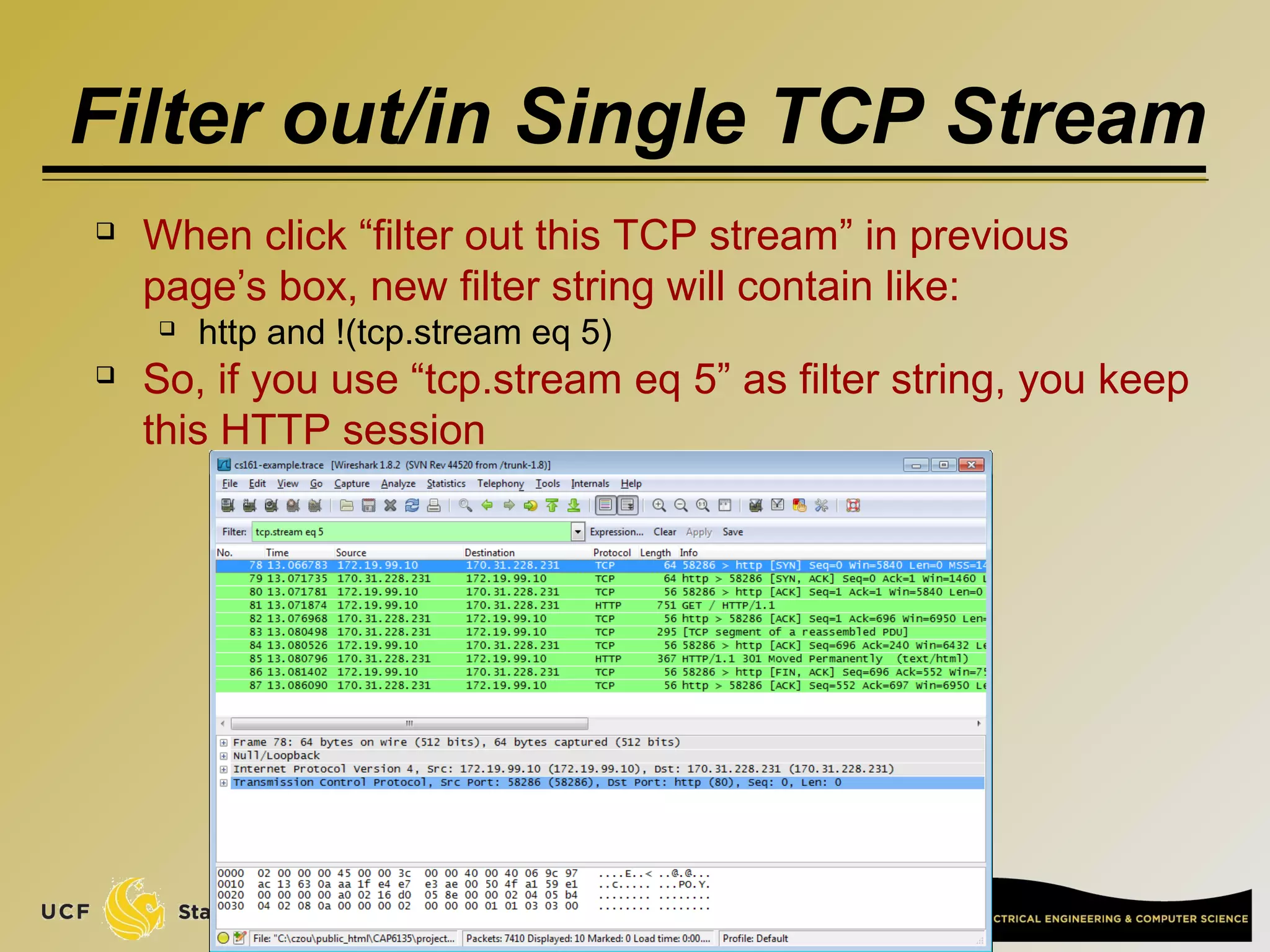
Filter out/in Single TCP Stream
 When click “filter out this TCP stream” in previous
page’s box, new filter string will contain like:
 http and !(tcp.stream eq 5)
 So, if you use “tcp.stream eq 5” as filter string, you keep
this HTTP session
40
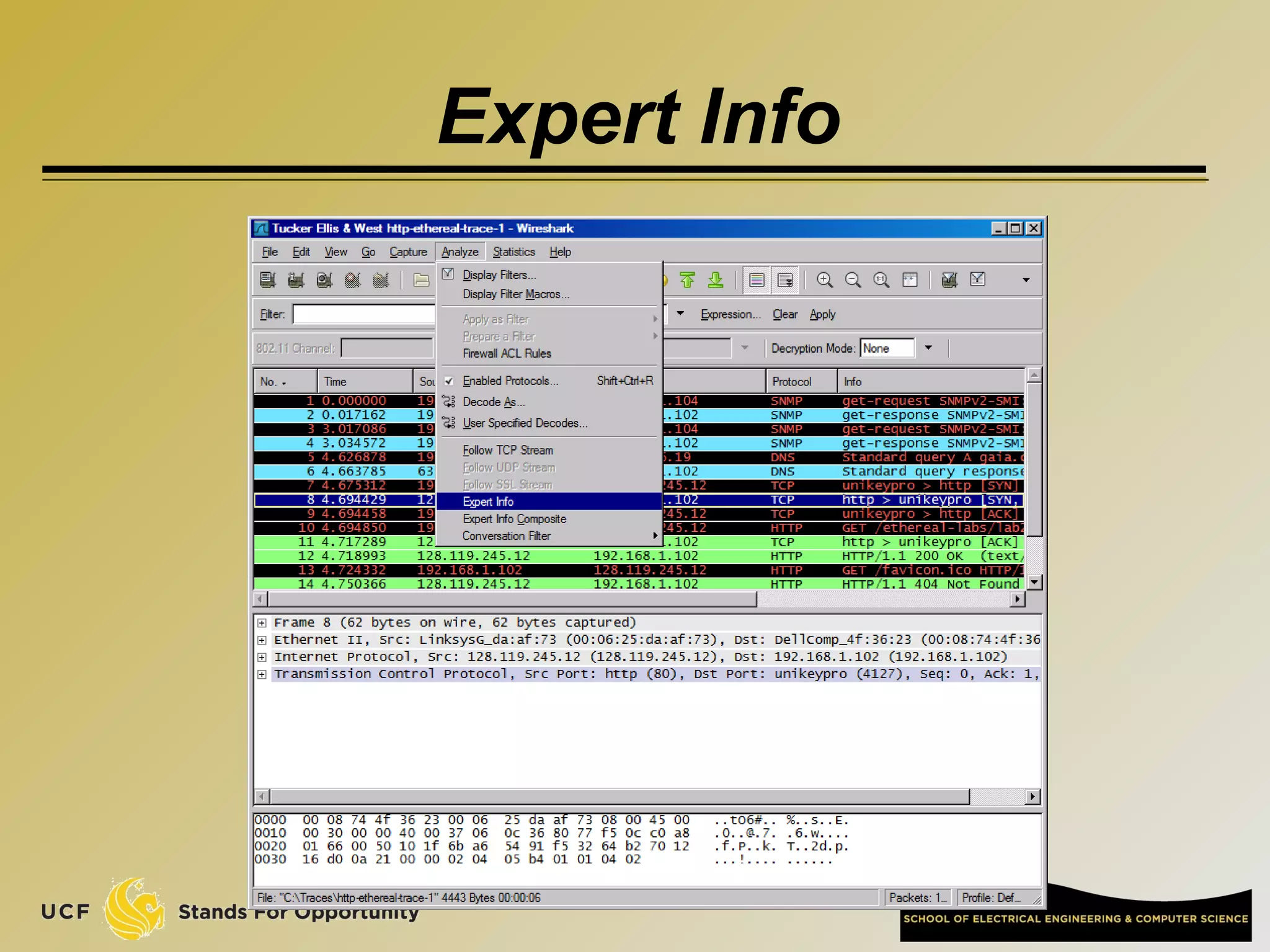
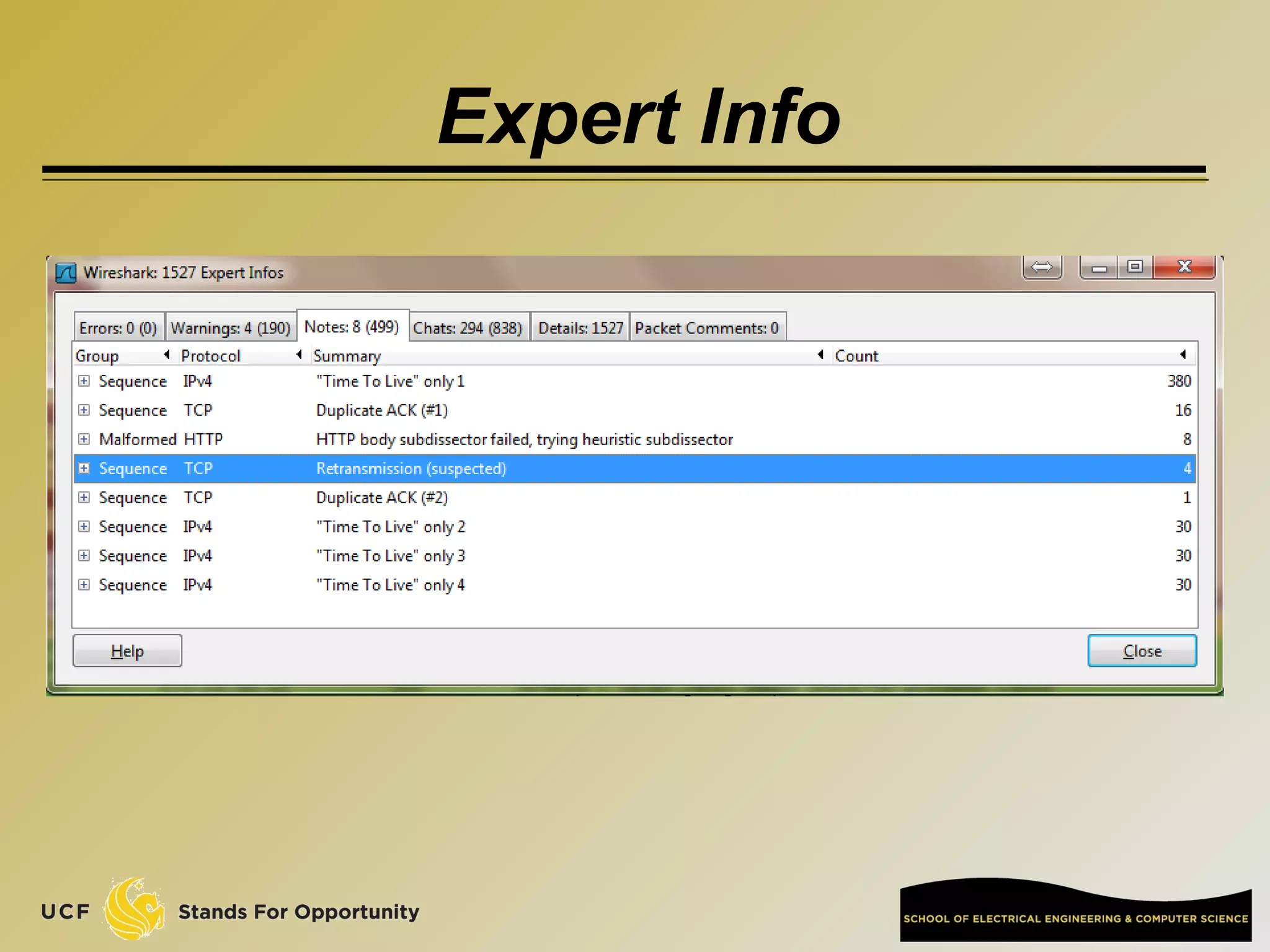
Expert Info
Expert Info
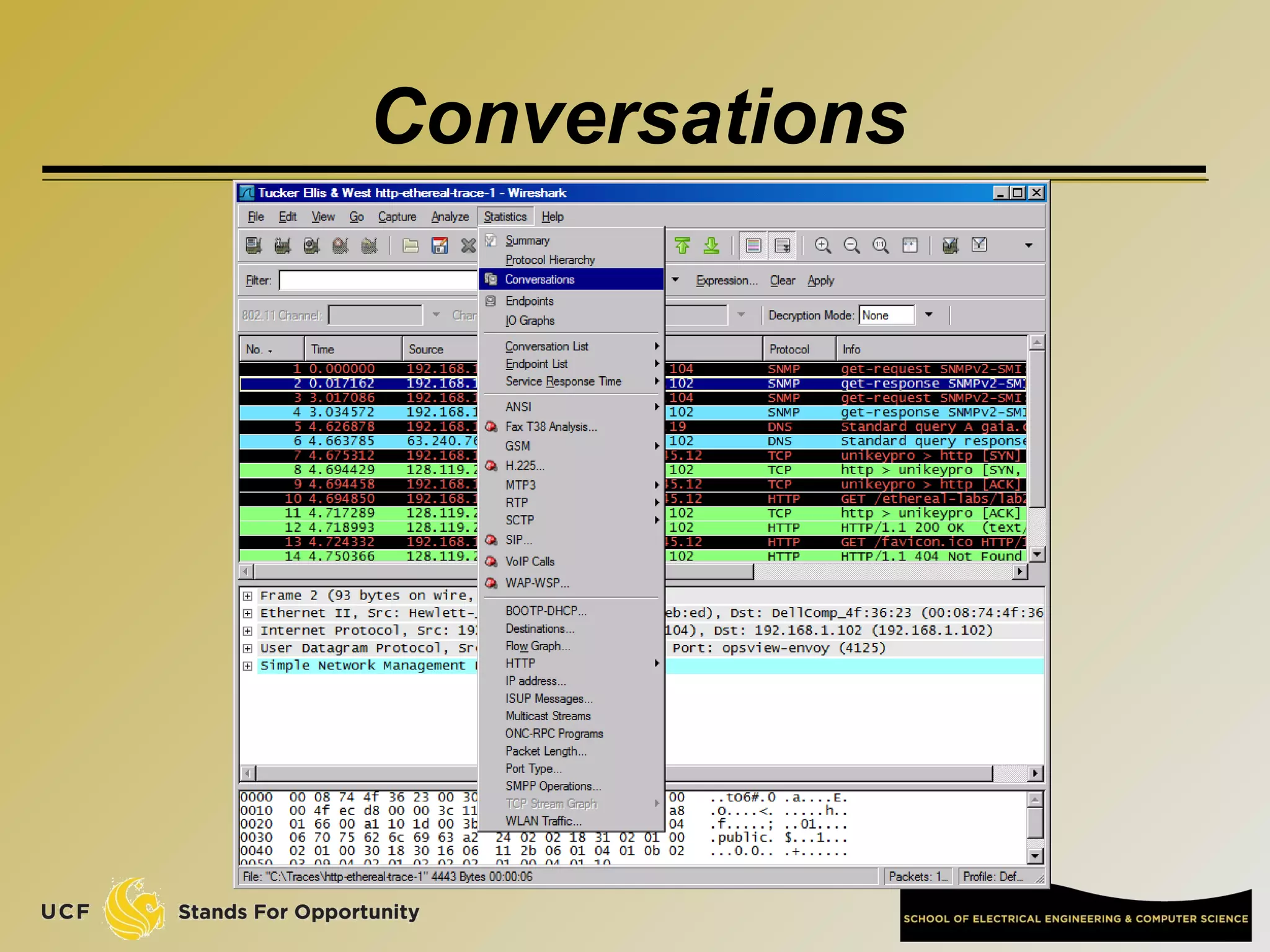
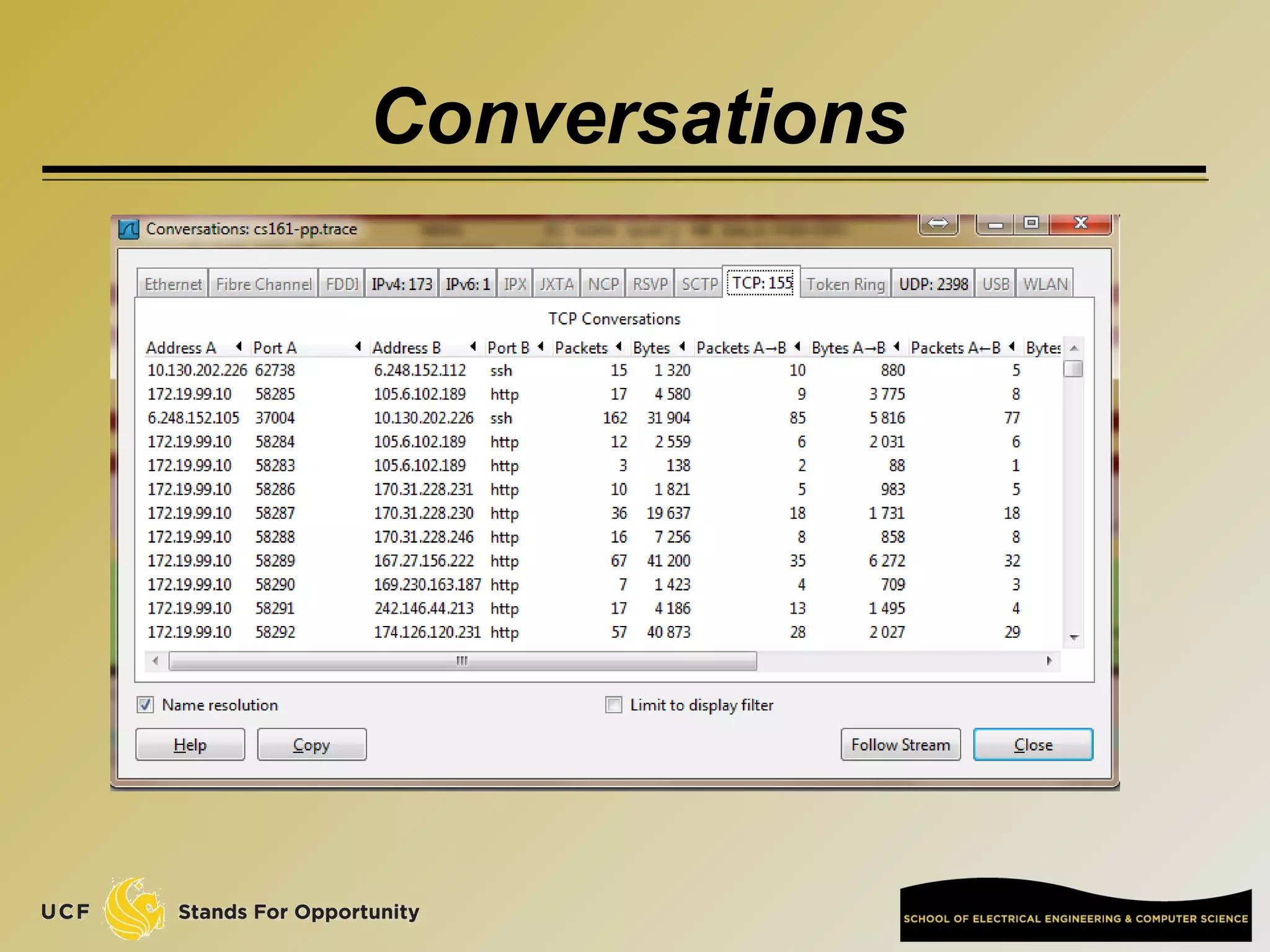
Conversations
Conversations
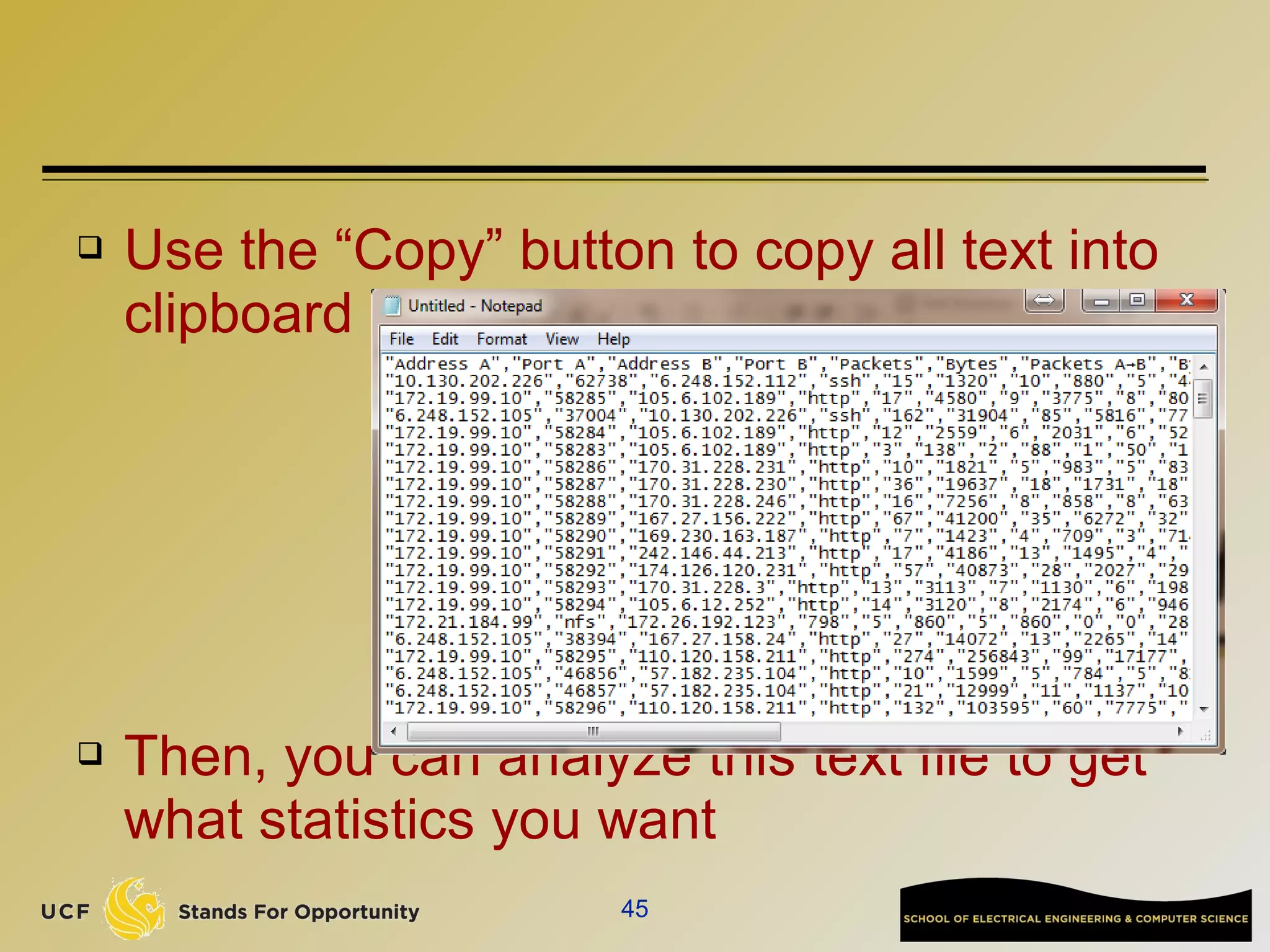
 Use the “Copy” button to copy all text into
clipboard
 Then, you can analyze this text file to get
what statistics you want
45
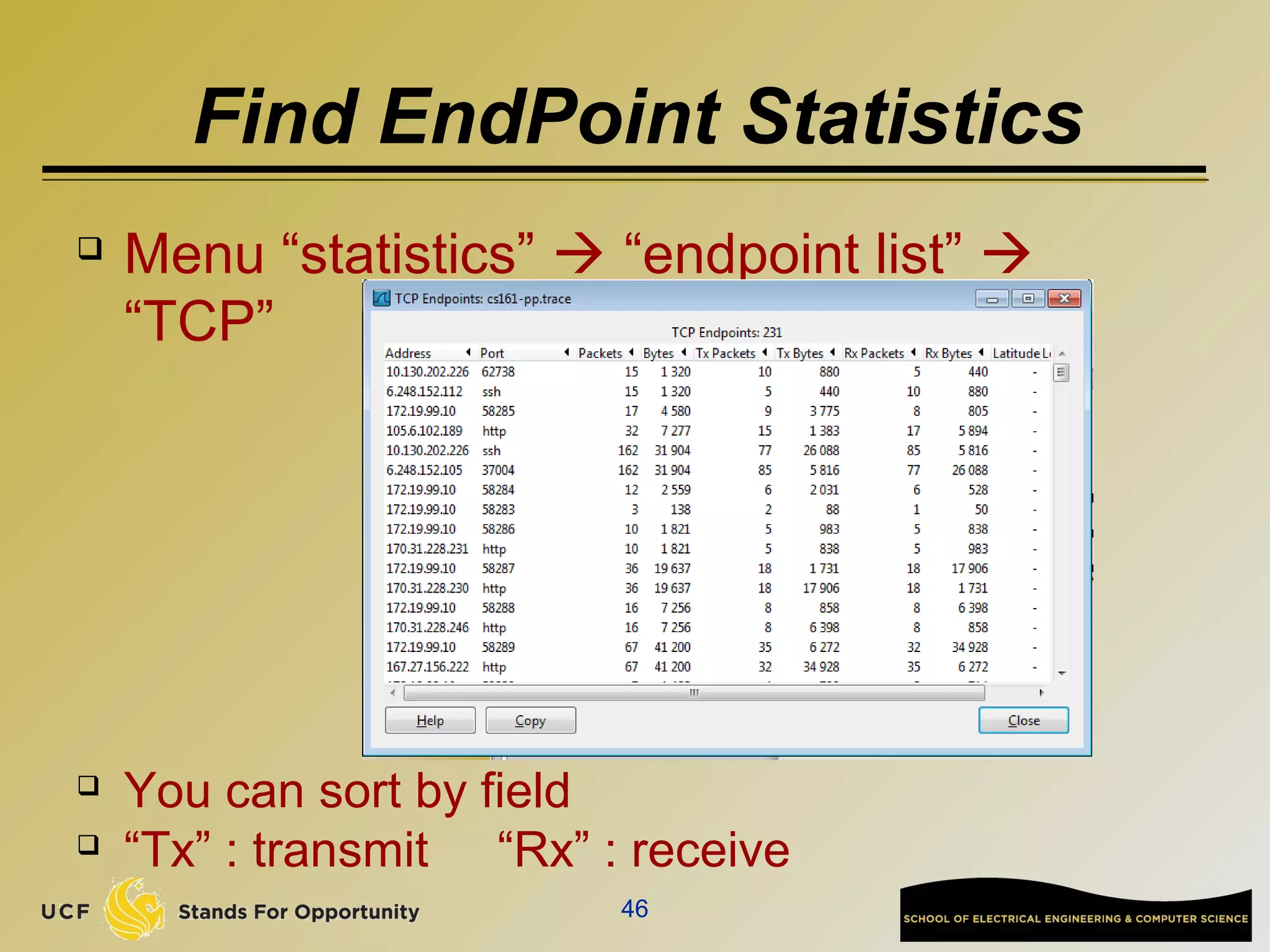
Find EndPoint Statistics
 Menu “statistics”  “endpoint list” 
“TCP”
 You can sort by field
 “Tx” : transmit “Rx” : receive
46
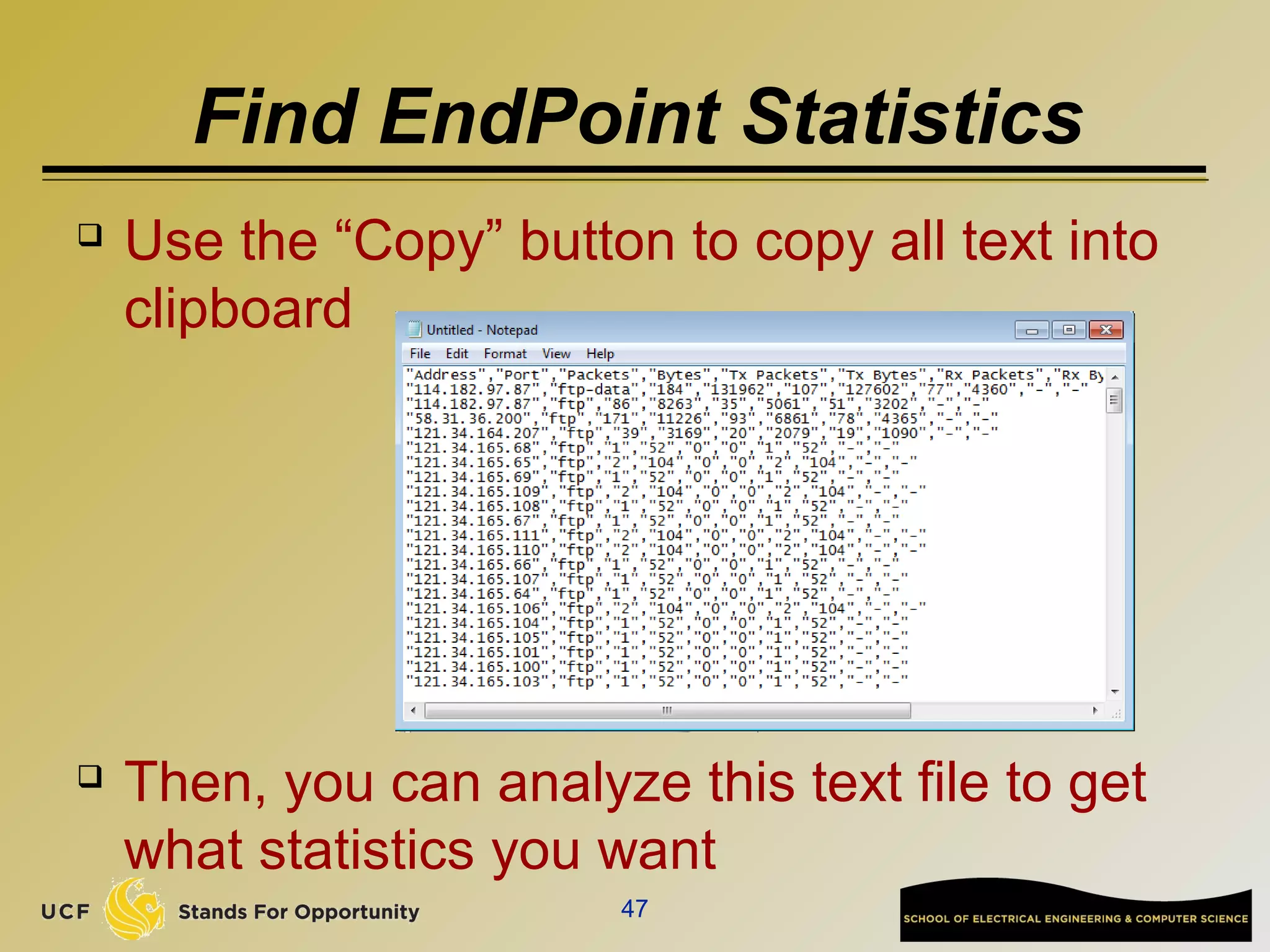
Find EndPoint Statistics
 Use the “Copy” button to copy all text into
clipboard
 Then, you can analyze this text file to get
what statistics you want
47
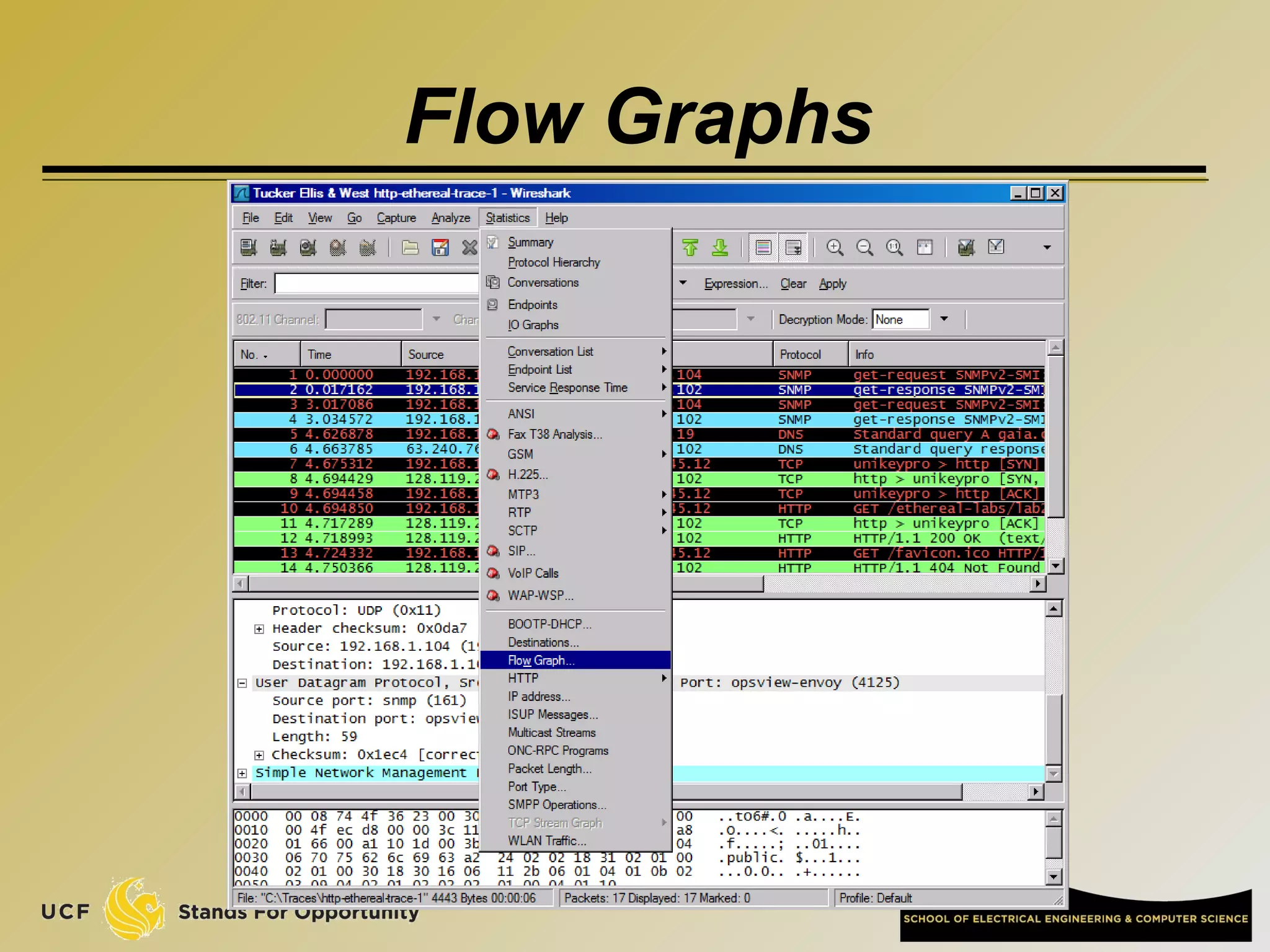
Flow Graphs
Flow Graphs
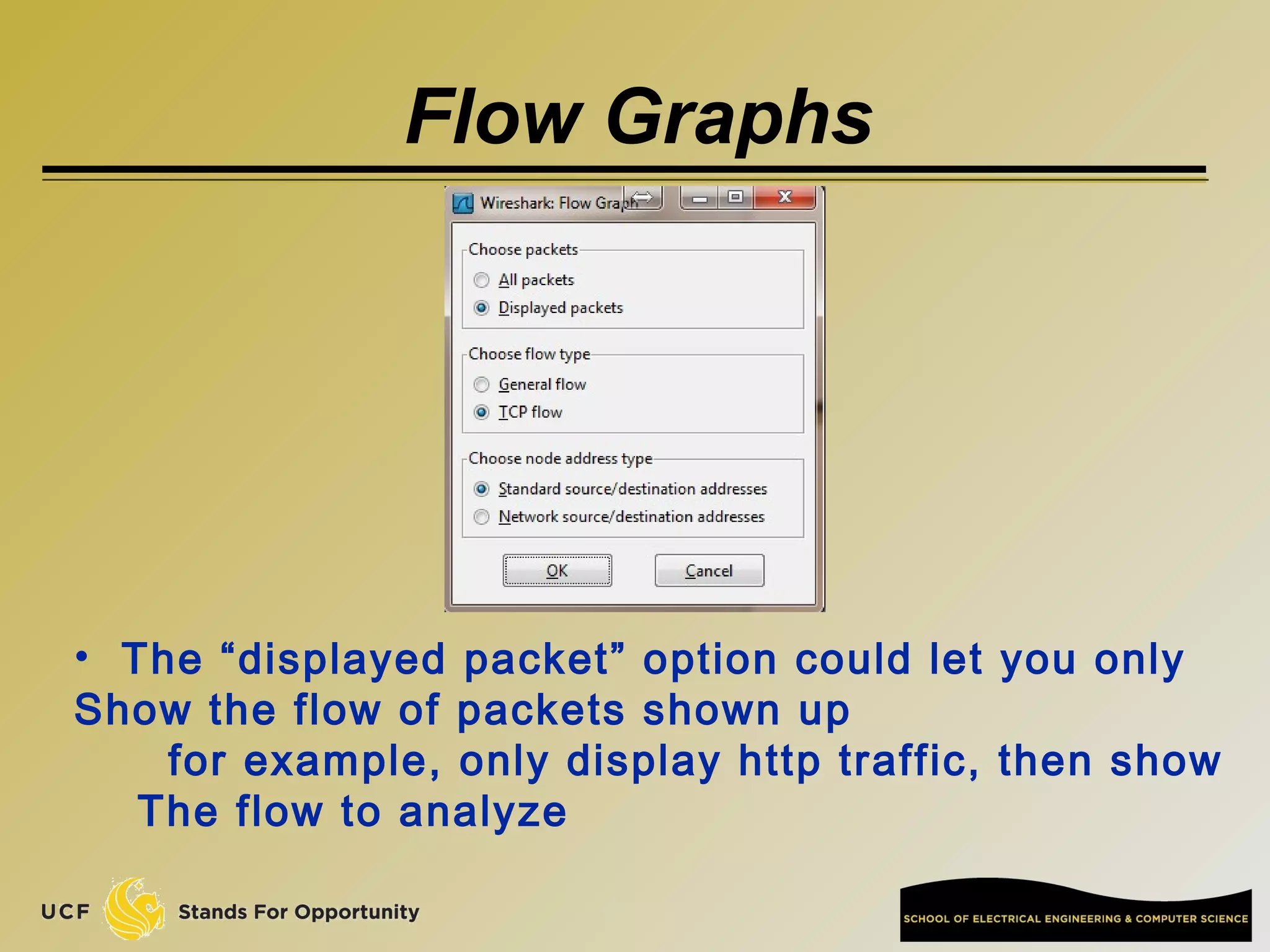
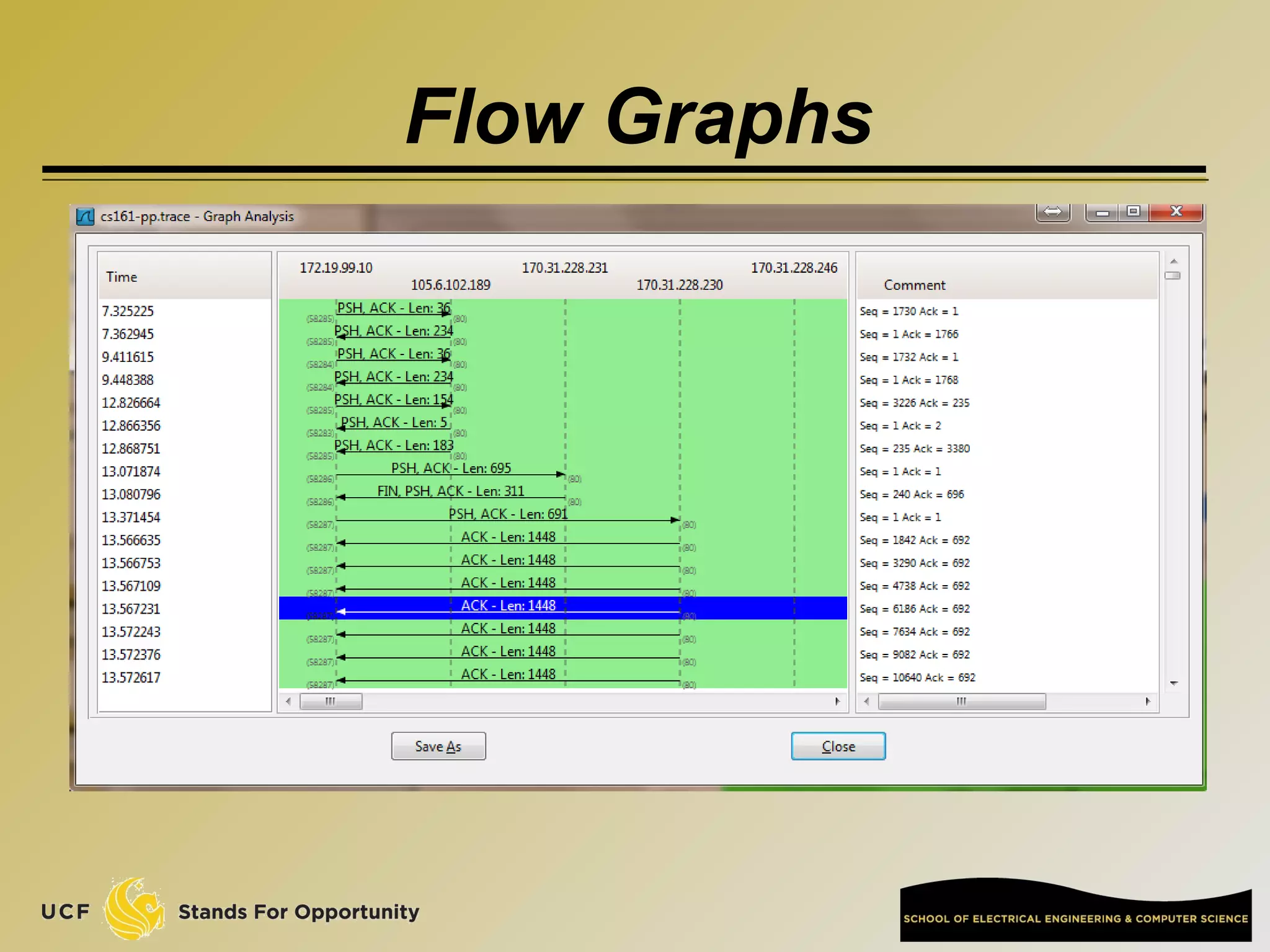
• The “displayed packet” option could let you only
Show the flow of packets shown up
for example, only display http traffic, then show
The flow to analyze
Flow Graphs
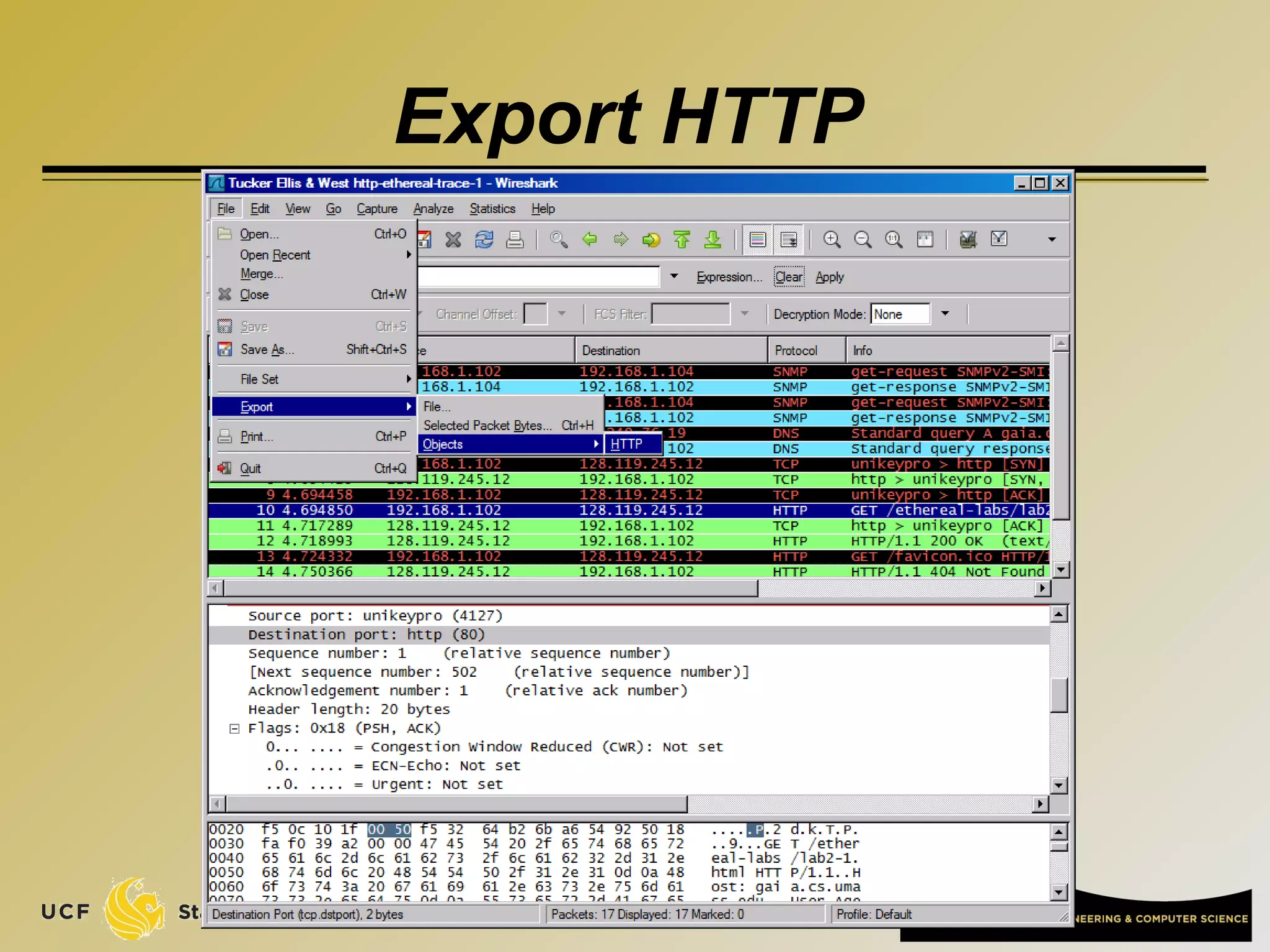
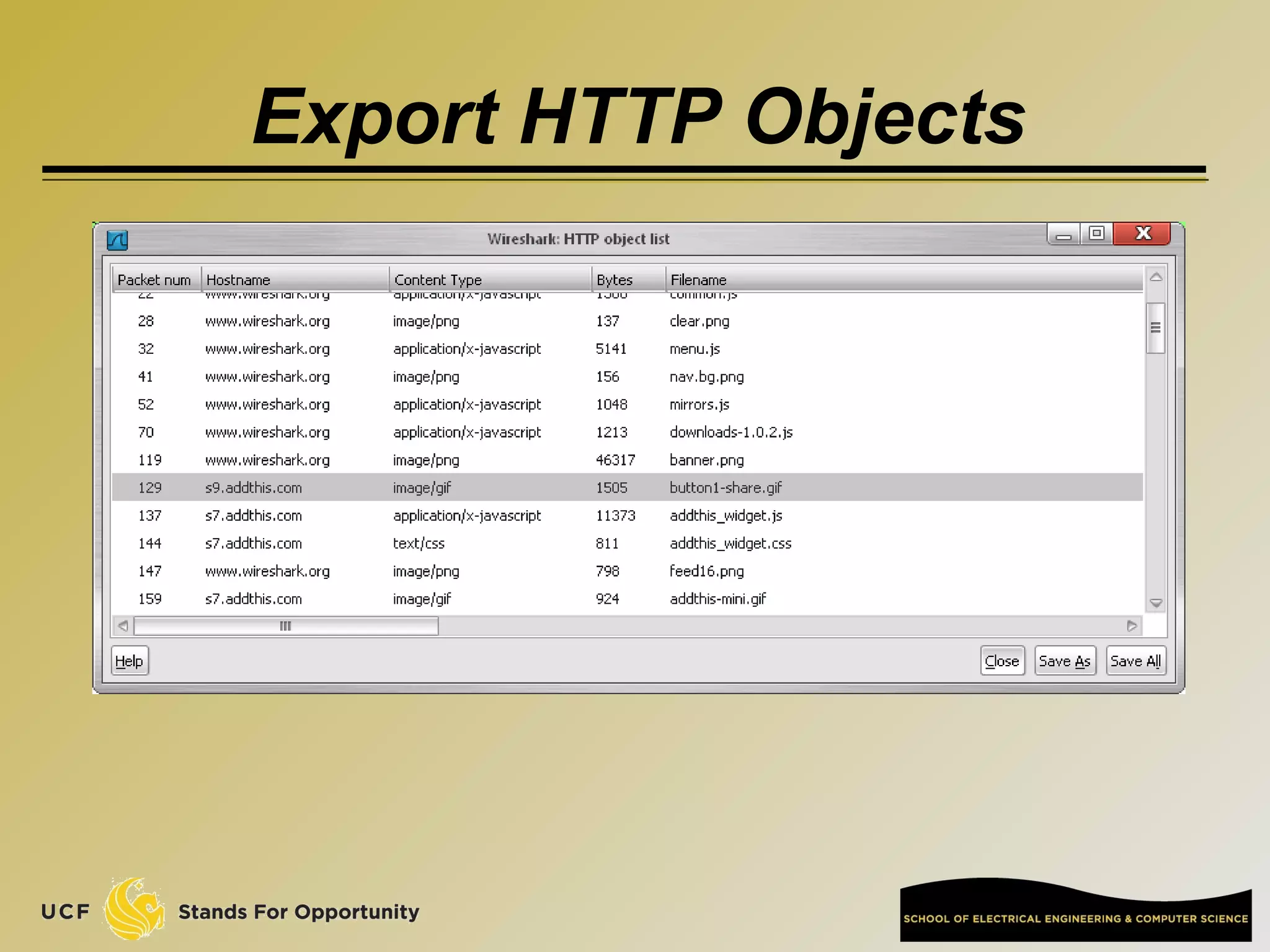
Export HTTP
Export HTTP Objects
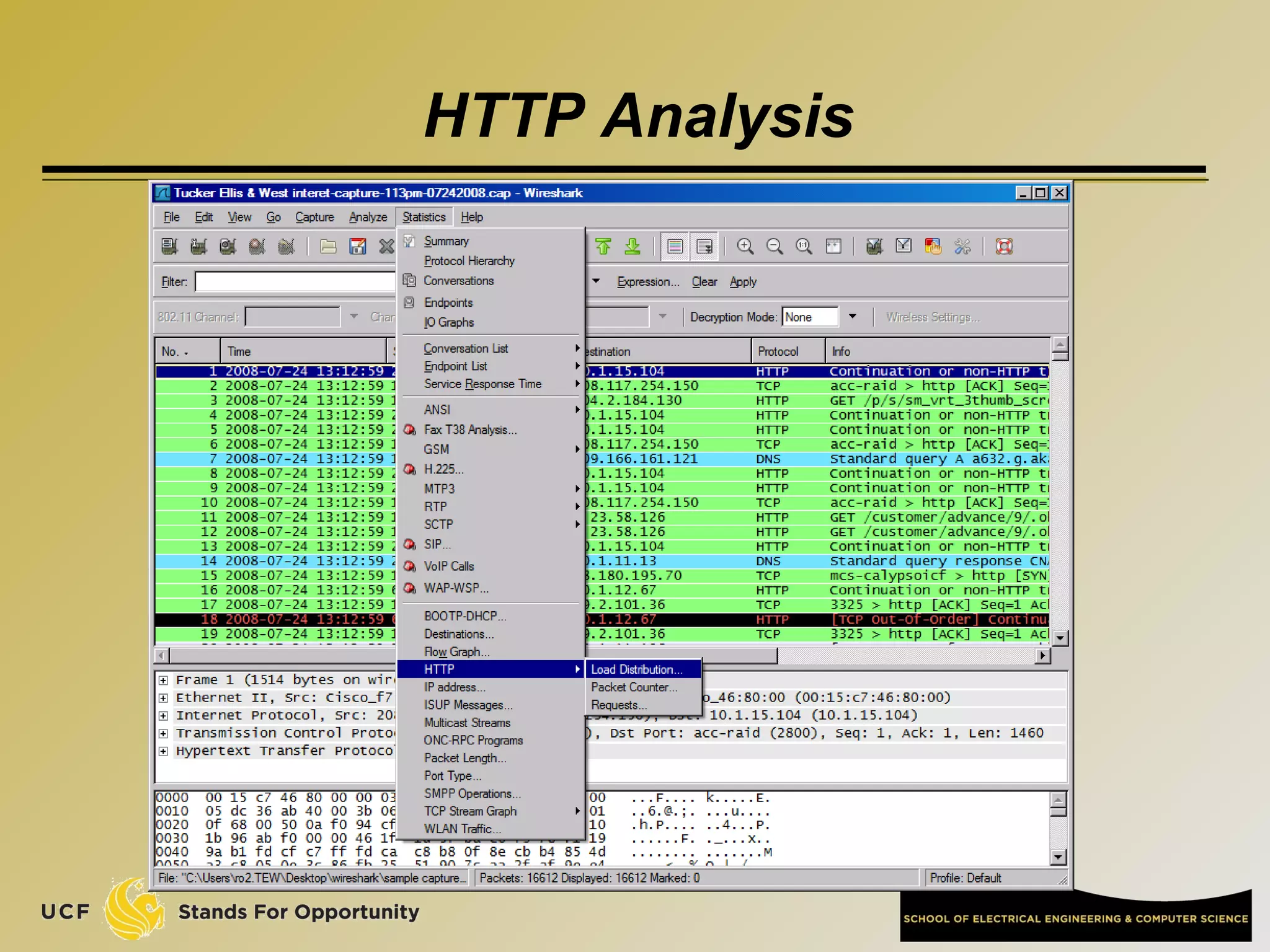
HTTP Analysis
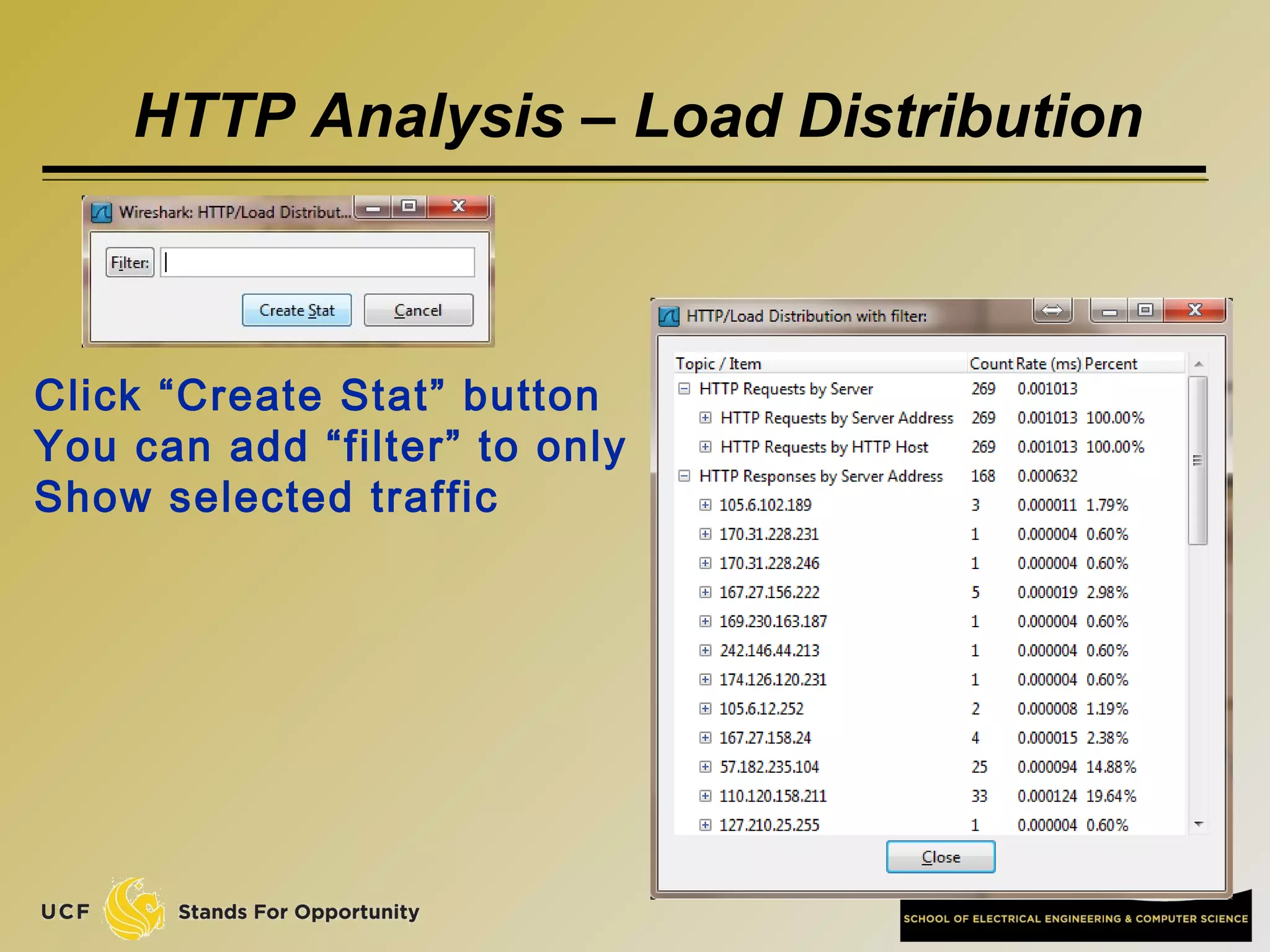
HTTP Analysis – Load Distribution
Click “Create Stat” button
You can add “filter” to only
Show selected traffic
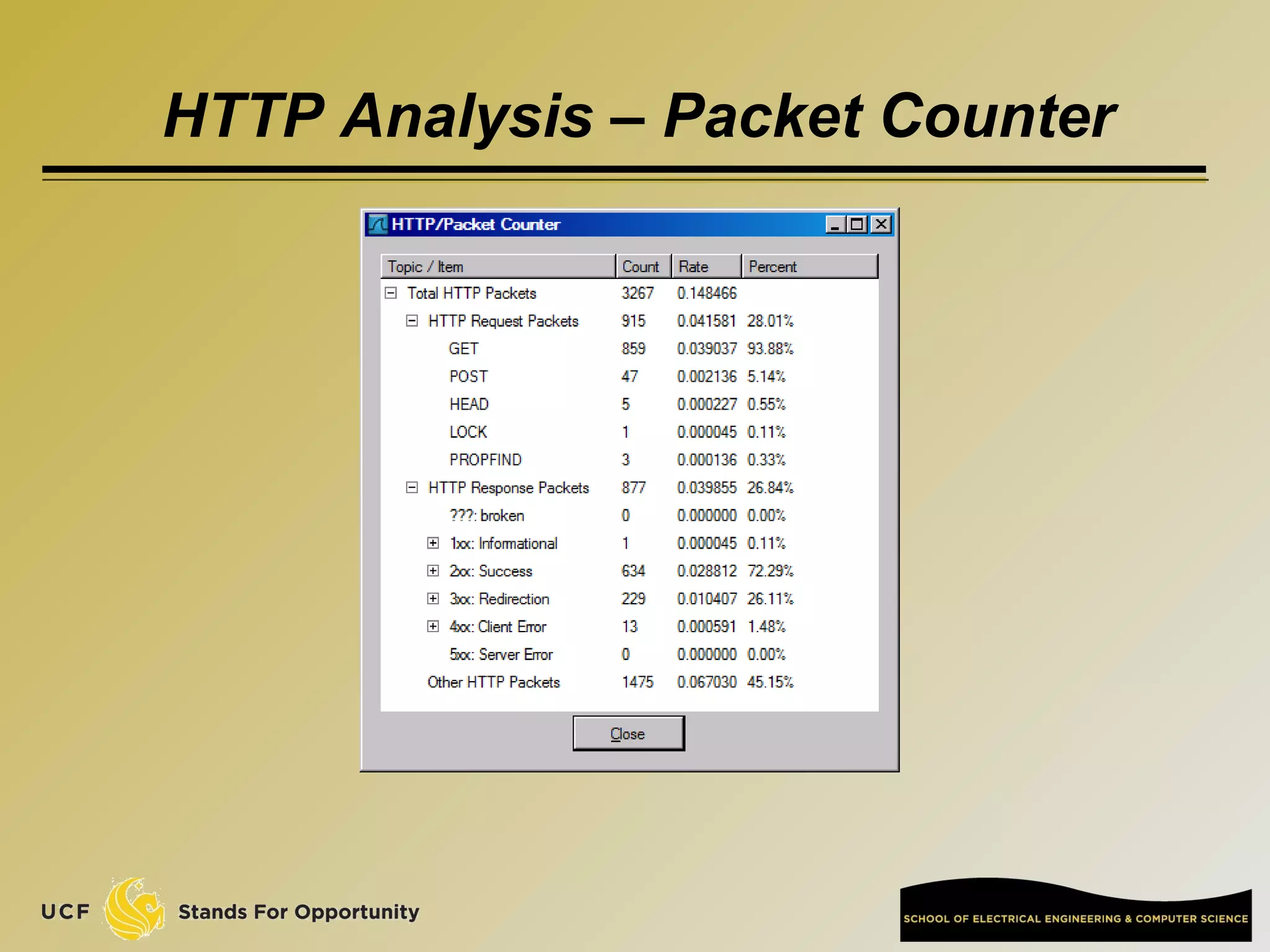
HTTP Analysis – Packet Counter
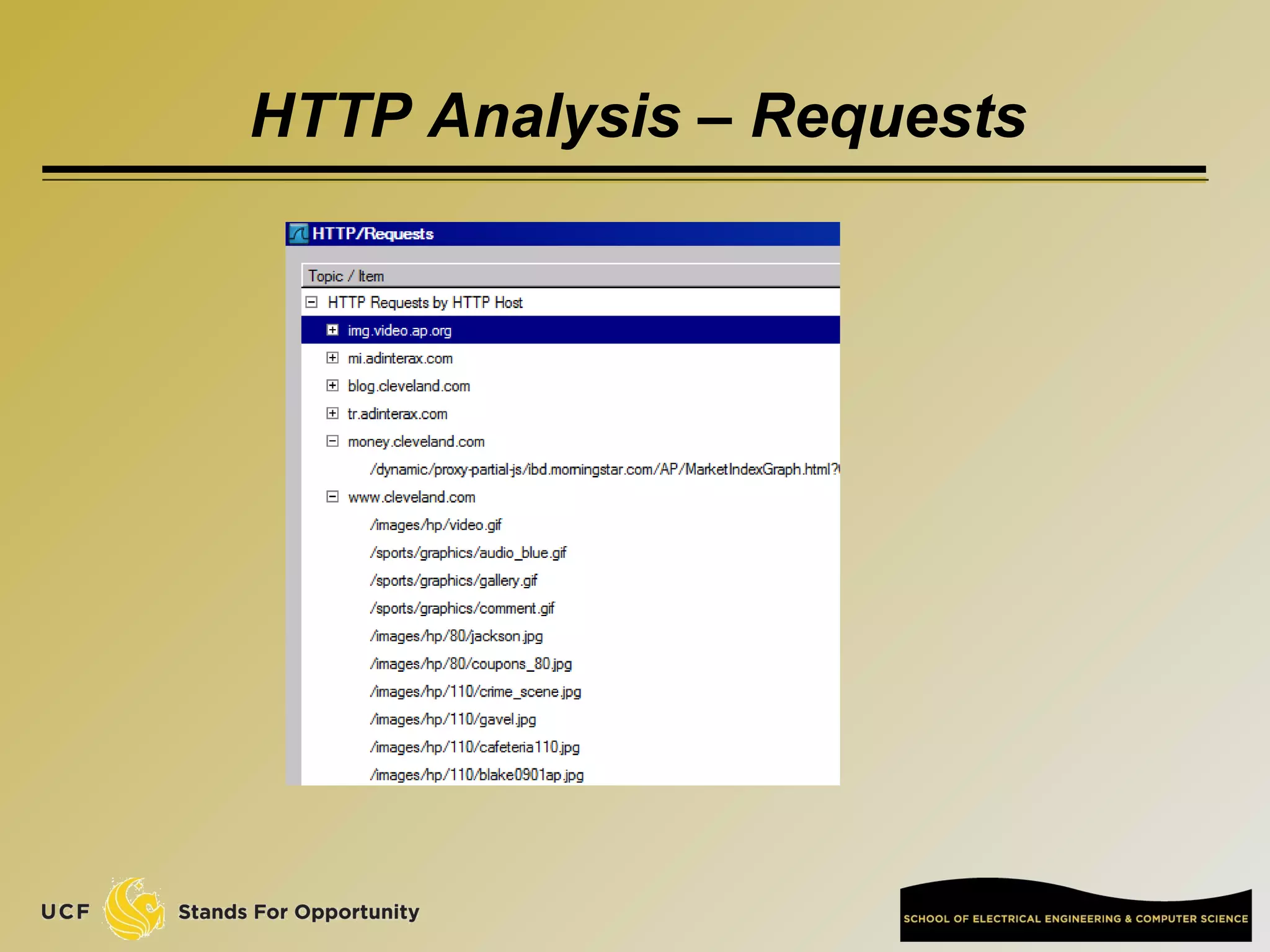
HTTP Analysis – Requests
Improving WireShark Performance
 Don’t use capture filters
 Increase your read buffer size
 Don’t update the screen dynamically
 Get a faster computer
 Use a TAP
 Don’t resolve names
Post-Processing Text File
 For saved text-format packet files, further
analysis needs coding or special tools
 One useful tool on Unix: Grep
 On Windows: PowerGrep
http://www.powergrep.com/
 Command-line based utility for searching
plain-text data sets for lines matching a
regular expression.
58
Basic usage of Grep
 Command-line text-search program in Linux
 Some useful usage:
 Grep ‘word’ filename # find lines with ‘word’
 Grep –v ‘word’ filename # find lines without ‘word’
 Grep ‘^word’ filename # find lines beginning with ‘word’
 Grep ‘word’ filename > file2 # output lines with ‘word’ to file2
 ls -l | grep rwxrwxrwx # list files that have ‘rwxrwxrwx’ feature
 grep '^[0-4]‘ filename # find lines beginning with any of the numbers
from 0-4
 Grep –c ‘word’ filename # find lines with ‘word’ and print out the
number of these lines
 Grep –i ‘word’ filename # find lines with ‘word’ regardless of case
 Many tutorials on grep online
 http://www.cyberciti.biz/faq/howto-use-grep-command-in-linux-unix/
 http://www.thegeekstuff.com/2009/03/15-practical-unix-grep-command-
examples/
59

Traffic monitoring

  • 1.
    CAP6135: Malware andSoftware Vulnerability Analysis Network Traffic Monitoring Using Wireshark Cliff Zou Spring 2013
  • 2.
    Acknowledgement  http://ilta.ebiz.uapps.net/ProductFiles/prod uctfiles/672/wireshark.ppt  UCBerkley course “EE 122: Intro to Communication Networks”  http://www.eecs.berkeley.edu/~jortiz/courses/ ee122/presentations/Wireshark.ppt  Other resources:  http://openmaniak.com/wireshark_filters.php 2
  • 3.
    Motivation for NetworkMonitoring  Essential for Network Management  Router and Firewall policy  Detecting abnormal/error in networking  Access control  Security Management  Detecting abnormal traffic  Traffic log for future forensic analysis 3
  • 4.
    4 Tools Overview  Tcpdump Unix-based command-line tool used to intercept packets  Including filtering to just the packets of interest  Reads “live traffic” from interface specified using -i option …  … or from a previously recorded trace file specified using -r option  You create these when capturing live traffic using -w option  Tshark  Tcpdump-like capture program that comes w/ Wireshark  Very similar behavior & flags to tcpdump  Wireshark  GUI for displaying tcpdump/tshark packet traces
  • 5.
    5 Tcpdump example 01:46:28.808262 IPdanjo.CS.Berkeley.EDU.ssh > adsl-69-228-230- 7.dsl.pltn13.pacbell.net.2481: . 2513546054:2513547434(1380) ack 1268355216 win 12816 01:46:28.808271 IP danjo.CS.Berkeley.EDU.ssh > adsl-69-228-230- 7.dsl.pltn13.pacbell.net.2481: P 1380:2128(748) ack 1 win 12816 01:46:28.808276 IP danjo.CS.Berkeley.EDU.ssh > adsl-69-228-230- 7.dsl.pltn13.pacbell.net.2481: . 2128:3508(1380) ack 1 win 12816 01:46:28.890021 IP adsl-69-228-230-7.dsl.pltn13.pacbell.net.2481 > danjo.CS.Berkeley.EDU.ssh: P 1:49(48) ack 1380 win 16560 • Ran tcpdump on a Unix machine • First few lines of the output:
  • 6.
    6 01:46:28.808262 IP danjo.CS.Berkeley.EDU.ssh> adsl-69-228-230-7.dsl.pltn13.pacbell.net.2481: . 2513546054:2513547434(1380) ack 1268355216 win 12816 Timestamp This is an IP packetSource host nameSource port number (22) Destination host name Destination port number TCP specific information • Different output formats for different packet types What does a line convey?
  • 7.
    7 Similar Output fromTshark 1190003744.940437 61.184.241.230 -> 128.32.48.169 SSH Encrypted request packet len=48 1190003744.940916 128.32.48.169 -> 61.184.241.230 SSH Encrypted response packet len=48 1190003744.955764 61.184.241.230 -> 128.32.48.169 TCP 6943 > ssh [ACK] Seq=48 Ack=48 Win=65514 Len=0 TSV=445871583 TSER=632535493 1190003745.035678 61.184.241.230 -> 128.32.48.169 SSH Encrypted request packet len=48 1190003745.036004 128.32.48.169 -> 61.184.241.230 SSH Encrypted response packet len=48 1190003745.050970 61.184.241.230 -> 128.32.48.169 TCP 6943 > ssh [ACK] Seq=96 Ack=96 Win=65514 Len=0 TSV=445871583 TSER=632535502
  • 8.
    8 Demo 1 –Basic Run  Syntax: tcpdump [options] [filter expression]  Unfortunately, Eustis machine does not allow normal users to run tcpdump  I will demonstrate it on my group’s Unix machine: cnsserver.eecs.ucf.edu  $ sudo tcpdump –i eth0  On your own Unix machine, you can run it using “sudo” or directly run “tcpdump”  Observe the output
  • 9.
    9 Filters  We areoften not interested in all packets flowing through the network  Use filters to capture only packets of interest to us
  • 10.
    10 Demo 2 1. Captureonly udp packets • tcpdump “udp” 1. Capture only tcp packets • tcpdump “tcp”
  • 11.
    11 Demo 2 (contd.) 1.Capture only UDP packets with destination port 53 (DNS requests) • tcpdump “udp dst port 53” 1. Capture only UDP packets with source port 53 (DNS replies) • tcpdump “udp src port 53” 1. Capture only UDP packets with source or destination port 53 (DNS requests and replies) • tcpdump “udp port 53”
  • 12.
    12 Demo 2 (contd.) 1.Capture only packets destined to quasar.cs.berkeley.edu • tcpdump “dst host quasar.cs.berkeley.edu” 1. Capture both DNS packets and TCP packets to/from quasar.cs.berkeley.edu • tcpdump “(tcp and host quasar.cs.berkeley.edu) or udp port 53”
  • 13.
    13 How to writefilters  Refer the tcpdump/tshark man page  Many example webpages on the Internet
  • 14.
    14 Running tcpdump  Requiressuperuser/administrator privileges on Unix  http://www.tcpdump.org/  You can do it on your own Unix machine  You can install a Linux OS in Vmware on your machine  Tcpdump for Windows  WinDump: http://www.winpcap.org/windump/  Free software
  • 15.
    So What isWireShark?  Packet sniffer/protocol analyzer  Open Source Network Tool  Latest version of the ethereal tool
  • 16.
    What is tShark? The command-line based packet capture tool  Equivalent to Wireshark 16
  • 17.
  • 18.
  • 19.
  • 20.
  • 21.
  • 22.
    Capture Filter examples host10.1.11.24 host 192.168.0.1 and host 10.1.11.1 tcp port http ip not broadcast not multicast ether host 00:04:13:00:09:a3
  • 23.
  • 25.
  • 26.
  • 27.
  • 28.
  • 29.
    Display Filters (Post-Filters) Display filters (also called post-filters) only filter the view of what you are seeing. All packets in the capture still exist in the trace  Display filters use their own format and are much more powerful then capture filters
  • 30.
  • 31.
  • 32.
  • 33.
    Display Filter  String1,String2 (Optional settings):  Sub protocol categories inside the protocol.  Look for a protocol and then click on the "+" character.  Example:  tcp.srcport == 80  tcp.flags == 2  SYN packet  Tcp.flags.syn==1  tcp.flags == 18  SYN/ACK  Note of TCP Flag field: 33
  • 34.
    Display Filter Expressions snmp || dns || icmp  Display the SNMP or DNS or ICMP traffics.  tcp.port == 25  Display packets with TCP source or destination port 25.  tcp.flags  Display packets having a TCP flags  tcp.flags.syn == 0x02  Display packets with a TCP SYN flag. 34 If the filter syntax is correct, it will be highlighted in green, otherwise if there is a syntax mistake it will be highlighted in red. Correct syntax Wrong syntax
  • 35.
    Save Filtered PacketsAfter Using Display Filter  We can also save all filtered packets in text file for further analysis  Operation: 35 FileExport packet dissections as “plain text” file 1). In “packet range” option, select “Displayed” 2). In choose “summary line” or “detail”
  • 36.
  • 37.
  • 38.
  • 39.
  • 40.
    Filter out/in SingleTCP Stream  When click “filter out this TCP stream” in previous page’s box, new filter string will contain like:  http and !(tcp.stream eq 5)  So, if you use “tcp.stream eq 5” as filter string, you keep this HTTP session 40
  • 41.
  • 42.
  • 43.
  • 44.
  • 45.
     Use the“Copy” button to copy all text into clipboard  Then, you can analyze this text file to get what statistics you want 45
  • 46.
    Find EndPoint Statistics Menu “statistics”  “endpoint list”  “TCP”  You can sort by field  “Tx” : transmit “Rx” : receive 46
  • 47.
    Find EndPoint Statistics Use the “Copy” button to copy all text into clipboard  Then, you can analyze this text file to get what statistics you want 47
  • 48.
  • 49.
    Flow Graphs • The“displayed packet” option could let you only Show the flow of packets shown up for example, only display http traffic, then show The flow to analyze
  • 50.
  • 51.
  • 52.
  • 53.
  • 54.
    HTTP Analysis –Load Distribution Click “Create Stat” button You can add “filter” to only Show selected traffic
  • 55.
    HTTP Analysis –Packet Counter
  • 56.
  • 57.
    Improving WireShark Performance Don’t use capture filters  Increase your read buffer size  Don’t update the screen dynamically  Get a faster computer  Use a TAP  Don’t resolve names
  • 58.
    Post-Processing Text File For saved text-format packet files, further analysis needs coding or special tools  One useful tool on Unix: Grep  On Windows: PowerGrep http://www.powergrep.com/  Command-line based utility for searching plain-text data sets for lines matching a regular expression. 58
  • 59.
    Basic usage ofGrep  Command-line text-search program in Linux  Some useful usage:  Grep ‘word’ filename # find lines with ‘word’  Grep –v ‘word’ filename # find lines without ‘word’  Grep ‘^word’ filename # find lines beginning with ‘word’  Grep ‘word’ filename > file2 # output lines with ‘word’ to file2  ls -l | grep rwxrwxrwx # list files that have ‘rwxrwxrwx’ feature  grep '^[0-4]‘ filename # find lines beginning with any of the numbers from 0-4  Grep –c ‘word’ filename # find lines with ‘word’ and print out the number of these lines  Grep –i ‘word’ filename # find lines with ‘word’ regardless of case  Many tutorials on grep online  http://www.cyberciti.biz/faq/howto-use-grep-command-in-linux-unix/  http://www.thegeekstuff.com/2009/03/15-practical-unix-grep-command- examples/ 59

Editor's Notes

  • #9 Depending on the kind of traffic, make some general observations – sources, destinations, kinds of traffic, DNS requests etc. Too much of output.
  • #13 Ping quasar.cs.berkeley.edu. Demonstrates the use of “or”