Introduction
 Embedded systems are designed to do some specific
 task, rather than be a general-purpose computer for
 multiple tasks.
 An embedded system is not always a separate block -
 very often it is physically built-in to the device it is
 controlling.
Description to project
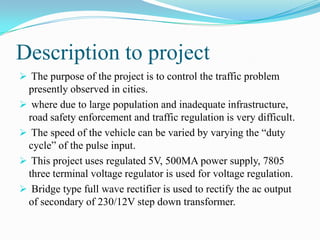
 The purpose of the project is to control the traffic problem
 presently observed in cities.
 where due to large population and inadequate infrastructure,
 road safety enforcement and traffic regulation is very difficult.
 The speed of the vehicle can be varied by varying the “duty
 cycle” of the pulse input.
 This project uses regulated 5V, 500MA power supply, 7805
 three terminal voltage regulator is used for voltage regulation.
 Bridge type full wave rectifier is used to rectify the ac output
 of secondary of 230/12V step down transformer.
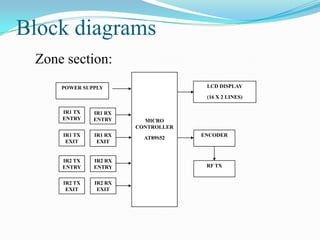
Block diagrams
 Zone section:
     POWER SUPPLY                    LCD DISPLAY

                                     (16 X 2 LINES)

     IR1 TX   IR1 RX
     ENTRY    ENTRY      MICRO
                       CONTROLLER
     IR1 TX   IR1 RX                ENCODER
                         AT89S52
      EXIT     EXIT


     IR2 TX   IR2 RX
     ENTRY    ENTRY                  RF TX


     IR2 TX   IR2 RX
      EXIT     EXIT
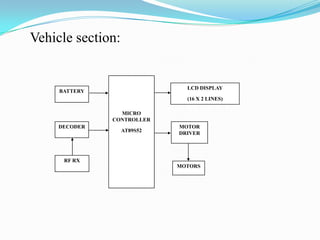
Vehicle section:


                               LCD DISPLAY
     BATTERY
                               (16 X 2 LINES)

                 MICRO
               CONTROLLER
     DECODER                 MOTOR
                   AT89S52   DRIVER


      RF RX
                             MOTORS
BLOCK DIAGRAM EXPLANATION

Micro controller:
 In this project work the micro-controller is plays major
 role.
 Micro-controllers were originally used as components in
 complicated process-control systems.
 Micro-controllers are small in size and less cost.
 One of the major differences between a Microprocessor
 and a Micro controller is that a controller often deals with
 bits not bytes as in the real world application.
RF transmitter section
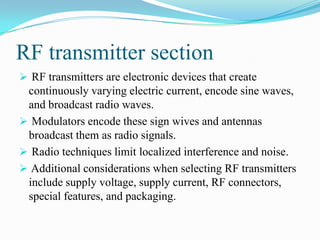
 RF transmitters are electronic devices that create
 continuously varying electric current, encode sine waves,
 and broadcast radio waves.
 Modulators encode these sign wives and antennas
 broadcast them as radio signals.
 Radio techniques limit localized interference and noise.
 Additional considerations when selecting RF transmitters
 include supply voltage, supply current, RF connectors,
 special features, and packaging.
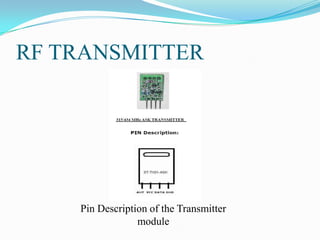
RF TRANSMITTER


    Pin Description of the Transmitter
                 module
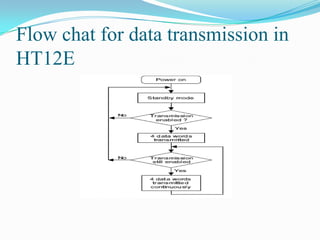
Flow chat for data transmission in
HT12E
RF receiver section
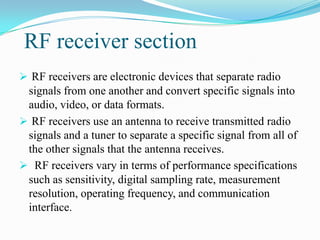
 RF receivers are electronic devices that separate radio
 signals from one another and convert specific signals into
 audio, video, or data formats.
 RF receivers use an antenna to receive transmitted radio
 signals and a tuner to separate a specific signal from all of
 the other signals that the antenna receives.
 RF receivers vary in terms of performance specifications
 such as sensitivity, digital sampling rate, measurement
 resolution, operating frequency, and communication
 interface.
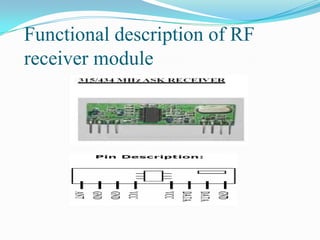
Functional description of RF
receiver module
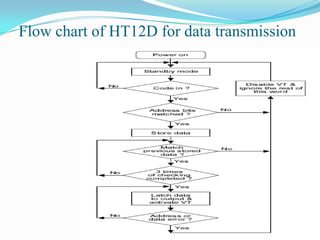
Flow chart of HT12D for data transmission
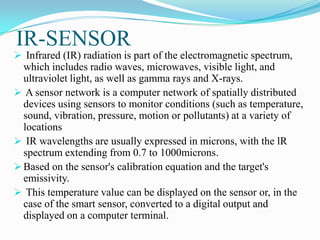
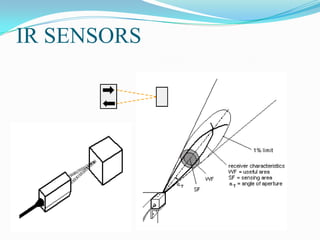
IR-SENSOR
 Infrared (IR) radiation is part of the electromagnetic spectrum,
  which includes radio waves, microwaves, visible light, and
  ultraviolet light, as well as gamma rays and X-rays.
 A sensor network is a computer network of spatially distributed
  devices using sensors to monitor conditions (such as temperature,
  sound, vibration, pressure, motion or pollutants) at a variety of
  locations
 IR wavelengths are usually expressed in microns, with the lR
  spectrum extending from 0.7 to 1000microns.
 Based on the sensor's calibration equation and the target's
  emissivity.
 This temperature value can be displayed on the sensor or, in the
  case of the smart sensor, converted to a digital output and
  displayed on a computer terminal.
IR SENSORS
MOTOR DRIVER
L293D:
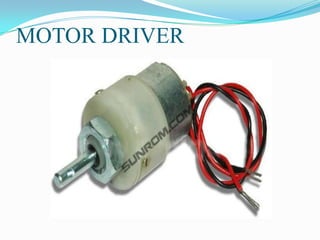
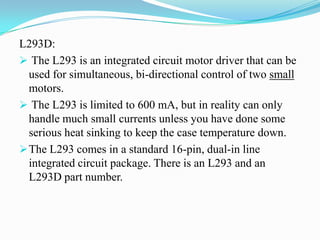
 The L293 is an integrated circuit motor driver that can be
  used for simultaneous, bi-directional control of two small
  motors.
 The L293 is limited to 600 mA, but in reality can only
  handle much small currents unless you have done some
  serious heat sinking to keep the case temperature down.
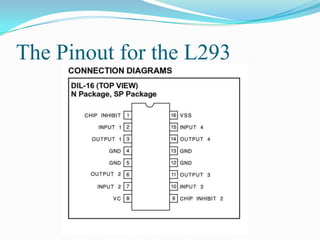
 The L293 comes in a standard 16-pin, dual-in line
  integrated circuit package. There is an L293 and an
  L293D part number.
The Pinout for the L293
LINEAR KEYPAD
 This section basically consists of a Linear Keypad. Basically a
  Keypad can be classified into 2 categories.
 One is Linear Keypad and the other is Matrix keypad.
 Linear Keypad: This Keypad got „n‟ no. of keys connected to
  „n‟ data lines of microcontroller.
 This Keypad is used in places where one needs to connect less
  no. of keys.
 Here in this project, a linear keypad is used with switches
  connected in a serial manner.
 Linear keypad is used in this project because it takes less no.
  of port pins.
Liquid crystal display
 Liquid crystal displays (LCDs) have materials, which
  combine the properties of both liquids and crystals
 An LCD consists of two glass panels, with the liquid
  crystal material sand witched in between them.
 The LCD‟s are lightweight with only a few millimeters
  thickness. Since the LCD‟s consume less power, they are
  compatible with low power electronic circuits, and can be
  powered for long durations.
 Changing the display size or the layout size is relatively
  simple which makes the LCD‟s more customers friendly.
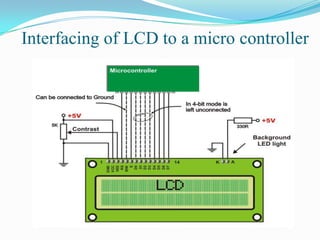
Interfacing of LCD to a micro controller
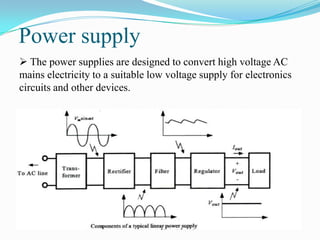
Power supply
 The power supplies are designed to convert high voltage AC
mains electricity to a suitable low voltage supply for electronics
circuits and other devices.
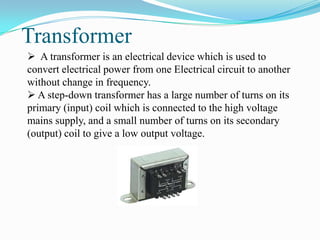
Transformer
 A transformer is an electrical device which is used to
convert electrical power from one Electrical circuit to another
without change in frequency.
 A step-down transformer has a large number of turns on its
primary (input) coil which is connected to the high voltage
mains supply, and a small number of turns on its secondary
(output) coil to give a low output voltage.
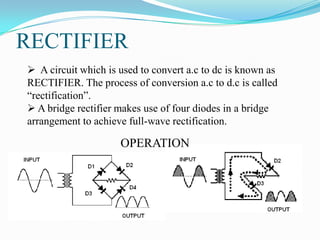
RECTIFIER
 A circuit which is used to convert a.c to dc is known as
RECTIFIER. The process of conversion a.c to d.c is called
“rectification”.
 A bridge rectifier makes use of four diodes in a bridge
arrangement to achieve full-wave rectification.

                     OPERATION
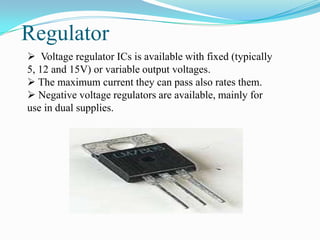
Regulator
 Voltage regulator ICs is available with fixed (typically
5, 12 and 15V) or variable output voltages.
 The maximum current they can pass also rates them.
 Negative voltage regulators are available, mainly for
use in dual supplies.
CIRCUIT DISCRIPTION
 The objective of the paper is to present a conceptual model of
 a microcontroller based variable electronic speed governor that
 can be implemented to control the speed of any vehicle
 depending on the local speed limit.
 The circuit is cost effective, efficient and easy to implement on
 already existing vehicles.
 Every city, town or a village, can be marked and divided into
 individual zones.
 The division depends upon the area under which the business,
 residential, and industrial regions come under.
 The central business district being a very busy traffic zone
 demands the least speed limit, with the residential and
 industrial zones having lesser traffic densities, the speed limits
 will vary accordingly.
CONCLUSION
 The project “MICRO CONTROLLER BASED
 AUTOMATION VARIABLE FREQUENCY ELECTRONIC
 SPEED GOVERNOR” has been successfully designed and
 tested.
 It has been developed by integrating features of all the
 hardware components used.
 Presence of every module has been reasoned out and placed
 carefully thus contributing to the best working of the unit.
 Secondly, using highly advanced IC‟s and with the help of
 growing technology the project has been successfully
 implemented.
Tracking and breaking system for vehicles

Tracking and breaking system for vehicles

  • 2.
    Introduction  Embedded systemsare designed to do some specific task, rather than be a general-purpose computer for multiple tasks.  An embedded system is not always a separate block - very often it is physically built-in to the device it is controlling.
  • 3.
    Description to project The purpose of the project is to control the traffic problem presently observed in cities.  where due to large population and inadequate infrastructure, road safety enforcement and traffic regulation is very difficult.  The speed of the vehicle can be varied by varying the “duty cycle” of the pulse input.  This project uses regulated 5V, 500MA power supply, 7805 three terminal voltage regulator is used for voltage regulation.  Bridge type full wave rectifier is used to rectify the ac output of secondary of 230/12V step down transformer.
  • 4.
    Block diagrams Zonesection: POWER SUPPLY LCD DISPLAY (16 X 2 LINES) IR1 TX IR1 RX ENTRY ENTRY MICRO CONTROLLER IR1 TX IR1 RX ENCODER AT89S52 EXIT EXIT IR2 TX IR2 RX ENTRY ENTRY RF TX IR2 TX IR2 RX EXIT EXIT
  • 5.
    Vehicle section: LCD DISPLAY BATTERY (16 X 2 LINES) MICRO CONTROLLER DECODER MOTOR AT89S52 DRIVER RF RX MOTORS
  • 6.
    BLOCK DIAGRAM EXPLANATION Microcontroller:  In this project work the micro-controller is plays major role.  Micro-controllers were originally used as components in complicated process-control systems.  Micro-controllers are small in size and less cost.  One of the major differences between a Microprocessor and a Micro controller is that a controller often deals with bits not bytes as in the real world application.
  • 7.
    RF transmitter section RF transmitters are electronic devices that create continuously varying electric current, encode sine waves, and broadcast radio waves.  Modulators encode these sign wives and antennas broadcast them as radio signals.  Radio techniques limit localized interference and noise.  Additional considerations when selecting RF transmitters include supply voltage, supply current, RF connectors, special features, and packaging.
  • 8.
    RF TRANSMITTER Pin Description of the Transmitter module
  • 9.
    Flow chat fordata transmission in HT12E
  • 10.
    RF receiver section RF receivers are electronic devices that separate radio signals from one another and convert specific signals into audio, video, or data formats.  RF receivers use an antenna to receive transmitted radio signals and a tuner to separate a specific signal from all of the other signals that the antenna receives.  RF receivers vary in terms of performance specifications such as sensitivity, digital sampling rate, measurement resolution, operating frequency, and communication interface.
  • 11.
    Functional description ofRF receiver module
  • 12.
    Flow chart ofHT12D for data transmission
  • 13.
    IR-SENSOR  Infrared (IR)radiation is part of the electromagnetic spectrum, which includes radio waves, microwaves, visible light, and ultraviolet light, as well as gamma rays and X-rays.  A sensor network is a computer network of spatially distributed devices using sensors to monitor conditions (such as temperature, sound, vibration, pressure, motion or pollutants) at a variety of locations  IR wavelengths are usually expressed in microns, with the lR spectrum extending from 0.7 to 1000microns.  Based on the sensor's calibration equation and the target's emissivity.  This temperature value can be displayed on the sensor or, in the case of the smart sensor, converted to a digital output and displayed on a computer terminal.
  • 14.
  • 15.
  • 16.
    L293D:  The L293is an integrated circuit motor driver that can be used for simultaneous, bi-directional control of two small motors.  The L293 is limited to 600 mA, but in reality can only handle much small currents unless you have done some serious heat sinking to keep the case temperature down.  The L293 comes in a standard 16-pin, dual-in line integrated circuit package. There is an L293 and an L293D part number.
  • 17.
  • 18.
    LINEAR KEYPAD  Thissection basically consists of a Linear Keypad. Basically a Keypad can be classified into 2 categories.  One is Linear Keypad and the other is Matrix keypad.  Linear Keypad: This Keypad got „n‟ no. of keys connected to „n‟ data lines of microcontroller.  This Keypad is used in places where one needs to connect less no. of keys.  Here in this project, a linear keypad is used with switches connected in a serial manner.  Linear keypad is used in this project because it takes less no. of port pins.
  • 19.
    Liquid crystal display Liquid crystal displays (LCDs) have materials, which combine the properties of both liquids and crystals  An LCD consists of two glass panels, with the liquid crystal material sand witched in between them.  The LCD‟s are lightweight with only a few millimeters thickness. Since the LCD‟s consume less power, they are compatible with low power electronic circuits, and can be powered for long durations.  Changing the display size or the layout size is relatively simple which makes the LCD‟s more customers friendly.
  • 20.
    Interfacing of LCDto a micro controller
  • 21.
    Power supply  Thepower supplies are designed to convert high voltage AC mains electricity to a suitable low voltage supply for electronics circuits and other devices.
  • 22.
    Transformer  A transformeris an electrical device which is used to convert electrical power from one Electrical circuit to another without change in frequency.  A step-down transformer has a large number of turns on its primary (input) coil which is connected to the high voltage mains supply, and a small number of turns on its secondary (output) coil to give a low output voltage.
  • 23.
    RECTIFIER  A circuitwhich is used to convert a.c to dc is known as RECTIFIER. The process of conversion a.c to d.c is called “rectification”.  A bridge rectifier makes use of four diodes in a bridge arrangement to achieve full-wave rectification. OPERATION
  • 24.
    Regulator  Voltage regulatorICs is available with fixed (typically 5, 12 and 15V) or variable output voltages.  The maximum current they can pass also rates them.  Negative voltage regulators are available, mainly for use in dual supplies.
  • 25.
    CIRCUIT DISCRIPTION  Theobjective of the paper is to present a conceptual model of a microcontroller based variable electronic speed governor that can be implemented to control the speed of any vehicle depending on the local speed limit.  The circuit is cost effective, efficient and easy to implement on already existing vehicles.  Every city, town or a village, can be marked and divided into individual zones.  The division depends upon the area under which the business, residential, and industrial regions come under.  The central business district being a very busy traffic zone demands the least speed limit, with the residential and industrial zones having lesser traffic densities, the speed limits will vary accordingly.
  • 26.
    CONCLUSION  The project“MICRO CONTROLLER BASED AUTOMATION VARIABLE FREQUENCY ELECTRONIC SPEED GOVERNOR” has been successfully designed and tested.  It has been developed by integrating features of all the hardware components used.  Presence of every module has been reasoned out and placed carefully thus contributing to the best working of the unit.  Secondly, using highly advanced IC‟s and with the help of growing technology the project has been successfully implemented.