DC-FC31C-02 V1.0
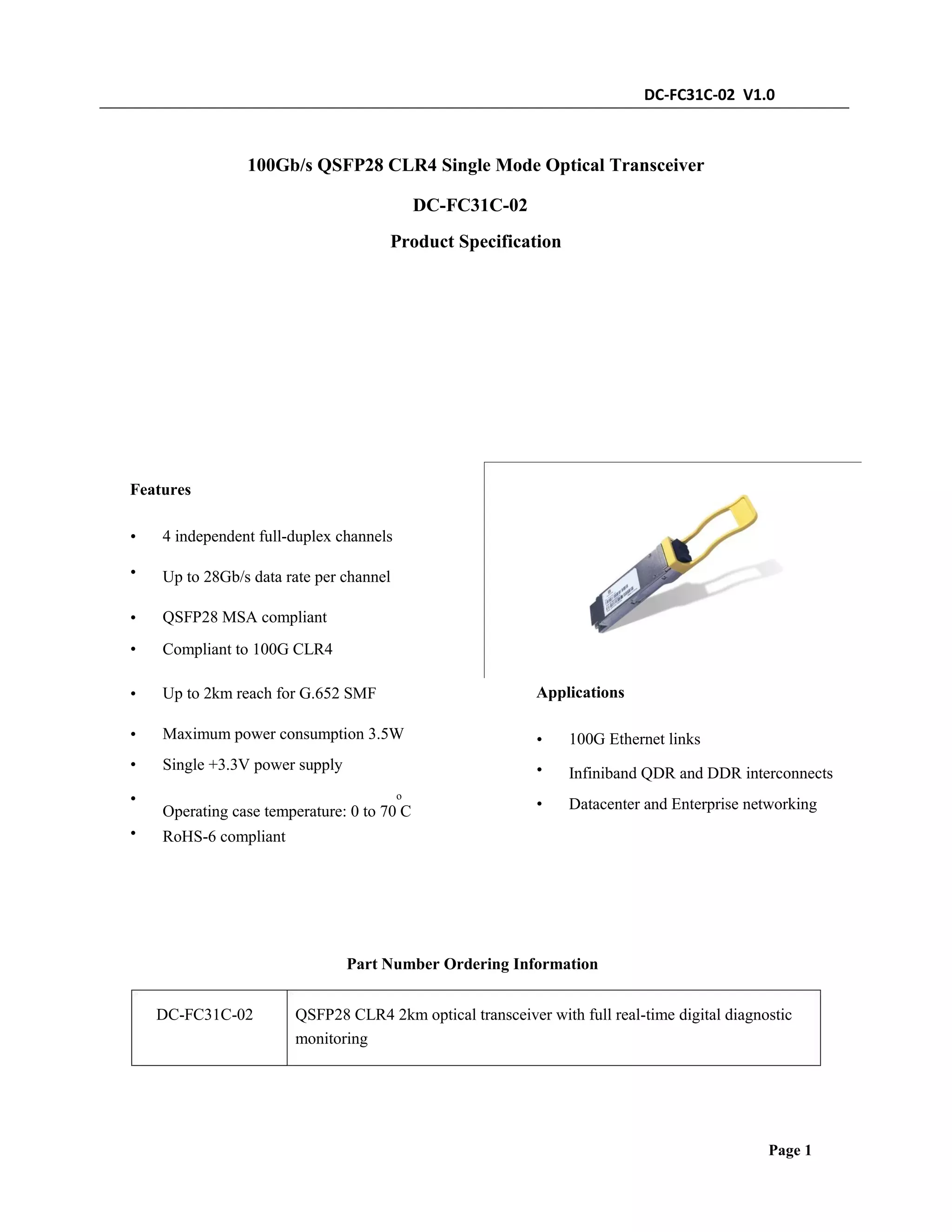
100Gb/s QSFP28 CLR4 Single Mode Optical Transceiver
DC-FC31C-02
Product Specification
Features


4 independent full-duplex channels
Up to 28Gb/s data rate per channel


QSFP28 MSA compliant
Compliant to 100G CLR4
Up to 2km reach for G.652 SMF Applications




Maximum power consumption 3.5W
Single +3.3V power supply



100G Ethernet links
Infiniband QDR and DDR interconnects
Datacenter and Enterprise networking
o
Operating case temperature: 0 to 70 C
RoHS-6 compliant
Part Number Ordering Information
DC-FC31C-02 QSFP28 CLR4 2km optical transceiver with full real-time digital diagnostic
monitoring
Page 1
DC-FC31C-02 V1.0
1. General Description
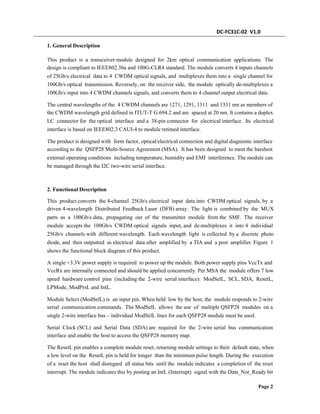
This product is a transceiver module designed for 2km optical communication applications. The
design is compliant to IEEE802.3ba and 100G-CLR4 standard. The module converts 4 inputs channels
of 25Gb/s electrical data to 4 CWDM optical signals, and multiplexes them into a single channel for
100Gb/s optical transmission. Reversely, on the receiver side, the module optically de-multiplexes a
100Gb/s input into 4 CWDM channels signals, and converts them to 4 channel output electrical data.
The central wavelengths of the 4 CWDM channels are 1271, 1291, 1311 and 1331 nm as members of
the CWDM wavelength grid defined in ITUT-T G.694.2 and are spaced at 20 nm. It contains a duplex
LC connector for the optical interface and a 38-pin connector for electrical interface. Its electrical
interface is based on IEEE802.3 CAUI-4 to module retimed interface.
The product is designed with form factor, optical/electrical connection and digital diagnostic interface
according to the QSFP28 Multi-Source Agreement (MSA). It has been designed to meet the harshest
external operating conditions including temperature, humidity and EMI interference. The module can
be managed through the I2C two-wire serial interface.
2. Functional Description
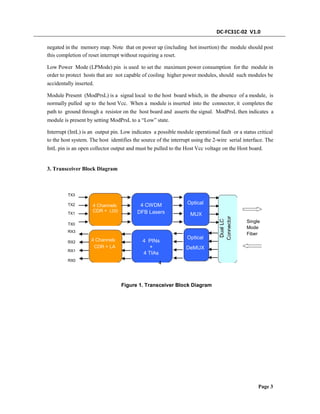
This product converts the 4-channel 25Gb/s electrical input data into CWDM optical signals, by a
driven 4-wavelength Distributed Feedback Laser (DFB) array. The light is combined by the MUX
parts as a 100Gb/s data, propagating out of the transmitter module from the SMF. The receiver
module accepts the 100Gb/s CWDM optical signals input, and de-multiplexes it into 4 individual
25Gb/s channels with different wavelength. Each wavelength light is collected by a discrete photo
diode, and then outputted as electrical data after amplified by a TIA and a post amplifier. Figure 1
shows the functional block diagram of this product.
A single +3.3V power supply is required to power up the module. Both power supply pins VccTx and
VccRx are internally connected and should be applied concurrently. Per MSA the module offers 7 low
speed hardware control pins (including the 2-wire serial interface): ModSelL, SCL, SDA, ResetL,
LPMode, ModPrsL and IntL.
Module Select (ModSelL) is an input pin. When held low by the host, the module responds to 2-wire
serial communication commands. The ModSelL allows the use of multiple QSFP28 modules on a
single 2-wire interface bus – individual ModSelL lines for each QSFP28 module must be used.
Serial Clock (SCL) and Serial Data (SDA) are required for the 2-wire serial bus communication
interface and enable the host to access the QSFP28 memory map.
The ResetL pin enables a complete module reset, returning module settings to their default state, when
a low level on the ResetL pin is held for longer than the minimum pulse length. During the execution
of a reset the host shall disregard all status bits until the module indicates a completion of the reset
interrupt. The module indicates this by posting an IntL (Interrupt) signal with the Data_Not_Ready bit
Page 2
DC-FC31C-02 V1.0
negated in the memory map. Note that on power up (including hot insertion) the module should post
this completion of reset interrupt without requiring a reset.
Low Power Mode (LPMode) pin is used to set the maximum power consumption for the module in
order to protect hosts that are not capable of cooling higher power modules, should such modules be
accidentally inserted.
Module Present (ModPrsL) is a signal local to the host board which, in the absence of a module, is
normally pulled up to the host Vcc. When a module is inserted into the connector, it completes the
path to ground through a resistor on the host board and asserts the signal. ModPrsL then indicates a
module is present by setting ModPrsL to a “Low” state.
Interrupt (IntL) is an output pin. Low indicates a possible module operational fault or a status critical
to the host system. The host identifies the source of the interrupt using the 2-wire serial interface. The
IntL pin is an open collector output and must be pulled to the Host Vcc voltage on the Host board.
3. Transceiver Block Diagram
TX3
OpticalTX2
TX1
4 Channels
CDR + LDD
4 CWDM
DFB Lasers MUX
Single
Mode
Fiber
TX0
RX3
4 PINs
+
Optical
DeMUX
4 Channels
CDR + LA
RX2
RX1
RX0
4 TIAs
4
Figure 1. Transceiver Block Diagram
Page 3
DC-FC31C-02 V1.0
4. Pin Assignment and Description
Figure 2. QSFP28 Transceiver Electrical Connector Layout
Pin Definition
PIN
1
Logic Symbol Name/Description Notes
GND Ground 1
2 CML-I
CML-I
Tx2n
Tx2p
GND
Tx4n
Tx4p
GND
ModSelL
ResetL
VccRx
SCL
Transmitter Inverted Data Input
3 Transmitter Non-Inverted Data output
Ground4 1
1
2
5 CML-I
CML-I
Transmitter Inverted Data Input
Transmitter Non-Inverted Data output
Ground
6
7
8 LVTLL-I
LVTLL-I
Module Select
9 Module Reset
10
11
12
13
14
15
+3.3V Power Supply Receiver
2-Wire Serial Interface Clock
2-Wire Serial Interface Data
Ground
LVCMOS-I/O
LVCMOS-I/O SDA
GND
Rx3p
Rx3n
CML-O
CML-O
Receiver Non-Inverted Data Output
Receiver Inverted Data Output
Page 4
DC-FC31C-02 V1.0
16
17
18
19
20
21
22
23
24
25
26
27
28
29
30
31
32
33
34
35
36
37
38
GND
Rx1p
Rx1n
GND
GND
Rx2n
Rx2p
GND
Rx4n
Rx4p
GND
ModPrsL
IntL
Ground 1
CML-O
CML-O
Receiver Non-Inverted Data Output
Receiver Inverted Data Output
Ground 1
1Ground
CML-O
CML-O
Receiver Inverted Data Output
Receiver Non-Inverted Data Output
Ground 1
1CML-O
CML-O
Receiver Inverted Data Output
Receiver Non-Inverted Data Output
Ground 1
LVTTL-O
LVTTL-O
Module Present
Interrupt
VccTx
Vcc1
LPMode
GND
Tx3p
Tx3n
GND
Tx1p
Tx1n
GND
+3.3 V Power Supply transmitter
+3.3 V Power Supply
Low Power Mode
2
2
LVTTL-I
Ground 1
CML-I
CML-I
Transmitter Non-Inverted Data Input
Transmitter Inverted Data Output
Ground 1
1
CML-I
CML-I
Transmitter Non-Inverted Data Input
Transmitter Inverted Data Output
Ground
Notes:
1. GND is the symbol for signal and supply (power) common for QSFP28 modules. All are
common within the QSFP28 module and all module voltages are referenced to this potential
unless otherwise noted. Connect these directly to the host board signal common ground plane.
VccRx, Vcc1 and VccTx are the receiver and transmitter power suppliers and shall be applied
concurrently. Recommended host board power supply filtering is shown in Figure 3 below. Vcc
Rx, Vcc1 and VccTx may be internally connected within the QSFP28 transceiver module in any
combination. The connector pins are each rated for a maximum current of 1000mA.
2.
Page 5
DC-FC31C-02 V1.0
5. Recommended Power Supply Filter
Figure 3. Recommended Power Supply Filter
6. Absolute Maximum Ratings
It has to be noted that the operation in excess of any absolute maximum ratings might cause
permanent damage to this module.
Parameter Symbol
TS
Min
-40
0
Max
85
Units
degC
degC
V
Notes
Storage Temperature
Operating Case Temperature
Power Supply Voltage
TOP 70
VCC -0.5
0
3.6
85Relative Humidity (non-condensation)
Damage Threshold, each Lane
RH
THd
%
3.5 dBm
7. Recommended Operating Conditions and Power Supply Requirements
Parameter Symbol
TOP
Min
0
Typical Max
70
Units
Operating Case Temperature
Power Supply Voltage
Data Rate, each Lane
degC
VVCC 3.135 3.3 3.465
25.78125 Gb/s
VControl Input Voltage High
Control Input Voltage Low
Link Distance with G.652
2
0
Vcc
0.8
2
V
D 0.002 km
Page 6
DC-FC31C-02 V1.0
8. Electrical Characteristics
The following electrical characteristics are defined over the Recommended Operating Environment
unless otherwise specified.
Parameter
Power Consumption
Supply Current
Symbol Min Typical Max
3.5
Units
W
Notes
Icc 1.1 A
Transceiver Power-on
Initialization Time
2000 ms 1
Module input characteristics (each Lane)
Parameter Test Point Min Typical Max Units Notes
Signal Rate, each Lane TP1 25.78125±100ppm Gb/s
Differential pk-pk Input
Voltage Tolerance
Differential Input Return
Loss
TP1a
TP1
TP1
TP1
TP1a
TP1a
TP1
900 mV
dB
dB
%
IEEE802.3bm Equation 83E-5
IEEE802.3bm Equation 83E-6
10
Differential to Common
Mode Input Return Loss
Differential Termination
Mismatch
Module Stressed Input
Test
IEEE802.3bm 83E.3.4.1 2
Single End Voltage
Tolerance Range
DC Common Mode
Voltage
-0.4 3.3 V
-350 2850 mV 3
Receiver (each Lane)
Parameter Test Point Min Typical Max Units Notes
Signaling Rate, each
Lane
TP4 25.78125±100ppm Gb/s
AC Common Mode
Output Voltage (RMS)
Differential Output
Voltage
TP4
TP4
17.5
900
mV
mV
Page 7
DC-FC31C-02 V1.0
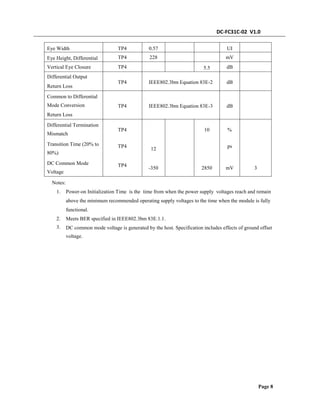
Eye Width TP4
TP4
TP4
0.57
228
UI
mV
dB
Eye Height, Differential
Vertical Eye Closure
Differential Output
Return Loss
5.5
TP4 IEEE802.3bm Equation 83E-2 dB
Common to Differential
Mode Conversion
Return Loss
TP4 IEEE802.3bm Equation 83E-3 dB
Differential Termination
Mismatch
TP4
TP4
TP4
10 %
psTransition Time (20% to
80%)
12
DC Common Mode
Voltage
-350 2850 mV 3
Notes:
1. Power-on Initialization Time is the time from when the power supply voltages reach and remain
above the minimum recommended operating supply voltages to the time when the module is fully
functional.
2.
3.
Meets BER specified in IEEE802.3bm 83E.1.1.
DC common mode voltage is generated by the host. Specification includes effects of ground offset
voltage.
Page 8
DC-FC31C-02 V1.0
9. Optical Characteristics
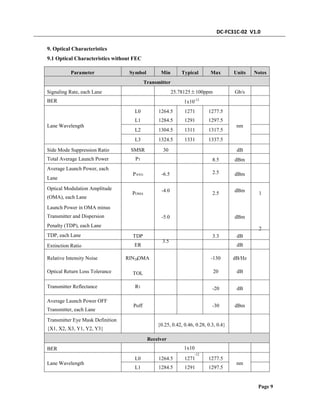
9.1 Optical Characteristics without FEC
Parameter Symbol Min Typical Max Units Notes
Transmitter
Signaling Rate, each Lane
BER
25.78125±100ppm Gb/s
1x10-12
L0
L1
L2
L3
1264.5
1284.5
1304.5
1324.5
1271
1291
1311
1331
1277.5
1297.5
1317.5
1337.5
Lane Wavelength nm
Side Mode Suppression Ratio
Total Average Launch Power
Average Launch Power, each
Lane
SMSR
PT
30 dB
8.5
2.5
dBm
PAVG -6.5
-4.0
dBm
dBmOptical Modulation Amplitude
(OMA), each Lane
POMA 2.5 1
2
Launch Power in OMA minus
Transmitter and Dispersion
Penalty (TDP), each Lane
TDP, each Lane
-5.0
3.5
dBm
TDP
ER
3.3 dB
dBExtinction Ratio
Relative Intensity Noise
Optical Return Loss Tolerance
Transmitter Reflectance
RIN OMA -130
20
dB/Hz
dB
20
TOL
RT
-20 dB
Average Launch Power OFF
Transmitter, each Lane
Poff -30 dBm
Transmitter Eye Mask Definition
{X1, X2, X3, Y1, Y2, Y3}
{0.25, 0.42, 0.46, 0.28, 0.3, 0.4}
Receiver
BER 1x10
-12
L0
L1
1264.5
1284.5
1271
1291
1277.5
1297.5
Lane Wavelength nm
Page 9
DC-FC31C-02 V1.0
L2
L3
1304.5
1324.5
1311
1331
1317.5
1337.5
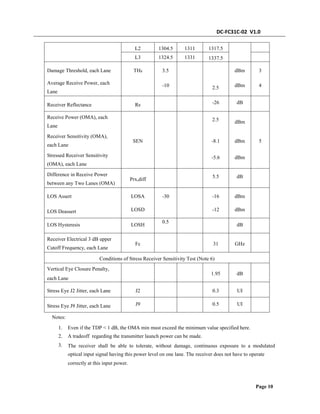
Damage Threshold, each Lane THd 3.5
-10
dBm
dBm
dB
3
4Average Receive Power, each
Lane
2.5
-26
2.5
Receiver Reflectance RR
Receive Power (OMA), each
Lane
dBm
Receiver Sensitivity (OMA),
each Lane
SEN -8.1
-5.6
5.5
dBm
dBm
dB
5
Stressed Receiver Sensitivity
(OMA), each Lane
Difference in Receive Power
between any Two Lanes (OMA)
Prx,diff
LOS Assert LOSA
LOSD
LOSH
-30
0.5
-16
-12
dBm
dBm
dB
LOS Deassert
LOS Hysteresis
Receiver Electrical 3 dB upper
Cutoff Frequency, each Lane
Fc 31 GHz
Conditions of Stress Receiver Sensitivity Test (Note 6)
Vertical Eye Closure Penalty,
1.95 dB
each Lane
Stress Eye J2 Jitter, each Lane J2
J9
0.3
0.5
UI
UIStress Eye J9 Jitter, each Lane
Notes:
1.
2.
3.
Even if the TDP < 1 dB, the OMA min must exceed the minimum value specified here.
A tradeoff regarding the transmitter launch power can be made.
The receiver shall be able to tolerate, without damage, continuous exposure to a modulated
optical input signal having this power level on one lane. The receiver does not have to operate
correctly at this input power.
Page 10
DC-FC31C-02 V1.0
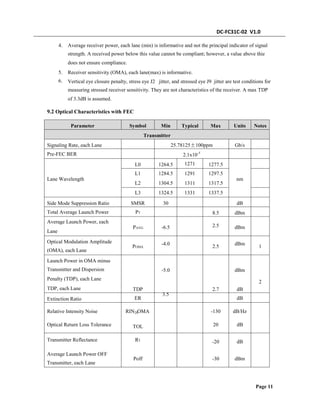
4. Average receiver power, each lane (min) is informative and not the principal indicator of signal
strength. A received power below this value cannot be compliant; however, a value above thie
does not ensure compliance.
5.
6.
Receiver sensitivity (OMA), each lane(max) is informative.
Vertical eye closure penalty, stress eye J2 jitter, and stressed eye J9 jitter are test conditions for
measuring stressed receiver sensitivity. They are not characteristics of the receiver. A max TDP
of 3.3dB is assumed.
9.2 Optical Characteristics with FEC
Parameter Symbol Min Typical Max Units Notes
Transmitter
Signaling Rate, each Lane
Pre-FEC BER
25.78125±100ppm Gb/s
2.1x10
1271
1291
1311
1331
-5
L0
L1
L2
L3
1264.5
1284.5
1304.5
1324.5
1277.5
1297.5
1317.5
1337.5
Lane Wavelength nm
Side Mode Suppression Ratio
Total Average Launch Power
Average Launch Power, each
Lane
SMSR
PT
30 dB
8.5
2.5
dBm
PAVG -6.5
-4.0
dBm
dBmOptical Modulation Amplitude
(OMA), each Lane
POMA 2.5 1
2
Launch Power in OMA minus
Transmitter and Dispersion
Penalty (TDP), each Lane
TDP, each Lane
-5.0
3.5
dBm
TDP
ER
2.7 dB
dBExtinction Ratio
Relative Intensity Noise
Optical Return Loss Tolerance
Transmitter Reflectance
RIN OMA -130
20
dB/Hz
dB
20
TOL
RT
-20 dB
Average Launch Power OFF
Transmitter, each Lane
Poff -30 dBm
Page 11
DC-FC31C-02 V1.0
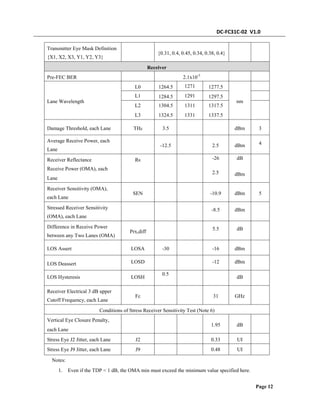
Transmitter Eye Mask Definition
{X1, X2, X3, Y1, Y2, Y3}
{0.31, 0.4, 0.45, 0.34, 0.38, 0.4}
Receiver
Pre-FEC BER 2.1x10
1271
1291
1311
1331
-5
L0
L1
L2
L3
1264.5 1277.5
1284.5
1304.5
1324.5
1297.5
1317.5
1337.5
Lane Wavelength nm
Damage Threshold, each Lane THd 3.5 dBm 3
4Average Receive Power, each
Lane
-12.5 2.5
-26
2.5
dBm
dBReceiver Reflectance
Receive Power (OMA), each
Lane
RR
dBm
Receiver Sensitivity (OMA),
each Lane
SEN -10.9
-8.5
5.5
dBm
dBm
dB
5
Stressed Receiver Sensitivity
(OMA), each Lane
Difference in Receive Power
between any Two Lanes (OMA)
Prx,diff
LOS Assert LOSA
LOSD
LOSH
-30
0.5
-16
-12
dBm
dBm
dB
LOS Deassert
LOS Hysteresis
Receiver Electrical 3 dB upper
Cutoff Frequency, each Lane
Fc 31 GHz
Conditions of Stress Receiver Sensitivity Test (Note 6)
Vertical Eye Closure Penalty,
1.95 dB
each Lane
Stress Eye J2 Jitter, each Lane
Stress Eye J9 Jitter, each Lane
Notes:
J2
J9
0.33
0.48
UI
UI
1. Even if the TDP < 1 dB, the OMA min must exceed the minimum value specified here.
Page 12
DC-FC31C-02 V1.0
2.
3.
A tradeoff regarding the transmitter launch power can be made.
The receiver shall be able to tolerate, without damage, continuous exposure to a modulated
optical input signal having this power level on one lane. The receiver does not have to operate
correctly at this input power.
4. Average receiver power, each lane (min) is informative and not the principal indicator of signal
strength. A received power below this value cannot be compliant; however, a value above thie
does not ensure compliance.
5.
6.
Receiver sensitivity (OMA), each lane (max) is informative.
Vertical eye closure penalty, stress eye J2 jitter, and stressed eye J9 jitter are test conditions for
measuring stressed receiver sensitivity. They are not characteristics of the receiver. A max TDP
of 3.3dB is assumed.
7. With-FEC numbers provided for reference; each parameter is met if the equivalent CLR4
parameter without FEC is met.
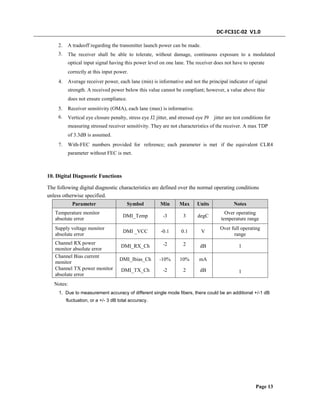
10. Digital Diagnostic Functions
The following digital diagnostic characteristics are defined over the normal operating conditions
unless otherwise specified.
Parameter Symbol Min Max Units Notes
Temperature monitor
absolute error
Over operating
temperature range
DMI_Temp -3 3 degC
Supply voltage monitor
absolute error
Over full operating
range
DMI _VCC -0.1
-2
0.1
2
V
Channel RX power
monitor absolute error
DMI_RX_Ch dB 1
Channel Bias current
monitor
Channel TX power monitor
absolute error
DMI_Ibias_Ch
DMI_TX_Ch
-10%
-2
10%
2
mA
dB 1
Notes:
1. Due to measurement accuracy of different single mode fibers, there could be an additional +/-1 dB
fluctuation, or a +/- 3 dB total accuracy.
Page 13
DC-FC31C-02 V1.0
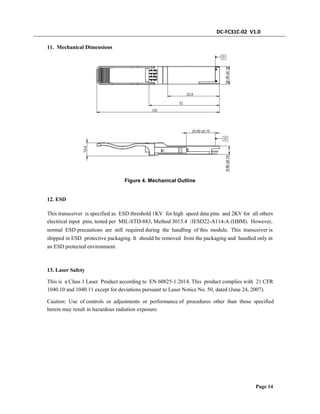
11. Mechanical Dimensions
Figure 4. Mechanical Outline
12. ESD
This transceiver is specified as ESD threshold 1KV for high speed data pins and 2KV for all others
electrical input pins, tested per MIL-STD-883, Method 3015.4 /JESD22-A114-A (HBM). However,
normal ESD precautions are still required during the handling of this module. This transceiver is
shipped in ESD protective packaging. It should be removed from the packaging and handled only in
an ESD protected environment.
13. Laser Safety
This is a Class 1 Laser Product according to EN 60825-1:2014. This product complies with 21 CFR
1040.10 and 1040.11 except for deviations pursuant to Laser Notice No. 50, dated (June 24, 2007).
Caution: Use of controls or adjustments or performance of procedures other than those specified
herein may result in hazardous radiation exposure.
Page 14
DC-FC31C-02 V1.0
January 5, 2016 Datacomm Technology Confidential Page 15

Datacomm 100G QSFP28 CLR4 Optical Transceivers

  • 1.
    DC-FC31C-02 V1.0 100Gb/s QSFP28CLR4 Single Mode Optical Transceiver DC-FC31C-02 Product Specification Features   4 independent full-duplex channels Up to 28Gb/s data rate per channel   QSFP28 MSA compliant Compliant to 100G CLR4 Up to 2km reach for G.652 SMF Applications     Maximum power consumption 3.5W Single +3.3V power supply    100G Ethernet links Infiniband QDR and DDR interconnects Datacenter and Enterprise networking o Operating case temperature: 0 to 70 C RoHS-6 compliant Part Number Ordering Information DC-FC31C-02 QSFP28 CLR4 2km optical transceiver with full real-time digital diagnostic monitoring Page 1
  • 2.
    DC-FC31C-02 V1.0 1. GeneralDescription This product is a transceiver module designed for 2km optical communication applications. The design is compliant to IEEE802.3ba and 100G-CLR4 standard. The module converts 4 inputs channels of 25Gb/s electrical data to 4 CWDM optical signals, and multiplexes them into a single channel for 100Gb/s optical transmission. Reversely, on the receiver side, the module optically de-multiplexes a 100Gb/s input into 4 CWDM channels signals, and converts them to 4 channel output electrical data. The central wavelengths of the 4 CWDM channels are 1271, 1291, 1311 and 1331 nm as members of the CWDM wavelength grid defined in ITUT-T G.694.2 and are spaced at 20 nm. It contains a duplex LC connector for the optical interface and a 38-pin connector for electrical interface. Its electrical interface is based on IEEE802.3 CAUI-4 to module retimed interface. The product is designed with form factor, optical/electrical connection and digital diagnostic interface according to the QSFP28 Multi-Source Agreement (MSA). It has been designed to meet the harshest external operating conditions including temperature, humidity and EMI interference. The module can be managed through the I2C two-wire serial interface. 2. Functional Description This product converts the 4-channel 25Gb/s electrical input data into CWDM optical signals, by a driven 4-wavelength Distributed Feedback Laser (DFB) array. The light is combined by the MUX parts as a 100Gb/s data, propagating out of the transmitter module from the SMF. The receiver module accepts the 100Gb/s CWDM optical signals input, and de-multiplexes it into 4 individual 25Gb/s channels with different wavelength. Each wavelength light is collected by a discrete photo diode, and then outputted as electrical data after amplified by a TIA and a post amplifier. Figure 1 shows the functional block diagram of this product. A single +3.3V power supply is required to power up the module. Both power supply pins VccTx and VccRx are internally connected and should be applied concurrently. Per MSA the module offers 7 low speed hardware control pins (including the 2-wire serial interface): ModSelL, SCL, SDA, ResetL, LPMode, ModPrsL and IntL. Module Select (ModSelL) is an input pin. When held low by the host, the module responds to 2-wire serial communication commands. The ModSelL allows the use of multiple QSFP28 modules on a single 2-wire interface bus – individual ModSelL lines for each QSFP28 module must be used. Serial Clock (SCL) and Serial Data (SDA) are required for the 2-wire serial bus communication interface and enable the host to access the QSFP28 memory map. The ResetL pin enables a complete module reset, returning module settings to their default state, when a low level on the ResetL pin is held for longer than the minimum pulse length. During the execution of a reset the host shall disregard all status bits until the module indicates a completion of the reset interrupt. The module indicates this by posting an IntL (Interrupt) signal with the Data_Not_Ready bit Page 2
  • 3.
    DC-FC31C-02 V1.0 negated inthe memory map. Note that on power up (including hot insertion) the module should post this completion of reset interrupt without requiring a reset. Low Power Mode (LPMode) pin is used to set the maximum power consumption for the module in order to protect hosts that are not capable of cooling higher power modules, should such modules be accidentally inserted. Module Present (ModPrsL) is a signal local to the host board which, in the absence of a module, is normally pulled up to the host Vcc. When a module is inserted into the connector, it completes the path to ground through a resistor on the host board and asserts the signal. ModPrsL then indicates a module is present by setting ModPrsL to a “Low” state. Interrupt (IntL) is an output pin. Low indicates a possible module operational fault or a status critical to the host system. The host identifies the source of the interrupt using the 2-wire serial interface. The IntL pin is an open collector output and must be pulled to the Host Vcc voltage on the Host board. 3. Transceiver Block Diagram TX3 OpticalTX2 TX1 4 Channels CDR + LDD 4 CWDM DFB Lasers MUX Single Mode Fiber TX0 RX3 4 PINs + Optical DeMUX 4 Channels CDR + LA RX2 RX1 RX0 4 TIAs 4 Figure 1. Transceiver Block Diagram Page 3
  • 4.
    DC-FC31C-02 V1.0 4. PinAssignment and Description Figure 2. QSFP28 Transceiver Electrical Connector Layout Pin Definition PIN 1 Logic Symbol Name/Description Notes GND Ground 1 2 CML-I CML-I Tx2n Tx2p GND Tx4n Tx4p GND ModSelL ResetL VccRx SCL Transmitter Inverted Data Input 3 Transmitter Non-Inverted Data output Ground4 1 1 2 5 CML-I CML-I Transmitter Inverted Data Input Transmitter Non-Inverted Data output Ground 6 7 8 LVTLL-I LVTLL-I Module Select 9 Module Reset 10 11 12 13 14 15 +3.3V Power Supply Receiver 2-Wire Serial Interface Clock 2-Wire Serial Interface Data Ground LVCMOS-I/O LVCMOS-I/O SDA GND Rx3p Rx3n CML-O CML-O Receiver Non-Inverted Data Output Receiver Inverted Data Output Page 4
  • 5.
    DC-FC31C-02 V1.0 16 17 18 19 20 21 22 23 24 25 26 27 28 29 30 31 32 33 34 35 36 37 38 GND Rx1p Rx1n GND GND Rx2n Rx2p GND Rx4n Rx4p GND ModPrsL IntL Ground 1 CML-O CML-O ReceiverNon-Inverted Data Output Receiver Inverted Data Output Ground 1 1Ground CML-O CML-O Receiver Inverted Data Output Receiver Non-Inverted Data Output Ground 1 1CML-O CML-O Receiver Inverted Data Output Receiver Non-Inverted Data Output Ground 1 LVTTL-O LVTTL-O Module Present Interrupt VccTx Vcc1 LPMode GND Tx3p Tx3n GND Tx1p Tx1n GND +3.3 V Power Supply transmitter +3.3 V Power Supply Low Power Mode 2 2 LVTTL-I Ground 1 CML-I CML-I Transmitter Non-Inverted Data Input Transmitter Inverted Data Output Ground 1 1 CML-I CML-I Transmitter Non-Inverted Data Input Transmitter Inverted Data Output Ground Notes: 1. GND is the symbol for signal and supply (power) common for QSFP28 modules. All are common within the QSFP28 module and all module voltages are referenced to this potential unless otherwise noted. Connect these directly to the host board signal common ground plane. VccRx, Vcc1 and VccTx are the receiver and transmitter power suppliers and shall be applied concurrently. Recommended host board power supply filtering is shown in Figure 3 below. Vcc Rx, Vcc1 and VccTx may be internally connected within the QSFP28 transceiver module in any combination. The connector pins are each rated for a maximum current of 1000mA. 2. Page 5
  • 6.
    DC-FC31C-02 V1.0 5. RecommendedPower Supply Filter Figure 3. Recommended Power Supply Filter 6. Absolute Maximum Ratings It has to be noted that the operation in excess of any absolute maximum ratings might cause permanent damage to this module. Parameter Symbol TS Min -40 0 Max 85 Units degC degC V Notes Storage Temperature Operating Case Temperature Power Supply Voltage TOP 70 VCC -0.5 0 3.6 85Relative Humidity (non-condensation) Damage Threshold, each Lane RH THd % 3.5 dBm 7. Recommended Operating Conditions and Power Supply Requirements Parameter Symbol TOP Min 0 Typical Max 70 Units Operating Case Temperature Power Supply Voltage Data Rate, each Lane degC VVCC 3.135 3.3 3.465 25.78125 Gb/s VControl Input Voltage High Control Input Voltage Low Link Distance with G.652 2 0 Vcc 0.8 2 V D 0.002 km Page 6
  • 7.
    DC-FC31C-02 V1.0 8. ElectricalCharacteristics The following electrical characteristics are defined over the Recommended Operating Environment unless otherwise specified. Parameter Power Consumption Supply Current Symbol Min Typical Max 3.5 Units W Notes Icc 1.1 A Transceiver Power-on Initialization Time 2000 ms 1 Module input characteristics (each Lane) Parameter Test Point Min Typical Max Units Notes Signal Rate, each Lane TP1 25.78125±100ppm Gb/s Differential pk-pk Input Voltage Tolerance Differential Input Return Loss TP1a TP1 TP1 TP1 TP1a TP1a TP1 900 mV dB dB % IEEE802.3bm Equation 83E-5 IEEE802.3bm Equation 83E-6 10 Differential to Common Mode Input Return Loss Differential Termination Mismatch Module Stressed Input Test IEEE802.3bm 83E.3.4.1 2 Single End Voltage Tolerance Range DC Common Mode Voltage -0.4 3.3 V -350 2850 mV 3 Receiver (each Lane) Parameter Test Point Min Typical Max Units Notes Signaling Rate, each Lane TP4 25.78125±100ppm Gb/s AC Common Mode Output Voltage (RMS) Differential Output Voltage TP4 TP4 17.5 900 mV mV Page 7
  • 8.
    DC-FC31C-02 V1.0 Eye WidthTP4 TP4 TP4 0.57 228 UI mV dB Eye Height, Differential Vertical Eye Closure Differential Output Return Loss 5.5 TP4 IEEE802.3bm Equation 83E-2 dB Common to Differential Mode Conversion Return Loss TP4 IEEE802.3bm Equation 83E-3 dB Differential Termination Mismatch TP4 TP4 TP4 10 % psTransition Time (20% to 80%) 12 DC Common Mode Voltage -350 2850 mV 3 Notes: 1. Power-on Initialization Time is the time from when the power supply voltages reach and remain above the minimum recommended operating supply voltages to the time when the module is fully functional. 2. 3. Meets BER specified in IEEE802.3bm 83E.1.1. DC common mode voltage is generated by the host. Specification includes effects of ground offset voltage. Page 8
  • 9.
    DC-FC31C-02 V1.0 9. OpticalCharacteristics 9.1 Optical Characteristics without FEC Parameter Symbol Min Typical Max Units Notes Transmitter Signaling Rate, each Lane BER 25.78125±100ppm Gb/s 1x10-12 L0 L1 L2 L3 1264.5 1284.5 1304.5 1324.5 1271 1291 1311 1331 1277.5 1297.5 1317.5 1337.5 Lane Wavelength nm Side Mode Suppression Ratio Total Average Launch Power Average Launch Power, each Lane SMSR PT 30 dB 8.5 2.5 dBm PAVG -6.5 -4.0 dBm dBmOptical Modulation Amplitude (OMA), each Lane POMA 2.5 1 2 Launch Power in OMA minus Transmitter and Dispersion Penalty (TDP), each Lane TDP, each Lane -5.0 3.5 dBm TDP ER 3.3 dB dBExtinction Ratio Relative Intensity Noise Optical Return Loss Tolerance Transmitter Reflectance RIN OMA -130 20 dB/Hz dB 20 TOL RT -20 dB Average Launch Power OFF Transmitter, each Lane Poff -30 dBm Transmitter Eye Mask Definition {X1, X2, X3, Y1, Y2, Y3} {0.25, 0.42, 0.46, 0.28, 0.3, 0.4} Receiver BER 1x10 -12 L0 L1 1264.5 1284.5 1271 1291 1277.5 1297.5 Lane Wavelength nm Page 9
  • 10.
    DC-FC31C-02 V1.0 L2 L3 1304.5 1324.5 1311 1331 1317.5 1337.5 Damage Threshold,each Lane THd 3.5 -10 dBm dBm dB 3 4Average Receive Power, each Lane 2.5 -26 2.5 Receiver Reflectance RR Receive Power (OMA), each Lane dBm Receiver Sensitivity (OMA), each Lane SEN -8.1 -5.6 5.5 dBm dBm dB 5 Stressed Receiver Sensitivity (OMA), each Lane Difference in Receive Power between any Two Lanes (OMA) Prx,diff LOS Assert LOSA LOSD LOSH -30 0.5 -16 -12 dBm dBm dB LOS Deassert LOS Hysteresis Receiver Electrical 3 dB upper Cutoff Frequency, each Lane Fc 31 GHz Conditions of Stress Receiver Sensitivity Test (Note 6) Vertical Eye Closure Penalty, 1.95 dB each Lane Stress Eye J2 Jitter, each Lane J2 J9 0.3 0.5 UI UIStress Eye J9 Jitter, each Lane Notes: 1. 2. 3. Even if the TDP < 1 dB, the OMA min must exceed the minimum value specified here. A tradeoff regarding the transmitter launch power can be made. The receiver shall be able to tolerate, without damage, continuous exposure to a modulated optical input signal having this power level on one lane. The receiver does not have to operate correctly at this input power. Page 10
  • 11.
    DC-FC31C-02 V1.0 4. Averagereceiver power, each lane (min) is informative and not the principal indicator of signal strength. A received power below this value cannot be compliant; however, a value above thie does not ensure compliance. 5. 6. Receiver sensitivity (OMA), each lane(max) is informative. Vertical eye closure penalty, stress eye J2 jitter, and stressed eye J9 jitter are test conditions for measuring stressed receiver sensitivity. They are not characteristics of the receiver. A max TDP of 3.3dB is assumed. 9.2 Optical Characteristics with FEC Parameter Symbol Min Typical Max Units Notes Transmitter Signaling Rate, each Lane Pre-FEC BER 25.78125±100ppm Gb/s 2.1x10 1271 1291 1311 1331 -5 L0 L1 L2 L3 1264.5 1284.5 1304.5 1324.5 1277.5 1297.5 1317.5 1337.5 Lane Wavelength nm Side Mode Suppression Ratio Total Average Launch Power Average Launch Power, each Lane SMSR PT 30 dB 8.5 2.5 dBm PAVG -6.5 -4.0 dBm dBmOptical Modulation Amplitude (OMA), each Lane POMA 2.5 1 2 Launch Power in OMA minus Transmitter and Dispersion Penalty (TDP), each Lane TDP, each Lane -5.0 3.5 dBm TDP ER 2.7 dB dBExtinction Ratio Relative Intensity Noise Optical Return Loss Tolerance Transmitter Reflectance RIN OMA -130 20 dB/Hz dB 20 TOL RT -20 dB Average Launch Power OFF Transmitter, each Lane Poff -30 dBm Page 11
  • 12.
    DC-FC31C-02 V1.0 Transmitter EyeMask Definition {X1, X2, X3, Y1, Y2, Y3} {0.31, 0.4, 0.45, 0.34, 0.38, 0.4} Receiver Pre-FEC BER 2.1x10 1271 1291 1311 1331 -5 L0 L1 L2 L3 1264.5 1277.5 1284.5 1304.5 1324.5 1297.5 1317.5 1337.5 Lane Wavelength nm Damage Threshold, each Lane THd 3.5 dBm 3 4Average Receive Power, each Lane -12.5 2.5 -26 2.5 dBm dBReceiver Reflectance Receive Power (OMA), each Lane RR dBm Receiver Sensitivity (OMA), each Lane SEN -10.9 -8.5 5.5 dBm dBm dB 5 Stressed Receiver Sensitivity (OMA), each Lane Difference in Receive Power between any Two Lanes (OMA) Prx,diff LOS Assert LOSA LOSD LOSH -30 0.5 -16 -12 dBm dBm dB LOS Deassert LOS Hysteresis Receiver Electrical 3 dB upper Cutoff Frequency, each Lane Fc 31 GHz Conditions of Stress Receiver Sensitivity Test (Note 6) Vertical Eye Closure Penalty, 1.95 dB each Lane Stress Eye J2 Jitter, each Lane Stress Eye J9 Jitter, each Lane Notes: J2 J9 0.33 0.48 UI UI 1. Even if the TDP < 1 dB, the OMA min must exceed the minimum value specified here. Page 12
  • 13.
    DC-FC31C-02 V1.0 2. 3. A tradeoffregarding the transmitter launch power can be made. The receiver shall be able to tolerate, without damage, continuous exposure to a modulated optical input signal having this power level on one lane. The receiver does not have to operate correctly at this input power. 4. Average receiver power, each lane (min) is informative and not the principal indicator of signal strength. A received power below this value cannot be compliant; however, a value above thie does not ensure compliance. 5. 6. Receiver sensitivity (OMA), each lane (max) is informative. Vertical eye closure penalty, stress eye J2 jitter, and stressed eye J9 jitter are test conditions for measuring stressed receiver sensitivity. They are not characteristics of the receiver. A max TDP of 3.3dB is assumed. 7. With-FEC numbers provided for reference; each parameter is met if the equivalent CLR4 parameter without FEC is met. 10. Digital Diagnostic Functions The following digital diagnostic characteristics are defined over the normal operating conditions unless otherwise specified. Parameter Symbol Min Max Units Notes Temperature monitor absolute error Over operating temperature range DMI_Temp -3 3 degC Supply voltage monitor absolute error Over full operating range DMI _VCC -0.1 -2 0.1 2 V Channel RX power monitor absolute error DMI_RX_Ch dB 1 Channel Bias current monitor Channel TX power monitor absolute error DMI_Ibias_Ch DMI_TX_Ch -10% -2 10% 2 mA dB 1 Notes: 1. Due to measurement accuracy of different single mode fibers, there could be an additional +/-1 dB fluctuation, or a +/- 3 dB total accuracy. Page 13
  • 14.
    DC-FC31C-02 V1.0 11. MechanicalDimensions Figure 4. Mechanical Outline 12. ESD This transceiver is specified as ESD threshold 1KV for high speed data pins and 2KV for all others electrical input pins, tested per MIL-STD-883, Method 3015.4 /JESD22-A114-A (HBM). However, normal ESD precautions are still required during the handling of this module. This transceiver is shipped in ESD protective packaging. It should be removed from the packaging and handled only in an ESD protected environment. 13. Laser Safety This is a Class 1 Laser Product according to EN 60825-1:2014. This product complies with 21 CFR 1040.10 and 1040.11 except for deviations pursuant to Laser Notice No. 50, dated (June 24, 2007). Caution: Use of controls or adjustments or performance of procedures other than those specified herein may result in hazardous radiation exposure. Page 14
  • 15.
    DC-FC31C-02 V1.0 January 5,2016 Datacomm Technology Confidential Page 15