LEADERSHIP AND
TQM
KULDEEP MATHUR
M.B.A. JIWAJI UNIVERSITY GWALIOR
Leadership for Success of TQM
Visionary Leadership is:
 “ An organizations senior leader should set direction
and create a customer focus, clear and visible values
and high expectations. The directions, values and
expectations should balance the needs of all your
stake holders. The leader should ensure creation of
strategies, systems and methods for achieving
excellence, stimulating innovation and building
knowledge and capabilities. The values and strategies
should guide all activities and decisions of the
organization. Senior leaders should inspire and
motivate the entire work force and should encourage
all employees to contribute, to develop and learn, to
be innovative and to be creative.”
Role of TQM Leaders in TQM Implementation
 Institute Quality Council
 Develop Core Values, Concepts and
Framework
 Prepare Quality Statements
 Strategic Planning
 Communications
 Decision Making
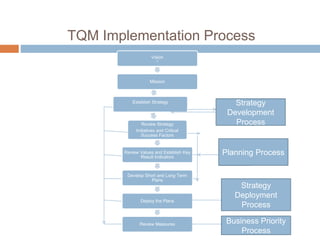
TQM Implementation Process
Vision
s
Mission
Establish Strategy
Review Strategy
Initiatives and Critical
Success Factors
Review Values and Establish Key
Result Indicators
Develop Short and Long Term
Plans
Deploy the Plans
Review Measures
Strategy
Deployment
Process
Business Priority
Process
Strategy
Development
Process
Planning Process
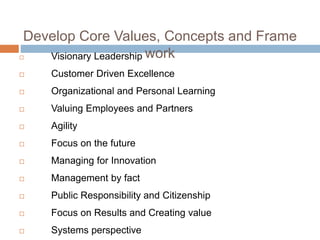
Develop Core Values, Concepts and Frame
work Visionary Leadership
 Customer Driven Excellence
 Organizational and Personal Learning
 Valuing Employees and Partners
 Agility
 Focus on the future
 Managing for Innovation
 Management by fact
 Public Responsibility and Citizenship
 Focus on Results and Creating value
 Systems perspective
Quality Statements - Vision
 Vision statement is a short declaration of what an
organization aspires to be tomorrow. It is state
that might never be reached but you continuously
strive to achieve. Successful visions are timeless,
inspirational, and become deeply shared within the
organization such as IBM’s service and Apple’s
computing for the masses.
 Example: “We will be preferred provider of safe,
reliable, and cost effective products and services
that satisfy the hardware related needs of all the
customers”.
Quality Statements - Mission
 The mission statement answers the following
questions: who we are, who are our customers,
what we do, and how we do it. This statement is
one paragraph and less in length, It is easy to
understand, and describes the function of the
organization. It provides clear statement of
purpose for employees, customers and suppliers.
 Example: For a transportation Company it could
be stated as “To meet customers, transportation
and distribution needs by being the best at moving
their goods on time, safely and damage free”.
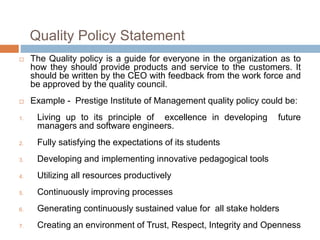
Quality Policy Statement
 The Quality policy is a guide for everyone in the organization as to
how they should provide products and service to the customers. It
should be written by the CEO with feedback from the work force and
be approved by the quality council.
 Example - Prestige Institute of Management quality policy could be:
1. Living up to its principle of excellence in developing future
managers and software engineers.
2. Fully satisfying the expectations of its students
3. Developing and implementing innovative pedagogical tools
4. Utilizing all resources productively
5. Continuously improving processes
6. Generating continuously sustained value for all stake holders
7. Creating an environment of Trust, Respect, Integrity and Openness
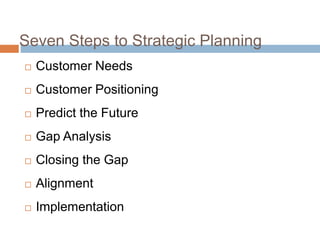
Seven Steps to Strategic Planning
 Customer Needs
 Customer Positioning
 Predict the Future
 Gap Analysis
 Closing the Gap
 Alignment
 Implementation
Characteristics of Good Quality
Leaders
 Give priority attention to customers (Internal &
External)
 Empower rather than control, subordinates
 Emphasize improvement rather than
maintenance
 Emphasize on prevention
 Encourage Collaboration rather than
competition
Characteristics of Good Quality Leaders
Contd.
 Learn from problems
 Continuously try to improve communication
 Continuously demonstrate their commitment to
quality
 They choose suppliers based on quality, not
price
 Organize organizational system to support the
quality effort
 Encourage and recognize team efforts
Thank You Very Much

Leadership and tqm

  • 1.
  • 2.
    Leadership for Successof TQM Visionary Leadership is:  “ An organizations senior leader should set direction and create a customer focus, clear and visible values and high expectations. The directions, values and expectations should balance the needs of all your stake holders. The leader should ensure creation of strategies, systems and methods for achieving excellence, stimulating innovation and building knowledge and capabilities. The values and strategies should guide all activities and decisions of the organization. Senior leaders should inspire and motivate the entire work force and should encourage all employees to contribute, to develop and learn, to be innovative and to be creative.”
  • 3.
    Role of TQMLeaders in TQM Implementation  Institute Quality Council  Develop Core Values, Concepts and Framework  Prepare Quality Statements  Strategic Planning  Communications  Decision Making
  • 4.
    TQM Implementation Process Vision s Mission EstablishStrategy Review Strategy Initiatives and Critical Success Factors Review Values and Establish Key Result Indicators Develop Short and Long Term Plans Deploy the Plans Review Measures Strategy Deployment Process Business Priority Process Strategy Development Process Planning Process
  • 5.
    Develop Core Values,Concepts and Frame work Visionary Leadership  Customer Driven Excellence  Organizational and Personal Learning  Valuing Employees and Partners  Agility  Focus on the future  Managing for Innovation  Management by fact  Public Responsibility and Citizenship  Focus on Results and Creating value  Systems perspective
  • 6.
    Quality Statements -Vision  Vision statement is a short declaration of what an organization aspires to be tomorrow. It is state that might never be reached but you continuously strive to achieve. Successful visions are timeless, inspirational, and become deeply shared within the organization such as IBM’s service and Apple’s computing for the masses.  Example: “We will be preferred provider of safe, reliable, and cost effective products and services that satisfy the hardware related needs of all the customers”.
  • 7.
    Quality Statements -Mission  The mission statement answers the following questions: who we are, who are our customers, what we do, and how we do it. This statement is one paragraph and less in length, It is easy to understand, and describes the function of the organization. It provides clear statement of purpose for employees, customers and suppliers.  Example: For a transportation Company it could be stated as “To meet customers, transportation and distribution needs by being the best at moving their goods on time, safely and damage free”.
  • 8.
    Quality Policy Statement The Quality policy is a guide for everyone in the organization as to how they should provide products and service to the customers. It should be written by the CEO with feedback from the work force and be approved by the quality council.  Example - Prestige Institute of Management quality policy could be: 1. Living up to its principle of excellence in developing future managers and software engineers. 2. Fully satisfying the expectations of its students 3. Developing and implementing innovative pedagogical tools 4. Utilizing all resources productively 5. Continuously improving processes 6. Generating continuously sustained value for all stake holders 7. Creating an environment of Trust, Respect, Integrity and Openness
  • 9.
    Seven Steps toStrategic Planning  Customer Needs  Customer Positioning  Predict the Future  Gap Analysis  Closing the Gap  Alignment  Implementation
  • 10.
    Characteristics of GoodQuality Leaders  Give priority attention to customers (Internal & External)  Empower rather than control, subordinates  Emphasize improvement rather than maintenance  Emphasize on prevention  Encourage Collaboration rather than competition
  • 11.
    Characteristics of GoodQuality Leaders Contd.  Learn from problems  Continuously try to improve communication  Continuously demonstrate their commitment to quality  They choose suppliers based on quality, not price  Organize organizational system to support the quality effort  Encourage and recognize team efforts
  • 12.