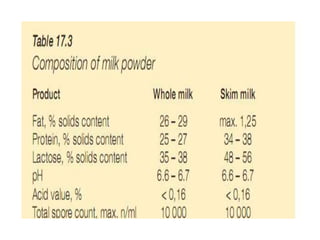
MILK POWDER
Dr. AYSHA SAMEEN
MILK POWDER
• Milk powder is produced on large scale in
modern plants
• Skim milk powder has maximum shelf life of
about three years
• Whole milk powder has maximum shelf life of
about six months
• Fat oxidises during storage, with a
consequent gradual deterioration in taste
Drying
• Drying means that the water in a liquid
product-in this case milk- is removed, so
that the product acquires a solid form.
• The water content of milk powder ranges
between 2.5 and 5%
Benefits of drying:
• Reduces the weight and volume
• Reduces the transportation and storing
cost.
• Freeze drying- the water is evaporated
under vacuum
Freeze Drying
• This method offer advantages from quality
aspects, as the protein fraction is not affected
• Freeze drying is not used widely because of
high energy demand
Two principal method used in dairy industry
• Roller drying
• Spray drying
In this method two stages
1. Concentration by evaporation
2. Drying in spray tower
USES OF MILK POWDER
• RECOMBINTION OF MILK
• Mixing into dough in bakery industry
– To increase the volume of bread
– Improve its water binding capacity
– Bread will remain fresh for longer time
• Mixing into pastry dough to make it crisper
• Substitute for eggs in bread and pastries
• Producing milk chocolate in chocolate industry
• Used in sausages
• Substitute for mothers milk in baby foods
• Production of ice cream
• Animal feed
Skimmed milk powder
• Most common type of milk powder
• Application makes it specific demand on milk
powder for example for recombined milk
– Easily soluble
– Correct taste
– Nutritive value
• Some degree of caramellisation of lactose is
beneficial in chocolate production
• For recombined milk gentle drying of product in
a spray tower is essential
• For chocolate powder may be subjected to
intense heat treatment in a roller dryer
Skimmed milk powder
• Two types of powder are
1. Roller dryer powder
2. Spray dryer powder
• solubility of spray powder is very good whereas that
of roller dryer powder is appreciably poor
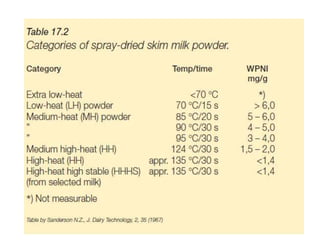
• Depending on intensity of heat treatment milk
powder is classified into categories
• Extra low heat
• Low heat
• Medium heat
• Medium high heat
• High heat
Whole milk powder
• Spray dried whole milk powder is normally
produced from standardized milk.
• Whole milk powder, unlike skim milk powder, is
not categorised.
• Milk intended for whole milk powder is
pasteurized at 80 – 85 °C
• To inactivate most of the lipolytic enzymes
• That would otherwise degrade the milk fat during
storage.
Instant-milk powder
• Special methods for the production of both skim
milk and whole milk powder with extremely good
wet ability and solubility known as instant powder
• This powder is agglomerated into larger
particles
• A number of particles are combined to form a
larger grain (agglomerate).
• The average grain size of the product increases.
Instant-milk powder
• instant powder, as it is known, dissolves instantly,
even in cold water.
• Bulk density
• Bulk density is the weight of a unit volume of
powder; in practice it is expressed as g/ml, g/100
ml or g/l.
• During shipping over long distances, it is
important that they have a high bulk density as the
reduced volume saves on transportation costs and
packaging.
Production of milk powder
Roller drying
• In the production of roller-dried powder, the pre-
treated milk is fed to a roller dryer after evaporation
and the whole drying process takes place in one stage.
Spray drying
• In the production of spray-dried powder, the milk is
first evaporated in a vacuum evaporator to a DM
content of 48 – 50 % and then dried in the
spray tower.
Raw material
• Very strict demands are made of the quality of the
raw material for the production of milk powder.
• Spray powder production involves vacuum
evaporation, it is very important to keep heat-
resistant bacteria under control so that they cannot
multiply during evaporation.
• Bactofugation or microfiltration of the milk can
therefore partly be used to remove bacteria spores
from the milk,
Raw material
• Milk for powder production must not be
subjected to excessive thermal impact prior
to evaporation and drying.
• This could denature whey proteins and there
by impair
1. solubility
2. aroma and flavour of the milk powder.
Raw material
• The milk is subjected to a peroxidase test or
a whey protein test to determine the degree
of heat treatment.
General pre-treatment of the milk
• In the production of skim milk powder, the
milk is clarified in conjunction with fat
separation.
• Whole milk and skim milk are pasteurised
at various temperatures depending on the
powder quality requirements.
Roller drying
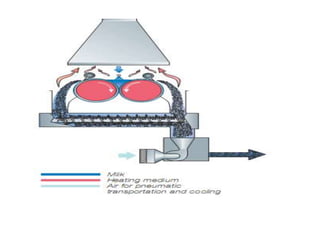
• In roller drying, the milk concentrate is
distributed as a film on rotating,steam-
heated drums or rollers.
• The water in the concentrated milk
evaporates, and the vapour is drawn off.
• The pre-treated milk is applied to the hot
roller surface as a thin film.
Roller drying
• The dried milk is scraped off the rollers and
removed by means of a screw conveyor, at which
point the milk is broken down into flakes.
• The flakes are then transferred to a grinder which
is used to create the desired grain size.
• After that, hard and burned particles are sifted off.
• Depending on the desired capacity, the roller dryer
is 1 – 6 m long and has a roller diameter of 0,6 – 3
m.
Roller drying
• Roller dryer performance is dependent on
1.Milk film thickness,
2. Roller surface temperature
3. Roller speed and
4. The DM content of the supplied milk.
Spray drying
• Powder production is carried out in two
phases.
• In the first phase, the pretreated milk is
evaporated to a DM content of 48 – 52 %.
• Whey is concentrated to a DM content of 58
– 62 %.
• In the second phase, the concentrate is
turned into powder in a spray tower.
Spray drying
• Spray drying is multiple-stage process:
• Atomization of the concentrate into very fine droplets in a hot
air stream
• Water evaporation
• Separation of the powder from the drying air
• Without prior concentration
– Powder particles will be very small
– Have a high air content
– Poor wetability
– Short shelf life.
– Process would also be extremely un economical
Basic drying installations
• Single-stage drying
• The simplest installation for producing a
powder consists
– drying chamber
– atomisation system,
– air heater,
– system for collecting the finished powder from the
dry air
– fan which sucks the necessary amount of air
through the entire system.
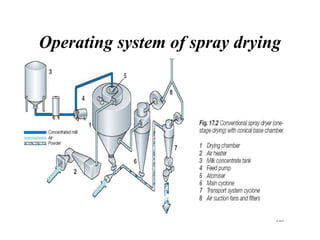
Operating system of spray drying
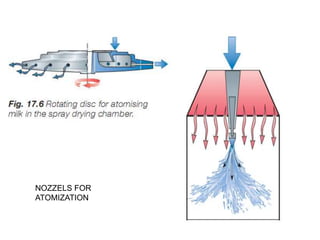
NOZZELS FOR
ATOMIZATION
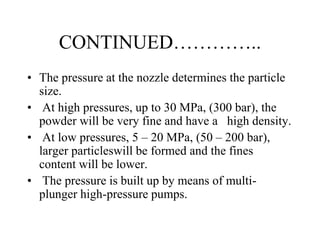
CONTINUED…………..
• The pressure at the nozzle determines the particle
size.
• At high pressures, up to 30 MPa, (300 bar), the
powder will be very fine and have a high density.
• At low pressures, 5 – 20 MPa, (50 – 200 bar),
larger particleswill be formed and the fines
content will be lower.
• The pressure is built up by means of multi-
plunger high-pressure pumps.
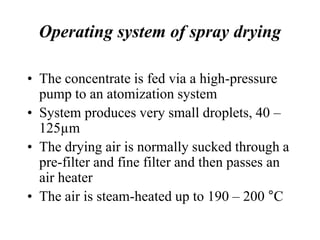
Operating system of spray drying
• The concentrate is fed via a high-pressure
pump to an atomization system
• System produces very small droplets, 40 –
125µm
• The drying air is normally sucked through a
pre-filter and fine filter and then passes an
air heater
• The air is steam-heated up to 190 – 200 °C
Operating system of spray drying
• An indirect heat recovery system can be
provided to improve energy economy
• The hot air flows through a distributor
which ensures that
– the air is traveling at a uniform speed into the
drying chamber, where it
– is mixed with the atomised product in the
straight flow.
• The free water evaporates immediately
when the atomized product enters the
drying chamber.
Operating system of spray drying
• Surface water evaporates very quickly, as does the
moisture from the inside of the droplets which
quickly reach the surface by capillary action.
• Then heat is transferred into the particles by
convection.
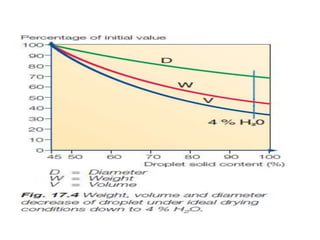
• The evaporation of the water from the droplets leads to a
considerable
– reduction in weight, volume and diameter.
• Under ideal drying conditions,
– weight will decrease by about 50 % and the volume by
about 40 %.
• The diameter is reduced to 75 % of the droplet size after
leaving the atomizer,
Operating system of spray drying
• During the drying process, the powder
settles in the bottom cone of the chamber
and is discharged from the system
• It is conveyed to a silo or packing station by
a pneumatic conveyor which uses cold air to
cool the hot powder.
• The powder is then separated from the
transport air by means of a cyclone.
milk powder (2).ppt

milk powder (2).ppt

  • 1.
  • 2.
    MILK POWDER • Milkpowder is produced on large scale in modern plants • Skim milk powder has maximum shelf life of about three years • Whole milk powder has maximum shelf life of about six months • Fat oxidises during storage, with a consequent gradual deterioration in taste
  • 3.
    Drying • Drying meansthat the water in a liquid product-in this case milk- is removed, so that the product acquires a solid form. • The water content of milk powder ranges between 2.5 and 5% Benefits of drying: • Reduces the weight and volume • Reduces the transportation and storing cost. • Freeze drying- the water is evaporated under vacuum
  • 4.
    Freeze Drying • Thismethod offer advantages from quality aspects, as the protein fraction is not affected • Freeze drying is not used widely because of high energy demand Two principal method used in dairy industry • Roller drying • Spray drying In this method two stages 1. Concentration by evaporation 2. Drying in spray tower
  • 5.
    USES OF MILKPOWDER • RECOMBINTION OF MILK • Mixing into dough in bakery industry – To increase the volume of bread – Improve its water binding capacity – Bread will remain fresh for longer time • Mixing into pastry dough to make it crisper • Substitute for eggs in bread and pastries • Producing milk chocolate in chocolate industry • Used in sausages • Substitute for mothers milk in baby foods • Production of ice cream • Animal feed
  • 6.
    Skimmed milk powder •Most common type of milk powder • Application makes it specific demand on milk powder for example for recombined milk – Easily soluble – Correct taste – Nutritive value • Some degree of caramellisation of lactose is beneficial in chocolate production • For recombined milk gentle drying of product in a spray tower is essential • For chocolate powder may be subjected to intense heat treatment in a roller dryer
  • 7.
    Skimmed milk powder •Two types of powder are 1. Roller dryer powder 2. Spray dryer powder • solubility of spray powder is very good whereas that of roller dryer powder is appreciably poor • Depending on intensity of heat treatment milk powder is classified into categories • Extra low heat • Low heat • Medium heat • Medium high heat • High heat
  • 9.
    Whole milk powder •Spray dried whole milk powder is normally produced from standardized milk. • Whole milk powder, unlike skim milk powder, is not categorised. • Milk intended for whole milk powder is pasteurized at 80 – 85 °C • To inactivate most of the lipolytic enzymes • That would otherwise degrade the milk fat during storage.
  • 10.
    Instant-milk powder • Specialmethods for the production of both skim milk and whole milk powder with extremely good wet ability and solubility known as instant powder • This powder is agglomerated into larger particles • A number of particles are combined to form a larger grain (agglomerate). • The average grain size of the product increases.
  • 11.
    Instant-milk powder • instantpowder, as it is known, dissolves instantly, even in cold water. • Bulk density • Bulk density is the weight of a unit volume of powder; in practice it is expressed as g/ml, g/100 ml or g/l. • During shipping over long distances, it is important that they have a high bulk density as the reduced volume saves on transportation costs and packaging.
  • 12.
    Production of milkpowder Roller drying • In the production of roller-dried powder, the pre- treated milk is fed to a roller dryer after evaporation and the whole drying process takes place in one stage. Spray drying • In the production of spray-dried powder, the milk is first evaporated in a vacuum evaporator to a DM content of 48 – 50 % and then dried in the spray tower.
  • 14.
    Raw material • Verystrict demands are made of the quality of the raw material for the production of milk powder. • Spray powder production involves vacuum evaporation, it is very important to keep heat- resistant bacteria under control so that they cannot multiply during evaporation. • Bactofugation or microfiltration of the milk can therefore partly be used to remove bacteria spores from the milk,
  • 15.
    Raw material • Milkfor powder production must not be subjected to excessive thermal impact prior to evaporation and drying. • This could denature whey proteins and there by impair 1. solubility 2. aroma and flavour of the milk powder.
  • 16.
    Raw material • Themilk is subjected to a peroxidase test or a whey protein test to determine the degree of heat treatment.
  • 17.
    General pre-treatment ofthe milk • In the production of skim milk powder, the milk is clarified in conjunction with fat separation. • Whole milk and skim milk are pasteurised at various temperatures depending on the powder quality requirements.
  • 18.
    Roller drying • Inroller drying, the milk concentrate is distributed as a film on rotating,steam- heated drums or rollers. • The water in the concentrated milk evaporates, and the vapour is drawn off. • The pre-treated milk is applied to the hot roller surface as a thin film.
  • 19.
    Roller drying • Thedried milk is scraped off the rollers and removed by means of a screw conveyor, at which point the milk is broken down into flakes. • The flakes are then transferred to a grinder which is used to create the desired grain size. • After that, hard and burned particles are sifted off. • Depending on the desired capacity, the roller dryer is 1 – 6 m long and has a roller diameter of 0,6 – 3 m.
  • 21.
    Roller drying • Rollerdryer performance is dependent on 1.Milk film thickness, 2. Roller surface temperature 3. Roller speed and 4. The DM content of the supplied milk.
  • 22.
    Spray drying • Powderproduction is carried out in two phases. • In the first phase, the pretreated milk is evaporated to a DM content of 48 – 52 %. • Whey is concentrated to a DM content of 58 – 62 %. • In the second phase, the concentrate is turned into powder in a spray tower.
  • 23.
    Spray drying • Spraydrying is multiple-stage process: • Atomization of the concentrate into very fine droplets in a hot air stream • Water evaporation • Separation of the powder from the drying air • Without prior concentration – Powder particles will be very small – Have a high air content – Poor wetability – Short shelf life. – Process would also be extremely un economical
  • 24.
    Basic drying installations •Single-stage drying • The simplest installation for producing a powder consists – drying chamber – atomisation system, – air heater, – system for collecting the finished powder from the dry air – fan which sucks the necessary amount of air through the entire system.
  • 25.
    Operating system ofspray drying
  • 26.
  • 27.
    CONTINUED………….. • The pressureat the nozzle determines the particle size. • At high pressures, up to 30 MPa, (300 bar), the powder will be very fine and have a high density. • At low pressures, 5 – 20 MPa, (50 – 200 bar), larger particleswill be formed and the fines content will be lower. • The pressure is built up by means of multi- plunger high-pressure pumps.
  • 28.
    Operating system ofspray drying • The concentrate is fed via a high-pressure pump to an atomization system • System produces very small droplets, 40 – 125µm • The drying air is normally sucked through a pre-filter and fine filter and then passes an air heater • The air is steam-heated up to 190 – 200 °C
  • 29.
    Operating system ofspray drying • An indirect heat recovery system can be provided to improve energy economy • The hot air flows through a distributor which ensures that – the air is traveling at a uniform speed into the drying chamber, where it – is mixed with the atomised product in the straight flow. • The free water evaporates immediately when the atomized product enters the drying chamber.
  • 30.
    Operating system ofspray drying • Surface water evaporates very quickly, as does the moisture from the inside of the droplets which quickly reach the surface by capillary action. • Then heat is transferred into the particles by convection. • The evaporation of the water from the droplets leads to a considerable – reduction in weight, volume and diameter. • Under ideal drying conditions, – weight will decrease by about 50 % and the volume by about 40 %. • The diameter is reduced to 75 % of the droplet size after leaving the atomizer,
  • 31.
    Operating system ofspray drying • During the drying process, the powder settles in the bottom cone of the chamber and is discharged from the system • It is conveyed to a silo or packing station by a pneumatic conveyor which uses cold air to cool the hot powder. • The powder is then separated from the transport air by means of a cyclone.