Mahesh Kankane
Theme Anchor-Vegetable Garden and PVSP Trial
Bhopal (M.P.)
7869954370
maheshkankane@gmail.com
• GAP are practices that address environmental, economic & social sustainability
for on-farm processes, and result in safe and quality food and non-food
agricultural products
• Developed by the food industry, producer organizations, governments &
NGOs, aiming to codify agricultural practices at farm level
• GAP benefits are:
-food quality & safety improvement
-facilitating market access
-reduction in non-compliance risks re. permitted pesticides, MRLs & other
contamination hazards
Main challenges:
-increase in production cost like recordkeeping, residue testing & certification
-Inadequate access to information and support services
• Water
• A)Agriculture
• B)Processing
• Manure, Compost and Other similar Fertilizers
• Sanitary Facility
• Field Sanitation
• Packing Facility Sanitation
• Transportation
• Trace back
Good Practices
Process Knowledge Values and
Ethics
Skills
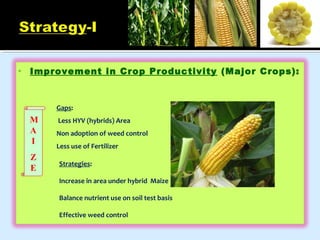
• Improvement in Crop Productivity (Major Crops):
M
A
I
Z
E
Gaps:
Less HYV (hybrids) Area
Non adoption of weed control
Less use of Fertilizer
Strategies:
Increase in area under hybrid Maize
Balance nutrient use on soil test basis
Effective weed control
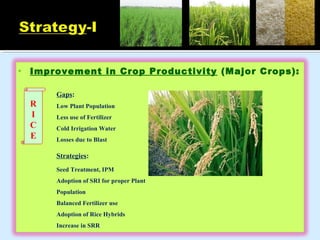
• Improvement in Crop Productivity (Major Crops):
R
I
C
E
Gaps:
Low Plant Population
Less use of Fertilizer
Cold Irrigation Water
Losses due to Blast
Strategies:
Seed Treatment, IPM
Adoption of SRI for proper Plant
Population
Balanced Fertilizer use
Adoption of Rice Hybrids
Increase in SRR
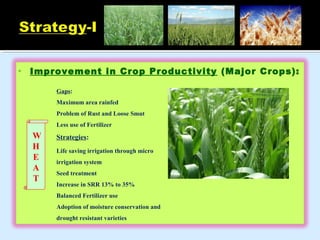
• Improvement in Crop Productivity (Major Crops):
W
H
E
A
T
Gaps:
Maximum area rainfed
Problem of Rust and Loose Smut
Less use of Fertilizer
Strategies:
Life saving irrigation through micro
irrigation system
Seed treatment
Increase in SRR 13% to 35%
Balanced Fertilizer use
Adoption of moisture conservation and
drought resistant varieties
• Soil Health Management:
To provide
Soil Health Card to each
farmer and to make it
online
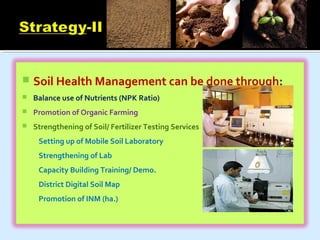
 Soil Health Management can be done through:
 Balance use of Nutrients (NPK Ratio)
 Promotion of Organic Farming
 Strengthening of Soil/ Fertilizer Testing Services
Setting up of Mobile Soil Laboratory
Strengthening of Lab
Capacity Building Training/ Demo.
District Digital Soil Map
Promotion of INM (ha.)
• Conservation and Management of Natural
Resources
Maximum area is under rainfed.
Annual rainfall 1017 mm.
Un even distribution of rain fall.
Problem of Soil erosion/Degradation
• Conservation and Management of Natural
Resources
 Watershed Development
Programme
 Impact of Watershed Programme
 Creation of Water potential
through Water Harvesting
• Seed Development/ Seed Chain
 Production and
Distribution of
Certified Seed
 Increase of Seed
Replacement Rate
(SRR %)
 Seed Village
Programme
• Precision Farming :
Polyhouses:
Micro-Irrigation:
 Sprinkler System
 Drip System
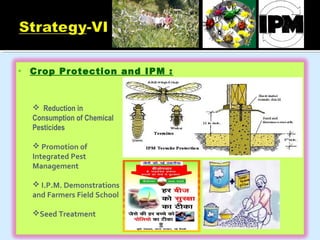
• Crop Protection and IPM :
 Reduction in
Consumption of Chemical
Pesticides
 Promotion of
Integrated Pest
Management
 I.P.M. Demonstrations
and Farmers Field School
Seed Treatment
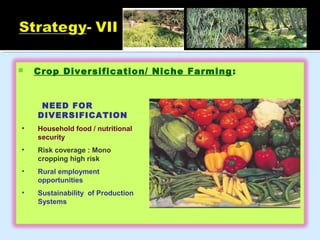
 Crop Diversification/ Niche Farming:
NEED FOR
DIVERSIFICATION
• Household food / nutritional
security
• Risk coverage : Mono
cropping high risk
• Rural employment
opportunities
• Sustainability of Production
Systems
• Extension and Transfer of Technology:
 Crop Demonstration
 Skill Training Prog. (Farmers)
 FIG/ SHG/ FO
 Exposure Visits
 Mass Media Support
 Implementation of AGRISNET
Portal
• Insurance and Credit :
 Distribution of Kisan credit card
 Crop loan scheme
 Loan on fertilizers
 Insurance of the crop
• Mechanisation:
 Tractors/ Power Tillers
 Power Thresher
 Other Equipments
 Demonstration of
New Equip.
GOOD AGRICULTURAL PRACTICES (GAP)
Why it is so important?
Growers
Growers
Consumer
Processors
Retailer
GMP
GHP
GAP
GOOD AGRICULTURAL PRACTICES (GAP)
Who initiated the GAP as a Standard?
1. EurepGAP, initiated in 1997, by European Retailers, and
other members of input and services side of Agriculture.
2. First version released in Europe in 2001.
3. EurepGAP standard is designed to reassure
consumers
– about how food is produced on farm by
minimizing detrimental environmental
impacts of Farming operations,
– reducing the use of chemical inputs
– ensuring responsible approach to worker
health and safety as well as animal
welfare.
GOOD AGRICULTURAL PRACTICES (GAP)
GAP BENEFITS:
 FOOD QUALITY & SAFETY IMPROVEMENT
 FACILITATING MARKET ACCESS
 REDUCTION IN NON COMPLIANCE RISES REGARDING
PERMITTED PESTICIDES AND OTHER CONTAMINATION HAZARDS.
MAIN CHALLENGES:
 INCREASE IN PRODUCTION COST LIKE RECORD KEEPING,
RESIDUE TESTING AND CERTIFICATION
 INADEQUATE ACCESS TO INFORMATION AND SUPORT
SERVICES.
Good  Agriculture Practices

Good Agriculture Practices

  • 1.
    Mahesh Kankane Theme Anchor-VegetableGarden and PVSP Trial Bhopal (M.P.) 7869954370 maheshkankane@gmail.com
  • 2.
    • GAP arepractices that address environmental, economic & social sustainability for on-farm processes, and result in safe and quality food and non-food agricultural products • Developed by the food industry, producer organizations, governments & NGOs, aiming to codify agricultural practices at farm level • GAP benefits are: -food quality & safety improvement -facilitating market access -reduction in non-compliance risks re. permitted pesticides, MRLs & other contamination hazards Main challenges: -increase in production cost like recordkeeping, residue testing & certification -Inadequate access to information and support services
  • 3.
    • Water • A)Agriculture •B)Processing • Manure, Compost and Other similar Fertilizers • Sanitary Facility • Field Sanitation • Packing Facility Sanitation • Transportation • Trace back
  • 4.
    Good Practices Process KnowledgeValues and Ethics Skills
  • 5.
    • Improvement inCrop Productivity (Major Crops): M A I Z E Gaps: Less HYV (hybrids) Area Non adoption of weed control Less use of Fertilizer Strategies: Increase in area under hybrid Maize Balance nutrient use on soil test basis Effective weed control
  • 6.
    • Improvement inCrop Productivity (Major Crops): R I C E Gaps: Low Plant Population Less use of Fertilizer Cold Irrigation Water Losses due to Blast Strategies: Seed Treatment, IPM Adoption of SRI for proper Plant Population Balanced Fertilizer use Adoption of Rice Hybrids Increase in SRR
  • 7.
    • Improvement inCrop Productivity (Major Crops): W H E A T Gaps: Maximum area rainfed Problem of Rust and Loose Smut Less use of Fertilizer Strategies: Life saving irrigation through micro irrigation system Seed treatment Increase in SRR 13% to 35% Balanced Fertilizer use Adoption of moisture conservation and drought resistant varieties
  • 8.
    • Soil HealthManagement: To provide Soil Health Card to each farmer and to make it online
  • 10.
     Soil HealthManagement can be done through:  Balance use of Nutrients (NPK Ratio)  Promotion of Organic Farming  Strengthening of Soil/ Fertilizer Testing Services Setting up of Mobile Soil Laboratory Strengthening of Lab Capacity Building Training/ Demo. District Digital Soil Map Promotion of INM (ha.)
  • 11.
    • Conservation andManagement of Natural Resources Maximum area is under rainfed. Annual rainfall 1017 mm. Un even distribution of rain fall. Problem of Soil erosion/Degradation
  • 12.
    • Conservation andManagement of Natural Resources  Watershed Development Programme  Impact of Watershed Programme  Creation of Water potential through Water Harvesting
  • 13.
    • Seed Development/Seed Chain  Production and Distribution of Certified Seed  Increase of Seed Replacement Rate (SRR %)  Seed Village Programme
  • 14.
    • Precision Farming: Polyhouses: Micro-Irrigation:  Sprinkler System  Drip System
  • 15.
    • Crop Protectionand IPM :  Reduction in Consumption of Chemical Pesticides  Promotion of Integrated Pest Management  I.P.M. Demonstrations and Farmers Field School Seed Treatment
  • 16.
     Crop Diversification/Niche Farming: NEED FOR DIVERSIFICATION • Household food / nutritional security • Risk coverage : Mono cropping high risk • Rural employment opportunities • Sustainability of Production Systems
  • 17.
    • Extension andTransfer of Technology:  Crop Demonstration  Skill Training Prog. (Farmers)  FIG/ SHG/ FO  Exposure Visits  Mass Media Support  Implementation of AGRISNET Portal
  • 18.
    • Insurance andCredit :  Distribution of Kisan credit card  Crop loan scheme  Loan on fertilizers  Insurance of the crop
  • 19.
    • Mechanisation:  Tractors/Power Tillers  Power Thresher  Other Equipments  Demonstration of New Equip.
  • 20.
    GOOD AGRICULTURAL PRACTICES(GAP) Why it is so important? Growers Growers Consumer Processors Retailer GMP GHP GAP
  • 21.
    GOOD AGRICULTURAL PRACTICES(GAP) Who initiated the GAP as a Standard? 1. EurepGAP, initiated in 1997, by European Retailers, and other members of input and services side of Agriculture. 2. First version released in Europe in 2001. 3. EurepGAP standard is designed to reassure consumers – about how food is produced on farm by minimizing detrimental environmental impacts of Farming operations, – reducing the use of chemical inputs – ensuring responsible approach to worker health and safety as well as animal welfare.
  • 22.
    GOOD AGRICULTURAL PRACTICES(GAP) GAP BENEFITS:  FOOD QUALITY & SAFETY IMPROVEMENT  FACILITATING MARKET ACCESS  REDUCTION IN NON COMPLIANCE RISES REGARDING PERMITTED PESTICIDES AND OTHER CONTAMINATION HAZARDS. MAIN CHALLENGES:  INCREASE IN PRODUCTION COST LIKE RECORD KEEPING, RESIDUE TESTING AND CERTIFICATION  INADEQUATE ACCESS TO INFORMATION AND SUPORT SERVICES.