Submitted by
Towkir Ahmed Ove
M.Sc. in Food Science & Nutrtion
NUTRITION EDUCATION
What is Nutrition?
It is the science of foods, the nutrients, and other
substances therein, their action, interaction, and
balance in relationship to health and disease.
What is Education?
Education is the process of bringing desirable
change in the behavior of human beings. The
behavioral changes must be directed towards a
desirable end.
Nutrition Education
educating for better nutrition and thus bringing the desirable
positive changes in knowledge, attitude and practice in order
to enhance the nutritional status of the individual and
community as a whole.
Importance of nutrition Education
An important part of the nutrition gap is the information gap.
Although poor economic condition does stand in the way of
improved nutrition, but, ignorance regarding nutrients
needed by the body and cheap foods which can provide
them and better utilization of the resources, are also partly
responsible.
• The importance of nutrition education as a means
for improving nutrition of the community in the
developing countries has increased rapidly during
the recent past.
• Lack of awareness about the dietary requirements
and nutritive value of different food is the main
cause for prevailing malnutrition among school
children, pregnant women, lactating mother and
other vulnerable sections of the community.
• Whether food supplies are scarce or abundant, it
is essential that people know how best to use
their resources to access a variety of safe and
good quality foods; to ensure nutritional
wellbeing.
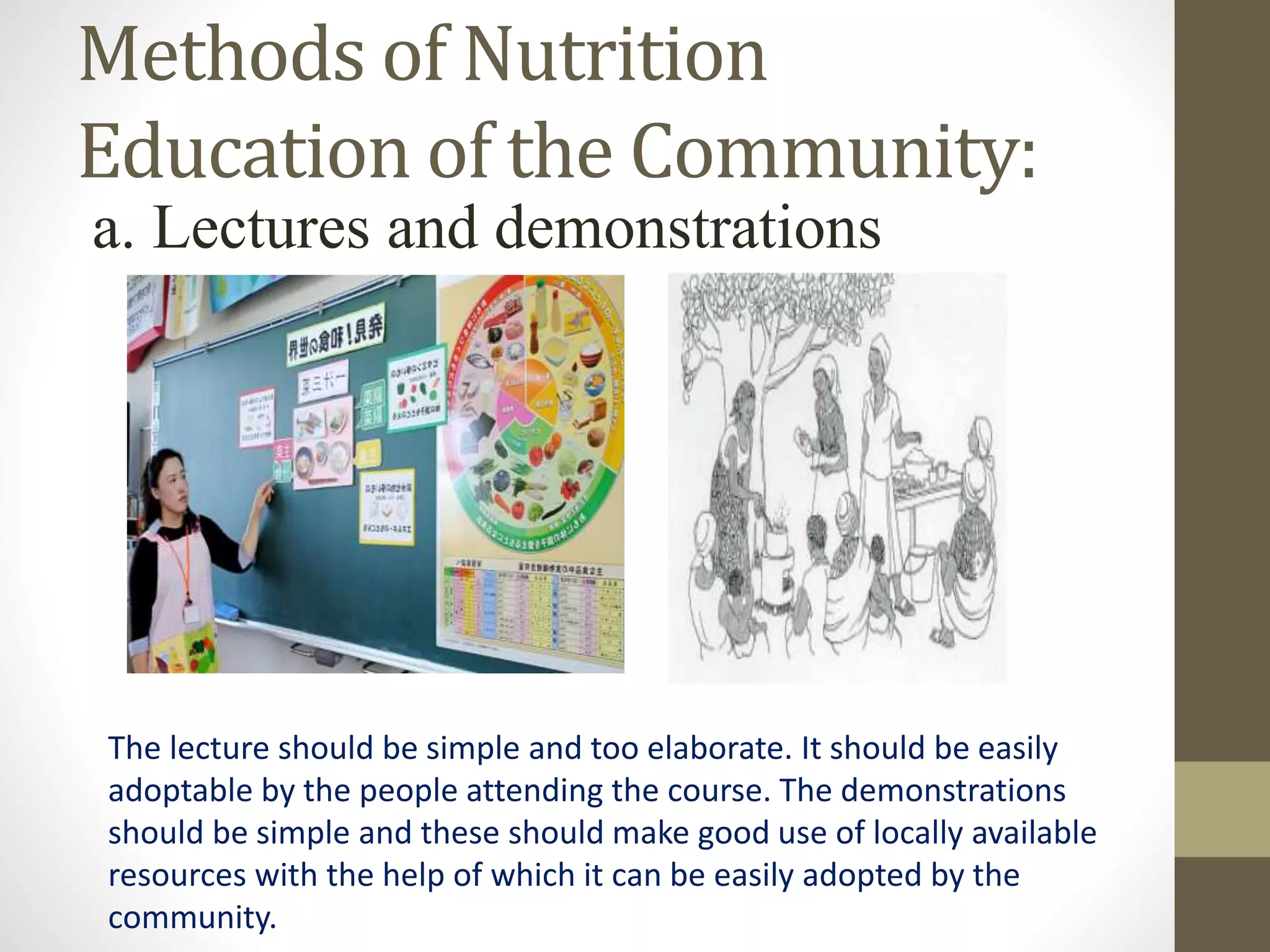
The mutually reinforcing relationship between nutrition,
health and education is shown in Figure Good nutrition is
the basis for good health, and both help in making
education effective; good education.
Aims of Nutrition Education
 Knowing which sort of problems it might solve and how
to use resources in the most effective way.
 Helping people to develop new attitudes and confidence
that they need to improve their nutritional habits, and how
to feed to their families.
 Developing nutrition advisory services and nutrition
education of the public.
 Training local key persons, health workers, agricultural
extensionists and other community or project workers for
further promotion of the messages.
 Improving nutritional status/ level in the community.
Settings for Nutrition Education actions
Nutrition educator must first understand why people follow
a particular pattern of feeding practices. One should find out
the details in order to have a good understanding of the
people who are to be taught, e.g.
— Where do they live?
— How much do they earn?
— Is their diet good or bad?
— What changes if any should they make in their diet?
— What are their food customs - hot and cold foods, and
special diets given to pregnant and nursing mothers etc.?
— Where foods are consumed (e.g. public sector catering in
schools, workplaces, households)?
—Where foods are produced (e.g. agricultural/field
settings?)
—Where foods are sold (e.g. retailers, public sector
catering)?
— Can they afford to make changes which educators
consider necessary?
continued
General Considerations for Successful Nutrition
Education:
Provide a clear formulation of the nutritional
problems.
When designing “messages”: keep them short
and simple and ensure that they are clear;.
Make people think about nutrition problems.
Have Something to demonstrate- a learning aid.
Real things such as food items or utensils that
people use are better than pictures or posters.
Get the audience to participate- encourage them
to ask questions and discuss issues of importance.
Use different methods and tools of Nutrition
Education to transmit the same message.
Methods of Nutrition
Education of the Community:
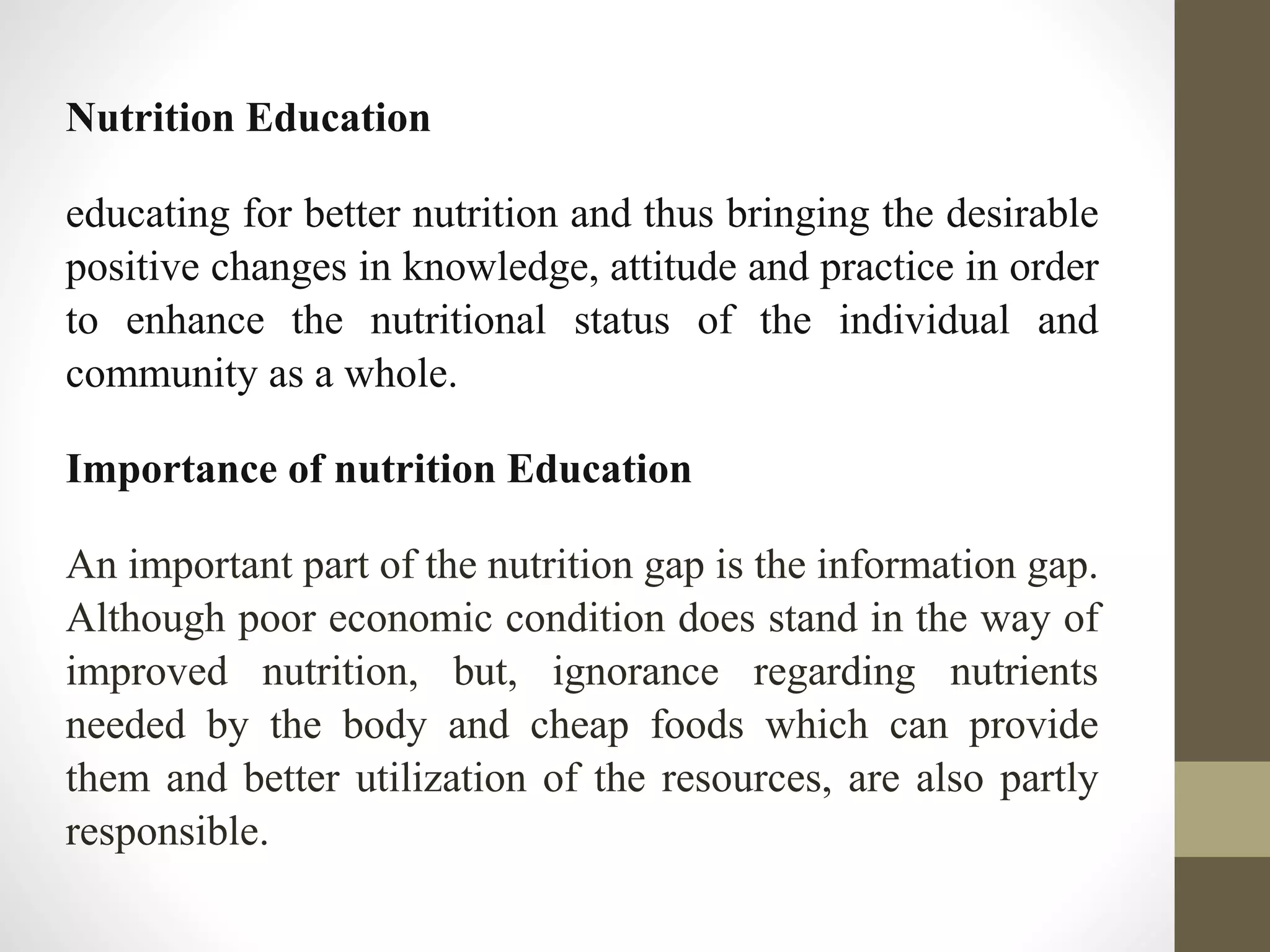
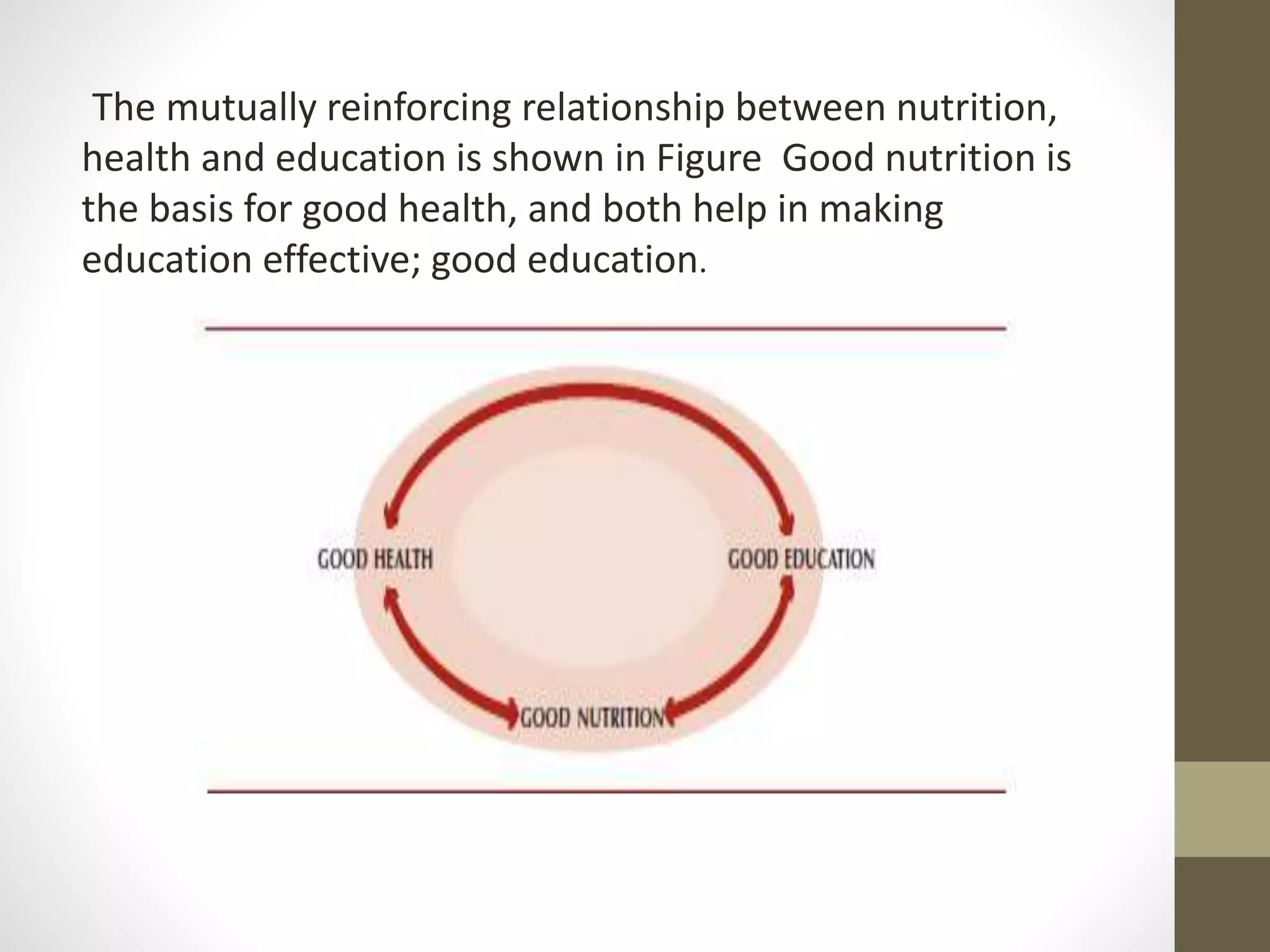
a. Lectures and demonstrations
The lecture should be simple and too elaborate. It should be easily
adoptable by the people attending the course. The demonstrations
should be simple and these should make good use of locally available
resources with the help of which it can be easily adopted by the
community.
b. Workshops
The nutrition work should discuss the prevailing
nutritional problem in the community in simplest
form and the solution for it.
c. Film and slide shows
These are extremely effective mode of education.
They should be practical and illustrative and easily
understandable.
d. Poster, charts and exhibition
Posters should be simple and should immediately catch the attention of the
viewers and should be written in the regional language. The letters should be
clearly and easily visible at a distance too. Charts also should be in a position to
stimulate the interest of the people. The charts should be well-balanced with the
use appropriate colors and should not be crowded
e. Books, pamphlets, bulletins and news paper
Printed matter for Nutrition Education is suitable for educating
students, teachers and other professionals. These materials should be
made available in regional languages and should give sufficient
information.
• f. Radio and television.
Radio and Television programmes reach a large number of audiences
within no time. Jokes, stories, dramas, etc. Involving the nutritional
problem help to create large scale awareness.
Conclusion and
Recommendations:
Good nutritional habits and a balanced diet aren't developed in
one day, nor are they destroyed in one unbalanced meal.
Nutrition education is an important element in an overall
strategy aimed at improving food security and preventing all
forms of malnutrition. So it should be taken into account to our
government agencies, NGOs, Schools, colleges, Universities to
share the knowledge about foods and their nutrients to
common people, students, pregnant women etc. to improve
their health, eating habits. Also they can share to their families,
friends and near ones.
Thank You

Nutrition education

  • 1.
    Submitted by Towkir AhmedOve M.Sc. in Food Science & Nutrtion NUTRITION EDUCATION
  • 2.
    What is Nutrition? Itis the science of foods, the nutrients, and other substances therein, their action, interaction, and balance in relationship to health and disease. What is Education? Education is the process of bringing desirable change in the behavior of human beings. The behavioral changes must be directed towards a desirable end.
  • 3.
    Nutrition Education educating forbetter nutrition and thus bringing the desirable positive changes in knowledge, attitude and practice in order to enhance the nutritional status of the individual and community as a whole. Importance of nutrition Education An important part of the nutrition gap is the information gap. Although poor economic condition does stand in the way of improved nutrition, but, ignorance regarding nutrients needed by the body and cheap foods which can provide them and better utilization of the resources, are also partly responsible.
  • 4.
    • The importanceof nutrition education as a means for improving nutrition of the community in the developing countries has increased rapidly during the recent past. • Lack of awareness about the dietary requirements and nutritive value of different food is the main cause for prevailing malnutrition among school children, pregnant women, lactating mother and other vulnerable sections of the community. • Whether food supplies are scarce or abundant, it is essential that people know how best to use their resources to access a variety of safe and good quality foods; to ensure nutritional wellbeing.
  • 5.
    The mutually reinforcingrelationship between nutrition, health and education is shown in Figure Good nutrition is the basis for good health, and both help in making education effective; good education.
  • 6.
    Aims of NutritionEducation  Knowing which sort of problems it might solve and how to use resources in the most effective way.  Helping people to develop new attitudes and confidence that they need to improve their nutritional habits, and how to feed to their families.  Developing nutrition advisory services and nutrition education of the public.  Training local key persons, health workers, agricultural extensionists and other community or project workers for further promotion of the messages.  Improving nutritional status/ level in the community.
  • 7.
    Settings for NutritionEducation actions Nutrition educator must first understand why people follow a particular pattern of feeding practices. One should find out the details in order to have a good understanding of the people who are to be taught, e.g. — Where do they live? — How much do they earn? — Is their diet good or bad? — What changes if any should they make in their diet?
  • 8.
    — What aretheir food customs - hot and cold foods, and special diets given to pregnant and nursing mothers etc.? — Where foods are consumed (e.g. public sector catering in schools, workplaces, households)? —Where foods are produced (e.g. agricultural/field settings?) —Where foods are sold (e.g. retailers, public sector catering)? — Can they afford to make changes which educators consider necessary? continued
  • 9.
    General Considerations forSuccessful Nutrition Education: Provide a clear formulation of the nutritional problems. When designing “messages”: keep them short and simple and ensure that they are clear;. Make people think about nutrition problems. Have Something to demonstrate- a learning aid. Real things such as food items or utensils that people use are better than pictures or posters. Get the audience to participate- encourage them to ask questions and discuss issues of importance. Use different methods and tools of Nutrition Education to transmit the same message.
  • 10.
    Methods of Nutrition Educationof the Community: a. Lectures and demonstrations The lecture should be simple and too elaborate. It should be easily adoptable by the people attending the course. The demonstrations should be simple and these should make good use of locally available resources with the help of which it can be easily adopted by the community.
  • 11.
    b. Workshops The nutritionwork should discuss the prevailing nutritional problem in the community in simplest form and the solution for it.
  • 12.
    c. Film andslide shows These are extremely effective mode of education. They should be practical and illustrative and easily understandable.
  • 13.
    d. Poster, chartsand exhibition Posters should be simple and should immediately catch the attention of the viewers and should be written in the regional language. The letters should be clearly and easily visible at a distance too. Charts also should be in a position to stimulate the interest of the people. The charts should be well-balanced with the use appropriate colors and should not be crowded
  • 14.
    e. Books, pamphlets,bulletins and news paper Printed matter for Nutrition Education is suitable for educating students, teachers and other professionals. These materials should be made available in regional languages and should give sufficient information.
  • 15.
    • f. Radioand television. Radio and Television programmes reach a large number of audiences within no time. Jokes, stories, dramas, etc. Involving the nutritional problem help to create large scale awareness.
  • 18.
    Conclusion and Recommendations: Good nutritionalhabits and a balanced diet aren't developed in one day, nor are they destroyed in one unbalanced meal. Nutrition education is an important element in an overall strategy aimed at improving food security and preventing all forms of malnutrition. So it should be taken into account to our government agencies, NGOs, Schools, colleges, Universities to share the knowledge about foods and their nutrients to common people, students, pregnant women etc. to improve their health, eating habits. Also they can share to their families, friends and near ones.
  • 19.