www.locusresearch.com 
Digital vs Analogue 
The challenges of going digital in product development 
www.locusresearch.com
Insert Process Image
Process Image
Digital Vs. Analogue 
Turns out to be hard to define: The best approximation for our discussion is: 
Digital 
: Lossless Reproduction 
Analogue 
: Reproduction with Loss over time.
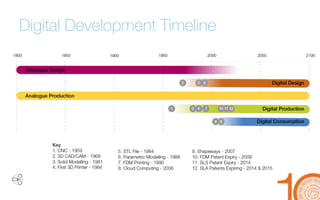
Digital Development Timeline
Hype? 
There is so much material on a daily basis in the public domain that it is hard to make sense of it. 
The seduction of digital manufacture is hard to turn down. It offers solutions to so many of the problems we face developing new products.
Hype? 
1. 
Being able to quickly learn through fast design iterations. 
2. 
No laborious and expensive tooling required for many production tools; 
3. 
Very short runs when your starting out; 
4. 
Ultimate design flexibility on a model by model basis; 
5. 
Not being limited to your last release until you can go again with what you have learnt. 
6. 
Borderless production –removes export and geographic issues. Digital distribution.
But the Issue is 
We still depend on Analogue methods of production: 
1. 
We require tooling (of some type) to deliver product in materials with the right performance; 
2. 
Speed of production is not where modern autonomous production is at to meet volume requirements; 
3. 
We combine materials in interesting and novel ways that confound current approaches to 3d Printing
The Reality 
A prevalence of plastic methods and approaches 
Other materials have had less research injected into 
them such as textiles, metals etc. 
Compromised material qualities 
Less strength 
More porosity & less detail 
Gimmicky software 
Limited component sizes and really suitable for smaller 
materials
The Reality 
Requires skill and commitment to run the equipment 
The equipment is being obsoleted at a very high rate with 
the progress 
There are a wide range of techniques and materials that 
suit different applications so no one machine will work for all applications (something we experience)
“Just because you can do it, doesn’t mean you should.” 
Anon
` 
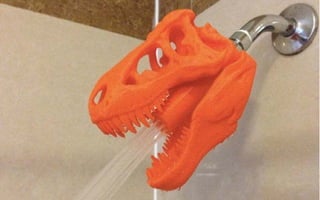
“The next time someone asks you to explain 3D printers, and why anyone would want one in their home, you can simply bring up this article and show them that without 3D printing technology we may never have had a T-Rex shower head.” 
GIZMODO
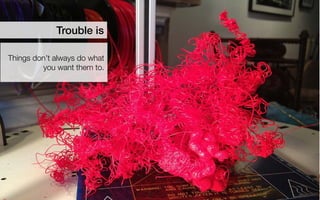
Trouble is 
Things don’t always do what you want them to.
Disruption is moving to a constant 
1. 
Digital Music –Changed the way the music business works and how we consume music (still happening with streaming) 
2. 
Digital Books –Changed they way the business works and how we consumer books. 
3. 
Digital Photography –Democratisedthe image. 
4. 
Ecommerce Retailing –Changed the way products are purchased and distributed. 
5. 
Manufactured Products?
Intellectual Property? 
Creates some headaches which other industries have already run into. 
Music & Books provide a perspective on the issues that 
may be encountered. 
More freely available full design data (previously less 
available). 
Digital distribution exacerbates this further, although other 
elements like digitisersdon’t limit the impact to just distribution issues.
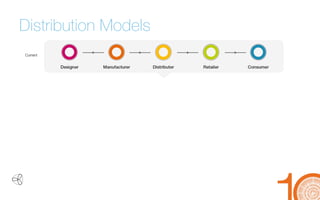
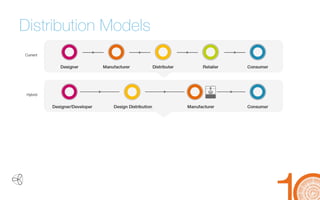
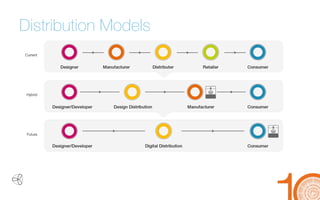
Distribution Models
Distribution Models
Distribution Models
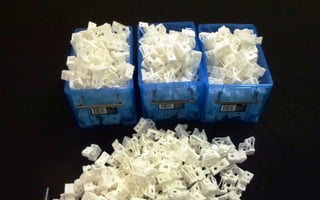
Digital Mass Manufacture
3D Printing Options in NZ 
Fused Deposition Modelling (FDM, FFF, PJP) 
Process: Extruded Filament 
Materials: Extensive.ABS, PLA, Nylon, Rubber, Polycarbonate, Wax… 
Why: Cheap, Quick, Availability, Strength Material Options, Simple 
Why Not: Complex/Interfacing Parts, High Resolution. 
State In NZ: Becoming Prominent, A number of suppliers, can buy and rent them.
3D Printing Options in NZ 
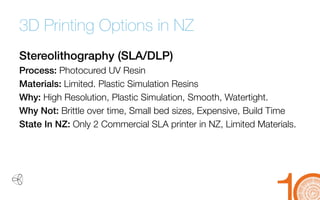
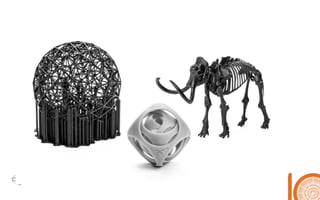
Stereolithography(SLA/DLP) 
Process: PhotocuredUV Resin 
Materials: Limited. Plastic Simulation Resins 
Why: High Resolution, Plastic Simulation, Smooth, Watertight. 
Why Not: Brittle over time, Small bed sizes, Expensive, Build Time 
State In NZ: Only 2 Commercial SLA printer in NZ, Limited Materials.
3D Printing Options in NZ 
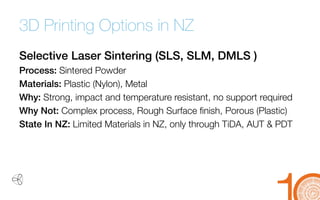
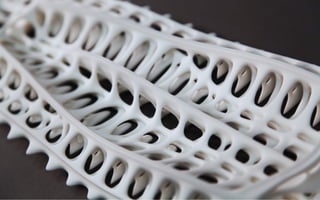
Selective Laser Sintering (SLS, SLM, DMLS ) 
Process: Sintered Powder 
Materials: Plastic (Nylon), Metal 
Why: Strong, impact and temperature resistant, no support required 
Why Not: Complex process, Rough Surface finish, Porous (Plastic) 
State In NZ: Limited Materials in NZ, only through TiDA, AUT & PDT
3D Printing Options in NZ 
Multijet/Polyjet 
Process: Jetted liquid photopolymer 
Materials: Large Range, Multi-material, Digital Materials, Elastomers 
Why: Super High Detail, Easy to Remove Support, Multimaterial. 
Why Not: Expensive, Materials not as durable, Strength 
State In NZ: A number of Multijetprinters in NZ. Polyjetonly at Victoria
Suppliers 
Plastic Design Technologies: SLA, SLS 
Stratatec-FDM, PolyJet, Offshore prototyping. 
One.61 Design -FDM, PolyJet, Partner with Quickparts 
Palmer Design and Manufacturing–FDM, Polyjet and SLS 
3Design-FDM, Polyjet. Australian partner with SLS and SLA 
AUT-SLS and SLM 
Victoria University -Polyjet 
CPIT-Projet 
RAM /TiDA –SLM 
Wintec–SLA
Offshore Options 
QuickParts-3D systems -Australia/US 
Objective3D/Red Eye -Stratasys–Australia 
3D Printing Marketplaces 
Shapeways-Netherlands 
iMaterealise-Belgium 
Sculpteo-France 
Ponoko-New Zealand
2Examples 
We are constantly trying new things and seeing what works and what doesn’t. Here are two relevant & different examples: 
1. 
Design to Production of a large volume DIY Product 
2. 
Design development of an Integrated PPE Filter to assess a new Cloud Based Modellingplatform.
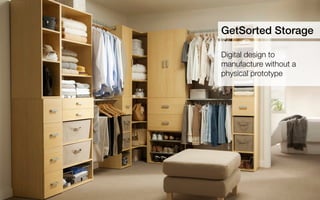
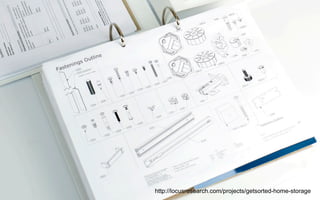
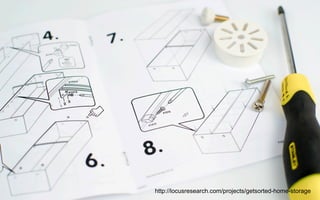
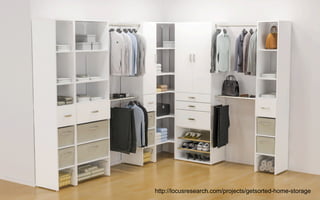
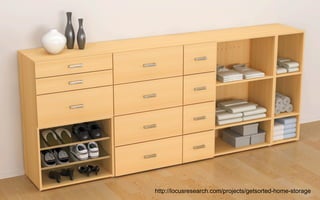
GetSortedStorage 
Digital design to manufacture without a physical prototype
Our Aims 
Develop a comprehensive yet simple wardrobe and 
storage system. 
Improve the ease of installation. 
Create a defined point of different from other products on 
the market. 
Launch nationwide in Australia in under 12 months.
http://locusresearch.com/projects/getsorted-home-storage
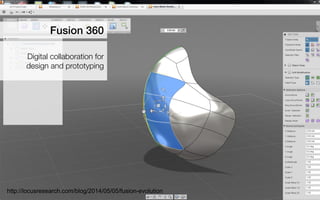
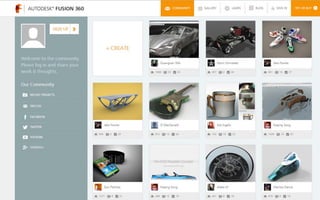
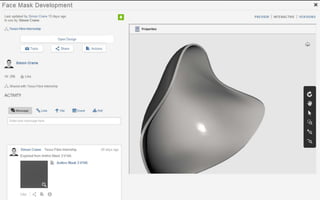
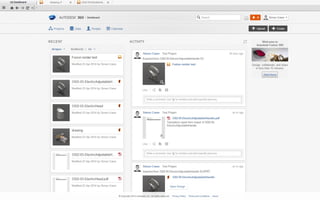
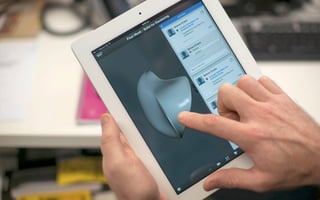
Fusion 360 
Digital collaboration for design and prototyping 
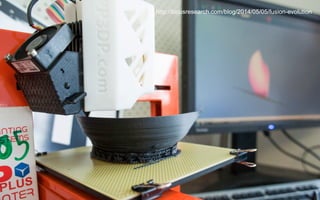
http://locusresearch.com/blog/2014/05/05/fusion-evolution
Our Aims 
Develop a project using the new tool fusion 360 
Understand how a true cloud modelling tool might work in 
the real world 
Undertake a project where we could use the design data 
and take it through to prototyping.
http://locusresearch.com/blog/2014/05/05/fusion-evolution
Blog Articles 
Fusion Evolution: http://locusresearch.com/blog/2014/05/05/fusion- evolution 
New Zealand's 3D Printed Future. 
http://locusresearch.com/blog/2014/11/05/new- zealands-3d-printed-future
Summary 
Mixing the digital and analogue methods speeds up 
development and provides unique advantages 
It increases/reduces Iterations 
in design cycles 
Digital design, prototyping and manufacture are here to 
stay 
Speed of development may be limited by the IP 
that surrounds the key methods and approaches for printing 
It is still materially limited 
and cannot simulate a lot of materials which means a hybrid approach is likely to remain in place for a while
Summary 
Digital distribution and consumption 
is something that should be looked at closely. 
There is a huge amount of investment going in 
internationally which will lead to further developments. 
It warrants many companies (particularly plastics 
producers) have a strategy in place to both monitor technology and develop capability in the area. 
Use experimental projects to probe what is possible and 
understand how it might interface commercially.
Summary 
There are many facets to the digital vs. analogue discussion: 
Digital design delivery 
–entrenched, but still parts of the process that are analogue. 
Look at research tools, collaboration tools and approaches

Digital vs Analogue

  • 1.
    www.locusresearch.com Digital vsAnalogue The challenges of going digital in product development www.locusresearch.com
  • 2.
  • 3.
  • 5.
    Digital Vs. Analogue Turns out to be hard to define: The best approximation for our discussion is: Digital : Lossless Reproduction Analogue : Reproduction with Loss over time.
  • 6.
  • 7.
    Hype? There isso much material on a daily basis in the public domain that it is hard to make sense of it. The seduction of digital manufacture is hard to turn down. It offers solutions to so many of the problems we face developing new products.
  • 8.
    Hype? 1. Beingable to quickly learn through fast design iterations. 2. No laborious and expensive tooling required for many production tools; 3. Very short runs when your starting out; 4. Ultimate design flexibility on a model by model basis; 5. Not being limited to your last release until you can go again with what you have learnt. 6. Borderless production –removes export and geographic issues. Digital distribution.
  • 9.
    But the Issueis We still depend on Analogue methods of production: 1. We require tooling (of some type) to deliver product in materials with the right performance; 2. Speed of production is not where modern autonomous production is at to meet volume requirements; 3. We combine materials in interesting and novel ways that confound current approaches to 3d Printing
  • 10.
    The Reality Aprevalence of plastic methods and approaches Other materials have had less research injected into them such as textiles, metals etc. Compromised material qualities Less strength More porosity & less detail Gimmicky software Limited component sizes and really suitable for smaller materials
  • 11.
    The Reality Requiresskill and commitment to run the equipment The equipment is being obsoleted at a very high rate with the progress There are a wide range of techniques and materials that suit different applications so no one machine will work for all applications (something we experience)
  • 12.
    “Just because youcan do it, doesn’t mean you should.” Anon
  • 13.
    ` “The nexttime someone asks you to explain 3D printers, and why anyone would want one in their home, you can simply bring up this article and show them that without 3D printing technology we may never have had a T-Rex shower head.” GIZMODO
  • 15.
    Trouble is Thingsdon’t always do what you want them to.
  • 16.
    Disruption is movingto a constant 1. Digital Music –Changed the way the music business works and how we consume music (still happening with streaming) 2. Digital Books –Changed they way the business works and how we consumer books. 3. Digital Photography –Democratisedthe image. 4. Ecommerce Retailing –Changed the way products are purchased and distributed. 5. Manufactured Products?
  • 18.
    Intellectual Property? Createssome headaches which other industries have already run into. Music & Books provide a perspective on the issues that may be encountered. More freely available full design data (previously less available). Digital distribution exacerbates this further, although other elements like digitisersdon’t limit the impact to just distribution issues.
  • 19.
  • 20.
  • 21.
  • 22.
  • 23.
    3D Printing Optionsin NZ Fused Deposition Modelling (FDM, FFF, PJP) Process: Extruded Filament Materials: Extensive.ABS, PLA, Nylon, Rubber, Polycarbonate, Wax… Why: Cheap, Quick, Availability, Strength Material Options, Simple Why Not: Complex/Interfacing Parts, High Resolution. State In NZ: Becoming Prominent, A number of suppliers, can buy and rent them.
  • 24.
    3D Printing Optionsin NZ Stereolithography(SLA/DLP) Process: PhotocuredUV Resin Materials: Limited. Plastic Simulation Resins Why: High Resolution, Plastic Simulation, Smooth, Watertight. Why Not: Brittle over time, Small bed sizes, Expensive, Build Time State In NZ: Only 2 Commercial SLA printer in NZ, Limited Materials.
  • 26.
    3D Printing Optionsin NZ Selective Laser Sintering (SLS, SLM, DMLS ) Process: Sintered Powder Materials: Plastic (Nylon), Metal Why: Strong, impact and temperature resistant, no support required Why Not: Complex process, Rough Surface finish, Porous (Plastic) State In NZ: Limited Materials in NZ, only through TiDA, AUT & PDT
  • 28.
    3D Printing Optionsin NZ Multijet/Polyjet Process: Jetted liquid photopolymer Materials: Large Range, Multi-material, Digital Materials, Elastomers Why: Super High Detail, Easy to Remove Support, Multimaterial. Why Not: Expensive, Materials not as durable, Strength State In NZ: A number of Multijetprinters in NZ. Polyjetonly at Victoria
  • 29.
    Suppliers Plastic DesignTechnologies: SLA, SLS Stratatec-FDM, PolyJet, Offshore prototyping. One.61 Design -FDM, PolyJet, Partner with Quickparts Palmer Design and Manufacturing–FDM, Polyjet and SLS 3Design-FDM, Polyjet. Australian partner with SLS and SLA AUT-SLS and SLM Victoria University -Polyjet CPIT-Projet RAM /TiDA –SLM Wintec–SLA
  • 30.
    Offshore Options QuickParts-3Dsystems -Australia/US Objective3D/Red Eye -Stratasys–Australia 3D Printing Marketplaces Shapeways-Netherlands iMaterealise-Belgium Sculpteo-France Ponoko-New Zealand
  • 31.
    2Examples We areconstantly trying new things and seeing what works and what doesn’t. Here are two relevant & different examples: 1. Design to Production of a large volume DIY Product 2. Design development of an Integrated PPE Filter to assess a new Cloud Based Modellingplatform.
  • 32.
    GetSortedStorage Digital designto manufacture without a physical prototype
  • 33.
    Our Aims Developa comprehensive yet simple wardrobe and storage system. Improve the ease of installation. Create a defined point of different from other products on the market. Launch nationwide in Australia in under 12 months.
  • 34.
  • 35.
  • 36.
  • 37.
  • 38.
    Fusion 360 Digitalcollaboration for design and prototyping http://locusresearch.com/blog/2014/05/05/fusion-evolution
  • 39.
    Our Aims Developa project using the new tool fusion 360 Understand how a true cloud modelling tool might work in the real world Undertake a project where we could use the design data and take it through to prototyping.
  • 44.
  • 45.
    Blog Articles FusionEvolution: http://locusresearch.com/blog/2014/05/05/fusion- evolution New Zealand's 3D Printed Future. http://locusresearch.com/blog/2014/11/05/new- zealands-3d-printed-future
  • 46.
    Summary Mixing thedigital and analogue methods speeds up development and provides unique advantages It increases/reduces Iterations in design cycles Digital design, prototyping and manufacture are here to stay Speed of development may be limited by the IP that surrounds the key methods and approaches for printing It is still materially limited and cannot simulate a lot of materials which means a hybrid approach is likely to remain in place for a while
  • 47.
    Summary Digital distributionand consumption is something that should be looked at closely. There is a huge amount of investment going in internationally which will lead to further developments. It warrants many companies (particularly plastics producers) have a strategy in place to both monitor technology and develop capability in the area. Use experimental projects to probe what is possible and understand how it might interface commercially.
  • 48.
    Summary There aremany facets to the digital vs. analogue discussion: Digital design delivery –entrenched, but still parts of the process that are analogue. Look at research tools, collaboration tools and approaches

Editor's Notes

  • #2 Intro Myself. Locus Research. What we do. Big part of product development is making and prototyping products. How are we moving into a digital workflow for design.
  • #3 “If you go into any design or enginerring university facuilty, I bet this I what you will see. The first true generation to grow up and design in a truly digital age. Spent most of my time at uni printing stuff. Graduates will be skilled in digital methods rather than older analogue design methods. Although I spent my time in the work shop, more and more parts are being CNC’d and 3D printed. Vic’s main programme. Heavily invested in by Universities. Developing a complete digital manufacturing process for Prosthetics
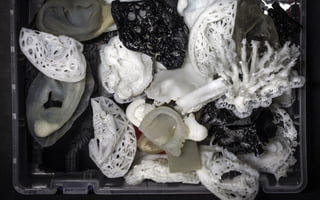
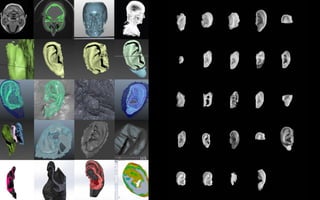
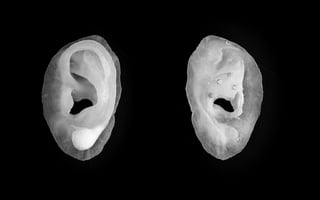
  • #4 Synthetic Anatomy explores multi-material 3D printing, 3D scanning and its application in the maxillofacial prosthetics industry. The project utilizes MRI and exterior 3D scanning to create anatomically correct ear prosthetics. Completley digital workflow. From gathering datato processing, testing, printing. Research was undertaken on the shore hardness of 3D printed materials and human tissue to design and print an ear that not only looked correct, but behaved like a human ear. Different materials were used to simulate tissues such as skin, cartilage and the ear lobe.
  • #5 This is a patients ear. Fully digitally created. Student have the power to do this. Scanned, Cartilage created, moulded to the scar tissue of the face. Unique. Example of an end to end losless digital process. Lossless is key. The data you put in is what you get out.
  • #6 But that’s not how its always been, and not how it is. How are we getting there. At the start of this presentation I went looking for a good explanation of what the difference was. We grapple with digital manufacture on a daily basis, and for commercial use, getting the results can be challenging. The Key is Losless. We are currently in this weird transition phase, of whether when designing products, can we go fully digital, or do we have to transition between
  • #7 So where have we come from and where are we going 3D printing companies have come from the base of 2 core technologies CNC – Realised by MIT and Aircraft Industry Association for Aerospace manufacture. 3D CAD/CAM – Ongoing development since 1968, mainly for fabrication of automobile and aerospace parts. Solid Modelling – Romulus and Uni-Solid First 3D Printer - Stereolithography printer invented by Chuck Hull Parametric Modelling – ProEngineer FDM Printing –S.Scott Crump Cloud Computing – Utilised commercially by Amazon Web Services by the Elastic Compute Cloud programme Shapeways – Now the worlds biggest online 3D printing marketplace and consumer printing company FDM Patent Expiry saw the explosion of FDM printers onto the scene, dramatically reduced cost and accessibility.
  • #8 I get so much info. Wired, 3D printing industry, Autodesk.
  • #9 What does digital design enable us to do. For start up companies strapped for capital, or ever evloving designs that change every month or so, its perfect. Removing taxes, trade barriers. All people need is a machine. No middle man.
  • #10 We design with current practices in mind, not designing for 3d printing, we design for tradition analogue. High resolution prints can take days. Micron layer by micron layer. Clever manufacturing techniques, overmoulding, combining different materials functionally is nearly
  • #11 It’s faster and cheaper, but only compared to other methods of creating one off parts. Will get into the detail soon Rembrandt – CNC cut suits – nesting for best economy Don’t get the same strength and finish in standard materials, because of Layer by layer approach. We have used Polycarbonate FDM prints, extremely strong but not very good surface finish.
  • #12 You talk to anyone who owns a 3D printer for home or prototyping use in design companies, the majority of the time they are fixing them The additive manufacture misnomer. More waste from 3d printers. “Environmetally friendly
  • #13 Because its now the new fad, everything seems to be needed to be 3D printed. Its not the ultimate answer in the product development process. Or for your home environment.
  • #15 Because something just shouldn’t Exist
  • #16 Along with making some crap products, they can be a bit crap to work with Is it worth Investing in a 3d printer at your work. Why are 3d printers transparent /Wifi/ Cameras.? So you can watch your print fail. 25-70% failure rate. They can be extremely use full, but you need to be prepared to spend the time and experience failed prints.
  • #17 All industries are slowly going digital The digital transition. Anyone who has tried to defend the digital transition has failed. Completley disruptive, its changed the way we do business. Digital Music – Itunes – Pandora – Spotify. Photography – Kodak - Die E-commerce – Torpedo 7 now owned by the Wharehouse Nearly all photography is digital Accsesablilty for the consumer.
  • #18 If you don’t digital, you will go the way of the dodo.
  • #19 Books and Music just had to go digital. You can now self publish through Amazon, removing the middle man. Emi tried Digital Rights management on CD’s failed. People got around it. If you don’t, people will begin to digitize your stuff
  • #20 Current manufacturing . What we should see is a removing of parties from the value chain to make it easier for the consumer or designers. Some companies can do it all, expensive, they pay a premium for a high quality good.
  • #21 Ponoko, someone who takes your design and gets it manufactured for you then it gets sent straight to you
  • #22 The one thing wrong with the manufactured product distribution method is that you have to rely on the consumer wanting to print the parts. It’s one level up from just downloading the book or the song. It potentially makes things more difficult for the consumer. The next step is direct from company to consumer, but with the current state of 3d prininting, that is a bit of misnomer at this stage. There is not a disruptive technology that does not have digital distribution.
  • #23 Palmer Design and Manufacture – Approx 30,000 parts in year and a half. Digital Mass Manufacture is perfect for project with stretched capital, limited run. Gives you design flexibility. Efficient up to say 20,000 units. Smaller the better. Some. parts are good, some aren’t. Mouldings or small parts. Based on Material Amount. Small runs. No set up but no real economy of scale at large runs. You pay for what you get You can always change part designs.
  • #24 Fused Deposition Modelling (Stratasys), Fused Filament Fabrication (Reprap), Plastic Jet Printing (3D systems most printers are around 100 microns. With the rudimentary technique can come a lot of problems, controlling settings and temperature that work best for different filaments and temperature   FDM has the most variability in success, depending very much on the printer you have, how it is set up and the model slicing programme you are running. Getting all of these right depending on the type of material you are running takes time.   The upside is the versatility of FDM printing. The most success comes from printers with fully enclosed heated build chambers, which are on the professional end of the spectrum. This keep the part at a constant temperature while it builds to stop warping and areas failing to print. Complex parts can be split up, printed separately then glued together.   FDM is one of the cheapest 3D printing options to date, with minimal wastage and cheap materials making it cost effective.   Be aware that getting materials to work can take time and experimentation.   Why Would You: Quick prototyping, Form and Size, Experimentation, Huge range of materials, cheap, basic/simple forms. Availability. Quick Turnaround. Can use production thermoplastics   Why Wouldn’t You: Complex parts and build, moving parts, parts that require a lot of support ie: low angled parts/undercuts. Parts that need to click and interface into other parts. High resolution parts.
  • #25 Stereo Lithography or Digital Light Projection – Similar Techniques. Utilise UV Cured photo-reactive resin that is cured via a UV Beam using a either a projector or a laser.   Super fine resolution, with machines going fewer than 10 microns in resolution. (Not commercially in NZ) This high resolution means it can get create surface finish and extreme detail. The amount of materials is somewhat limited but manufacturers have a number resins to simulate engineering plastics. Proprietery resins expensive, 2000 a litre. Long supply chain. Not as quick as you might thing. Becomes not so rapid. SLA has begun to emerge into the home market, with desktop SLA machines such as Form 1 + and the B9 Creator bringing high resolution parts to your desktop. However they have limited materials and small build volumes. Bringing these to your desktop however comes with a price tag, with these printers going above $40000 dollars.  Make sure you can get the resolution you need from the printer.   State in New Zealand PDT – 10 year old machine. Wintec – 20 MicronFor higher quality SLA and vast range of materials, you have to search overseas.   Why Would You: Especially good for High resolution complex parts. SLA still requires support but can be easily removed. Materials are advancing to a state that they can simulate a range of plastics.   Why Wouldn’t You: SLA printed parts become brittle over time, and loose strength and durability, making them function for a short period of time. This is because the parts "over cure" with exposure to sunlight or UV light. Majority of bed sizes are small and parts can take a long time to build. The proprietary and limited number of materials means materials are expensive. Can only be used for light functional testing.
  • #26 Desktop 3D Printing. Very Famous startup out of MIT – Now grown to 80 person company in 2 years. Just on Tuesday announced shipping and support to New Zealand.
  • #27  Selective Laser Sintering Selective Laser Melting, Direct Metal Laser Sintering SLS printing utilises powdered plastic or metal that is sintered by laser, layer by layer. This object is then built up with unused powder in the print bed being utilised as support. SLS prints are strong and durable, best fit for end use applications and testing. They are stronger than SLA, but not as strong as moulded parts. Because of the complexity of the technology and the patents around SLS printing, the machines are large and expensive. Currently there are wide range of powdered materials, such as Nylon, Elastomers , polymer and Metal. Can build extremely complex shapes as no support is necessary. Gives a distinctly rough/powdered finish and is porous. SLS is more complex procedure than SLA, with more variables to control to get a correct print. Getting precise temperatures for your model can be difficult, which can cause warping in the build chamber which can be dependant on your size of model Materials Majority of Materials are limited to Nylon based powders with most common being a Nylon 12 Polyamide or Glass Reinforced Nylon 12 Polyamide. Metals Titanium, Aluminium and Cobalt Chrome.   Why Would You? Strong functional prototypes, that can withstand impact and temperature. Snap clips and live hinges (Plastic). Larger Parts, Complex parts that would tradiotionally require lots of support Why Wouldn’t You? Rough surface finish, difficult to paint, not good for miniature details, porous/not watertight. Expensive. Prone to problems with varying cooling temperatures in large parts, can warp (Plastic). Metal is another complex process, metals can be left under a lot or residual stress.   State in New Zealand PDT and AUT have SLS machines, with AUT with a SLM metal printer. Limited materials. And build volumes.
  • #28 No support.
  • #29 MultiJet (3D systems) or Polyjet (Stratasys) Utilises a curable liquid photopolymer that is jetted via a large inkjet head and UV cured as it laid down. Support and material is laid down at the same time, which can be a easily removable gel or wax – washed away, allows minature features. Moving paets inside each other Both options have a large range of materials. These are beginning to take over SLA as the high precision printing type of choice. Multijet becoming popular and affordable in NZ Materials: Large Range of Plastic Simulants and Rubber simulants but the chemistry of the rubber parts let them down. Great detail for tiny parts. Multimaterial Printing are Polyjet - Different shore hardness digital material, the blending together of different resins. Reality of Polymer elastomers: Rip and tear easily, hard to clean and degrade over time, don’t stay clean for long.   MultiJet printers are becoming common in New Zealand, but the only Polyjet printers is based at Victoria University...   MultiJet and Poly Jet Printing both utilise support materials that can be dissolved our washed away. This means they can print very small features, complex assemblies and moveable parts   Can go brittle overtime from overcuring. New Materials being developed over time.
  • #30 3D Hubs is a great website that lists local 3d printing companies worldwide, many listings in New Zealand They will all run differentmachines with different materials so research The Buzz still hasn't reached New Zealand Many companies partner with companies overseas in Australia or China - Be wary of IP. Can be long turnaround times in this case - Check with Supplier. Could be 2 weeks or more. Proliferation - The 3D printing boom - more and more suppliers, more and more printers. Noisy, how do you know which one is right for you - Especially FDM. Many small FDM printing stores are popping up - using consumer style 3D printers. Understand the Printing machines they have and what materials they are running.   Projet is becoming the new SLA, the majority of businesses in NZ have Projet machines, but will run limited or one material because of the cost to buy and change materials over can be too high, as you have to purge the entire machine.  Prototyping options in New Zealand are limited when it comes to 3D printing. FDM is becoming prolific but commercial scale 3D printing companies are still few and far between. Most companies run limited materials through their machines, if you want the full range of SLS or SLA materials, you'll have to look offshore, with Australia being the closest.   Information - There is a huge amount of data online, reviews and blogs on the instructions and performance on different 3D printers and materials.
  • #31 Qucikparts and Objective/Red Eye in Australia are the next step up in Prototyping. They offer complete prototyping suites with full 3D printing options, and Finishing. Don’t offer all the materials Rapid Prototyping, All types of printing and finishing/, Colour printing, Investment Casting, Preproduction Tooling. Can get to NZ within the week, Inquire about material options.
  • #33 Multi module Furniture system that has gone into Bunnings in Australia New Zealand – 12 months 40 20ft Containers into Store The reason we undertook it was the processes were known, stable and a known supply chain
  • #35 All manuals, website, brochures, QC documents. All Digitally made
  • #36 Line art assembly instructions All digital
  • #37 Rendered product for promotion. Went into sotre with no physical prototypes
  • #38 Rendered product for promotion
  • #39 Started off my time at Locus Research designing face masks. Trying to us a fully digital design process
  • #40 +
  • #43 Part of the Audesk 360 Package
  • #45 A drawing free design process. Using native files embedded with informatio. This shape goes foword to making a mould, when we begon to go analogue
  • #48 The age of analogue makers is fading away. Companies are trying to uptake digital tech. Massive saving to be had not having to transfer from analougue to digital. Plastics companies need to look how they can stay up with the game Internships and Internal projects are perfect to start experimenting with new software. You can slowly integrate them into your team.