Satu Miettinen, Juha Miettinen, Antti Kares, Raisa Leinonen and Timo Sirviö
    Kuopio Academy of Design, Savonia University of Applied Sciences
                                 Finland

                     P.O. BOX 98, FIN -70101 KUOPIO
                      Email: office@designkuopio.fi


                                             "DE-SME - Intelligent Furniture - Training for Design,
                                             Environment and New Materials in SMEs"
                                             Agreement n. 2009 - 2196 / 001 - 001
Theme 5.3.3. How to use drama
methods in service concept design?
Bodystorming
 • Prototyping method, creating, generating and
   modelling new service features Empathic design
   method
 • The idea in bodystorming is to act as though the
   service would exist, ideally in the context where it
   would be used.
 • This method gives the opportunity to test the
   proposed service and its interactions either inside
   the service design team or including the
   participants.
Bodystorming
• Different service situations can be acted out,
  for example, the customer service situation at
  the hotel reception. Service designers create
  the service situation, cast the roles, practise
  with the professional or on their own and play
  the situation. The purpose is to prototype and
  come up with new solutions, test new
  interactions and make ad hoc innovations.
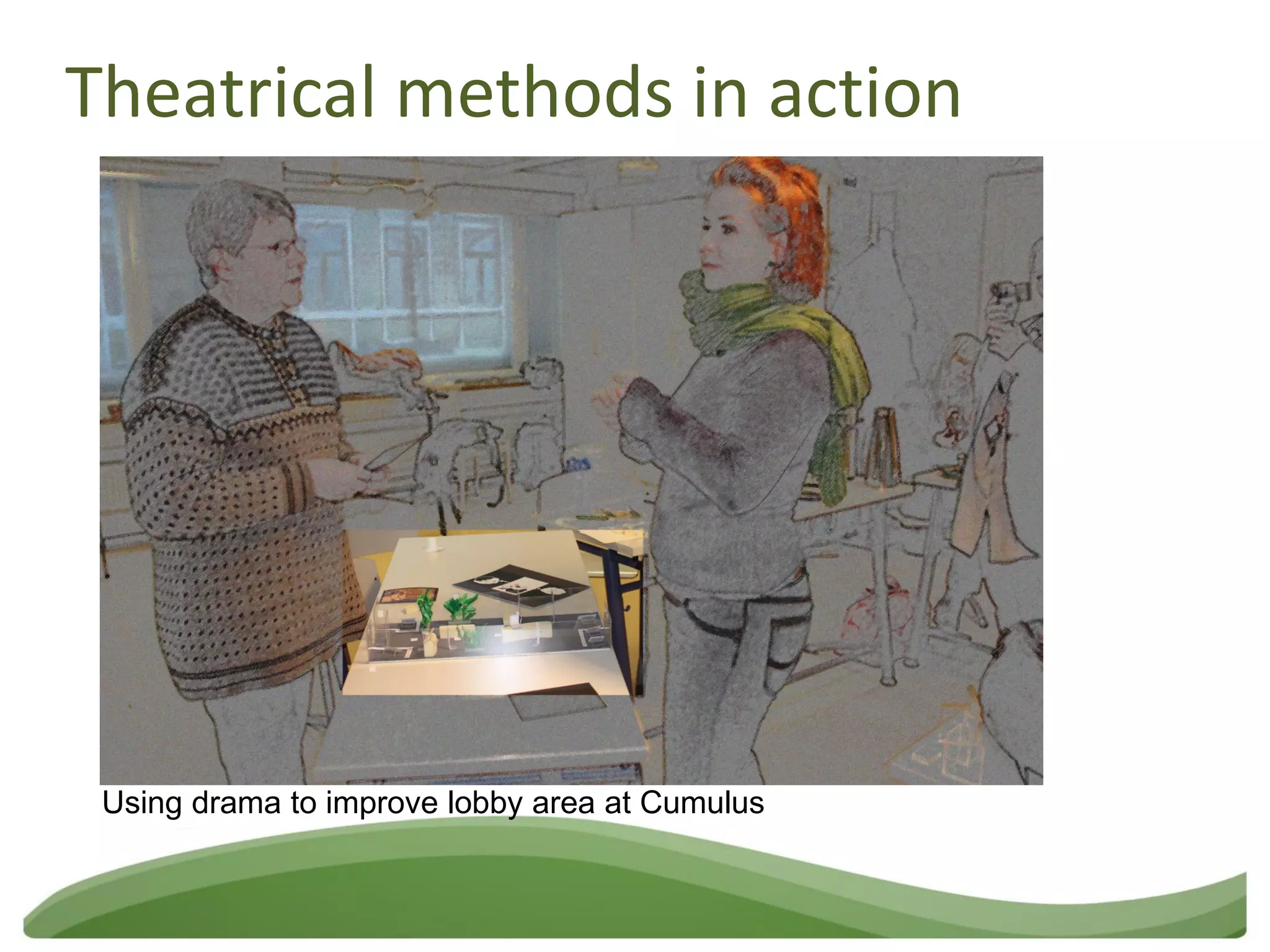
Theatrical methods in action


 Using drama to improve lobby area at Cumulus
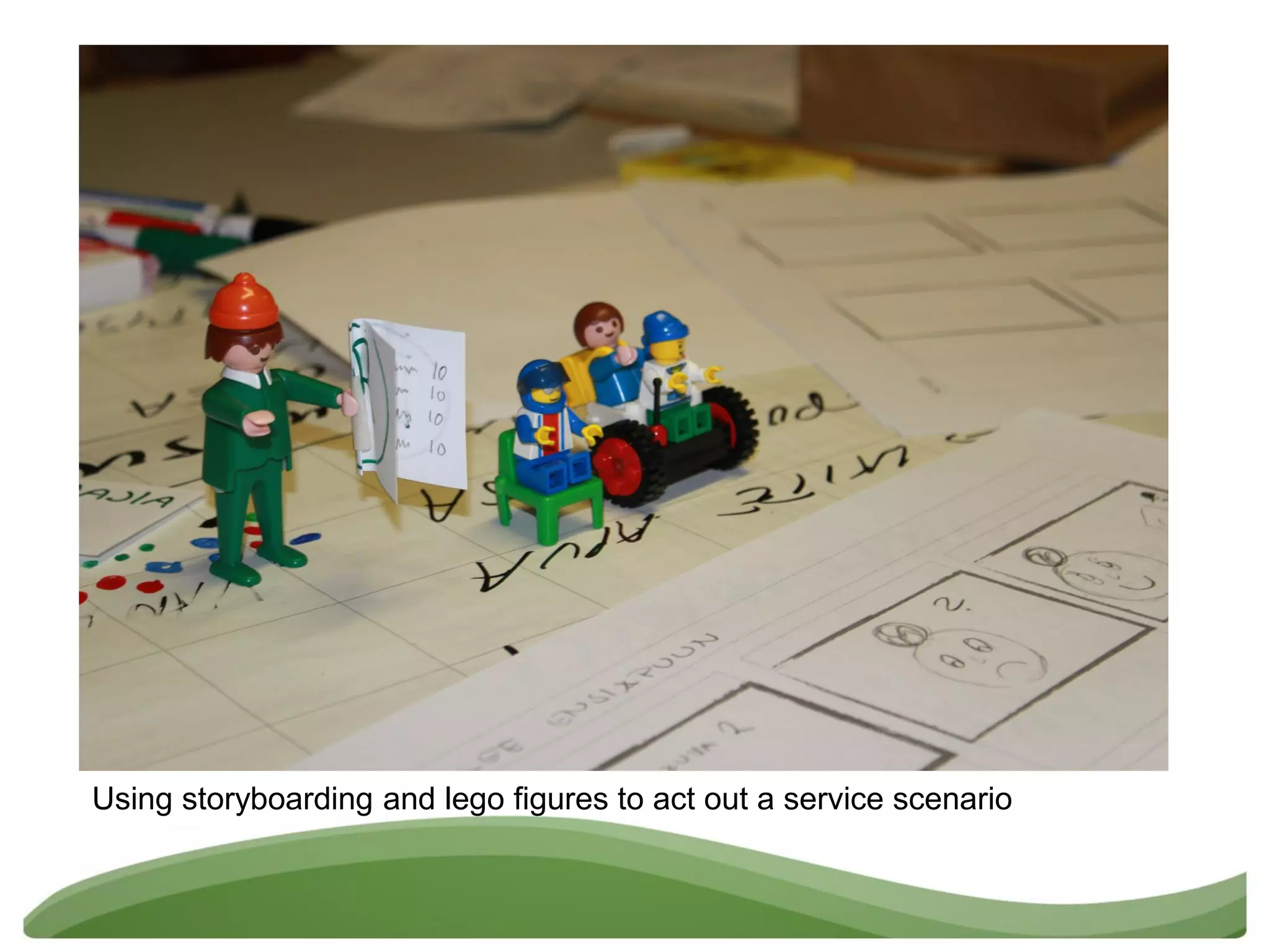
Using storyboarding and lego figures to act out a service scenario
Bodystorming
• Bodystorming can reduce the amount of time needed to
  study documents of user observations. People can more
  quickly and with less effort build a mental model of the
  surrounding, directly observable environment. In contrast,
  in traditional brainstorming, documentations of contextual
  factors, be they textual or pictorial, tend to be lengthy and
  take long to study.
• The key idea in bodystorming is that the descriptions of a
  problem domain (i.e. design questions) given to
  bodystorming participants can concentrate more on the
  description of aspects of the problem that are not
  observable, e.g. psychological (e.g. user needs), social (e.g.
  interpersonal relationships) or interactional (e.g. turn-
  taking in conversations).
Collecting stories in play-back theatre
• In play-back theatre spectators are asked to tell
  stories, usually within the frame of some leading
  theme and opening questions asked by the
  conductor. Conductor is a link between the audience
  and the actors. These tales can be anything from the
  simple everyday events to the most dramatic
  moments of life.The teller will watch his / her story
  played back by actors, who improvise with different
  techniques depending on what aspects of the story
  are seen crucial.
• Despite the importance of the narratives, the
  performance is to take the verbal rendition of
  experience and translate it into not-so-verbal
  drama. The person whose story is played is
  thus able to see new aspects of his experience
  and to relate to it in a more inclusive and
  communal way.
• First, the actors lay out the rules of the game
  by coming to stage and telling their own little
  stories connected to the theme. This works as
  an introduction and kind of a model to the
  audience: you can tell simple things in a
  simple way. After this conductor asks some
  very simple questions like “What came to your
  minds when you watched these stories?”.
• The actors create an image with movements
  and improvised speech. This session with the
  teachers in the social and health care
  department started with feelings and
  projections of the working week and the
  questions of retirement came little later.After
  short techniques came a moment of
  discussion in pairs relating the feelings about
  growing older and ending one’s working life.
• This was followed by longer stories told by any
  volunteer, who wanted to have her story
  displayed. The teller wasasked to choose one
  of the actors to represent her self. The teller
  can then give feedback of what she has seen:
  associations, thoughts, emotions, corrections
Collecting stories in drama workshops
• Drama workshop is a matrix for collaborative,
  active doing, using a variety of methods and
  exercises to investigate chosen issues. It may
  involve warm-up games and physical
  exercises, discussion, improvisation and
  creating still images and small scenes which
  are observed, reflected and modified.
• In drama workshops the stories were seen in the
  physical embodiments and reflections done by the
  participants, in still images and small scenes based
  on the instructions like: “Relate in small groups a)
  the worst moment of your working life and b) the
  best imaginable moment and then do still images of
  them”. The images were first interpreted and
  observed by others: “What do you see in this image?
  Who are these people? What are they thinking?”
  And: “How could we change this nightmarish scene
  to a positive one?”
References
 Oulasvirta, A., Kurvinen, E. and Kankainen, T. (2003): Understanding contexts by being there: case studies
 in bodystorming. Pers Ubiquit Comput (2003) 7: 125–134 DOI 10.1007/s00779-003-0238-7. London: Springer-Verlag.
 http://www.cs.helsinki.fi/u/oulasvir/ scipubs/bodystorming_AO_EK_TK.pdf (2.5.2009)
 Iacucci, G., Kuutti, K. and Ranta, M. (2000): On the Move with a Magic Thing: Role Playing in Concept
 Design of Mobile Services and Devices. DIS ’00, Brooklyn, New York. http://users.tkk.fi/~giulio/ P1_jacucci.pdf (2.5.2009)
 Buchenau, M. and Fulton Suri, J. (2000): Experience Prototyping. San
 Francisco: IDEO. http://www.ideo. com/images/uploads/thinking/ publications/pdfs/FultonSuriBuchenau-
 Experience_PrototypingACM_8-00. pdf (20.4.2009)


15
This project has been funded with support from the European Commission. This publication
     reflects the views only of the author, and the Commission cannot be held responsible for any
     use which may be made of the information contained therein.


13.3.2012                                                                                           16

TP2 How to use drama methods in service concept design

  • 1.
    Satu Miettinen, JuhaMiettinen, Antti Kares, Raisa Leinonen and Timo Sirviö Kuopio Academy of Design, Savonia University of Applied Sciences Finland P.O. BOX 98, FIN -70101 KUOPIO Email: office@designkuopio.fi "DE-SME - Intelligent Furniture - Training for Design, Environment and New Materials in SMEs" Agreement n. 2009 - 2196 / 001 - 001
  • 2.
    Theme 5.3.3. Howto use drama methods in service concept design?
  • 3.
    Bodystorming • Prototypingmethod, creating, generating and modelling new service features Empathic design method • The idea in bodystorming is to act as though the service would exist, ideally in the context where it would be used. • This method gives the opportunity to test the proposed service and its interactions either inside the service design team or including the participants.
  • 4.
    Bodystorming • Different servicesituations can be acted out, for example, the customer service situation at the hotel reception. Service designers create the service situation, cast the roles, practise with the professional or on their own and play the situation. The purpose is to prototype and come up with new solutions, test new interactions and make ad hoc innovations.
  • 5.
    Theatrical methods inaction Using drama to improve lobby area at Cumulus
  • 6.
    Using storyboarding andlego figures to act out a service scenario
  • 7.
    Bodystorming • Bodystorming canreduce the amount of time needed to study documents of user observations. People can more quickly and with less effort build a mental model of the surrounding, directly observable environment. In contrast, in traditional brainstorming, documentations of contextual factors, be they textual or pictorial, tend to be lengthy and take long to study. • The key idea in bodystorming is that the descriptions of a problem domain (i.e. design questions) given to bodystorming participants can concentrate more on the description of aspects of the problem that are not observable, e.g. psychological (e.g. user needs), social (e.g. interpersonal relationships) or interactional (e.g. turn- taking in conversations).
  • 8.
    Collecting stories inplay-back theatre • In play-back theatre spectators are asked to tell stories, usually within the frame of some leading theme and opening questions asked by the conductor. Conductor is a link between the audience and the actors. These tales can be anything from the simple everyday events to the most dramatic moments of life.The teller will watch his / her story played back by actors, who improvise with different techniques depending on what aspects of the story are seen crucial.
  • 9.
    • Despite theimportance of the narratives, the performance is to take the verbal rendition of experience and translate it into not-so-verbal drama. The person whose story is played is thus able to see new aspects of his experience and to relate to it in a more inclusive and communal way.
  • 10.
    • First, theactors lay out the rules of the game by coming to stage and telling their own little stories connected to the theme. This works as an introduction and kind of a model to the audience: you can tell simple things in a simple way. After this conductor asks some very simple questions like “What came to your minds when you watched these stories?”.
  • 11.
    • The actorscreate an image with movements and improvised speech. This session with the teachers in the social and health care department started with feelings and projections of the working week and the questions of retirement came little later.After short techniques came a moment of discussion in pairs relating the feelings about growing older and ending one’s working life.
  • 12.
    • This wasfollowed by longer stories told by any volunteer, who wanted to have her story displayed. The teller wasasked to choose one of the actors to represent her self. The teller can then give feedback of what she has seen: associations, thoughts, emotions, corrections
  • 13.
    Collecting stories indrama workshops • Drama workshop is a matrix for collaborative, active doing, using a variety of methods and exercises to investigate chosen issues. It may involve warm-up games and physical exercises, discussion, improvisation and creating still images and small scenes which are observed, reflected and modified.
  • 14.
    • In dramaworkshops the stories were seen in the physical embodiments and reflections done by the participants, in still images and small scenes based on the instructions like: “Relate in small groups a) the worst moment of your working life and b) the best imaginable moment and then do still images of them”. The images were first interpreted and observed by others: “What do you see in this image? Who are these people? What are they thinking?” And: “How could we change this nightmarish scene to a positive one?”
  • 15.
    References Oulasvirta, A.,Kurvinen, E. and Kankainen, T. (2003): Understanding contexts by being there: case studies in bodystorming. Pers Ubiquit Comput (2003) 7: 125–134 DOI 10.1007/s00779-003-0238-7. London: Springer-Verlag. http://www.cs.helsinki.fi/u/oulasvir/ scipubs/bodystorming_AO_EK_TK.pdf (2.5.2009) Iacucci, G., Kuutti, K. and Ranta, M. (2000): On the Move with a Magic Thing: Role Playing in Concept Design of Mobile Services and Devices. DIS ’00, Brooklyn, New York. http://users.tkk.fi/~giulio/ P1_jacucci.pdf (2.5.2009) Buchenau, M. and Fulton Suri, J. (2000): Experience Prototyping. San Francisco: IDEO. http://www.ideo. com/images/uploads/thinking/ publications/pdfs/FultonSuriBuchenau- Experience_PrototypingACM_8-00. pdf (20.4.2009) 15
  • 16.
    This project hasbeen funded with support from the European Commission. This publication reflects the views only of the author, and the Commission cannot be held responsible for any use which may be made of the information contained therein. 13.3.2012 16