T Y P E S O F
P R O T O T Y P E S
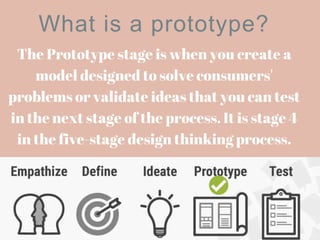
The Prototype stage is when you create a
model designed to solve consumers'
problems or validate ideas that you can test
in the next stage of the process. It is stage 4
in the five-stage design thinking process.
What is a prototype?
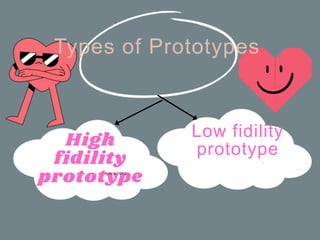
Types of Prototypes
High
fidility
prototype
Since 2012
Low fidility
prototype
Low Fidelity prototype
• Low-fidelity prototypes are
often paper-based and do not
allow user interactions.
• They range from a series of
hand-drawn mock-ups to
printouts.
• In theory, low-fidelity sketches
are quicker to create.
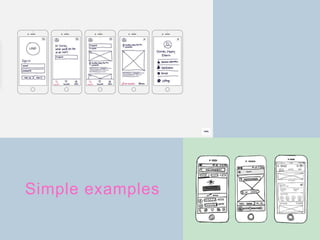
Simple examples
PROS AND CONS
OF LOW-FIDELITY PROTOTYPES
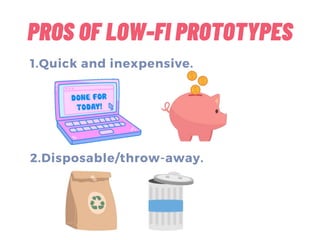
PROS OF LOW-FI PROTOTYPES
1.Quick and inexpensive.
2.Disposable/throw-away.
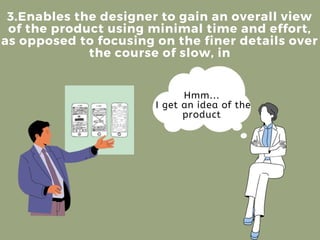
3.Enables the designer to gain an overall view
of the product using minimal time and effort,
as opposed to focusing on the finer details over
the course of slow, in
Hmm...
I get an idea of the
product
CONS OF LOW-FI
PROTOTYPES
1. An inherent lack of
realism.
2. Users might have a hard time giving
feedback
3. Can oversimplify complex
issues
4. Lack of interactivity deprives users of
direct control.
5. Users must imagine how they would use
the product.
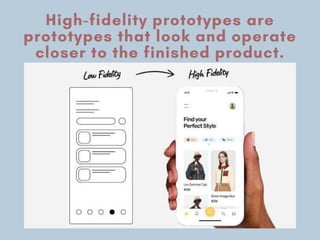
• High-fidelity prototypes are
computer-based, and usually
allow realistic user interactions.
• High-fidelity prototypes take you
as close as possible to a true
representation of the user
interface.
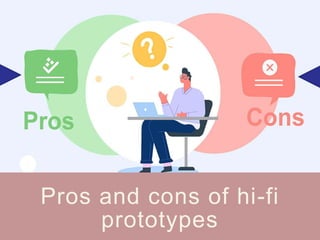
Pros and cons of hi-fi
prototypes
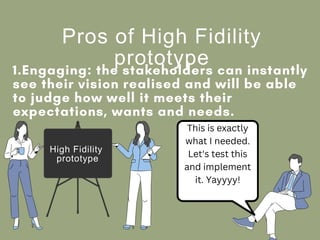
Pros of High Fidility
prototype
High Fidility
prototype
This is exactly
what I needed.
Let's test this
and implement
it. Yayyyy!
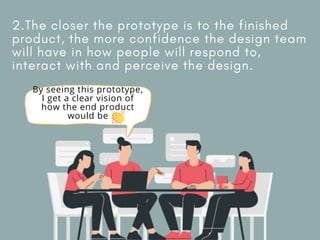
By seeing this prototype,
I get a clear vision of
how the end product
would be
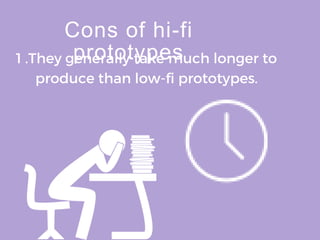
Cons of hi-fi
prototypes
1 .They generally take much longer to
produce than low-fi prototypes.
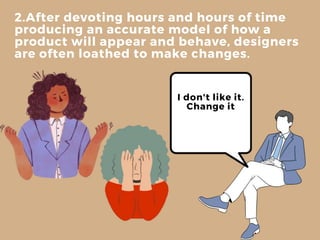
2.After devoting hours and hours of time
producing an accurate model of how a
product will appear and behave, designers
are often loathed to make changes.
I don't like it.
Change it
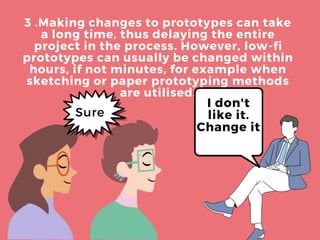
3 .Making changes to prototypes can take
a long time, thus delaying the entire
project in the process. However, low-fi
prototypes can usually be changed within
hours, if not minutes, for example when
sketching or paper prototyping methods
are utilised.
I don't
like it.
Change it
Sure
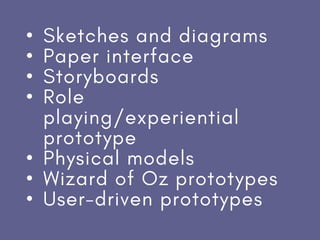
Types/Examples of
Low-Fi prototypes
•
•
•
•
•
•
•
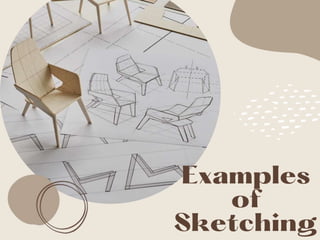
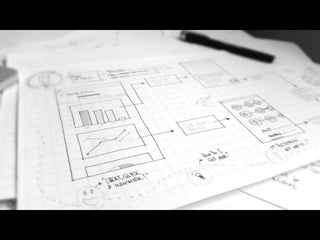
• Sketching requires minimal effort
and does not require any drawing
skills to do it.
• sketches are used to begin the
process of conceptualising and
building a new product.
• Sketches can be shared with
teammates for more ideas and
discussions
• They can be extremely helpful for
making decisions.
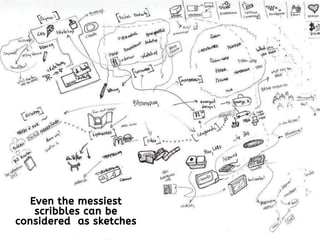
Even the messiest
scribbles can be
considered as sketches
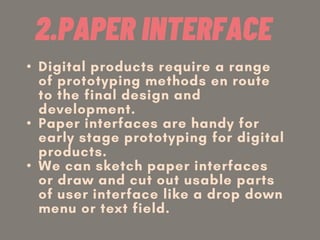
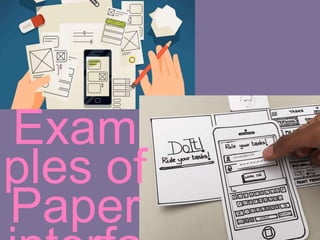
2.PAPER INTERFACE
•
•
•
Exam
ples of
Paper
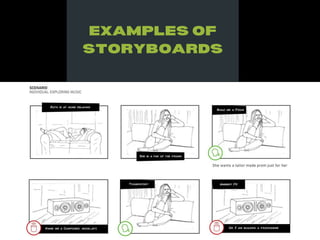
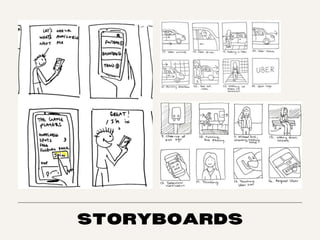
• Storyboard is a way of telling stories
and guiding targeted customers
through a user experience.
• This type is used for early
prototyping.
• It is presented in a series of images or
sketches.
• It evokes new ideas through
collaboration with other designers.
• This helps a designer to understand
the user's world and think from their
perspective.
4 . R O L E P L A Y I N G
• Roleplaying enables designers to explore
target situations within the system
physically.
• It is used in capturing and enacting the
user's experience of a product.
• The designers create props,use objects
and audio simulations to imitate the user
environment.
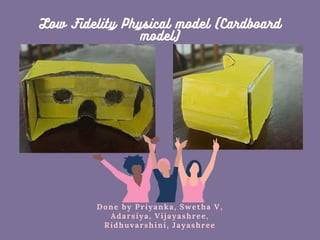
Done by Priyanka, Swetha V,
Adarsiya, Vijayashree,
Ridhuvarshini, Jayashree
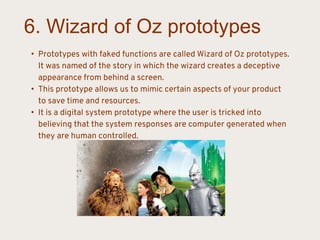
6. Wizard of Oz prototypes
• Prototypes with faked functions are called Wizard of Oz prototypes.
It was named of the story in which the wizard creates a deceptive
appearance from behind a screen.

• This prototype allows us to mimic certain aspects of your product
to save time and resources.
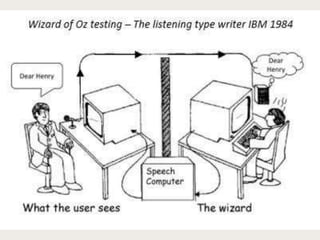
• It is a digital system prototype where the user is tricked into
believing that the system responses are computer generated when
they are human controlled.
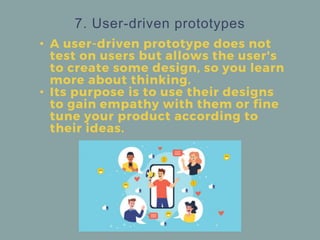
• A user-driven prototype does not
test on users but allows the user's
to create some design, so you learn
more about thinking.
• Its purpose is to use their designs
to gain empathy with them or fine
tune your product according to
their ideas.
7. User-driven prototypes
Wait a minute!!
This doesn't end here..
GAME
TIME

Design Thinking - Types of prototypes

  • 1.
    T Y PE S O F P R O T O T Y P E S
  • 2.
    The Prototype stageis when you create a model designed to solve consumers' problems or validate ideas that you can test in the next stage of the process. It is stage 4 in the five-stage design thinking process. What is a prototype?
  • 3.
  • 4.
    Low Fidelity prototype •Low-fidelity prototypes are often paper-based and do not allow user interactions. • They range from a series of hand-drawn mock-ups to printouts. • In theory, low-fidelity sketches are quicker to create.
  • 5.
  • 6.
    PROS AND CONS OFLOW-FIDELITY PROTOTYPES
  • 7.
    PROS OF LOW-FIPROTOTYPES 1.Quick and inexpensive. 2.Disposable/throw-away.
  • 8.
    3.Enables the designerto gain an overall view of the product using minimal time and effort, as opposed to focusing on the finer details over the course of slow, in Hmm... I get an idea of the product
  • 9.
    CONS OF LOW-FI PROTOTYPES 1.An inherent lack of realism. 2. Users might have a hard time giving feedback 3. Can oversimplify complex issues 4. Lack of interactivity deprives users of direct control. 5. Users must imagine how they would use the product.
  • 10.
    • High-fidelity prototypesare computer-based, and usually allow realistic user interactions. • High-fidelity prototypes take you as close as possible to a true representation of the user interface.
  • 12.
    Pros and consof hi-fi prototypes
  • 13.
    Pros of HighFidility prototype High Fidility prototype This is exactly what I needed. Let's test this and implement it. Yayyyy!
  • 14.
    By seeing thisprototype, I get a clear vision of how the end product would be
  • 15.
    Cons of hi-fi prototypes 1.They generally take much longer to produce than low-fi prototypes.
  • 16.
    2.After devoting hoursand hours of time producing an accurate model of how a product will appear and behave, designers are often loathed to make changes. I don't like it. Change it
  • 17.
    3 .Making changesto prototypes can take a long time, thus delaying the entire project in the process. However, low-fi prototypes can usually be changed within hours, if not minutes, for example when sketching or paper prototyping methods are utilised. I don't like it. Change it Sure
  • 18.
  • 19.
  • 20.
    • Sketching requiresminimal effort and does not require any drawing skills to do it. • sketches are used to begin the process of conceptualising and building a new product. • Sketches can be shared with teammates for more ideas and discussions • They can be extremely helpful for making decisions.
  • 23.
    Even the messiest scribblescan be considered as sketches
  • 24.
  • 25.
  • 26.
    • Storyboard isa way of telling stories and guiding targeted customers through a user experience. • This type is used for early prototyping. • It is presented in a series of images or sketches. • It evokes new ideas through collaboration with other designers. • This helps a designer to understand the user's world and think from their perspective.
  • 29.
    4 . RO L E P L A Y I N G • Roleplaying enables designers to explore target situations within the system physically. • It is used in capturing and enacting the user's experience of a product. • The designers create props,use objects and audio simulations to imitate the user environment.
  • 33.
    Done by Priyanka,Swetha V, Adarsiya, Vijayashree, Ridhuvarshini, Jayashree
  • 34.
    6. Wizard ofOz prototypes • Prototypes with faked functions are called Wizard of Oz prototypes. It was named of the story in which the wizard creates a deceptive appearance from behind a screen. • This prototype allows us to mimic certain aspects of your product to save time and resources. • It is a digital system prototype where the user is tricked into believing that the system responses are computer generated when they are human controlled.
  • 38.
    • A user-drivenprototype does not test on users but allows the user's to create some design, so you learn more about thinking. • Its purpose is to use their designs to gain empathy with them or fine tune your product according to their ideas. 7. User-driven prototypes
  • 40.
    Wait a minute!! Thisdoesn't end here..
  • 41.