Topic Outline Introducing Toyota Australia & Her Supply Chain Management By Cong Xue
History of Toyota Australia Toyota Motor Corporation  Australia (TMCA) is a subsidiary of Toyota Motor Corporation (TMC). Toyota Australia’s origins go back to 1958. The commercial vehicle business became Thesis Toyota in 1971 In 1988, Toyota’s local operations were unified to form Toyota Motor Corporation Australia Toyota Australia currently build two models—the Camry and Avalon series.
Toyota Australia Current Business Toyota Australia is the second largest vehicle manufacturer in Australia. Toyota Australia has exported over 60,000 cars to over 20 different commercial locations worldwide in 2003. Toyota is a people oriented organization that sees the development of its staff as a foundation stone for future business prosperity. Toyota has long been recognized as one of the most efficient manufacturers in the world
Business Context The business context of Toyota Australia is actually link to the operating environment that consists of a number of factors.  The global industry operating environment;  Automotive investment trends;  Policy environment;  International market access;  Australian industry operating environment; and  Government policy environment.
Toyota Australia’s supply network The basic of Toyota Australia’s supply network: Supplier Association Effect of “knowledge sharing network” on supply chain coordination Upstream and downstream entities
Suppliers Association The key to Toyota’s success would appear to be their highly effective supplier integration process that over the past 50 years has enabled the excellence of their internal “ hoshin kanri”   strategic management, cross functional process based management and Toyota Production System to be shared directly with their direct suppliers.
Effect of “knowledge sharing network” The effects of knowledge sharing network on the coordination of supply chain and product customization forms the basis of Toyota Production System (TPS).  The aim is to have members identify themselves as part of an interdependent economic network.
The Upstream problems After a series of research, few critical factors were identified:  Bundled outsourcing Logistic challenge  Import of vehicle components
Bundled Outsourcing One of the important characteristics of Toyota Japan suppliers system in terms of the inter-firm tasking portioning is that the outsourcing ratio is high not only in manufacturing but also in product development. There is a difference in terms assembly process and the level of hierarchy in supplier.  Without bundled Outsourcing, it has first changed the internal process of the supply chain and most importantly, the number of first tier suppliers decreases and many of the suppliers ascended to the higher tiers and the hierarchy of the parts markers.
Logistic Challenge One advantage of localization is closer relationships facilitate collaborative problem solving.  Longer supply lines required faster order processing, and this was done electronically.  Essentially, electronic kanban cards were identical in function to the physical kanban cards used by Toyota in Japan.
Import of Vehicle Components In the case of Toyota Australia, only 79 per cent of components are local content, with the balance relying on imports. This has been highlighted as one of the critical factors in terms of supply chain due to the fact the it affects the supply chain coordination as well as the upstream entities.
Upstream Entities At current, Toyota Australia has an extensive local supplier base from its 98 component suppliers and 300 general suppliers. In general, suppliers may be broadly classified into three categories:  Parts suppliers (Key component/ low assets specificity component)  Raw materials suppliers  Suppliers of equipment and tools
Downstream Entities In general, Toyota Australia has the following downstream entities: Warehouse facilities in all major states  Distributors in all major states  Dealer network of over 285 outlets across Australia
Internal entities To build a car, the internal entities of the supply chain which includes all of the in-house processes used in transforming the inputs from the suppliers are as follows: Production of Engines  (Once completed, the engines head straight for the final assembly)  Pressing of steel panels and parts  Welding of car shells  Painting of car shells  Final Assembly
Topic Outline Toyota’s Australia  & Her Current IT Setup By Simon Chew
Topic Outline IT Solution for  Toyota Motor Corporation  (TMC)
IT Solution for TMC Enterprise Resource Planning System (ERP) E-Marketplace  TradeMatrix system
IT Solution for TMC Enterprise Resource Planning System (ERP)
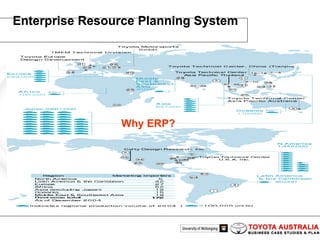
Enterprise Resource Planning System   Why ERP?
Enterprise Resource Planning System One of the largest automotive companies in the world  Total of 51 overseas manufacturing companies in 26 countries / locations Overseas network consisting of more than 160 importers / distributors and numerous dealers.
Enterprise Resource Planning System SAP Automotive ERP Suit  Main means of information flow between Toyota and its counterparts worldwide. Tighter collaboration links  With SAP, gain: Outstanding strategic, Operational, Financial, Marketing positions
IT Solution for TMC E-Marketplace
TMC E-Marketplace iStarXchange  Initiative with i2 Technologies Inc. Allow subscripted members able to view a single catalogue to: view information on parts  checking the prices and availability conduct transaction online forecasting supply and demand  delivery cycle  Improved forecasting  Enhancing the planning Enhance deployment and replenishment of the inventory
IT Solution for TMC TradeMatrix system
TradeMatrix system Initiative with i2 Technologies Inc  Automates with equipment manufacturer and suppliers in terms of :  site’s inventory management  warehousing  Logistic and shipping
Topic Outline IT Solution for  Toyota Motor Corporation Australia (TMCA)
IT Solution for TMCA Main SAP Automotive suit ERP system BEA Web-logic Integration 8.1 (Integrated within the SAP automotive suit) Electronic “Kanban”-Card  System Participant of iStarXchange  Major Player in Australian Automotive Network eXchange (AANX)
IT Solution for TMCA Main SAP Automotive Suit ERP System
Main SAP Automotive Suit (ERP) Main means of information flow between Toyota Australia and its counterparts worldwide. Tighter collaboration links between TMCA and TMC Logistic and shipping Overall Value Chain
IT Solution for TMCA BEA Web-logic Integration 8.1
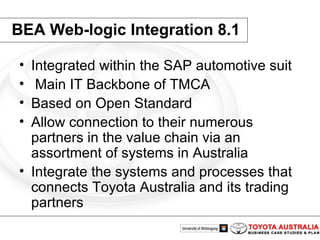
BEA Web-logic Integration 8.1 Integrated within the SAP automotive suit Main IT Backbone of TMCA Based on Open Standard Allow connection to their numerous partners in the value chain via an assortment of systems in Australia  Integrate the systems and processes that connects Toyota Australia and its trading partners
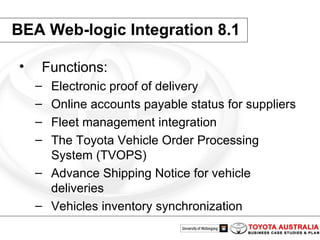
BEA Web-logic Integration 8.1 Functions: Electronic proof of delivery  Online accounts payable status for suppliers Fleet management integration The Toyota Vehicle Order Processing System (TVOPS) Advance Shipping Notice for vehicle deliveries Vehicles inventory synchronization
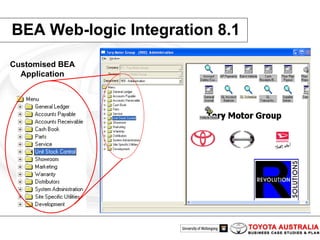
BEA Web-logic Integration 8.1 Customised BEA Application
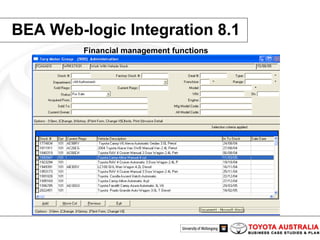
BEA Web-logic Integration 8.1 Financial management functions
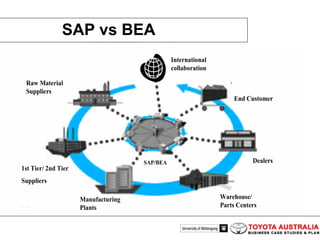
IT Solution for TMCA SAP vs BEA
SAP vs BEA
IT Solution for TMCA Electronic “Kanban”-Card  System
Electronic “Kanban”-Card  System Identical in function to the physical “kanban” cards used by Toyota in Japan 4 main purpose: Sole means of requesting new parts  Send for every order shipment  Send to a specific supplier plant  Establishing the mix and volume criteria for assessing if an order was correct
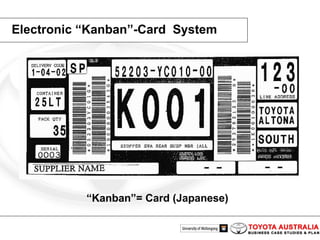
Electronic “Kanban”-Card  System “ Kanban”= Card (Japanese)
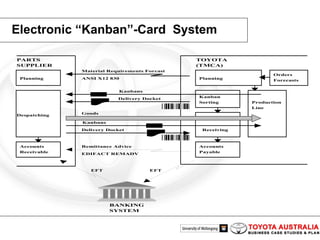
Electronic “Kanban”-Card  System
IT Solution for TMCA Participant of iStarXchange
Participant of iStarXchange Main e-marketplace between TMCA and its counterparts worldwide Allow subscripted members able to view a single catalogue to: view information on parts  checking the prices and availability conduct transaction online forecasting supply and demand  delivery cycle  Improved forecasting outside Australia Enhancing the planning outside Australia Enhance deployment and replenishment of the inventory
IT Solution for TMCA Australian Automotive Network eXchange (AANX)
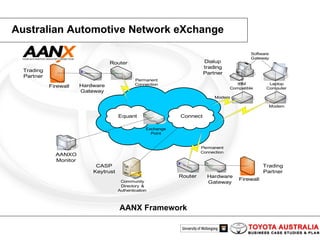
Australian Automotive Network eXchange   Four major car manufacturers in Australia are involved  Numerous service providers and non-key suppliers  Provides IP based Extranets for the automotive industry in Australia  Operates as a virtual point network (VPN) Allows users to send date to each other in a reliable and secure manner
Australian Automotive Network eXchange Main components: A network that is based on available Internet technology Operated by agreed and standardized service levels. Demonstrating proactive management of trading partner connections Practice the best standard of security and privacy for transactions and interoperability between service providers
Australian Automotive Network eXchange Benefits includes: Pervasive supply chain communications Rapid application deployment across the supply chain Lower cost of EDI Faster Business Cycles Simpler integration into trading partners' and customers' online e-business systems and strategies
Australian Automotive Network eXchange AANX Framework
IT Solution for TMCA Problem Statement
IT Solution for TMCA Weaknesses   Lack of alternatives in the domestic supplier base and risk of currency exposure Problems arising in linear supply chain Over-reliance on forecast planning for production Lack of Vertical industrial relations environment
IT Solution for TMCA Lack of alternatives in the domestic supplier base and risk of currency exposure
IT Solution for TMCA TMCA’s supplier agreements have to be obtained with the approval of the TMC   Import costs and extended time taken for components to arrive in Australia hinder TMCA’s JIT system.   Currency exposure will cause too great a financial risk for TMCA   Components also take longer to arrive the plant   Affect on the overall production costs and time taken to produce a “locally produced” Toyota cars   Lack of alternatives in the domestic supplier base and risk of currency exposure
IT Solution for TMCA Problems arising in linear  supply chain
IT Solution for TMCA Dispersed geographical location of the TMCA supply chain infrastructure   Cannot currently communicate and interact with other members further downstream   No collaborate in spite of TMCA’s involvement with the AANX network   Escalate problems with ongoing redundant supplier delivery expenses   Problems arising in linear supply chain
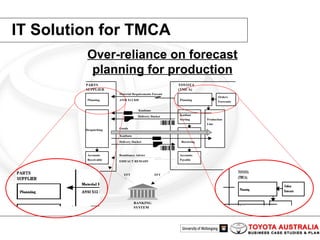
IT Solution for TMCA Over-reliance on forecast planning for production
IT Solution for TMCA Lack of Vertical industrial relations environment
IT Solution for TMCA Currently   industrial relationships with automotive manufacturers in terms of sharing suppliers   Current AANX network relying on the freight company to do all the logistics planning   Automotive shipments require specialised vehicle transport ships  Lack of Vertical industrial relations environment
IT Solution for TMCA Business Goals
IT Solution for TMCA Business Goals Provide a comprehensive domestic supplier base   Provide initiatives for a non-linear, hub-based supply chain system   Provide real-time updates on demand and supply allocation   Vertical industry logistics collaboration
IT Solution for TMCA Solutions Overview
IT Solution for TMCA Goal 1:  Provide a comprehensive domestic supplier base Solution:  Implementation of a supplier website Goal 2:  Provide initiatives for a non-linear, hub-based supply chain system Solution:  An agent-based e-marketplace initiative .  Goal 3:  Provide real-time updates on demand and supply allocation Solution:  Real-time tracking function module incorporated into the current    electronic BEA system  Goal 4:  Vertical industry logistics collaboration Solution:  An intelligent logistic coordinating agent in the form of a      collaborative e-logistics hub.
Solution 1 Solution 1 Implementation of a supplier website By Joseph Baez
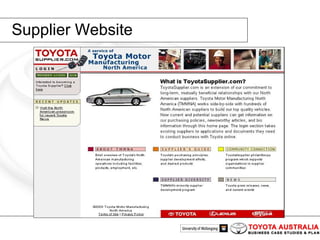
Solution Description Goal 1 – Provide a Comprehensive Domestic Supplier Base SOLUTION: Implementation of a supplier web site U.S. version of Toyota supplier web site Toyota Supplier.com www.toyotasupplier.com
Supplier Website
Supplier Website TMCA focused on core competencies in high-end design engineering and system integration Toyota Australia needs highly focused core competency   oriented  suppliers. Small and diverse companies though have the ability to display such potential to add Innovation Flexibility  and Strength  to TMCA’s supply base.
TMCA  first has to  open its doors  to the domestic market suppliers Invest in their new concept of supply base Target:  100% domestic suppliers Supplier-centric  web site Provide  opportunities to expand TMCA supplier network. Supplier Website
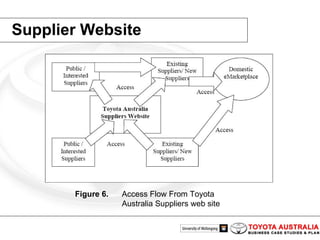
Supplier Website Figure 6. Access Flow From Toyota Australia Suppliers web site
Reasoning behind Goal 1 – The Business Needs Many of TMCA’s car components have to be imported due to the lack of domestic suppliers Application of the “right part at the right place at the right time” concept or JIT to lack the optimal efficiency throughout the TMCA supply chain. The implementation of a comprehensive domestic supplier base is essential. Provision of collaborative web site linking current TMCA online presence which provides similar functions to the Toyota supplier’s web site currently in use in North America Allowing TMCA to have comprehensive overview of their current suppliers. Also reducing the red-tape involved to be part of the TMCA supply chain; and most importantly Provides TMCA with a  channel to disseminate  important  supplier related   information  to its  upstream entities . Supplier Website
Web site functions Potential suppliers will be able to acquire information on the requirements of becoming part of TMCA’s supplier network Potential suppliers need only to download/complete an online form to join the network Information such as Supplier’s guide Community activities; and Any core information about TMCA’s current supplier’s network can be obtained from the website.  Connection links provided to domestic e-Marketplace Registered e-Marketplace members: Able to enjoy the privileges on what the e-Marketplace is offering To be discussed in  Solution 2 New  opportunities  for  potential suppliers  as well as existing suppliers who possess the  capabilities  to  improve TMCA’s overall  supply chain process  using this proposed collaborative  web site. Supplier Website
Solution 2 An agent-based e-marketplace initiative
Solution Description Goal 2 – Provide initiatives for a non-linear, hub-based supply chain system SOLUTION:  Agent-Oriented Domestic e-Marketplace
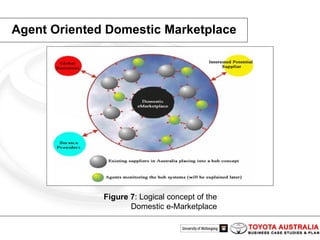
Agent Oriented Domestic Marketplace   Figure 7 : Logical concept of the Domestic e-Marketplace
Agent Oriented Domestic Marketplace General Overview Proposed e-Marketplace functions Will be able to support a  broader base  of  services  given further growth in e-Market infrastructure Baseline interaction  and  directory services Specialty  market services , such as: Dynamic trading ; Cooperative  supply chain  integration and management Enables  and  facilitates  the  relationship  between business participants Suppliers and service providers; and Supporting systems
Agent Oriented Domestic Marketplace Proposed e-Marketplace functions (contd.) Many-to-many relationships supported between TMCA and these business partners. Enables both TMCA and suppliers to leverage economies of scale in their trading relationships Allows access to a more liquid marketplace Further allows the use of dynamic pricing models e.g. Auctions (one of the services provided in the proposed e-marketplace) Improve the economic efficiency of the market where uncertainty about prices and demands are common.
Agent Oriented Domestic Marketplace Integration with existing systems   e-Marketplace architecture accommodates and supports interfaces to the existing business models of the participant entities through cooperative supply-chain integration and management To provide smooth and effective integration at the business level There is a need for well-accepted interoperability standards, which must be meshed for supply chain integration to meet business demands. e-Marketplace corresponds with the supply chain with flexibility and agility in responding to customer demand shifts without conflicts in resource utilization.
Integration with existing systems (contd.)   Fundamental objective     improve  coordination   within  and  between  various  participant  business entities in the supply-chain The increased coordination can lead to: Reduction in lead times and costs Alignment of interdependent decision-making processes Improvement in the overall performance of each participant in the chain as well as the supply chain itself. Agent Oriented Domestic Marketplace
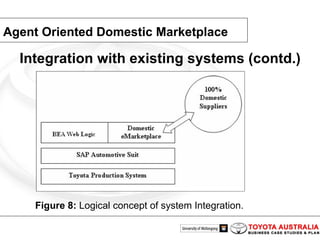
Agent Oriented Domestic Marketplace Integration with existing systems (contd.)  Figure 8:  Logical concept of system Integration.
Agent Oriented Domestic Marketplace Agent-Oriented e-Marketplace Handles complex and non-deterministic interactions usually involved in e-Marketplace E.g. Auctions and ad-hoc service integrations Components of proposed e-Market system  for TMCA will be able to change its configuration to participate in different, often simultaneous roles in e-Marketplaces. Completes tasks that would be manually impossible. e-Marketplace agents play several roles Will be able to coordinate, cooperatively or competitively, with the other agents, including HR
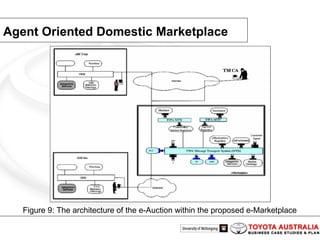
Agent Oriented Domestic Marketplace Figure 9: The architecture of the e-Auction within the proposed e-Marketplace
Agent Oriented Domestic Marketplace Agents for the proposed e-Marketplace:  User interface agents support and collaborate with users in the same work environment to achieve the users’ goals  Business-specific service agents Specialists that provide a collection of business-services available in the e-Marketplace Performing the functionality of a business service is typically the cooperative integration of several agents including: business-specific service agents; and market service agents Acts as a representative in the e-Marketplace for some functionality that is based on legacy applications or libraries, such as a product catalogue web site
Agent Oriented Domestic Marketplace Agents for the proposed e-Marketplace (contd.)  Market service agents: Specialises in providing a  collection  of  functions  for  generic e-Businesses  in e-Marketplace environments in which a single entity (usually an agent) can perform its tasks in the e-Marketplace. Market services  (value-added and core services) are  horizontal , i.e., services that are used in several business domains by several business entities. Integration service agents Also provide a collection of integration functions for a cooperative distributed system in which a  single entity  (agent, component, object, etc.) can perform its tasks. Used by  several distributed entities . E.g. a brokering agent provides a capability-based integration service in the e-Marketplace. Another type of integration agent provides view-integration, which is a service to merge and map the description of business-objects (e.g., source schemas) in the e-Marketplace supported by the business ontology into an integrated view or schema
Agent Oriented Domestic Marketplace Reasoning behind Goal 2 – The Business Needs The acquisition process of parts, materials and supplies from TMCA’s 100+ suppliers can be  slow ,  expensive  and  ineffective A “milk run” system could be possible within these groups of suppliers. No coordination among suppliers have been established   Currently a missed opportunity Current electronic Kanban (card) system is the only existing mechanism for ordering supplies between TMCA and its suppliers; A linear supply chain is not able to efficiently support the JIT productions as significant collaboration among entities within the supply chain. For these reasons an  agent-based e-marketplace initiative will be suitable TMCA will be able to eliminate its existing linear supply chain system to permit supplier collaboration and integration.
Topic Outline Solution 3 Real Time Inventory Tracking Module By Nurhazman Abdul Aziz
Solution 3 : Real Time Inventory Tracking Module Why did introduce this module? GOAL 3: Provide real-time updates on demand and supply allocation  Solution:  Real-time tracking function module incorporated into the current electronic BEA system
General Overview A complete modular solution, reduce the bullwhip effect which causes shifts in orders up and down the supply chain, eliminating any stockpiling cause by the current forecast method of determining the quantity of components needed for the productions.
General Overview to provide process visibility across the value chain, giving suppliers greater control over the process and  ensure synchronization of information with all partners regardless of size or geographic location.
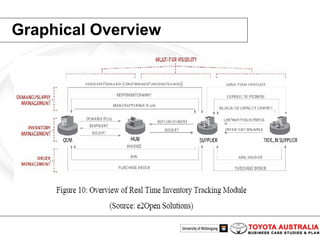
Graphical Overview
The Real Time Inventory Tracking Module To be incorporated into the BEA system, which comprises of 4 agents Forecast Agent Inventory Agent Order Agent Multi - Tier Visibility Agent
Details of the Desired Agents to be work as Forecast Agent  enables suppliers to rapidly align demand and supply in the mid-to-long-term planning horizon,  allowing customers and their partners to arrive at a consensus forecast or plan. provides alerts and notifications of demand supply mismatches and  can support a single-phase or two-phase commit planning process.  Inventory Agent  enables suppliers to align demand and supply by providing visibility to inventory status levels at multiple internal and external locations, as well as in-transit positions, enabling optimal levels of inventory.  allows partners to exchange key inventory-related information, such as demand-pull requests and target inventory levels can be used to track supplier compliance to contract obligations such as min/max inventory levels.  exception alerts can be configured to flag any inventory-level violations.
Details of the Desired Agents to be work as Order Agent enables suppliers to manage and track the entire purchase order lifecycle through TMCA’s supply process.  Suppliers can manage and track, in real-time, the complete end-to-end process for discrete, replenishment, demand pull and/or blanket purchase orders from order creation through shipment, receipt, invoicing and payment. Multi-Tier Visibility Module   allows TMCA to extend their demand/supply planning, order management and inventory management workflows beyond their first-tier partners to provide visibility to the processes executed between tier two, three and four partners.  allows to monitor demand/supply disconnects and exceptions throughout the extended supply chain, providing tools to help identify the impact of problems identified multiple tiers away.
A Suitable Scenario The interest of this system is focused on a complete solution to provide a real-time updates on the demand and supply allocation.  one of the distributors of TMCA has just received an order of purchase of a locally made Toyota Camry. logs the order into the current BEA system, the information will immediately be sent Toyota Vehicle Order Processing System (TVOPS). the real-time inventory module will acquire the new order information and be analysed. sent to the respective suppliers to be updated onto their own system. With such message flow, suppliers can get their supply ready for the next delivery to meet the JIT production in the shortest possible time needed.
Topic Outline Solution 4 An agent-based transport and logistics coordination system
Solution 4 An agent-based transport and logistics coordination system Why did introduce this module? Goal 4: Vertical industry logistics collaboration  Solution:  An intelligent logistic coordinating agent in the form of a collaborative e-logistics hub.
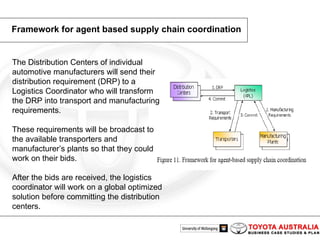
General Overview An agent-based transport and logistics coordination system (collaborative e-market), are designed to accomplish transport and logistic coordination tasks among different automotive manufacturers in Australia. Consist of 4 generic roles agents in supply chain: Distribution Hub Agent  Logistics Coordinator Agent,  Manufacturer Agent  Transporter Agent.
Framework for agent based supply chain coordination The Distribution Centers of individual automotive manufacturers will send their distribution requirement (DRP) to a Logistics Coordinator who will transform the DRP into transport and manufacturing requirements.  These requirements will be broadcast to the available transporters and manufacturer’s plants so that they could work on their bids.  After the bids are received, the logistics coordinator will work on a global optimized solution before committing the distribution centers.
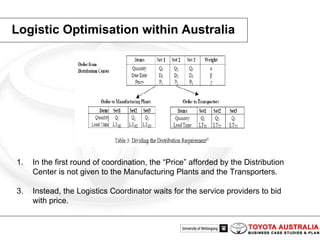
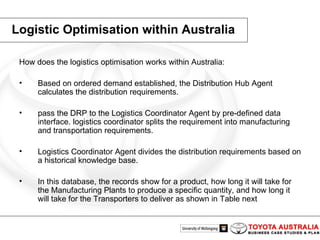
Logistic Optimisation within Australia How does the logistics optimisation works within Australia: Based on ordered demand established, the Distribution Hub Agent calculates the distribution requirements. pass the DRP to the Logistics Coordinator Agent by pre-defined data interface. logistics coordinator splits the requirement into manufacturing and transportation requirements.  Logistics Coordinator Agent divides the distribution requirements based on a historical knowledge base. In this database, the records show for a product, how long it will take for the Manufacturing Plants to produce a specific quantity, and how long it will take for the Transporters to deliver as shown in Table next
Logistic Optimisation within Australia In the first round of coordination, the “Price” afforded by the Distribution Center is not given to the Manufacturing Plants and the Transporters.  Instead, the Logistics Coordinator waits for the service providers to bid with price.
Logistic Optimisation within Australia The Transporter Agents perform local optimization using their own data on routes, schedules and consignments. The Manufacturer Agents will perform local optimization using data on inventory, capacity and processing times.  The results of the optimization will be transferred to the Logistics Coordinator Agent for global optimization.
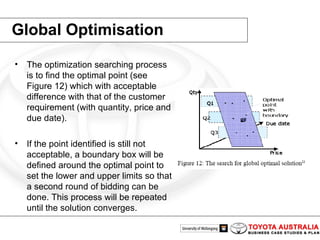
Global Optimisation After the Manufacturer and Transporter Agents finish local optimization process, they will commit the orders back to the Logistics Coordinator Agent.  to combine the respective commitments to produce joint commitments by summing up price and lead times (for Q1, Q2 and Q3 respectively)
Global Optimisation The optimization searching process is to find the optimal point (see Figure 12) which with acceptable difference with that of the customer requirement (with quantity, price and due date). If the point identified is still not acceptable, a boundary box will be defined around the optimal point to set the lower and upper limits so that a second round of bidding can be done. This process will be repeated until the solution converges.
A Suitable Scenario The interest of this system is focused on improving the current logistic demand to provide customers with the fastest delivery of their vehicles. wish to send 20 cars to a country.  not feasible for TMCA to ship the cars. With the system, TMCA invites other automotive manufacturers to join collaborative e-logistic marketplace. individual automotive manufacturers will submit their orders to the e-marketplace. Together with the shipping information provided by the freight companies, the system will conduct an optimization searching process based on manufacturer’s requirements (quantity, designation, price and due-date) and the shipping details until the search has reached a optimal point when is feasible for the shipment to be made to the country or even nearby ports with the least time needed for the vehicles to arrive to their final designations.
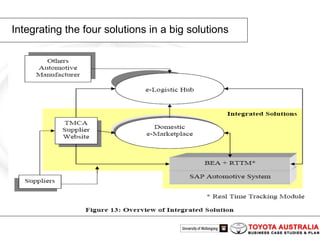
Integrating the four solutions in a big solutions
Integrating is made possible In order to overcome the weaknesses as previously identified, the team have provide with individual solution to address each weakness.  the proposed solutions are based on open standards means that is inherently easy to modify.  designed to be flexible,  allows the stakeholders to decide on which system is to be integrated and which system to be run alone.  Additionally, exposing functionality and data as services across the enterprise also helps TMCA reduce overhead by eliminating the need for infrastructure duplication. the messaging-oriented nature of these solutions enables the team to link sales, marketing, manufacturing, and financial applications in real-time, which improves customer service by making up-to-the-minute information accessible across our value chain.  Therefore, the team strongly suggests the implementation of the integrated solution.
Topic Outline Financial Analysis By Loh How Whay
Financial Analysis Increased ROI on Existing System Toyota’s WebLogic platform WebLogic development environment is built on the standards-based Java 2 Enterprise Edition (J2EE) platform
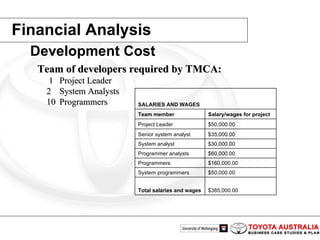
Financial Analysis Development Cost Team of developers required by TMCA: 1 Project Leader 2  System Analysts  10  Programmers $385,000.00 T otal salaries and wages $50,000.00 S ystem programmers $160,000.00 P rogrammers $60,000.00 P rogrammer analysts $30,000.00 S ystem analyst $35,000.00 Senior system analyst $50,000.00 Project Leader Salary/wages for project Team member SALARIES AND WAGES
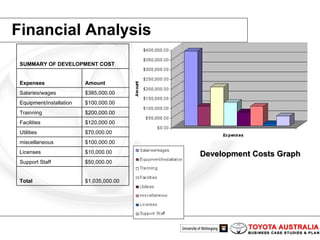
Financial Analysis Development Costs Graph $1,035,000.00 T otal  $50,000.00 Support Staff $10,000.00 Licenses $100,000.00 miscellaneous $70,000.00 Utilities $120,000.00 Facilities $200,000.00 Trainning $100,000.00 Equipment/installation $385,000.00 Salaries/wages Amount Expenses SUMMARY OF DEVELOPMENT COST
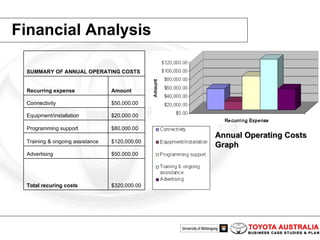
Financial Analysis Annual Operating Costs Graph $320,000.00 Total recuring costs $50,000.00 Advertising $120,000.00 Training & ongoing   assistance $80,000.00 Programming support $20,000.00 Equipment/installation $50,000.00 Connectivity Amount Recurring expense SUMMARY OF ANNUAL OPERATING COSTS
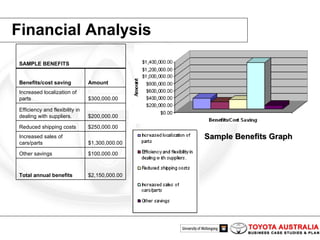
Financial Analysis Sample Benefits Graph $2,150,000.00 Total annual benefits $100,000.00 Other savings $1,300,000.00 Increased sales of cars/parts $250,000.00 Reduced shipping costs $200,000.00 Efficiency and flexibility in dealing with suppliers. $300,000.00 Increased localization of parts Amount Benefits/cost saving SAMPLE BENEFITS
Topic Outline Net Present Value &  Return of Investment
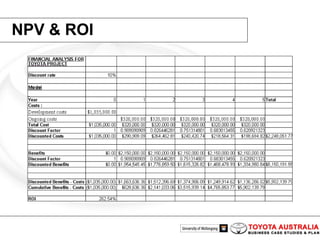
NPV & ROI
Topic Outline Financial Challenge
Financial Challenge PROJECT COST Professional constraint programmers + months of development time Significant investment amount from TMCA. THE NEED TO TRAIN INTERNAL AND EXTERNAL USERS Company staff, suppliers, customers, automotive manufacturers, etc. PROPER INFRASTRUCTURE NEEDS TO BE PROVIDED Users need to be capable of operating the system with minimal technical support Requires a significant amount of time and money Crucial to ensure project success. THE NEED TO RETAIN SYSTEM EXPERTS None of required skills currently available to develop/support the system PREPARING FOR POSSIBLE OUTCOMES  Toyota should be prepared for project failure A contingency plan fallback to other alternatives e.g. AANX.
Topic Outline Organisational Challenge
Organisational Challenge COLLABORATION WITH PROJECT TEAM IT staff to work closely with the development team  Business requirements and project goals to be met Constant communication between the development team and TMCA staff COLLABORATION WITH AUTOMOTIVE MANUFACTURERS, SUPPLIERS & CUSTOMERS Crucial requirements need to be identified -> successful solution   Effective system use by users FOSTERING NEW RELATIONSHIPS Marketplace will open up to potential customers and business partners Vertical/Horizontal industry   Requires better customer & supplier relationship management   ADVERTISING THE NEW SYSTEM Internal and external users mist be informed of new system E.g. automotive manufacturers, suppliers & customers
Organisational Challenge TRAINING USERS WITH NEW SKILLS & KNOWLEDGE TMCA Needs to provide proper training methods to both  internal  and  external users of the system; USERS: Internal staff, suppliers, manufacturers & customers. ACHIEVING GLOBAL REACH International market remains major challenge for TMCA CONVINCING TMC TO ADOPT THE SYSTEM  Pressure on TMCA for successful and reusable implementation MONOPOLY ISSUES Blackbox method Solution 4 will be an optional solution which requires careful consideration
Financial Feasibility 6 months to develop and deploy -> Complexity Benefits Shipping cost reduction; Higher percentage of parts localization; Increased profitability; increased efficiency; etc.
Topic Seminar Cost Benefit Analysis
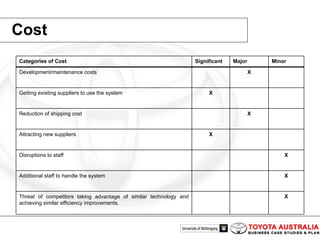
Cost X Threat of competitors taking advantage of similar technology and achieving similar efficiency improvements.  X Additional staff to handle the system X Disruptions to staff  X Attracting new suppliers X Reduction of shipping cost X Getting existing suppliers to use the system X Development/maintenance costs Minor Major  Significant Categories of Cost
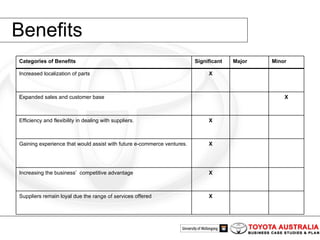
Benefits X Suppliers remain loyal due the range of services offered X Increasing the business’  competitive advantage X Gaining experience that would assist with future e-commerce ventures. X Efficiency and flexibility in dealing with suppliers. X Expanded sales and customer base X Increased localization of parts Minor Major  Significant Categories of Benefits
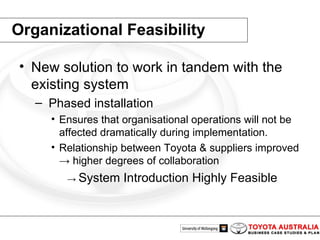
Organizational Feasibility New solution to work in tandem with the existing system Phased installation Ensures that organisational operations will not be affected dramatically during implementation. Relationship between Toyota & suppliers improved -> higher degrees of collaboration ->  System Introduction Highly Feasible
Conclusion The study is being conduct in procedural manner.  Focus on current supply chain and what the current IT setup exist Weakness were identified based on overall supply chain process Goal are set to close the current gap of inefficiency identified. Based on each goals, solutions are derived. To prove worthiness of each solution, illustrates in terms of business needs are provided.  Other factors, such as challenges and financial, have proofed feasible for these proposed solutions to be implemented.
Q & A  Session

Toyota Production System (Bussiness Case Studies & Plan)

  • 1.
  • 2.
  • 3.
    Topic Outline IntroducingToyota Australia & Her Supply Chain Management By Cong Xue
  • 4.
    History of ToyotaAustralia Toyota Motor Corporation Australia (TMCA) is a subsidiary of Toyota Motor Corporation (TMC). Toyota Australia’s origins go back to 1958. The commercial vehicle business became Thesis Toyota in 1971 In 1988, Toyota’s local operations were unified to form Toyota Motor Corporation Australia Toyota Australia currently build two models—the Camry and Avalon series.
  • 5.
    Toyota Australia CurrentBusiness Toyota Australia is the second largest vehicle manufacturer in Australia. Toyota Australia has exported over 60,000 cars to over 20 different commercial locations worldwide in 2003. Toyota is a people oriented organization that sees the development of its staff as a foundation stone for future business prosperity. Toyota has long been recognized as one of the most efficient manufacturers in the world
  • 6.
    Business Context Thebusiness context of Toyota Australia is actually link to the operating environment that consists of a number of factors. The global industry operating environment; Automotive investment trends; Policy environment; International market access; Australian industry operating environment; and Government policy environment.
  • 7.
    Toyota Australia’s supplynetwork The basic of Toyota Australia’s supply network: Supplier Association Effect of “knowledge sharing network” on supply chain coordination Upstream and downstream entities
  • 8.
    Suppliers Association Thekey to Toyota’s success would appear to be their highly effective supplier integration process that over the past 50 years has enabled the excellence of their internal “ hoshin kanri” strategic management, cross functional process based management and Toyota Production System to be shared directly with their direct suppliers.
  • 9.
    Effect of “knowledgesharing network” The effects of knowledge sharing network on the coordination of supply chain and product customization forms the basis of Toyota Production System (TPS). The aim is to have members identify themselves as part of an interdependent economic network.
  • 10.
    The Upstream problemsAfter a series of research, few critical factors were identified: Bundled outsourcing Logistic challenge Import of vehicle components
  • 11.
    Bundled Outsourcing Oneof the important characteristics of Toyota Japan suppliers system in terms of the inter-firm tasking portioning is that the outsourcing ratio is high not only in manufacturing but also in product development. There is a difference in terms assembly process and the level of hierarchy in supplier. Without bundled Outsourcing, it has first changed the internal process of the supply chain and most importantly, the number of first tier suppliers decreases and many of the suppliers ascended to the higher tiers and the hierarchy of the parts markers.
  • 12.
    Logistic Challenge Oneadvantage of localization is closer relationships facilitate collaborative problem solving. Longer supply lines required faster order processing, and this was done electronically. Essentially, electronic kanban cards were identical in function to the physical kanban cards used by Toyota in Japan.
  • 13.
    Import of VehicleComponents In the case of Toyota Australia, only 79 per cent of components are local content, with the balance relying on imports. This has been highlighted as one of the critical factors in terms of supply chain due to the fact the it affects the supply chain coordination as well as the upstream entities.
  • 14.
    Upstream Entities Atcurrent, Toyota Australia has an extensive local supplier base from its 98 component suppliers and 300 general suppliers. In general, suppliers may be broadly classified into three categories: Parts suppliers (Key component/ low assets specificity component) Raw materials suppliers Suppliers of equipment and tools
  • 15.
    Downstream Entities Ingeneral, Toyota Australia has the following downstream entities: Warehouse facilities in all major states Distributors in all major states Dealer network of over 285 outlets across Australia
  • 16.
    Internal entities Tobuild a car, the internal entities of the supply chain which includes all of the in-house processes used in transforming the inputs from the suppliers are as follows: Production of Engines (Once completed, the engines head straight for the final assembly) Pressing of steel panels and parts Welding of car shells Painting of car shells Final Assembly
  • 17.
    Topic Outline Toyota’sAustralia & Her Current IT Setup By Simon Chew
  • 18.
    Topic Outline ITSolution for Toyota Motor Corporation (TMC)
  • 19.
    IT Solution forTMC Enterprise Resource Planning System (ERP) E-Marketplace TradeMatrix system
  • 20.
    IT Solution forTMC Enterprise Resource Planning System (ERP)
  • 21.
  • 22.
    Enterprise Resource PlanningSystem One of the largest automotive companies in the world Total of 51 overseas manufacturing companies in 26 countries / locations Overseas network consisting of more than 160 importers / distributors and numerous dealers.
  • 23.
    Enterprise Resource PlanningSystem SAP Automotive ERP Suit Main means of information flow between Toyota and its counterparts worldwide. Tighter collaboration links With SAP, gain: Outstanding strategic, Operational, Financial, Marketing positions
  • 24.
    IT Solution forTMC E-Marketplace
  • 25.
    TMC E-Marketplace iStarXchange Initiative with i2 Technologies Inc. Allow subscripted members able to view a single catalogue to: view information on parts checking the prices and availability conduct transaction online forecasting supply and demand delivery cycle Improved forecasting Enhancing the planning Enhance deployment and replenishment of the inventory
  • 26.
    IT Solution forTMC TradeMatrix system
  • 27.
    TradeMatrix system Initiativewith i2 Technologies Inc Automates with equipment manufacturer and suppliers in terms of : site’s inventory management warehousing Logistic and shipping
  • 28.
    Topic Outline ITSolution for Toyota Motor Corporation Australia (TMCA)
  • 29.
    IT Solution forTMCA Main SAP Automotive suit ERP system BEA Web-logic Integration 8.1 (Integrated within the SAP automotive suit) Electronic “Kanban”-Card System Participant of iStarXchange Major Player in Australian Automotive Network eXchange (AANX)
  • 30.
    IT Solution forTMCA Main SAP Automotive Suit ERP System
  • 31.
    Main SAP AutomotiveSuit (ERP) Main means of information flow between Toyota Australia and its counterparts worldwide. Tighter collaboration links between TMCA and TMC Logistic and shipping Overall Value Chain
  • 32.
    IT Solution forTMCA BEA Web-logic Integration 8.1
  • 33.
    BEA Web-logic Integration8.1 Integrated within the SAP automotive suit Main IT Backbone of TMCA Based on Open Standard Allow connection to their numerous partners in the value chain via an assortment of systems in Australia Integrate the systems and processes that connects Toyota Australia and its trading partners
  • 34.
    BEA Web-logic Integration8.1 Functions: Electronic proof of delivery Online accounts payable status for suppliers Fleet management integration The Toyota Vehicle Order Processing System (TVOPS) Advance Shipping Notice for vehicle deliveries Vehicles inventory synchronization
  • 35.
    BEA Web-logic Integration8.1 Customised BEA Application
  • 36.
    BEA Web-logic Integration8.1 Financial management functions
  • 37.
    IT Solution forTMCA SAP vs BEA
  • 38.
  • 39.
    IT Solution forTMCA Electronic “Kanban”-Card System
  • 40.
    Electronic “Kanban”-Card System Identical in function to the physical “kanban” cards used by Toyota in Japan 4 main purpose: Sole means of requesting new parts Send for every order shipment Send to a specific supplier plant Establishing the mix and volume criteria for assessing if an order was correct
  • 41.
    Electronic “Kanban”-Card System “ Kanban”= Card (Japanese)
  • 42.
  • 43.
    IT Solution forTMCA Participant of iStarXchange
  • 44.
    Participant of iStarXchangeMain e-marketplace between TMCA and its counterparts worldwide Allow subscripted members able to view a single catalogue to: view information on parts checking the prices and availability conduct transaction online forecasting supply and demand delivery cycle Improved forecasting outside Australia Enhancing the planning outside Australia Enhance deployment and replenishment of the inventory
  • 45.
    IT Solution forTMCA Australian Automotive Network eXchange (AANX)
  • 46.
    Australian Automotive NetworkeXchange Four major car manufacturers in Australia are involved Numerous service providers and non-key suppliers Provides IP based Extranets for the automotive industry in Australia Operates as a virtual point network (VPN) Allows users to send date to each other in a reliable and secure manner
  • 47.
    Australian Automotive NetworkeXchange Main components: A network that is based on available Internet technology Operated by agreed and standardized service levels. Demonstrating proactive management of trading partner connections Practice the best standard of security and privacy for transactions and interoperability between service providers
  • 48.
    Australian Automotive NetworkeXchange Benefits includes: Pervasive supply chain communications Rapid application deployment across the supply chain Lower cost of EDI Faster Business Cycles Simpler integration into trading partners' and customers' online e-business systems and strategies
  • 49.
    Australian Automotive NetworkeXchange AANX Framework
  • 50.
    IT Solution forTMCA Problem Statement
  • 51.
    IT Solution forTMCA Weaknesses Lack of alternatives in the domestic supplier base and risk of currency exposure Problems arising in linear supply chain Over-reliance on forecast planning for production Lack of Vertical industrial relations environment
  • 52.
    IT Solution forTMCA Lack of alternatives in the domestic supplier base and risk of currency exposure
  • 53.
    IT Solution forTMCA TMCA’s supplier agreements have to be obtained with the approval of the TMC Import costs and extended time taken for components to arrive in Australia hinder TMCA’s JIT system. Currency exposure will cause too great a financial risk for TMCA Components also take longer to arrive the plant Affect on the overall production costs and time taken to produce a “locally produced” Toyota cars Lack of alternatives in the domestic supplier base and risk of currency exposure
  • 54.
    IT Solution forTMCA Problems arising in linear supply chain
  • 55.
    IT Solution forTMCA Dispersed geographical location of the TMCA supply chain infrastructure Cannot currently communicate and interact with other members further downstream No collaborate in spite of TMCA’s involvement with the AANX network Escalate problems with ongoing redundant supplier delivery expenses Problems arising in linear supply chain
  • 56.
    IT Solution forTMCA Over-reliance on forecast planning for production
  • 57.
    IT Solution forTMCA Over-reliance on forecast planning for production
  • 58.
    IT Solution forTMCA Lack of Vertical industrial relations environment
  • 59.
    IT Solution forTMCA Currently industrial relationships with automotive manufacturers in terms of sharing suppliers Current AANX network relying on the freight company to do all the logistics planning Automotive shipments require specialised vehicle transport ships Lack of Vertical industrial relations environment
  • 60.
    IT Solution forTMCA Business Goals
  • 61.
    IT Solution forTMCA Business Goals Provide a comprehensive domestic supplier base Provide initiatives for a non-linear, hub-based supply chain system Provide real-time updates on demand and supply allocation Vertical industry logistics collaboration
  • 62.
    IT Solution forTMCA Solutions Overview
  • 63.
    IT Solution forTMCA Goal 1: Provide a comprehensive domestic supplier base Solution: Implementation of a supplier website Goal 2: Provide initiatives for a non-linear, hub-based supply chain system Solution: An agent-based e-marketplace initiative . Goal 3: Provide real-time updates on demand and supply allocation Solution: Real-time tracking function module incorporated into the current electronic BEA system Goal 4: Vertical industry logistics collaboration Solution: An intelligent logistic coordinating agent in the form of a collaborative e-logistics hub.
  • 64.
    Solution 1 Solution1 Implementation of a supplier website By Joseph Baez
  • 65.
    Solution Description Goal1 – Provide a Comprehensive Domestic Supplier Base SOLUTION: Implementation of a supplier web site U.S. version of Toyota supplier web site Toyota Supplier.com www.toyotasupplier.com
  • 66.
  • 67.
    Supplier Website TMCAfocused on core competencies in high-end design engineering and system integration Toyota Australia needs highly focused core competency oriented suppliers. Small and diverse companies though have the ability to display such potential to add Innovation Flexibility and Strength to TMCA’s supply base.
  • 68.
    TMCA firsthas to open its doors to the domestic market suppliers Invest in their new concept of supply base Target: 100% domestic suppliers Supplier-centric web site Provide opportunities to expand TMCA supplier network. Supplier Website
  • 69.
    Supplier Website Figure6. Access Flow From Toyota Australia Suppliers web site
  • 70.
    Reasoning behind Goal1 – The Business Needs Many of TMCA’s car components have to be imported due to the lack of domestic suppliers Application of the “right part at the right place at the right time” concept or JIT to lack the optimal efficiency throughout the TMCA supply chain. The implementation of a comprehensive domestic supplier base is essential. Provision of collaborative web site linking current TMCA online presence which provides similar functions to the Toyota supplier’s web site currently in use in North America Allowing TMCA to have comprehensive overview of their current suppliers. Also reducing the red-tape involved to be part of the TMCA supply chain; and most importantly Provides TMCA with a channel to disseminate important supplier related information to its upstream entities . Supplier Website
  • 71.
    Web site functionsPotential suppliers will be able to acquire information on the requirements of becoming part of TMCA’s supplier network Potential suppliers need only to download/complete an online form to join the network Information such as Supplier’s guide Community activities; and Any core information about TMCA’s current supplier’s network can be obtained from the website. Connection links provided to domestic e-Marketplace Registered e-Marketplace members: Able to enjoy the privileges on what the e-Marketplace is offering To be discussed in Solution 2 New opportunities for potential suppliers as well as existing suppliers who possess the capabilities to improve TMCA’s overall supply chain process using this proposed collaborative web site. Supplier Website
  • 72.
    Solution 2 Anagent-based e-marketplace initiative
  • 73.
    Solution Description Goal2 – Provide initiatives for a non-linear, hub-based supply chain system SOLUTION: Agent-Oriented Domestic e-Marketplace
  • 74.
    Agent Oriented DomesticMarketplace Figure 7 : Logical concept of the Domestic e-Marketplace
  • 75.
    Agent Oriented DomesticMarketplace General Overview Proposed e-Marketplace functions Will be able to support a broader base of services given further growth in e-Market infrastructure Baseline interaction and directory services Specialty market services , such as: Dynamic trading ; Cooperative supply chain integration and management Enables and facilitates the relationship between business participants Suppliers and service providers; and Supporting systems
  • 76.
    Agent Oriented DomesticMarketplace Proposed e-Marketplace functions (contd.) Many-to-many relationships supported between TMCA and these business partners. Enables both TMCA and suppliers to leverage economies of scale in their trading relationships Allows access to a more liquid marketplace Further allows the use of dynamic pricing models e.g. Auctions (one of the services provided in the proposed e-marketplace) Improve the economic efficiency of the market where uncertainty about prices and demands are common.
  • 77.
    Agent Oriented DomesticMarketplace Integration with existing systems e-Marketplace architecture accommodates and supports interfaces to the existing business models of the participant entities through cooperative supply-chain integration and management To provide smooth and effective integration at the business level There is a need for well-accepted interoperability standards, which must be meshed for supply chain integration to meet business demands. e-Marketplace corresponds with the supply chain with flexibility and agility in responding to customer demand shifts without conflicts in resource utilization.
  • 78.
    Integration with existingsystems (contd.) Fundamental objective  improve coordination within and between various participant business entities in the supply-chain The increased coordination can lead to: Reduction in lead times and costs Alignment of interdependent decision-making processes Improvement in the overall performance of each participant in the chain as well as the supply chain itself. Agent Oriented Domestic Marketplace
  • 79.
    Agent Oriented DomesticMarketplace Integration with existing systems (contd.) Figure 8: Logical concept of system Integration.
  • 80.
    Agent Oriented DomesticMarketplace Agent-Oriented e-Marketplace Handles complex and non-deterministic interactions usually involved in e-Marketplace E.g. Auctions and ad-hoc service integrations Components of proposed e-Market system for TMCA will be able to change its configuration to participate in different, often simultaneous roles in e-Marketplaces. Completes tasks that would be manually impossible. e-Marketplace agents play several roles Will be able to coordinate, cooperatively or competitively, with the other agents, including HR
  • 81.
    Agent Oriented DomesticMarketplace Figure 9: The architecture of the e-Auction within the proposed e-Marketplace
  • 82.
    Agent Oriented DomesticMarketplace Agents for the proposed e-Marketplace: User interface agents support and collaborate with users in the same work environment to achieve the users’ goals Business-specific service agents Specialists that provide a collection of business-services available in the e-Marketplace Performing the functionality of a business service is typically the cooperative integration of several agents including: business-specific service agents; and market service agents Acts as a representative in the e-Marketplace for some functionality that is based on legacy applications or libraries, such as a product catalogue web site
  • 83.
    Agent Oriented DomesticMarketplace Agents for the proposed e-Marketplace (contd.) Market service agents: Specialises in providing a collection of functions for generic e-Businesses in e-Marketplace environments in which a single entity (usually an agent) can perform its tasks in the e-Marketplace. Market services (value-added and core services) are horizontal , i.e., services that are used in several business domains by several business entities. Integration service agents Also provide a collection of integration functions for a cooperative distributed system in which a single entity (agent, component, object, etc.) can perform its tasks. Used by several distributed entities . E.g. a brokering agent provides a capability-based integration service in the e-Marketplace. Another type of integration agent provides view-integration, which is a service to merge and map the description of business-objects (e.g., source schemas) in the e-Marketplace supported by the business ontology into an integrated view or schema
  • 84.
    Agent Oriented DomesticMarketplace Reasoning behind Goal 2 – The Business Needs The acquisition process of parts, materials and supplies from TMCA’s 100+ suppliers can be slow , expensive and ineffective A “milk run” system could be possible within these groups of suppliers. No coordination among suppliers have been established  Currently a missed opportunity Current electronic Kanban (card) system is the only existing mechanism for ordering supplies between TMCA and its suppliers; A linear supply chain is not able to efficiently support the JIT productions as significant collaboration among entities within the supply chain. For these reasons an agent-based e-marketplace initiative will be suitable TMCA will be able to eliminate its existing linear supply chain system to permit supplier collaboration and integration.
  • 85.
    Topic Outline Solution3 Real Time Inventory Tracking Module By Nurhazman Abdul Aziz
  • 86.
    Solution 3 :Real Time Inventory Tracking Module Why did introduce this module? GOAL 3: Provide real-time updates on demand and supply allocation Solution: Real-time tracking function module incorporated into the current electronic BEA system
  • 87.
    General Overview Acomplete modular solution, reduce the bullwhip effect which causes shifts in orders up and down the supply chain, eliminating any stockpiling cause by the current forecast method of determining the quantity of components needed for the productions.
  • 88.
    General Overview toprovide process visibility across the value chain, giving suppliers greater control over the process and ensure synchronization of information with all partners regardless of size or geographic location.
  • 89.
  • 90.
    The Real TimeInventory Tracking Module To be incorporated into the BEA system, which comprises of 4 agents Forecast Agent Inventory Agent Order Agent Multi - Tier Visibility Agent
  • 91.
    Details of theDesired Agents to be work as Forecast Agent enables suppliers to rapidly align demand and supply in the mid-to-long-term planning horizon, allowing customers and their partners to arrive at a consensus forecast or plan. provides alerts and notifications of demand supply mismatches and can support a single-phase or two-phase commit planning process. Inventory Agent enables suppliers to align demand and supply by providing visibility to inventory status levels at multiple internal and external locations, as well as in-transit positions, enabling optimal levels of inventory. allows partners to exchange key inventory-related information, such as demand-pull requests and target inventory levels can be used to track supplier compliance to contract obligations such as min/max inventory levels. exception alerts can be configured to flag any inventory-level violations.
  • 92.
    Details of theDesired Agents to be work as Order Agent enables suppliers to manage and track the entire purchase order lifecycle through TMCA’s supply process. Suppliers can manage and track, in real-time, the complete end-to-end process for discrete, replenishment, demand pull and/or blanket purchase orders from order creation through shipment, receipt, invoicing and payment. Multi-Tier Visibility Module allows TMCA to extend their demand/supply planning, order management and inventory management workflows beyond their first-tier partners to provide visibility to the processes executed between tier two, three and four partners. allows to monitor demand/supply disconnects and exceptions throughout the extended supply chain, providing tools to help identify the impact of problems identified multiple tiers away.
  • 93.
    A Suitable ScenarioThe interest of this system is focused on a complete solution to provide a real-time updates on the demand and supply allocation. one of the distributors of TMCA has just received an order of purchase of a locally made Toyota Camry. logs the order into the current BEA system, the information will immediately be sent Toyota Vehicle Order Processing System (TVOPS). the real-time inventory module will acquire the new order information and be analysed. sent to the respective suppliers to be updated onto their own system. With such message flow, suppliers can get their supply ready for the next delivery to meet the JIT production in the shortest possible time needed.
  • 94.
    Topic Outline Solution4 An agent-based transport and logistics coordination system
  • 95.
    Solution 4 Anagent-based transport and logistics coordination system Why did introduce this module? Goal 4: Vertical industry logistics collaboration Solution: An intelligent logistic coordinating agent in the form of a collaborative e-logistics hub.
  • 96.
    General Overview Anagent-based transport and logistics coordination system (collaborative e-market), are designed to accomplish transport and logistic coordination tasks among different automotive manufacturers in Australia. Consist of 4 generic roles agents in supply chain: Distribution Hub Agent Logistics Coordinator Agent, Manufacturer Agent Transporter Agent.
  • 97.
    Framework for agentbased supply chain coordination The Distribution Centers of individual automotive manufacturers will send their distribution requirement (DRP) to a Logistics Coordinator who will transform the DRP into transport and manufacturing requirements. These requirements will be broadcast to the available transporters and manufacturer’s plants so that they could work on their bids. After the bids are received, the logistics coordinator will work on a global optimized solution before committing the distribution centers.
  • 98.
    Logistic Optimisation withinAustralia How does the logistics optimisation works within Australia: Based on ordered demand established, the Distribution Hub Agent calculates the distribution requirements. pass the DRP to the Logistics Coordinator Agent by pre-defined data interface. logistics coordinator splits the requirement into manufacturing and transportation requirements. Logistics Coordinator Agent divides the distribution requirements based on a historical knowledge base. In this database, the records show for a product, how long it will take for the Manufacturing Plants to produce a specific quantity, and how long it will take for the Transporters to deliver as shown in Table next
  • 99.
    Logistic Optimisation withinAustralia In the first round of coordination, the “Price” afforded by the Distribution Center is not given to the Manufacturing Plants and the Transporters. Instead, the Logistics Coordinator waits for the service providers to bid with price.
  • 100.
    Logistic Optimisation withinAustralia The Transporter Agents perform local optimization using their own data on routes, schedules and consignments. The Manufacturer Agents will perform local optimization using data on inventory, capacity and processing times. The results of the optimization will be transferred to the Logistics Coordinator Agent for global optimization.
  • 101.
    Global Optimisation Afterthe Manufacturer and Transporter Agents finish local optimization process, they will commit the orders back to the Logistics Coordinator Agent. to combine the respective commitments to produce joint commitments by summing up price and lead times (for Q1, Q2 and Q3 respectively)
  • 102.
    Global Optimisation Theoptimization searching process is to find the optimal point (see Figure 12) which with acceptable difference with that of the customer requirement (with quantity, price and due date). If the point identified is still not acceptable, a boundary box will be defined around the optimal point to set the lower and upper limits so that a second round of bidding can be done. This process will be repeated until the solution converges.
  • 103.
    A Suitable ScenarioThe interest of this system is focused on improving the current logistic demand to provide customers with the fastest delivery of their vehicles. wish to send 20 cars to a country. not feasible for TMCA to ship the cars. With the system, TMCA invites other automotive manufacturers to join collaborative e-logistic marketplace. individual automotive manufacturers will submit their orders to the e-marketplace. Together with the shipping information provided by the freight companies, the system will conduct an optimization searching process based on manufacturer’s requirements (quantity, designation, price and due-date) and the shipping details until the search has reached a optimal point when is feasible for the shipment to be made to the country or even nearby ports with the least time needed for the vehicles to arrive to their final designations.
  • 104.
    Integrating the foursolutions in a big solutions
  • 105.
    Integrating is madepossible In order to overcome the weaknesses as previously identified, the team have provide with individual solution to address each weakness. the proposed solutions are based on open standards means that is inherently easy to modify. designed to be flexible, allows the stakeholders to decide on which system is to be integrated and which system to be run alone. Additionally, exposing functionality and data as services across the enterprise also helps TMCA reduce overhead by eliminating the need for infrastructure duplication. the messaging-oriented nature of these solutions enables the team to link sales, marketing, manufacturing, and financial applications in real-time, which improves customer service by making up-to-the-minute information accessible across our value chain. Therefore, the team strongly suggests the implementation of the integrated solution.
  • 106.
    Topic Outline FinancialAnalysis By Loh How Whay
  • 107.
    Financial Analysis IncreasedROI on Existing System Toyota’s WebLogic platform WebLogic development environment is built on the standards-based Java 2 Enterprise Edition (J2EE) platform
  • 108.
    Financial Analysis DevelopmentCost Team of developers required by TMCA: 1 Project Leader 2 System Analysts 10 Programmers $385,000.00 T otal salaries and wages $50,000.00 S ystem programmers $160,000.00 P rogrammers $60,000.00 P rogrammer analysts $30,000.00 S ystem analyst $35,000.00 Senior system analyst $50,000.00 Project Leader Salary/wages for project Team member SALARIES AND WAGES
  • 109.
    Financial Analysis DevelopmentCosts Graph $1,035,000.00 T otal $50,000.00 Support Staff $10,000.00 Licenses $100,000.00 miscellaneous $70,000.00 Utilities $120,000.00 Facilities $200,000.00 Trainning $100,000.00 Equipment/installation $385,000.00 Salaries/wages Amount Expenses SUMMARY OF DEVELOPMENT COST
  • 110.
    Financial Analysis AnnualOperating Costs Graph $320,000.00 Total recuring costs $50,000.00 Advertising $120,000.00 Training & ongoing assistance $80,000.00 Programming support $20,000.00 Equipment/installation $50,000.00 Connectivity Amount Recurring expense SUMMARY OF ANNUAL OPERATING COSTS
  • 111.
    Financial Analysis SampleBenefits Graph $2,150,000.00 Total annual benefits $100,000.00 Other savings $1,300,000.00 Increased sales of cars/parts $250,000.00 Reduced shipping costs $200,000.00 Efficiency and flexibility in dealing with suppliers. $300,000.00 Increased localization of parts Amount Benefits/cost saving SAMPLE BENEFITS
  • 112.
    Topic Outline NetPresent Value & Return of Investment
  • 113.
  • 114.
  • 115.
    Financial Challenge PROJECTCOST Professional constraint programmers + months of development time Significant investment amount from TMCA. THE NEED TO TRAIN INTERNAL AND EXTERNAL USERS Company staff, suppliers, customers, automotive manufacturers, etc. PROPER INFRASTRUCTURE NEEDS TO BE PROVIDED Users need to be capable of operating the system with minimal technical support Requires a significant amount of time and money Crucial to ensure project success. THE NEED TO RETAIN SYSTEM EXPERTS None of required skills currently available to develop/support the system PREPARING FOR POSSIBLE OUTCOMES Toyota should be prepared for project failure A contingency plan fallback to other alternatives e.g. AANX.
  • 116.
  • 117.
    Organisational Challenge COLLABORATIONWITH PROJECT TEAM IT staff to work closely with the development team Business requirements and project goals to be met Constant communication between the development team and TMCA staff COLLABORATION WITH AUTOMOTIVE MANUFACTURERS, SUPPLIERS & CUSTOMERS Crucial requirements need to be identified -> successful solution Effective system use by users FOSTERING NEW RELATIONSHIPS Marketplace will open up to potential customers and business partners Vertical/Horizontal industry Requires better customer & supplier relationship management ADVERTISING THE NEW SYSTEM Internal and external users mist be informed of new system E.g. automotive manufacturers, suppliers & customers
  • 118.
    Organisational Challenge TRAININGUSERS WITH NEW SKILLS & KNOWLEDGE TMCA Needs to provide proper training methods to both internal and external users of the system; USERS: Internal staff, suppliers, manufacturers & customers. ACHIEVING GLOBAL REACH International market remains major challenge for TMCA CONVINCING TMC TO ADOPT THE SYSTEM Pressure on TMCA for successful and reusable implementation MONOPOLY ISSUES Blackbox method Solution 4 will be an optional solution which requires careful consideration
  • 119.
    Financial Feasibility 6months to develop and deploy -> Complexity Benefits Shipping cost reduction; Higher percentage of parts localization; Increased profitability; increased efficiency; etc.
  • 120.
    Topic Seminar CostBenefit Analysis
  • 121.
    Cost X Threatof competitors taking advantage of similar technology and achieving similar efficiency improvements. X Additional staff to handle the system X Disruptions to staff X Attracting new suppliers X Reduction of shipping cost X Getting existing suppliers to use the system X Development/maintenance costs Minor Major Significant Categories of Cost
  • 122.
    Benefits X Suppliersremain loyal due the range of services offered X Increasing the business’ competitive advantage X Gaining experience that would assist with future e-commerce ventures. X Efficiency and flexibility in dealing with suppliers. X Expanded sales and customer base X Increased localization of parts Minor Major Significant Categories of Benefits
  • 123.
    Organizational Feasibility Newsolution to work in tandem with the existing system Phased installation Ensures that organisational operations will not be affected dramatically during implementation. Relationship between Toyota & suppliers improved -> higher degrees of collaboration -> System Introduction Highly Feasible
  • 124.
    Conclusion The studyis being conduct in procedural manner. Focus on current supply chain and what the current IT setup exist Weakness were identified based on overall supply chain process Goal are set to close the current gap of inefficiency identified. Based on each goals, solutions are derived. To prove worthiness of each solution, illustrates in terms of business needs are provided. Other factors, such as challenges and financial, have proofed feasible for these proposed solutions to be implemented.
  • 125.
    Q & A Session