Agricultural Production 
Value Chain
What value chain is all about? 
A ‘value chain’ in agriculture 
describes the range of activities and 
set of actors that bring agricultural 
product from production in the field 
to final consumption, wherein at 
each stage value is added to the 
product.
What value chain is all about? 
The production stages entail a 
combination of physical 
transformation and the 
participation of various 
producers and services up to 
product’s disposal after use.
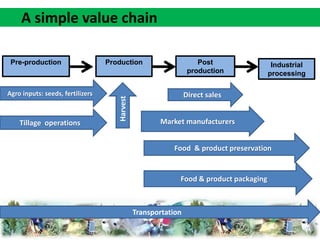
A simple value chain 
Pre-production Post 
Production Industrial 
production 
processing 
Agro inputs: seeds, fertilizers 
Tillage operations 
Harvest 
Direct sales 
Market manufacturers 
Food & product preservation 
Food & product packaging 
Transportation
What is value chain Analysis? 
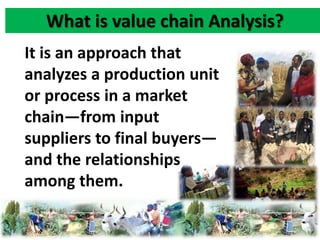
It is an approach that 
analyzes a production unit 
or process in a market 
chain—from input 
suppliers to final buyers— 
and the relationships 
among them.
What is value chain Analysis 2 
• It analyzes the factors influencing 
performance, including access to 
and the requirements of end 
markets; the legal, regulatory and 
policy environment; coordination 
between firms in the industry; 
and the level and quality of 
support services.
Usefulness of Value chain analyses 
Value chain analysis is a useful 
analytical tool that helps 
understand overall trends of 
industrial reorganization and 
identify change agents and 
leverage points for policy and 
technical interventions.
Usefulness of Value chain analyses 
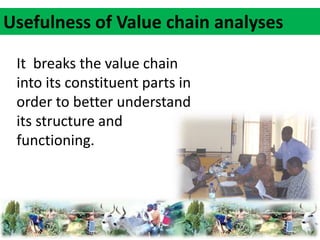
It breaks the value chain 
into its constituent parts in 
order to better understand 
its structure and 
functioning.
Usefulness of Value chain analyses 
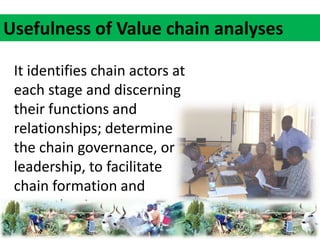
It identifies chain actors at 
each stage and discerning 
their functions and 
relationships; determine 
the chain governance, or 
leadership, to facilitate 
chain formation and 
strengthening
Usefulness of Value chain analyses 
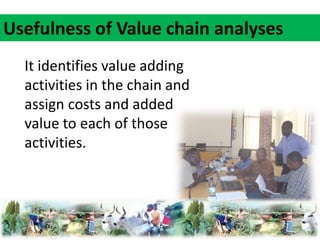
It identifies value adding 
activities in the chain and 
assign costs and added 
value to each of those 
activities.
Usefulness of Value chain analyses 
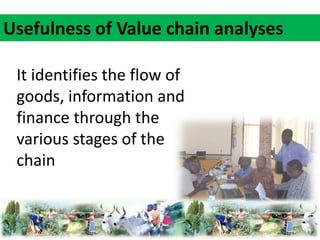
It identifies the flow of 
goods, information and 
finance through the 
various stages of the 
chain
Usefulness of Value chain analyses 
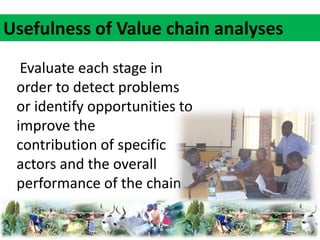
Evaluate each stage in 
order to detect problems 
or identify opportunities to 
improve the 
contribution of specific 
actors and the overall 
performance of the chain
Tools used in value chain analysis 
• There are no fixed rules as to how value chain 
analysis should be carried out 
• A range of qualitative and/or quantitative 
research tools are available 
– Participant observation 
– Semi-structured interviews 
– Focus group meetings 
– Structured Questionnaire 
– Market Mapping
Steps used in Value chain analysis 
• Activity Analysis 
• Value Analysis 
• Evaluation and Planning
Steps used in Value chain analysis 
• Step 1 – Activity Analysis 
–Brainstorm the activities that you, your 
team or your company undertakes that 
in some way contribute towards your 
customer's experience. 
–Identify step-by-step flow of work that 
you or your team carry out
Steps used in Value chain analysis 
• Step 2 – Value Analysis 
– For each activity you've identified, list the 
"Value Factors" – the things that your 
customers' value in the way that each activity 
is conducted 
–Write down these Value Factors. 
–Write down what needs to be done or 
changed to provide great value for each Value 
Factor.
Steps used in Value chain analysis 
• Step 3 – Evaluate Changes and Plan for 
Action 
–Pick out the quick, easy, cheap wins 
–Screen the more difficult changes 
–Prioritize the remaining tasks and plan 
to tackle them in an achievable way
Activities: Pre-Production 
• Set of activities carried out by other 
practitioners outside the farmers that 
contribute to effective production of 
agricultural commodities. 
– Research 
– Extension 
– Land policies 
– Infrastructures 
– Etc.
Activities: Production 
• All the activities of the farmers that lead to effective 
cultivation of crops, husbandry of livestock to yield 
the different commodities. 
– Tillage 
– Planting 
– Agronomic /husbandry practices 
– Harvesting 
– Post harvest practices 
o Factors Affecting Production efficiencies. 
o How can balanced value be accorded to the 
primary producer in the agricultural value chain?
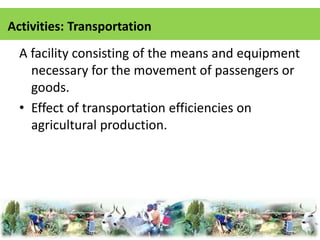
Activities: Transportation 
A facility consisting of the means and equipment 
necessary for the movement of passengers or 
goods. 
• Effect of transportation efficiencies on 
agricultural production.
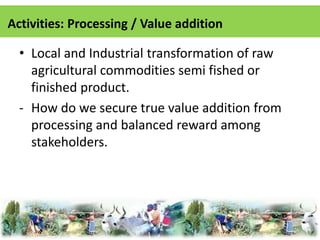
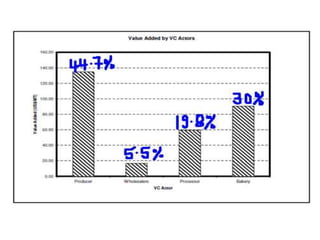
Activities: Processing / Value addition 
• Local and Industrial transformation of raw 
agricultural commodities semi fished or 
finished product. 
- How do we secure true value addition from 
processing and balanced reward among 
stakeholders.
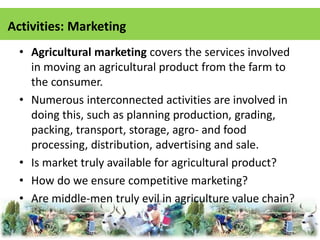
Activities: Marketing 
• Agricultural marketing covers the services involved 
in moving an agricultural product from the farm to 
the consumer. 
• Numerous interconnected activities are involved in 
doing this, such as planning production, grading, 
packing, transport, storage, agro- and food 
processing, distribution, advertising and sale. 
• Is market truly available for agricultural product? 
• How do we ensure competitive marketing? 
• Are middle-men truly evil in agriculture value chain?
Summary 
• Understanding the agricultural value chain is vital to 
the development of the sector. 
• Quantification of the value addition along the chain is 
vital to equitable sharing of benefits among the 
stakeholders. 
• Efficiency lag can easily be removed with good 
appreciation of the value chain.

Agricultural value chain analysis

  • 1.
  • 2.
    What value chainis all about? A ‘value chain’ in agriculture describes the range of activities and set of actors that bring agricultural product from production in the field to final consumption, wherein at each stage value is added to the product.
  • 3.
    What value chainis all about? The production stages entail a combination of physical transformation and the participation of various producers and services up to product’s disposal after use.
  • 4.
    A simple valuechain Pre-production Post Production Industrial production processing Agro inputs: seeds, fertilizers Tillage operations Harvest Direct sales Market manufacturers Food & product preservation Food & product packaging Transportation
  • 5.
    What is valuechain Analysis? It is an approach that analyzes a production unit or process in a market chain—from input suppliers to final buyers— and the relationships among them.
  • 6.
    What is valuechain Analysis 2 • It analyzes the factors influencing performance, including access to and the requirements of end markets; the legal, regulatory and policy environment; coordination between firms in the industry; and the level and quality of support services.
  • 7.
    Usefulness of Valuechain analyses Value chain analysis is a useful analytical tool that helps understand overall trends of industrial reorganization and identify change agents and leverage points for policy and technical interventions.
  • 8.
    Usefulness of Valuechain analyses It breaks the value chain into its constituent parts in order to better understand its structure and functioning.
  • 9.
    Usefulness of Valuechain analyses It identifies chain actors at each stage and discerning their functions and relationships; determine the chain governance, or leadership, to facilitate chain formation and strengthening
  • 10.
    Usefulness of Valuechain analyses It identifies value adding activities in the chain and assign costs and added value to each of those activities.
  • 11.
    Usefulness of Valuechain analyses It identifies the flow of goods, information and finance through the various stages of the chain
  • 12.
    Usefulness of Valuechain analyses Evaluate each stage in order to detect problems or identify opportunities to improve the contribution of specific actors and the overall performance of the chain
  • 13.
    Tools used invalue chain analysis • There are no fixed rules as to how value chain analysis should be carried out • A range of qualitative and/or quantitative research tools are available – Participant observation – Semi-structured interviews – Focus group meetings – Structured Questionnaire – Market Mapping
  • 14.
    Steps used inValue chain analysis • Activity Analysis • Value Analysis • Evaluation and Planning
  • 15.
    Steps used inValue chain analysis • Step 1 – Activity Analysis –Brainstorm the activities that you, your team or your company undertakes that in some way contribute towards your customer's experience. –Identify step-by-step flow of work that you or your team carry out
  • 16.
    Steps used inValue chain analysis • Step 2 – Value Analysis – For each activity you've identified, list the "Value Factors" – the things that your customers' value in the way that each activity is conducted –Write down these Value Factors. –Write down what needs to be done or changed to provide great value for each Value Factor.
  • 17.
    Steps used inValue chain analysis • Step 3 – Evaluate Changes and Plan for Action –Pick out the quick, easy, cheap wins –Screen the more difficult changes –Prioritize the remaining tasks and plan to tackle them in an achievable way
  • 18.
    Activities: Pre-Production •Set of activities carried out by other practitioners outside the farmers that contribute to effective production of agricultural commodities. – Research – Extension – Land policies – Infrastructures – Etc.
  • 19.
    Activities: Production •All the activities of the farmers that lead to effective cultivation of crops, husbandry of livestock to yield the different commodities. – Tillage – Planting – Agronomic /husbandry practices – Harvesting – Post harvest practices o Factors Affecting Production efficiencies. o How can balanced value be accorded to the primary producer in the agricultural value chain?
  • 20.
    Activities: Transportation Afacility consisting of the means and equipment necessary for the movement of passengers or goods. • Effect of transportation efficiencies on agricultural production.
  • 21.
    Activities: Processing /Value addition • Local and Industrial transformation of raw agricultural commodities semi fished or finished product. - How do we secure true value addition from processing and balanced reward among stakeholders.
  • 23.
    Activities: Marketing •Agricultural marketing covers the services involved in moving an agricultural product from the farm to the consumer. • Numerous interconnected activities are involved in doing this, such as planning production, grading, packing, transport, storage, agro- and food processing, distribution, advertising and sale. • Is market truly available for agricultural product? • How do we ensure competitive marketing? • Are middle-men truly evil in agriculture value chain?
  • 24.
    Summary • Understandingthe agricultural value chain is vital to the development of the sector. • Quantification of the value addition along the chain is vital to equitable sharing of benefits among the stakeholders. • Efficiency lag can easily be removed with good appreciation of the value chain.