Sujith Jayawardhane
Zaryab Haider
Mohammad Habib
Mahmoud Kamal
Jerrym Jose
Hassan Wali
Mostafa Ahmed
Eslam Salah
Samsung – Next Is Now
• One of the world’s leading providers of digital
convergence technologies and digital media.
• Founded in 1938 by Lee Byung-Chull as a trading
company.
• Headquartered in Seoul, South Korea; operates in 80
countries with over 307,000 Employee’s Aprox
• Increased globalization of activities since 1990 with
mobiles and semiconductors becoming major source of
income.
• Strong brand equity and involvement in CSR (Corporate
Social Responsibility) business activity, which initiates
to benefit the society.
• Diversified product portfolio with constant focus on
Research & Development.
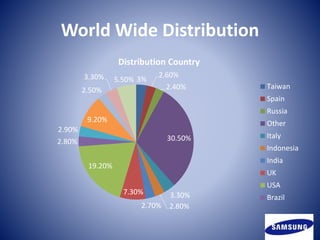
World Wide Distribution
3%
2.60%
2.40%
30.50%
3.30%
2.80%2.70%
7.30%
19.20%
2.80%
2.90%
9.20%
2.50%
3.30% 5.50%
Distribution Country
Taiwan
Spain
Russia
Other
Italy
Indonesia
India
UK
USA
Brazil
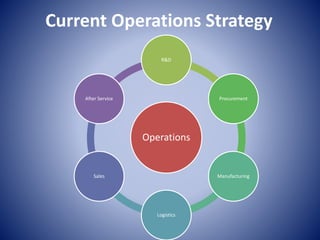
Operations
R&D
Procurement
Manufacturing
Logistics
Sales
After Service
Current Operations Strategy
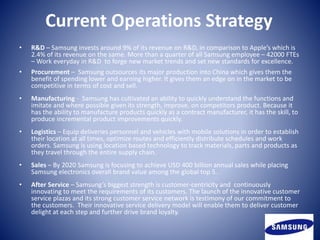
• R&D – Samsung invests around 9% of its revenue on R&D, in comparison to Apple’s which is
2.4% of its revenue on the same. More than a quarter of all Samsung employee – 42000 FTEs
– Work everyday in R&D to forge new market trends and set new standards for excellence.
• Procurement – Samsung outsources its major production into China which gives them the
benefit of spending lower and earning higher. It gives them an edge on in the market to be
competitive in terms of cost and sell.
• Manufacturing - Samsung has cultivated an ability to quickly understand the functions and
imitate and where possible given its strength, improve, on competitors product. Because it
has the ability to manufacture products quickly as a contract manufacturer, it has the skill, to
produce incremental product improvements quickly.
• Logistics – Equip deliveries personnel and vehicles with mobile solutions in order to establish
their location at all times, optimize routes and efficiently distribute schedules and work
orders. Samsung is using location based technology to track materials, parts and products as
they travel through the entire supply chain.
• Sales – By 2020 Samsung is focusing to achieve USD 400 billion annual sales while placing
Samsung electronics overall brand value among the global top 5.
• After Service – Samsung’s biggest strength is customer-centricity and continuously
innovating to meet the requirements of its customers. The launch of the innovative customer
service plazas and its strong customer service network is testimony of our commitment to
the customers. Their innovative service delivery model will enable them to deliver customer
delight at each step and further drive brand loyalty.
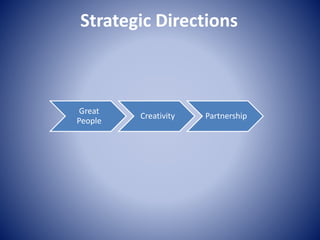
Great
People
Creativity Partnership
Strategic Directions
Effectiveness of Current Strategy
• Samsung enjoyed phenomenal success with the S2, S3 & S4 but the S5 & S6
did not match expectations and as a result, their market share was affected in
2015.
• Could not keep up at the high-end of the market after the arrival of iPhone 6
and 6 Plus. Suffered at the low-end too at the hands of upstart Chinese
manufacturers like Xiaomi and OnePlus.
• Robust demand for memory chips with an increase in profitability.
Recommendations - The future
• Focus less on variety, more on quality
• Strengthen its technology with regard to
software and features
• Launch sub-brands to the company with new
and improved strategies
• Expand the number of stores to establish
footprint on a wider horizon
• Step ahead of competitors in terms of
innovation and unique functions
Tools to improve operational
efficiency
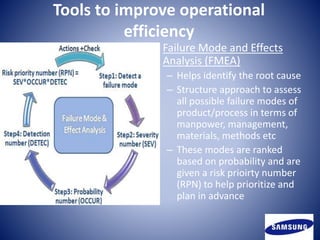
• Failure Mode and Effects
Analysis (FMEA)
– Helps identify the root cause
– Structure approach to assess
all possible failure modes of
product/process in terms of
manpower, management,
materials, methods etc
– These modes are ranked
based on probability and are
given a risk prioirty number
(RPN) to help prioritize and
plan in advance
Tools to improve operational
efficiency
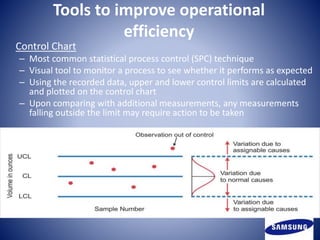
Control Chart
– Most common statistical process control (SPC) technique
– Visual tool to monitor a process to see whether it performs as expected
– Using the recorded data, upper and lower control limits are calculated
and plotted on the control chart
– Upon comparing with additional measurements, any measurements
falling outside the limit may require action to be taken
Scope for future sustainability
• Create their own software and reduce
outsourcing
• Expand the memory chip division as it
maintains the firm at an advantage
• Innovative product design along with value
added features
• Lead rather than follow competitors
• Enter newly emerging markets like Bangladesh
& Africa.
Samsung - Operations Strategy

Samsung - Operations Strategy

  • 1.
    Sujith Jayawardhane Zaryab Haider MohammadHabib Mahmoud Kamal Jerrym Jose Hassan Wali Mostafa Ahmed Eslam Salah
  • 2.
    Samsung – NextIs Now • One of the world’s leading providers of digital convergence technologies and digital media. • Founded in 1938 by Lee Byung-Chull as a trading company. • Headquartered in Seoul, South Korea; operates in 80 countries with over 307,000 Employee’s Aprox • Increased globalization of activities since 1990 with mobiles and semiconductors becoming major source of income. • Strong brand equity and involvement in CSR (Corporate Social Responsibility) business activity, which initiates to benefit the society. • Diversified product portfolio with constant focus on Research & Development.
  • 3.
    World Wide Distribution 3% 2.60% 2.40% 30.50% 3.30% 2.80%2.70% 7.30% 19.20% 2.80% 2.90% 9.20% 2.50% 3.30%5.50% Distribution Country Taiwan Spain Russia Other Italy Indonesia India UK USA Brazil
  • 4.
  • 5.
    Current Operations Strategy •R&D – Samsung invests around 9% of its revenue on R&D, in comparison to Apple’s which is 2.4% of its revenue on the same. More than a quarter of all Samsung employee – 42000 FTEs – Work everyday in R&D to forge new market trends and set new standards for excellence. • Procurement – Samsung outsources its major production into China which gives them the benefit of spending lower and earning higher. It gives them an edge on in the market to be competitive in terms of cost and sell. • Manufacturing - Samsung has cultivated an ability to quickly understand the functions and imitate and where possible given its strength, improve, on competitors product. Because it has the ability to manufacture products quickly as a contract manufacturer, it has the skill, to produce incremental product improvements quickly. • Logistics – Equip deliveries personnel and vehicles with mobile solutions in order to establish their location at all times, optimize routes and efficiently distribute schedules and work orders. Samsung is using location based technology to track materials, parts and products as they travel through the entire supply chain. • Sales – By 2020 Samsung is focusing to achieve USD 400 billion annual sales while placing Samsung electronics overall brand value among the global top 5. • After Service – Samsung’s biggest strength is customer-centricity and continuously innovating to meet the requirements of its customers. The launch of the innovative customer service plazas and its strong customer service network is testimony of our commitment to the customers. Their innovative service delivery model will enable them to deliver customer delight at each step and further drive brand loyalty.
  • 6.
  • 7.
    Effectiveness of CurrentStrategy • Samsung enjoyed phenomenal success with the S2, S3 & S4 but the S5 & S6 did not match expectations and as a result, their market share was affected in 2015. • Could not keep up at the high-end of the market after the arrival of iPhone 6 and 6 Plus. Suffered at the low-end too at the hands of upstart Chinese manufacturers like Xiaomi and OnePlus. • Robust demand for memory chips with an increase in profitability.
  • 8.
    Recommendations - Thefuture • Focus less on variety, more on quality • Strengthen its technology with regard to software and features • Launch sub-brands to the company with new and improved strategies • Expand the number of stores to establish footprint on a wider horizon • Step ahead of competitors in terms of innovation and unique functions
  • 9.
    Tools to improveoperational efficiency • Failure Mode and Effects Analysis (FMEA) – Helps identify the root cause – Structure approach to assess all possible failure modes of product/process in terms of manpower, management, materials, methods etc – These modes are ranked based on probability and are given a risk prioirty number (RPN) to help prioritize and plan in advance
  • 10.
    Tools to improveoperational efficiency Control Chart – Most common statistical process control (SPC) technique – Visual tool to monitor a process to see whether it performs as expected – Using the recorded data, upper and lower control limits are calculated and plotted on the control chart – Upon comparing with additional measurements, any measurements falling outside the limit may require action to be taken
  • 11.
    Scope for futuresustainability • Create their own software and reduce outsourcing • Expand the memory chip division as it maintains the firm at an advantage • Innovative product design along with value added features • Lead rather than follow competitors • Enter newly emerging markets like Bangladesh & Africa.