Tesla: A Comprehensive Strategic
Analysis
By: Herb Benson, Robert Korn, Samantha Nettnin, and Kevin Peterson
Tesla Motors (TSLA) History
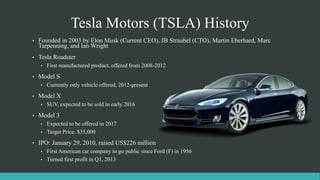
• Founded in 2003 by Elon Musk (Current CEO), JB Straubel (CTO), Martin Eberhard, Marc
Tarpenning, and Ian Wright
• Tesla Roadster
• First manufactured product, offered from 2008-2012
• Model S
• Currently only vehicle offered, 2012-present
• Model X
• SUV, expected to be sold in early 2016
• Model 3
• Expected to be offered in 2017
• Target Price: $35,000
• IPO: January 29, 2010, raised US$226 million
• First American car company to go public since Ford (F) in 1956
• Turned first profit in Q1, 2013
Mission and Vision
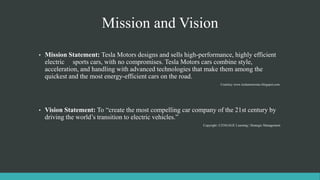
• Mission Statement: Tesla Motors designs and sells high-performance, highly efficient
electric sports cars, with no compromises. Tesla Motors cars combine style,
acceleration, and handling with advanced technologies that make them among the
quickest and the most energy-efficient cars on the road.
Courtesy www.teslamotorsinc.blogspot.com
• Vision Statement: To “create the most compelling car company of the 21st century by
driving the world’s transition to electric vehicles.”
Copyright | CENGAGE Learning | Strategic Management
General Environment Analysis
Segment Elements Industry Effect
Political/Legal • Regulations on Emissions and Safety Standards
• National Traffic and Motor Vehicle Safety Act, 1966
• Energy Policy and Conservation Act, 1975
Neutral
Technology • Higher demand for reliable, fuel efficient vehicles
• Alternate fuel vehicles (Ethanol, Biodiesel, Hydrogen Fuel
Cells)
• Online shopping/research
Positive
Sociocultural • Luxury vs. Economy Vehicles
• Power vs. Fuel Efficiency
Positive
Industry Analysis
Force Description Influence on Industry
Threat of New Entrants • Mature Industry has reached Economies of
Scale
• High Initial Capital Requirements
• Difficult Access to Distribution Channels
Low
Bargaining Power of
Buyers
• Private and Commercial buyers account for
majority of revenue
• Low Switching Costs
• Buyers are unable to integrate backwards
Moderately High
Intensity of Rivalry
Among Competitors
• Gaining Market Share means Reducing
Market Share of Competitor
• Few Opportunities for Differentiation
High
Type of Firm Description Industry Attractiveness
New Entrants High Startup Costs, Legal Fees, Intense Competition Very Unattractive
Incumbent High Liquid Assets, Distribution, Holding Costs Moderate
Integrated SWOT Analysis
• Strengths
• Brand Equity
• Product Quality
• Eco-friendly Product Line
• Enhanced Opportunities
• Increase Market Share through High-Growth EV Industry
• Limited Threats
• Consumers Deterred due to “Range-Anxiety”
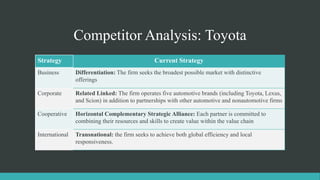
Competitor Analysis: Toyota
Strategy Current Strategy
Business Differentiation: The firm seeks the broadest possible market with distinctive
offerings
Corporate Related Linked: The firm operates five automotive brands (including Toyota, Lexus,
and Scion) in addition to partnerships with other automotive and nonautomotive firms
Cooperative Horizontal Complementary Strategic Alliance: Each partner is committed to
combining their resources and skills to create value within the value chain
International Transnational: the firm seeks to achieve both global efficiency and local
responsiveness.
Competitor Analysis: General Motors
Strategy Current Strategy
Business Differentiation: The firm seeks the broadest possible market with distinctive
offerings
Corporate Related Linked: The firm operates thirteen brands (including Chevrolet, Buick and
Cadillac) in addition to partnerships with other automotive and nonautomotive firms.
Cooperative Horizontal Complementary Strategic Alliance: Each partner is committed to
combining their resources and skills to create value within the value chain
International Transnational: The firm seeks to achieve both global efficiency and local
responsiveness.
Competitor Analysis: Conclusions
• Strategic Competitive Advantages
• Toyota
• Market Power
• Capital Resources
• Just-in-Time (JIT) Inventory Management
System
• General Motors
• Capital Resources
• Diverse Product Offering
• First to Offer New Technology
• Chevrolet Volt, Wi-Fi in cars
• Future Industry Assumptions
• Culture shift towards energy efficient
and renewable energy
• Eco-Friendly companies will have more
long term success
• Future Major Objectives
• “Greening”
• Product Lines
• Supply-Chain Networks
• Operations
• Marketing Messages
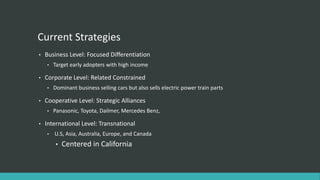
Current Strategies
• Business Level: Focused Differentiation
• Target early adopters with high income
• Corporate Level: Related Constrained
• Dominant business selling cars but also sells electric power train parts
• Cooperative Level: Strategic Alliances
• Panasonic, Toyota, Dailmer, Mercedes Benz,
• International Level: Transnational
• U.S, Asia, Australia, Europe, and Canada
• Centered in California
Value Chain Comparison
Toyota General Motors
Marketing Superior Superior
Distribution Inferior Inferior
Important Financial and Nonfinancial Data
Tesla Toyota General Motors
Earnings Per Share -$2.36 $10.67 $1.64
ROE -10.81% 14.8% 7.5%
Net Income -$294,000,000 $19,891,000,000 $3,949,000,000
Long-Term Debt to
Capitalization Ratio
55.5% 2.8% 18.4%
Revenue $3,198,000,000 $256,585,000,000 $155,929,000,000
Important Nonfinancial Factor: Culture
VRIN Analysis: Batteries
Valuable
Yes
Rare
Yes
Inimitable
Yes
Nonsubstitutable
Yes
Result: Sustainable Competitive Advantage
Strategic Issues
• Small company
• Limited capital
• Niche market
• Charger network
• Range concerns
• Lithium-ion batteries
• Distribution network
Distribution Network
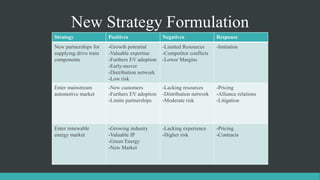
New Strategy Formulation
Strategy Positives Negatives Response
New Strategy Formulation
Strategy Positives Negatives Response
New partnerships for
supplying drive train
components
-Growth potential
-Valuable expertise
-Furthers EV adoption
-Early-mover
-Distribution network
-Low risk
-Limited Resources
-Competitor conflicts
-Lower Margins
-Imitation
New Strategy Formulation
Strategy Positives Negatives Response
New partnerships for
supplying drive train
components
-Growth potential
-Valuable expertise
-Furthers EV adoption
-Early-mover
-Distribution network
-Low risk
-Limited Resources
-Competitor conflicts
-Lower Margins
-Imitation
Enter mainstream
automotive market
-New customers
-Furthers EV adoption
-Limits partnerships
-Lacking resources
-Distribution network
-Moderate risk
-Pricing
-Alliance relations
-Litigation
New Strategy Formulation
Strategy Positives Negatives Response
New partnerships for
supplying drive train
components
-Growth potential
-Valuable expertise
-Furthers EV adoption
-Early-mover
-Distribution network
-Low risk
-Limited Resources
-Competitor conflicts
-Lower Margins
-Imitation
Enter mainstream
automotive market
-New customers
-Furthers EV adoption
-Limits partnerships
-Lacking resources
-Distribution network
-Moderate risk
-Pricing
-Alliance relations
-Litigation
Enter renewable
energy market
-Growing industry
-Valuable IP
-Green Energy
-New Market
-Lacking experience
-Higher risk
-Pricing
-Contracts
New Partnerships for Drive Train Components
Strategy Old New
Business Differentiation Differentiation
Corporate Related Constrained Related Constrained
International Transnational Transnational
Cooperative Strategic Alliances Strategic Alliances
7S Implementation
Strategy Expansion of production facilities, Aggressive R&D
Skills Acquire employees with mass production experience
Staff Increase in all levels of staff
Action Item Timeline
New production facility – additional capital required 2-4 years
Develop partnerships to supply drive-train components 1+ years
Enter Mainstream Automotive Market
Strategy Old New
Business Differentiation Differentiation
Corporate Related Constrained Dominant Business
International Transnational Transnational
Cooperative Strategic Alliances Vertical Strategic Alliances
7S Implementation
Strategy Expansion of production facilities
Skills Acquire employees with mainstream automotive experience
Staff Increase in low and mid-level staff
Action Item Timeline
New production facilities – additional capital required 4-5 years
New distribution network 2+ years
Enter Renewable Energy Market
Strategy Old New
Business Differentiation Differentiation
Corporate Related Constrained Related Linked
International Transnational Transnational
Cooperative Strategic Alliances Horizontal Strategic Alliances
7S Implementation
Strategy Expansion of production facilities
Skills Acquire employees with renewable energy experience
Staff Increase in upper-level staff
Action Item Timeline
New production facilities – additional capital required 2-3 years
New partnerships with similar companies 1+ years
Consumer-level renewable energy 1-2 years
Business-level renewable energy 3-4 years
New Strategy Choice
Strategy Reason
New partnerships for
supplying drive train
components
 Smallest change from current strategy
 Least risk
 Large growth potential
 Shortest time frame
 Distribution network
Enter mainstream
automotive market
x Distribution network
x Moderate risk
x Competitor response
Enter renewable energy
market
x Largest change from current strategy
x Unfamiliar with market
x Competitor response
x Contracts

tesla case study

  • 1.
    Tesla: A ComprehensiveStrategic Analysis By: Herb Benson, Robert Korn, Samantha Nettnin, and Kevin Peterson
  • 2.
    Tesla Motors (TSLA)History • Founded in 2003 by Elon Musk (Current CEO), JB Straubel (CTO), Martin Eberhard, Marc Tarpenning, and Ian Wright • Tesla Roadster • First manufactured product, offered from 2008-2012 • Model S • Currently only vehicle offered, 2012-present • Model X • SUV, expected to be sold in early 2016 • Model 3 • Expected to be offered in 2017 • Target Price: $35,000 • IPO: January 29, 2010, raised US$226 million • First American car company to go public since Ford (F) in 1956 • Turned first profit in Q1, 2013
  • 3.
    Mission and Vision •Mission Statement: Tesla Motors designs and sells high-performance, highly efficient electric sports cars, with no compromises. Tesla Motors cars combine style, acceleration, and handling with advanced technologies that make them among the quickest and the most energy-efficient cars on the road. Courtesy www.teslamotorsinc.blogspot.com • Vision Statement: To “create the most compelling car company of the 21st century by driving the world’s transition to electric vehicles.” Copyright | CENGAGE Learning | Strategic Management
  • 4.
    General Environment Analysis SegmentElements Industry Effect Political/Legal • Regulations on Emissions and Safety Standards • National Traffic and Motor Vehicle Safety Act, 1966 • Energy Policy and Conservation Act, 1975 Neutral Technology • Higher demand for reliable, fuel efficient vehicles • Alternate fuel vehicles (Ethanol, Biodiesel, Hydrogen Fuel Cells) • Online shopping/research Positive Sociocultural • Luxury vs. Economy Vehicles • Power vs. Fuel Efficiency Positive
  • 5.
    Industry Analysis Force DescriptionInfluence on Industry Threat of New Entrants • Mature Industry has reached Economies of Scale • High Initial Capital Requirements • Difficult Access to Distribution Channels Low Bargaining Power of Buyers • Private and Commercial buyers account for majority of revenue • Low Switching Costs • Buyers are unable to integrate backwards Moderately High Intensity of Rivalry Among Competitors • Gaining Market Share means Reducing Market Share of Competitor • Few Opportunities for Differentiation High Type of Firm Description Industry Attractiveness New Entrants High Startup Costs, Legal Fees, Intense Competition Very Unattractive Incumbent High Liquid Assets, Distribution, Holding Costs Moderate
  • 6.
    Integrated SWOT Analysis •Strengths • Brand Equity • Product Quality • Eco-friendly Product Line • Enhanced Opportunities • Increase Market Share through High-Growth EV Industry • Limited Threats • Consumers Deterred due to “Range-Anxiety”
  • 7.
    Competitor Analysis: Toyota StrategyCurrent Strategy Business Differentiation: The firm seeks the broadest possible market with distinctive offerings Corporate Related Linked: The firm operates five automotive brands (including Toyota, Lexus, and Scion) in addition to partnerships with other automotive and nonautomotive firms Cooperative Horizontal Complementary Strategic Alliance: Each partner is committed to combining their resources and skills to create value within the value chain International Transnational: the firm seeks to achieve both global efficiency and local responsiveness.
  • 8.
    Competitor Analysis: GeneralMotors Strategy Current Strategy Business Differentiation: The firm seeks the broadest possible market with distinctive offerings Corporate Related Linked: The firm operates thirteen brands (including Chevrolet, Buick and Cadillac) in addition to partnerships with other automotive and nonautomotive firms. Cooperative Horizontal Complementary Strategic Alliance: Each partner is committed to combining their resources and skills to create value within the value chain International Transnational: The firm seeks to achieve both global efficiency and local responsiveness.
  • 9.
    Competitor Analysis: Conclusions •Strategic Competitive Advantages • Toyota • Market Power • Capital Resources • Just-in-Time (JIT) Inventory Management System • General Motors • Capital Resources • Diverse Product Offering • First to Offer New Technology • Chevrolet Volt, Wi-Fi in cars • Future Industry Assumptions • Culture shift towards energy efficient and renewable energy • Eco-Friendly companies will have more long term success • Future Major Objectives • “Greening” • Product Lines • Supply-Chain Networks • Operations • Marketing Messages
  • 10.
    Current Strategies • BusinessLevel: Focused Differentiation • Target early adopters with high income • Corporate Level: Related Constrained • Dominant business selling cars but also sells electric power train parts • Cooperative Level: Strategic Alliances • Panasonic, Toyota, Dailmer, Mercedes Benz, • International Level: Transnational • U.S, Asia, Australia, Europe, and Canada • Centered in California
  • 11.
    Value Chain Comparison ToyotaGeneral Motors Marketing Superior Superior Distribution Inferior Inferior
  • 12.
    Important Financial andNonfinancial Data Tesla Toyota General Motors Earnings Per Share -$2.36 $10.67 $1.64 ROE -10.81% 14.8% 7.5% Net Income -$294,000,000 $19,891,000,000 $3,949,000,000 Long-Term Debt to Capitalization Ratio 55.5% 2.8% 18.4% Revenue $3,198,000,000 $256,585,000,000 $155,929,000,000 Important Nonfinancial Factor: Culture
  • 13.
  • 14.
    Strategic Issues • Smallcompany • Limited capital • Niche market • Charger network • Range concerns • Lithium-ion batteries • Distribution network
  • 15.
  • 16.
    New Strategy Formulation StrategyPositives Negatives Response
  • 17.
    New Strategy Formulation StrategyPositives Negatives Response New partnerships for supplying drive train components -Growth potential -Valuable expertise -Furthers EV adoption -Early-mover -Distribution network -Low risk -Limited Resources -Competitor conflicts -Lower Margins -Imitation
  • 18.
    New Strategy Formulation StrategyPositives Negatives Response New partnerships for supplying drive train components -Growth potential -Valuable expertise -Furthers EV adoption -Early-mover -Distribution network -Low risk -Limited Resources -Competitor conflicts -Lower Margins -Imitation Enter mainstream automotive market -New customers -Furthers EV adoption -Limits partnerships -Lacking resources -Distribution network -Moderate risk -Pricing -Alliance relations -Litigation
  • 19.
    New Strategy Formulation StrategyPositives Negatives Response New partnerships for supplying drive train components -Growth potential -Valuable expertise -Furthers EV adoption -Early-mover -Distribution network -Low risk -Limited Resources -Competitor conflicts -Lower Margins -Imitation Enter mainstream automotive market -New customers -Furthers EV adoption -Limits partnerships -Lacking resources -Distribution network -Moderate risk -Pricing -Alliance relations -Litigation Enter renewable energy market -Growing industry -Valuable IP -Green Energy -New Market -Lacking experience -Higher risk -Pricing -Contracts
  • 20.
    New Partnerships forDrive Train Components Strategy Old New Business Differentiation Differentiation Corporate Related Constrained Related Constrained International Transnational Transnational Cooperative Strategic Alliances Strategic Alliances 7S Implementation Strategy Expansion of production facilities, Aggressive R&D Skills Acquire employees with mass production experience Staff Increase in all levels of staff Action Item Timeline New production facility – additional capital required 2-4 years Develop partnerships to supply drive-train components 1+ years
  • 21.
    Enter Mainstream AutomotiveMarket Strategy Old New Business Differentiation Differentiation Corporate Related Constrained Dominant Business International Transnational Transnational Cooperative Strategic Alliances Vertical Strategic Alliances 7S Implementation Strategy Expansion of production facilities Skills Acquire employees with mainstream automotive experience Staff Increase in low and mid-level staff Action Item Timeline New production facilities – additional capital required 4-5 years New distribution network 2+ years
  • 22.
    Enter Renewable EnergyMarket Strategy Old New Business Differentiation Differentiation Corporate Related Constrained Related Linked International Transnational Transnational Cooperative Strategic Alliances Horizontal Strategic Alliances 7S Implementation Strategy Expansion of production facilities Skills Acquire employees with renewable energy experience Staff Increase in upper-level staff Action Item Timeline New production facilities – additional capital required 2-3 years New partnerships with similar companies 1+ years Consumer-level renewable energy 1-2 years Business-level renewable energy 3-4 years
  • 23.
    New Strategy Choice StrategyReason New partnerships for supplying drive train components  Smallest change from current strategy  Least risk  Large growth potential  Shortest time frame  Distribution network Enter mainstream automotive market x Distribution network x Moderate risk x Competitor response Enter renewable energy market x Largest change from current strategy x Unfamiliar with market x Competitor response x Contracts

Editor's Notes

  • #5 1966: improve the safety for the passengers, the driver visibility, and the braking of the car. 1975: all automobiles had to meet a standard of 20mpg by the 1980 model and then 27.5 mpg for the 1985 model Online shopping: 60% of the buyers referred to the internet before making their purchases