PROJECT TESLA
Zach Huggins
Nikita Kulkarni
James Malin
Anthony Campana
Group F4
TESLA – WHO THEY ARE
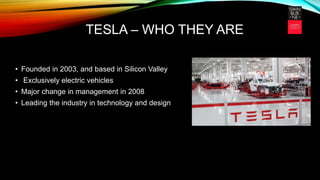
• Founded in 2003, and based in Silicon Valley
• Exclusively electric vehicles
• Major change in management in 2008
• Leading the industry in technology and design
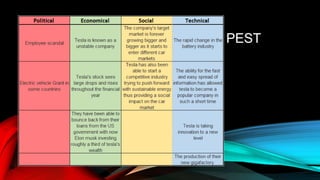
PEST
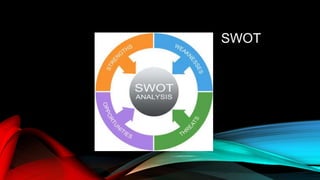
SWOT
STRENGTHS
• Strong reputation
• Elon Musk
• Daimler strategic alliance
• Panasonic strategic alliance
• Worlds first mass produced highway capable EV
• Ability to manufacture vehicles in house
• Sell all vehicles themselves, no other dealers
• Popular among younger age groups
WEAKNESSES
• Low global supply of batteries
• Use a lot of new technology that is more expensive
• Lower demand for electric vehicles
• Charging infrastructure is still being developed and expanded
• Unfounded supply chain
OPPORTUNITIES
• Large un-captured market
• Government implementing more support for clean energy
• Accessories
• Home charge kits
THREATS
• Introduction of laws prohibiting direct sales
• Competitor products
• Current business model limits Tesla's production of vehicles opening up the chance for larger
manufactures to steal market share
SUSTAINABILTY
Tesla’s Giga Factory
• Net Zero energy quota
• To double the world’s battery product
SUSTAINABILITY
Their Cars
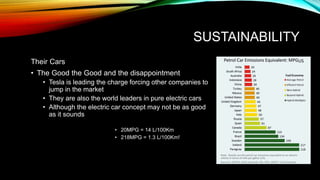
• The Good the Good and the disappointment
• Tesla is leading the charge forcing other companies to
jump in the market
• They are also the world leaders in pure electric cars
• Although the electric car concept may not be as good
as it sounds
• 20MPG = 14 L/100Km
• 218MPG = 1.3 L/100Km!
SUSTAINABILITY
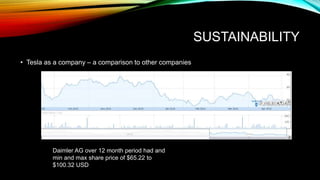
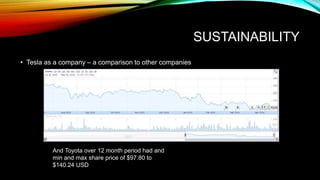
• Tesla as a company – a comparison to other companies
Daimler AG over 12 month period had and
min and max share price of $65.22 to
$100.32 USD
SUSTAINABILITY
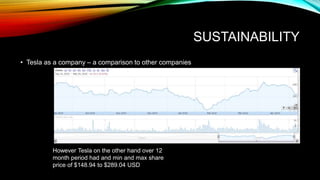
• Tesla as a company – a comparison to other companies
And Toyota over 12 month period had and
min and max share price of $97.80 to
$140.24 USD
SUSTAINABILITY
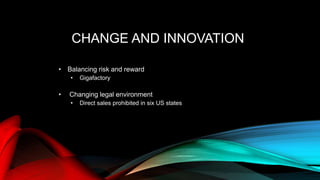
• Tesla as a company – a comparison to other companies
However Tesla on the other hand over 12
month period had and min and max share
price of $148.94 to $289.04 USD
CHANGE AND INNOVATION
• Balancing risk and reward
• Gigafactory
• Changing legal environment
• Direct sales prohibited in six US states
CHANGE AND INNOVATION
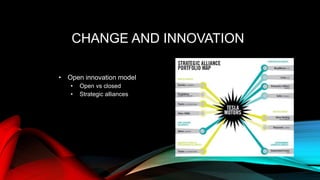
• Open innovation model
• Open vs closed
• Strategic alliances
CHALLENGES OF PLANNING AND
MANAGERIAL DECISION MAKING
Positive decisions:
1. Backwards business plan
2. Unusual Goals
3. Selling cars directly
4. Open patents
CHALLENGES OF PLANNING AND
MANAGERIAL DECISION MAKING
Possible problems caused by their decisions:
1. Could sacrifice what consumers want in the car when making it
cheaper
2. Cars might not hold value in rapidly developing technology
industry
3. Not reaching deadlines could hinder the companies growth
4. Large number of competitors
SOCIAL AND ETHICAL
RESPONSIBILITY
• Code of Business Conduct and Ethics
• Separate Code for the CEO and Senior Financial Officers
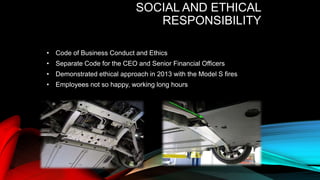
• Demonstrated ethical approach in 2013 with the Model S fires
• Employees not so happy, working long hours
SOCIAL AND ETHICAL RESPONSIBLITY
• A better future, Tesla’s aim
• Risky business endeavor and yet Tesla is moving forward
• Opening eyes and making people think about battery powered vehicles
• Gender Equality not Tesla’s strong suit
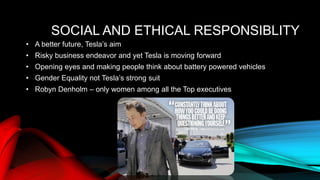
• Robyn Denholm – only women among all the Top executives
CONCLUSION AND
RECOMMENDATIONS
“All In all Tesla is an incredible company, but with some flaws they
are leading the innovation and sustainability charge with great
success however they are still a young and sometimes unstable
company with a lot to learn”
-Group F4-
THANK
YOU

Final presentation Tesla management project(Swinburne University)

  • 1.
    PROJECT TESLA Zach Huggins NikitaKulkarni James Malin Anthony Campana Group F4
  • 2.
    TESLA – WHOTHEY ARE • Founded in 2003, and based in Silicon Valley • Exclusively electric vehicles • Major change in management in 2008 • Leading the industry in technology and design
  • 3.
  • 4.
  • 5.
    STRENGTHS • Strong reputation •Elon Musk • Daimler strategic alliance • Panasonic strategic alliance • Worlds first mass produced highway capable EV • Ability to manufacture vehicles in house • Sell all vehicles themselves, no other dealers • Popular among younger age groups
  • 6.
    WEAKNESSES • Low globalsupply of batteries • Use a lot of new technology that is more expensive • Lower demand for electric vehicles • Charging infrastructure is still being developed and expanded • Unfounded supply chain
  • 7.
    OPPORTUNITIES • Large un-capturedmarket • Government implementing more support for clean energy • Accessories • Home charge kits
  • 8.
    THREATS • Introduction oflaws prohibiting direct sales • Competitor products • Current business model limits Tesla's production of vehicles opening up the chance for larger manufactures to steal market share
  • 9.
    SUSTAINABILTY Tesla’s Giga Factory •Net Zero energy quota • To double the world’s battery product
  • 10.
    SUSTAINABILITY Their Cars • TheGood the Good and the disappointment • Tesla is leading the charge forcing other companies to jump in the market • They are also the world leaders in pure electric cars • Although the electric car concept may not be as good as it sounds • 20MPG = 14 L/100Km • 218MPG = 1.3 L/100Km!
  • 11.
    SUSTAINABILITY • Tesla asa company – a comparison to other companies Daimler AG over 12 month period had and min and max share price of $65.22 to $100.32 USD
  • 12.
    SUSTAINABILITY • Tesla asa company – a comparison to other companies And Toyota over 12 month period had and min and max share price of $97.80 to $140.24 USD
  • 13.
    SUSTAINABILITY • Tesla asa company – a comparison to other companies However Tesla on the other hand over 12 month period had and min and max share price of $148.94 to $289.04 USD
  • 14.
    CHANGE AND INNOVATION •Balancing risk and reward • Gigafactory • Changing legal environment • Direct sales prohibited in six US states
  • 15.
    CHANGE AND INNOVATION •Open innovation model • Open vs closed • Strategic alliances
  • 16.
    CHALLENGES OF PLANNINGAND MANAGERIAL DECISION MAKING Positive decisions: 1. Backwards business plan 2. Unusual Goals 3. Selling cars directly 4. Open patents
  • 17.
    CHALLENGES OF PLANNINGAND MANAGERIAL DECISION MAKING Possible problems caused by their decisions: 1. Could sacrifice what consumers want in the car when making it cheaper 2. Cars might not hold value in rapidly developing technology industry 3. Not reaching deadlines could hinder the companies growth 4. Large number of competitors
  • 18.
    SOCIAL AND ETHICAL RESPONSIBILITY •Code of Business Conduct and Ethics • Separate Code for the CEO and Senior Financial Officers • Demonstrated ethical approach in 2013 with the Model S fires • Employees not so happy, working long hours
  • 19.
    SOCIAL AND ETHICALRESPONSIBLITY • A better future, Tesla’s aim • Risky business endeavor and yet Tesla is moving forward • Opening eyes and making people think about battery powered vehicles • Gender Equality not Tesla’s strong suit • Robyn Denholm – only women among all the Top executives
  • 20.
    CONCLUSION AND RECOMMENDATIONS “All Inall Tesla is an incredible company, but with some flaws they are leading the innovation and sustainability charge with great success however they are still a young and sometimes unstable company with a lot to learn” -Group F4-
  • 21.

Editor's Notes

  • #2 Name and course
  • #3 James to talk about points
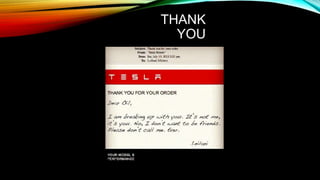
  • #22 Have a laugh