By Samer Salameh
Business Administration
Year 2 Group 8832
About Toyota
Toyota is a Japanese automotive manufacturer
headquartered in Toyota Aichi, Japan. In March
2014 the Multinational corporation consisted of
338,875 employees worldwide.
Toyota was the largest automobile manufacture in
2012 (by production) ahead of the Volkswagen
Group and General Motors.
Toyota is the world's first automobile manufacturer
to produce more than 10 million vehicles per
About Toyota
The company was founded by Kiichiro Toyoda in
1937 as a spinoff from his father's company
Toyota Industries to create automobiles.
Toyota Motor Corporation produces vehicles under
5 brands, including the Toyota brand, Hino,
Lexus, Ranz, and Scion.
Toyota Motor Corporation’s vehicle production
system is a way of “making things” that is
referred to as “lean manufacturing system”.
Objective
“making the vehicles ordered by customers in the
quickest and most efficient way, in order to
deliver the vehicles as quickly as possible”.
Toyota's management philosophy has evolved
from the company's origins and has been
reflected in the terms "Lean Manufacturing"
and Just In Time Production, which it was
instrumental in developing. Toyota's managerial
values and business methods are known
collectively as the Toyota Way. In April 2001,
Toyota adopted the "Toyota Way 2001", an
expression of values and conduct guidelines that
all Toyota employees should embrace. Under
’Marketing
Toyota's marketing efforts in North America have
focused on emphasizing the positive
experiences of ownership and vehicle quality.
In Japan, Toyota currently maintains separate
dealership sales channels.
The first sales channel established in 1946 called
"Toyota Store" sells large luxury sedans such as
the Toyota Century, and the Toyota Crown. In
1955 the "Toyopet Store" arrived, originally
established to sell the Toyota Corona and
the Toyopet ToyoAce truck. (Toyota's five
channel dealerships in Japan chronology in
Marketing
Toyota also operated a commercial dealership
called Toyota Diesel Shop from 1957 until 1988, that
sold various commercial platform trucks, buses, and
forklifts, such as the Toyota Dyna and the Toyota
Coaster.
Hino products were sold at specific Hino locations, and
shared at Toyota Diesel Store locations after Toyota
acquired the company in 1967.
Starting in 1980, the Diesel Shop also sold the Starlet,
Corolla, Corona, Vista and Crown installed with
diesel engines.
When the Toyota Diesel Store was disbanded,
SWOT Analysis
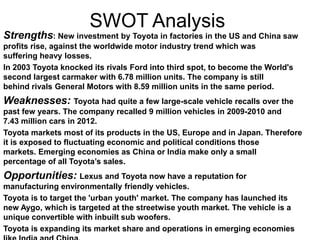
Strengths: New investment by Toyota in factories in the US and China saw
profits rise, against the worldwide motor industry trend which was
suffering heavy losses.
In 2003 Toyota knocked its rivals Ford into third spot, to become the World's
second largest carmaker with 6.78 million units. The company is still
behind rivals General Motors with 8.59 million units in the same period.
Weaknesses: Toyota had quite a few large-scale vehicle recalls over the
past few years. The company recalled 9 million vehicles in 2009-2010 and
7.43 million cars in 2012.
Toyota markets most of its products in the US, Europe and in Japan. Therefore
it is exposed to fluctuating economic and political conditions those
markets. Emerging economies as China or India make only a small
percentage of all Toyota’s sales.
Opportunities: Lexus and Toyota now have a reputation for
manufacturing environmentally friendly vehicles.
Toyota is to target the 'urban youth' market. The company has launched its
new Aygo, which is targeted at the streetwise youth market. The vehicle is a
unique convertible with inbuilt sub woofers.
Toyota is expanding its market share and operations in emerging economies
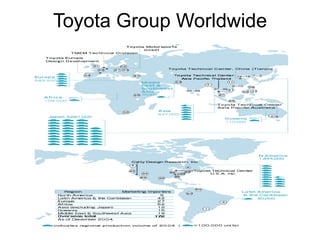
Toyota Group Worldwide
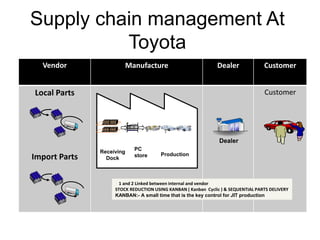
Supply chain management At
Toyota
CustomerDealerManufactureVendor
CustomerLocal Parts
Import Parts
PC
store Production
Receiving
Dock
Dealer
• 1 and 2 Linked between internal and vendor
STOCK REDUCTION USING KANBAN ( Kanban Cyclic ) & SEQUENTIAL PARTS DELIVERY
KANBAN:- A small time that is the key control for JIT production
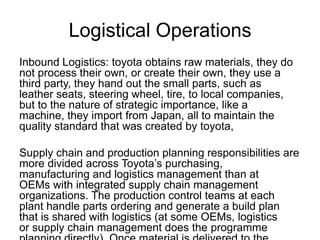
Logistical Operations
Inbound Logistics: toyota obtains raw materials, they do
not process their own, or create their own, they use a
third party, they hand out the small parts, such as
leather seats, steering wheel, tire, to local companies,
but to the nature of strategic importance, like a
machine, they import from Japan, all to maintain the
quality standard that was created by toyota,
Supply chain and production planning responsibilities are
more divided across Toyota’s purchasing,
manufacturing and logistics management than at
OEMs with integrated supply chain management
organizations. The production control teams at each
plant handle parts ordering and generate a build plan
that is shared with logistics (at some OEMs, logistics
or supply chain management does the programme
Logistical Operations
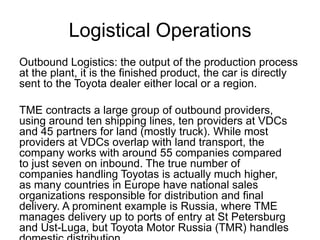
Outbound Logistics: the output of the production process
at the plant, it is the finished product, the car is directly
sent to the Toyota dealer either local or a region.
TME contracts a large group of outbound providers,
using around ten shipping lines, ten providers at VDCs
and 45 partners for land (mostly truck). While most
providers at VDCs overlap with land transport, the
company works with around 55 companies compared
to just seven on inbound. The true number of
companies handling Toyotas is actually much higher,
as many countries in Europe have national sales
organizations responsible for distribution and final
delivery. A prominent example is Russia, where TME
manages delivery up to ports of entry at St Petersburg
and Ust-Luga, but Toyota Motor Russia (TMR) handles
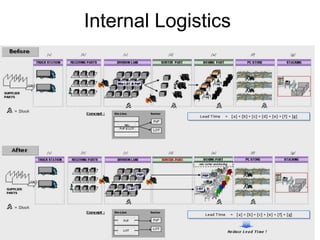
Internal Logistics
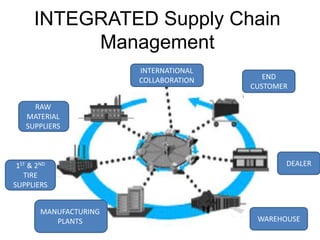
INTEGRATED Supply Chain
Management
RAW
MATERIAL
SUPPLIERS
1ST & 2ND
TIRE
SUPPLIERS
MANUFACTURING
PLANTS WAREHOUSE
DEALER
END
CUSTOMER
INTERNATIONAL
COLLABORATION
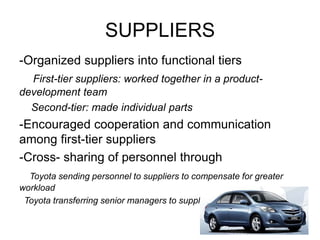
SUPPLIERS
-Organized suppliers into functional tiers
First-tier suppliers: worked together in a product-
development team
Second-tier: made individual parts
-Encouraged cooperation and communication
among first-tier suppliers
-Cross- sharing of personnel through
Toyota sending personnel to suppliers to compensate for greater
workload
Toyota transferring senior managers to suppliers for top positions
Suppliers
-“market price minus” system, not “supplier cost
plus” system
Value analysis reduces costs
-Production smoothing enables suppliers to
maintain a constant volume of business
-Focus is on long-term relationships that
underscores cooperation, teamwork
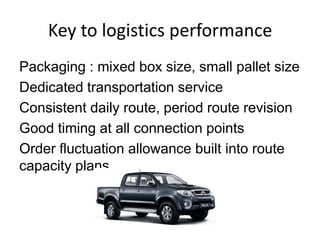
Key to logistics performance
Packaging : mixed box size, small pallet size
Dedicated transportation service
Consistent daily route, period route revision
Good timing at all connection points
Order fluctuation allowance built into route
capacity plans
Distribution
In Japan, Toyota’s sales and marketing work is
divided into four distribution channels
Toyota (mostly high-end, large cars),
Toyopet (medium size),
Toyota Corolla(compact), and
Netz Toyota (compact).
Overall, Toyota offers about 60 car models, with
each channel offering only 15-25 models.
The Toyota dealers as a whole have approximately
5,000 outlets and 120,000 employees.
Distribution
This way, each dealer can develop deep knowledge of all
models he has for sale, and can make an effort to sell all
car models assigned to him, rather than only the few
most profitable ones.
Toyota applies the “Toyota Way” to manage dealers, based
on three basic principles:
Dealers are free to make independent decisions, and
Toyota can only help them to invest in the right things
to improve. Such a strategy motivates dealers to be
more proactive.
Both the dealers and Toyota must prosper jointly.
Distribution
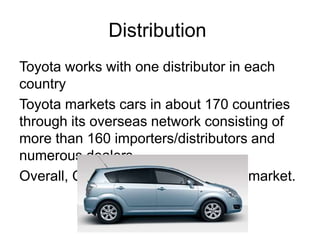
Toyota works with one distributor in each
country
Toyota markets cars in about 170 countries
through its overseas network consisting of
more than 160 importers/distributors and
numerous dealers.
Overall, China is the highest-growth market.
Drivers of the Supply Chain
Facility:
Vehicles coming out of an assembly line and are moved into warehouses
called ''Marshaling Yard''.
Fitting Accessories, Price Tags, and final quality assurance takes place
here.
Inventory:
Just in time- is time based inventory method. It refers to the
manufacturing and conveyance of only what is needed, when is
needed, and in the amount needed in the system”.
Pull Based system and Kanban methods are followed.
The Kanban is unique production control method called the "kanban
system" plays an integral role. The kanban system has also been
called the "Supermarket method" because the idea behind it was
borrowed from supermarkets.
Transport:
Transportation of raw materials is usually transported by truck, since
‘’Just in Time’’ Method
"Just-in-Time" means making "only what is
needed, when it is needed, and in the
amount needed." For example, to
efficiently produce a large number of
automobiles, which can consist of around
30,000 parts, it is necessary to create a
detailed production plan that includes
parts procurement. Supplying "what is
needed, when it is needed, and in the
amount needed" according to this
production plan can eliminate waste,
inconsistencies, and unreasonable
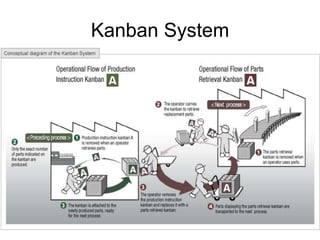
Kanban System
In the TPS (Toyota Production System), a
unique production control method called the
"kanban system" plays an integral role. The
kanban system has also been called the
"Supermarket method" because the idea
behind it was borrowed from supermarkets.
Such mass merchandizing stores use product
control cards upon which product-related
information, such as a product's name, code
and storage location, are entered. Because
Toyota employed kanban signs for use in
their production processes, the method came
to be called the "kanban system." At Toyota,
when a process refers to a preceding process
Kanban System
Thank You for your attention

Toyota Logistics

  • 1.
    By Samer Salameh BusinessAdministration Year 2 Group 8832
  • 2.
    About Toyota Toyota isa Japanese automotive manufacturer headquartered in Toyota Aichi, Japan. In March 2014 the Multinational corporation consisted of 338,875 employees worldwide. Toyota was the largest automobile manufacture in 2012 (by production) ahead of the Volkswagen Group and General Motors. Toyota is the world's first automobile manufacturer to produce more than 10 million vehicles per
  • 3.
    About Toyota The companywas founded by Kiichiro Toyoda in 1937 as a spinoff from his father's company Toyota Industries to create automobiles. Toyota Motor Corporation produces vehicles under 5 brands, including the Toyota brand, Hino, Lexus, Ranz, and Scion. Toyota Motor Corporation’s vehicle production system is a way of “making things” that is referred to as “lean manufacturing system”.
  • 4.
    Objective “making the vehiclesordered by customers in the quickest and most efficient way, in order to deliver the vehicles as quickly as possible”. Toyota's management philosophy has evolved from the company's origins and has been reflected in the terms "Lean Manufacturing" and Just In Time Production, which it was instrumental in developing. Toyota's managerial values and business methods are known collectively as the Toyota Way. In April 2001, Toyota adopted the "Toyota Way 2001", an expression of values and conduct guidelines that all Toyota employees should embrace. Under
  • 5.
    ’Marketing Toyota's marketing effortsin North America have focused on emphasizing the positive experiences of ownership and vehicle quality. In Japan, Toyota currently maintains separate dealership sales channels. The first sales channel established in 1946 called "Toyota Store" sells large luxury sedans such as the Toyota Century, and the Toyota Crown. In 1955 the "Toyopet Store" arrived, originally established to sell the Toyota Corona and the Toyopet ToyoAce truck. (Toyota's five channel dealerships in Japan chronology in
  • 6.
    Marketing Toyota also operateda commercial dealership called Toyota Diesel Shop from 1957 until 1988, that sold various commercial platform trucks, buses, and forklifts, such as the Toyota Dyna and the Toyota Coaster. Hino products were sold at specific Hino locations, and shared at Toyota Diesel Store locations after Toyota acquired the company in 1967. Starting in 1980, the Diesel Shop also sold the Starlet, Corolla, Corona, Vista and Crown installed with diesel engines. When the Toyota Diesel Store was disbanded,
  • 7.
    SWOT Analysis Strengths: Newinvestment by Toyota in factories in the US and China saw profits rise, against the worldwide motor industry trend which was suffering heavy losses. In 2003 Toyota knocked its rivals Ford into third spot, to become the World's second largest carmaker with 6.78 million units. The company is still behind rivals General Motors with 8.59 million units in the same period. Weaknesses: Toyota had quite a few large-scale vehicle recalls over the past few years. The company recalled 9 million vehicles in 2009-2010 and 7.43 million cars in 2012. Toyota markets most of its products in the US, Europe and in Japan. Therefore it is exposed to fluctuating economic and political conditions those markets. Emerging economies as China or India make only a small percentage of all Toyota’s sales. Opportunities: Lexus and Toyota now have a reputation for manufacturing environmentally friendly vehicles. Toyota is to target the 'urban youth' market. The company has launched its new Aygo, which is targeted at the streetwise youth market. The vehicle is a unique convertible with inbuilt sub woofers. Toyota is expanding its market share and operations in emerging economies
  • 8.
  • 9.
    Supply chain managementAt Toyota CustomerDealerManufactureVendor CustomerLocal Parts Import Parts PC store Production Receiving Dock Dealer • 1 and 2 Linked between internal and vendor STOCK REDUCTION USING KANBAN ( Kanban Cyclic ) & SEQUENTIAL PARTS DELIVERY KANBAN:- A small time that is the key control for JIT production
  • 10.
    Logistical Operations Inbound Logistics:toyota obtains raw materials, they do not process their own, or create their own, they use a third party, they hand out the small parts, such as leather seats, steering wheel, tire, to local companies, but to the nature of strategic importance, like a machine, they import from Japan, all to maintain the quality standard that was created by toyota, Supply chain and production planning responsibilities are more divided across Toyota’s purchasing, manufacturing and logistics management than at OEMs with integrated supply chain management organizations. The production control teams at each plant handle parts ordering and generate a build plan that is shared with logistics (at some OEMs, logistics or supply chain management does the programme
  • 11.
    Logistical Operations Outbound Logistics:the output of the production process at the plant, it is the finished product, the car is directly sent to the Toyota dealer either local or a region. TME contracts a large group of outbound providers, using around ten shipping lines, ten providers at VDCs and 45 partners for land (mostly truck). While most providers at VDCs overlap with land transport, the company works with around 55 companies compared to just seven on inbound. The true number of companies handling Toyotas is actually much higher, as many countries in Europe have national sales organizations responsible for distribution and final delivery. A prominent example is Russia, where TME manages delivery up to ports of entry at St Petersburg and Ust-Luga, but Toyota Motor Russia (TMR) handles
  • 12.
  • 13.
    INTEGRATED Supply Chain Management RAW MATERIAL SUPPLIERS 1ST& 2ND TIRE SUPPLIERS MANUFACTURING PLANTS WAREHOUSE DEALER END CUSTOMER INTERNATIONAL COLLABORATION
  • 14.
    SUPPLIERS -Organized suppliers intofunctional tiers First-tier suppliers: worked together in a product- development team Second-tier: made individual parts -Encouraged cooperation and communication among first-tier suppliers -Cross- sharing of personnel through Toyota sending personnel to suppliers to compensate for greater workload Toyota transferring senior managers to suppliers for top positions
  • 15.
    Suppliers -“market price minus”system, not “supplier cost plus” system Value analysis reduces costs -Production smoothing enables suppliers to maintain a constant volume of business -Focus is on long-term relationships that underscores cooperation, teamwork
  • 16.
    Key to logisticsperformance Packaging : mixed box size, small pallet size Dedicated transportation service Consistent daily route, period route revision Good timing at all connection points Order fluctuation allowance built into route capacity plans
  • 17.
    Distribution In Japan, Toyota’ssales and marketing work is divided into four distribution channels Toyota (mostly high-end, large cars), Toyopet (medium size), Toyota Corolla(compact), and Netz Toyota (compact). Overall, Toyota offers about 60 car models, with each channel offering only 15-25 models. The Toyota dealers as a whole have approximately 5,000 outlets and 120,000 employees.
  • 18.
    Distribution This way, eachdealer can develop deep knowledge of all models he has for sale, and can make an effort to sell all car models assigned to him, rather than only the few most profitable ones. Toyota applies the “Toyota Way” to manage dealers, based on three basic principles: Dealers are free to make independent decisions, and Toyota can only help them to invest in the right things to improve. Such a strategy motivates dealers to be more proactive. Both the dealers and Toyota must prosper jointly.
  • 19.
    Distribution Toyota works withone distributor in each country Toyota markets cars in about 170 countries through its overseas network consisting of more than 160 importers/distributors and numerous dealers. Overall, China is the highest-growth market.
  • 20.
    Drivers of theSupply Chain Facility: Vehicles coming out of an assembly line and are moved into warehouses called ''Marshaling Yard''. Fitting Accessories, Price Tags, and final quality assurance takes place here. Inventory: Just in time- is time based inventory method. It refers to the manufacturing and conveyance of only what is needed, when is needed, and in the amount needed in the system”. Pull Based system and Kanban methods are followed. The Kanban is unique production control method called the "kanban system" plays an integral role. The kanban system has also been called the "Supermarket method" because the idea behind it was borrowed from supermarkets. Transport: Transportation of raw materials is usually transported by truck, since
  • 21.
    ‘’Just in Time’’Method "Just-in-Time" means making "only what is needed, when it is needed, and in the amount needed." For example, to efficiently produce a large number of automobiles, which can consist of around 30,000 parts, it is necessary to create a detailed production plan that includes parts procurement. Supplying "what is needed, when it is needed, and in the amount needed" according to this production plan can eliminate waste, inconsistencies, and unreasonable
  • 22.
    Kanban System In theTPS (Toyota Production System), a unique production control method called the "kanban system" plays an integral role. The kanban system has also been called the "Supermarket method" because the idea behind it was borrowed from supermarkets. Such mass merchandizing stores use product control cards upon which product-related information, such as a product's name, code and storage location, are entered. Because Toyota employed kanban signs for use in their production processes, the method came to be called the "kanban system." At Toyota, when a process refers to a preceding process
  • 23.
  • 24.
    Thank You foryour attention