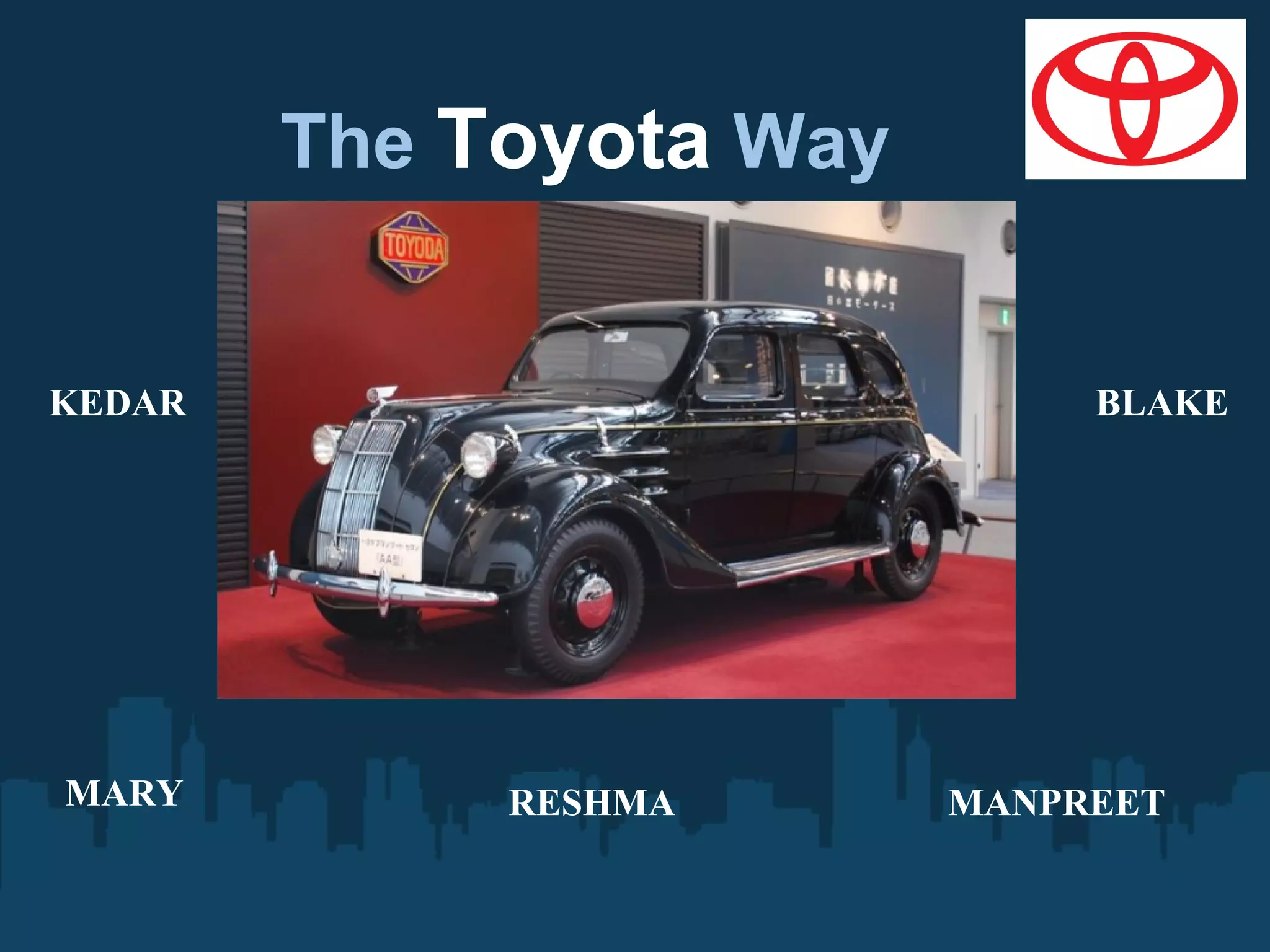

The Toyota Way

KEDAR

MARY

BLAKE

RESHMA

MANPREET
The Toyota style is not to create results by working
hard. It is a system that says there is no limit to
people’s creativity. People don’t go to Toyota to ‘work’
they go there to ‘think’. – Taichii Ohno.
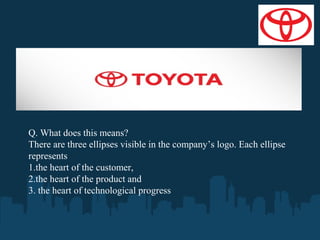
Q. What does this means?
There are three ellipses visible in the company’s logo. Each ellipse
represents
1.the heart of the customer,
2.the heart of the product and
3. the heart of technological progress
THE TOYOTA PHILOSOPHY
Introduction
The Toyota Way In 2004, Dr. Jeffrey Liker,
published "The Toyota Way”. Liker calls the Toyota
Way, "a system designed to provide the tools for
people to continually improve their work.”
It consists of principles in two key areas:
1. continuous improvement
2. respect for people
Continuous Improvement
• Challenge
Form a long-term vision and meet challenges with courage and
creativity.
• continuous improvement)
Improve business operations continuously, always driving for
innovation and evolution.
• Go and see
Go to the source to find the facts to make correct decisions,
build consensus and achieve goals at best speed.
Respect for People
The principles relating to respect for people include ways of
building respect and teamwork:
• Respect
Respect others. Make every effort to understand each other,
take responsibility and do your best to build mutual trust.
• Teamwork
Stimulate personal and professional growth, share the
opportunities of development and maximize individual and team
performance.
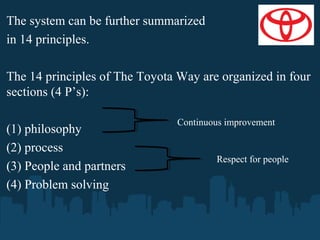
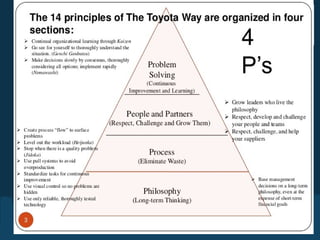
The system can be further summarized
in 14 principles.
The 14 principles of The Toyota Way are organized in four
sections (4 P’s):
(1) philosophy
(2) process
(3) People and partners
(4) Problem solving

Continuous improvement

Respect for people
Section I — Long-Term Philosophy

Principle 1
• Base your management decisions on a long-term philosophy,
even at the expense of short-term financial goals.
People need purpose to find motivation and establish goals.
Section II — The Right Process
Will Produce the Right Results
Principle 2
• Create a continuous process flow to bring problems to the
surface.
Work processes are redesigned to eliminate waste (muda)
through the process of continuous improvement — kaizen. The
seven types of muda are:
1. Overproduction
2. Waiting (time on hand)
3. Unnecessary transport or conveyance
4. Overprocessing or incorrect processing
5. Excess inventory
6. Motion
7. Defects
Principle 3
• Use "pull" systems to avoid overproduction.
A method where a process signals its predecessor that more
material is needed. The pull system produces only the required
material after the subsequent operation signals a need for it.
This process is necessary to reduce overproduction.
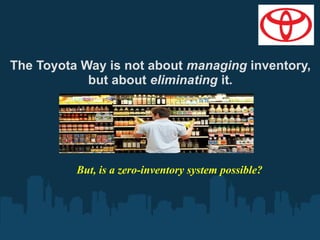
The Toyota Way is not about managing inventory,
but about eliminating it.

But, is a zero-inventory system possible?
The Kanban way
• Is a visual system of pull-replenishment
• Kanban means sign, signboard, card
Principle 4
• Level out the workload (heijunka). (Work like the tortoise, not
the hare).

This helps achieve the goal of minimizing waste (muda), not
overburdening people or the equipment (muri), and not creating
uneven production levels (mura).
• The leveling of production by volume and product mix is known
as heijunka.
•The process does not build up products according to the actual
flow of customer orders.
• It takes the total volume of orders in a period and levels them
out.
•This results in having the same amount and mix made each
day
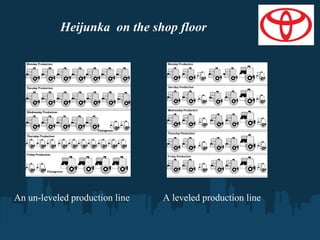
Heijunka on the shop floor

An un-leveled production line

A leveled production line
Benefits of Heijunka
1. Flexibility to make what the customer
wants when they want it
2. Reduced risk of unsold goods
3. Balanced used of labor and goods
Principle 5
• Build a culture of stopping to fix problems, to get quality right
the first time.
Quality takes precedence (Jidoka). Any employee in the Toyota
Production System has the authority to stop the process to
signal a quality issue.
Benefits of Jidoka

The development of a company principle of stopping or
slowing down work when a problem is detected and getting
the quality right enhances productivity and profitability in
the long run.
Principle 6
• Standardized tasks and processes are the foundation for
continuous improvement and employee empowerment.
Although Toyota has a bureaucratic system, the way that it is
implemented allows for continuous improvement from the
people affected by that system. It empowers the employee to
aid in the growth and improvement of the company.
Principle 7
• Use visual control so no problems are hidden.
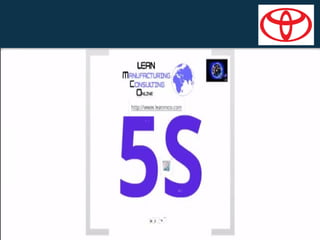
Included in this principle is the 5S Program - steps that are used
to make all work spaces efficient and productive, help people
share work stations, reduce time looking for needed tools and
improve the work environment.
• Sort: Sort out unneeded items
• Straighten: Have a place for everything
• Shine: Keep the area clean
• Standardize: Create rules and standard operating
procedures
• Sustain: Maintain the system and continue to improve it
Principle 8
• Use only reliable, thoroughly tested technology that serves
your people and processes.
Technology is pulled by manufacturing, not pushed to
manufacturing.
Section III — Add Value to the
Organization by Developing Your
People
Principle 9
• Grow leaders who thoroughly understand the work, live the
philosophy, and teach it to others.
Without constant attention, the principles will fade. The
principles have to be ingrained, it must be the way one thinks.
Employees must be educated and trained: they have to
maintain a learning organization.
Principle 10
• Develop exceptional people and teams who follow your
company's philosophy.
Teams should consist of 4-5 people and numerous
management tiers. Success is based on the team, not the
individual.
Principle 11
• Respect your extended network of partners and suppliers by
challenging them and helping them improve.
Toyota treats suppliers much like they treat their employees,
challenging them to do better and helping them to achieve it.
Toyota provides cross functional teams to help suppliers
discover and fix problems so that they can become a stronger,
better supplier.
Section IV — Continuously Solving
Root Problems Drives
Organizational Learning
Principle 12
• Go and see for yourself to thoroughly understand the
situation (Genchi Genbutsu).
Toyota managers are expected to "go-and-see" operations.
Without experiencing the situation firsthand, managers will not
have an understanding of how it can be improved. Furthermore,
managers use Tadashi Yamashima's (President, Toyota
Technical Center (TTC)) ten management principles as a
guideline:
1. Always keep the final target in mind.
2. Clearly assign tasks to yourself and others.
3. Think and speak on verified, proven information and data.
4. Take full advantage of the wisdom and experiences of others
to send, gather or discuss information.
5. Share information with others in a timely fashion.
6. Always report, inform and consult in a timely manner.
7. Analyze and understand shortcomings in your capabilities in
a measurable way.
8. Relentlessly strive to conduct kaizen activities.
9. Think "outside the box," or beyond common sense and
standard rules.
10.Always be mindful of protecting your safety and health.
Principle 13
• Make decisions slowly by consensus, thoroughly considering
all options; implement decisions rapidly (nemawashi).
The following are decision parameters:
1. Find what is really going on (go-and-see) to test
2. Determine the underlying cause
3. Consider a broad range of alternatives
4. Build consensus on the resolution
5. Use efficient communication tools
Principle 14
• Become a learning organization through relentless reflection
(hansei) and continuous improvement (kaizen).
The process of becoming a learning organization involves
criticizing every aspect of what one does. The general problem
solving technique to determine the root cause of a problem
includes:
1. Initial problem perception
2. Clarify the problem
3. Locate area/point of cause
4. Investigate root cause (5 w’s)
5. Countermeasure
6. Evaluate
7. Standardize
The end

The toyota way By Manpreet singh digital

  • 1.
  • 2.
    The Toyota styleis not to create results by working hard. It is a system that says there is no limit to people’s creativity. People don’t go to Toyota to ‘work’ they go there to ‘think’. – Taichii Ohno.
  • 4.
    Q. What doesthis means? There are three ellipses visible in the company’s logo. Each ellipse represents 1.the heart of the customer, 2.the heart of the product and 3. the heart of technological progress
  • 5.
  • 6.
    Introduction The Toyota WayIn 2004, Dr. Jeffrey Liker, published "The Toyota Way”. Liker calls the Toyota Way, "a system designed to provide the tools for people to continually improve their work.” It consists of principles in two key areas: 1. continuous improvement 2. respect for people
  • 7.
    Continuous Improvement • Challenge Forma long-term vision and meet challenges with courage and creativity. • continuous improvement) Improve business operations continuously, always driving for innovation and evolution. • Go and see Go to the source to find the facts to make correct decisions, build consensus and achieve goals at best speed.
  • 8.
    Respect for People Theprinciples relating to respect for people include ways of building respect and teamwork: • Respect Respect others. Make every effort to understand each other, take responsibility and do your best to build mutual trust. • Teamwork Stimulate personal and professional growth, share the opportunities of development and maximize individual and team performance.
  • 9.
    The system canbe further summarized in 14 principles. The 14 principles of The Toyota Way are organized in four sections (4 P’s): (1) philosophy (2) process (3) People and partners (4) Problem solving Continuous improvement Respect for people
  • 11.
    Section I —Long-Term Philosophy Principle 1 • Base your management decisions on a long-term philosophy, even at the expense of short-term financial goals. People need purpose to find motivation and establish goals.
  • 12.
    Section II —The Right Process Will Produce the Right Results Principle 2 • Create a continuous process flow to bring problems to the surface. Work processes are redesigned to eliminate waste (muda) through the process of continuous improvement — kaizen. The seven types of muda are: 1. Overproduction 2. Waiting (time on hand) 3. Unnecessary transport or conveyance 4. Overprocessing or incorrect processing 5. Excess inventory 6. Motion 7. Defects
  • 13.
    Principle 3 • Use"pull" systems to avoid overproduction. A method where a process signals its predecessor that more material is needed. The pull system produces only the required material after the subsequent operation signals a need for it. This process is necessary to reduce overproduction.
  • 14.
    The Toyota Wayis not about managing inventory, but about eliminating it. But, is a zero-inventory system possible?
  • 15.
    The Kanban way •Is a visual system of pull-replenishment • Kanban means sign, signboard, card
  • 16.
    Principle 4 • Levelout the workload (heijunka). (Work like the tortoise, not the hare). This helps achieve the goal of minimizing waste (muda), not overburdening people or the equipment (muri), and not creating uneven production levels (mura).
  • 17.
    • The levelingof production by volume and product mix is known as heijunka. •The process does not build up products according to the actual flow of customer orders. • It takes the total volume of orders in a period and levels them out. •This results in having the same amount and mix made each day
  • 18.
    Heijunka on theshop floor An un-leveled production line A leveled production line
  • 19.
    Benefits of Heijunka 1.Flexibility to make what the customer wants when they want it 2. Reduced risk of unsold goods 3. Balanced used of labor and goods
  • 20.
    Principle 5 • Builda culture of stopping to fix problems, to get quality right the first time. Quality takes precedence (Jidoka). Any employee in the Toyota Production System has the authority to stop the process to signal a quality issue.
  • 21.
    Benefits of Jidoka Thedevelopment of a company principle of stopping or slowing down work when a problem is detected and getting the quality right enhances productivity and profitability in the long run.
  • 22.
    Principle 6 • Standardizedtasks and processes are the foundation for continuous improvement and employee empowerment. Although Toyota has a bureaucratic system, the way that it is implemented allows for continuous improvement from the people affected by that system. It empowers the employee to aid in the growth and improvement of the company.
  • 23.
    Principle 7 • Usevisual control so no problems are hidden. Included in this principle is the 5S Program - steps that are used to make all work spaces efficient and productive, help people share work stations, reduce time looking for needed tools and improve the work environment. • Sort: Sort out unneeded items • Straighten: Have a place for everything • Shine: Keep the area clean • Standardize: Create rules and standard operating procedures • Sustain: Maintain the system and continue to improve it
  • 25.
    Principle 8 • Useonly reliable, thoroughly tested technology that serves your people and processes. Technology is pulled by manufacturing, not pushed to manufacturing.
  • 26.
    Section III —Add Value to the Organization by Developing Your People Principle 9 • Grow leaders who thoroughly understand the work, live the philosophy, and teach it to others. Without constant attention, the principles will fade. The principles have to be ingrained, it must be the way one thinks. Employees must be educated and trained: they have to maintain a learning organization.
  • 27.
    Principle 10 • Developexceptional people and teams who follow your company's philosophy. Teams should consist of 4-5 people and numerous management tiers. Success is based on the team, not the individual.
  • 28.
    Principle 11 • Respectyour extended network of partners and suppliers by challenging them and helping them improve. Toyota treats suppliers much like they treat their employees, challenging them to do better and helping them to achieve it. Toyota provides cross functional teams to help suppliers discover and fix problems so that they can become a stronger, better supplier.
  • 29.
    Section IV —Continuously Solving Root Problems Drives Organizational Learning Principle 12 • Go and see for yourself to thoroughly understand the situation (Genchi Genbutsu). Toyota managers are expected to "go-and-see" operations. Without experiencing the situation firsthand, managers will not have an understanding of how it can be improved. Furthermore, managers use Tadashi Yamashima's (President, Toyota Technical Center (TTC)) ten management principles as a guideline:
  • 30.
    1. Always keepthe final target in mind. 2. Clearly assign tasks to yourself and others. 3. Think and speak on verified, proven information and data. 4. Take full advantage of the wisdom and experiences of others to send, gather or discuss information. 5. Share information with others in a timely fashion. 6. Always report, inform and consult in a timely manner. 7. Analyze and understand shortcomings in your capabilities in a measurable way. 8. Relentlessly strive to conduct kaizen activities. 9. Think "outside the box," or beyond common sense and standard rules. 10.Always be mindful of protecting your safety and health.
  • 31.
    Principle 13 • Makedecisions slowly by consensus, thoroughly considering all options; implement decisions rapidly (nemawashi). The following are decision parameters: 1. Find what is really going on (go-and-see) to test 2. Determine the underlying cause 3. Consider a broad range of alternatives 4. Build consensus on the resolution 5. Use efficient communication tools
  • 32.
    Principle 14 • Becomea learning organization through relentless reflection (hansei) and continuous improvement (kaizen). The process of becoming a learning organization involves criticizing every aspect of what one does. The general problem solving technique to determine the root cause of a problem includes: 1. Initial problem perception 2. Clarify the problem 3. Locate area/point of cause 4. Investigate root cause (5 w’s) 5. Countermeasure 6. Evaluate 7. Standardize
  • 33.