Title: End term Assignment for project report groups 
Subject: Managerial Economics 
Prepared by: 
Nimisha Agarwal 
2013173 
Section-D 
Total words in assignment: 2000 
Automobile Industry: Toyota Motor Corporation
1. Brief Background of the Firm: 
Toyota Motor Corporation is a Japanese multinational automaker headquartered in Toyota, 
Aichi, Japan. In 2010, Toyota employed 325,905 people worldwide, and was the third-largest 
manufacturer in 2011 by production behind General Motors and Volkswagen 
Group. Toyota is the eleventh-largest company in the world by revenue. In July 2012, the 
company reported it had manufactured its 200-millionth vehicle. The company was founded 
by Kiichiro Toyoda in 1937 as a spinoff from his father's company Toyota Industries to 
create automobiles. Three years earlier, in 1934, while still a department of Toyota Industries, 
it created its first product, the Type A engine, and, in 1936, its first passenger car, the Toyota. 
Toyota Motor Corporation group companies are Toyota (including 
the Scion brand), Lexus, Daihatsu, and Hino Motors, along with several "nonautomotive" 
companies. TMC is part of the Toyota Group, one of the largest conglomerates in the 
world. The thrifty Corolla was introduced in 1968 and, like the Corona, was a huge success 
with American drivers. Corolla has since become the world’s all-time best-selling passenger 
car, with over 30 million sold in more than 140 countries. In 1972 Toyota sold its one-millionth 
vehicle. By the end of 1975, Toyota surpassed Volkswagen to become the No. 1 
import brand in the United States. Three years later, in 1978, Toyota won the "Import Triple 
Crown" by leading all import brands in sales of cars, trucks and total vehicles. 
As Toyota celebrated its 25th anniversary in America during 1982, it opened a new national 
sales headquarters complex that it occupies today in Torrance, Calif. May 2001 marked the 
incorporation of Toyota Motor Sales de Mexico, Toyota's new sales and marketing subsidiary 
in Mexico. By the end of the year, Toyota had grown to become the third-best-selling 
automotive brand in the United States, surpassing Dodge with best-ever sales of 1,741,254 
vehicles. In December of 2002, Toyota delivered its first two zero-emission, market-ready 
hydrogen fuel cell vehicles to customers in California for real-world testing. The next year, 
Toyota's new, breakthrough hybrid technology, "Hybrid Synergy Drive," debuted in the all-new 
2004 Prius. Toyota's growth in America continued in 2003 when Toyota launched Scion 
as its third line of vehicles. In 2005, Toyota continued expanding its environmentally 
advanced line-up with the introduction of the world’s first luxury hybrid, the Lexus RX 400h, 
and a hybrid option for the Toyota Highlander. Toyota added a hybrid option to its popular 
Camry sedan in 2006 and began building it in the United States at its massive Kentucky 
plant. The company also opened up its 10th U.S. plant in San Antonio, Texas, to build 
pickups. During 2007, its 50th year in America, Toyota introduced its largest pickup truck 
ever as well as the second-generation of its iconic Scion xB urban utility vehicle and the 
world’s first V8 hybrid, the Lexus LS 600h.As a result of an economic recession, Toyota’s 
sales were down in 2008. In 2009, Toyota launched two all-new gas/electric hybrids. During 
2010; Toyota began production of the third-generation Sienna at its Indiana plant. Toyota has 
factories in most parts of the world, manufacturing or assembling vehicles for local markets. 
Toyota has manufacturing or assembly plants in Japan, Australia, India, Sri Lanka, Canada, 
Indonesia, Poland, South Africa, Turkey, Colombia, the United Kingdom, the United States, 
France, Brazil, Portugal, and more recently, Argentina, Czech Republic, Mexico, Malaysia, 
Thailand, Pakistan, Egypt, China, Vietnam, Venezuela, the Philippines, and Russia. Toyota's 
management philosophy has evolved from the company's origins and has been reflected in 
the terms "Lean Manufacturing" and Just in Time Production, which it was instrumental in 
developing. Toyota's managerial values and business methods are known collectively as the 
Toyota Way. In April 2001, Toyota adopted the "Toyota Way 2001", an expression of values 
and conduct guidelines that all Toyota employees should embrace.
2. Market Structure and Pricing Policies of the Firm: 
1. Destinations of the firm’s products or services: 
Toyota as an automobile firm serves both local and global market. 
2. Competitors 
a) National Level 
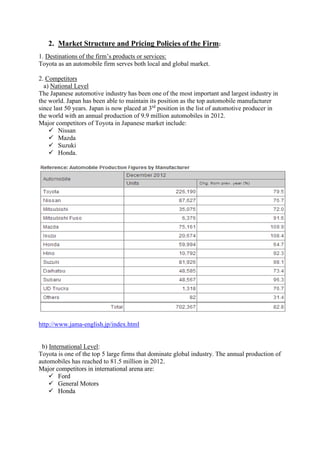
The Japanese automotive industry has been one of the most important and largest industry in 
the world. Japan has been able to maintain its position as the top automobile manufacturer 
since last 50 years. Japan is now placed at 3rd position in the list of automotive producer in 
the world with an annual production of 9.9 million automobiles in 2012. 
Major competitors of Toyota in Japanese market include: 
 Nissan 
 Mazda 
 Suzuki 
 Honda. 
http://www.jama-english.jp/index.html 
b) International Level: 
Toyota is one of the top 5 large firms that dominate global industry. The annual production of 
automobiles has reached to 81.5 million in 2012. 
Major competitors in international arena are: 
 Ford 
 General Motors 
 Honda
Direct Competitor Comparison 
Toyota Ford GM Honda Industry 
Market Cap: 196.93B 64.37B 47.25B 65.77B 21.50B 
Employees: 333,498 171,000 213,000 190,338 62.72K 
Qtrly Rev 
0.14 0.15 0.04 0.16 0.42 
Growth (yoy): 
Revenue (ttm): 289.95B 142.50B 152.84B 130.58B 65.16B 
Gross Margin 
(ttm): 
0.17 0.14 0.09 0.25 0.19 
EBITDA 
(ttm): 
36.35B 11.99B 7.90B 11.86B 5.59B 
Operating 
Margin (ttm): 
0.08 0.05 0.01 0.05 0.07 
Net Income 
(ttm): 
15.68B 6.07B 4.53B 4.55B N/A 
EPS (ttm): 9.90 1.52 2.79 2.52 2.90 
P/E (ttm): 12.56 10.76 12.23 14.46 13.87 
PEG (5 yr 
0.32 0.77 0.57 0.58 1.05 
expected): 
P/S (ttm): 0.68 0.45 0.31 0.50 0.61 
http://finance.yahoo.com/;_ylt=An_OhXZ9NTXkqISYTK_Oov_p8rcF 
3. Demand and cost curves: 
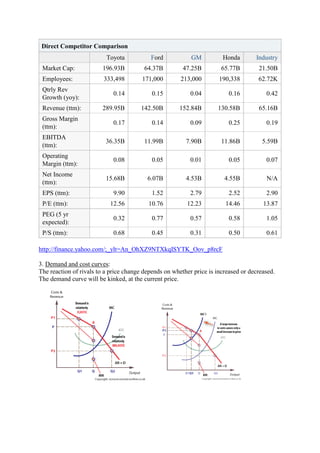
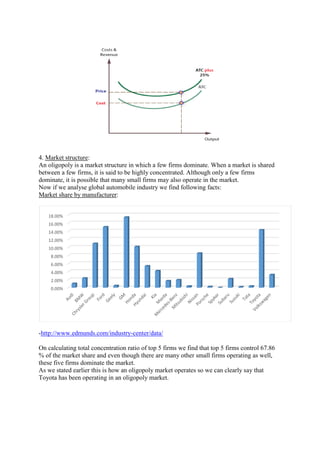
The reaction of rivals to a price change depends on whether price is increased or decreased. 
The demand curve will be kinked, at the current price.
4. Market structure: 
An oligopoly is a market structure in which a few firms dominate. When a market is shared 
between a few firms, it is said to be highly concentrated. Although only a few firms 
dominate, it is possible that many small firms may also operate in the market. 
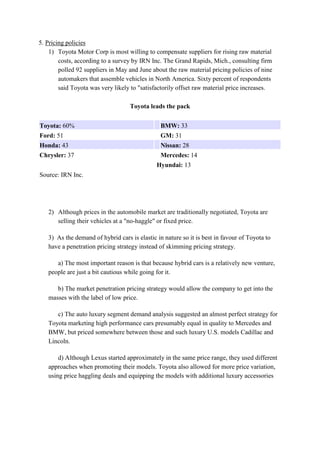
Now if we analyse global automobile industry we find following facts: 
Market share by manufacturer: 
18.00% 
16.00% 
14.00% 
12.00% 
10.00% 
8.00% 
6.00% 
4.00% 
2.00% 
0.00% 
-http://www.edmunds.com/industry-center/data/ 
On calculating total concentration ratio of top 5 firms we find that top 5 firms control 67.86 
% of the market share and even though there are many other small firms operating as well, 
these five firms dominate the market. 
As we stated earlier this is how an oligopoly market operates so we can clearly say that 
Toyota has been operating in an oligopoly market.
5. Pricing policies 
1) Toyota Motor Corp is most willing to compensate suppliers for rising raw material 
costs, according to a survey by IRN Inc. The Grand Rapids, Mich., consulting firm 
polled 92 suppliers in May and June about the raw material pricing policies of nine 
automakers that assemble vehicles in North America. Sixty percent of respondents 
said Toyota was very likely to "satisfactorily offset raw material price increases. 
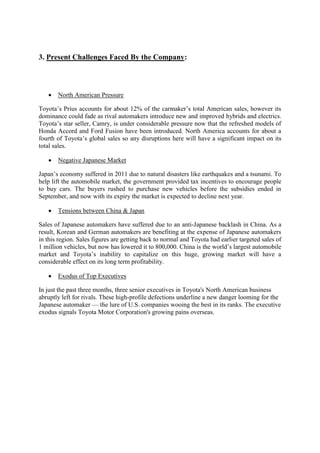
Toyota leads the pack 
Toyota: 60% BMW: 33 
Ford: 51 GM: 31 
Honda: 43 Nissan: 28 
Chrysler: 37 Mercedes: 14 
Hyundai: 13 
Source: IRN Inc. 
2) Although prices in the automobile market are traditionally negotiated, Toyota are 
selling their vehicles at a "no-haggle" or fixed price. 
3) As the demand of hybrid cars is elastic in nature so it is best in favour of Toyota to 
have a penetration pricing strategy instead of skimming pricing strategy. 
a) The most important reason is that because hybrid cars is a relatively new venture, 
people are just a bit cautious while going for it. 
b) The market penetration pricing strategy would allow the company to get into the 
masses with the label of low price. 
c) The auto luxury segment demand analysis suggested an almost perfect strategy for 
Toyota marketing high performance cars presumably equal in quality to Mercedes and 
BMW, but priced somewhere between those and such luxury U.S. models Cadillac and 
Lincoln. 
d) Although Lexus started approximately in the same price range, they used different 
approaches when promoting their models. Toyota also allowed for more price variation, 
using price haggling deals and equipping the models with additional luxury accessories
3. Present Challenges Faced By the Company: 
 North American Pressure 
Toyota’s Prius accounts for about 12% of the carmaker’s total American sales, however its 
dominance could fade as rival automakers introduce new and improved hybrids and electrics. 
Toyota’s star seller, Camry, is under considerable pressure now that the refreshed models of 
Honda Accord and Ford Fusion have been introduced. North America accounts for about a 
fourth of Toyota’s global sales so any disruptions here will have a significant impact on its 
total sales. 
 Negative Japanese Market 
Japan’s economy suffered in 2011 due to natural disasters like earthquakes and a tsunami. To 
help lift the automobile market, the government provided tax incentives to encourage people 
to buy cars. The buyers rushed to purchase new vehicles before the subsidies ended in 
September, and now with its expiry the market is expected to decline next year. 
 Tensions between China & Japan 
Sales of Japanese automakers have suffered due to an anti-Japanese backlash in China. As a 
result, Korean and German automakers are benefiting at the expense of Japanese automakers 
in this region. Sales figures are getting back to normal and Toyota had earlier targeted sales of 
1 million vehicles, but now has lowered it to 800,000. China is the world’s largest automobile 
market and Toyota’s inability to capitalize on this huge, growing market will have a 
considerable effect on its long term profitability. 
 Exodus of Top Executives 
In just the past three months, three senior executives in Toyota's North American business 
abruptly left for rivals. These high-profile defections underline a new danger looming for the 
Japanese automaker — the lure of U.S. companies wooing the best in its ranks. The executive 
exodus signals Toyota Motor Corporation's growing pains overseas.
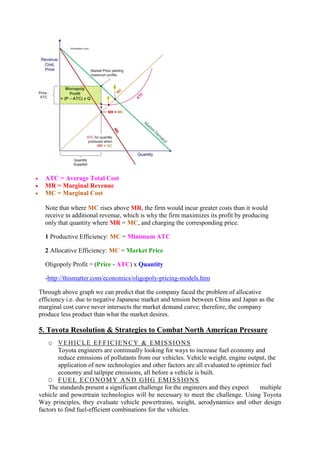
 ATC = Average Total Cost 
 MR = Marginal Revenue 
 MC = Marginal Cost 
Note that where MC rises above MR, the firm would incur greater costs than it would 
receive in additional revenue, which is why the firm maximizes its profit by producing 
only that quantity where MR = MC, and charging the corresponding price. 
1 Productive Efficiency: MC = Minimum ATC 
2 Allocative Efficiency: MC = Market Price 
Oligopoly Profit = (Price - ATC) x Quantity 
-http://thismatter.com/economics/oligopoly-pricing-models.htm 
Through above graph we can predict that the company faced the problem of allocative 
efficiency i.e. due to negative Japanese market and tension between China and Japan as the 
marginal cost curve never intersects the market demand curve; therefore, the company 
produce less product than what the market desires. 
5. Toyota Resolution & Strategies to Combat North American Pressure 
o VEHICLE EFFICIENCY & EMISSIONS 
Toyota engineers are continually looking for ways to increase fuel economy and 
reduce emissions of pollutants from our vehicles. Vehicle weight, engine output, the 
application of new technologies and other factors are all evaluated to optimize fuel 
economy and tailpipe emissions, all before a vehicle is built. 
O FUEL ECONOMY AND GHG EMISSIONS 
The standards present a significant challenge for the engineers and they expect multiple 
vehicle and powertrain technologies will be necessary to meet the challenge. Using Toyota 
Way principles, they evaluate vehicle powertrains, weight, aerodynamics and other design 
factors to find fuel-efficient combinations for the vehicles.
O CHEMICAL MANAGEMENT 
Toyota uses the International Material Data System (IMDS) as the primary tool for 
tracking the chemical composition of parts and accessories. 
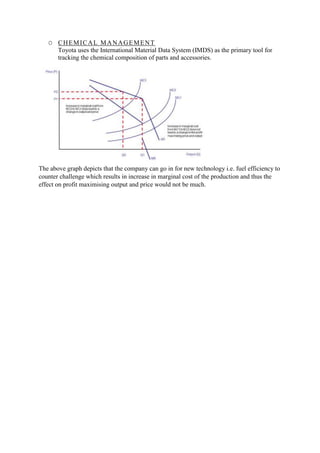
The above graph depicts that the company can go in for new technology i.e. fuel efficiency to 
counter challenge which results in increase in marginal cost of the production and thus the 
effect on profit maximising output and price would not be much.

Economic analysis of automobile industry

  • 1.
    Title: End termAssignment for project report groups Subject: Managerial Economics Prepared by: Nimisha Agarwal 2013173 Section-D Total words in assignment: 2000 Automobile Industry: Toyota Motor Corporation
  • 2.
    1. Brief Backgroundof the Firm: Toyota Motor Corporation is a Japanese multinational automaker headquartered in Toyota, Aichi, Japan. In 2010, Toyota employed 325,905 people worldwide, and was the third-largest manufacturer in 2011 by production behind General Motors and Volkswagen Group. Toyota is the eleventh-largest company in the world by revenue. In July 2012, the company reported it had manufactured its 200-millionth vehicle. The company was founded by Kiichiro Toyoda in 1937 as a spinoff from his father's company Toyota Industries to create automobiles. Three years earlier, in 1934, while still a department of Toyota Industries, it created its first product, the Type A engine, and, in 1936, its first passenger car, the Toyota. Toyota Motor Corporation group companies are Toyota (including the Scion brand), Lexus, Daihatsu, and Hino Motors, along with several "nonautomotive" companies. TMC is part of the Toyota Group, one of the largest conglomerates in the world. The thrifty Corolla was introduced in 1968 and, like the Corona, was a huge success with American drivers. Corolla has since become the world’s all-time best-selling passenger car, with over 30 million sold in more than 140 countries. In 1972 Toyota sold its one-millionth vehicle. By the end of 1975, Toyota surpassed Volkswagen to become the No. 1 import brand in the United States. Three years later, in 1978, Toyota won the "Import Triple Crown" by leading all import brands in sales of cars, trucks and total vehicles. As Toyota celebrated its 25th anniversary in America during 1982, it opened a new national sales headquarters complex that it occupies today in Torrance, Calif. May 2001 marked the incorporation of Toyota Motor Sales de Mexico, Toyota's new sales and marketing subsidiary in Mexico. By the end of the year, Toyota had grown to become the third-best-selling automotive brand in the United States, surpassing Dodge with best-ever sales of 1,741,254 vehicles. In December of 2002, Toyota delivered its first two zero-emission, market-ready hydrogen fuel cell vehicles to customers in California for real-world testing. The next year, Toyota's new, breakthrough hybrid technology, "Hybrid Synergy Drive," debuted in the all-new 2004 Prius. Toyota's growth in America continued in 2003 when Toyota launched Scion as its third line of vehicles. In 2005, Toyota continued expanding its environmentally advanced line-up with the introduction of the world’s first luxury hybrid, the Lexus RX 400h, and a hybrid option for the Toyota Highlander. Toyota added a hybrid option to its popular Camry sedan in 2006 and began building it in the United States at its massive Kentucky plant. The company also opened up its 10th U.S. plant in San Antonio, Texas, to build pickups. During 2007, its 50th year in America, Toyota introduced its largest pickup truck ever as well as the second-generation of its iconic Scion xB urban utility vehicle and the world’s first V8 hybrid, the Lexus LS 600h.As a result of an economic recession, Toyota’s sales were down in 2008. In 2009, Toyota launched two all-new gas/electric hybrids. During 2010; Toyota began production of the third-generation Sienna at its Indiana plant. Toyota has factories in most parts of the world, manufacturing or assembling vehicles for local markets. Toyota has manufacturing or assembly plants in Japan, Australia, India, Sri Lanka, Canada, Indonesia, Poland, South Africa, Turkey, Colombia, the United Kingdom, the United States, France, Brazil, Portugal, and more recently, Argentina, Czech Republic, Mexico, Malaysia, Thailand, Pakistan, Egypt, China, Vietnam, Venezuela, the Philippines, and Russia. Toyota's management philosophy has evolved from the company's origins and has been reflected in the terms "Lean Manufacturing" and Just in Time Production, which it was instrumental in developing. Toyota's managerial values and business methods are known collectively as the Toyota Way. In April 2001, Toyota adopted the "Toyota Way 2001", an expression of values and conduct guidelines that all Toyota employees should embrace.
  • 3.
    2. Market Structureand Pricing Policies of the Firm: 1. Destinations of the firm’s products or services: Toyota as an automobile firm serves both local and global market. 2. Competitors a) National Level The Japanese automotive industry has been one of the most important and largest industry in the world. Japan has been able to maintain its position as the top automobile manufacturer since last 50 years. Japan is now placed at 3rd position in the list of automotive producer in the world with an annual production of 9.9 million automobiles in 2012. Major competitors of Toyota in Japanese market include:  Nissan  Mazda  Suzuki  Honda. http://www.jama-english.jp/index.html b) International Level: Toyota is one of the top 5 large firms that dominate global industry. The annual production of automobiles has reached to 81.5 million in 2012. Major competitors in international arena are:  Ford  General Motors  Honda
  • 4.
    Direct Competitor Comparison Toyota Ford GM Honda Industry Market Cap: 196.93B 64.37B 47.25B 65.77B 21.50B Employees: 333,498 171,000 213,000 190,338 62.72K Qtrly Rev 0.14 0.15 0.04 0.16 0.42 Growth (yoy): Revenue (ttm): 289.95B 142.50B 152.84B 130.58B 65.16B Gross Margin (ttm): 0.17 0.14 0.09 0.25 0.19 EBITDA (ttm): 36.35B 11.99B 7.90B 11.86B 5.59B Operating Margin (ttm): 0.08 0.05 0.01 0.05 0.07 Net Income (ttm): 15.68B 6.07B 4.53B 4.55B N/A EPS (ttm): 9.90 1.52 2.79 2.52 2.90 P/E (ttm): 12.56 10.76 12.23 14.46 13.87 PEG (5 yr 0.32 0.77 0.57 0.58 1.05 expected): P/S (ttm): 0.68 0.45 0.31 0.50 0.61 http://finance.yahoo.com/;_ylt=An_OhXZ9NTXkqISYTK_Oov_p8rcF 3. Demand and cost curves: The reaction of rivals to a price change depends on whether price is increased or decreased. The demand curve will be kinked, at the current price.
  • 5.
    4. Market structure: An oligopoly is a market structure in which a few firms dominate. When a market is shared between a few firms, it is said to be highly concentrated. Although only a few firms dominate, it is possible that many small firms may also operate in the market. Now if we analyse global automobile industry we find following facts: Market share by manufacturer: 18.00% 16.00% 14.00% 12.00% 10.00% 8.00% 6.00% 4.00% 2.00% 0.00% -http://www.edmunds.com/industry-center/data/ On calculating total concentration ratio of top 5 firms we find that top 5 firms control 67.86 % of the market share and even though there are many other small firms operating as well, these five firms dominate the market. As we stated earlier this is how an oligopoly market operates so we can clearly say that Toyota has been operating in an oligopoly market.
  • 6.
    5. Pricing policies 1) Toyota Motor Corp is most willing to compensate suppliers for rising raw material costs, according to a survey by IRN Inc. The Grand Rapids, Mich., consulting firm polled 92 suppliers in May and June about the raw material pricing policies of nine automakers that assemble vehicles in North America. Sixty percent of respondents said Toyota was very likely to "satisfactorily offset raw material price increases. Toyota leads the pack Toyota: 60% BMW: 33 Ford: 51 GM: 31 Honda: 43 Nissan: 28 Chrysler: 37 Mercedes: 14 Hyundai: 13 Source: IRN Inc. 2) Although prices in the automobile market are traditionally negotiated, Toyota are selling their vehicles at a "no-haggle" or fixed price. 3) As the demand of hybrid cars is elastic in nature so it is best in favour of Toyota to have a penetration pricing strategy instead of skimming pricing strategy. a) The most important reason is that because hybrid cars is a relatively new venture, people are just a bit cautious while going for it. b) The market penetration pricing strategy would allow the company to get into the masses with the label of low price. c) The auto luxury segment demand analysis suggested an almost perfect strategy for Toyota marketing high performance cars presumably equal in quality to Mercedes and BMW, but priced somewhere between those and such luxury U.S. models Cadillac and Lincoln. d) Although Lexus started approximately in the same price range, they used different approaches when promoting their models. Toyota also allowed for more price variation, using price haggling deals and equipping the models with additional luxury accessories
  • 7.
    3. Present ChallengesFaced By the Company:  North American Pressure Toyota’s Prius accounts for about 12% of the carmaker’s total American sales, however its dominance could fade as rival automakers introduce new and improved hybrids and electrics. Toyota’s star seller, Camry, is under considerable pressure now that the refreshed models of Honda Accord and Ford Fusion have been introduced. North America accounts for about a fourth of Toyota’s global sales so any disruptions here will have a significant impact on its total sales.  Negative Japanese Market Japan’s economy suffered in 2011 due to natural disasters like earthquakes and a tsunami. To help lift the automobile market, the government provided tax incentives to encourage people to buy cars. The buyers rushed to purchase new vehicles before the subsidies ended in September, and now with its expiry the market is expected to decline next year.  Tensions between China & Japan Sales of Japanese automakers have suffered due to an anti-Japanese backlash in China. As a result, Korean and German automakers are benefiting at the expense of Japanese automakers in this region. Sales figures are getting back to normal and Toyota had earlier targeted sales of 1 million vehicles, but now has lowered it to 800,000. China is the world’s largest automobile market and Toyota’s inability to capitalize on this huge, growing market will have a considerable effect on its long term profitability.  Exodus of Top Executives In just the past three months, three senior executives in Toyota's North American business abruptly left for rivals. These high-profile defections underline a new danger looming for the Japanese automaker — the lure of U.S. companies wooing the best in its ranks. The executive exodus signals Toyota Motor Corporation's growing pains overseas.
  • 8.
     ATC =Average Total Cost  MR = Marginal Revenue  MC = Marginal Cost Note that where MC rises above MR, the firm would incur greater costs than it would receive in additional revenue, which is why the firm maximizes its profit by producing only that quantity where MR = MC, and charging the corresponding price. 1 Productive Efficiency: MC = Minimum ATC 2 Allocative Efficiency: MC = Market Price Oligopoly Profit = (Price - ATC) x Quantity -http://thismatter.com/economics/oligopoly-pricing-models.htm Through above graph we can predict that the company faced the problem of allocative efficiency i.e. due to negative Japanese market and tension between China and Japan as the marginal cost curve never intersects the market demand curve; therefore, the company produce less product than what the market desires. 5. Toyota Resolution & Strategies to Combat North American Pressure o VEHICLE EFFICIENCY & EMISSIONS Toyota engineers are continually looking for ways to increase fuel economy and reduce emissions of pollutants from our vehicles. Vehicle weight, engine output, the application of new technologies and other factors are all evaluated to optimize fuel economy and tailpipe emissions, all before a vehicle is built. O FUEL ECONOMY AND GHG EMISSIONS The standards present a significant challenge for the engineers and they expect multiple vehicle and powertrain technologies will be necessary to meet the challenge. Using Toyota Way principles, they evaluate vehicle powertrains, weight, aerodynamics and other design factors to find fuel-efficient combinations for the vehicles.
  • 9.
    O CHEMICAL MANAGEMENT Toyota uses the International Material Data System (IMDS) as the primary tool for tracking the chemical composition of parts and accessories. The above graph depicts that the company can go in for new technology i.e. fuel efficiency to counter challenge which results in increase in marginal cost of the production and thus the effect on profit maximising output and price would not be much.