Toyota: A Global Leader in
Automotive Manufacturing
Presented By:
Selvamuthu Kumar S
125071075
History of Toyota
Toyota Motor Corporation is a Japanese multinational automotive manufacturer that was founded in 1937 by Kiichiro Toyoda.
The company's roots can be traced back to 1924, when Kiichiro's father, Sakichi Toyoda, invented an automatic loom. The
invention was a success and led to the founding of the Toyoda Automatic Loom Works in 1926. Kiichiro, who had been working
for his father's company, became interested in automobiles and began studying automobile production in the United States in
the early 1930s.
Pre-War Era
In 1933, Kiichiro returned to Japan and founded the Toyota Motor Company as a subsidiary of the Toyoda Automatic
Loom Works. The company's first production car, the Model AA, was produced in 1936. However, the outbreak of
World War II halted Toyota's automobile production, and the company was forced to produce trucks and military
vehicles for the Japanese army.
Post-War Era
After the war, Toyota resumed automobile production and began exporting cars to the United States in the late 1950s.
The company's first export, the Toyota Crown, was not successful in the US market due to its small size and lack of
power. However, Toyota continued to improve its products and in 1965 introduced the Toyota Corolla, which became a
huge success and helped establish Toyota as a major player in the global automotive market.
Recent History
In recent years, Toyota has faced challenges such as the global financial crisis and the 2011 earthquake and tsunami in
Japan. However, the company has remained committed to innovation and sustainability. In 2015, Toyota announced
its Toyota Environmental Challenge 2050, which aims to reduce the company's carbon footprint and promote
sustainable manufacturing and recycling practices.
Toyota's Global Presence:
Toyota is a global company with a presence in over 170 countries and regions. The company has manufacturing plants,
research and development facilities, and sales offices around the world.
Manufacturing Plants
Toyota has manufacturing plants in
many countries including Japan,
the United States, Canada, Mexico,
the United Kingdom, France,
Turkey, South Africa, Brazil, and
China. These plants produce a wide
range of Toyota vehicles for both
domestic and international
markets.
Sales Offices
Toyota has sales offices in many
countries around the world, including
the United States, Canada, Mexico,
Brazil, the United Kingdom, Germany,
Italy, Spain, Australia, China, and Japan.
These offices are responsible for
marketing and selling Toyota vehicles in
their respective regions.
Research and Development Facilities
Toyota has research and development
facilities in many countries around the
world, including Japan, the United States,
Germany, France, and China. These
facilities are responsible for developing
new technologies and improving existing
ones to make Toyota more efficient, and
more environmentally friendly.
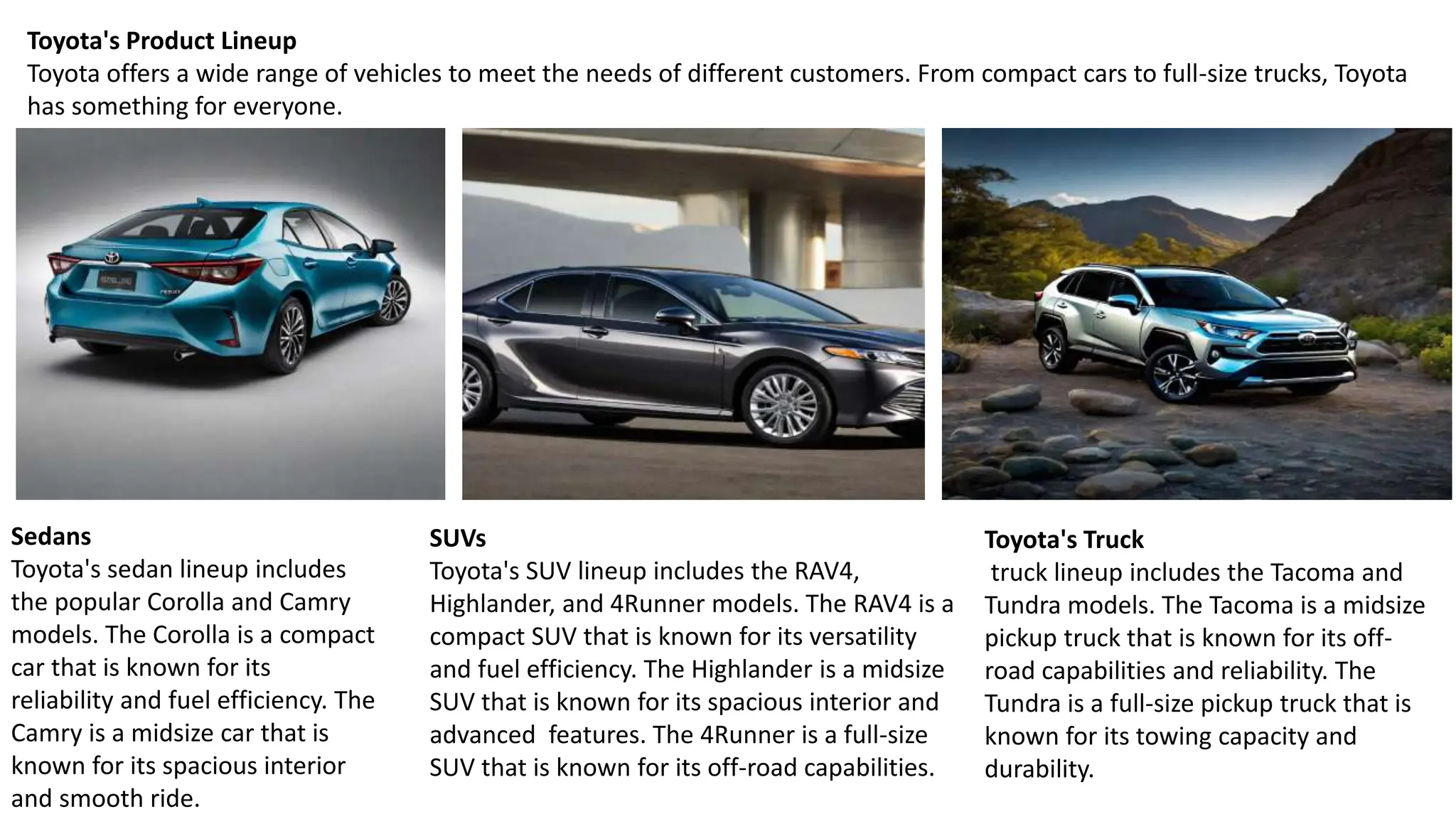
Toyota's Product Lineup
Toyota offers a wide range of vehicles to meet the needs of different customers. From compact cars to full-size trucks, Toyota
has something for everyone.
Sedans
Toyota's sedan lineup includes
the popular Corolla and Camry
models. The Corolla is a compact
car that is known for its
reliability and fuel efficiency. The
Camry is a midsize car that is
known for its spacious interior
and smooth ride.
SUVs
Toyota's SUV lineup includes the RAV4,
Highlander, and 4Runner models. The RAV4 is a
compact SUV that is known for its versatility
and fuel efficiency. The Highlander is a midsize
SUV that is known for its spacious interior and
advanced features. The 4Runner is a full-size
SUV that is known for its off-road capabilities.
Toyota's Truck
truck lineup includes the Tacoma and
Tundra models. The Tacoma is a midsize
pickup truck that is known for its off-
road capabilities and reliability. The
Tundra is a full-size pickup truck that is
known for its towing capacity and
durability.
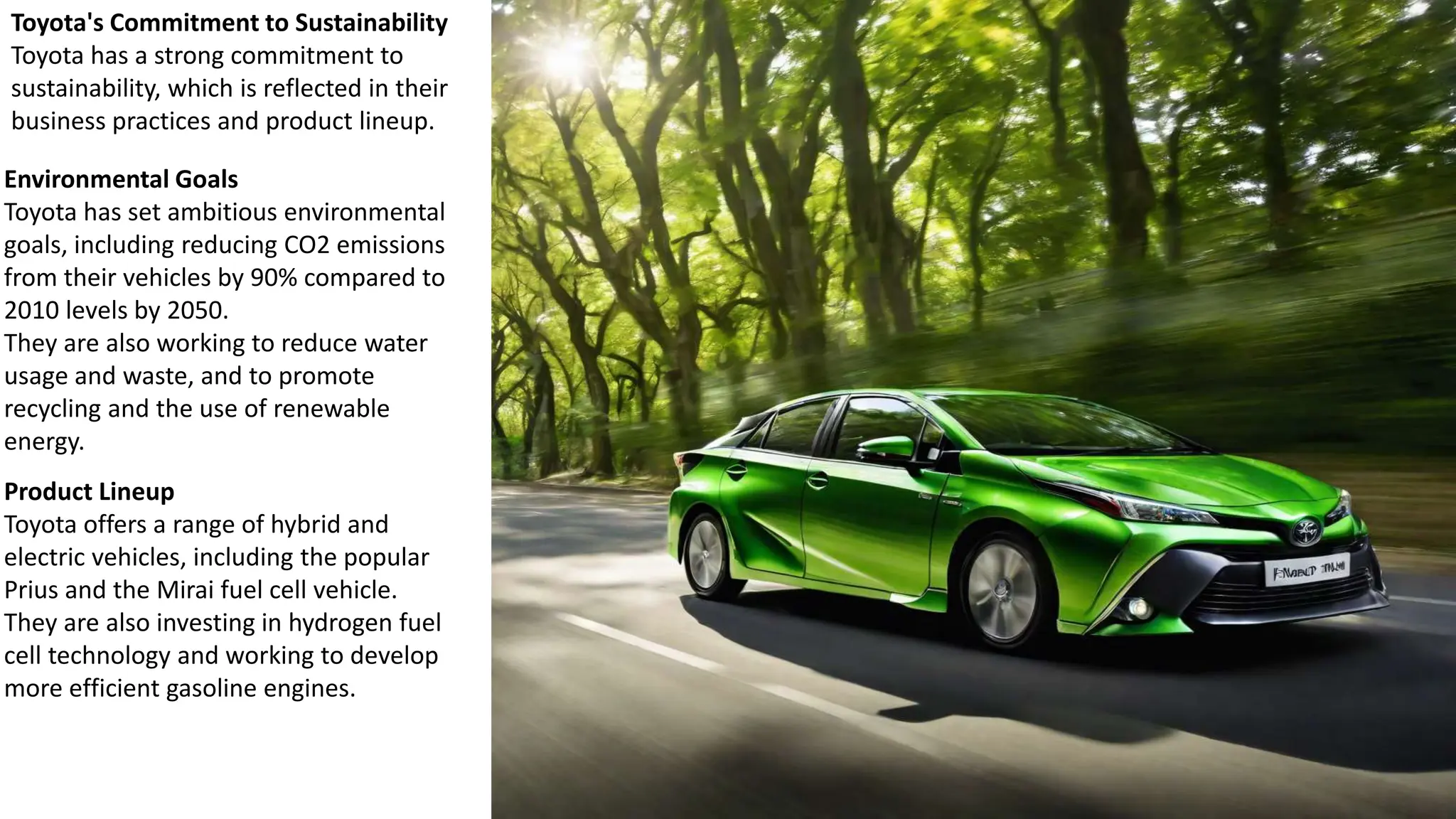
Toyota's Commitment to Sustainability
Toyota has a strong commitment to
sustainability, which is reflected in their
business practices and product lineup.
Environmental Goals
Toyota has set ambitious environmental
goals, including reducing CO2 emissions
from their vehicles by 90% compared to
2010 levels by 2050.
They are also working to reduce water
usage and waste, and to promote
recycling and the use of renewable
energy.
Product Lineup
Toyota offers a range of hybrid and
electric vehicles, including the popular
Prius and the Mirai fuel cell vehicle.
They are also investing in hydrogen fuel
cell technology and working to develop
more efficient gasoline engines.
Toyota: A Brief Overview
History
Toyota was founded in 1937 by Kiichiro Toyoda, and
is headquartered in Toyota City, Japan. The company
started as a spinoff of Toyota Industries, a textile
machinery manufacturer, and initially focused on
producing automobiles. In the years following World
War II, Toyota expanded its operations globally, and
by the 1960s had become one of the largest
automobile manufacturers in the world.
Global Presence
Toyota has a global presence, with manufacturing
facilities and sales offices in over 160 countries. The
company is one of the largest automobile
manufacturers in the world, and is known for its wide
range of vehicles, including cars, trucks, and SUVs. In
addition to its automotive operations, Toyota also has
a significant presence in other industries, such as
robotics and space exploration.
Toyota ppt.pptx

Toyota ppt.pptx

  • 1.
    Toyota: A GlobalLeader in Automotive Manufacturing Presented By: Selvamuthu Kumar S 125071075
  • 2.
    History of Toyota ToyotaMotor Corporation is a Japanese multinational automotive manufacturer that was founded in 1937 by Kiichiro Toyoda. The company's roots can be traced back to 1924, when Kiichiro's father, Sakichi Toyoda, invented an automatic loom. The invention was a success and led to the founding of the Toyoda Automatic Loom Works in 1926. Kiichiro, who had been working for his father's company, became interested in automobiles and began studying automobile production in the United States in the early 1930s.
  • 3.
    Pre-War Era In 1933,Kiichiro returned to Japan and founded the Toyota Motor Company as a subsidiary of the Toyoda Automatic Loom Works. The company's first production car, the Model AA, was produced in 1936. However, the outbreak of World War II halted Toyota's automobile production, and the company was forced to produce trucks and military vehicles for the Japanese army. Post-War Era After the war, Toyota resumed automobile production and began exporting cars to the United States in the late 1950s. The company's first export, the Toyota Crown, was not successful in the US market due to its small size and lack of power. However, Toyota continued to improve its products and in 1965 introduced the Toyota Corolla, which became a huge success and helped establish Toyota as a major player in the global automotive market. Recent History In recent years, Toyota has faced challenges such as the global financial crisis and the 2011 earthquake and tsunami in Japan. However, the company has remained committed to innovation and sustainability. In 2015, Toyota announced its Toyota Environmental Challenge 2050, which aims to reduce the company's carbon footprint and promote sustainable manufacturing and recycling practices.
  • 4.
    Toyota's Global Presence: Toyotais a global company with a presence in over 170 countries and regions. The company has manufacturing plants, research and development facilities, and sales offices around the world. Manufacturing Plants Toyota has manufacturing plants in many countries including Japan, the United States, Canada, Mexico, the United Kingdom, France, Turkey, South Africa, Brazil, and China. These plants produce a wide range of Toyota vehicles for both domestic and international markets. Sales Offices Toyota has sales offices in many countries around the world, including the United States, Canada, Mexico, Brazil, the United Kingdom, Germany, Italy, Spain, Australia, China, and Japan. These offices are responsible for marketing and selling Toyota vehicles in their respective regions. Research and Development Facilities Toyota has research and development facilities in many countries around the world, including Japan, the United States, Germany, France, and China. These facilities are responsible for developing new technologies and improving existing ones to make Toyota more efficient, and more environmentally friendly.
  • 5.
    Toyota's Product Lineup Toyotaoffers a wide range of vehicles to meet the needs of different customers. From compact cars to full-size trucks, Toyota has something for everyone. Sedans Toyota's sedan lineup includes the popular Corolla and Camry models. The Corolla is a compact car that is known for its reliability and fuel efficiency. The Camry is a midsize car that is known for its spacious interior and smooth ride. SUVs Toyota's SUV lineup includes the RAV4, Highlander, and 4Runner models. The RAV4 is a compact SUV that is known for its versatility and fuel efficiency. The Highlander is a midsize SUV that is known for its spacious interior and advanced features. The 4Runner is a full-size SUV that is known for its off-road capabilities. Toyota's Truck truck lineup includes the Tacoma and Tundra models. The Tacoma is a midsize pickup truck that is known for its off- road capabilities and reliability. The Tundra is a full-size pickup truck that is known for its towing capacity and durability.
  • 6.
    Toyota's Commitment toSustainability Toyota has a strong commitment to sustainability, which is reflected in their business practices and product lineup. Environmental Goals Toyota has set ambitious environmental goals, including reducing CO2 emissions from their vehicles by 90% compared to 2010 levels by 2050. They are also working to reduce water usage and waste, and to promote recycling and the use of renewable energy. Product Lineup Toyota offers a range of hybrid and electric vehicles, including the popular Prius and the Mirai fuel cell vehicle. They are also investing in hydrogen fuel cell technology and working to develop more efficient gasoline engines.
  • 7.
    Toyota: A BriefOverview History Toyota was founded in 1937 by Kiichiro Toyoda, and is headquartered in Toyota City, Japan. The company started as a spinoff of Toyota Industries, a textile machinery manufacturer, and initially focused on producing automobiles. In the years following World War II, Toyota expanded its operations globally, and by the 1960s had become one of the largest automobile manufacturers in the world. Global Presence Toyota has a global presence, with manufacturing facilities and sales offices in over 160 countries. The company is one of the largest automobile manufacturers in the world, and is known for its wide range of vehicles, including cars, trucks, and SUVs. In addition to its automotive operations, Toyota also has a significant presence in other industries, such as robotics and space exploration.