BASIC CONCEPTS OF
TOXICOLOGY
MALAVIKA MR
2015-09-013
1
TOXICOLOGY
 The traditional definition of toxicology is "the
science of poisons.“
 The study of the adverse effects of chemicals or
physical agents on living organisms
 Adverse effects may occur in many forms,
ranging from immediate death to subtle
changes not realized until months or years later.
 They may occur at various levels within the
body, such as an organ, a type of cell, or a
specific biochemical. 2
 Orfila, a Spanish physician, is often referred to as the
founder of toxicology.
 It was Orfila who first prepared a systematic correlation
between the chemical and biological properties of
poisons of the time.
3
 Xenobiotic is the general term that is used
for a foreign substance taken into the body.
 It is derived from the Greek term xeno which
means "foreigner.
 " Xenobiotics may produce beneficial effects
(such as a pharmaceuticals) or they may be
toxic (such as lead).
 A xenobiotic in small amounts may be non-toxic
and even beneficial but when the dose is
increased, toxic and lethal effects may result.
4
5
Toxic substances may be systemic
toxins or organ toxins
 A systemic toxin is one that affects the entire body or many
organs rather than a specific site.
 potassium cyanide is a systemic toxicant in that it affects virtually
every cell and organ in the body by interfering with the cell's ability
to utilize oxygen.
 Toxicants may also affect only specific tissues or organs while not
producing damage to the body as a whole.These specific sites are
known as the target organs or target tissues.
 Some examples: Benzene is a specific organ toxin in that it is
primarily toxic to the blood-forming tissues.
 Lead is also a specific organ toxin; however, it has three target
organs (central nervous system, kidney, and hematopoietic system).
6
7
Factors determining adverse
effects
 intrinsic toxicity
 dose
 exposure conditions
 response of host
8
INTRINSIC TOXICITY
Chemical properties
 molecular structure & functional groups
 solubility - insolubility
 volatility
 stability (light, water, acids, enzymes, …)
 reactivity
Physical properties
 gas (density, …)
 liquid (vapour pressure, …)
 solid (crystal structure, size, shape, …)
9
Dose
 Dose by definition is the amount of a
substance administered at one time. However,
other parameters are needed to characterize the
exposure to xenobiotics.
 The most important are the number of doses,
frequency, and total time period of the
treatment.
Some examples:
 500 mg Asperin as a single dose
 500 mg Penicillin every 8 hours for 10 days
 15 mg DDT per day for 60 days
10
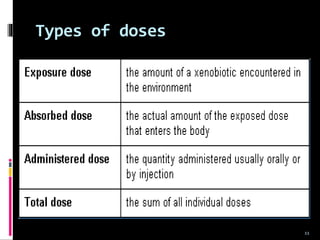
Types of doses
11
 The dose level at which a toxic effect is first
encountered is known as the threshold dose.
 Doses below the threshold dose are often
referred to as "subthreshold doses."
12
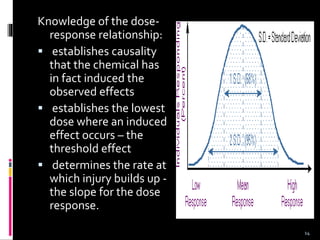
Dose-response relationship
 The higher the dose, the more severe the
response.
 The dose-response relationship is based on
observed data from experimental animal,
human clinical, or cell studies.
13
Knowledge of the dose-
response relationship:
 establishes causality
that the chemical has
in fact induced the
observed effects
 establishes the lowest
dose where an induced
effect occurs – the
threshold effect
 determines the rate at
which injury builds up -
the slope for the dose
response.
14
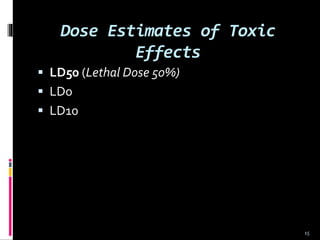
Dose Estimates of Toxic
Effects
 LD50 (Lethal Dose 50%)
 LD0
 LD10
15
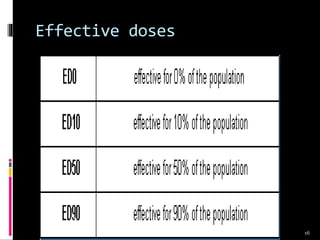
Effective doses
16
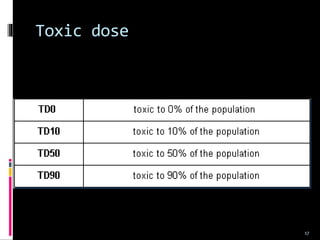
Toxic dose
17
 No Observed Adverse Effect Level(NOAEL)
 Low Observed Adverse Effect Level
(LOAEL)
 No Observed Effect Level (NOEL)
 Lowest Observed Effect Level (LOEL)
 The NOAEL, LOAEL, NOEL, and LOEL have
great importance in the conduct of risk
assessments.
18
Exposure conditions
 routes of exposure
 frequency & duration of exposure
 mixed exposures
 environmental circumstances
19
Response of host
Toxicity can result from adverse cellular, biochemical,
or macromolecular changes. Examples are:
 - cell replacement, such as fibrosis
 - damage to an enzyme system
 - disruption of protein synthesis
 - production of reactive chemicals in cells
 - DNA damage
Some xenobiotics may also act indirectly by:
 - modification of an essential biochemical function
 - interference with nutrition
 - alteration of a physiological mechanism
20
Systemic Toxic Effects
 􀂇􀂇 AcuteToxicity occurs almost immediately
(hours/days) after an exposure, methyl isocyanate
from an industrial accident in Bhopal
 􀂇􀂇 SubchronicToxicity results from repeated
exposure for several weeks or months,
 􀂇􀂇 ChronicToxicity represents cumulative
damage to specific organ systems and takes
many months or years to become a recognizable
clinical disease
21
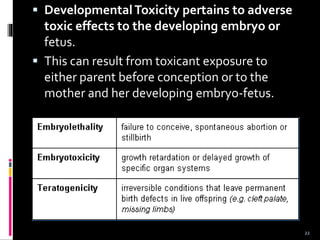
 DevelopmentalToxicity pertains to adverse
toxic effects to the developing embryo or
fetus.
 This can result from toxicant exposure to
either parent before conception or to the
mother and her developing embryo-fetus.
22
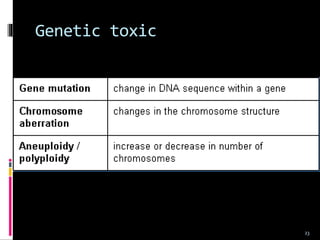
Genetic toxic
23
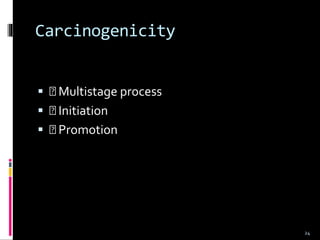
Carcinogenicity
 􀂇 Multistage process
 􀂇 Initiation
 􀂇 Promotion
24
Organ specific toxicity
 Blood/CardiovascularToxicity
 Dermal/OcularToxicity
 GeneticToxicity (germ cells)
 Hepatotoxicity
 Immunotoxicity
 Nephrotoxicity
 Neurotoxicity
 ReproductiveToxicity
 RespiratoryToxicity
25
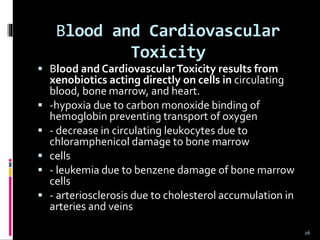
Blood and Cardiovascular
Toxicity
 Blood and CardiovascularToxicity results from
xenobiotics acting directly on cells in circulating
blood, bone marrow, and heart.
 -hypoxia due to carbon monoxide binding of
hemoglobin preventing transport of oxygen
 - decrease in circulating leukocytes due to
chloramphenicol damage to bone marrow
 cells
 - leukemia due to benzene damage of bone marrow
cells
 - arteriosclerosis due to cholesterol accumulation in
arteries and veins
26
Dermal Toxicity
 DermalToxicity may result from direct contact or
internal distribution to the skin.
 Effects range from mild irritation to severe changes,
such as corrosivity, hypersensitivity, and skin cancer.
Examples of dermal toxicity are:
 - dermal irritation due to skin exposure to gasoline
 - dermal corrosion due to skin exposure to sodium
hydroxide
 - dermal hypersensitivity due to skin exposure to
poison ivy
 - skin cancer due to ingestion of arsenic or skin
exposure to UV light
27
Eye (Ocular) Toxicity
 Eye (Ocular)Toxicity results from direct contact or
internal distribution to the eye.
 The cornea and conjunctiva are directly exposed to
toxicants.
 Thus, conjunctivitis and corneal erosion may be observed
following occupational exposure to chemicals.
 Chemicals in the circulatory system can distribute to the
eye and cause corneal opacity, cataracts, retinal and optic
nerve damage.
 - acids and strong alkalis may cause severe corneal
corrosion
 - corticosteroids may cause cataracts
 - methanol (wood alcohol) may damage the optic nerve
28
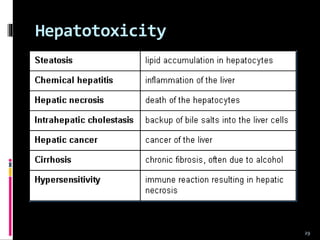
Hepatotoxicity
29
Immunotoxicity
 Immunotoxicity relates to the immune
system. It can take several forms:
hypersensitivity (allergy and autoimmunity),
immunodeficiency, and uncontrolled
proliferation (leukemia and lymphoma).
30
Nephrotoxicity
 Nephrotoxicity is toxicity to the kidneys. It
can result in systemic toxicity causing:
 - decreased ability to excrete body wastes
 - inability to maintain body fluid and
electrolyte balance
 - decreased synthesis of essential hormones
(e.g., erythropoietin)
31
Reproductive Toxicity
 ReproductiveToxicity involves toxicant damage to
either the male or female reproductive system.
Toxic effects may cause:
 - decreased libido and impotence
 - infertility
 - interrupted pregnancy (abortion, fetal death, or
premature delivery)
 - infant death or childhood morbidity
 - altered sex ratio and multiple births
 - chromosome abnormalities and birth defects
 - childhood cancer
32
Respiratory Toxicity
 RespiratoryToxicity relates to effects on the upper
respiratory system
 The primary types of respiratory toxicity are:
 - pulmonary irritation
 - asthma/bronchitis
 - reactive airway disease
 - emphysema
 - allergic alveolitis
 - fibrotic lung disease
 - pneumoconiosis
 - lung cancer
33
34
THANK YOU

Basic concepts of toxicology

  • 1.
  • 2.
    TOXICOLOGY  The traditionaldefinition of toxicology is "the science of poisons.“  The study of the adverse effects of chemicals or physical agents on living organisms  Adverse effects may occur in many forms, ranging from immediate death to subtle changes not realized until months or years later.  They may occur at various levels within the body, such as an organ, a type of cell, or a specific biochemical. 2
  • 3.
     Orfila, aSpanish physician, is often referred to as the founder of toxicology.  It was Orfila who first prepared a systematic correlation between the chemical and biological properties of poisons of the time. 3
  • 4.
     Xenobiotic isthe general term that is used for a foreign substance taken into the body.  It is derived from the Greek term xeno which means "foreigner.  " Xenobiotics may produce beneficial effects (such as a pharmaceuticals) or they may be toxic (such as lead).  A xenobiotic in small amounts may be non-toxic and even beneficial but when the dose is increased, toxic and lethal effects may result. 4
  • 5.
  • 6.
    Toxic substances maybe systemic toxins or organ toxins  A systemic toxin is one that affects the entire body or many organs rather than a specific site.  potassium cyanide is a systemic toxicant in that it affects virtually every cell and organ in the body by interfering with the cell's ability to utilize oxygen.  Toxicants may also affect only specific tissues or organs while not producing damage to the body as a whole.These specific sites are known as the target organs or target tissues.  Some examples: Benzene is a specific organ toxin in that it is primarily toxic to the blood-forming tissues.  Lead is also a specific organ toxin; however, it has three target organs (central nervous system, kidney, and hematopoietic system). 6
  • 7.
  • 8.
    Factors determining adverse effects intrinsic toxicity  dose  exposure conditions  response of host 8
  • 9.
    INTRINSIC TOXICITY Chemical properties molecular structure & functional groups  solubility - insolubility  volatility  stability (light, water, acids, enzymes, …)  reactivity Physical properties  gas (density, …)  liquid (vapour pressure, …)  solid (crystal structure, size, shape, …) 9
  • 10.
    Dose  Dose bydefinition is the amount of a substance administered at one time. However, other parameters are needed to characterize the exposure to xenobiotics.  The most important are the number of doses, frequency, and total time period of the treatment. Some examples:  500 mg Asperin as a single dose  500 mg Penicillin every 8 hours for 10 days  15 mg DDT per day for 60 days 10
  • 11.
  • 12.
     The doselevel at which a toxic effect is first encountered is known as the threshold dose.  Doses below the threshold dose are often referred to as "subthreshold doses." 12
  • 13.
    Dose-response relationship  Thehigher the dose, the more severe the response.  The dose-response relationship is based on observed data from experimental animal, human clinical, or cell studies. 13
  • 14.
    Knowledge of thedose- response relationship:  establishes causality that the chemical has in fact induced the observed effects  establishes the lowest dose where an induced effect occurs – the threshold effect  determines the rate at which injury builds up - the slope for the dose response. 14
  • 15.
    Dose Estimates ofToxic Effects  LD50 (Lethal Dose 50%)  LD0  LD10 15
  • 16.
  • 17.
  • 18.
     No ObservedAdverse Effect Level(NOAEL)  Low Observed Adverse Effect Level (LOAEL)  No Observed Effect Level (NOEL)  Lowest Observed Effect Level (LOEL)  The NOAEL, LOAEL, NOEL, and LOEL have great importance in the conduct of risk assessments. 18
  • 19.
    Exposure conditions  routesof exposure  frequency & duration of exposure  mixed exposures  environmental circumstances 19
  • 20.
    Response of host Toxicitycan result from adverse cellular, biochemical, or macromolecular changes. Examples are:  - cell replacement, such as fibrosis  - damage to an enzyme system  - disruption of protein synthesis  - production of reactive chemicals in cells  - DNA damage Some xenobiotics may also act indirectly by:  - modification of an essential biochemical function  - interference with nutrition  - alteration of a physiological mechanism 20
  • 21.
    Systemic Toxic Effects 􀂇􀂇 AcuteToxicity occurs almost immediately (hours/days) after an exposure, methyl isocyanate from an industrial accident in Bhopal  􀂇􀂇 SubchronicToxicity results from repeated exposure for several weeks or months,  􀂇􀂇 ChronicToxicity represents cumulative damage to specific organ systems and takes many months or years to become a recognizable clinical disease 21
  • 22.
     DevelopmentalToxicity pertainsto adverse toxic effects to the developing embryo or fetus.  This can result from toxicant exposure to either parent before conception or to the mother and her developing embryo-fetus. 22
  • 23.
  • 24.
    Carcinogenicity  􀂇 Multistageprocess  􀂇 Initiation  􀂇 Promotion 24
  • 25.
    Organ specific toxicity Blood/CardiovascularToxicity  Dermal/OcularToxicity  GeneticToxicity (germ cells)  Hepatotoxicity  Immunotoxicity  Nephrotoxicity  Neurotoxicity  ReproductiveToxicity  RespiratoryToxicity 25
  • 26.
    Blood and Cardiovascular Toxicity Blood and CardiovascularToxicity results from xenobiotics acting directly on cells in circulating blood, bone marrow, and heart.  -hypoxia due to carbon monoxide binding of hemoglobin preventing transport of oxygen  - decrease in circulating leukocytes due to chloramphenicol damage to bone marrow  cells  - leukemia due to benzene damage of bone marrow cells  - arteriosclerosis due to cholesterol accumulation in arteries and veins 26
  • 27.
    Dermal Toxicity  DermalToxicitymay result from direct contact or internal distribution to the skin.  Effects range from mild irritation to severe changes, such as corrosivity, hypersensitivity, and skin cancer. Examples of dermal toxicity are:  - dermal irritation due to skin exposure to gasoline  - dermal corrosion due to skin exposure to sodium hydroxide  - dermal hypersensitivity due to skin exposure to poison ivy  - skin cancer due to ingestion of arsenic or skin exposure to UV light 27
  • 28.
    Eye (Ocular) Toxicity Eye (Ocular)Toxicity results from direct contact or internal distribution to the eye.  The cornea and conjunctiva are directly exposed to toxicants.  Thus, conjunctivitis and corneal erosion may be observed following occupational exposure to chemicals.  Chemicals in the circulatory system can distribute to the eye and cause corneal opacity, cataracts, retinal and optic nerve damage.  - acids and strong alkalis may cause severe corneal corrosion  - corticosteroids may cause cataracts  - methanol (wood alcohol) may damage the optic nerve 28
  • 29.
  • 30.
    Immunotoxicity  Immunotoxicity relatesto the immune system. It can take several forms: hypersensitivity (allergy and autoimmunity), immunodeficiency, and uncontrolled proliferation (leukemia and lymphoma). 30
  • 31.
    Nephrotoxicity  Nephrotoxicity istoxicity to the kidneys. It can result in systemic toxicity causing:  - decreased ability to excrete body wastes  - inability to maintain body fluid and electrolyte balance  - decreased synthesis of essential hormones (e.g., erythropoietin) 31
  • 32.
    Reproductive Toxicity  ReproductiveToxicityinvolves toxicant damage to either the male or female reproductive system. Toxic effects may cause:  - decreased libido and impotence  - infertility  - interrupted pregnancy (abortion, fetal death, or premature delivery)  - infant death or childhood morbidity  - altered sex ratio and multiple births  - chromosome abnormalities and birth defects  - childhood cancer 32
  • 33.
    Respiratory Toxicity  RespiratoryToxicityrelates to effects on the upper respiratory system  The primary types of respiratory toxicity are:  - pulmonary irritation  - asthma/bronchitis  - reactive airway disease  - emphysema  - allergic alveolitis  - fibrotic lung disease  - pneumoconiosis  - lung cancer 33
  • 34.