Introduction To Toxicology
&
Factors Influencing Toxicity
By: Dr. Sarita Sharma
Assistant Professor
Department of Pharmacology
Mumbai
Blueprint:
Total: 40 Marks
Total 5 questions: each 8 marks
Q.1 Q.2 Q.3 Q.4 Q.5
Unit 1:
+ +
Unit 2:
+ + + (1 Q)
Unit 3: + + (2 Q)
Unit 4: + +
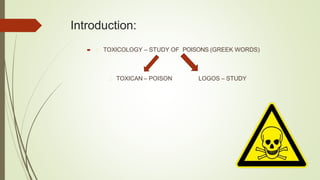
Introduction:
 TOXICOLOGY – STUDY OF POISONS (GREEK WORDS)
TOXICAN – POISON LOGOS – STUDY
DOSE-RESPONSE
RELATIOSHIP
Toxicology:
 Toxicology involves the study of the deleterious effects of chemical
substances on living organisms and the practice of diagnosing and
treating exposures to toxins and toxicants.
 Toxicology is the science dealing with properties, actions, toxicity, fatal dose,
detection of, interpretation of the result of toxicological analysis and treatment
of poisons
 Any substance can be toxic if introduced in a dose capable of
disturbing the normal physiological homeostasis of the exposed body.
OR
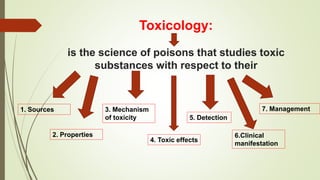
Toxicology:
is the science of poisons that studies toxic
substances with respect to their
1. Sources
5. Detection
2. Properties
3. Mechanism
of toxicity
4. Toxic effects
6.Clinical
manifestation
7. Management
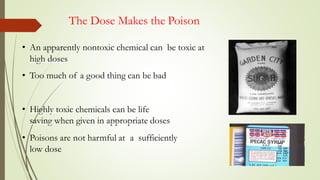
The Dose Makes the Poison
• An apparently nontoxic chemical can be toxic at
high doses
• Too much of a good thing can be bad
• Highly toxic chemicals can be life
saving when given in appropriate doses
• Poisons are not harmful at a sufficiently
low dose
Definations:
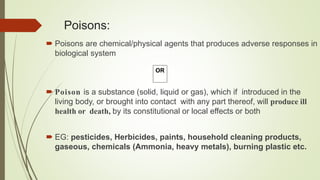
Poisons:
 Poisons are chemical/physical agents that produces adverse responses in
biological system
 Poison is a substance (solid, liquid or gas), which if introduced in the
living body, or brought into contact with any part thereof, will produce ill
health or death, by its constitutional or local effects or both
 EG: pesticides, Herbicides, paints, household cleaning products,
gaseous, chemicals (Ammonia, heavy metals), burning plastic etc.
OR
Hazard—
 Hazard is the ability of a chemical agent to cause injury in a given situation or setting.
 For example, asphyxiation(suffocation) is the hazard from acute exposures to
carbon monoxide (CO).
 To assess hazard, one need to have knowledge about both the inherent toxicity of the
substance & the amount to which individuals are liable to be exposed.
 Humans can safely use potentially toxic substances when the necessary conditions
minimising absorption are established and respected.
Risk—
 the measure or probability that a specific exposure situation or dose will produce
a toxic effect.
OR
 Defined as the expected frequency of the occurrence of an undesirable effect
arising from exposure to a chemical or physical agent.
 Estimation of risk makes use of dose-response data & extrapolation from the
observed relationship to the expected responses at doses occurring in actual
exposure situations.
 The quality and suitability of the biologic data used in such estimates are major
limiting factors.
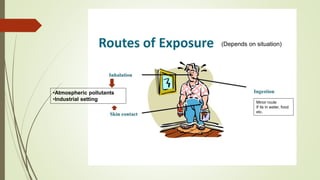
•Atmospheric pollutants
•Industrial setting
Minor route
If its in water, food
etc.
(Depends on situation)
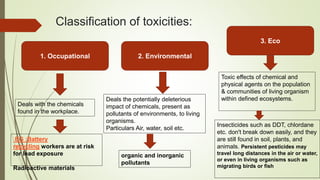
Classification of toxicities:
1. Occupational 2. Environmental
3. Eco
Deals with the chemicals
found in the workplace.
Deals the potentially deleterious
impact of chemicals, present as
pollutants of environments, to living
organisms.
Particulars Air, water, soil etc.
Toxic effects of chemical and
physical agents on the population
& communities of living organism
within defined ecosystems.
EG :Battery
recycling workers are at risk
for lead exposure
Radioactive materials
organic and inorganic
pollutants
Insecticides such as DDT, chlordane
etc. don't break down easily, and they
are still found in soil, plants, and
animals. Persistent pesticides may
travel long distances in the air or water,
or even in living organisms such as
migrating birds or fish
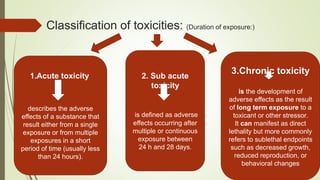
Classification of toxicities: (Duration of exposure:)
1.Acute toxicity
describes the adverse
effects of a substance that
result either from a single
exposure or from multiple
exposures in a short
period of time (usually less
than 24 hours).
3.Chronic toxicity
is the development of
adverse effects as the result
of long term exposure to a
toxicant or other stressor.
It can manifest as direct
lethality but more commonly
refers to sublethal endpoints
such as decreased growth,
reduced reproduction, or
behavioral changes
2. Sub acute
toxicity
is defined as adverse
effects occurring after
multiple or continuous
exposure between
24 h and 28 days.
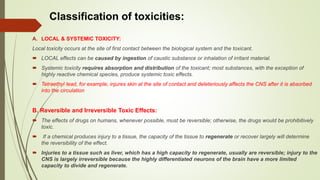
A. LOCAL & SYSTEMIC TOXICITY:
Local toxicity occurs at the site of first contact between the biological system and the toxicant.
 LOCAL effects can be caused by ingestion of caustic substance or inhalation of irritant material.
 Systemic toxicity requires absorption and distribution of the toxicant; most substances, with the exception of
highly reactive chemical species, produce systemic toxic effects.
 Tetraethyl lead, for example, injures skin at the site of contact and deleteriously affects the CNS after it is absorbed
into the circulation
B. Reversible and Irreversible Toxic Effects:
 The effects of drugs on humans, whenever possible, must be reversible; otherwise, the drugs would be prohibitively
toxic.
 If a chemical produces injury to a tissue, the capacity of the tissue to regenerate or recover largely will determine
the reversibility of the effect.
 Injuries to a tissue such as liver, which has a high capacity to regenerate, usually are reversible; injury to the
CNS is largely irreversible because the highly differentiated neurons of the brain have a more limited
capacity to divide and regenerate.
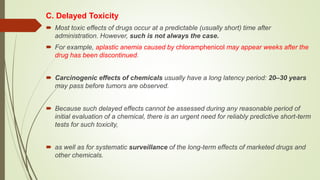
Classification of toxicities:
C. Delayed Toxicity
 Most toxic effects of drugs occur at a predictable (usually short) time after
administration. However, such is not always the case.
 For example, aplastic anemia caused by chloramphenicol may appear weeks after the
drug has been discontinued.
 Carcinogenic effects of chemicals usually have a long latency period: 20–30 years
may pass before tumors are observed.
 Because such delayed effects cannot be assessed during any reasonable period of
initial evaluation of a chemical, there is an urgent need for reliably predictive short-term
tests for such toxicity,
 as well as for systematic surveillance of the long-term effects of marketed drugs and
other chemicals.
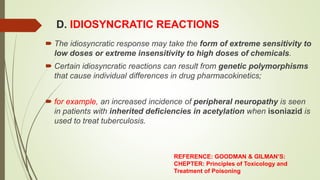
D. IDIOSYNCRATIC REACTIONS
 The idiosyncratic response may take the form of extreme sensitivity to
low doses or extreme insensitivity to high doses of chemicals.
 Certain idiosyncratic reactions can result from genetic polymorphisms
that cause individual differences in drug pharmacokinetics;
 for example, an increased incidence of peripheral neuropathy is seen
in patients with inherited deficiencies in acetylation when isoniazid is
used to treat tuberculosis.
REFERENCE: GOODMAN & GILMAN’S:
CHEPTER: Principles of Toxicology and
Treatment of Poisoning
Factors influencing toxicity
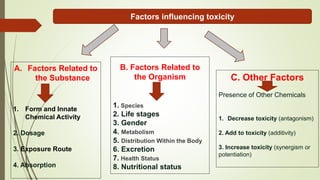
B. Factors Related to
the Organism
1. Species
2. Life stages
3. Gender
4. Metabolism
5. Distribution Within the Body
6. Excretion
7. Health Status
8. Nutritional status
Factors influencing toxicity
A. Factors Related to
the Substance
1. Form and Innate
Chemical Activity
2. Dosage
3. Exposure Route
4. Absorption
C. Other Factors
Presence of Other Chemicals
1. Decrease toxicity (antagonism)
2. Add to toxicity (additivity)
3. Increase toxicity (synergism or
potentiation)
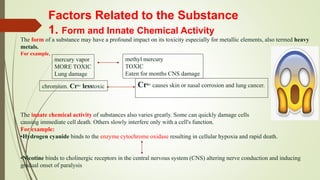
Factors Related to the Substance
1. Form and Innate Chemical Activity
The form of a substance may have a profound impact on its toxicity especially for metallic elements, also termed heavy
metals.
For example,
The innate chemical activity of substances also varies greatly. Some can quickly damage cells
causing immediate cell death. Others slowly interfere only with a cell's function.
For example:
•Hydrogen cyanide binds to the enzyme cytochrome oxidase resulting in cellular hypoxia and rapid death.
•Nicotine binds to cholinergic receptors in the central nervous system (CNS) altering nerve conduction and inducing
gradual onset of paralysis
mercury vapor
MORE TOXIC
Lung damage
methyl mercury
TOXIC
Eaten for months CNS damage
chromium. Cr3+ lesstoxic Cr6+ causes skin or nasal corrosion and lung cancer.
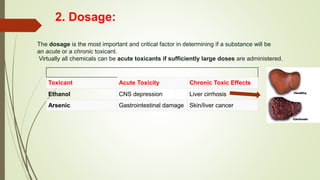
2. Dosage:
Toxicant Acute Toxicity Chronic Toxic Effects
Ethanol CNS depression Liver cirrhosis
Arsenic Gastrointestinal damage Skin/liver cancer
The dosage is the most important and critical factor in determining if a substance will be
an acute or a chronic toxicant.
Virtually all chemicals can be acute toxicants if sufficiently large doses are administered.
3. Exposure Route
 The way an individual comes in contact with a toxic substance, or exposure route, is important in determining toxicity.
 Some chemicals may be highly toxic by one route but not by others.
 Two major reasons are differences in absorption and distribution within the body.
For example:
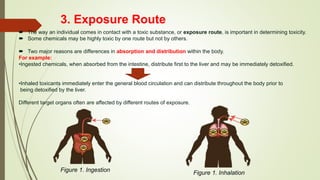
•Ingested chemicals, when absorbed from the intestine, distribute first to the liver and may be immediately detoxified.
•Inhaled toxicants immediately enter the general blood circulation and can distribute throughout the body prior to
being detoxified by the liver.
Different target organs often are affected by different routes of exposure.
Figure 1. Ingestion Figure 1. Inhalation
4. Absorption:
 The ability to be absorbed is essential to systemic toxicity.
 Some chemicals are readily absorbed and others are poorly absorbed.
 many substances are readily absorbed when ingested, whereas there is virtually
no absorption for most polymers. The rates and extent of absorption may vary greatly
depending on the form of a chemical and the route of exposure to it.
 For example:
•Ethanol is readily absorbed from the gastrointestinal tract but poorly absorbed through the skin.
•Organic mercury is readily absorbed from the gastrointestinal tract; inorganic lead sulfate is not.
B. Factors Related to the Organism: 1. Species
Toxic responses can vary substantially depending on the species.
Most differences between species are attributable to differences in metabolism.
Others may be due to anatomical or physiological differences.
For example, rats cannot vomit and expel toxicants before they are absorbed or cause severe irritation,
whereas humans and dogs are capable of vomiting.
Selective toxicity refers to species differences in toxicity between two species simultaneously
exposed.
This is the basis for the effectiveness of pesticides and drugs.
For example:
•An insecticide is lethal to insects but relatively nontoxic to animals.
•Antibiotics are selectively toxic to microorganisms while virtually nontoxic to humans.
2. Life Stage
An individual's age or life stage may be important in determining his or her response to toxicants.
Some chemicals are more toxic to infants or the elderly than to young adults.
For example:
•Nitrosamines are more carcinogenic to newborn or young animals.
•Chloramphenicol – gray baby syndrome
An individual's life stage can impact that person's response to toxicants
3. Gender
 Physiologic differences between men and women, including differences in pharmacokinetics and
pharmacodynamics, can affect drug activity.
 In comparison with men, pharmacokinetics(ADME) in women generally can be impacted by their lower
body weight, slower gastrointestinal motility, reduced intestinal enzymatic activity, and slower
kidney function (GFR/glomerular filtration rate).
Slower renal clearance in women, for example, may result in a need for dosage adjustment for drugs such
as digoxin that are excreted via the kidneys.
 In general, pharmacodynamic differences between women and men include greater sensitivity to and
enhanced effectiveness,
in women, of some drugs, such as ALCOHOL, opioids, and some antipsychotics.
Studies in animals also have identified gender-related differences.
.
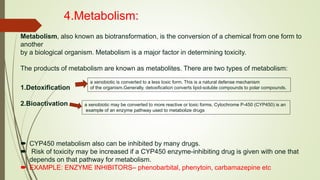
4.Metabolism:
Metabolism, also known as biotransformation, is the conversion of a chemical from one form to
another
by a biological organism. Metabolism is a major factor in determining toxicity.
The products of metabolism are known as metabolites. There are two types of metabolism:
1.Detoxification
2.Bioactivation
 CYP450 metabolism also can be inhibited by many drugs.
 Risk of toxicity may be increased if a CYP450 enzyme-inhibiting drug is given with one that
depends on that pathway for metabolism.
 EXAMPLE: ENZYME INHIBITORS– phenobarbital, phenytoin, carbamazepine etc
a xenobiotic is converted to a less toxic form. This is a natural defense mechanism
of the organism.Generally, detoxification converts lipid-soluble compounds to polar compounds.
a xenobiotic may be converted to more reactive or toxic forms. Cytochrome P-450 (CYP450) is an
example of an enzyme pathway used to metabolize drugs
5. Distribution Within the Body
 The distribution of toxicants and toxic metabolites throughout the body ultimately
determines the sites where toxicity occurs.
 A major determinant of whether a toxicant will damage cells is its lipid solubility. If
a toxicant is lipid-soluble, it readily penetrates cell membranes.
 Many toxicants are stored in the body. Fat tissue, liver, kidney, and bone are the most
common storage sites. Blood serves as the main avenue for distribution. Lymph also
distributes some materials.
6. Excretion:
 The site and rate of excretion is another major factor affecting the toxicity of a xenobiotic. The
kidney is the primary excretory organ, followed by the gastrointestinal tract, and the lungs (for
gases).
 Xenobiotics may also be excreted in sweat, tears, and milk.
 A large volume of blood serum is filtered through the kidney. Lipid-soluble toxicants are reabsorbed
and concentrated in kidney cells.
 Impaired kidney function causes slower elimination of toxicants and increases their toxic potential.
7.Health Status:
 The health of an individual or organism can play a major role in determining the levels and types of
potential toxicity.
 For example, an individual may have pre-existing kidney or liver disease that could influence toxicity.
8. Nutritional Status:
Diet (nutritional status) can be a major factor in determining who does or does not develop toxicity.
For example:
•Consumption of fish that have absorbed mercury from contaminated water can result in mercury toxicity;
•Some vegetables can accumulate cadmium from contaminated soil;
C. Other Factors:
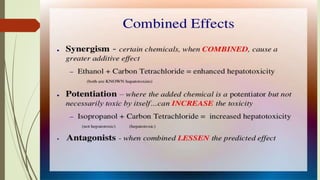
1. Presence of Other Chemicals/ drug interactions:
The presence of other chemicals, at the same time, earlier, or later may:
For example:
•Antidotes used to counteract the effects of poisons function
through antagonism (atropine counteracts poisoning by organophosphate insecticides).
•Alcohol may enhance the effect of many antihistamines and sedatives.
•A synergistic interaction between the antioxidant butylated hydroxytoluene (BHT) and a
certain concentration of oxygen results in lung damage in the form of interstitial pulmonary fibrosis.
Decrease toxicity (antagonism)
•Add to toxicity (additivity)
•Increase toxicity (syne
rgism or potentiation)
Introduction To Toxicology updated.pptx

Introduction To Toxicology updated.pptx

  • 1.
    Introduction To Toxicology & FactorsInfluencing Toxicity By: Dr. Sarita Sharma Assistant Professor Department of Pharmacology Mumbai
  • 2.
    Blueprint: Total: 40 Marks Total5 questions: each 8 marks Q.1 Q.2 Q.3 Q.4 Q.5 Unit 1: + + Unit 2: + + + (1 Q) Unit 3: + + (2 Q) Unit 4: + +
  • 3.
    Introduction:  TOXICOLOGY –STUDY OF POISONS (GREEK WORDS) TOXICAN – POISON LOGOS – STUDY
  • 4.
  • 5.
    Toxicology:  Toxicology involvesthe study of the deleterious effects of chemical substances on living organisms and the practice of diagnosing and treating exposures to toxins and toxicants.  Toxicology is the science dealing with properties, actions, toxicity, fatal dose, detection of, interpretation of the result of toxicological analysis and treatment of poisons  Any substance can be toxic if introduced in a dose capable of disturbing the normal physiological homeostasis of the exposed body. OR
  • 6.
    Toxicology: is the scienceof poisons that studies toxic substances with respect to their 1. Sources 5. Detection 2. Properties 3. Mechanism of toxicity 4. Toxic effects 6.Clinical manifestation 7. Management
  • 7.
    The Dose Makesthe Poison • An apparently nontoxic chemical can be toxic at high doses • Too much of a good thing can be bad • Highly toxic chemicals can be life saving when given in appropriate doses • Poisons are not harmful at a sufficiently low dose
  • 8.
  • 9.
    Poisons:  Poisons arechemical/physical agents that produces adverse responses in biological system  Poison is a substance (solid, liquid or gas), which if introduced in the living body, or brought into contact with any part thereof, will produce ill health or death, by its constitutional or local effects or both  EG: pesticides, Herbicides, paints, household cleaning products, gaseous, chemicals (Ammonia, heavy metals), burning plastic etc. OR
  • 10.
    Hazard—  Hazard isthe ability of a chemical agent to cause injury in a given situation or setting.  For example, asphyxiation(suffocation) is the hazard from acute exposures to carbon monoxide (CO).  To assess hazard, one need to have knowledge about both the inherent toxicity of the substance & the amount to which individuals are liable to be exposed.  Humans can safely use potentially toxic substances when the necessary conditions minimising absorption are established and respected.
  • 11.
    Risk—  the measureor probability that a specific exposure situation or dose will produce a toxic effect. OR  Defined as the expected frequency of the occurrence of an undesirable effect arising from exposure to a chemical or physical agent.  Estimation of risk makes use of dose-response data & extrapolation from the observed relationship to the expected responses at doses occurring in actual exposure situations.  The quality and suitability of the biologic data used in such estimates are major limiting factors.
  • 12.
    •Atmospheric pollutants •Industrial setting Minorroute If its in water, food etc. (Depends on situation)
  • 14.
    Classification of toxicities: 1.Occupational 2. Environmental 3. Eco Deals with the chemicals found in the workplace. Deals the potentially deleterious impact of chemicals, present as pollutants of environments, to living organisms. Particulars Air, water, soil etc. Toxic effects of chemical and physical agents on the population & communities of living organism within defined ecosystems. EG :Battery recycling workers are at risk for lead exposure Radioactive materials organic and inorganic pollutants Insecticides such as DDT, chlordane etc. don't break down easily, and they are still found in soil, plants, and animals. Persistent pesticides may travel long distances in the air or water, or even in living organisms such as migrating birds or fish
  • 15.
    Classification of toxicities:(Duration of exposure:) 1.Acute toxicity describes the adverse effects of a substance that result either from a single exposure or from multiple exposures in a short period of time (usually less than 24 hours). 3.Chronic toxicity is the development of adverse effects as the result of long term exposure to a toxicant or other stressor. It can manifest as direct lethality but more commonly refers to sublethal endpoints such as decreased growth, reduced reproduction, or behavioral changes 2. Sub acute toxicity is defined as adverse effects occurring after multiple or continuous exposure between 24 h and 28 days.
  • 16.
    A. LOCAL &SYSTEMIC TOXICITY: Local toxicity occurs at the site of first contact between the biological system and the toxicant.  LOCAL effects can be caused by ingestion of caustic substance or inhalation of irritant material.  Systemic toxicity requires absorption and distribution of the toxicant; most substances, with the exception of highly reactive chemical species, produce systemic toxic effects.  Tetraethyl lead, for example, injures skin at the site of contact and deleteriously affects the CNS after it is absorbed into the circulation B. Reversible and Irreversible Toxic Effects:  The effects of drugs on humans, whenever possible, must be reversible; otherwise, the drugs would be prohibitively toxic.  If a chemical produces injury to a tissue, the capacity of the tissue to regenerate or recover largely will determine the reversibility of the effect.  Injuries to a tissue such as liver, which has a high capacity to regenerate, usually are reversible; injury to the CNS is largely irreversible because the highly differentiated neurons of the brain have a more limited capacity to divide and regenerate. Classification of toxicities:
  • 17.
    C. Delayed Toxicity Most toxic effects of drugs occur at a predictable (usually short) time after administration. However, such is not always the case.  For example, aplastic anemia caused by chloramphenicol may appear weeks after the drug has been discontinued.  Carcinogenic effects of chemicals usually have a long latency period: 20–30 years may pass before tumors are observed.  Because such delayed effects cannot be assessed during any reasonable period of initial evaluation of a chemical, there is an urgent need for reliably predictive short-term tests for such toxicity,  as well as for systematic surveillance of the long-term effects of marketed drugs and other chemicals.
  • 18.
    D. IDIOSYNCRATIC REACTIONS The idiosyncratic response may take the form of extreme sensitivity to low doses or extreme insensitivity to high doses of chemicals.  Certain idiosyncratic reactions can result from genetic polymorphisms that cause individual differences in drug pharmacokinetics;  for example, an increased incidence of peripheral neuropathy is seen in patients with inherited deficiencies in acetylation when isoniazid is used to treat tuberculosis. REFERENCE: GOODMAN & GILMAN’S: CHEPTER: Principles of Toxicology and Treatment of Poisoning
  • 19.
  • 20.
    B. Factors Relatedto the Organism 1. Species 2. Life stages 3. Gender 4. Metabolism 5. Distribution Within the Body 6. Excretion 7. Health Status 8. Nutritional status Factors influencing toxicity A. Factors Related to the Substance 1. Form and Innate Chemical Activity 2. Dosage 3. Exposure Route 4. Absorption C. Other Factors Presence of Other Chemicals 1. Decrease toxicity (antagonism) 2. Add to toxicity (additivity) 3. Increase toxicity (synergism or potentiation)
  • 21.
    Factors Related tothe Substance 1. Form and Innate Chemical Activity The form of a substance may have a profound impact on its toxicity especially for metallic elements, also termed heavy metals. For example, The innate chemical activity of substances also varies greatly. Some can quickly damage cells causing immediate cell death. Others slowly interfere only with a cell's function. For example: •Hydrogen cyanide binds to the enzyme cytochrome oxidase resulting in cellular hypoxia and rapid death. •Nicotine binds to cholinergic receptors in the central nervous system (CNS) altering nerve conduction and inducing gradual onset of paralysis mercury vapor MORE TOXIC Lung damage methyl mercury TOXIC Eaten for months CNS damage chromium. Cr3+ lesstoxic Cr6+ causes skin or nasal corrosion and lung cancer.
  • 22.
    2. Dosage: Toxicant AcuteToxicity Chronic Toxic Effects Ethanol CNS depression Liver cirrhosis Arsenic Gastrointestinal damage Skin/liver cancer The dosage is the most important and critical factor in determining if a substance will be an acute or a chronic toxicant. Virtually all chemicals can be acute toxicants if sufficiently large doses are administered.
  • 23.
    3. Exposure Route The way an individual comes in contact with a toxic substance, or exposure route, is important in determining toxicity.  Some chemicals may be highly toxic by one route but not by others.  Two major reasons are differences in absorption and distribution within the body. For example: •Ingested chemicals, when absorbed from the intestine, distribute first to the liver and may be immediately detoxified. •Inhaled toxicants immediately enter the general blood circulation and can distribute throughout the body prior to being detoxified by the liver. Different target organs often are affected by different routes of exposure. Figure 1. Ingestion Figure 1. Inhalation
  • 24.
    4. Absorption:  Theability to be absorbed is essential to systemic toxicity.  Some chemicals are readily absorbed and others are poorly absorbed.  many substances are readily absorbed when ingested, whereas there is virtually no absorption for most polymers. The rates and extent of absorption may vary greatly depending on the form of a chemical and the route of exposure to it.  For example: •Ethanol is readily absorbed from the gastrointestinal tract but poorly absorbed through the skin. •Organic mercury is readily absorbed from the gastrointestinal tract; inorganic lead sulfate is not.
  • 25.
    B. Factors Relatedto the Organism: 1. Species Toxic responses can vary substantially depending on the species. Most differences between species are attributable to differences in metabolism. Others may be due to anatomical or physiological differences. For example, rats cannot vomit and expel toxicants before they are absorbed or cause severe irritation, whereas humans and dogs are capable of vomiting. Selective toxicity refers to species differences in toxicity between two species simultaneously exposed. This is the basis for the effectiveness of pesticides and drugs. For example: •An insecticide is lethal to insects but relatively nontoxic to animals. •Antibiotics are selectively toxic to microorganisms while virtually nontoxic to humans.
  • 26.
    2. Life Stage Anindividual's age or life stage may be important in determining his or her response to toxicants. Some chemicals are more toxic to infants or the elderly than to young adults. For example: •Nitrosamines are more carcinogenic to newborn or young animals. •Chloramphenicol – gray baby syndrome An individual's life stage can impact that person's response to toxicants
  • 27.
    3. Gender  Physiologicdifferences between men and women, including differences in pharmacokinetics and pharmacodynamics, can affect drug activity.  In comparison with men, pharmacokinetics(ADME) in women generally can be impacted by their lower body weight, slower gastrointestinal motility, reduced intestinal enzymatic activity, and slower kidney function (GFR/glomerular filtration rate). Slower renal clearance in women, for example, may result in a need for dosage adjustment for drugs such as digoxin that are excreted via the kidneys.  In general, pharmacodynamic differences between women and men include greater sensitivity to and enhanced effectiveness, in women, of some drugs, such as ALCOHOL, opioids, and some antipsychotics. Studies in animals also have identified gender-related differences. .
  • 28.
    4.Metabolism: Metabolism, also knownas biotransformation, is the conversion of a chemical from one form to another by a biological organism. Metabolism is a major factor in determining toxicity. The products of metabolism are known as metabolites. There are two types of metabolism: 1.Detoxification 2.Bioactivation  CYP450 metabolism also can be inhibited by many drugs.  Risk of toxicity may be increased if a CYP450 enzyme-inhibiting drug is given with one that depends on that pathway for metabolism.  EXAMPLE: ENZYME INHIBITORS– phenobarbital, phenytoin, carbamazepine etc a xenobiotic is converted to a less toxic form. This is a natural defense mechanism of the organism.Generally, detoxification converts lipid-soluble compounds to polar compounds. a xenobiotic may be converted to more reactive or toxic forms. Cytochrome P-450 (CYP450) is an example of an enzyme pathway used to metabolize drugs
  • 29.
    5. Distribution Withinthe Body  The distribution of toxicants and toxic metabolites throughout the body ultimately determines the sites where toxicity occurs.  A major determinant of whether a toxicant will damage cells is its lipid solubility. If a toxicant is lipid-soluble, it readily penetrates cell membranes.  Many toxicants are stored in the body. Fat tissue, liver, kidney, and bone are the most common storage sites. Blood serves as the main avenue for distribution. Lymph also distributes some materials. 6. Excretion:  The site and rate of excretion is another major factor affecting the toxicity of a xenobiotic. The kidney is the primary excretory organ, followed by the gastrointestinal tract, and the lungs (for gases).  Xenobiotics may also be excreted in sweat, tears, and milk.  A large volume of blood serum is filtered through the kidney. Lipid-soluble toxicants are reabsorbed and concentrated in kidney cells.  Impaired kidney function causes slower elimination of toxicants and increases their toxic potential.
  • 30.
    7.Health Status:  Thehealth of an individual or organism can play a major role in determining the levels and types of potential toxicity.  For example, an individual may have pre-existing kidney or liver disease that could influence toxicity. 8. Nutritional Status: Diet (nutritional status) can be a major factor in determining who does or does not develop toxicity. For example: •Consumption of fish that have absorbed mercury from contaminated water can result in mercury toxicity; •Some vegetables can accumulate cadmium from contaminated soil;
  • 31.
    C. Other Factors: 1.Presence of Other Chemicals/ drug interactions: The presence of other chemicals, at the same time, earlier, or later may: For example: •Antidotes used to counteract the effects of poisons function through antagonism (atropine counteracts poisoning by organophosphate insecticides). •Alcohol may enhance the effect of many antihistamines and sedatives. •A synergistic interaction between the antioxidant butylated hydroxytoluene (BHT) and a certain concentration of oxygen results in lung damage in the form of interstitial pulmonary fibrosis. Decrease toxicity (antagonism) •Add to toxicity (additivity) •Increase toxicity (syne rgism or potentiation)