Principles and Methods of
Toxicology
Dr. P.B.Reddy
M.Sc,M.Phil,Ph.D, FIMRF,FICER,FSLSc,FISZS,FISQEM
PG DEPARTMENT OF ZOOLOGY
GOVERTNAMENT PG COLLEGE AND INSTITUTE, RATLAM.M.P
reddysirr@gmail.com
1/22/2021 DR. REDDY PB 1
OUTLINE
Module I: Introduction to Toxicology.
 Introduction
History
Definitions and terminology
 Principles and concepts
Module II: Dose-Response
 Dose response curve
NOAEL and LOAEL
Toxicokinetics and ADME
 Determining Toxicity and measurement (probit Analysis)
Module III: Toxicity testing methods
 Animal testing
 Types of Toxicity Tests (Acute, subchronic and chronic)
 Alternatives to Animal Testing (In vitro tests, In silico tests and Chip
models)
1/22/2021 DR. REDDY PB 2
INTRODUCTION
Toxicology is the science of the poisons. It also studies the nature, effects, detection,
assessment and treatment of their effects on biological material.
 Toxicology is a multidisciplinary science. The ultimate objective of the combined
research is to determine how an organism is affected by exposure to an agent.
This includes an understanding of:
How the agent moves and interact with living cells and tissues of the organism;
What parts of the organism are affected by its presence and health outcomes of
this exposure.
 Evaluation of the toxicity of substances whose biological effects may not have
been well characterized.
The influence of chemical toxicity is mainly
determined by the dosage, duration of exposure,
route of exposure, species, age, sex, and environment.
 The goal of toxicology is to contribute to the
1. general knowledge and harmful actions of
chemical substances.
2. to study their mechanisms of action,
3. and to estimate their possible risks to humans
1/22/2021 DR. REDDY PB 3
HISTORY
 Dioscorides, a Greek physician in the court of the Roman emperor Nero,
made the first attempt to classify plants according to their toxic and
therapeutic effect. Poisonous plants and animals were recognized and their
extracts used for hunting or in warfare.
 In 1500 BC people used hemlock, opium, arrow poisons, and certain metals
to poison enemies or for state executions.
 Theophrastus Phillipus Auroleus Bombastus von Hohenheim (1493–1541)
(also referred to as Paracelsus, a Roman physician from the first century) is
considered "the father" of toxicology.
 He stated that "All things are poisonous and nothing is without poison; only
the dose makes a thing not poisonous.“
Mathieu Orfila (1813) is considered the modern father of toxicology.
 In 1850, Jean Stas became the first person to successfully isolate plant
poisons from human tissue.
Hippolyte Visart de Bocarmé used nicotine to kill his brother-in-law. He
extracted nicotine from tobacco leaves.
The 20th and 21st Centuries have marked by great advancements in the level
of understanding of toxicology. DNA and various biochemicals that maintain
body functions have been discovered. Our level of knowledge of toxic effects on
1/22/2021 DR. REDDY PB 4
DEFINITIONS AND CONCEPTS
Toxicity is the intrinsic capacity of a chemical agent to affect an
organism adversely.
 Xenobiotics are a term for “foreign substances”, that is, foreign to the
organism. Its opposite is endogenous compounds. Xenobiotics include
drugs, industrial chemicals, naturally occurring poisons and
environmental pollutants.
 A hazard evaluation in toxicology focuses on defining what types of
harmful effects could occur and under what circumstances (e.g.
ingestion, inhalation, skin exposure).
 Risk is the probability of a specific adverse effect to occur. It is often
expressed as the percentage of cases in a given population and during a
specific time period. A risk estimate can be based upon actual cases or a
projection of future cases, based upon extrapolations.
• in vitro = Use of living cells in an artificial or test tube system, or is otherwise
performed outside of a living organism.
• in vivo = A research or testing methodology performed in living organisms.
1/22/2021 DR. REDDY PB 5
• dose, dosage = A dose is often expressed as the amount of a xenobiotic
entering an organism (in units such as mg/kg body weight).
• dose-response curve = A graphic representation of the relationship between
the dose of a chemical administered and the effect produced.
• dose-response relationships=The dose-response relationship is the
relationship between dose and the percentage of individuals showing a specific
effect.
• threshold. The level above which effects will occur and below which no
effects occur."
Latency time = is the time between first exposure and the appearance of a
detectable effect or response.
 Systemic effects = are toxic effects in tissues distant from the route of
absorption.
 Target organ = is the primary or most sensitive organ affected after
exposure. The same chemical entering the body by different routes of exposure
dose, dose rate, sex and species may affect different target organs.
 Toxinology, a specialized area of study, looks at microbial, plant and
animal venoms, poisons, and toxins.
1/22/2021 DR. REDDY PB 6
1/22/2021 DR. REDDY PB 7
 Based on the allergenic, neurotoxic, carcinogenic and other important
toxic effects regulatory authorities classified the chemicals into various
categories.
The grading can be “supertoxic,” “highly toxic,” “moderately toxic” and so
on. The most common ratings concern acute toxicity.
 This classification can be of administrative value as a warning and as
information.
Toxicant, toxin, and poison are often used interchangeably in the
literature but there are slight differences as shown below:
Toxicants: Toxins: Poisons:
•Substances producing adverse
biological effects of any kind.
•May be chemical or physical in
nature.
•Effects may be acute or chronic.
•Peptides or proteins
produced by living organisms.
•Venoms are toxins injected
by a bite or sting.
•Toxins produced by
organisms.
1/22/2021 DR. REDDY PB 8
Toxic Agents
A toxic agent is anything (chemical, physical, or biological) that can produce
an adverse biological effect. For example, toxic agents may be:
Many chemicals are of relatively low toxicity in the native form, but
when acted on by enzymes and can interfere with normal cells in the
body. The toxicity of the agent is dependent on the dose.
1/22/2021 DR. REDDY PB 9
 A distinction is made for diseases people get
from living organisms. Organisms that invade and
multiply within another organism and produce their
effects by biological activity are not classified as toxic
agents but as biological agents. An example of this is a
virus that damages cell membranes resulting in cell
death.
Biological agents
If the invading organisms excrete chemicals. They are
the basis for their toxicity.
The excreted substances are known as biological
toxins. In that case, the organisms are called toxic
organisms.
A specific example is tetanus. Tetanus is caused by a
bacterium, Clostridium tetani. The bacteria C.
tetani itself does not cause disease by invading and
destroying cells. Rather, a toxin (neurotoxin) that the
bacteria excrete travels to the nervous system and
produces the disease.
1/22/2021 DR. REDDY PB 10
Toxic Substances
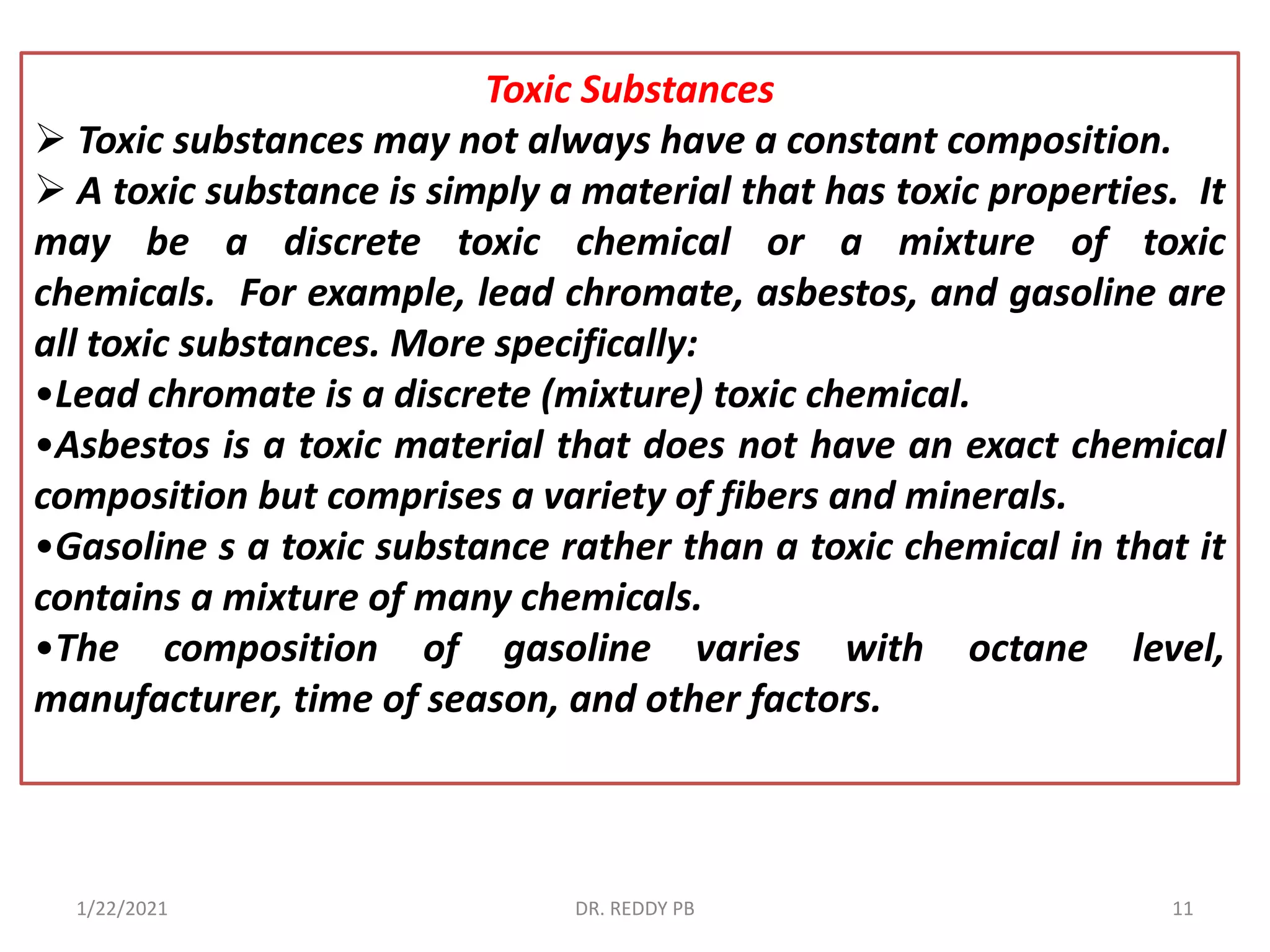
 Toxic substances may not always have a constant composition.
 A toxic substance is simply a material that has toxic properties. It
may be a discrete toxic chemical or a mixture of toxic
chemicals. For example, lead chromate, asbestos, and gasoline are
all toxic substances. More specifically:
•Lead chromate is a discrete (mixture) toxic chemical.
•Asbestos is a toxic material that does not have an exact chemical
composition but comprises a variety of fibers and minerals.
•Gasoline s a toxic substance rather than a toxic chemical in that it
contains a mixture of many chemicals.
•The composition of gasoline varies with octane level,
manufacturer, time of season, and other factors.
1/22/2021 DR. REDDY PB 11
 A systemic toxicant affects the entire
body or many organs rather than a
specific site. For example, potassium
cyanide is a systemic toxicant in that it
affects virtually every cell and organ in
the body by interfering with the cells’
ability to use oxygen.
 Organ Toxicants may also affect only
specific tissues or organs.
These specific sites are known as
the target organs or target tissues.
 Benzene is a specific organ toxicant in
that it is primarily toxic to the blood-
forming tissues.
 Lead is also a specific organ toxicant
and is toxic to central nervous system, the
kidneys, and the hematopoietic system).
Systemic Toxicants and Organ Toxicants
1/22/2021 DR. REDDY PB 12
1/22/2021 DR. REDDY PB 13
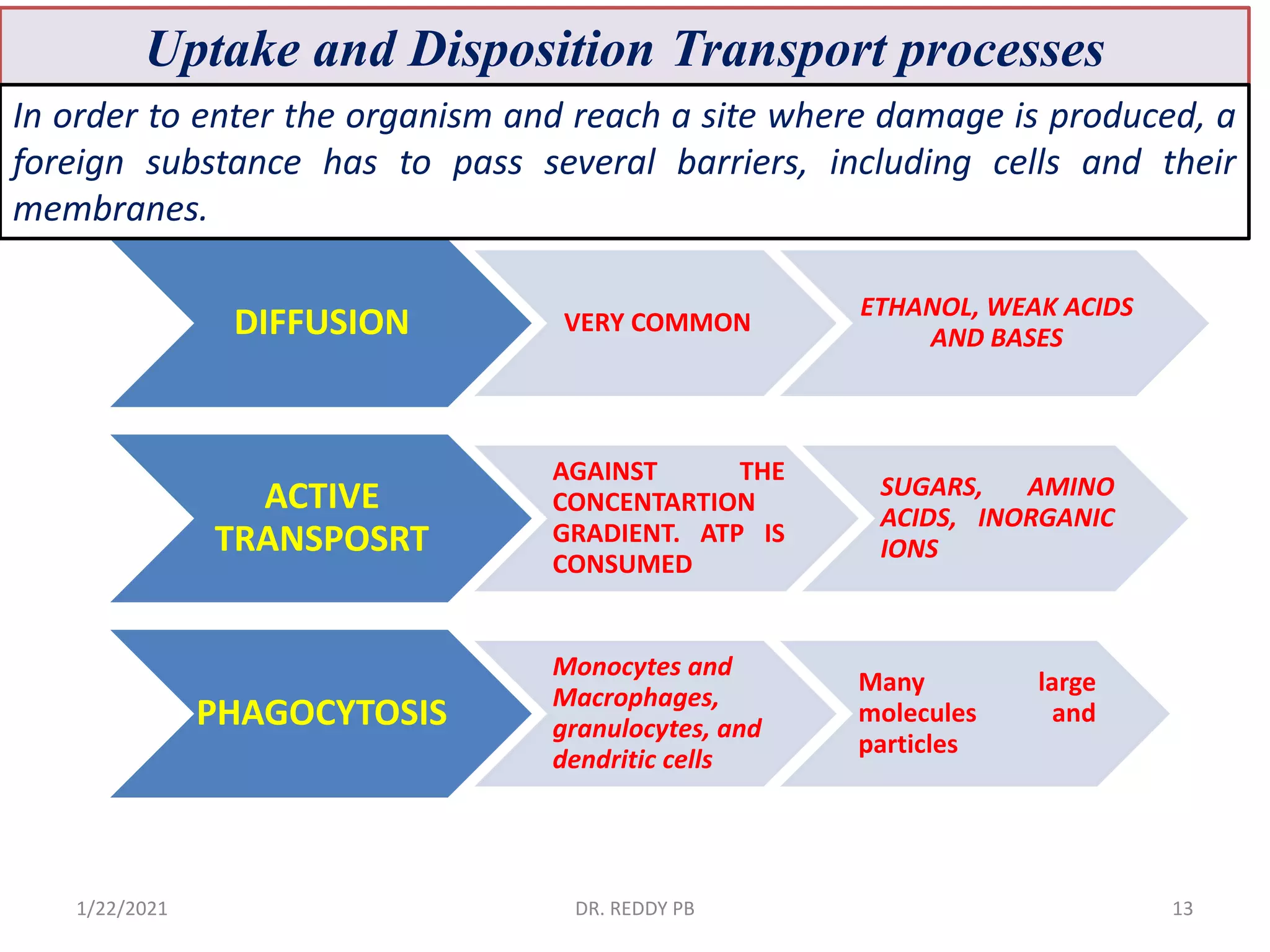
Uptake and Disposition Transport processes
DIFFUSION VERY COMMON
ETHANOL, WEAK ACIDS
AND BASES
ACTIVE
TRANSPOSRT
AGAINST THE
CONCENTARTION
GRADIENT. ATP IS
CONSUMED
SUGARS, AMINO
ACIDS, INORGANIC
IONS
PHAGOCYTOSIS
Monocytes and
Macrophages,
granulocytes, and
dendritic cells
Many large
molecules and
particles
In order to enter the organism and reach a site where damage is produced, a
foreign substance has to pass several barriers, including cells and their
membranes.
1/22/2021 DR. REDDY PB 14
Pulmonary
absorption
LUNGS
Primary route of deposition
and absorption of small
airborne particles, gases,
vapours and aerosols
Percutaneous
absorption SKIN
Highly toxic, fat-soluble
substances such as
organophosphorous insecticides
and organic solvents
Gastrointestinal
STOMACH AND
INTESTINE
accidental or intentional
ingestion
Absorption
Absorption is the uptake of a substance from the environment into the
organism. The term usually includes not only the entrance into the barrier
tissue but also the further transport into circulating blood.
OTHER ROUTES
INJECTIONS
Section 2: Dose and Dose Response
All Interactions between
chemicals and biological
systems follow a
Dose-Response Relationship
1/22/2021 DR. REDDY PB 15
Dose-response relationship
Dose: It is the amount of that toxic substance that comes into contact with a living
organism or some part of a living organism. It is clearly expressed in terms of body
weight and, often, in terms of time as well (mg/kg/day). Other parameters like the
number of doses, frequency, and total time period of the treatment have to take into
consideration.
For example:
•650 mg acetaminophen (Tylenol® products) as a single dose.
•500 mg penicillin every 8 hours for 10 days.
•10 mg DDT per day for 90 days.
1. Exposed dose: This definition is generally applied in cases of occupational and
environmental exposures. It Refer to the amount of a substance to which an
individual or population is exposed.
2. Administered dose: The quantity administered usually orally or by injection.
(note that an administered dose taken orally may not necessarily be absorbed).
3. Absorbed dose — the amount of a substance that entered the body through the
skin, eyes, lungs, or digestive tract and was taken up by organs or particular
tissues. Absorbed dose can also be called internal dose.
4. Target organ dose or biologically effective dose : The amount of toxicant that
reaches the site(s) at which the adverse effects occur.
5. Total dose — the sum of all individual doses.
1/22/2021 DR. REDDY PB 16
The following variables must be taken into account in the
determination of the consequences of dose. It include:
•Dose Amount - A measure of the magnitude of the dose.
•Dose Frequency - How often exposure occurs, e.g., daily, weekly, five
days out of seven, etc.
•Dose Duration - Over how long a total period of time dose exposure
occur, e.g., a week, a month, a year, a lifetime.
•Subject Variability (Natural) - Individual characteristics such as age,
sex, body weight, ethnic background, and genetics.
•Subject Variability (Health Status) - Whether any pre-existing health
conditions, such as asthma, diabetes, or hypertension, may affect
susceptibility to an agent.
•Route of Exposure - The way in which the person is exposed. The
three most common routes of exposure are ingestion, inhalation and
skin contact.
1/22/2021 DR. REDDY PB 17
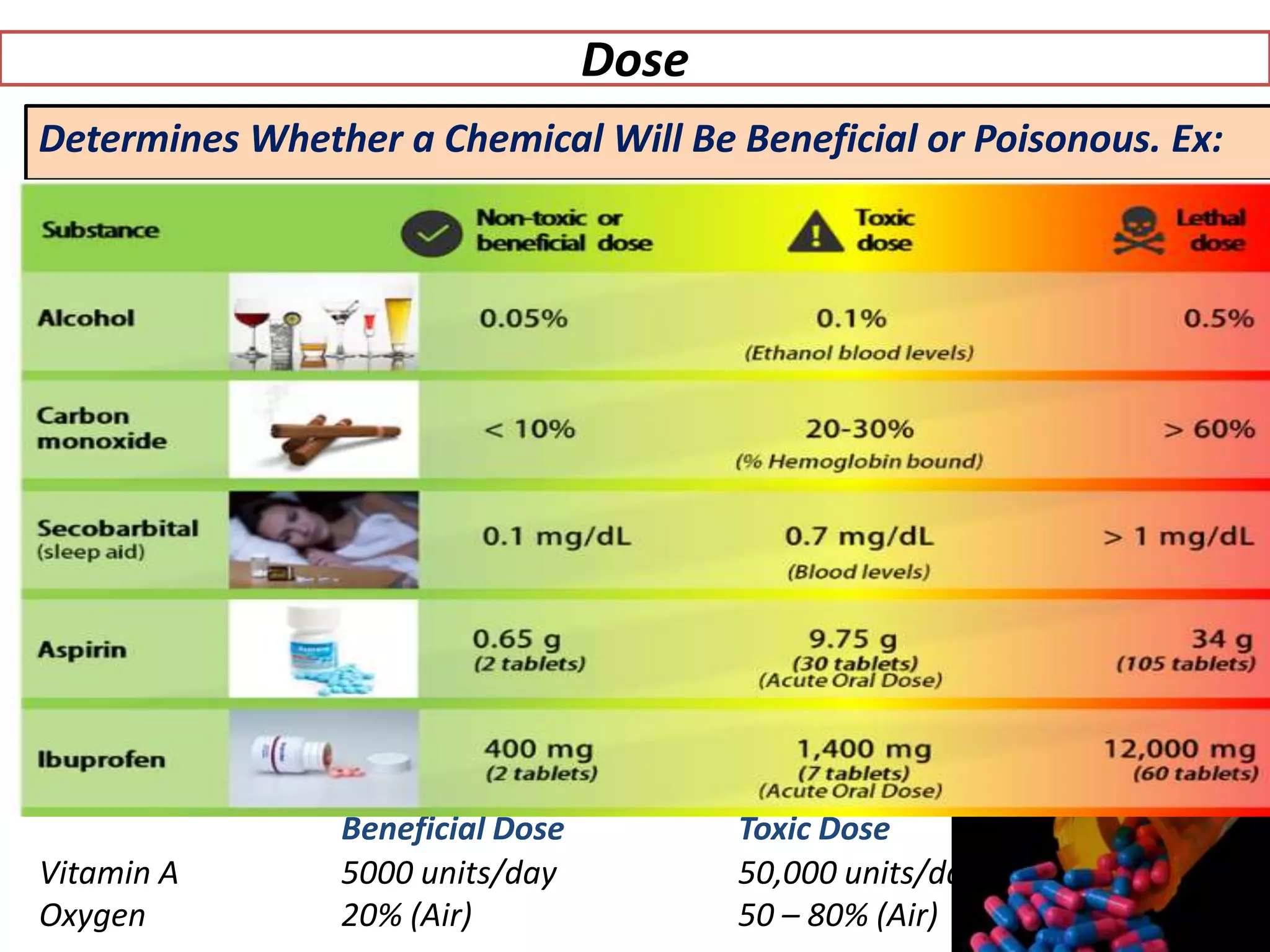
Dose
Determines Whether a Chemical Will Be Beneficial or Poisonous. Ex:
Beneficial Dose Toxic Dose
Vitamin A 5000 units/day 50,000 units/day
Oxygen 20% (Air) 50 – 80% (Air)
1/22/2021 DR. REDDY PB 19
Jan 14, 2007
The Jennifer Strange Story
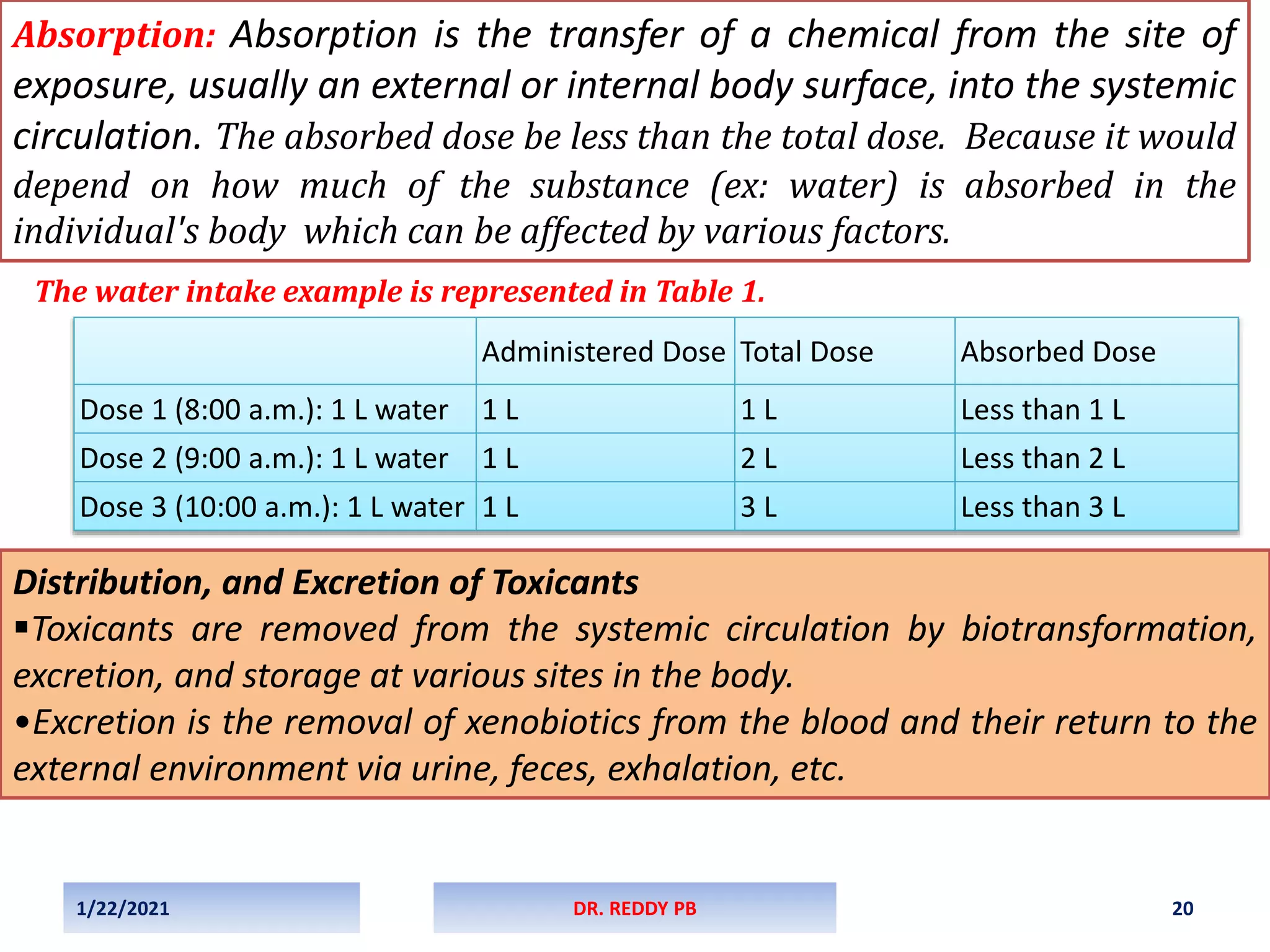
Absorption: Absorption is the transfer of a chemical from the site of
exposure, usually an external or internal body surface, into the systemic
circulation. The absorbed dose be less than the total dose. Because it would
depend on how much of the substance (ex: water) is absorbed in the
individual's body which can be affected by various factors.
Administered Dose Total Dose Absorbed Dose
Dose 1 (8:00 a.m.): 1 L water 1 L 1 L Less than 1 L
Dose 2 (9:00 a.m.): 1 L water 1 L 2 L Less than 2 L
Dose 3 (10:00 a.m.): 1 L water 1 L 3 L Less than 3 L
1/22/2021 DR. REDDY PB 20
The water intake example is represented in Table 1.
Distribution, and Excretion of Toxicants
Toxicants are removed from the systemic circulation by biotransformation,
excretion, and storage at various sites in the body.
•Excretion is the removal of xenobiotics from the blood and their return to the
external environment via urine, feces, exhalation, etc.
1/22/2021 DR. REDDY PB 21
Types of doses
The units used in
toxicology are basically
the same as those used
in medicine. The gram is
the standard unit.
Fractionating Doses :
 Fractionating a total dose usually decreases the probability that the
total dose will cause toxicity.
 The reason is that the body often can repair the effect of each
subtoxic dose if sufficient time elapses before the next dose is
received.
 In that case, a total dose that would be harmful if received all at
once is non-toxic when administered over a period of time.
 For example, 30 mg of strychnine (alkaloid pesticide) swallowed at
one time could be fatal to an adult whereas 3 mg of strychnine
swallowed each day for 10 days is not considered a fatal dose.
 Concentration: Concentration is the amount of a substance found
in a certain amount of another substance, such as water, air, soil,
food, blood, hair, urine, or breath. For example, the weight of a toxic
substance found in a certain weight of food is indicated as a measure
of concentration rather than the total amount.
1/22/2021 DR. REDDY PB 22
Following figure illustrates this
concept. The two glasses contain
samples of juice that are being
tested for contamination with lead.
The volume of juice in Glass A is
100 mL and the volume of juice in
Glass B is 50 mL. The concentration
of lead is the same in both samples
of juice: 20 parts per billion (ppb).
The total amount of lead would be
higher in Glass A but the
concentration of lead per unit
volume is the same in both glasses.
1/22/2021 DR. REDDY PB 23
The dose-response curve is a visual representation of the response rates of a
population to a range of doses of a substance. The dose-response relationship is a
fundamental and essential concept in toxicology. It is based on observed data from
experimental animal, human clinical, or cell studies.
Knowledge of the dose-response relationship:
- establishes causality
- establishes the – the threshold effect.
-determines the rate at which injury builds up –
1/22/2021 DR. REDDY PB 24
The dose-response curve
The dose-response curve form of a
sigmoid curve.
The point at which toxicity first
appears is known as the threshold
dose level. From that point, the
curve increases with higher dose
levels.
A threshold for toxic effects occurs
at the point where the body's ability
to detoxify a xenobiotic or repair
toxic injury has been exceeded.
Population Dose-Response
Mild Extreme
Many
Few
Number
of
Individuals
Response to SAME dose
Sensitive
Individuals
Maximal
Effect
Resistant
Individuals
Minimal
Effect
Majority of
Individuals
Average Effect
1/22/2021 DR. REDDY PB 25
Within a population, the majority of responses to a toxicant are similar; however, some
individuals are susceptible and others resistant. (depicted as a bell shaped standard
distribution curve.
Lethal Doses/Concentrations
Dose-response curves are used to derive dose estimates of chemical substances.
• Lethal Dose 0% (LD0) — Represents the dose at which no individuals are expected to die. This is
just below the threshold for lethality.
• Lethal Dose 10% (LD10) — Refers to the dose at which 10% of the individuals will die.
• Lethal Concentration 50% (LC50) — for inhalation toxicity, air concentrations are used for
exposure values. The LC50 refers to the calculated concentration of a gas lethal to 50% of a
group. Occasionally LC0 and LC10 are also used.
Effective Doses (EDs)
Effective Doses (EDs) are used to indicate the
effectiveness of a substance (drug).
Normally, effective dose refers to a beneficial
effect such as relief of pain. It may also
stand for a harmful effect such as paralysis.
Thus, the specific endpoint must be
indicated. The usual terms are:
Term
Effective for this percentage of
the population
ED0 0%
ED10 10%
ED50 50%
ED90 90%
Toxic Doses (TDs)
Toxic Doses (TDs) are used to indicate doses
that cause adverse toxic effects. The usual
dose estimates include:
Term
Toxic to this percentage
of the population
TD0 0%
TD10 10%
TD50 50%
TD90 90%
1/22/2021 DR. REDDY PB 26
 LD50 (Lethal Dose 50%) has been a common dose estimate for acute toxicity.
It is a statistically derived maximum dose at which 50% of the group of
organisms (rat, mouse, or other species) would be expected to die.
 Now LD50 testing is no longer the recommended method for assessing
toxicity because of the ethics of using large numbers of animals, the variability
of responses in animals and humans, and the use of mortality as the only
endpoint. Regulatory agencies use LD50 only if it is justified by scientific
necessity and ethical considerations.
The Three Rs
The current practice for estimating acute toxicity emphasizes the following
approaches, known as the Three Rs:
1.Replacing animals in science by in vitro, in silico, and other approaches.
2.Reducing the number of animals used. For example, the oral LD50 approach
has been replaced in some circumstances by an up-and-down method in which
animals are dosed one at a time.
3.Refining care and procedures to minimize pain and distress.
Other dose estimates also may be used.
1/22/2021 DR. REDDY PB 27
Threshold dose: The dose at which this effect
occurs is known as the threshold dose.
 NOAEL: The NOEL (no observable adverse
effect level) is the highest dose or exposure
level of a substance or material that produces
no noticeable (observable) toxic effect on
tested animals. The NOAEL level may be used
in the process of establishing a dose-response
relationship, a fundamental step in most risk
assessment methodologies
 LOAEL: The LOAEL is the lowest dosage level
at which chronic exposure to the substance
shows adverse effects on tested animals.
 The threshold dose lies between the NOAEL
and LOAEL.
 The value of the NOAEL and LOAEL depends
on the design of the experiment.
 An experiment with more or fewer animals,
or with a difference selection of test doses, will
have a different NOAEL and LOAEL.
1/22/2021 DR. REDDY PB 28
NOAELs are very important. They are used
to derive threshold safety exposure dose
to humans such as derived no-effect level
(DNEL), occupational exposure limit (OEL)
and acceptable daily intake (ADI). The
units of NOAEL are mg/kg
bw/day or ppm for dermal and oral
route. For inthalation route, NOAEC is
used instead. The unit can
be mg/L/6h/day.
Probit Analysis and LC50 Computation Using Microsoft Excel

Probit analysis is a type of regression used to analyze binomial response variables.
•It transforms the sigmoid dose-response curve to a straight line that can then be
analyzed by regression either through least squares or maximum likelihood.
•Probit analysis can be conducted by one of three techniques:
 Using tables to estimate the probits and fitting the relationship by eye, or Hand
calculating the probits, regression coefficient, and confidence intervals
, or Having a statistical package such as SPSS or Windows Excel7 or 10.
1/22/2021 DR. REDDY PB 29
1/22/2021 DR. REDDY PB 30
1. Open the Microsoft Excel
2. Enter the concentration of the substance
3. Get the log10 concentration
4. Enter the mortality% of dead
5. Transform the % of dead into probits using the probit table
6. Perform regression analysis
7. Copy the ‘x’value and intercept
8. Substitute the ‘x’ variable and intercept in the formula
9. Y=ax+b
where;- a= x variable ; b= intercept
9. To compute for LC50:
A: Transform 50 to Probit using probit transformation table
B. Substitute ‘Y’ with the probit value of 50 from the previous equation: Y=ax+b
Input Y range (values ) (probits)
Input ‘x’ range (log concentrations)
1/22/2021 DR. REDDY PB 31
To compute LC 50 values, Transform 50 to probit using probit transformation table
1/22/2021 DR. REDDY PB 32
1/22/2021 DR. REDDY PB 33
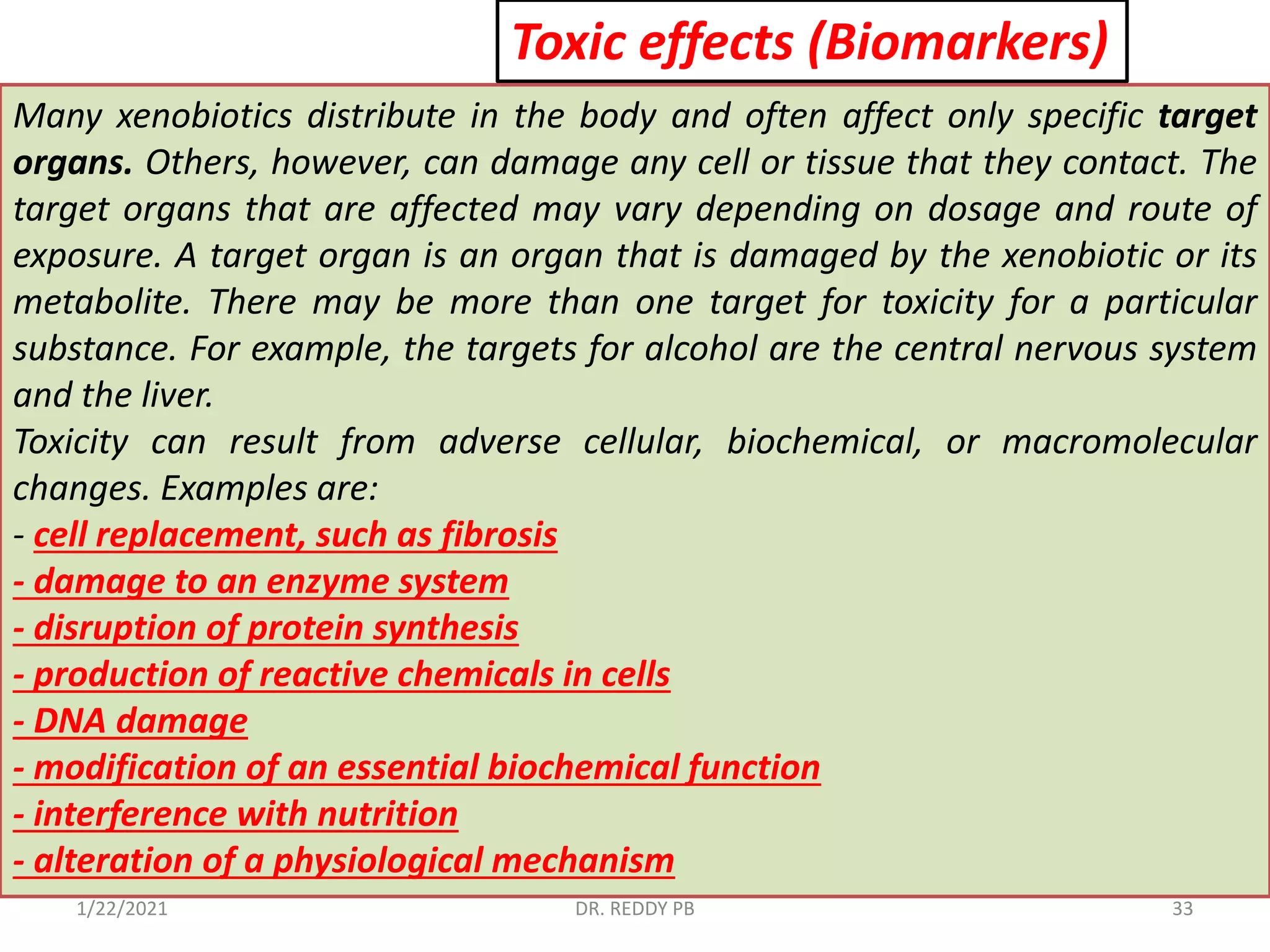
Toxic effects (Biomarkers)
Many xenobiotics distribute in the body and often affect only specific target
organs. Others, however, can damage any cell or tissue that they contact. The
target organs that are affected may vary depending on dosage and route of
exposure. A target organ is an organ that is damaged by the xenobiotic or its
metabolite. There may be more than one target for toxicity for a particular
substance. For example, the targets for alcohol are the central nervous system
and the liver.
Toxicity can result from adverse cellular, biochemical, or macromolecular
changes. Examples are:
- cell replacement, such as fibrosis
- damage to an enzyme system
- disruption of protein synthesis
- production of reactive chemicals in cells
- DNA damage
- modification of an essential biochemical function
- interference with nutrition
- alteration of a physiological mechanism
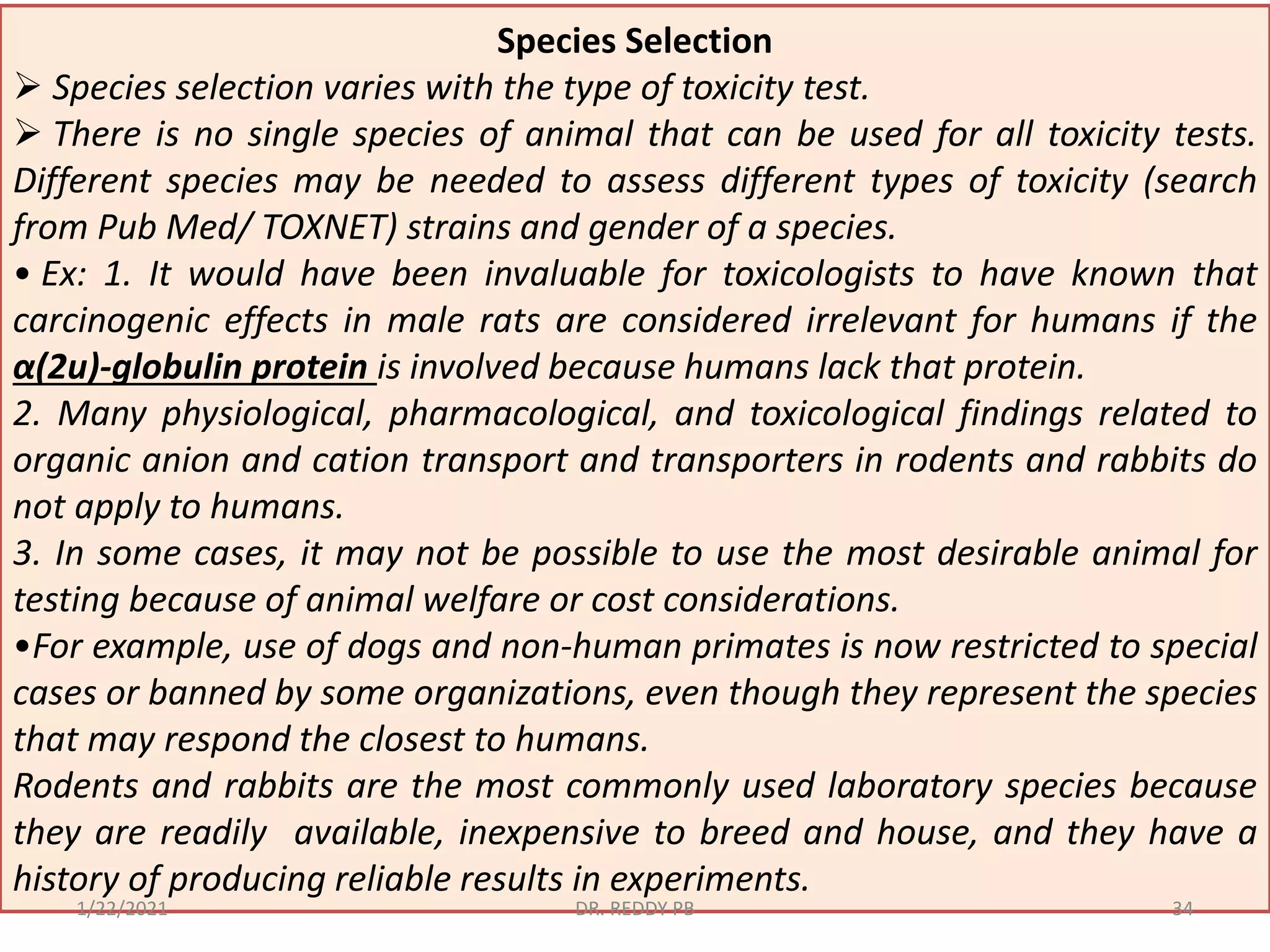
Species Selection
 Species selection varies with the type of toxicity test.
 There is no single species of animal that can be used for all toxicity tests.
Different species may be needed to assess different types of toxicity (search
from Pub Med/ TOXNET) strains and gender of a species.
• Ex: 1. It would have been invaluable for toxicologists to have known that
carcinogenic effects in male rats are considered irrelevant for humans if the
α(2u)-globulin protein is involved because humans lack that protein.
2. Many physiological, pharmacological, and toxicological findings related to
organic anion and cation transport and transporters in rodents and rabbits do
not apply to humans.
3. In some cases, it may not be possible to use the most desirable animal for
testing because of animal welfare or cost considerations.
•For example, use of dogs and non-human primates is now restricted to special
cases or banned by some organizations, even though they represent the species
that may respond the closest to humans.
Rodents and rabbits are the most commonly used laboratory species because
they are readily available, inexpensive to breed and house, and they have a
history of producing reliable results in experiments.
1/22/2021 DR. REDDY PB 34
1/22/2021 DR. REDDY PB 35
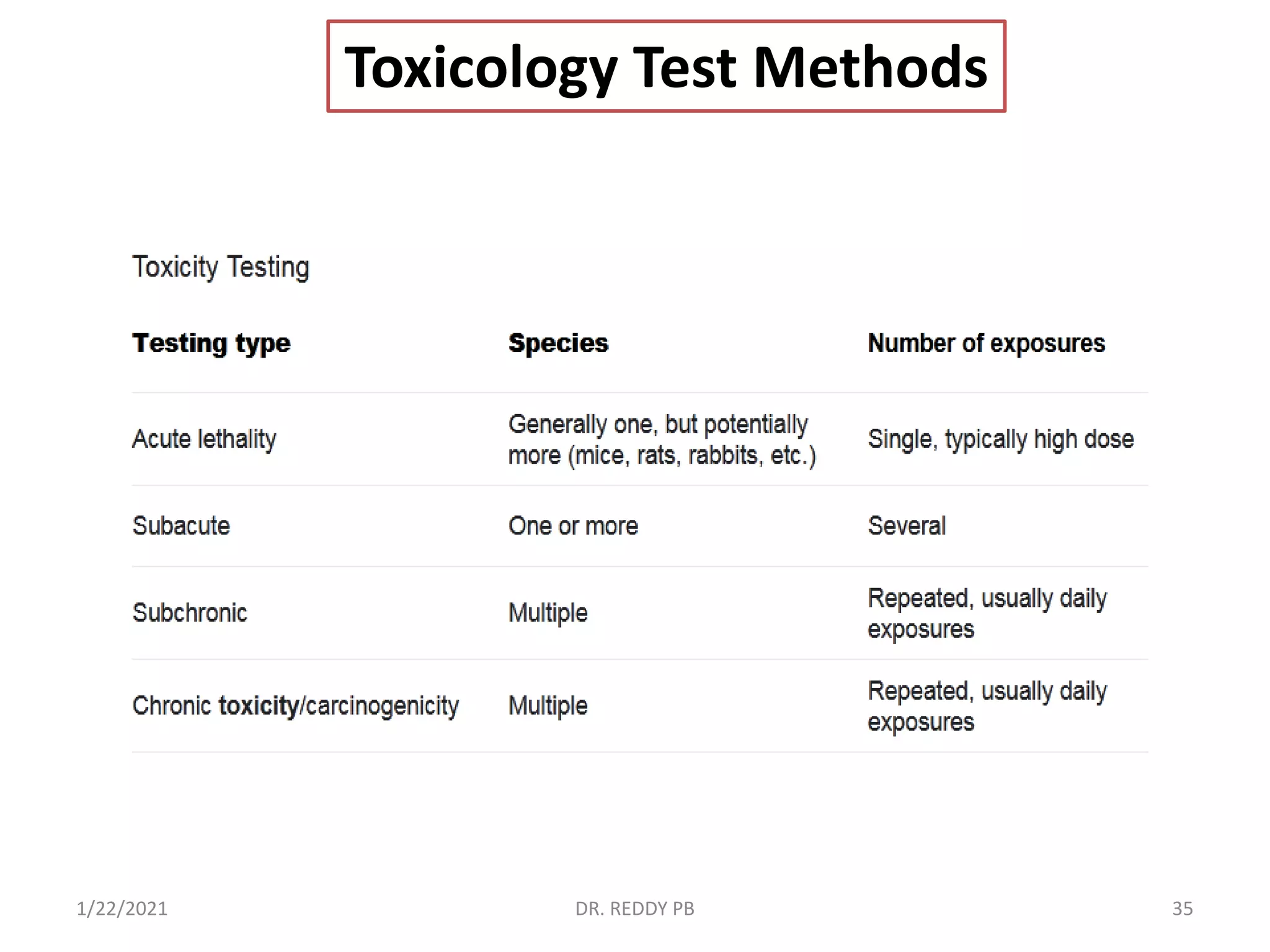
(Types of toxicities ) Acute Toxicity
Toxicology Test Methods
1/22/2021 DR. REDDY PB 36
Standardized tests:
•Acute Toxicity
•Subchronic Toxicity
•Chronic Toxicity
•Carcinogenicity
•Reproductive Toxicity
•Developmental Toxicity
•Dermal Toxicity
•Ocular Toxicity
•Neurotoxicity
•Genetic Toxicity
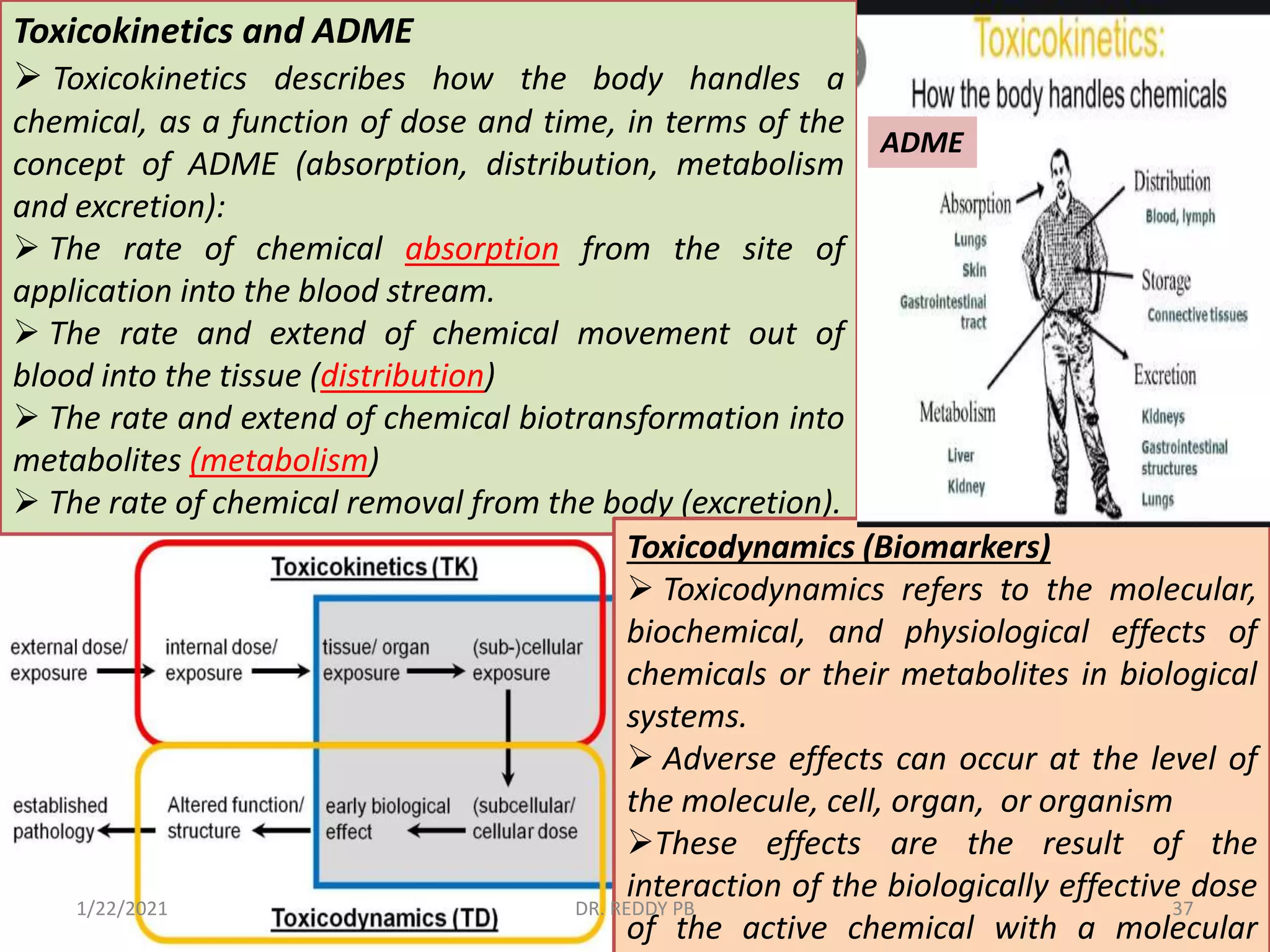
Toxicokinetics and ADME
 Toxicokinetics describes how the body handles a
chemical, as a function of dose and time, in terms of the
concept of ADME (absorption, distribution, metabolism
and excretion):
 The rate of chemical absorption from the site of
application into the blood stream.
 The rate and extend of chemical movement out of
blood into the tissue (distribution)
 The rate and extend of chemical biotransformation into
metabolites (metabolism)
 The rate of chemical removal from the body (excretion).
Toxicodynamics (Biomarkers)
 Toxicodynamics refers to the molecular,
biochemical, and physiological effects of
chemicals or their metabolites in biological
systems.
 Adverse effects can occur at the level of
the molecule, cell, organ, or organism
These effects are the result of the
interaction of the biologically effective dose
of the active chemical with a molecular
ADME
1/22/2021 DR. REDDY PB 37
1/22/2021 DR. REDDY PB 38
Category Parameter
Species
Rats preferred for oral and inhalation tests; rabbits
preferred for dermal tests
Age Young adults
Number of animals 5 of each sex per dose level
Dosage
Three dose levels recommended; exposures are
single doses or fractionated doses up to 24 hours
for oral and dermal studies and 4-hour exposure
for inhalation studies
Observation period 14 days
Acute Toxicity
They provide data on the relative toxicity likely to arise from a single or brief
exposure, or sometimes multiple doses over a brief period of time.
 Standardized tests are available for oral, dermal, and inhalation exposures,
and many regulatory agencies still require the use of all or some of these tests.
Table 1 lists basic parameters historically used in acute toxicity testing.
1/22/2021 DR. REDDY PB 39
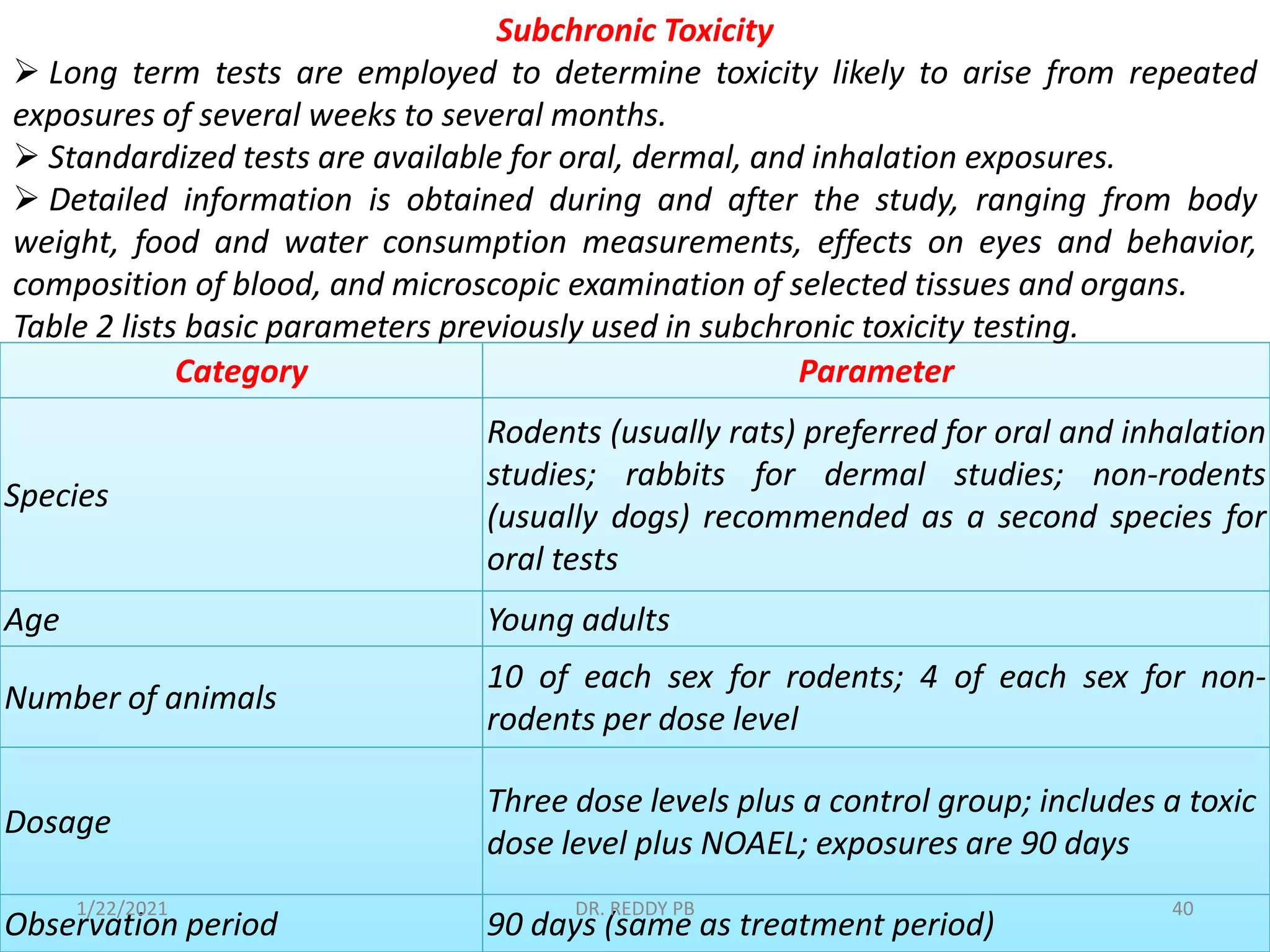
Category Parameter
Species
Rodents (usually rats) preferred for oral and inhalation
studies; rabbits for dermal studies; non-rodents
(usually dogs) recommended as a second species for
oral tests
Age Young adults
Number of animals
10 of each sex for rodents; 4 of each sex for non-
rodents per dose level
Dosage
Three dose levels plus a control group; includes a toxic
dose level plus NOAEL; exposures are 90 days
Observation period 90 days (same as treatment period)
Subchronic Toxicity
 Long term tests are employed to determine toxicity likely to arise from repeated
exposures of several weeks to several months.
 Standardized tests are available for oral, dermal, and inhalation exposures.
 Detailed information is obtained during and after the study, ranging from body
weight, food and water consumption measurements, effects on eyes and behavior,
composition of blood, and microscopic examination of selected tissues and organs.
Table 2 lists basic parameters previously used in subchronic toxicity testing.
1/22/2021 DR. REDDY PB 40
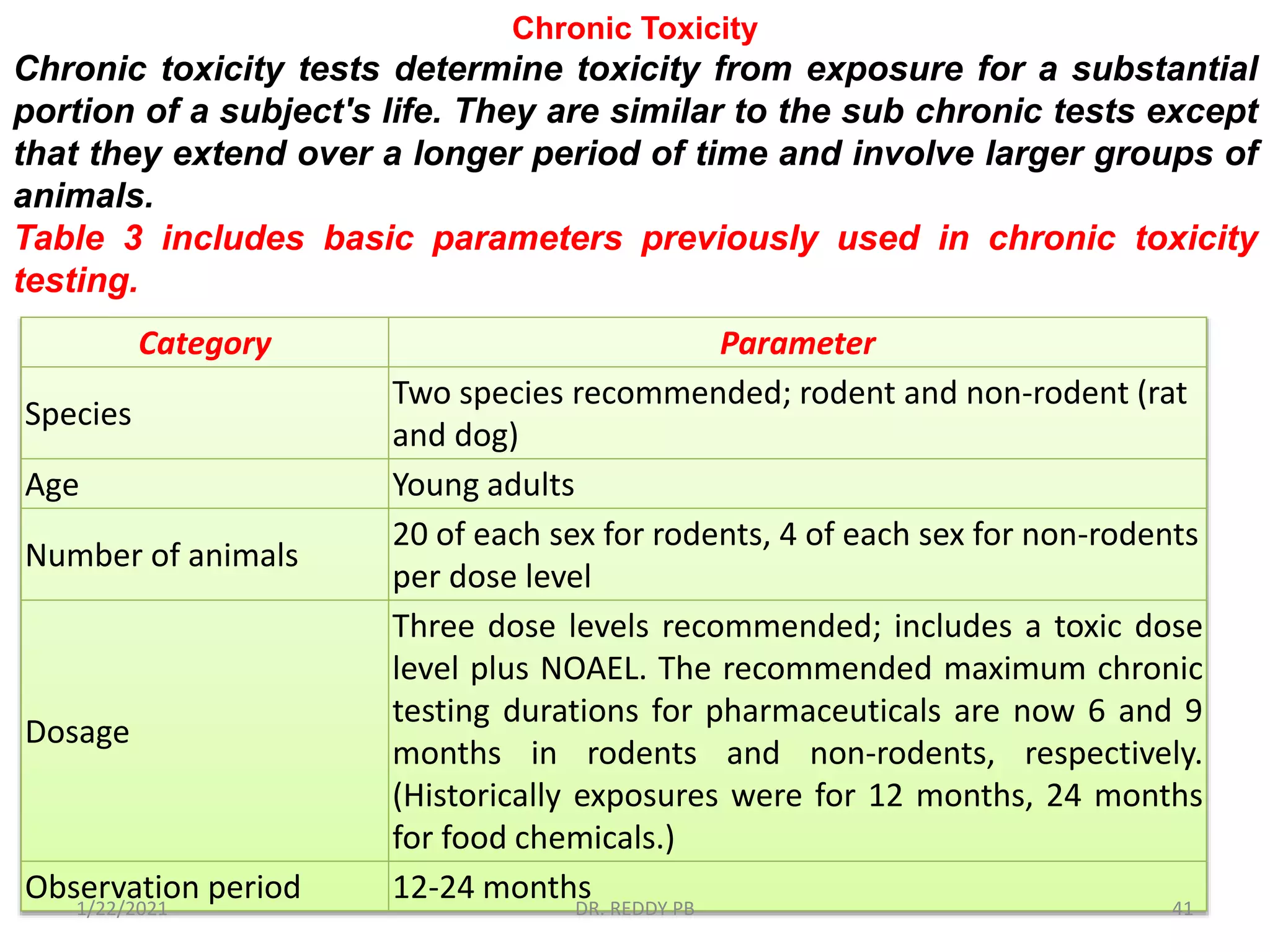
Category Parameter
Species
Two species recommended; rodent and non-rodent (rat
and dog)
Age Young adults
Number of animals
20 of each sex for rodents, 4 of each sex for non-rodents
per dose level
Dosage
Three dose levels recommended; includes a toxic dose
level plus NOAEL. The recommended maximum chronic
testing durations for pharmaceuticals are now 6 and 9
months in rodents and non-rodents, respectively.
(Historically exposures were for 12 months, 24 months
for food chemicals.)
Observation period 12-24 months
Chronic Toxicity
Chronic toxicity tests determine toxicity from exposure for a substantial
portion of a subject's life. They are similar to the sub chronic tests except
that they extend over a longer period of time and involve larger groups of
animals.
Table 3 includes basic parameters previously used in chronic toxicity
testing.
1/22/2021 DR. REDDY PB 41
1/22/2021 DR. REDDY PB 42
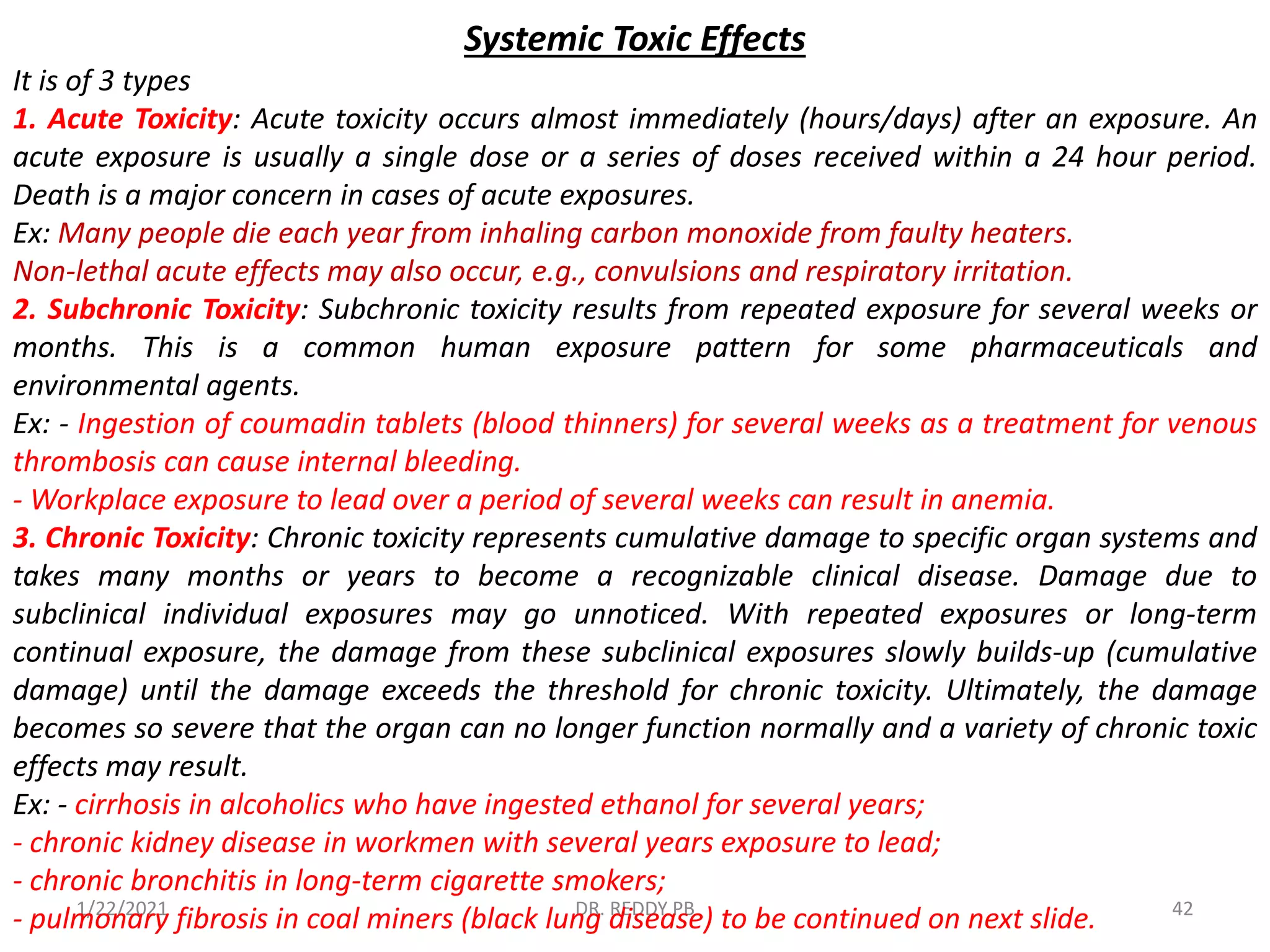
Systemic Toxic Effects
It is of 3 types
1. Acute Toxicity: Acute toxicity occurs almost immediately (hours/days) after an exposure. An
acute exposure is usually a single dose or a series of doses received within a 24 hour period.
Death is a major concern in cases of acute exposures.
Ex: Many people die each year from inhaling carbon monoxide from faulty heaters.
Non-lethal acute effects may also occur, e.g., convulsions and respiratory irritation.
2. Subchronic Toxicity: Subchronic toxicity results from repeated exposure for several weeks or
months. This is a common human exposure pattern for some pharmaceuticals and
environmental agents.
Ex: - Ingestion of coumadin tablets (blood thinners) for several weeks as a treatment for venous
thrombosis can cause internal bleeding.
- Workplace exposure to lead over a period of several weeks can result in anemia.
3. Chronic Toxicity: Chronic toxicity represents cumulative damage to specific organ systems and
takes many months or years to become a recognizable clinical disease. Damage due to
subclinical individual exposures may go unnoticed. With repeated exposures or long-term
continual exposure, the damage from these subclinical exposures slowly builds-up (cumulative
damage) until the damage exceeds the threshold for chronic toxicity. Ultimately, the damage
becomes so severe that the organ can no longer function normally and a variety of chronic toxic
effects may result.
Ex: - cirrhosis in alcoholics who have ingested ethanol for several years;
- chronic kidney disease in workmen with several years exposure to lead;
- chronic bronchitis in long-term cigarette smokers;
- pulmonary fibrosis in coal miners (black lung disease) to be continued on next slide.
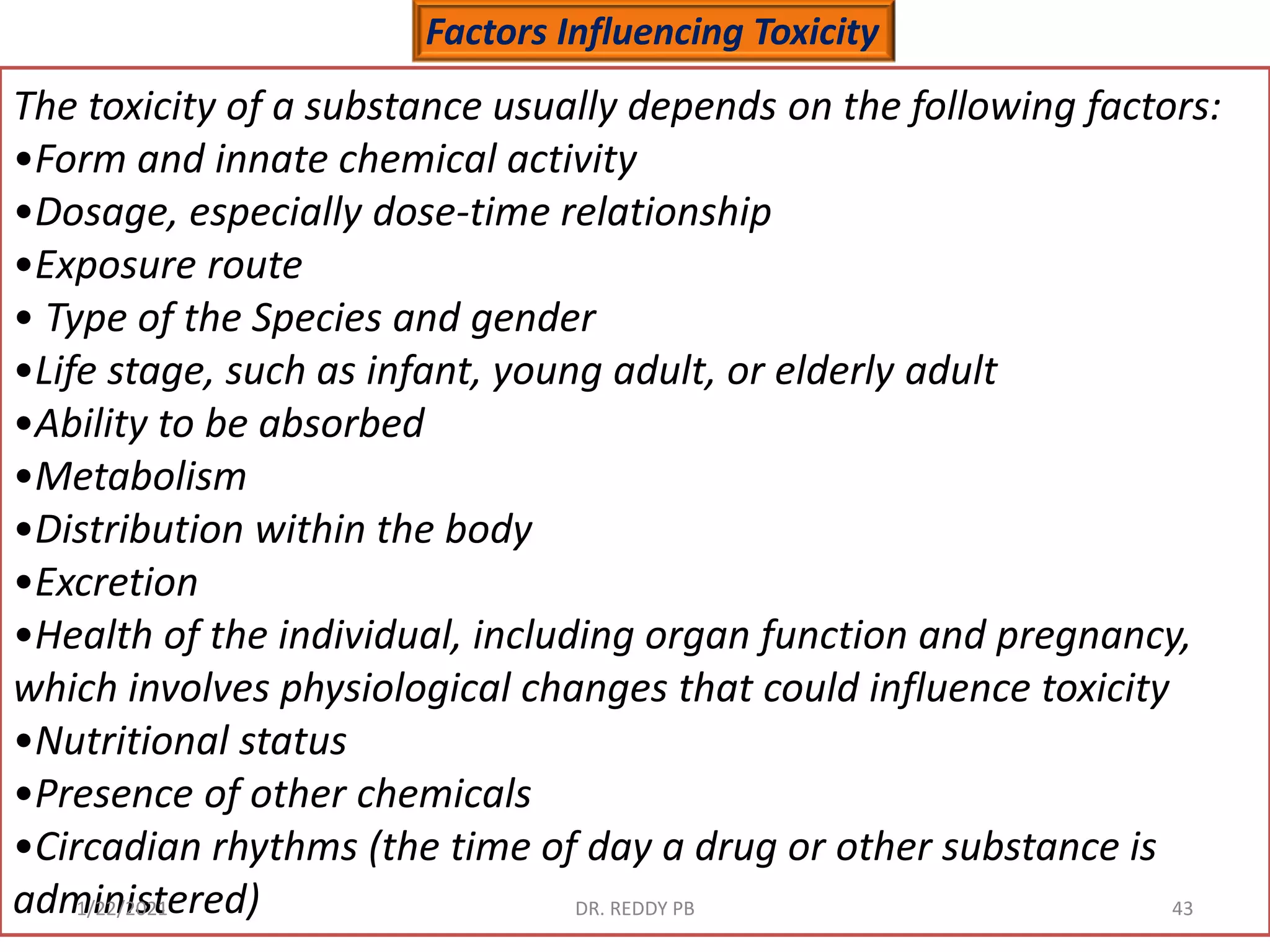
Factors Influencing Toxicity
The toxicity of a substance usually depends on the following factors:
•Form and innate chemical activity
•Dosage, especially dose-time relationship
•Exposure route
• Type of the Species and gender
•Life stage, such as infant, young adult, or elderly adult
•Ability to be absorbed
•Metabolism
•Distribution within the body
•Excretion
•Health of the individual, including organ function and pregnancy,
which involves physiological changes that could influence toxicity
•Nutritional status
•Presence of other chemicals
•Circadian rhythms (the time of day a drug or other substance is
administered)
1/22/2021 DR. REDDY PB 43
Animal Tests
Animal tests for toxicity have been conducted prior to and in parallel
with human clinical investigations as part of the non-clinical laboratory
tests of pharmaceuticals. Because, Exposing human beings to health
risks in order to observe the toxic effects is wrong and unethical. For that
reason, animals are needed in research to develop drugs and medical
procedures to treat diseases.
In the past, results from animal tests were often the only way to
effectively predict toxicity in humans.
Animal tests were developed and used because:
•Chemical exposure can be precisely controlled.
•Environmental conditions can be well-controlled.
•Virtually any type of toxic effect can be evaluated.
•The mechanism by which toxicity occurs can be studied.
1/22/2021 DR. REDDY PB 44
1/22/2021 DR. REDDY PB 45
Millions of laboratory animals are used
worldwide in tests to assess the safety of
chemicals (paints, dyes, plastics, pesticides,
household cleaners, cosmetics and food
additives).
•In the absence of human data, research with
experimental animals is the most reliable
means of detecting important toxic properties
of chemical substances and for estimating risks
to human and environmental health.
•Research involving laboratory animals is
necessary to ensure and enhance human and
animal health and protection of the
environment.
1/22/2021 DR. REDDY PB 46
Alternatives to Animal Testing
non-animal tests could be much cheaper and much faster,
These alternatives to animal testing include sophisticated tests using
human cells and tissues (also known as in vitro methods), advanced
computer-modeling techniques (often referred to as in silico models),
and studies with human
Finding Information about Alternatives to Animal Testing
Numerous Web resources are now available to provide guidance and other information
on in vitro and other alternatives to animal testing, completing such searches and
keeping current with information associated with alternatives to animal testing.
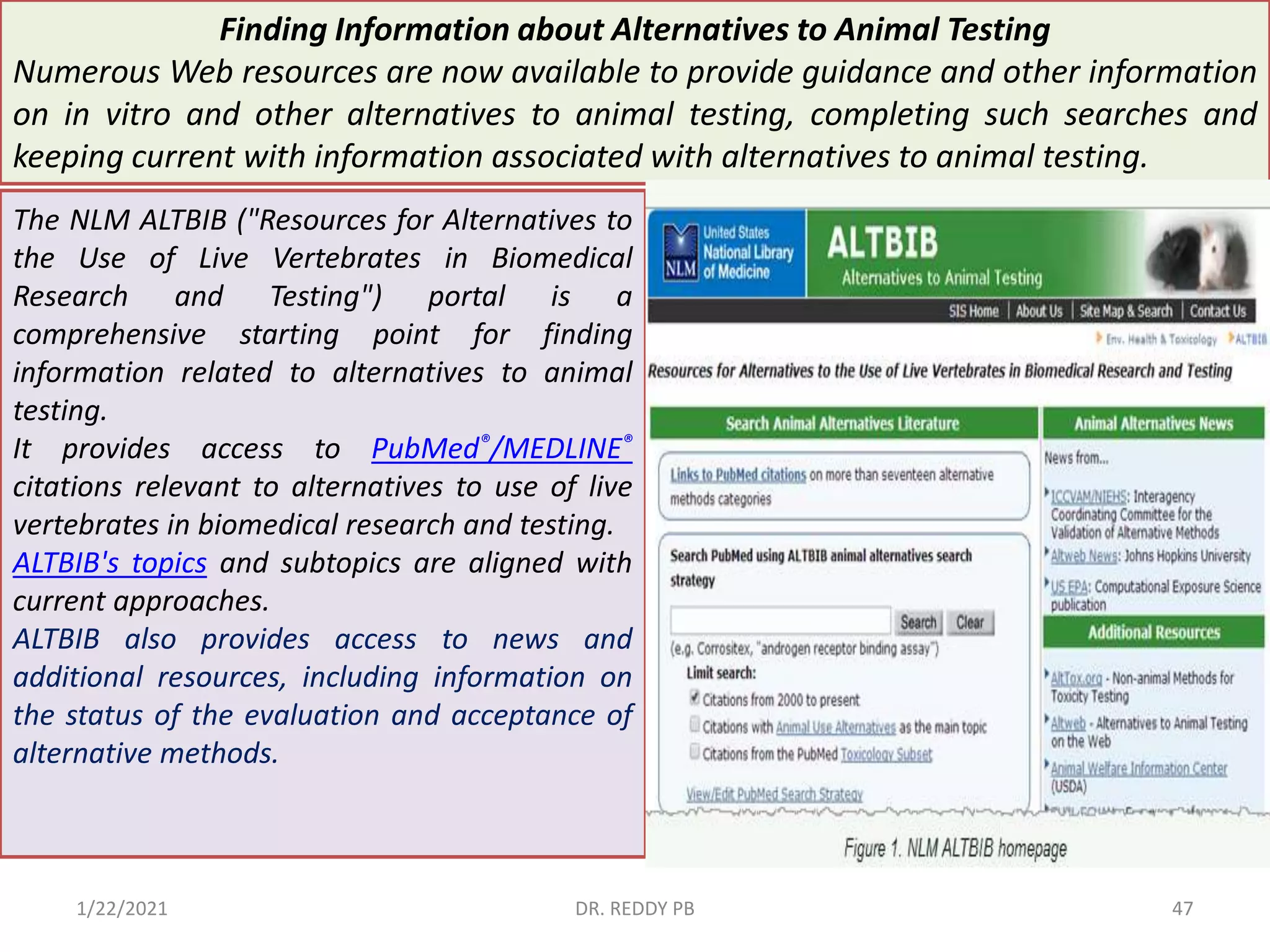
The NLM ALTBIB ("Resources for Alternatives to
the Use of Live Vertebrates in Biomedical
Research and Testing") portal is a
comprehensive starting point for finding
information related to alternatives to animal
testing.
It provides access to PubMed®/MEDLINE®
citations relevant to alternatives to use of live
vertebrates in biomedical research and testing.
ALTBIB's topics and subtopics are aligned with
current approaches.
ALTBIB also provides access to news and
additional resources, including information on
the status of the evaluation and acceptance of
alternative methods.
1/22/2021 DR. REDDY PB 47
Emerging Approaches and Methods
In the future, there will likely be additional and refined in vitro methods, and
the emergence of in silico and "chip" approaches.
Many current efforts are underway to refine, develop, and validate in
vitro methods.
In Silico Methods
They are "performed on computer or via computer simulation." This term was
developed as an analogy to the Latin phrases in vivo and in vitro.
Advanced computer models called "Virtual Tissue Models" are being developed
by the U.S. EPA's National Center for Computational Toxicology (NCCT). The
advanced computer models capable of simulating how chemicals may affect
human development. The models will help reduce dependence on animal study
data and provide much faster chemical risk assessments. Virtual Embryo
models simulate biological interactions observed during development and
predict chemical disruption of key biological events in pathways that is believed
to lead to adverse effects.
In silico (Pseudo-Latin for "in silicon", alluding to the
mass use of silicon for computer chips) is an expression
meaning "performed on computer or via computer
simulation" in reference to biological experiments.
1/22/2021 DR. REDDY PB 48
Chip" Models
An organ-on-a-chip (OOC) is a multi-channel 3-D microfluidic cell culture chip that simulates the
activities, mechanics and physiological response of entire organs and organ systems, a type of
artificial organ.
The chips are lined with living human cells and their tiny fluidic channels reproduce blood and/or
air flow just as in the human body. Their flexibility allows the chips to recreate breathing
motions, or undergo muscle contractions.
For example, the "Lung-on-a-chip" is described as "combining microfabrication techniques with
modern tissue engineering, lung-on-a-chip offers a new in vitro approach to drug screening by
mimicking the complicated mechanical and biochemical behaviors of a human lung.“
Using a connected series of tissue chips as an integrated multi-organ system can allow for the
creation of a "human-on-a-chip," to be used to model the metabolism and effects of drugs and
other substances moving through a human. For example, a liver chip could provide fluids and
metabolites to a kidney chip, allowing for the assessment of the nephrotoxic (kidney damage)
potential of a substance metabolized in the liver.
1/22/2021 DR. REDDY PB 49
Summary
• Toxicologists help to create a safer world .
• Toxicology provides important and critical information and
knowledge about the poisons.
• This information can be used by regulatory agencies, decision makers,
and others to put programs and policies in place to limit our
exposures to these substances.
• Prioritize substances for further in-depth toxicological evaluation
• Identify mechanisms of action for further investigation.
• Develop models that better predict how substances will affect
biological responses (predictive toxicology)
• Employ testing methods using human cells (in vitro approaches)
• Reduce time, effort, and costs associated with testing
• Contribute to the reduction, refinement, and replacement of animals
used in toxicity testing
1/22/2021 DR. REDDY PB 51

Concepts of toxicology

  • 1.
    Principles and Methodsof Toxicology Dr. P.B.Reddy M.Sc,M.Phil,Ph.D, FIMRF,FICER,FSLSc,FISZS,FISQEM PG DEPARTMENT OF ZOOLOGY GOVERTNAMENT PG COLLEGE AND INSTITUTE, RATLAM.M.P reddysirr@gmail.com 1/22/2021 DR. REDDY PB 1
  • 2.
    OUTLINE Module I: Introductionto Toxicology.  Introduction History Definitions and terminology  Principles and concepts Module II: Dose-Response  Dose response curve NOAEL and LOAEL Toxicokinetics and ADME  Determining Toxicity and measurement (probit Analysis) Module III: Toxicity testing methods  Animal testing  Types of Toxicity Tests (Acute, subchronic and chronic)  Alternatives to Animal Testing (In vitro tests, In silico tests and Chip models) 1/22/2021 DR. REDDY PB 2
  • 3.
    INTRODUCTION Toxicology is thescience of the poisons. It also studies the nature, effects, detection, assessment and treatment of their effects on biological material.  Toxicology is a multidisciplinary science. The ultimate objective of the combined research is to determine how an organism is affected by exposure to an agent. This includes an understanding of: How the agent moves and interact with living cells and tissues of the organism; What parts of the organism are affected by its presence and health outcomes of this exposure.  Evaluation of the toxicity of substances whose biological effects may not have been well characterized. The influence of chemical toxicity is mainly determined by the dosage, duration of exposure, route of exposure, species, age, sex, and environment.  The goal of toxicology is to contribute to the 1. general knowledge and harmful actions of chemical substances. 2. to study their mechanisms of action, 3. and to estimate their possible risks to humans 1/22/2021 DR. REDDY PB 3
  • 4.
    HISTORY  Dioscorides, aGreek physician in the court of the Roman emperor Nero, made the first attempt to classify plants according to their toxic and therapeutic effect. Poisonous plants and animals were recognized and their extracts used for hunting or in warfare.  In 1500 BC people used hemlock, opium, arrow poisons, and certain metals to poison enemies or for state executions.  Theophrastus Phillipus Auroleus Bombastus von Hohenheim (1493–1541) (also referred to as Paracelsus, a Roman physician from the first century) is considered "the father" of toxicology.  He stated that "All things are poisonous and nothing is without poison; only the dose makes a thing not poisonous.“ Mathieu Orfila (1813) is considered the modern father of toxicology.  In 1850, Jean Stas became the first person to successfully isolate plant poisons from human tissue. Hippolyte Visart de Bocarmé used nicotine to kill his brother-in-law. He extracted nicotine from tobacco leaves. The 20th and 21st Centuries have marked by great advancements in the level of understanding of toxicology. DNA and various biochemicals that maintain body functions have been discovered. Our level of knowledge of toxic effects on 1/22/2021 DR. REDDY PB 4
  • 5.
    DEFINITIONS AND CONCEPTS Toxicityis the intrinsic capacity of a chemical agent to affect an organism adversely.  Xenobiotics are a term for “foreign substances”, that is, foreign to the organism. Its opposite is endogenous compounds. Xenobiotics include drugs, industrial chemicals, naturally occurring poisons and environmental pollutants.  A hazard evaluation in toxicology focuses on defining what types of harmful effects could occur and under what circumstances (e.g. ingestion, inhalation, skin exposure).  Risk is the probability of a specific adverse effect to occur. It is often expressed as the percentage of cases in a given population and during a specific time period. A risk estimate can be based upon actual cases or a projection of future cases, based upon extrapolations. • in vitro = Use of living cells in an artificial or test tube system, or is otherwise performed outside of a living organism. • in vivo = A research or testing methodology performed in living organisms. 1/22/2021 DR. REDDY PB 5
  • 6.
    • dose, dosage= A dose is often expressed as the amount of a xenobiotic entering an organism (in units such as mg/kg body weight). • dose-response curve = A graphic representation of the relationship between the dose of a chemical administered and the effect produced. • dose-response relationships=The dose-response relationship is the relationship between dose and the percentage of individuals showing a specific effect. • threshold. The level above which effects will occur and below which no effects occur." Latency time = is the time between first exposure and the appearance of a detectable effect or response.  Systemic effects = are toxic effects in tissues distant from the route of absorption.  Target organ = is the primary or most sensitive organ affected after exposure. The same chemical entering the body by different routes of exposure dose, dose rate, sex and species may affect different target organs.  Toxinology, a specialized area of study, looks at microbial, plant and animal venoms, poisons, and toxins. 1/22/2021 DR. REDDY PB 6
  • 7.
    1/22/2021 DR. REDDYPB 7  Based on the allergenic, neurotoxic, carcinogenic and other important toxic effects regulatory authorities classified the chemicals into various categories. The grading can be “supertoxic,” “highly toxic,” “moderately toxic” and so on. The most common ratings concern acute toxicity.  This classification can be of administrative value as a warning and as information.
  • 8.
    Toxicant, toxin, andpoison are often used interchangeably in the literature but there are slight differences as shown below: Toxicants: Toxins: Poisons: •Substances producing adverse biological effects of any kind. •May be chemical or physical in nature. •Effects may be acute or chronic. •Peptides or proteins produced by living organisms. •Venoms are toxins injected by a bite or sting. •Toxins produced by organisms. 1/22/2021 DR. REDDY PB 8
  • 9.
    Toxic Agents A toxicagent is anything (chemical, physical, or biological) that can produce an adverse biological effect. For example, toxic agents may be: Many chemicals are of relatively low toxicity in the native form, but when acted on by enzymes and can interfere with normal cells in the body. The toxicity of the agent is dependent on the dose. 1/22/2021 DR. REDDY PB 9
  • 10.
     A distinctionis made for diseases people get from living organisms. Organisms that invade and multiply within another organism and produce their effects by biological activity are not classified as toxic agents but as biological agents. An example of this is a virus that damages cell membranes resulting in cell death. Biological agents If the invading organisms excrete chemicals. They are the basis for their toxicity. The excreted substances are known as biological toxins. In that case, the organisms are called toxic organisms. A specific example is tetanus. Tetanus is caused by a bacterium, Clostridium tetani. The bacteria C. tetani itself does not cause disease by invading and destroying cells. Rather, a toxin (neurotoxin) that the bacteria excrete travels to the nervous system and produces the disease. 1/22/2021 DR. REDDY PB 10
  • 11.
    Toxic Substances  Toxicsubstances may not always have a constant composition.  A toxic substance is simply a material that has toxic properties. It may be a discrete toxic chemical or a mixture of toxic chemicals. For example, lead chromate, asbestos, and gasoline are all toxic substances. More specifically: •Lead chromate is a discrete (mixture) toxic chemical. •Asbestos is a toxic material that does not have an exact chemical composition but comprises a variety of fibers and minerals. •Gasoline s a toxic substance rather than a toxic chemical in that it contains a mixture of many chemicals. •The composition of gasoline varies with octane level, manufacturer, time of season, and other factors. 1/22/2021 DR. REDDY PB 11
  • 12.
     A systemictoxicant affects the entire body or many organs rather than a specific site. For example, potassium cyanide is a systemic toxicant in that it affects virtually every cell and organ in the body by interfering with the cells’ ability to use oxygen.  Organ Toxicants may also affect only specific tissues or organs. These specific sites are known as the target organs or target tissues.  Benzene is a specific organ toxicant in that it is primarily toxic to the blood- forming tissues.  Lead is also a specific organ toxicant and is toxic to central nervous system, the kidneys, and the hematopoietic system). Systemic Toxicants and Organ Toxicants 1/22/2021 DR. REDDY PB 12
  • 13.
    1/22/2021 DR. REDDYPB 13 Uptake and Disposition Transport processes DIFFUSION VERY COMMON ETHANOL, WEAK ACIDS AND BASES ACTIVE TRANSPOSRT AGAINST THE CONCENTARTION GRADIENT. ATP IS CONSUMED SUGARS, AMINO ACIDS, INORGANIC IONS PHAGOCYTOSIS Monocytes and Macrophages, granulocytes, and dendritic cells Many large molecules and particles In order to enter the organism and reach a site where damage is produced, a foreign substance has to pass several barriers, including cells and their membranes.
  • 14.
    1/22/2021 DR. REDDYPB 14 Pulmonary absorption LUNGS Primary route of deposition and absorption of small airborne particles, gases, vapours and aerosols Percutaneous absorption SKIN Highly toxic, fat-soluble substances such as organophosphorous insecticides and organic solvents Gastrointestinal STOMACH AND INTESTINE accidental or intentional ingestion Absorption Absorption is the uptake of a substance from the environment into the organism. The term usually includes not only the entrance into the barrier tissue but also the further transport into circulating blood. OTHER ROUTES INJECTIONS
  • 15.
    Section 2: Doseand Dose Response All Interactions between chemicals and biological systems follow a Dose-Response Relationship 1/22/2021 DR. REDDY PB 15
  • 16.
    Dose-response relationship Dose: Itis the amount of that toxic substance that comes into contact with a living organism or some part of a living organism. It is clearly expressed in terms of body weight and, often, in terms of time as well (mg/kg/day). Other parameters like the number of doses, frequency, and total time period of the treatment have to take into consideration. For example: •650 mg acetaminophen (Tylenol® products) as a single dose. •500 mg penicillin every 8 hours for 10 days. •10 mg DDT per day for 90 days. 1. Exposed dose: This definition is generally applied in cases of occupational and environmental exposures. It Refer to the amount of a substance to which an individual or population is exposed. 2. Administered dose: The quantity administered usually orally or by injection. (note that an administered dose taken orally may not necessarily be absorbed). 3. Absorbed dose — the amount of a substance that entered the body through the skin, eyes, lungs, or digestive tract and was taken up by organs or particular tissues. Absorbed dose can also be called internal dose. 4. Target organ dose or biologically effective dose : The amount of toxicant that reaches the site(s) at which the adverse effects occur. 5. Total dose — the sum of all individual doses. 1/22/2021 DR. REDDY PB 16
  • 17.
    The following variablesmust be taken into account in the determination of the consequences of dose. It include: •Dose Amount - A measure of the magnitude of the dose. •Dose Frequency - How often exposure occurs, e.g., daily, weekly, five days out of seven, etc. •Dose Duration - Over how long a total period of time dose exposure occur, e.g., a week, a month, a year, a lifetime. •Subject Variability (Natural) - Individual characteristics such as age, sex, body weight, ethnic background, and genetics. •Subject Variability (Health Status) - Whether any pre-existing health conditions, such as asthma, diabetes, or hypertension, may affect susceptibility to an agent. •Route of Exposure - The way in which the person is exposed. The three most common routes of exposure are ingestion, inhalation and skin contact. 1/22/2021 DR. REDDY PB 17
  • 18.
    Dose Determines Whether aChemical Will Be Beneficial or Poisonous. Ex: Beneficial Dose Toxic Dose Vitamin A 5000 units/day 50,000 units/day Oxygen 20% (Air) 50 – 80% (Air)
  • 19.
    1/22/2021 DR. REDDYPB 19 Jan 14, 2007 The Jennifer Strange Story
  • 20.
    Absorption: Absorption isthe transfer of a chemical from the site of exposure, usually an external or internal body surface, into the systemic circulation. The absorbed dose be less than the total dose. Because it would depend on how much of the substance (ex: water) is absorbed in the individual's body which can be affected by various factors. Administered Dose Total Dose Absorbed Dose Dose 1 (8:00 a.m.): 1 L water 1 L 1 L Less than 1 L Dose 2 (9:00 a.m.): 1 L water 1 L 2 L Less than 2 L Dose 3 (10:00 a.m.): 1 L water 1 L 3 L Less than 3 L 1/22/2021 DR. REDDY PB 20 The water intake example is represented in Table 1. Distribution, and Excretion of Toxicants Toxicants are removed from the systemic circulation by biotransformation, excretion, and storage at various sites in the body. •Excretion is the removal of xenobiotics from the blood and their return to the external environment via urine, feces, exhalation, etc.
  • 21.
    1/22/2021 DR. REDDYPB 21 Types of doses The units used in toxicology are basically the same as those used in medicine. The gram is the standard unit.
  • 22.
    Fractionating Doses : Fractionating a total dose usually decreases the probability that the total dose will cause toxicity.  The reason is that the body often can repair the effect of each subtoxic dose if sufficient time elapses before the next dose is received.  In that case, a total dose that would be harmful if received all at once is non-toxic when administered over a period of time.  For example, 30 mg of strychnine (alkaloid pesticide) swallowed at one time could be fatal to an adult whereas 3 mg of strychnine swallowed each day for 10 days is not considered a fatal dose.  Concentration: Concentration is the amount of a substance found in a certain amount of another substance, such as water, air, soil, food, blood, hair, urine, or breath. For example, the weight of a toxic substance found in a certain weight of food is indicated as a measure of concentration rather than the total amount. 1/22/2021 DR. REDDY PB 22
  • 23.
    Following figure illustratesthis concept. The two glasses contain samples of juice that are being tested for contamination with lead. The volume of juice in Glass A is 100 mL and the volume of juice in Glass B is 50 mL. The concentration of lead is the same in both samples of juice: 20 parts per billion (ppb). The total amount of lead would be higher in Glass A but the concentration of lead per unit volume is the same in both glasses. 1/22/2021 DR. REDDY PB 23
  • 24.
    The dose-response curveis a visual representation of the response rates of a population to a range of doses of a substance. The dose-response relationship is a fundamental and essential concept in toxicology. It is based on observed data from experimental animal, human clinical, or cell studies. Knowledge of the dose-response relationship: - establishes causality - establishes the – the threshold effect. -determines the rate at which injury builds up – 1/22/2021 DR. REDDY PB 24 The dose-response curve The dose-response curve form of a sigmoid curve. The point at which toxicity first appears is known as the threshold dose level. From that point, the curve increases with higher dose levels. A threshold for toxic effects occurs at the point where the body's ability to detoxify a xenobiotic or repair toxic injury has been exceeded.
  • 25.
    Population Dose-Response Mild Extreme Many Few Number of Individuals Responseto SAME dose Sensitive Individuals Maximal Effect Resistant Individuals Minimal Effect Majority of Individuals Average Effect 1/22/2021 DR. REDDY PB 25 Within a population, the majority of responses to a toxicant are similar; however, some individuals are susceptible and others resistant. (depicted as a bell shaped standard distribution curve.
  • 26.
    Lethal Doses/Concentrations Dose-response curvesare used to derive dose estimates of chemical substances. • Lethal Dose 0% (LD0) — Represents the dose at which no individuals are expected to die. This is just below the threshold for lethality. • Lethal Dose 10% (LD10) — Refers to the dose at which 10% of the individuals will die. • Lethal Concentration 50% (LC50) — for inhalation toxicity, air concentrations are used for exposure values. The LC50 refers to the calculated concentration of a gas lethal to 50% of a group. Occasionally LC0 and LC10 are also used. Effective Doses (EDs) Effective Doses (EDs) are used to indicate the effectiveness of a substance (drug). Normally, effective dose refers to a beneficial effect such as relief of pain. It may also stand for a harmful effect such as paralysis. Thus, the specific endpoint must be indicated. The usual terms are: Term Effective for this percentage of the population ED0 0% ED10 10% ED50 50% ED90 90% Toxic Doses (TDs) Toxic Doses (TDs) are used to indicate doses that cause adverse toxic effects. The usual dose estimates include: Term Toxic to this percentage of the population TD0 0% TD10 10% TD50 50% TD90 90% 1/22/2021 DR. REDDY PB 26
  • 27.
     LD50 (LethalDose 50%) has been a common dose estimate for acute toxicity. It is a statistically derived maximum dose at which 50% of the group of organisms (rat, mouse, or other species) would be expected to die.  Now LD50 testing is no longer the recommended method for assessing toxicity because of the ethics of using large numbers of animals, the variability of responses in animals and humans, and the use of mortality as the only endpoint. Regulatory agencies use LD50 only if it is justified by scientific necessity and ethical considerations. The Three Rs The current practice for estimating acute toxicity emphasizes the following approaches, known as the Three Rs: 1.Replacing animals in science by in vitro, in silico, and other approaches. 2.Reducing the number of animals used. For example, the oral LD50 approach has been replaced in some circumstances by an up-and-down method in which animals are dosed one at a time. 3.Refining care and procedures to minimize pain and distress. Other dose estimates also may be used. 1/22/2021 DR. REDDY PB 27
  • 28.
    Threshold dose: Thedose at which this effect occurs is known as the threshold dose.  NOAEL: The NOEL (no observable adverse effect level) is the highest dose or exposure level of a substance or material that produces no noticeable (observable) toxic effect on tested animals. The NOAEL level may be used in the process of establishing a dose-response relationship, a fundamental step in most risk assessment methodologies  LOAEL: The LOAEL is the lowest dosage level at which chronic exposure to the substance shows adverse effects on tested animals.  The threshold dose lies between the NOAEL and LOAEL.  The value of the NOAEL and LOAEL depends on the design of the experiment.  An experiment with more or fewer animals, or with a difference selection of test doses, will have a different NOAEL and LOAEL. 1/22/2021 DR. REDDY PB 28 NOAELs are very important. They are used to derive threshold safety exposure dose to humans such as derived no-effect level (DNEL), occupational exposure limit (OEL) and acceptable daily intake (ADI). The units of NOAEL are mg/kg bw/day or ppm for dermal and oral route. For inthalation route, NOAEC is used instead. The unit can be mg/L/6h/day.
  • 29.
    Probit Analysis andLC50 Computation Using Microsoft Excel  Probit analysis is a type of regression used to analyze binomial response variables. •It transforms the sigmoid dose-response curve to a straight line that can then be analyzed by regression either through least squares or maximum likelihood. •Probit analysis can be conducted by one of three techniques:  Using tables to estimate the probits and fitting the relationship by eye, or Hand calculating the probits, regression coefficient, and confidence intervals , or Having a statistical package such as SPSS or Windows Excel7 or 10. 1/22/2021 DR. REDDY PB 29
  • 30.
    1/22/2021 DR. REDDYPB 30 1. Open the Microsoft Excel 2. Enter the concentration of the substance 3. Get the log10 concentration 4. Enter the mortality% of dead 5. Transform the % of dead into probits using the probit table 6. Perform regression analysis 7. Copy the ‘x’value and intercept 8. Substitute the ‘x’ variable and intercept in the formula 9. Y=ax+b where;- a= x variable ; b= intercept 9. To compute for LC50: A: Transform 50 to Probit using probit transformation table B. Substitute ‘Y’ with the probit value of 50 from the previous equation: Y=ax+b
  • 31.
    Input Y range(values ) (probits) Input ‘x’ range (log concentrations) 1/22/2021 DR. REDDY PB 31
  • 32.
    To compute LC50 values, Transform 50 to probit using probit transformation table 1/22/2021 DR. REDDY PB 32
  • 33.
    1/22/2021 DR. REDDYPB 33 Toxic effects (Biomarkers) Many xenobiotics distribute in the body and often affect only specific target organs. Others, however, can damage any cell or tissue that they contact. The target organs that are affected may vary depending on dosage and route of exposure. A target organ is an organ that is damaged by the xenobiotic or its metabolite. There may be more than one target for toxicity for a particular substance. For example, the targets for alcohol are the central nervous system and the liver. Toxicity can result from adverse cellular, biochemical, or macromolecular changes. Examples are: - cell replacement, such as fibrosis - damage to an enzyme system - disruption of protein synthesis - production of reactive chemicals in cells - DNA damage - modification of an essential biochemical function - interference with nutrition - alteration of a physiological mechanism
  • 34.
    Species Selection  Speciesselection varies with the type of toxicity test.  There is no single species of animal that can be used for all toxicity tests. Different species may be needed to assess different types of toxicity (search from Pub Med/ TOXNET) strains and gender of a species. • Ex: 1. It would have been invaluable for toxicologists to have known that carcinogenic effects in male rats are considered irrelevant for humans if the α(2u)-globulin protein is involved because humans lack that protein. 2. Many physiological, pharmacological, and toxicological findings related to organic anion and cation transport and transporters in rodents and rabbits do not apply to humans. 3. In some cases, it may not be possible to use the most desirable animal for testing because of animal welfare or cost considerations. •For example, use of dogs and non-human primates is now restricted to special cases or banned by some organizations, even though they represent the species that may respond the closest to humans. Rodents and rabbits are the most commonly used laboratory species because they are readily available, inexpensive to breed and house, and they have a history of producing reliable results in experiments. 1/22/2021 DR. REDDY PB 34
  • 35.
    1/22/2021 DR. REDDYPB 35 (Types of toxicities ) Acute Toxicity Toxicology Test Methods
  • 36.
    1/22/2021 DR. REDDYPB 36 Standardized tests: •Acute Toxicity •Subchronic Toxicity •Chronic Toxicity •Carcinogenicity •Reproductive Toxicity •Developmental Toxicity •Dermal Toxicity •Ocular Toxicity •Neurotoxicity •Genetic Toxicity
  • 37.
    Toxicokinetics and ADME Toxicokinetics describes how the body handles a chemical, as a function of dose and time, in terms of the concept of ADME (absorption, distribution, metabolism and excretion):  The rate of chemical absorption from the site of application into the blood stream.  The rate and extend of chemical movement out of blood into the tissue (distribution)  The rate and extend of chemical biotransformation into metabolites (metabolism)  The rate of chemical removal from the body (excretion). Toxicodynamics (Biomarkers)  Toxicodynamics refers to the molecular, biochemical, and physiological effects of chemicals or their metabolites in biological systems.  Adverse effects can occur at the level of the molecule, cell, organ, or organism These effects are the result of the interaction of the biologically effective dose of the active chemical with a molecular ADME 1/22/2021 DR. REDDY PB 37
  • 38.
  • 39.
    Category Parameter Species Rats preferredfor oral and inhalation tests; rabbits preferred for dermal tests Age Young adults Number of animals 5 of each sex per dose level Dosage Three dose levels recommended; exposures are single doses or fractionated doses up to 24 hours for oral and dermal studies and 4-hour exposure for inhalation studies Observation period 14 days Acute Toxicity They provide data on the relative toxicity likely to arise from a single or brief exposure, or sometimes multiple doses over a brief period of time.  Standardized tests are available for oral, dermal, and inhalation exposures, and many regulatory agencies still require the use of all or some of these tests. Table 1 lists basic parameters historically used in acute toxicity testing. 1/22/2021 DR. REDDY PB 39
  • 40.
    Category Parameter Species Rodents (usuallyrats) preferred for oral and inhalation studies; rabbits for dermal studies; non-rodents (usually dogs) recommended as a second species for oral tests Age Young adults Number of animals 10 of each sex for rodents; 4 of each sex for non- rodents per dose level Dosage Three dose levels plus a control group; includes a toxic dose level plus NOAEL; exposures are 90 days Observation period 90 days (same as treatment period) Subchronic Toxicity  Long term tests are employed to determine toxicity likely to arise from repeated exposures of several weeks to several months.  Standardized tests are available for oral, dermal, and inhalation exposures.  Detailed information is obtained during and after the study, ranging from body weight, food and water consumption measurements, effects on eyes and behavior, composition of blood, and microscopic examination of selected tissues and organs. Table 2 lists basic parameters previously used in subchronic toxicity testing. 1/22/2021 DR. REDDY PB 40
  • 41.
    Category Parameter Species Two speciesrecommended; rodent and non-rodent (rat and dog) Age Young adults Number of animals 20 of each sex for rodents, 4 of each sex for non-rodents per dose level Dosage Three dose levels recommended; includes a toxic dose level plus NOAEL. The recommended maximum chronic testing durations for pharmaceuticals are now 6 and 9 months in rodents and non-rodents, respectively. (Historically exposures were for 12 months, 24 months for food chemicals.) Observation period 12-24 months Chronic Toxicity Chronic toxicity tests determine toxicity from exposure for a substantial portion of a subject's life. They are similar to the sub chronic tests except that they extend over a longer period of time and involve larger groups of animals. Table 3 includes basic parameters previously used in chronic toxicity testing. 1/22/2021 DR. REDDY PB 41
  • 42.
    1/22/2021 DR. REDDYPB 42 Systemic Toxic Effects It is of 3 types 1. Acute Toxicity: Acute toxicity occurs almost immediately (hours/days) after an exposure. An acute exposure is usually a single dose or a series of doses received within a 24 hour period. Death is a major concern in cases of acute exposures. Ex: Many people die each year from inhaling carbon monoxide from faulty heaters. Non-lethal acute effects may also occur, e.g., convulsions and respiratory irritation. 2. Subchronic Toxicity: Subchronic toxicity results from repeated exposure for several weeks or months. This is a common human exposure pattern for some pharmaceuticals and environmental agents. Ex: - Ingestion of coumadin tablets (blood thinners) for several weeks as a treatment for venous thrombosis can cause internal bleeding. - Workplace exposure to lead over a period of several weeks can result in anemia. 3. Chronic Toxicity: Chronic toxicity represents cumulative damage to specific organ systems and takes many months or years to become a recognizable clinical disease. Damage due to subclinical individual exposures may go unnoticed. With repeated exposures or long-term continual exposure, the damage from these subclinical exposures slowly builds-up (cumulative damage) until the damage exceeds the threshold for chronic toxicity. Ultimately, the damage becomes so severe that the organ can no longer function normally and a variety of chronic toxic effects may result. Ex: - cirrhosis in alcoholics who have ingested ethanol for several years; - chronic kidney disease in workmen with several years exposure to lead; - chronic bronchitis in long-term cigarette smokers; - pulmonary fibrosis in coal miners (black lung disease) to be continued on next slide.
  • 43.
    Factors Influencing Toxicity Thetoxicity of a substance usually depends on the following factors: •Form and innate chemical activity •Dosage, especially dose-time relationship •Exposure route • Type of the Species and gender •Life stage, such as infant, young adult, or elderly adult •Ability to be absorbed •Metabolism •Distribution within the body •Excretion •Health of the individual, including organ function and pregnancy, which involves physiological changes that could influence toxicity •Nutritional status •Presence of other chemicals •Circadian rhythms (the time of day a drug or other substance is administered) 1/22/2021 DR. REDDY PB 43
  • 44.
    Animal Tests Animal testsfor toxicity have been conducted prior to and in parallel with human clinical investigations as part of the non-clinical laboratory tests of pharmaceuticals. Because, Exposing human beings to health risks in order to observe the toxic effects is wrong and unethical. For that reason, animals are needed in research to develop drugs and medical procedures to treat diseases. In the past, results from animal tests were often the only way to effectively predict toxicity in humans. Animal tests were developed and used because: •Chemical exposure can be precisely controlled. •Environmental conditions can be well-controlled. •Virtually any type of toxic effect can be evaluated. •The mechanism by which toxicity occurs can be studied. 1/22/2021 DR. REDDY PB 44
  • 45.
    1/22/2021 DR. REDDYPB 45 Millions of laboratory animals are used worldwide in tests to assess the safety of chemicals (paints, dyes, plastics, pesticides, household cleaners, cosmetics and food additives). •In the absence of human data, research with experimental animals is the most reliable means of detecting important toxic properties of chemical substances and for estimating risks to human and environmental health. •Research involving laboratory animals is necessary to ensure and enhance human and animal health and protection of the environment.
  • 46.
    1/22/2021 DR. REDDYPB 46 Alternatives to Animal Testing non-animal tests could be much cheaper and much faster, These alternatives to animal testing include sophisticated tests using human cells and tissues (also known as in vitro methods), advanced computer-modeling techniques (often referred to as in silico models), and studies with human
  • 47.
    Finding Information aboutAlternatives to Animal Testing Numerous Web resources are now available to provide guidance and other information on in vitro and other alternatives to animal testing, completing such searches and keeping current with information associated with alternatives to animal testing. The NLM ALTBIB ("Resources for Alternatives to the Use of Live Vertebrates in Biomedical Research and Testing") portal is a comprehensive starting point for finding information related to alternatives to animal testing. It provides access to PubMed®/MEDLINE® citations relevant to alternatives to use of live vertebrates in biomedical research and testing. ALTBIB's topics and subtopics are aligned with current approaches. ALTBIB also provides access to news and additional resources, including information on the status of the evaluation and acceptance of alternative methods. 1/22/2021 DR. REDDY PB 47
  • 48.
    Emerging Approaches andMethods In the future, there will likely be additional and refined in vitro methods, and the emergence of in silico and "chip" approaches. Many current efforts are underway to refine, develop, and validate in vitro methods. In Silico Methods They are "performed on computer or via computer simulation." This term was developed as an analogy to the Latin phrases in vivo and in vitro. Advanced computer models called "Virtual Tissue Models" are being developed by the U.S. EPA's National Center for Computational Toxicology (NCCT). The advanced computer models capable of simulating how chemicals may affect human development. The models will help reduce dependence on animal study data and provide much faster chemical risk assessments. Virtual Embryo models simulate biological interactions observed during development and predict chemical disruption of key biological events in pathways that is believed to lead to adverse effects. In silico (Pseudo-Latin for "in silicon", alluding to the mass use of silicon for computer chips) is an expression meaning "performed on computer or via computer simulation" in reference to biological experiments. 1/22/2021 DR. REDDY PB 48
  • 49.
    Chip" Models An organ-on-a-chip(OOC) is a multi-channel 3-D microfluidic cell culture chip that simulates the activities, mechanics and physiological response of entire organs and organ systems, a type of artificial organ. The chips are lined with living human cells and their tiny fluidic channels reproduce blood and/or air flow just as in the human body. Their flexibility allows the chips to recreate breathing motions, or undergo muscle contractions. For example, the "Lung-on-a-chip" is described as "combining microfabrication techniques with modern tissue engineering, lung-on-a-chip offers a new in vitro approach to drug screening by mimicking the complicated mechanical and biochemical behaviors of a human lung.“ Using a connected series of tissue chips as an integrated multi-organ system can allow for the creation of a "human-on-a-chip," to be used to model the metabolism and effects of drugs and other substances moving through a human. For example, a liver chip could provide fluids and metabolites to a kidney chip, allowing for the assessment of the nephrotoxic (kidney damage) potential of a substance metabolized in the liver. 1/22/2021 DR. REDDY PB 49
  • 50.
    Summary • Toxicologists helpto create a safer world . • Toxicology provides important and critical information and knowledge about the poisons. • This information can be used by regulatory agencies, decision makers, and others to put programs and policies in place to limit our exposures to these substances. • Prioritize substances for further in-depth toxicological evaluation • Identify mechanisms of action for further investigation. • Develop models that better predict how substances will affect biological responses (predictive toxicology) • Employ testing methods using human cells (in vitro approaches) • Reduce time, effort, and costs associated with testing • Contribute to the reduction, refinement, and replacement of animals used in toxicity testing
  • 51.