 Biodiversity is the degree of variation of life . This can
refer to genetic variation, species variation, or ecosystem
variation
 Biologists most often define biodiversity as the "totality
of genes, species, and ecosystems of a region".
 An advantage of this definition is that it seems to
describe most circumstances and presents a unified view
of the traditional three levels at which biological variety
has been identified:
Species diversity
Ecosystem diversity
Genetic diversity
 Genetic diversity
This represents the heritable variation within and
between populations of organisms. Ultimately, this
resides in variations in the sequence of the four base-
pairs which, as components of nucleic acids, constitute
the genetic code.
 Species diversity
Perhaps because the living world is most widely
considered in terms of species, biodiversity is very
commonly used as a synonym of species diversity, in
particular of 'species richness', which is the number of
species in a site or habitat.
 Ecosystemdiversity
The quantitative assessment of diversity at the
ecosystem, habitat or community level remains
problematic.
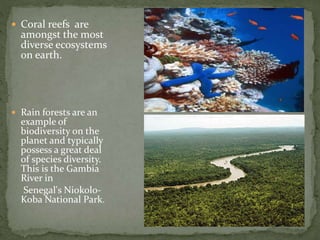
 Coral reefs are
amongst the most
diverse ecosystems
on earth.
 Rain forests are an
example of
biodiversity on the
planet and typically
possess a great deal
of species diversity.
This is the Gambia
River in
Senegal's Niokolo-
Koba National Park.
 The word 'biodiversity' is a contraction of biological
diversity.
 Diversity is a concept which refers to the range of
variation or differences among some set of entities;
biological diversity thus refers to variety within the living
world.
 The term 'biodiversity' is indeed commonly used to
describe the number, variety and variability of living
organisms. This very broad usage, embracing many
different parameters, is essentially a synonym of 'Life on
Earth'.
 Biodiversity generally tends to cluster in hotspots,and
has been increasing through time but will be likely to
slow in the future.
 The period since the emergence of humans has displayed
an ongoing biodiversity reduction and an accompanying
loss of genetic diversity. Named the Holocene extinction,
the reduction is caused primarily by human impacts,
particularly habitat destruction.
 Conversely, biodiversity impacts human health in a
number of ways, both positively and negatively.
 The United Nations designated 2011–2020 as the United
Nations Decade on Biodiversity.
Direct values
The direct value include food resources like grains, vegetables, fruits
which are obtained from plant resources and meat, fish, egg, milk
and milk products from animal resources. These also include other
values like medicine, fuel, timber, fiber, wool, wax, resin, rubber, silk
and decorative items.
Consumptive use value: These are the direct use values where the
biodiversity products can be harvested and consumed directly.
Example: Food, fuel and drugs. These goods are consumed locally
and do no figure in national and international market.
Productive use values: These are the direct use values where the
product is commercially sold in national and international market.
Many industries are dependent upon these values. Example- Textile,
leather, silk, paper and pulp industry etc. Although there is an
international ban on trade of products from endangered species like
tusks of elephants, wool from sheep, fur of many animals etc. These
are traded in market and fetch a booming business.
Indirect values
Biodiversity provides indirect benefits to human beings which
support the existence of biological life and other benefits
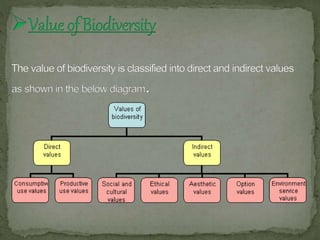
which are difficult to quantify. These include social and
cultural values, ethical values, aesthetic values, option values
and environment service values.
Social and cultural value: Many plants and animals are
considered holy and sacred in India and are worshipped like
Tulsi, peepal, cow, snake etc. In Indian society great cultural
value is given to forest and as such tiger, peacock and lotus are
named as the national animal, bird and flower respectively.
Ethical: These values are related to conservation of biodiversity
where ethical issue of ‘all life forms must be preserved’ is laid
down. There is an existence value which is attached to each
species because biodiversity is valuable for the survival of
human race. Moreover all species have a moral right to exist
independent of our need for them.
Aesthetic value: There is a great aesthetic value which is
attached to biodiversity. Natural landscapes at undisturbed
places are a delight to watch and also provide opportunities for
recreational activities like bird watching, photography etc. It
promotes eco-tourism which further generates revenue by
designing of zoological, botanical gardens, national parks,
wild life conservation etc.
Environment service values: The most important benefit of
biodiversity is maintenance of environment services which
includes
 Carbon dioxide fixation through photosynthesis.
 Maintaining of essential nutrients by carbon (C), oxygen (O), Nitrogen
(N), Sulphur (S), Phosphorus (P) cycles.
 Maintaining water cycle and recharging of ground water.
 Soil formation and protection from erosion.
 Regulating climate by recycling moisture into the atmosphere.
 In 2006 many species were formally classified
as rare or endangered or threatened; moreover, scientists have
estimated that millions more species are at risk which have not
been formally recognized. About 40 percent of the 40,177
species assessed using the IUCN Red List criteria are now
listed as threatened with extinction—a total of 16,119.
• Habitat destruction:- Habitat destruction has played a key
role in extinctions, especially related to tropical
forest destruction. Factors contributing to habitat loss are :
overpopulation, deforestation, pollution (air pollution, water
pollution, soil contamination) and global warming or climate
change.
 Hybridization, genetic pollution/erosion and food
security:- In agriculture and animal husbandry, the Green
Revolution popularized the use of
conventional hybridization to increase yield. Often hybridized
breeds originated in developed countries and were further
hybridized with local varieties in the developing world to
create high yield strains resistant to local climate and diseases.
Local governments and industry have been pushing
hybridization. Formerly huge gene pools of various wild and
indigenous breeds have collapsed causing widespread genetic
erosion and genetic pollution. This has resulted in loss of
genetic diversity and biodiversity as a whole.
 Climate change
 Human overpopulation
Biodiversity

Biodiversity

  • 2.
     Biodiversity isthe degree of variation of life . This can refer to genetic variation, species variation, or ecosystem variation  Biologists most often define biodiversity as the "totality of genes, species, and ecosystems of a region".  An advantage of this definition is that it seems to describe most circumstances and presents a unified view of the traditional three levels at which biological variety has been identified: Species diversity Ecosystem diversity Genetic diversity
  • 3.
     Genetic diversity Thisrepresents the heritable variation within and between populations of organisms. Ultimately, this resides in variations in the sequence of the four base- pairs which, as components of nucleic acids, constitute the genetic code.  Species diversity Perhaps because the living world is most widely considered in terms of species, biodiversity is very commonly used as a synonym of species diversity, in particular of 'species richness', which is the number of species in a site or habitat.  Ecosystemdiversity The quantitative assessment of diversity at the ecosystem, habitat or community level remains problematic.
  • 4.
     Coral reefsare amongst the most diverse ecosystems on earth.  Rain forests are an example of biodiversity on the planet and typically possess a great deal of species diversity. This is the Gambia River in Senegal's Niokolo- Koba National Park.
  • 5.
     The word'biodiversity' is a contraction of biological diversity.  Diversity is a concept which refers to the range of variation or differences among some set of entities; biological diversity thus refers to variety within the living world.  The term 'biodiversity' is indeed commonly used to describe the number, variety and variability of living organisms. This very broad usage, embracing many different parameters, is essentially a synonym of 'Life on Earth'.  Biodiversity generally tends to cluster in hotspots,and has been increasing through time but will be likely to slow in the future.
  • 6.
     The periodsince the emergence of humans has displayed an ongoing biodiversity reduction and an accompanying loss of genetic diversity. Named the Holocene extinction, the reduction is caused primarily by human impacts, particularly habitat destruction.  Conversely, biodiversity impacts human health in a number of ways, both positively and negatively.  The United Nations designated 2011–2020 as the United Nations Decade on Biodiversity.
  • 8.
    Direct values The directvalue include food resources like grains, vegetables, fruits which are obtained from plant resources and meat, fish, egg, milk and milk products from animal resources. These also include other values like medicine, fuel, timber, fiber, wool, wax, resin, rubber, silk and decorative items. Consumptive use value: These are the direct use values where the biodiversity products can be harvested and consumed directly. Example: Food, fuel and drugs. These goods are consumed locally and do no figure in national and international market. Productive use values: These are the direct use values where the product is commercially sold in national and international market. Many industries are dependent upon these values. Example- Textile, leather, silk, paper and pulp industry etc. Although there is an international ban on trade of products from endangered species like tusks of elephants, wool from sheep, fur of many animals etc. These are traded in market and fetch a booming business.
  • 9.
    Indirect values Biodiversity providesindirect benefits to human beings which support the existence of biological life and other benefits which are difficult to quantify. These include social and cultural values, ethical values, aesthetic values, option values and environment service values. Social and cultural value: Many plants and animals are considered holy and sacred in India and are worshipped like Tulsi, peepal, cow, snake etc. In Indian society great cultural value is given to forest and as such tiger, peacock and lotus are named as the national animal, bird and flower respectively. Ethical: These values are related to conservation of biodiversity where ethical issue of ‘all life forms must be preserved’ is laid down. There is an existence value which is attached to each species because biodiversity is valuable for the survival of human race. Moreover all species have a moral right to exist independent of our need for them.
  • 10.
    Aesthetic value: Thereis a great aesthetic value which is attached to biodiversity. Natural landscapes at undisturbed places are a delight to watch and also provide opportunities for recreational activities like bird watching, photography etc. It promotes eco-tourism which further generates revenue by designing of zoological, botanical gardens, national parks, wild life conservation etc. Environment service values: The most important benefit of biodiversity is maintenance of environment services which includes  Carbon dioxide fixation through photosynthesis.  Maintaining of essential nutrients by carbon (C), oxygen (O), Nitrogen (N), Sulphur (S), Phosphorus (P) cycles.  Maintaining water cycle and recharging of ground water.  Soil formation and protection from erosion.  Regulating climate by recycling moisture into the atmosphere.
  • 11.
     In 2006many species were formally classified as rare or endangered or threatened; moreover, scientists have estimated that millions more species are at risk which have not been formally recognized. About 40 percent of the 40,177 species assessed using the IUCN Red List criteria are now listed as threatened with extinction—a total of 16,119. • Habitat destruction:- Habitat destruction has played a key role in extinctions, especially related to tropical forest destruction. Factors contributing to habitat loss are : overpopulation, deforestation, pollution (air pollution, water pollution, soil contamination) and global warming or climate change.
  • 12.
     Hybridization, geneticpollution/erosion and food security:- In agriculture and animal husbandry, the Green Revolution popularized the use of conventional hybridization to increase yield. Often hybridized breeds originated in developed countries and were further hybridized with local varieties in the developing world to create high yield strains resistant to local climate and diseases. Local governments and industry have been pushing hybridization. Formerly huge gene pools of various wild and indigenous breeds have collapsed causing widespread genetic erosion and genetic pollution. This has resulted in loss of genetic diversity and biodiversity as a whole.  Climate change  Human overpopulation