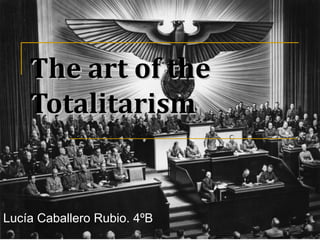
The art of the
    Totalitarism


Lucía Caballero Rubio. 4ºB
Index:
   Introduction
   Objetives of the art of the Totalitarism
   Common theme
   Nazi Art
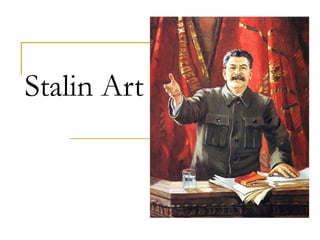
   Stalin Art
   Fascist Art
Introduction:

   All the world knows about Fascism, I-II World
    War, its weapons, battles, heroes, and of
    course its victims…but nobody looks in other
    aspects of the society for example the art in
    the dictatorships.
Introduction:
    During the period between 1922 to 1953 Art was
    converted in the expression of the ideologies with
    propagandistic objectives:

   The art should teach, inform, and inculcate the
    ideologies of the State.
   The dictators stimulate art pieces with neoclassic or
    realistic style.
   They try to show the nation’s triumphs and the dictators
    were myths. The visual art was used to symbolize the
    triumph of this ideologies.
Objectives

   The individual desire for experiment and
    investigate was suppressed.
    Artistic ideal = Racial ideal
Common theme:

   Large Public buildings.
   Portraits of the dictators.
   New factories, buildings and highways.
   Big concentrations of mass.
   Glorify the healthy body
   Heroic education
   Death cult
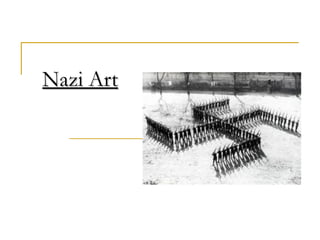
Nazi Art
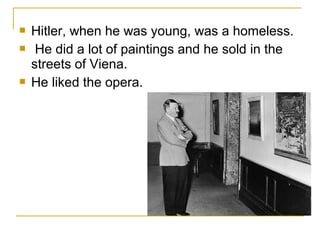
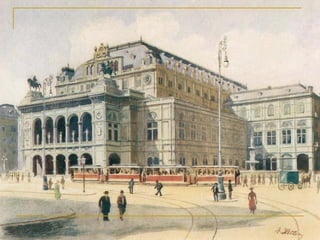
   Hitler, when he was young, was a homeless.
    He did a lot of paintings and he sold in the
    streets of Viena.
   He liked the opera.
 Until the rise of power of National Socialism
  in Germany considered modern art, but now
  Germany requires a German art again and it
                                            ​
  must and will be like all creative values of a
  new town, a modern art .
( Discourse of Adolf Hitler in the inaguration of
  the Gran exhibición del arte alemán, 1937)
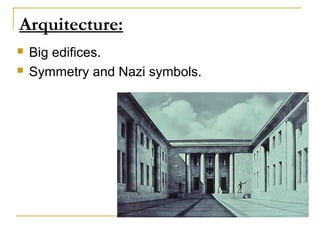
Arquitecture:
   Big edifices.
   Symmetry and Nazi symbols.
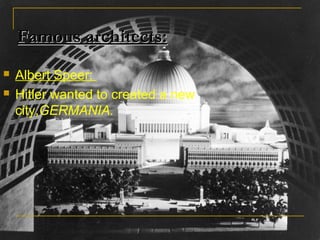
Famous architects:
   Albert Speer:
   Hitler wanted to created a new
    city,GERMANIA.
Famous architects:


   Paul Ludwig Troost
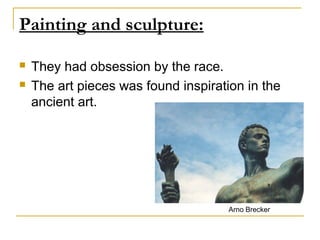
Painting and sculpture:

   They had obsession by the race.
   The art pieces was found inspiration in the
    ancient art.


                                      Arno Brecker
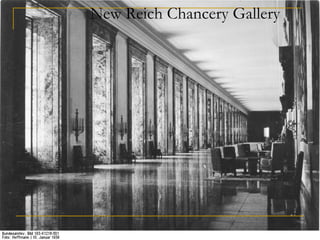
New Reich Chancery Gallery
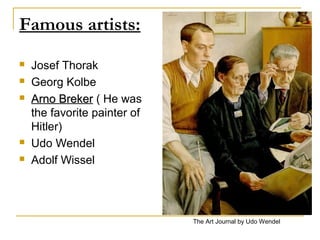
Famous artists:
   Josef Thorak
   Georg Kolbe
   Arno Breker ( He was
    the favorite painter of
    Hitler)
   Udo Wendel
   Adolf Wissel


                              The Art Journal by Udo Wendel
Farm Family from Kahlenberg by Adolf Wissel
Aphrodite by Joseph Thorak
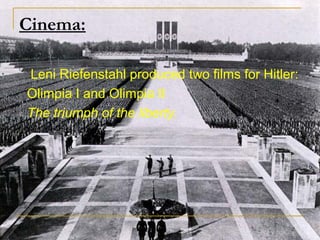
Cinema:

Leni Riefenstahl produced two films for Hitler:
Olimpia I and Olimpia II
The triumph of the liberty.
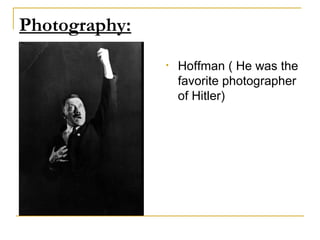
Photography:
               •   Hoffman ( He was the
                   favorite photographer
                   of Hitler)
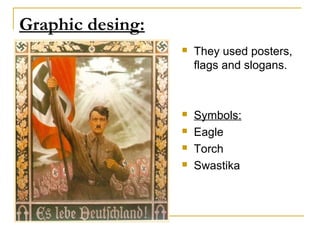
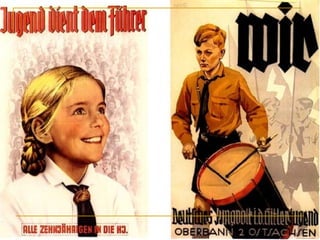
Graphic desing:
                     They used posters,
                      flags and slogans.


                     Symbols:
                     Eagle
                     Torch
                     Swastika
Music:

   Richard Wagner
   Carl Off
   Richard Strauss
Stalin Art
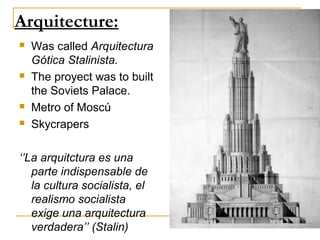
Arquitecture:
   Was called Arquitectura
    Gótica Stalinista.
   The proyect was to built
    the Soviets Palace.
   Metro of Moscú
   Skycrapers

‘’La arquitctura es una
   parte indispensable de
   la cultura socialista, el
   realismo socialista
   exige una arquitectura
   verdadera’’ (Stalin)
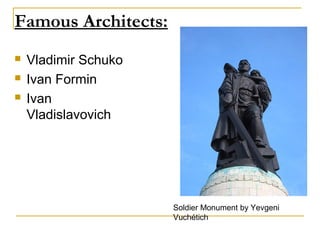
Famous Architects:
   Vladimir Schuko
   Ivan Formin
   Ivan
    Vladislavovich


                      Soldier Monument by Yevgeni
                      Vuchétich
Painting:
   Historic realism


                       "Rosas para Stalin" - Boris Vladimirski
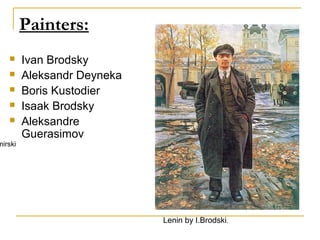
Painters:
        Ivan Brodsky
        Aleksandr Deyneka
        Boris Kustodier
        Isaak Brodsky
        Aleksandre
         Guerasimov
mirski


                             Lenin by I.Brodski.
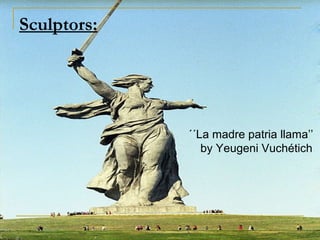
Sculptors:


             ´´La madre patria llama’’
                by Yeugeni Vuchétich
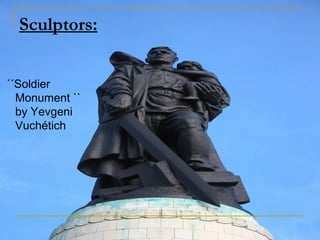
Sculptors:


´´Soldier
  Monument ``
  by Yevgeni
  Vuchétich
Fascist Art
Introduction and objetives:

   The Fascist ideology was transmitted by the
    schools, mass media and culture.

   Objetives:
   Heroic realism.
   Advertising
Futurism:

   It was a new style created in this period.
   It was found by Marinetti.
   Expressed admiration for modern machines,
    and the exaltation of youth, militarism, speed,
    war and patriotism.
   Group 7
Painters:
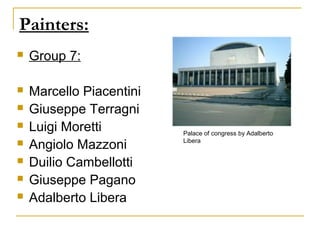
   Group 7:

   Marcello Piacentini
   Giuseppe Terragni
   Luigi Moretti         Palace of congress by Adalberto
   Angiolo Mazzoni       Libera


   Duilio Cambellotti
   Giuseppe Pagano
   Adalberto Libera
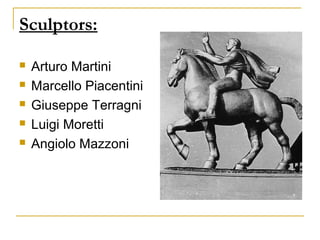
Sculptors:

   Arturo Martini
   Marcello Piacentini
   Giuseppe Terragni
   Luigi Moretti
   Angiolo Mazzoni
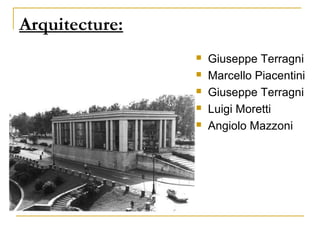
Arquitecture:
                   Giuseppe Terragni
                   Marcello Piacentini
                   Giuseppe Terragni
                   Luigi Moretti
                   Angiolo Mazzoni
Palace of the civilization by Marcello Piacentini
Cinema:

   Luce institute
   Cineccita studies
Bibliographie:
   EL PALACIO DE LOS SOVIETS" de N. Atarov, Ediciones Pueblos Unidos,
    Montevideo.
   La estética nazi. Eric Michaud.
   Arquitectura en la era de Stalin. Alex Tarkhanov
   Diccionario critico de mitos Nacismo. Rosa Sala
   Atlas ilustrado del Fascismo.El arte al servicio del poder. Varios autores
   Futurismo. Antonio Fernández García

Totalitarism in Art

  • 1.
    The art ofthe Totalitarism Lucía Caballero Rubio. 4ºB
  • 2.
    Index:  Introduction  Objetives of the art of the Totalitarism  Common theme  Nazi Art  Stalin Art  Fascist Art
  • 3.
    Introduction:  All the world knows about Fascism, I-II World War, its weapons, battles, heroes, and of course its victims…but nobody looks in other aspects of the society for example the art in the dictatorships.
  • 4.
    Introduction: During the period between 1922 to 1953 Art was converted in the expression of the ideologies with propagandistic objectives:  The art should teach, inform, and inculcate the ideologies of the State.  The dictators stimulate art pieces with neoclassic or realistic style.  They try to show the nation’s triumphs and the dictators were myths. The visual art was used to symbolize the triumph of this ideologies.
  • 5.
    Objectives  The individual desire for experiment and investigate was suppressed.  Artistic ideal = Racial ideal
  • 6.
    Common theme:  Large Public buildings.  Portraits of the dictators.  New factories, buildings and highways.  Big concentrations of mass.  Glorify the healthy body  Heroic education  Death cult
  • 7.
  • 8.
    Hitler, when he was young, was a homeless.  He did a lot of paintings and he sold in the streets of Viena.  He liked the opera.
  • 10.
     Until therise of power of National Socialism in Germany considered modern art, but now Germany requires a German art again and it ​ must and will be like all creative values of a new town, a modern art . ( Discourse of Adolf Hitler in the inaguration of the Gran exhibición del arte alemán, 1937)
  • 11.
    Arquitecture:  Big edifices.  Symmetry and Nazi symbols.
  • 12.
    Famous architects:  Albert Speer:  Hitler wanted to created a new city,GERMANIA.
  • 13.
    Famous architects: Paul Ludwig Troost
  • 14.
    Painting and sculpture:  They had obsession by the race.  The art pieces was found inspiration in the ancient art. Arno Brecker
  • 15.
  • 16.
    Famous artists:  Josef Thorak  Georg Kolbe  Arno Breker ( He was the favorite painter of Hitler)  Udo Wendel  Adolf Wissel The Art Journal by Udo Wendel
  • 17.
    Farm Family fromKahlenberg by Adolf Wissel
  • 18.
  • 19.
    Cinema: Leni Riefenstahl producedtwo films for Hitler: Olimpia I and Olimpia II The triumph of the liberty.
  • 20.
    Photography: • Hoffman ( He was the favorite photographer of Hitler)
  • 21.
    Graphic desing:  They used posters, flags and slogans.  Symbols:  Eagle  Torch  Swastika
  • 23.
    Music:  Richard Wagner  Carl Off  Richard Strauss
  • 24.
  • 25.
    Arquitecture:  Was called Arquitectura Gótica Stalinista.  The proyect was to built the Soviets Palace.  Metro of Moscú  Skycrapers ‘’La arquitctura es una parte indispensable de la cultura socialista, el realismo socialista exige una arquitectura verdadera’’ (Stalin)
  • 26.
    Famous Architects:  Vladimir Schuko  Ivan Formin  Ivan Vladislavovich Soldier Monument by Yevgeni Vuchétich
  • 27.
    Painting:  Historic realism "Rosas para Stalin" - Boris Vladimirski
  • 28.
    Painters:  Ivan Brodsky  Aleksandr Deyneka  Boris Kustodier  Isaak Brodsky  Aleksandre Guerasimov mirski Lenin by I.Brodski.
  • 29.
    Sculptors: ´´La madre patria llama’’ by Yeugeni Vuchétich
  • 30.
    Sculptors: ´´Soldier Monument`` by Yevgeni Vuchétich
  • 31.
  • 32.
    Introduction and objetives:  The Fascist ideology was transmitted by the schools, mass media and culture.  Objetives:  Heroic realism.  Advertising
  • 33.
    Futurism:  It was a new style created in this period.  It was found by Marinetti.  Expressed admiration for modern machines, and the exaltation of youth, militarism, speed, war and patriotism.  Group 7
  • 34.
    Painters:  Group 7:  Marcello Piacentini  Giuseppe Terragni  Luigi Moretti Palace of congress by Adalberto  Angiolo Mazzoni Libera  Duilio Cambellotti  Giuseppe Pagano  Adalberto Libera
  • 35.
    Sculptors:  Arturo Martini  Marcello Piacentini  Giuseppe Terragni  Luigi Moretti  Angiolo Mazzoni
  • 36.
    Arquitecture:  Giuseppe Terragni  Marcello Piacentini  Giuseppe Terragni  Luigi Moretti  Angiolo Mazzoni
  • 37.
    Palace of thecivilization by Marcello Piacentini
  • 38.
    Cinema:  Luce institute  Cineccita studies
  • 39.
    Bibliographie:  EL PALACIO DE LOS SOVIETS" de N. Atarov, Ediciones Pueblos Unidos, Montevideo.  La estética nazi. Eric Michaud.  Arquitectura en la era de Stalin. Alex Tarkhanov  Diccionario critico de mitos Nacismo. Rosa Sala  Atlas ilustrado del Fascismo.El arte al servicio del poder. Varios autores  Futurismo. Antonio Fernández García