Context
• Prewar intellectual & art currents
– Duchamp, Benjamin, Greenberg, avante garde &
kitsch
– Surrealism
– automatism, automatic drawing, psychology, the
unconscious
• Effects of WWII
• Movements:
– US: Abstract Expressionism (AbEx)
• aka 'The New York School', 'The Irascibles'
– Europe: Art Informel (Art without Form), Michel Tapie
– Japan: Gutai Bijutsu Kyokai (Concrete or Embodied
Art Association)
Beginnings: 20th
C Art & Ideas
• Marcel Duchamp (doo-shahm) & The
Readymade
• Walter Benjamin (ben ya meeen) &
Mechanical Reproduction
• Clement Greenberg & Kitsch
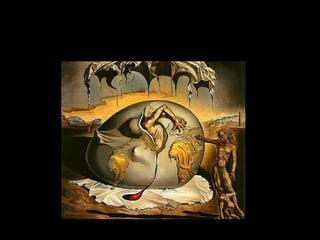
• Surrealism
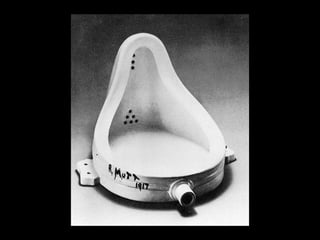
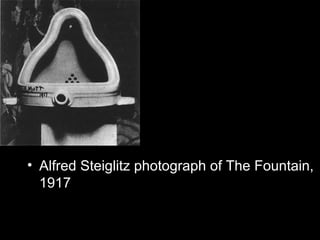
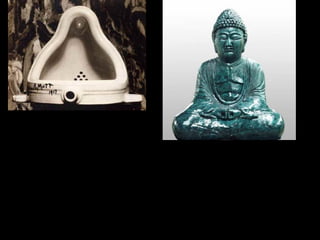
• Alfred Steiglitz photograph of The Fountain,
1917
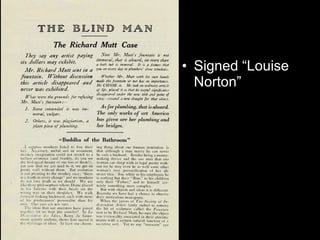
• Signed “Louise
Norton”
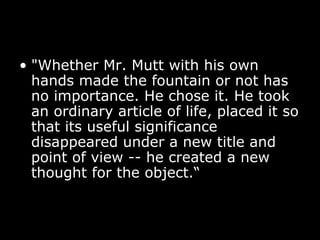
• "Whether Mr. Mutt with his own
hands made the fountain or not has
no importance. He chose it. He took
an ordinary article of life, placed it so
that its useful significance
disappeared under a new title and
point of view -- he created a new
thought for the object.“
Marcel Duchamp
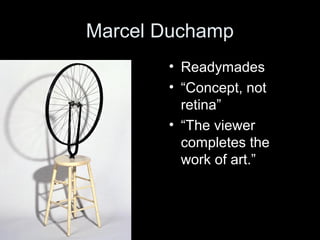
• Readymades
• “Concept, not
retina”
• “The viewer
completes the
work of art.”
The Readymade
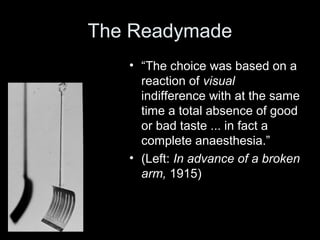
• “The choice was based on a
reaction of visual
indifference with at the same
time a total absence of good
or bad taste ... in fact a
complete anaesthesia.”
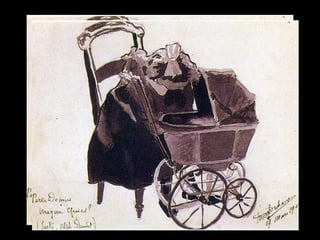
• (Left: In advance of a broken
arm, 1915)
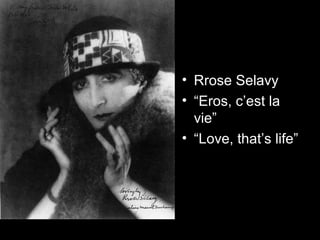
• Rrose Selavy
• “Eros, c’est la
vie”
• “Love, that’s life”
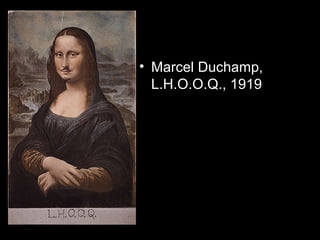
• Marcel Duchamp,
L.H.O.O.Q., 1919
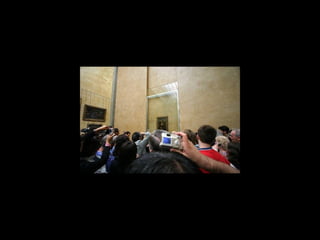
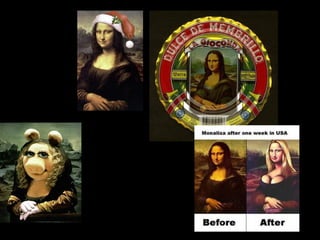
Things to think about:
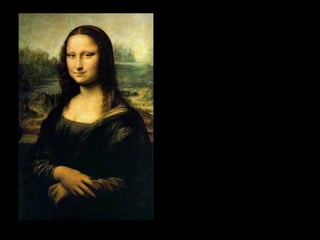
• What is kitsch according to Clement
Greenberg, and how do modern
appropriations of Mona Lisa fit into this
idea?
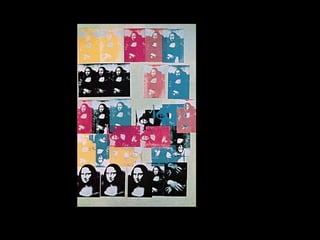
• How do these take-offs on Mona Lisa
illustrate Benjamin’s claims about the
effect of mechanical reproduction on the
work of art?
Which of these requires "initiation into
their [artists'] craft" to understand?
Georges Braque, The Portuguese, 1911
Norman Rockwell, The Love Song, 1926
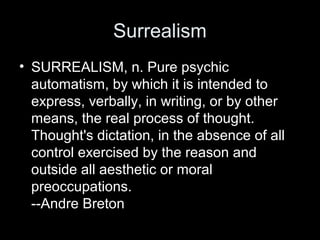
Surrealism
• SURREALISM, n. Pure psychic
automatism, by which it is intended to
express, verbally, in writing, or by other
means, the real process of thought.
Thought's dictation, in the absence of all
control exercised by the reason and
outside all aesthetic or moral
preoccupations.
--Andre Breton
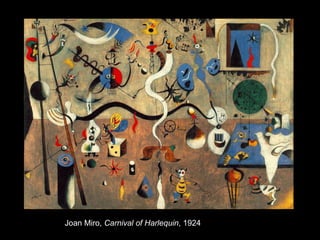
Joan Miro, Carnival of Harlequin, 1924
Postwar Art
(After WWII, 1945)
World War II (WWII)
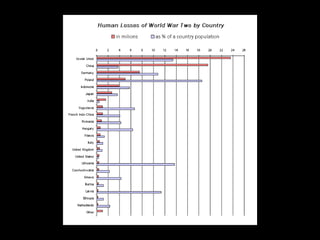
• worldwide casualties
• the Holocaust
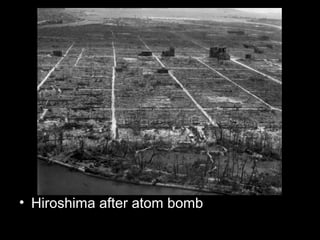
• the atom bomb
• biochemical weapons
• refugees
• rise of totalitarian Communism
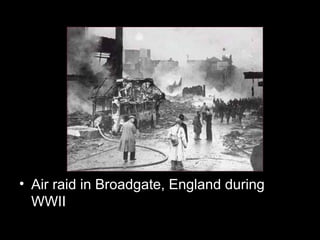
• Air raid in Broadgate, England during
WWII
• Hiroshima after atom bomb
After WWII
• “The American Century”
– Postwar economic boom
– Victory and rebuilding Europe & Japan
• New York as new center of art world
– European artists had fled from war & Hitler
– Economic center of the world
– “How New York Stole the Idea of Modern Art”
– Serge Gilbault’s history of Abstract
Expressionism

01 art after wwii

  • 1.
    Context • Prewar intellectual& art currents – Duchamp, Benjamin, Greenberg, avante garde & kitsch – Surrealism – automatism, automatic drawing, psychology, the unconscious • Effects of WWII • Movements: – US: Abstract Expressionism (AbEx) • aka 'The New York School', 'The Irascibles' – Europe: Art Informel (Art without Form), Michel Tapie – Japan: Gutai Bijutsu Kyokai (Concrete or Embodied Art Association)
  • 2.
    Beginnings: 20th C Art& Ideas • Marcel Duchamp (doo-shahm) & The Readymade • Walter Benjamin (ben ya meeen) & Mechanical Reproduction • Clement Greenberg & Kitsch • Surrealism
  • 4.
    • Alfred Steiglitzphotograph of The Fountain, 1917
  • 6.
  • 7.
    • "Whether Mr.Mutt with his own hands made the fountain or not has no importance. He chose it. He took an ordinary article of life, placed it so that its useful significance disappeared under a new title and point of view -- he created a new thought for the object.“
  • 8.
    Marcel Duchamp • Readymades •“Concept, not retina” • “The viewer completes the work of art.”
  • 9.
    The Readymade • “Thechoice was based on a reaction of visual indifference with at the same time a total absence of good or bad taste ... in fact a complete anaesthesia.” • (Left: In advance of a broken arm, 1915)
  • 13.
    • Rrose Selavy •“Eros, c’est la vie” • “Love, that’s life”
  • 14.
  • 19.
    Things to thinkabout: • What is kitsch according to Clement Greenberg, and how do modern appropriations of Mona Lisa fit into this idea? • How do these take-offs on Mona Lisa illustrate Benjamin’s claims about the effect of mechanical reproduction on the work of art?
  • 20.
    Which of theserequires "initiation into their [artists'] craft" to understand? Georges Braque, The Portuguese, 1911 Norman Rockwell, The Love Song, 1926
  • 26.
    Surrealism • SURREALISM, n.Pure psychic automatism, by which it is intended to express, verbally, in writing, or by other means, the real process of thought. Thought's dictation, in the absence of all control exercised by the reason and outside all aesthetic or moral preoccupations. --Andre Breton
  • 28.
    Joan Miro, Carnivalof Harlequin, 1924
  • 29.
  • 30.
    World War II(WWII) • worldwide casualties • the Holocaust • the atom bomb • biochemical weapons • refugees • rise of totalitarian Communism
  • 32.
    • Air raidin Broadgate, England during WWII
  • 33.
  • 34.
    After WWII • “TheAmerican Century” – Postwar economic boom – Victory and rebuilding Europe & Japan • New York as new center of art world – European artists had fled from war & Hitler – Economic center of the world – “How New York Stole the Idea of Modern Art” – Serge Gilbault’s history of Abstract Expressionism