EXPRESSIONISM
Developed during the LATE 19th and EARLY
             20th centuries

        (Dominant in Germany
             1905-1925)
Characteristics (painting):
The use of uncharacteristic colours
chosen by the artist…
 To release of the artist’s inner vision
 To evoke feelings from the viewer
 Distortion of images and violent
brushstrokes.
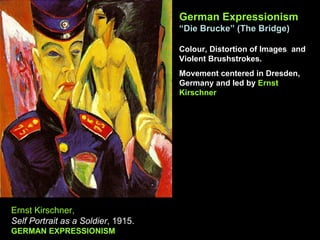
German Expressionism
                                    “Die Brucke” (The Bridge)

                                    Colour, Distortion of Images and
                                    Violent Brushstrokes.
                                    Movement centered in Dresden,
                                    Germany and led by Ernst
                                    Kirschner


Ernst Kirschner,
Self Portrait as a Soldier, 1915.
GERMAN EXPRESSIONISM
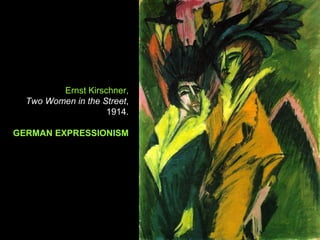
Ernst Kirschner,
  Two Women in the Street,
                    1914.

GERMAN EXPRESSIONISM
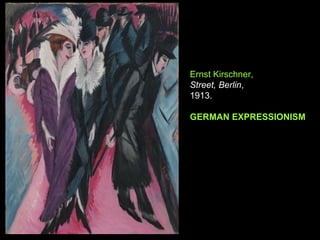
Ernst Kirschner,
Street, Berlin,
1913.

GERMAN EXPRESSIONISM
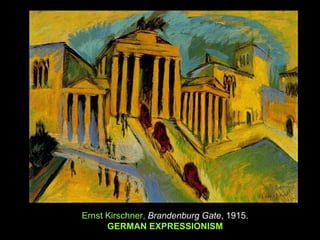
Ernst Kirschner, Brandenburg Gate, 1915.
      GERMAN EXPRESSIONISM
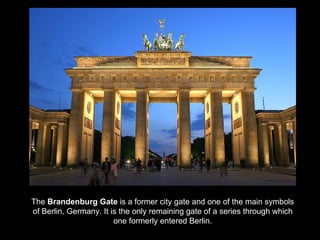
The Brandenburg Gate is a former city gate and one of the main symbols
of Berlin, Germany. It is the only remaining gate of a series through which
                        one formerly entered Berlin.
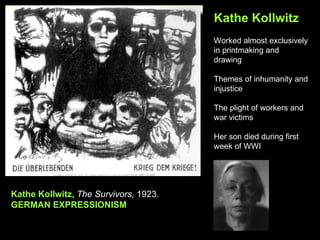
Kathe Kollwitz
                                       Worked almost exclusively
                                       in printmaking and
                                       drawing

                                       Themes of inhumanity and
                                       injustice

                                       The plight of workers and
                                       war victims

                                       Her son died during first
                                       week of WWI


Kathe Kollwitz, The Survivors, 1923.
GERMAN EXPRESSIONISM
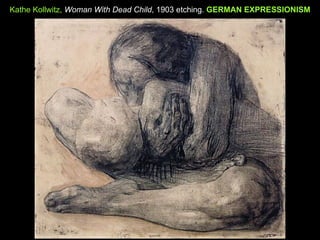
Kathe Kollwitz, Woman With Dead Child, 1903 etching. GERMAN EXPRESSIONISM
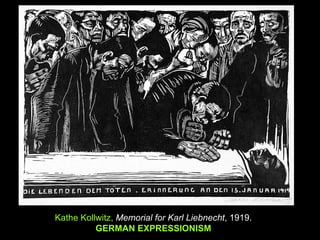
Kathe Kollwitz, Memorial for Karl Liebnecht, 1919.
          GERMAN EXPRESSIONISM
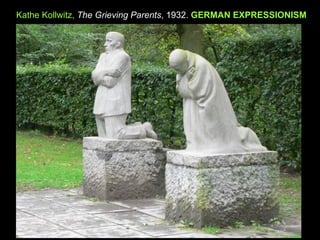
Kathe Kollwitz, The Grieving Parents, 1932. GERMAN EXPRESSIONISM
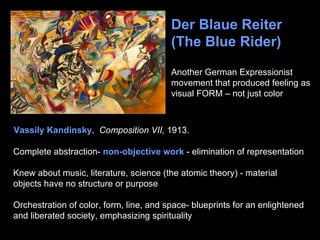
Der Blaue Reiter
                                         (The Blue Rider)

                                         Another German Expressionist
                                         movement that produced feeling as
                                         visual FORM – not just color


Vassily Kandinsky, Composition VII, 1913.

Complete abstraction- non-objective work - elimination of representation

Knew about music, literature, science (the atomic theory) - material
objects have no structure or purpose

Orchestration of color, form, line, and space- blueprints for an enlightened
and liberated society, emphasizing spirituality
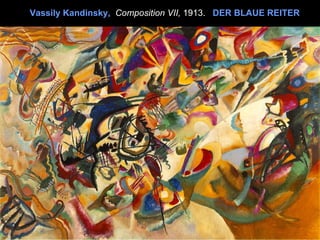
Vassily Kandinsky, Composition VII, 1913. DER BLAUE REITER
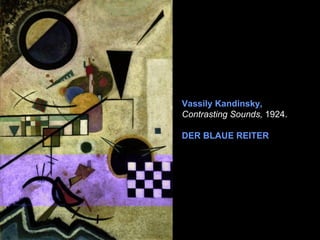
Vassily Kandinsky,
Contrasting Sounds, 1924.

DER BLAUE REITER
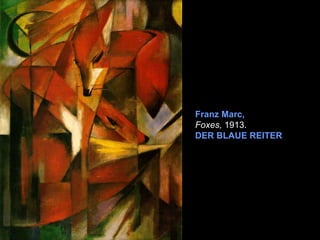
Franz Marc,
Foxes, 1913.
DER BLAUE REITER
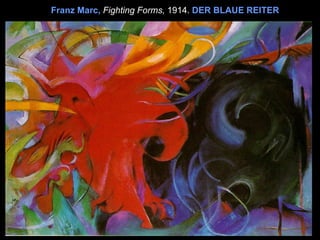
Franz Marc, Fighting Forms, 1914. DER BLAUE REITER
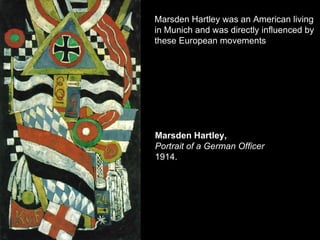
Marsden Hartley was an American living
in Munich and was directly influenced by
these European movements


Marsden Hartley,
Portrait of a German Officer
1914.
OTHER FIELDS:

•MUSIC (ARNOLD SCHOENBERG)

•DANCE ( MARY WIGMAN)

•CINEMA (ALFRED HITCHCOCK, TIM
BURTON)

Expressionism

  • 1.
    EXPRESSIONISM Developed during theLATE 19th and EARLY 20th centuries (Dominant in Germany 1905-1925)
  • 2.
    Characteristics (painting): The useof uncharacteristic colours chosen by the artist…  To release of the artist’s inner vision  To evoke feelings from the viewer  Distortion of images and violent brushstrokes.
  • 3.
    German Expressionism “Die Brucke” (The Bridge) Colour, Distortion of Images and Violent Brushstrokes. Movement centered in Dresden, Germany and led by Ernst Kirschner Ernst Kirschner, Self Portrait as a Soldier, 1915. GERMAN EXPRESSIONISM
  • 4.
    Ernst Kirschner, Two Women in the Street, 1914. GERMAN EXPRESSIONISM
  • 5.
  • 6.
    Ernst Kirschner, BrandenburgGate, 1915. GERMAN EXPRESSIONISM
  • 7.
    The Brandenburg Gateis a former city gate and one of the main symbols of Berlin, Germany. It is the only remaining gate of a series through which one formerly entered Berlin.
  • 8.
    Kathe Kollwitz Worked almost exclusively in printmaking and drawing Themes of inhumanity and injustice The plight of workers and war victims Her son died during first week of WWI Kathe Kollwitz, The Survivors, 1923. GERMAN EXPRESSIONISM
  • 9.
    Kathe Kollwitz, WomanWith Dead Child, 1903 etching. GERMAN EXPRESSIONISM
  • 10.
    Kathe Kollwitz, Memorialfor Karl Liebnecht, 1919. GERMAN EXPRESSIONISM
  • 11.
    Kathe Kollwitz, TheGrieving Parents, 1932. GERMAN EXPRESSIONISM
  • 12.
    Der Blaue Reiter (The Blue Rider) Another German Expressionist movement that produced feeling as visual FORM – not just color Vassily Kandinsky, Composition VII, 1913. Complete abstraction- non-objective work - elimination of representation Knew about music, literature, science (the atomic theory) - material objects have no structure or purpose Orchestration of color, form, line, and space- blueprints for an enlightened and liberated society, emphasizing spirituality
  • 13.
    Vassily Kandinsky, CompositionVII, 1913. DER BLAUE REITER
  • 14.
  • 15.
  • 16.
    Franz Marc, FightingForms, 1914. DER BLAUE REITER
  • 17.
    Marsden Hartley wasan American living in Munich and was directly influenced by these European movements Marsden Hartley, Portrait of a German Officer 1914.
  • 19.
    OTHER FIELDS: •MUSIC (ARNOLDSCHOENBERG) •DANCE ( MARY WIGMAN) •CINEMA (ALFRED HITCHCOCK, TIM BURTON)