Continuous quality improvement
FOCUS-PDCA
Quality and patient safety department
Quality improvement division
OBJECTIVES
KNOW WHAT IS QUALITY?
KNOW WHAT IS QUALITY IMPROVEMENT.
UNDERSTAND THE DIFFERENCE BETWEEN QI AND INFORMAL
IMPROVEMENT.
IDENTIFY FOCUS PDCA AND ITS STEPS AS A QUALITY
IMPROVEMENT METHODOLOGY.
PRACTICE DIFFERENT TECHNIQUES AND TOOLS FOR FOCUS PDCA
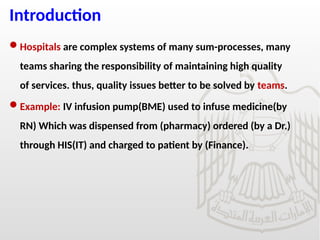
Introduction
Hospitals are complex systems of many sum-processes, many
teams sharing the responsibility of maintaining high quality
of services. thus, quality issues better to be solved by teams.
Example: IV infusion pump(BME) used to infuse medicine(by
RN) Which was dispensed from (pharmacy) ordered (by a Dr.)
through HIS(IT) and charged to patient by (Finance).
Hospitals are safe?
Thanks for joining CQI teams, what you do is
important
http://www.youtube.com/watch?v=BFd54Yzg-
vo
Quality is?
 The degree to which health services for
individuals and populations increase the
likelihood of desired health outcomes and are
consistent with current professional knowledge.
IOM definition
Quality Improvement
A process of innovation and adaptation designed
to bring about immediate positive changes in the
delivery of health care in particular settings
 systematic
 data-guided
 multidisciplinary
7
Continuous
Quality Improvement
A quality management model whereby
healthcare is seen as a series of processes and a
system leading to an outcome. QI strives to
make changes in the structural and process
components of care to achieve better outcomes.
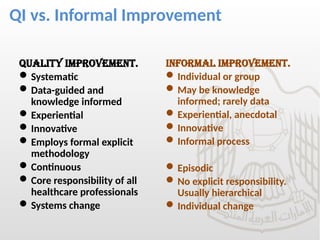
QI vs. Informal Improvement
Quality improvement.
Systematic
Data-guided and
knowledge informed
Experiential
Innovative
Employs formal explicit
methodology
Continuous
Core responsibility of all
healthcare professionals
Systems change
Informal improvement.
Individual or group
May be knowledge
informed; rarely data
Experiential, anecdotal
Innovative
Informal process
Episodic
No explicit responsibility.
Usually hierarchical
Individual change
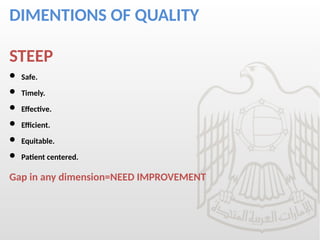
DIMENTIONS OF QUALITY
STEEP
 Safe.
 Timely.
 Effective.
 Efficient.
 Equitable.
 Patient centered.
Gap in any dimension=NEED IMPROVEMENT
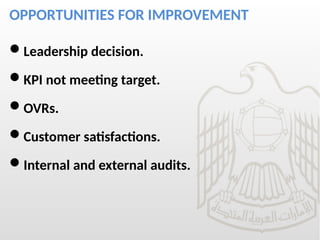
OPPORTUNITIES FOR IMPROVEMENT
Leadership decision.
KPI not meeting target.
OVRs.
Customer satisfactions.
Internal and external audits.
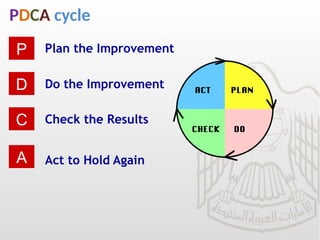
PDCA cycle
Plan the Improvement
Do the Improvement
Check the Results
Act to Hold Again
P
D
C
A
WHEN TO DO PDCA
As a model for continuous improvement.
When starting a new improvement project.
When developing a new or improved design
of a process, product or service.
When implementing any change.
PDCA
The plan–do–check–act cycle is a four–step
model for carrying out change. Just as a circle
has no end, the PDCA cycle should be
repeated again and again for continuous
improvement.
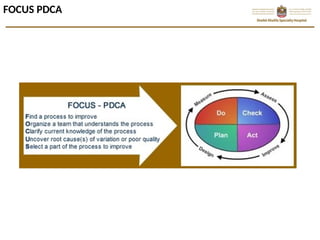
FOCUS PDCA
FOCUS-PDCA
F = Find a process to improve
 Identify problems & desired outcomes
 Review related standards & documents
 Analysis of collected data
POSSIBLE SOURCES
 Leadership decision.
 KPI not meeting target.
 OVRs.
 Customer satisfactions.
 Internal and external audits.
FOCUS-PDCA
F = Find a process to improve
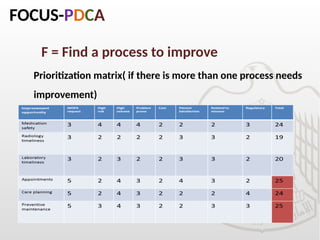
Prioritization matrix( if there is more than one process needs
improvement)
ORGANIZE
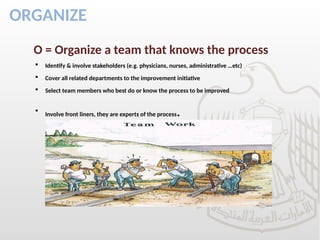
O = Organize a team that knows the process
 Identify & involve stakeholders (e.g. physicians, nurses, administrative …etc)
 Cover all related departments to the improvement initiative
 Select team members who best do or know the process to be improved

Involve front liners, they are experts of the process.
CQI proposal form
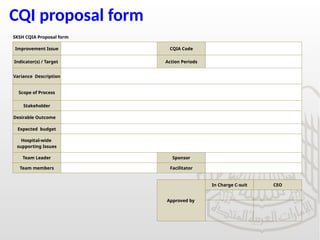
SKSH CQIA Proposal form
Improvement Issue CQIA Code
Indicator(s) / Target Action Periods
Variance Description
Scope of Process
Stakeholder
Desirable Outcome
Expected budget
Hospital-wide
supporting Issues
Team Leader Sponsor
Team members Facilitator
Approved by
In Charge C-suit CEO
Team stages
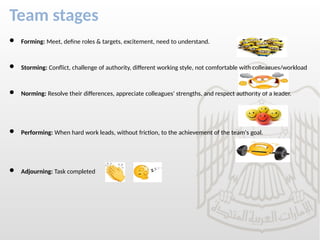
 Forming: Meet, define roles & targets, excitement, need to understand.
 Storming: Conflict, challenge of authority, different working style, not comfortable with colleagues/workload
 Norming: Resolve their differences, appreciate colleagues' strengths, and respect authority of a leader.
 Performing: When hard work leads, without friction, to the achievement of the team's goal.
 Adjourning: Task completed
Team are fun
• Team work is fun.
• You learn little thing about
everything.
• Know your colleagues.
• Appreciate what other departments
are doing.
• Break intra departmental barriers.
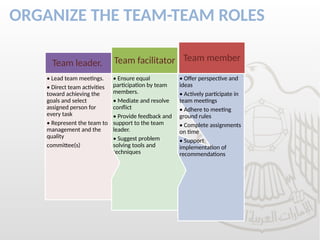
ORGANIZE THE TEAM-TEAM ROLES
• Offer perspective and
ideas
• Actively participate in
team meetings
• Adhere to meeting
ground rules
• Complete assignments
on time
• Support
implementation of
recommendations
Team member
• Ensure equal
participation by team
members.
• Mediate and resolve
conflict
• Provide feedback and
support to the team
leader.
• Suggest problem
solving tools and
techniques
Team facilitator
• Lead team meetings.
• Direct team activities
toward achieving the
goals and select
assigned person for
every task
• Represent the team to
management and the
quality
committee(s)
Team leader.
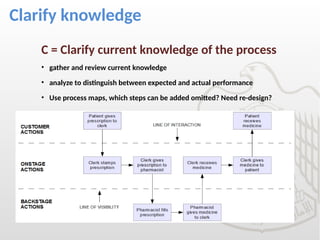
Clarify knowledge
C = Clarify current knowledge of the process
• gather and review current knowledge
• analyze to distinguish between expected and actual performance
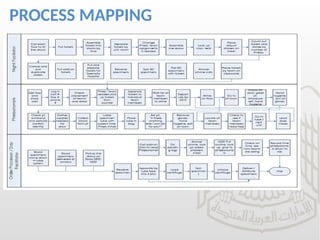
• Use process maps, which steps can be added omitted? Need re-design?
PROCESS MAPPING
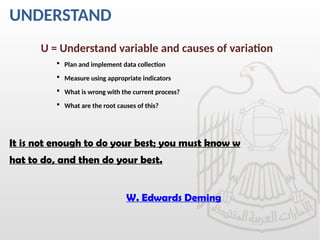
UNDERSTAND
U = Understand variable and causes of variation
 Plan and implement data collection
 Measure using appropriate indicators
 What is wrong with the current process?
 What are the root causes of this?
It is not enough to do your best; you must know w
hat to do, and then do your best.
W. Edwards Deming
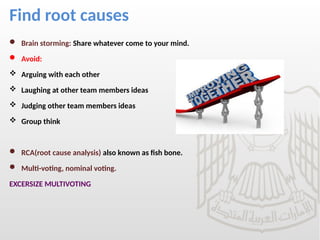
Find root causes
 Brain storming: Share whatever come to your mind.
 Avoid:
 Arguing with each other
 Laughing at other team members ideas
 Judging other team members ideas
 Group think
 RCA(root cause analysis) also known as fish bone.
 Multi-voting, nominal voting.
EXCERSIZE MULTIVOTING
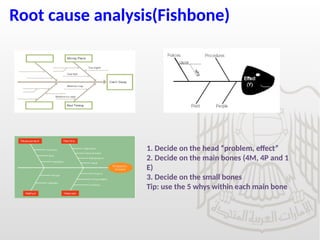
Root cause analysis(Fishbone)
1. Decide on the head “problem, effect”
2. Decide on the main bones (4M, 4P and 1
E)
3. Decide on the small bones
Tip: use the 5 whys within each main bone
FISH BONE VIDEO
https://www.youtube.com/watch?v=zo_-AsAM
MQ0
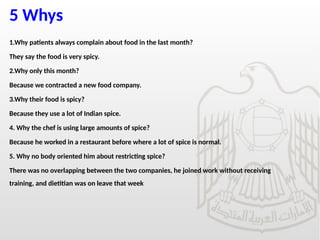
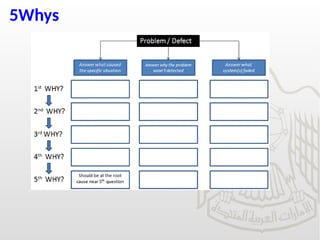
5 Whys
1.Why patients always complain about food in the last month?
They say the food is very spicy.
2.Why only this month?
Because we contracted a new food company.
3.Why their food is spicy?
Because they use a lot of Indian spice.
4. Why the chef is using large amounts of spice?
Because he worked in a restaurant before where a lot of spice is normal.
5. Why no body oriented him about restricting spice?
There was no overlapping between the two companies, he joined work without receiving
training, and dietitian was on leave that week
5Whys
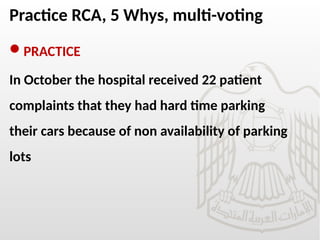
Practice RCA, 5 Whys, multi-voting
PRACTICE
In October the hospital received 22 patient
complaints that they had hard time parking
their cars because of non availability of parking
lots
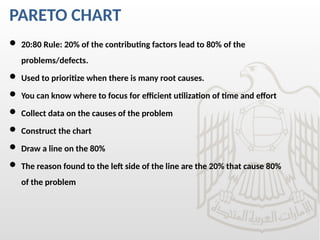
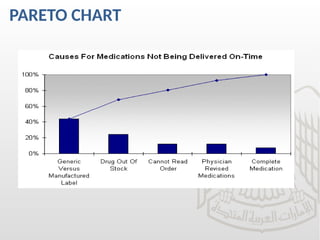
PARETO CHART
 20:80 Rule: 20% of the contributing factors lead to 80% of the
problems/defects.
 Used to prioritize when there is many root causes.
 You can know where to focus for efficient utilization of time and effort
 Collect data on the causes of the problem
 Construct the chart
 Draw a line on the 80%
 The reason found to the left side of the line are the 20% that cause 80%
of the problem
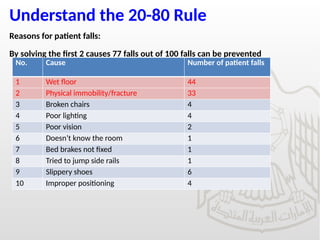
Understand the 20-80 Rule
Reasons for patient falls:
By solving the first 2 causes 77 falls out of 100 falls can be prevented
No. Cause Number of patient falls
1 Wet floor 44
2 Physical immobility/fracture 33
3 Broken chairs 4
4 Poor lighting 4
5 Poor vision 2
6 Doesn’t know the room 1
7 Bed brakes not fixed 1
8 Tried to jump side rails 1
9 Slippery shoes 6
10 Improper positioning 4
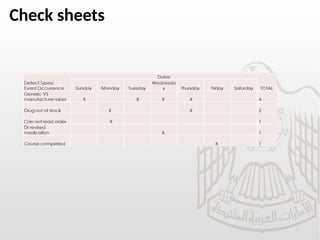
Check sheets
PARETO CHART
SELECT IMPROVEMENT
Select = the process improvement
 Analyze alternative solutions related to process
improvement
 Choose the best solution/action that will achieve desired
outcome
 Develop approval with a summary of required
information about expected outcomes, resources needed,
time-frame, responsibilities ..etc
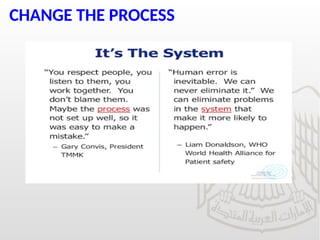
CHANGE THE PROCESS
CHANGE THE PROCESS
Less is more?
More is more?
Which step of the current process has no value?
Which step can be added and will add value to the process?
The process change can range from changing one step in one
process to redesigning whole process
SELECT ACTIONS
Criteria for selection:
 Leadership support
 Practicality
 Use friendly
 Customer satisfaction
 Time effective
 Profitability
 Cost effective
•Saving potentials
•Resource availability
•Use of tools
•Culturally sensitive
•Availability of team
•Data availability
•Feasibility
•Effectiveness
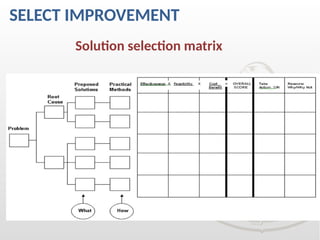
SELECT IMPROVEMENT
Solution selection matrix
PDCA-Plan
Plan for improvement project (initiative):
 Assign tasks with agreed criteria checklist & set time
frame
 Allocate resources, determine responsibilities & gain
support from all who will be affected by implementation.
 Establish monitoring system to collect necessary data to
keep project on the track ( If it is a KPI, no need)
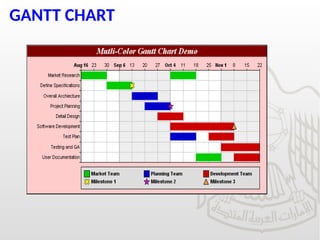
 Specify timelines for DO, CHECK, ACT stages(Gantt
CHART).
PDCA-Plan
What
How
How much
Who
When
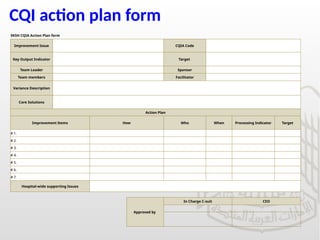
CQI action plan form
SKSH CQIA Action Plan form
Improvement Issue CQIA Code
Key Output Indicator Target
Team Leader Sponsor
Team members Facilitator
Variance Description
Core Solutions
Action Plan
Improvement Items How Who When Processing Indicator Target
# 1.
# 2.
# 3.
# 4.
# 5.
# 6.
# 7.
Hospital-wide supporting Issues
Approved by
In Charge C-suit CEO
GANTT CHART
PDCA-DO
Do the improvement project:
 Implement the best solution stated in FOCUS process.
 Empower all people involved by training, education & moral
support.
 Collect data & update checklists.
 Communicate new change in process-make it a focus.
 Monitor compliance with new process (check sheet, audit tools)
 In pilot range if possible.
PDCA-CHECK
Check the results
 If the desired outcome is obtained & lead expected
improvement.
 Compare data collected from FOCUS process with that
during DO( before and after change)
 Check for any unexpected, undesired consequences or
outcomes
PDCA-CHECK
Monitor
 Monitor the process: Staff compliance with the agreed
tool, staff knows the new process, availability of
resources, actions done on time.
 Monitor the outcome: KPI target met, Higher customer
satisfaction, pain score within target. Is there any extra
outcome achieved?
THINK ABOUT IT FOR IMPROVEMENT OF PAIN
MANAGEMENT.
PDCA-CHECK
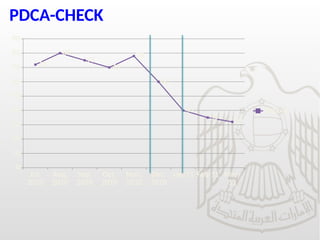
Jul.
2010
Aug.
2010
Sep.
2010
Oct.
2010
Nov.
2010
Dec.
2010
Jan-11 Feb-11 Mar-
11
0
10
20
30
40
50
60
70
80
90
72
80
75
70
78
60
40
35
32
Series1
CONTROL CHART
PDCA-ACT
Act to hold gains or re-adjust
 If improvement initiative is reached; standardize the
process, adjust documents & empower people
 Adjust policies, guidelines, process maps(COMMUNICATE)
 If improvement initiative is not reached, repeat FOCUS-
PDCA cycle
 For both situations, continue to monitor the process to
identify further improvement.
 Celebrate the win
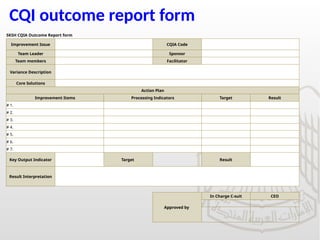
CQI outcome report form
SKSH CQIA Outcome Report form
Improvement Issue CQIA Code
Team Leader Sponsor
Team members Facilitator
Variance Description
Core Solutions
Action Plan
Improvement Items Processing Indicators Target Result
# 1.
# 2.
# 3.
# 4.
# 5.
# 6.
# 7.
Key Output Indicator Target Result
Result Interpretation
Approved by
In Charge C-suit CEO
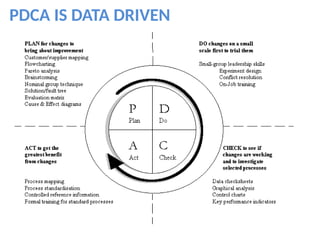
PDCA IS DATA DRIVEN
Exercise
Pediatric hospital bed demands occasionally exceed capacity, especially during high-
census periods such as viral respiratory seasons (winter seasons). When bed demand
exceeds capacity, patient admissions and scheduled surgical procedures can be delayed or
cancelled. Patients can also be diverted to other hospitals. These changes can lead to
major patient/family dissatisfaction, loss of hospital revenue and loss of competitive
edge. During the viral respiratory (winter) season, the hospital bed demands exceeded
capacity. The hospital was forced to cancel 102 surgical procedures and some patients
were diverted to other hospitals. The perception by the administrative staff, based on
physician feedback, was that more hospital beds needed to be built.
Faced at that time with community dissatisfaction and an expensive solution to build
more beds, they decided to understand the problem and design alternative interventions
to facilitate patient discharge in a timely fashion, minimize delays in admissions and
minimize cancellations of surgical procedures at the same hospital bed capacity.
Thank you
REFERENCES
1. Evans and Lindsay, the management and control of quality, 6th
edition.
2. James and Mona Fitzsimmons, Service management, 7th
edition.
3. Susan White, Essential recourses for health care quality professionals:
Quality and performance improvement, 3rd
edition.
367663873-Focus-PDCA Quality Improvement

  • 1.
    Continuous quality improvement FOCUS-PDCA Qualityand patient safety department Quality improvement division
  • 2.
    OBJECTIVES KNOW WHAT ISQUALITY? KNOW WHAT IS QUALITY IMPROVEMENT. UNDERSTAND THE DIFFERENCE BETWEEN QI AND INFORMAL IMPROVEMENT. IDENTIFY FOCUS PDCA AND ITS STEPS AS A QUALITY IMPROVEMENT METHODOLOGY. PRACTICE DIFFERENT TECHNIQUES AND TOOLS FOR FOCUS PDCA
  • 3.
    Introduction Hospitals are complexsystems of many sum-processes, many teams sharing the responsibility of maintaining high quality of services. thus, quality issues better to be solved by teams. Example: IV infusion pump(BME) used to infuse medicine(by RN) Which was dispensed from (pharmacy) ordered (by a Dr.) through HIS(IT) and charged to patient by (Finance).
  • 4.
    Hospitals are safe? Thanksfor joining CQI teams, what you do is important http://www.youtube.com/watch?v=BFd54Yzg- vo
  • 5.
    Quality is?  Thedegree to which health services for individuals and populations increase the likelihood of desired health outcomes and are consistent with current professional knowledge. IOM definition
  • 6.
    Quality Improvement A processof innovation and adaptation designed to bring about immediate positive changes in the delivery of health care in particular settings  systematic  data-guided  multidisciplinary
  • 7.
    7 Continuous Quality Improvement A qualitymanagement model whereby healthcare is seen as a series of processes and a system leading to an outcome. QI strives to make changes in the structural and process components of care to achieve better outcomes.
  • 8.
    QI vs. InformalImprovement Quality improvement. Systematic Data-guided and knowledge informed Experiential Innovative Employs formal explicit methodology Continuous Core responsibility of all healthcare professionals Systems change Informal improvement. Individual or group May be knowledge informed; rarely data Experiential, anecdotal Innovative Informal process Episodic No explicit responsibility. Usually hierarchical Individual change
  • 9.
    DIMENTIONS OF QUALITY STEEP Safe.  Timely.  Effective.  Efficient.  Equitable.  Patient centered. Gap in any dimension=NEED IMPROVEMENT
  • 10.
    OPPORTUNITIES FOR IMPROVEMENT Leadershipdecision. KPI not meeting target. OVRs. Customer satisfactions. Internal and external audits.
  • 11.
    PDCA cycle Plan theImprovement Do the Improvement Check the Results Act to Hold Again P D C A
  • 12.
    WHEN TO DOPDCA As a model for continuous improvement. When starting a new improvement project. When developing a new or improved design of a process, product or service. When implementing any change.
  • 13.
    PDCA The plan–do–check–act cycleis a four–step model for carrying out change. Just as a circle has no end, the PDCA cycle should be repeated again and again for continuous improvement.
  • 14.
  • 15.
    FOCUS-PDCA F = Finda process to improve  Identify problems & desired outcomes  Review related standards & documents  Analysis of collected data POSSIBLE SOURCES  Leadership decision.  KPI not meeting target.  OVRs.  Customer satisfactions.  Internal and external audits.
  • 16.
    FOCUS-PDCA F = Finda process to improve Prioritization matrix( if there is more than one process needs improvement)
  • 17.
    ORGANIZE O = Organizea team that knows the process  Identify & involve stakeholders (e.g. physicians, nurses, administrative …etc)  Cover all related departments to the improvement initiative  Select team members who best do or know the process to be improved  Involve front liners, they are experts of the process.
  • 18.
    CQI proposal form SKSHCQIA Proposal form Improvement Issue CQIA Code Indicator(s) / Target Action Periods Variance Description Scope of Process Stakeholder Desirable Outcome Expected budget Hospital-wide supporting Issues Team Leader Sponsor Team members Facilitator Approved by In Charge C-suit CEO
  • 19.
    Team stages  Forming:Meet, define roles & targets, excitement, need to understand.  Storming: Conflict, challenge of authority, different working style, not comfortable with colleagues/workload  Norming: Resolve their differences, appreciate colleagues' strengths, and respect authority of a leader.  Performing: When hard work leads, without friction, to the achievement of the team's goal.  Adjourning: Task completed
  • 20.
    Team are fun •Team work is fun. • You learn little thing about everything. • Know your colleagues. • Appreciate what other departments are doing. • Break intra departmental barriers.
  • 21.
    ORGANIZE THE TEAM-TEAMROLES • Offer perspective and ideas • Actively participate in team meetings • Adhere to meeting ground rules • Complete assignments on time • Support implementation of recommendations Team member • Ensure equal participation by team members. • Mediate and resolve conflict • Provide feedback and support to the team leader. • Suggest problem solving tools and techniques Team facilitator • Lead team meetings. • Direct team activities toward achieving the goals and select assigned person for every task • Represent the team to management and the quality committee(s) Team leader.
  • 22.
    Clarify knowledge C =Clarify current knowledge of the process • gather and review current knowledge • analyze to distinguish between expected and actual performance • Use process maps, which steps can be added omitted? Need re-design?
  • 23.
  • 24.
    UNDERSTAND U = Understandvariable and causes of variation  Plan and implement data collection  Measure using appropriate indicators  What is wrong with the current process?  What are the root causes of this? It is not enough to do your best; you must know w hat to do, and then do your best. W. Edwards Deming
  • 25.
    Find root causes Brain storming: Share whatever come to your mind.  Avoid:  Arguing with each other  Laughing at other team members ideas  Judging other team members ideas  Group think  RCA(root cause analysis) also known as fish bone.  Multi-voting, nominal voting. EXCERSIZE MULTIVOTING
  • 26.
    Root cause analysis(Fishbone) 1.Decide on the head “problem, effect” 2. Decide on the main bones (4M, 4P and 1 E) 3. Decide on the small bones Tip: use the 5 whys within each main bone
  • 27.
  • 28.
    5 Whys 1.Why patientsalways complain about food in the last month? They say the food is very spicy. 2.Why only this month? Because we contracted a new food company. 3.Why their food is spicy? Because they use a lot of Indian spice. 4. Why the chef is using large amounts of spice? Because he worked in a restaurant before where a lot of spice is normal. 5. Why no body oriented him about restricting spice? There was no overlapping between the two companies, he joined work without receiving training, and dietitian was on leave that week
  • 29.
  • 30.
    Practice RCA, 5Whys, multi-voting PRACTICE In October the hospital received 22 patient complaints that they had hard time parking their cars because of non availability of parking lots
  • 31.
    PARETO CHART  20:80Rule: 20% of the contributing factors lead to 80% of the problems/defects.  Used to prioritize when there is many root causes.  You can know where to focus for efficient utilization of time and effort  Collect data on the causes of the problem  Construct the chart  Draw a line on the 80%  The reason found to the left side of the line are the 20% that cause 80% of the problem
  • 32.
    Understand the 20-80Rule Reasons for patient falls: By solving the first 2 causes 77 falls out of 100 falls can be prevented No. Cause Number of patient falls 1 Wet floor 44 2 Physical immobility/fracture 33 3 Broken chairs 4 4 Poor lighting 4 5 Poor vision 2 6 Doesn’t know the room 1 7 Bed brakes not fixed 1 8 Tried to jump side rails 1 9 Slippery shoes 6 10 Improper positioning 4
  • 33.
  • 34.
  • 35.
    SELECT IMPROVEMENT Select =the process improvement  Analyze alternative solutions related to process improvement  Choose the best solution/action that will achieve desired outcome  Develop approval with a summary of required information about expected outcomes, resources needed, time-frame, responsibilities ..etc
  • 36.
  • 37.
    CHANGE THE PROCESS Lessis more? More is more? Which step of the current process has no value? Which step can be added and will add value to the process? The process change can range from changing one step in one process to redesigning whole process
  • 38.
    SELECT ACTIONS Criteria forselection:  Leadership support  Practicality  Use friendly  Customer satisfaction  Time effective  Profitability  Cost effective •Saving potentials •Resource availability •Use of tools •Culturally sensitive •Availability of team •Data availability •Feasibility •Effectiveness
  • 39.
  • 40.
    PDCA-Plan Plan for improvementproject (initiative):  Assign tasks with agreed criteria checklist & set time frame  Allocate resources, determine responsibilities & gain support from all who will be affected by implementation.  Establish monitoring system to collect necessary data to keep project on the track ( If it is a KPI, no need)  Specify timelines for DO, CHECK, ACT stages(Gantt CHART).
  • 41.
  • 42.
    CQI action planform SKSH CQIA Action Plan form Improvement Issue CQIA Code Key Output Indicator Target Team Leader Sponsor Team members Facilitator Variance Description Core Solutions Action Plan Improvement Items How Who When Processing Indicator Target # 1. # 2. # 3. # 4. # 5. # 6. # 7. Hospital-wide supporting Issues Approved by In Charge C-suit CEO
  • 43.
  • 44.
    PDCA-DO Do the improvementproject:  Implement the best solution stated in FOCUS process.  Empower all people involved by training, education & moral support.  Collect data & update checklists.  Communicate new change in process-make it a focus.  Monitor compliance with new process (check sheet, audit tools)  In pilot range if possible.
  • 45.
    PDCA-CHECK Check the results If the desired outcome is obtained & lead expected improvement.  Compare data collected from FOCUS process with that during DO( before and after change)  Check for any unexpected, undesired consequences or outcomes
  • 46.
    PDCA-CHECK Monitor  Monitor theprocess: Staff compliance with the agreed tool, staff knows the new process, availability of resources, actions done on time.  Monitor the outcome: KPI target met, Higher customer satisfaction, pain score within target. Is there any extra outcome achieved? THINK ABOUT IT FOR IMPROVEMENT OF PAIN MANAGEMENT.
  • 47.
  • 48.
  • 49.
    PDCA-ACT Act to holdgains or re-adjust  If improvement initiative is reached; standardize the process, adjust documents & empower people  Adjust policies, guidelines, process maps(COMMUNICATE)  If improvement initiative is not reached, repeat FOCUS- PDCA cycle  For both situations, continue to monitor the process to identify further improvement.  Celebrate the win
  • 50.
    CQI outcome reportform SKSH CQIA Outcome Report form Improvement Issue CQIA Code Team Leader Sponsor Team members Facilitator Variance Description Core Solutions Action Plan Improvement Items Processing Indicators Target Result # 1. # 2. # 3. # 4. # 5. # 6. # 7. Key Output Indicator Target Result Result Interpretation Approved by In Charge C-suit CEO
  • 51.
  • 52.
    Exercise Pediatric hospital beddemands occasionally exceed capacity, especially during high- census periods such as viral respiratory seasons (winter seasons). When bed demand exceeds capacity, patient admissions and scheduled surgical procedures can be delayed or cancelled. Patients can also be diverted to other hospitals. These changes can lead to major patient/family dissatisfaction, loss of hospital revenue and loss of competitive edge. During the viral respiratory (winter) season, the hospital bed demands exceeded capacity. The hospital was forced to cancel 102 surgical procedures and some patients were diverted to other hospitals. The perception by the administrative staff, based on physician feedback, was that more hospital beds needed to be built. Faced at that time with community dissatisfaction and an expensive solution to build more beds, they decided to understand the problem and design alternative interventions to facilitate patient discharge in a timely fashion, minimize delays in admissions and minimize cancellations of surgical procedures at the same hospital bed capacity.
  • 53.
  • 54.
    REFERENCES 1. Evans andLindsay, the management and control of quality, 6th edition. 2. James and Mona Fitzsimmons, Service management, 7th edition. 3. Susan White, Essential recourses for health care quality professionals: Quality and performance improvement, 3rd edition.
Editor's Notes

  • #7 Talk about structure, process, outcomes