1
Key Performance Indicators
Thomas Nguyen
2
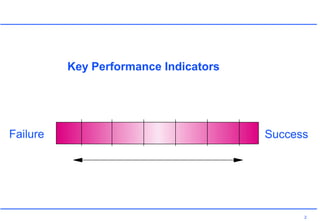
Key Performance Indicators
SuccessFailure
3
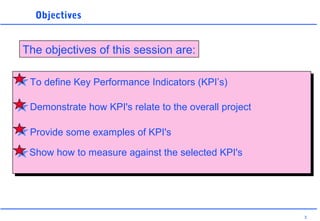
Objectives
Demonstrate how KPI's relate to the overall project
To define Key Performance Indicators (KPI’s)
Provide some examples of KPI's
Show how to measure against the selected KPI's
The objectives of this session are:
4
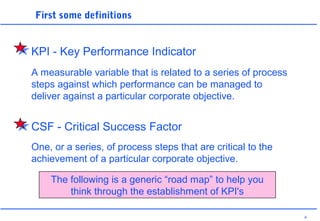
First some definitions
A measurable variable that is related to a series of process
steps against which performance can be managed to
deliver against a particular corporate objective.
One, or a series, of process steps that are critical to the
achievement of a particular corporate objective.
The following is a generic “road map” to help you
think through the establishment of KPI's
KPI - Key Performance Indicator
CSF - Critical Success Factor
5
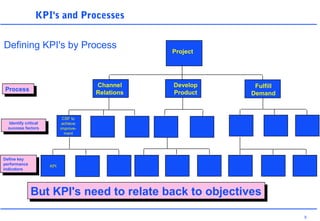
KPI's and Processes
But KPI's need to relate back to objectivesBut KPI's need to relate back to objectives
Project
Channel
Relations
Develop
Product
Fulfill
Demand
CSF
CSF to
achieve
improve-
ment
ProcessProcess
Identify critical
success factors
Identify critical
success factors
Define key
performance
indicators
Define key
performance
indicators
KPI
Defining KPI's by Process
7
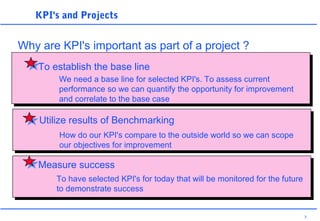
KPI's and Projects
Why are KPI's important as part of a project ?
To establish the base line
We need a base line for selected KPI's. To assess current
performance so we can quantify the opportunity for improvement
and correlate to the base case
Measure success
To have selected KPI's for today that will be monitored for the future
to demonstrate success
Utilize results of Benchmarking
How do our KPI's compare to the outside world so we can scope
our objectives for improvement
8
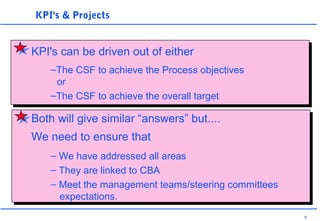
KPI's & Projects
–The CSF to achieve the Process objectives
or
–The CSF to achieve the overall target
KPI's can be driven out of either
Both will give similar “answers” but....
We need to ensure that
– We have addressed all areas
– They are linked to CBA
– Meet the management teams/steering committees
expectations.
9
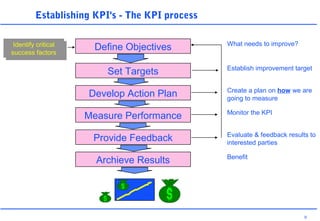
Establishing KPI's - The KPI process
Define Objectives
Set Targets
Develop Action Plan
Measure Performance
Provide Feedback
Archieve Results
What needs to improve?
Establish improvement target
Create a plan on how we are
going to measure
Monitor the KPI
Evaluate & feedback results to
interested parties
Benefit
Identify critical
success factors
Identify critical
success factors
10
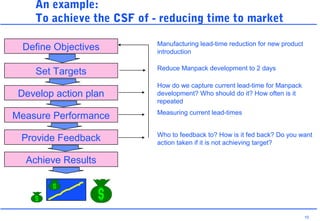
An example:
To achieve the CSF of - reducing time to market
Define Objectives
Set Targets
Develop action plan
Measure Performance
Provide Feedback
Achieve Results
Manufacturing lead-time reduction for new product
introduction
Reduce Manpack development to 2 days
How do we capture current lead-time for Manpack
development? Who should do it? How often is it
repeated
Measuring current lead-times
Who to feedback to? How is it fed back? Do you want
action taken if it is not achieving target?
11
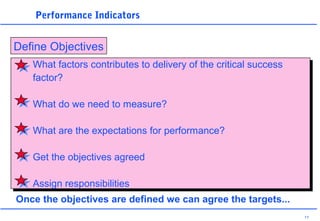
Performance Indicators
What factors contributes to delivery of the critical success
factor?
What do we need to measure?
What are the expectations for performance?
Get the objectives agreed
Assign responsibilities
Define Objectives
Once the objectives are defined we can agree the targets...
12
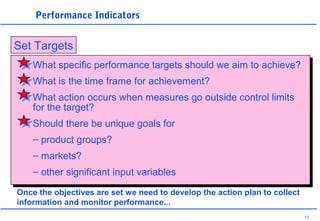
Performance Indicators
Set Targets
Once the objectives are set we need to develop the action plan to collect
information and monitor performance...
What specific performance targets should we aim to achieve?
What is the time frame for achievement?
What action occurs when measures go outside control limits
for the target?
Should there be unique goals for
– product groups?
– markets?
– other significant input variables
13
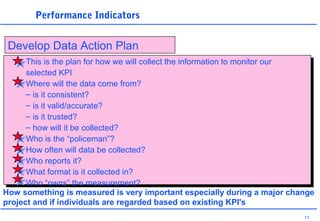
Performance Indicators
Develop Data Action Plan
How something is measured is very important especially during a major change
project and if individuals are regarded based on existing KPI's
This is the plan for how we will collect the information to monitor our
selected KPI
Where will the data come from?
– is it consistent?
– is it valid/accurate?
– is it trusted?
– how will it be collected?
Who is the “policeman”?
How often will data be collected?
Who reports it?
What format is it collected in?
Who “owns” the measurement?
14
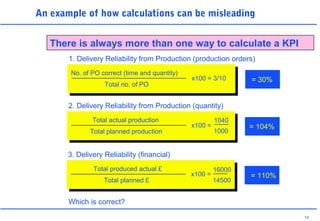
An example of how calculations can be misleading
1. Delivery Reliability from Production (production orders)
No. of PO correct (time and quantity)
Total no. of PO
x100 = 3/10 = 30%
2. Delivery Reliability from Production (quantity)
Total actual production
Total planned production
x100 = = 104%
3. Delivery Reliability (financial)
Total produced actual £
Total planned £
x100 = = 110%
1040
1000
16000
14500
Which is correct?
There is always more than one way to calculate a KPI
15
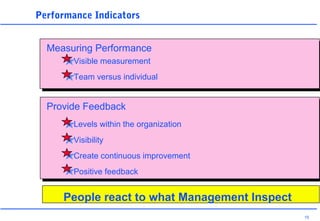
Performance Indicators
Visible measurement
Team versus individual
People react to what Management Inspect
Levels within the organization
Visibility
Create continuous improvement
Positive feedback
Measuring Performance
Provide Feedback
16
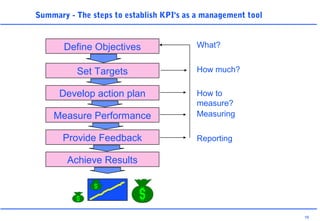
Summary - The steps to establish KPI's as a management tool
Define Objectives
Set Targets
Develop action plan
Measure Performance
Provide Feedback
Achieve Results
What?
How much?
How to
measure?
Measuring
Reporting
17
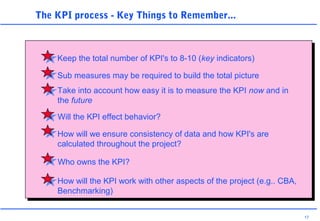
The KPI process - Key Things to Remember...
Keep the total number of KPI's to 8-10 (key indicators)
Sub measures may be required to build the total picture
Take into account how easy it is to measure the KPI now and in
the future
Will the KPI effect behavior?
How will we ensure consistency of data and how KPI's are
calculated throughout the project?
Who owns the KPI?
How will the KPI work with other aspects of the project (e.g.. CBA,
Benchmarking)
18
Now...
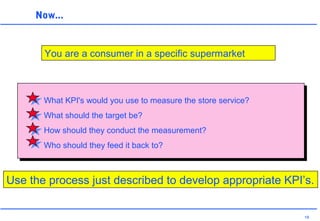
You are a consumer in a specific supermarket
Use the process just described to develop appropriate KPI’s.
What KPI's would you use to measure the store service?
What should the target be?
How should they conduct the measurement?
Who should they feed it back to?
19
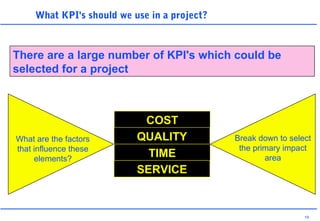
What KPI's should we use in a project?
COST
QUALITY
TIME
SERVICE
What are the factors
that influence these
elements?
Break down to select
the primary impact
area
There are a large number of KPI's which could be
selected for a project
20
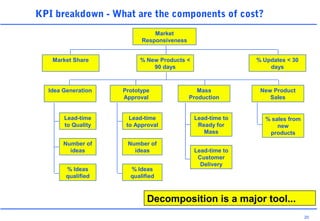
KPI breakdown - What are the components of cost?
Decomposition is a major tool...
Market
Responsiveness
% New Products <
90 days
% Updates < 30
days
Market Share
Idea Generation Prototype
Approval
Mass
Production
New Product
Sales
Lead-time
to Quality
Number of
ideas
% Ideas
qualified
Lead-time
to Approval
Number of
ideas
% Ideas
qualified
Lead-time to
Ready for
Mass
Lead-time to
Customer
Delivery
% sales from
new
products
21
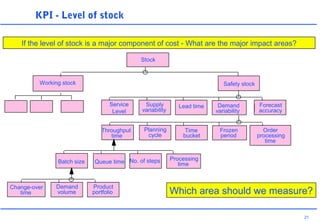
KPI - Level of stock
Stock
Working stock Safety stock
Forecast
accuracy
Demand
variability
Lead timeSupply
variability
Service
Level
Order
processing
time
Frozen
period
Time
bucket
Planning
cycle
Throughput
time
Processing
time
No. of stepsQueue timeBatch size
Product
portfolio
Demand
volume
Change-over
time Which area should we measure?
If the level of stock is a major component of cost - What are the major impact areas?
22
Raw material price
Holding cost
Purchasing dept.. expenses
Write-offs/disposal costs
Interest on raw material held
Raw material inspectors
premium freight
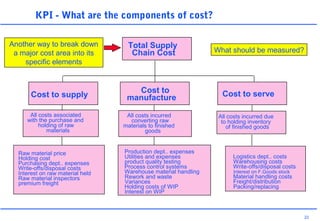
KPI - What are the components of cost?
What should be measured?
Total Supply
Chain Cost
Cost to supply
Cost to
manufacture Cost to serve
All costs associated
with the purchase and
holding of raw
materials
All costs incurred
converting raw
materials to finished
goods
All costs incurred due
to holding inventory
of finished goods
Production dept.. expenses
Utilities and expenses
product quality testing
Process control systems
Warehouse material handling
Rework and waste
Variances
Holding costs of WIP
Interest on WIP
Write-offs/disposal costs
Logistics dept.. costs
Warehousing costs
Interest on F.Goods stock
Material handling costs
Freight/distribution
Packing/replacing
Another way to break down
a major cost area into its
specific elements
23
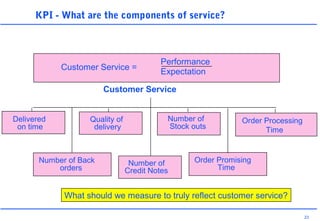
Stock outs
KPI - What are the components of service?
What should we measure to truly reflect customer service?
Order Processing
Customer Service
Customer Service =
Performance
Expectation
Delivered
on time
Quality of
delivery
Number of
Time
Number of Back
orders
Order Promising
Time
Number of
Credit Notes
24
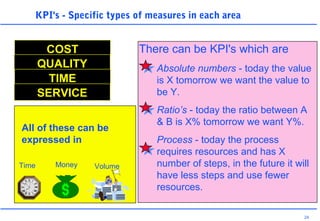
KPI's - Specific types of measures in each area
COST
QUALITY
TIME
SERVICE
There can be KPI's which are
Absolute numbers - today the value
is X tomorrow we want the value to
be Y.
Ratio’s - today the ratio between A
& B is X% tomorrow we want Y%.
Process - today the process
requires resources and has X
number of steps, in the future it will
have less steps and use fewer
resources.
Time Money Volume
All of these can be
expressed in
25
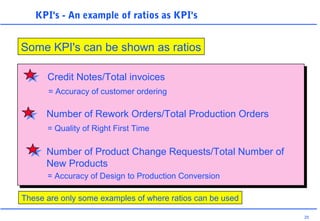
KPI's - An example of ratios as KPI's
Credit Notes/Total invoices
Some KPI's can be shown as ratios
= Accuracy of customer ordering
Number of Rework Orders/Total Production Orders
= Quality of Right First Time
Number of Product Change Requests/Total Number of
New Products
= Accuracy of Design to Production Conversion
These are only some examples of where ratios can be used
26
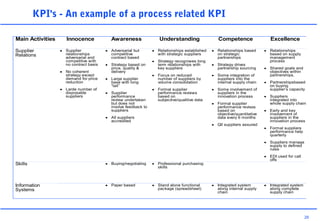
Main Activities Innocence Awareness Understanding Competence Excellence
Supplier
Relations
• Supplier
relationships
adversarial and
competitive with
no contract basis
• No coherent
strategy except
demand for price
reduction
• Larde number of
disposable
suppliers
• Adversarial but
competitive
contract based
• Strategy based on
price, quality &
delivery
• Large supplier
base with long
“tail”
• Supplier
performance
review undertaken
but does not
involve feedback to
suppliers
• All suppliers
accredited
• Relationships established
with strategic suppliers
• Strategy recogniwes long
term relationships with
key suppliers
• Focus on reduced
number of suppliers by
volume consolidation
• Formal supplier
performance reviews
based on
subjective/qualitive data
• Relationships based
on strategic
partnerships
• Strategy drives
partnership sourcing
• Some integration of
suppliers into the
internal supply chain
• Some involvement of
suppliers in the
innovation process
• Formal supplier
performance reviezs
based on
objective/quantitative
data every 6 months
• Qll suppliers assured
• Relationships
based on supply
management
process
• Shared goals and
objectives within
partnerships.
• Partnershipsbased
on buying
supplier’s capacity
• Suppliers
integrated into
whole supply chain
• Early and key
involvement of
suppliers in the
innovation process
• Formal suppliers
performance help
quarterly
• Suppliers manage
supply to defined
rules
• EDI used for call
offs
Skills • Buying/negotiating • Professional purchasing
skills
Information
Systems
• Paper based • Stand alone functional
package (spreadsheet)
• Integrated system
along internal supply
chain
• Integrated system
along complete
supply chain
KPI's - An example of a process related KPI
27
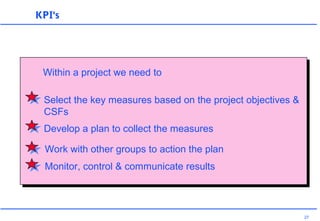
KPI's
Select the key measures based on the project objectives &
CSFs
Develop a plan to collect the measures
Work with other groups to action the plan
Monitor, control & communicate results
Within a project we need to
28
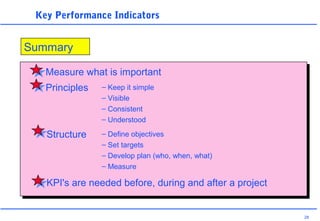
Key Performance Indicators
Summary
Measure what is important
Principles
Structure
KPI's are needed before, during and after a project
– Keep it simple
– Visible
– Consistent
– Understood
– Define objectives
– Set targets
– Develop plan (who, when, what)
– Measure
29
Key Performance Indicators and
ECSI
SuccessFailure

Kpiscsfs

  • 1.
  • 2.
  • 3.
    3 Objectives Demonstrate how KPI'srelate to the overall project To define Key Performance Indicators (KPI’s) Provide some examples of KPI's Show how to measure against the selected KPI's The objectives of this session are:
  • 4.
    4 First some definitions Ameasurable variable that is related to a series of process steps against which performance can be managed to deliver against a particular corporate objective. One, or a series, of process steps that are critical to the achievement of a particular corporate objective. The following is a generic “road map” to help you think through the establishment of KPI's KPI - Key Performance Indicator CSF - Critical Success Factor
  • 5.
    5 KPI's and Processes ButKPI's need to relate back to objectivesBut KPI's need to relate back to objectives Project Channel Relations Develop Product Fulfill Demand CSF CSF to achieve improve- ment ProcessProcess Identify critical success factors Identify critical success factors Define key performance indicators Define key performance indicators KPI Defining KPI's by Process
  • 6.
    7 KPI's and Projects Whyare KPI's important as part of a project ? To establish the base line We need a base line for selected KPI's. To assess current performance so we can quantify the opportunity for improvement and correlate to the base case Measure success To have selected KPI's for today that will be monitored for the future to demonstrate success Utilize results of Benchmarking How do our KPI's compare to the outside world so we can scope our objectives for improvement
  • 7.
    8 KPI's & Projects –TheCSF to achieve the Process objectives or –The CSF to achieve the overall target KPI's can be driven out of either Both will give similar “answers” but.... We need to ensure that – We have addressed all areas – They are linked to CBA – Meet the management teams/steering committees expectations.
  • 8.
    9 Establishing KPI's -The KPI process Define Objectives Set Targets Develop Action Plan Measure Performance Provide Feedback Archieve Results What needs to improve? Establish improvement target Create a plan on how we are going to measure Monitor the KPI Evaluate & feedback results to interested parties Benefit Identify critical success factors Identify critical success factors
  • 9.
    10 An example: To achievethe CSF of - reducing time to market Define Objectives Set Targets Develop action plan Measure Performance Provide Feedback Achieve Results Manufacturing lead-time reduction for new product introduction Reduce Manpack development to 2 days How do we capture current lead-time for Manpack development? Who should do it? How often is it repeated Measuring current lead-times Who to feedback to? How is it fed back? Do you want action taken if it is not achieving target?
  • 10.
    11 Performance Indicators What factorscontributes to delivery of the critical success factor? What do we need to measure? What are the expectations for performance? Get the objectives agreed Assign responsibilities Define Objectives Once the objectives are defined we can agree the targets...
  • 11.
    12 Performance Indicators Set Targets Oncethe objectives are set we need to develop the action plan to collect information and monitor performance... What specific performance targets should we aim to achieve? What is the time frame for achievement? What action occurs when measures go outside control limits for the target? Should there be unique goals for – product groups? – markets? – other significant input variables
  • 12.
    13 Performance Indicators Develop DataAction Plan How something is measured is very important especially during a major change project and if individuals are regarded based on existing KPI's This is the plan for how we will collect the information to monitor our selected KPI Where will the data come from? – is it consistent? – is it valid/accurate? – is it trusted? – how will it be collected? Who is the “policeman”? How often will data be collected? Who reports it? What format is it collected in? Who “owns” the measurement?
  • 13.
    14 An example ofhow calculations can be misleading 1. Delivery Reliability from Production (production orders) No. of PO correct (time and quantity) Total no. of PO x100 = 3/10 = 30% 2. Delivery Reliability from Production (quantity) Total actual production Total planned production x100 = = 104% 3. Delivery Reliability (financial) Total produced actual £ Total planned £ x100 = = 110% 1040 1000 16000 14500 Which is correct? There is always more than one way to calculate a KPI
  • 14.
    15 Performance Indicators Visible measurement Teamversus individual People react to what Management Inspect Levels within the organization Visibility Create continuous improvement Positive feedback Measuring Performance Provide Feedback
  • 15.
    16 Summary - Thesteps to establish KPI's as a management tool Define Objectives Set Targets Develop action plan Measure Performance Provide Feedback Achieve Results What? How much? How to measure? Measuring Reporting
  • 16.
    17 The KPI process- Key Things to Remember... Keep the total number of KPI's to 8-10 (key indicators) Sub measures may be required to build the total picture Take into account how easy it is to measure the KPI now and in the future Will the KPI effect behavior? How will we ensure consistency of data and how KPI's are calculated throughout the project? Who owns the KPI? How will the KPI work with other aspects of the project (e.g.. CBA, Benchmarking)
  • 17.
    18 Now... You are aconsumer in a specific supermarket Use the process just described to develop appropriate KPI’s. What KPI's would you use to measure the store service? What should the target be? How should they conduct the measurement? Who should they feed it back to?
  • 18.
    19 What KPI's shouldwe use in a project? COST QUALITY TIME SERVICE What are the factors that influence these elements? Break down to select the primary impact area There are a large number of KPI's which could be selected for a project
  • 19.
    20 KPI breakdown -What are the components of cost? Decomposition is a major tool... Market Responsiveness % New Products < 90 days % Updates < 30 days Market Share Idea Generation Prototype Approval Mass Production New Product Sales Lead-time to Quality Number of ideas % Ideas qualified Lead-time to Approval Number of ideas % Ideas qualified Lead-time to Ready for Mass Lead-time to Customer Delivery % sales from new products
  • 20.
    21 KPI - Levelof stock Stock Working stock Safety stock Forecast accuracy Demand variability Lead timeSupply variability Service Level Order processing time Frozen period Time bucket Planning cycle Throughput time Processing time No. of stepsQueue timeBatch size Product portfolio Demand volume Change-over time Which area should we measure? If the level of stock is a major component of cost - What are the major impact areas?
  • 21.
    22 Raw material price Holdingcost Purchasing dept.. expenses Write-offs/disposal costs Interest on raw material held Raw material inspectors premium freight KPI - What are the components of cost? What should be measured? Total Supply Chain Cost Cost to supply Cost to manufacture Cost to serve All costs associated with the purchase and holding of raw materials All costs incurred converting raw materials to finished goods All costs incurred due to holding inventory of finished goods Production dept.. expenses Utilities and expenses product quality testing Process control systems Warehouse material handling Rework and waste Variances Holding costs of WIP Interest on WIP Write-offs/disposal costs Logistics dept.. costs Warehousing costs Interest on F.Goods stock Material handling costs Freight/distribution Packing/replacing Another way to break down a major cost area into its specific elements
  • 22.
    23 Stock outs KPI -What are the components of service? What should we measure to truly reflect customer service? Order Processing Customer Service Customer Service = Performance Expectation Delivered on time Quality of delivery Number of Time Number of Back orders Order Promising Time Number of Credit Notes
  • 23.
    24 KPI's - Specifictypes of measures in each area COST QUALITY TIME SERVICE There can be KPI's which are Absolute numbers - today the value is X tomorrow we want the value to be Y. Ratio’s - today the ratio between A & B is X% tomorrow we want Y%. Process - today the process requires resources and has X number of steps, in the future it will have less steps and use fewer resources. Time Money Volume All of these can be expressed in
  • 24.
    25 KPI's - Anexample of ratios as KPI's Credit Notes/Total invoices Some KPI's can be shown as ratios = Accuracy of customer ordering Number of Rework Orders/Total Production Orders = Quality of Right First Time Number of Product Change Requests/Total Number of New Products = Accuracy of Design to Production Conversion These are only some examples of where ratios can be used
  • 25.
    26 Main Activities InnocenceAwareness Understanding Competence Excellence Supplier Relations • Supplier relationships adversarial and competitive with no contract basis • No coherent strategy except demand for price reduction • Larde number of disposable suppliers • Adversarial but competitive contract based • Strategy based on price, quality & delivery • Large supplier base with long “tail” • Supplier performance review undertaken but does not involve feedback to suppliers • All suppliers accredited • Relationships established with strategic suppliers • Strategy recogniwes long term relationships with key suppliers • Focus on reduced number of suppliers by volume consolidation • Formal supplier performance reviews based on subjective/qualitive data • Relationships based on strategic partnerships • Strategy drives partnership sourcing • Some integration of suppliers into the internal supply chain • Some involvement of suppliers in the innovation process • Formal supplier performance reviezs based on objective/quantitative data every 6 months • Qll suppliers assured • Relationships based on supply management process • Shared goals and objectives within partnerships. • Partnershipsbased on buying supplier’s capacity • Suppliers integrated into whole supply chain • Early and key involvement of suppliers in the innovation process • Formal suppliers performance help quarterly • Suppliers manage supply to defined rules • EDI used for call offs Skills • Buying/negotiating • Professional purchasing skills Information Systems • Paper based • Stand alone functional package (spreadsheet) • Integrated system along internal supply chain • Integrated system along complete supply chain KPI's - An example of a process related KPI
  • 26.
    27 KPI's Select the keymeasures based on the project objectives & CSFs Develop a plan to collect the measures Work with other groups to action the plan Monitor, control & communicate results Within a project we need to
  • 27.
    28 Key Performance Indicators Summary Measurewhat is important Principles Structure KPI's are needed before, during and after a project – Keep it simple – Visible – Consistent – Understood – Define objectives – Set targets – Develop plan (who, when, what) – Measure
  • 28.
    29 Key Performance Indicatorsand ECSI SuccessFailure