TOTAL QUALITY
MANAGEMENT
SUBMITTED BY
MUHAMMAD BILAL
2015-CH-228
TOTAL QUALITY MANAGEMENT
Introduction to TQM
What is TQM?
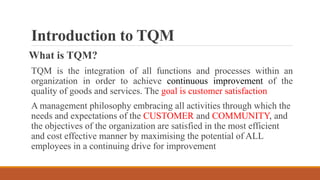
TQM is the integration of all functions and processes within an
organization in order to achieve continuous improvement of the
quality of goods and services. The goal is customer satisfaction
A management philosophy embracing all activities through which the
needs and expectations of the CUSTOMER and COMMUNITY, and
the objectives of the organization are satisfied in the most efficient
and cost effective manner by maximising the potential of ALL
employees in a continuing drive for improvement
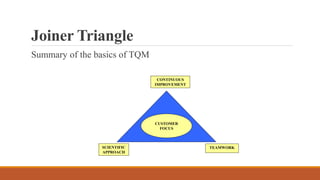
Joiner Triangle
Summary of the basics of TQM
CONTINUOUS
IMPROVEMENT
CUSTOMER
FOCUS
SCIENTIFIC
APPROACH
TEAMWORK
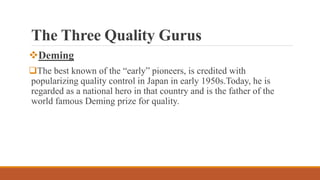
The Three Quality Gurus
Deming
The best known of the “early” pioneers, is credited with
popularizing quality control in Japan in early 1950s.Today, he is
regarded as a national hero in that country and is the father of the
world famous Deming prize for quality.
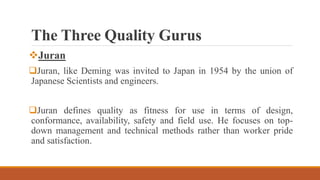
The Three Quality Gurus
Juran
Juran, like Deming was invited to Japan in 1954 by the union of
Japanese Scientists and engineers.
Juran defines quality as fitness for use in terms of design,
conformance, availability, safety and field use. He focuses on top-
down management and technical methods rather than worker pride
and satisfaction.
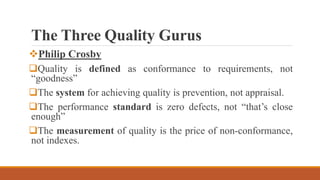
The Three Quality Gurus
Philip Crosby
Quality is defined as conformance to requirements, not
“goodness”
The system for achieving quality is prevention, not appraisal.
The performance standard is zero defects, not “that’s close
enough”
The measurement of quality is the price of non-conformance,
not indexes.
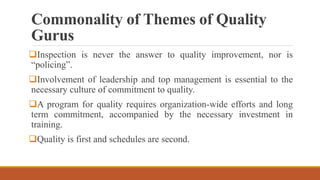
Commonality of Themes of Quality
Gurus
Inspection is never the answer to quality improvement, nor is
“policing”.
Involvement of leadership and top management is essential to the
necessary culture of commitment to quality.
A program for quality requires organization-wide efforts and long
term commitment, accompanied by the necessary investment in
training.
Quality is first and schedules are second.
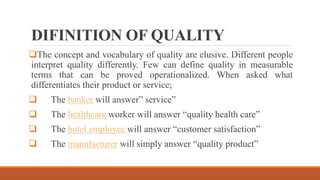
DIFINITION OF QUALITY
The concept and vocabulary of quality are elusive. Different people
interpret quality differently. Few can define quality in measurable
terms that can be proved operationalized. When asked what
differentiates their product or service;
 The banker will answer” service”
 The healthcare worker will answer “quality health care”
 The hotel employee will answer “customer satisfaction”
 The manufacturer will simply answer “quality product”
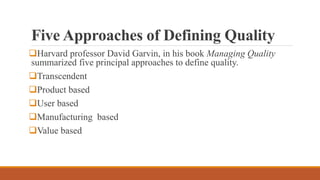
Five Approaches of Defining Quality
Harvard professor David Garvin, in his book Managing Quality
summarized five principal approaches to define quality.
Transcendent
Product based
User based
Manufacturing based
Value based
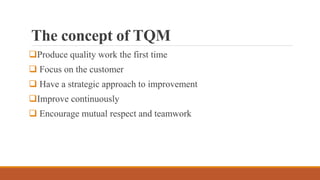
The concept of TQM
Produce quality work the first time
 Focus on the customer
 Have a strategic approach to improvement
Improve continuously
 Encourage mutual respect and teamwork
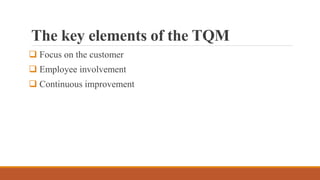
The key elements of the TQM
 Focus on the customer
 Employee involvement
 Continuous improvement
Transcendental view
Those who hold the transcendental view would say “I can’t define it,
but I know it when I see it”
Advertisers are fond of promoting products in these terms.
“ Where shopping is a pleasure” (supermarket). “We love to fly and
it shows" (airline).
Transcendental view
Television and print media are awash with such indefinable claims and
therein lies the problem:
Quality is difficult to define or to operationalize. It thus becomes
elusive when using the approach as basis for competitive advantage.
Moreover, the functions of design, production and service may find it
difficult to use the definition as a basis for quality management
PRODUCT BASED
Quality is viewed as a quantifiable or measurable characteristic or
attribute. For example durability or reliability can be measured and
the engineer can design to that benchmark.
Quality is determined objectively.
Although this approach has many benefits, it has limitation as well.
Where quality is based on individual taste or preference, the
benchmark for measurement may be misleading.
USER BASED
It is based on idea that quality is an individual matter and products
that best satisfy their preferences are those with the highest quality.
This is rational approach but leads to two problems;
Consumer preference vary widely and it is difficult to aggregate these
preferences into products with wide appeal. This leads to the choice
between a niche strategy or a market aggregation approach which tries
to identify those product attributes that meet the needs of the largest
number of consumers.
USER BASED
Another problem concerns the answer to the question “Are quality
and customer satisfaction the same?” the answer is probably not. One
may admit that a Lincoln continental has many quality attribute, but
satisfaction may be better achieved with an Escort.
Value Based
It is defined in term of costs and prices as well as number of other
attributes. Thus, the consumer’s purchased decision is based on
quality at an acceptable price. This approach is reflected in the
popular Consumer Reports magazine which ranks products and
services based on two criteria: Quality and Value.
The highest quality is not usually the best value. That designation is
assigned to the “best- buy” product or service.
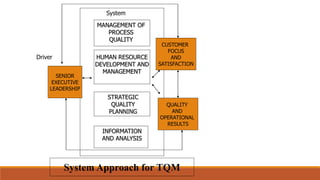
MANAGEMENT OF
PROCESS
QUALITY
HUMAN RESOURCE
DEVELOPMENT AND
MANAGEMENT
STRATEGIC
QUALITY
PLANNING
INFORMATION
AND ANALYSIS
CUSTOMER
FOCUS
AND
SATISFACTION
QUALITY
AND
OPERATIONAL
RESULTS
SENIOR
EXECUTIVE
LEADERSHIP
System Approach for TQM
Driver
System
Cost of Quality
Higher quality means higher cost.
Quality attributes such as performance and features cost more in
terms of labor, material, design and other costly resources.
The additional benefits from improved quality do not compensate for
additional expense.
The cost of improving quality is less than the resulting savings.
The saving result from less rework, scrap and other direct expenses
related defects.
This is said to account for the focus on continuous improvement of
processes in Japanese firms.
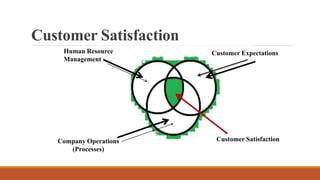
Customer Satisfaction
Customer Expectations
Company Operations
(Processes)
Customer Satisfaction
Cost of Quality
Quality costs are those incurred in excess of those that would have
been incurred if the product were built or the service performed
exactly right the first time.
This view is held by adherents of TQM philosophy.
Costs include not only those that are direct, but also those
resulting from lost customers, lost market share and the many
hidden costs and foregone opportunities not identified by modern
cost accounting systems
Types of Quality Costs
The cost of quality is generally classified into four categories
1. Cost of Prevention
2. Cost of Appraisal
3. Cost of Internal Failure
4. Cost of External Failure
Benefits of TQM
Greater customer loyalty
Market share improvement
Higher stock prices
Reduced service calls
Higher prices
Greater productivity
Conclusion
Remember the earth revolves around the CUSTOMER. Quality
begets customers and customers beget quality. Let us all have action
plans to support quality, this will make the world happy and earn us
the blessing of God Almighty.
“Actions are direct reflection of one’s intentions” (Al-Quran)

Total quality management

  • 1.
  • 2.
  • 3.
    Introduction to TQM Whatis TQM? TQM is the integration of all functions and processes within an organization in order to achieve continuous improvement of the quality of goods and services. The goal is customer satisfaction A management philosophy embracing all activities through which the needs and expectations of the CUSTOMER and COMMUNITY, and the objectives of the organization are satisfied in the most efficient and cost effective manner by maximising the potential of ALL employees in a continuing drive for improvement
  • 4.
    Joiner Triangle Summary ofthe basics of TQM CONTINUOUS IMPROVEMENT CUSTOMER FOCUS SCIENTIFIC APPROACH TEAMWORK
  • 5.
    The Three QualityGurus Deming The best known of the “early” pioneers, is credited with popularizing quality control in Japan in early 1950s.Today, he is regarded as a national hero in that country and is the father of the world famous Deming prize for quality.
  • 6.
    The Three QualityGurus Juran Juran, like Deming was invited to Japan in 1954 by the union of Japanese Scientists and engineers. Juran defines quality as fitness for use in terms of design, conformance, availability, safety and field use. He focuses on top- down management and technical methods rather than worker pride and satisfaction.
  • 7.
    The Three QualityGurus Philip Crosby Quality is defined as conformance to requirements, not “goodness” The system for achieving quality is prevention, not appraisal. The performance standard is zero defects, not “that’s close enough” The measurement of quality is the price of non-conformance, not indexes.
  • 8.
    Commonality of Themesof Quality Gurus Inspection is never the answer to quality improvement, nor is “policing”. Involvement of leadership and top management is essential to the necessary culture of commitment to quality. A program for quality requires organization-wide efforts and long term commitment, accompanied by the necessary investment in training. Quality is first and schedules are second.
  • 9.
    DIFINITION OF QUALITY Theconcept and vocabulary of quality are elusive. Different people interpret quality differently. Few can define quality in measurable terms that can be proved operationalized. When asked what differentiates their product or service;  The banker will answer” service”  The healthcare worker will answer “quality health care”  The hotel employee will answer “customer satisfaction”  The manufacturer will simply answer “quality product”
  • 10.
    Five Approaches ofDefining Quality Harvard professor David Garvin, in his book Managing Quality summarized five principal approaches to define quality. Transcendent Product based User based Manufacturing based Value based
  • 11.
    The concept ofTQM Produce quality work the first time  Focus on the customer  Have a strategic approach to improvement Improve continuously  Encourage mutual respect and teamwork
  • 12.
    The key elementsof the TQM  Focus on the customer  Employee involvement  Continuous improvement
  • 13.
    Transcendental view Those whohold the transcendental view would say “I can’t define it, but I know it when I see it” Advertisers are fond of promoting products in these terms. “ Where shopping is a pleasure” (supermarket). “We love to fly and it shows" (airline).
  • 14.
    Transcendental view Television andprint media are awash with such indefinable claims and therein lies the problem: Quality is difficult to define or to operationalize. It thus becomes elusive when using the approach as basis for competitive advantage. Moreover, the functions of design, production and service may find it difficult to use the definition as a basis for quality management
  • 15.
    PRODUCT BASED Quality isviewed as a quantifiable or measurable characteristic or attribute. For example durability or reliability can be measured and the engineer can design to that benchmark. Quality is determined objectively. Although this approach has many benefits, it has limitation as well. Where quality is based on individual taste or preference, the benchmark for measurement may be misleading.
  • 16.
    USER BASED It isbased on idea that quality is an individual matter and products that best satisfy their preferences are those with the highest quality. This is rational approach but leads to two problems; Consumer preference vary widely and it is difficult to aggregate these preferences into products with wide appeal. This leads to the choice between a niche strategy or a market aggregation approach which tries to identify those product attributes that meet the needs of the largest number of consumers.
  • 17.
    USER BASED Another problemconcerns the answer to the question “Are quality and customer satisfaction the same?” the answer is probably not. One may admit that a Lincoln continental has many quality attribute, but satisfaction may be better achieved with an Escort.
  • 18.
    Value Based It isdefined in term of costs and prices as well as number of other attributes. Thus, the consumer’s purchased decision is based on quality at an acceptable price. This approach is reflected in the popular Consumer Reports magazine which ranks products and services based on two criteria: Quality and Value. The highest quality is not usually the best value. That designation is assigned to the “best- buy” product or service.
  • 19.
    MANAGEMENT OF PROCESS QUALITY HUMAN RESOURCE DEVELOPMENTAND MANAGEMENT STRATEGIC QUALITY PLANNING INFORMATION AND ANALYSIS CUSTOMER FOCUS AND SATISFACTION QUALITY AND OPERATIONAL RESULTS SENIOR EXECUTIVE LEADERSHIP System Approach for TQM Driver System
  • 20.
    Cost of Quality Higherquality means higher cost. Quality attributes such as performance and features cost more in terms of labor, material, design and other costly resources. The additional benefits from improved quality do not compensate for additional expense. The cost of improving quality is less than the resulting savings. The saving result from less rework, scrap and other direct expenses related defects. This is said to account for the focus on continuous improvement of processes in Japanese firms.
  • 21.
    Customer Satisfaction Customer Expectations CompanyOperations (Processes) Customer Satisfaction
  • 22.
    Cost of Quality Qualitycosts are those incurred in excess of those that would have been incurred if the product were built or the service performed exactly right the first time. This view is held by adherents of TQM philosophy. Costs include not only those that are direct, but also those resulting from lost customers, lost market share and the many hidden costs and foregone opportunities not identified by modern cost accounting systems
  • 23.
    Types of QualityCosts The cost of quality is generally classified into four categories 1. Cost of Prevention 2. Cost of Appraisal 3. Cost of Internal Failure 4. Cost of External Failure
  • 24.
    Benefits of TQM Greatercustomer loyalty Market share improvement Higher stock prices Reduced service calls Higher prices Greater productivity
  • 25.
    Conclusion Remember the earthrevolves around the CUSTOMER. Quality begets customers and customers beget quality. Let us all have action plans to support quality, this will make the world happy and earn us the blessing of God Almighty. “Actions are direct reflection of one’s intentions” (Al-Quran)