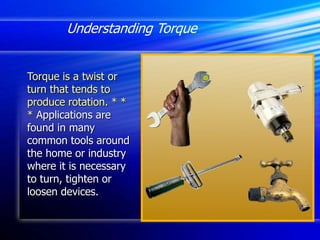
Torque is a twist or
turn that tends to
produce rotation. * *
* Applications are
found in many
common tools around
the home or industry
where it is necessary
to turn, tighten or
loosen devices.
Understanding Torque
Definition of Torque
Torque is defined as the tendency to
produce a change in rotational motion.
Examples:
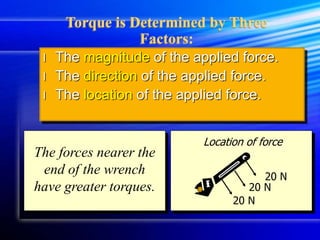
Torque is Determined by Three
Factors:
l The magnitude of the applied force.
l The direction of the applied force.
l The location of the applied force.
20 N
Magnitude of force
40 N
The 40-N force
produces twice the
torque as does the
20-N force.
Each of the 20-N
forces has a different
torque due to the
direction of force. 20 N
Direction of Force
20 N
q
q
20 N
20 N
Location of force
The forces nearer the
end of the wrench
have greater torques.
20 N
20 N
Units for Torque
Torque is proportional to the magnitude of
F and to the distance r from the axis. Thus,
a tentative formula might be:
t = Fr Units: Nm or lbft
6 cm
40 N
t = (40 N)(0.60 m)
= 24.0 Nm, cw
t = 24.0 Nm, cw
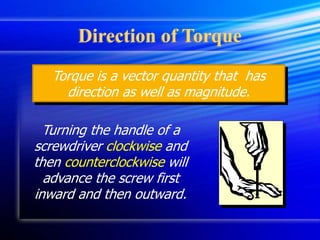
Direction of Torque
Torque is a vector quantity that has
direction as well as magnitude.
Turning the handle of a
screwdriver clockwise and
then counterclockwise will
advance the screw first
inward and then outward.
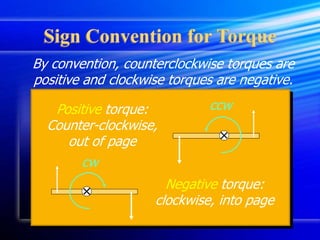
Sign Convention for Torque
By convention, counterclockwise torques are
positive and clockwise torques are negative.
Positive torque:
Counter-clockwise,
out of page
cw
ccw
Negative torque:
clockwise, into page
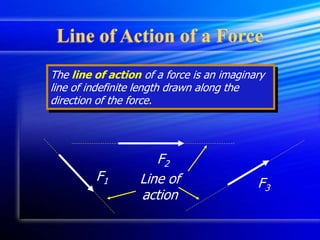
Line of Action of a Force
The line of action of a force is an imaginary
line of indefinite length drawn along the
direction of the force.
F1
F2
F3
Line of
action
The Moment Arm
The moment arm of a force is the perpendicular
distance from the line of action of a force to the
axis of rotation.
F2
F1
F3
r
r
r
Calculating Torque
l Read problem and draw a rough
figure.
l Extend line of action of the force.
l Draw and label moment arm.
l Calculate the moment arm if
necessary.
l Apply definition of torque:
t = Fr Torque = force x moment arm
Example 1: An 80-N force acts at the
end of a 12-cm wrench as shown. Find
the torque.
• Extend line of action, draw, calculate r.
t = (80 N)(0.104 m)
= 8.31 N m
r = 12 cm sin 600
= 10.4 cm
Alternate: An 80-N force acts at the
end of a 12-cm wrench as shown. Find
the torque.
Resolve 80-N force into components as shown.
Note from figure: rx = 0 and ry = 12 cm
t = (69.3 N)(0.12 m) t = 8.31 N m as before
positive
12 cm
Calculating Resultant Torque
• Read, draw, and label a rough figure.
• Draw free-body diagram showing all forces,
distances, and axis of rotation.
• Extend lines of action for each force.
• Calculate moment arms if necessary.
• Calculate torques due to EACH individual force
affixing proper sign. CCW (+) and CW (-).
• Resultant torque is sum of individual torques.
Example 2: Find resultant torque about
axis A for the arrangement shown
below:
300
300
6 m 2 m
4 m
20 N
30 N
40 N
A
Find t due to
each force.
Consider 20-N
force first:
r = (4 m) sin 300
= 2.00 m
t = Fr = (20 N)(2 m)
= 40 N m, cw
The torque about A is
clockwise and negative.
t20 = -40 N m
r
negative
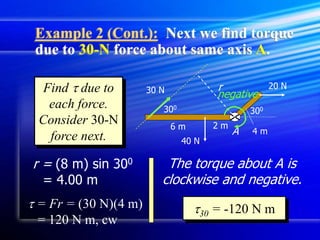
Example 2 (Cont.): Next we find torque
due to 30-N force about same axis A.
300
300
6 m 2 m
4 m
20 N
30 N
40 N
A
Find t due to
each force.
Consider 30-N
force next.
r = (8 m) sin 300
= 4.00 m
t = Fr = (30 N)(4 m)
= 120 N m, cw
The torque about A is
clockwise and negative.
t30 = -120 N m
r
negative
Example 2 (Cont.): Finally, we consider
the torque due to the 40-N force.
Find t due to
each force.
Consider 40-N
force next:
r = (2 m) sin 900
= 2.00 m
t = Fr = (40 N)(2 m)
= 80 N m, ccw
The torque about A is
CCW and positive.
t40 = +80 N m
300
300
6 m 2 m
4 m
20 N
30 N
40 N
A
r
positive
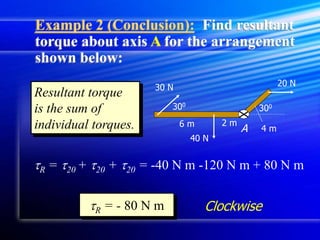
Example 2 (Conclusion): Find resultant
torque about axis A for the arrangement
shown below:
300
300
6 m 2 m
4 m
20 N
30 N
40 N
A
Resultant torque
is the sum of
individual torques.
tR = - 80 N m Clockwise
tR = t20 + t20 + t20 = -40 N m -120 N m + 80 N m
Part II: Torque and the Cross
Product or Vector Product.
Optional Discussion
This concludes the general treatment
of torque. Part II details the use of
the vector product in calculating
resultant torque. Check with your
instructor before studying this section.
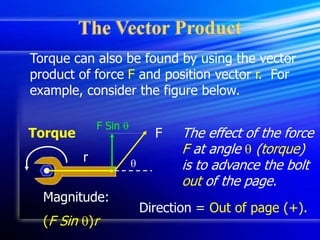
The Vector Product
Torque can also be found by using the vector
product of force F and position vector r. For
example, consider the figure below.
F
q
r
F Sin q
The effect of the force
F at angle q (torque)
is to advance the bolt
out of the page.
Torque
Magnitude:
(F Sin q)r
Direction = Out of page (+).
Definition of a Vector
Product
The magnitude of the vector (cross) product
of two vectors A and B is defined as follows:
A x B = l A l l B l Sin q
F x r = l F l l r l Sin q Magnitude only
F
(F Sin q) r or F (r Sin q)
In our example, the cross product of F and r is:
In effect, this becomes simply:
q
r
F Sin q
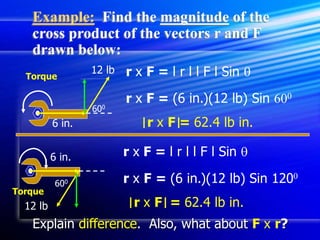
Example: Find the magnitude of the
cross product of the vectors r and F
drawn below:
r x F = l r l l F l Sin q
r x F = (6 in.)(12 lb) Sin 600
r x F = l r l l F l Sin q
r x F = (6 in.)(12 lb) Sin 1200
Explain difference. Also, what about F x r?
12 lb
r x F = 62.4 lb in.
Torque
600
6 in.
Torque
600
6 in.
12 lb r x F = 62.4 lb in.
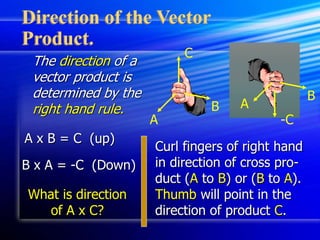
Direction of the Vector
Product.
The direction of a
vector product is
determined by the
right hand rule.
A
C
B
B
-C
A
A x B = C (up)
B x A = -C (Down)
Curl fingers of right hand
in direction of cross pro-
duct (A to B) or (B to A).
Thumb will point in the
direction of product C.
What is direction
of A x C?
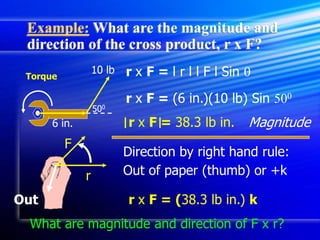
Example: What are the magnitude and
direction of the cross product, r x F?
r x F = l r l l F l Sin q
r x F = (6 in.)(10 lb) Sin 500
r x F = 38.3 lb in.
10 lb
Torque
500
6 in. Magnitude
Out
r
F
Direction by right hand rule:
Out of paper (thumb) or +k
r x F = (38.3 lb in.) k
What are magnitude and direction of F x r?
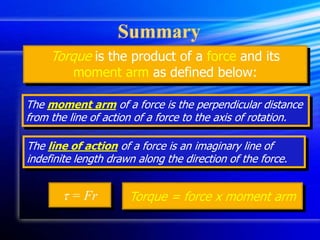
Summary
Torque is the product of a force and its
moment arm as defined below:
The moment arm of a force is the perpendicular distance
from the line of action of a force to the axis of rotation.
The line of action of a force is an imaginary line of
indefinite length drawn along the direction of the force.
t = Fr Torque = force x moment arm
Summary: Resultant Torque
• Read, draw, and label a rough figure.
• Draw free-body diagram showing all forces,
distances, and axis of rotation.
• Extend lines of action for each force.
• Calculate moment arms if necessary.
• Calculate torques due to EACH individual force
affixing proper sign. CCW (+) and CW (-).
• Resultant torque is sum of individual torques.

Torque.ppt

  • 1.
    Torque is atwist or turn that tends to produce rotation. * * * Applications are found in many common tools around the home or industry where it is necessary to turn, tighten or loosen devices. Understanding Torque
  • 2.
    Definition of Torque Torqueis defined as the tendency to produce a change in rotational motion. Examples:
  • 3.
    Torque is Determinedby Three Factors: l The magnitude of the applied force. l The direction of the applied force. l The location of the applied force. 20 N Magnitude of force 40 N The 40-N force produces twice the torque as does the 20-N force. Each of the 20-N forces has a different torque due to the direction of force. 20 N Direction of Force 20 N q q 20 N 20 N Location of force The forces nearer the end of the wrench have greater torques. 20 N 20 N
  • 4.
    Units for Torque Torqueis proportional to the magnitude of F and to the distance r from the axis. Thus, a tentative formula might be: t = Fr Units: Nm or lbft 6 cm 40 N t = (40 N)(0.60 m) = 24.0 Nm, cw t = 24.0 Nm, cw
  • 5.
    Direction of Torque Torqueis a vector quantity that has direction as well as magnitude. Turning the handle of a screwdriver clockwise and then counterclockwise will advance the screw first inward and then outward.
  • 6.
    Sign Convention forTorque By convention, counterclockwise torques are positive and clockwise torques are negative. Positive torque: Counter-clockwise, out of page cw ccw Negative torque: clockwise, into page
  • 7.
    Line of Actionof a Force The line of action of a force is an imaginary line of indefinite length drawn along the direction of the force. F1 F2 F3 Line of action
  • 8.
    The Moment Arm Themoment arm of a force is the perpendicular distance from the line of action of a force to the axis of rotation. F2 F1 F3 r r r
  • 9.
    Calculating Torque l Readproblem and draw a rough figure. l Extend line of action of the force. l Draw and label moment arm. l Calculate the moment arm if necessary. l Apply definition of torque: t = Fr Torque = force x moment arm
  • 10.
    Example 1: An80-N force acts at the end of a 12-cm wrench as shown. Find the torque. • Extend line of action, draw, calculate r. t = (80 N)(0.104 m) = 8.31 N m r = 12 cm sin 600 = 10.4 cm
  • 11.
    Alternate: An 80-Nforce acts at the end of a 12-cm wrench as shown. Find the torque. Resolve 80-N force into components as shown. Note from figure: rx = 0 and ry = 12 cm t = (69.3 N)(0.12 m) t = 8.31 N m as before positive 12 cm
  • 12.
    Calculating Resultant Torque •Read, draw, and label a rough figure. • Draw free-body diagram showing all forces, distances, and axis of rotation. • Extend lines of action for each force. • Calculate moment arms if necessary. • Calculate torques due to EACH individual force affixing proper sign. CCW (+) and CW (-). • Resultant torque is sum of individual torques.
  • 13.
    Example 2: Findresultant torque about axis A for the arrangement shown below: 300 300 6 m 2 m 4 m 20 N 30 N 40 N A Find t due to each force. Consider 20-N force first: r = (4 m) sin 300 = 2.00 m t = Fr = (20 N)(2 m) = 40 N m, cw The torque about A is clockwise and negative. t20 = -40 N m r negative
  • 14.
    Example 2 (Cont.):Next we find torque due to 30-N force about same axis A. 300 300 6 m 2 m 4 m 20 N 30 N 40 N A Find t due to each force. Consider 30-N force next. r = (8 m) sin 300 = 4.00 m t = Fr = (30 N)(4 m) = 120 N m, cw The torque about A is clockwise and negative. t30 = -120 N m r negative
  • 15.
    Example 2 (Cont.):Finally, we consider the torque due to the 40-N force. Find t due to each force. Consider 40-N force next: r = (2 m) sin 900 = 2.00 m t = Fr = (40 N)(2 m) = 80 N m, ccw The torque about A is CCW and positive. t40 = +80 N m 300 300 6 m 2 m 4 m 20 N 30 N 40 N A r positive
  • 16.
    Example 2 (Conclusion):Find resultant torque about axis A for the arrangement shown below: 300 300 6 m 2 m 4 m 20 N 30 N 40 N A Resultant torque is the sum of individual torques. tR = - 80 N m Clockwise tR = t20 + t20 + t20 = -40 N m -120 N m + 80 N m
  • 17.
    Part II: Torqueand the Cross Product or Vector Product. Optional Discussion This concludes the general treatment of torque. Part II details the use of the vector product in calculating resultant torque. Check with your instructor before studying this section.
  • 18.
    The Vector Product Torquecan also be found by using the vector product of force F and position vector r. For example, consider the figure below. F q r F Sin q The effect of the force F at angle q (torque) is to advance the bolt out of the page. Torque Magnitude: (F Sin q)r Direction = Out of page (+).
  • 19.
    Definition of aVector Product The magnitude of the vector (cross) product of two vectors A and B is defined as follows: A x B = l A l l B l Sin q F x r = l F l l r l Sin q Magnitude only F (F Sin q) r or F (r Sin q) In our example, the cross product of F and r is: In effect, this becomes simply: q r F Sin q
  • 20.
    Example: Find themagnitude of the cross product of the vectors r and F drawn below: r x F = l r l l F l Sin q r x F = (6 in.)(12 lb) Sin 600 r x F = l r l l F l Sin q r x F = (6 in.)(12 lb) Sin 1200 Explain difference. Also, what about F x r? 12 lb r x F = 62.4 lb in. Torque 600 6 in. Torque 600 6 in. 12 lb r x F = 62.4 lb in.
  • 21.
    Direction of theVector Product. The direction of a vector product is determined by the right hand rule. A C B B -C A A x B = C (up) B x A = -C (Down) Curl fingers of right hand in direction of cross pro- duct (A to B) or (B to A). Thumb will point in the direction of product C. What is direction of A x C?
  • 22.
    Example: What arethe magnitude and direction of the cross product, r x F? r x F = l r l l F l Sin q r x F = (6 in.)(10 lb) Sin 500 r x F = 38.3 lb in. 10 lb Torque 500 6 in. Magnitude Out r F Direction by right hand rule: Out of paper (thumb) or +k r x F = (38.3 lb in.) k What are magnitude and direction of F x r?
  • 23.
    Summary Torque is theproduct of a force and its moment arm as defined below: The moment arm of a force is the perpendicular distance from the line of action of a force to the axis of rotation. The line of action of a force is an imaginary line of indefinite length drawn along the direction of the force. t = Fr Torque = force x moment arm
  • 24.
    Summary: Resultant Torque •Read, draw, and label a rough figure. • Draw free-body diagram showing all forces, distances, and axis of rotation. • Extend lines of action for each force. • Calculate moment arms if necessary. • Calculate torques due to EACH individual force affixing proper sign. CCW (+) and CW (-). • Resultant torque is sum of individual torques.