Measurement of force
torque and pressure
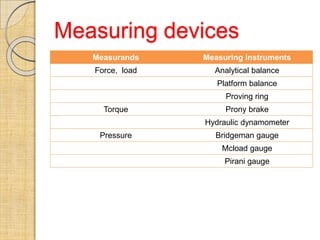
Measuring devices
Measurands Measuring instruments
Force, load Analytical balance
Platform balance
Proving ring
Torque Prony brake
Hydraulic dynamometer
Pressure Bridgeman gauge
Mcload gauge
Pirani gauge
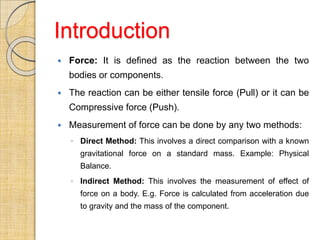
Introduction
 Force: It is defined as the reaction between the two
bodies or components.
 The reaction can be either tensile force (Pull) or it can be
Compressive force (Push).
 Measurement of force can be done by any two methods:
◦ Direct Method: This involves a direct comparison with a known
gravitational force on a standard mass. Example: Physical
Balance.
◦ Indirect Method: This involves the measurement of effect of
force on a body. E.g. Force is calculated from acceleration due
to gravity and the mass of the component.
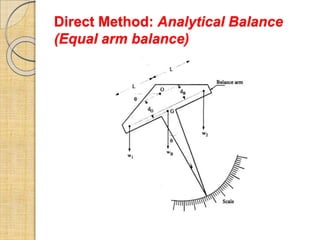
Direct Method: Analytical Balance
(Equal arm balance)
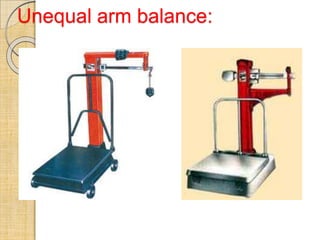
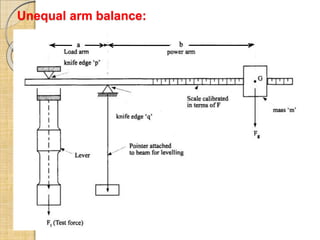
Unequal arm balance:
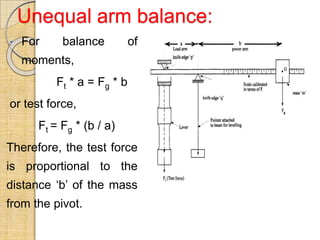
• For balance of
moments,
Ft * a = Fg * b
or test force,
Ft = Fg * (b / a)
Therefore, the test force
is proportional to the
distance ‘b’ of the mass
from the pivot.
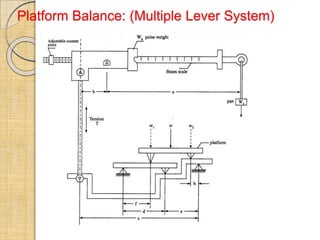
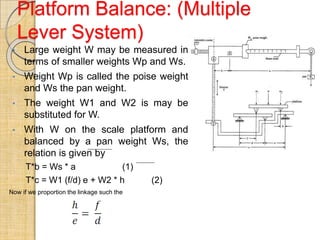
Platform Balance: (Multiple Lever System)
Platform Balance: (Multiple
Lever System)
• Large weight W may be measured in
terms of smaller weights Wp and Ws.
• Weight Wp is called the poise weight
and Ws the pan weight.
• The weight W1 and W2 is may be
substituted for W.
• With W on the scale platform and
balanced by a pan weight Ws, the
relation is given by
T*b = Ws * a (1)
T*c = W1 (f/d) e + W2 * h (2)
Now if we proportion the linkage such the
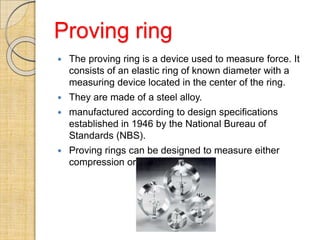
Proving ring
 The proving ring is a device used to measure force. It
consists of an elastic ring of known diameter with a
measuring device located in the center of the ring.
 They are made of a steel alloy.
 manufactured according to design specifications
established in 1946 by the National Bureau of
Standards (NBS).
 Proving rings can be designed to measure either
compression or tension forces.
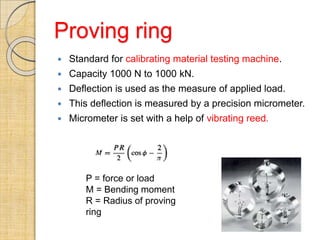
Proving ring
 Standard for calibrating material testing machine.
 Capacity 1000 N to 1000 kN.
 Deflection is used as the measure of applied load.
 This deflection is measured by a precision micrometer.
 Micrometer is set with a help of vibrating reed.
P = force or load
M = Bending moment
R = Radius of proving
ring
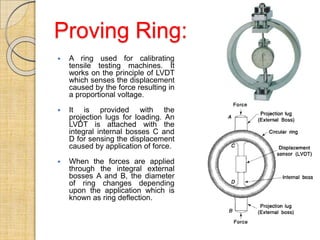
Proving Ring:
 A ring used for calibrating
tensile testing machines. It
works on the principle of LVDT
which senses the displacement
caused by the force resulting in
a proportional voltage.
 It is provided with the
projection lugs for loading. An
LVDT is attached with the
integral internal bosses C and
D for sensing the displacement
caused by application of force.
 When the forces are applied
through the integral external
bosses A and B, the diameter
of ring changes depending
upon the application which is
known as ring deflection.
Proving Ring:
• The resulting deflection of the ring is measured by LVDT
which converts the ring deflection or displacement in to
voltage signal.
• An external amplifier may be connected to provide direct
current to drive the indicators or the measured value of
force.
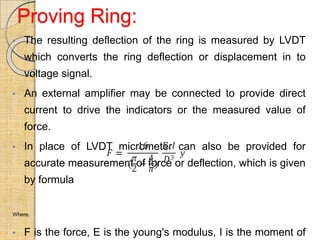
• In place of LVDT micrometer can also be provided for
accurate measurement of force or deflection, which is given
by formula
Where,
• F is the force, E is the young's modulus, I is the moment of
Torque Measurement:
 Torque: Force that causes twisting or turning moment.
E.g. the force generated by an internal-combustion engine
to turn a vehicle's drive or shaft.
 Torque measuring devices are called as dynamometers.
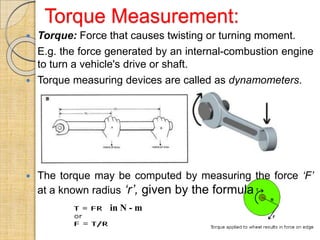
 The torque may be computed by measuring the force ‘F’
at a known radius ‘r’, given by the formula
in N - m
Torque Measurement:
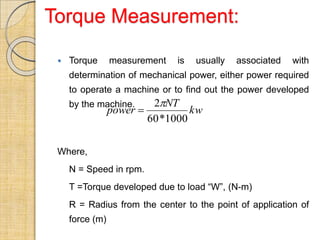
 Torque measurement is usually associated with
determination of mechanical power, either power required
to operate a machine or to find out the power developed
by the machine.
Where,
N = Speed in rpm.
T =Torque developed due to load “W”, (N-m)
R = Radius from the center to the point of application of
force (m)
kw
NT
power
1000
*
60
2

Types of Dynamometers:
 Absorption dynamometers:
◦ They are useful for measuring power or torque
developed by power source such as engines or electric
motors.
 Driving dynamometers:
◦ These dynamometers measure power or torque and as
well provide energy to operate the device to be tested.
◦ These are useful in determining performance
characteristics of devices such as pumps and
compression.
 Transmission dynamometers:
◦ These are the passive devices placed at an appropriate
location within a machine or in between the machine to
sense the torque at that location.
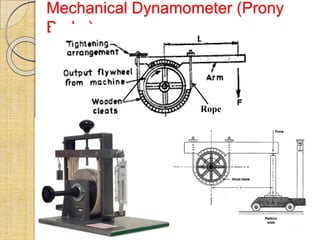
Mechanical Dynamometer (Prony
Brake):
Rope
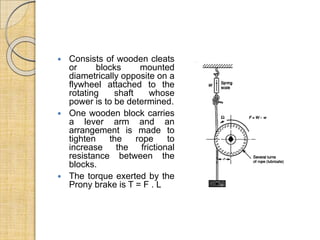
 Consists of wooden cleats
or blocks mounted
diametrically opposite on a
flywheel attached to the
rotating shaft whose
power is to be determined.
 One wooden block carries
a lever arm and an
arrangement is made to
tighten the rope to
increase the frictional
resistance between the
blocks.
 The torque exerted by the
Prony brake is T = F . L
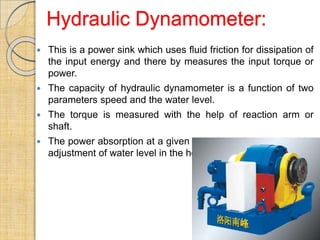
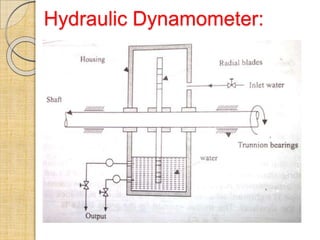
Hydraulic Dynamometer:
 This is a power sink which uses fluid friction for dissipation of
the input energy and there by measures the input torque or
power.
 The capacity of hydraulic dynamometer is a function of two
parameters speed and the water level.
 The torque is measured with the help of reaction arm or
shaft.
 The power absorption at a given speed may be controlled by
adjustment of water level in the housing.
 This dynamometer may be used in larger capacities
than the simple Prony brake dynamometer because
heat generated can be can be easily removed by
circulating the water in and out of the housing.
 The force acting on the shaft is then measured by
using the force measuring device or strain gauges.
 Then by using the relation, T = F . r, we can find the
torque acting on it.
Hydraulic Dynamometer:
Hydraulic Dynamometer
Characters
 Small in size. Easy installation
 Simple dynamometer structure and easy for
maintenance
 High brake torque
 High measurement accuracy
 Reliable and stable working condition
 High real-time speed measurement accuracy with
EM sensors
 Fast loading control by electronic-control butterfly
valve
 High reaction speed which is suitable on dynamic
testing Tuning of in-use engines, typically at
service centers or for racing applications

force-torque-and-pressure.pptx

  • 1.
  • 2.
    Measuring devices Measurands Measuringinstruments Force, load Analytical balance Platform balance Proving ring Torque Prony brake Hydraulic dynamometer Pressure Bridgeman gauge Mcload gauge Pirani gauge
  • 3.
    Introduction  Force: Itis defined as the reaction between the two bodies or components.  The reaction can be either tensile force (Pull) or it can be Compressive force (Push).  Measurement of force can be done by any two methods: ◦ Direct Method: This involves a direct comparison with a known gravitational force on a standard mass. Example: Physical Balance. ◦ Indirect Method: This involves the measurement of effect of force on a body. E.g. Force is calculated from acceleration due to gravity and the mass of the component.
  • 4.
    Direct Method: AnalyticalBalance (Equal arm balance)
  • 5.
  • 6.
  • 7.
    Unequal arm balance: •For balance of moments, Ft * a = Fg * b or test force, Ft = Fg * (b / a) Therefore, the test force is proportional to the distance ‘b’ of the mass from the pivot.
  • 8.
  • 9.
    Platform Balance: (Multiple LeverSystem) • Large weight W may be measured in terms of smaller weights Wp and Ws. • Weight Wp is called the poise weight and Ws the pan weight. • The weight W1 and W2 is may be substituted for W. • With W on the scale platform and balanced by a pan weight Ws, the relation is given by T*b = Ws * a (1) T*c = W1 (f/d) e + W2 * h (2) Now if we proportion the linkage such the
  • 10.
    Proving ring  Theproving ring is a device used to measure force. It consists of an elastic ring of known diameter with a measuring device located in the center of the ring.  They are made of a steel alloy.  manufactured according to design specifications established in 1946 by the National Bureau of Standards (NBS).  Proving rings can be designed to measure either compression or tension forces.
  • 11.
    Proving ring  Standardfor calibrating material testing machine.  Capacity 1000 N to 1000 kN.  Deflection is used as the measure of applied load.  This deflection is measured by a precision micrometer.  Micrometer is set with a help of vibrating reed. P = force or load M = Bending moment R = Radius of proving ring
  • 12.
    Proving Ring:  Aring used for calibrating tensile testing machines. It works on the principle of LVDT which senses the displacement caused by the force resulting in a proportional voltage.  It is provided with the projection lugs for loading. An LVDT is attached with the integral internal bosses C and D for sensing the displacement caused by application of force.  When the forces are applied through the integral external bosses A and B, the diameter of ring changes depending upon the application which is known as ring deflection.
  • 13.
    Proving Ring: • Theresulting deflection of the ring is measured by LVDT which converts the ring deflection or displacement in to voltage signal. • An external amplifier may be connected to provide direct current to drive the indicators or the measured value of force. • In place of LVDT micrometer can also be provided for accurate measurement of force or deflection, which is given by formula Where, • F is the force, E is the young's modulus, I is the moment of
  • 14.
    Torque Measurement:  Torque:Force that causes twisting or turning moment. E.g. the force generated by an internal-combustion engine to turn a vehicle's drive or shaft.  Torque measuring devices are called as dynamometers.  The torque may be computed by measuring the force ‘F’ at a known radius ‘r’, given by the formula in N - m
  • 15.
    Torque Measurement:  Torquemeasurement is usually associated with determination of mechanical power, either power required to operate a machine or to find out the power developed by the machine. Where, N = Speed in rpm. T =Torque developed due to load “W”, (N-m) R = Radius from the center to the point of application of force (m) kw NT power 1000 * 60 2 
  • 16.
    Types of Dynamometers: Absorption dynamometers: ◦ They are useful for measuring power or torque developed by power source such as engines or electric motors.  Driving dynamometers: ◦ These dynamometers measure power or torque and as well provide energy to operate the device to be tested. ◦ These are useful in determining performance characteristics of devices such as pumps and compression.  Transmission dynamometers: ◦ These are the passive devices placed at an appropriate location within a machine or in between the machine to sense the torque at that location.
  • 17.
  • 18.
     Consists ofwooden cleats or blocks mounted diametrically opposite on a flywheel attached to the rotating shaft whose power is to be determined.  One wooden block carries a lever arm and an arrangement is made to tighten the rope to increase the frictional resistance between the blocks.  The torque exerted by the Prony brake is T = F . L
  • 19.
    Hydraulic Dynamometer:  Thisis a power sink which uses fluid friction for dissipation of the input energy and there by measures the input torque or power.  The capacity of hydraulic dynamometer is a function of two parameters speed and the water level.  The torque is measured with the help of reaction arm or shaft.  The power absorption at a given speed may be controlled by adjustment of water level in the housing.
  • 20.
     This dynamometermay be used in larger capacities than the simple Prony brake dynamometer because heat generated can be can be easily removed by circulating the water in and out of the housing.  The force acting on the shaft is then measured by using the force measuring device or strain gauges.  Then by using the relation, T = F . r, we can find the torque acting on it.
  • 21.
  • 22.
    Hydraulic Dynamometer Characters  Smallin size. Easy installation  Simple dynamometer structure and easy for maintenance  High brake torque  High measurement accuracy  Reliable and stable working condition  High real-time speed measurement accuracy with EM sensors  Fast loading control by electronic-control butterfly valve  High reaction speed which is suitable on dynamic testing Tuning of in-use engines, typically at service centers or for racing applications