Premier IOL choices
Technique & Decision Making
or earlier cataract surgery
or do we really need femtosec
laser cataract surgery
Dr. Inderjit Singh
FRCS(E)., FRCOphth., FRANZCO
Chatswood , Sydney
Aim of modern cataract Surgery
Royal College of Ophthalmologists
 Restoration of vision
 Achievement of desired refractive
outcome
 Improvement QOL
 Ensuring safety and satisfaction
 A VA is not mentioned
 Meticulous pre-op;intra-op;post op mng
Earlier Cataract Operations
(1)
 Outcomes in small incision is more predictable
 Glasses free vision-Toric and Multifocal IOLs
 Safer operation because of smaller incisions
 Meet the visual demands that patient expects
 Short recovery period
Earlier Cataract Operations
(2)
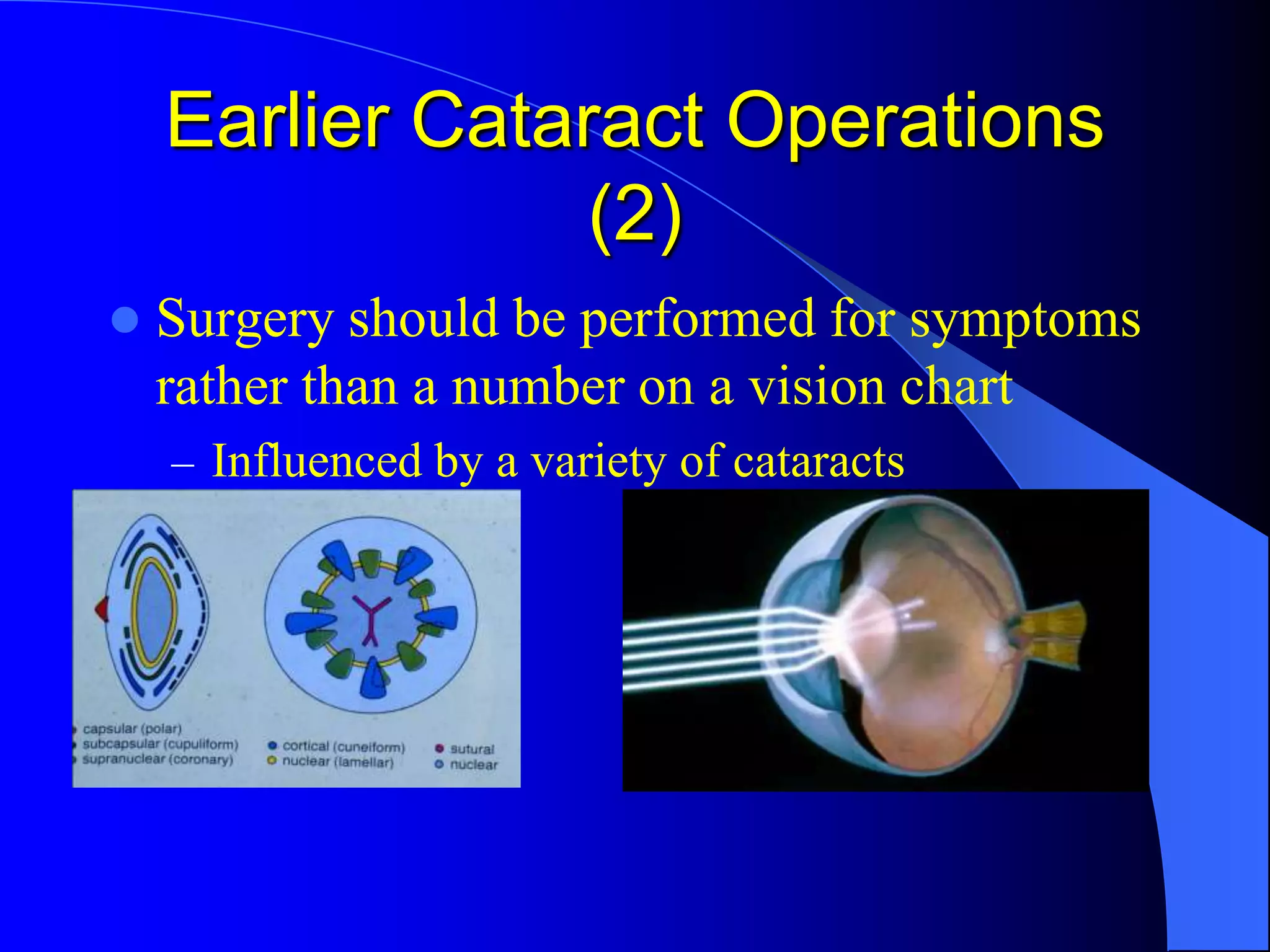
 Surgery should be performed for symptoms
rather than a number on a vision chart
– Influenced by a variety of cataracts
Earlier Cataract Operations
(3)
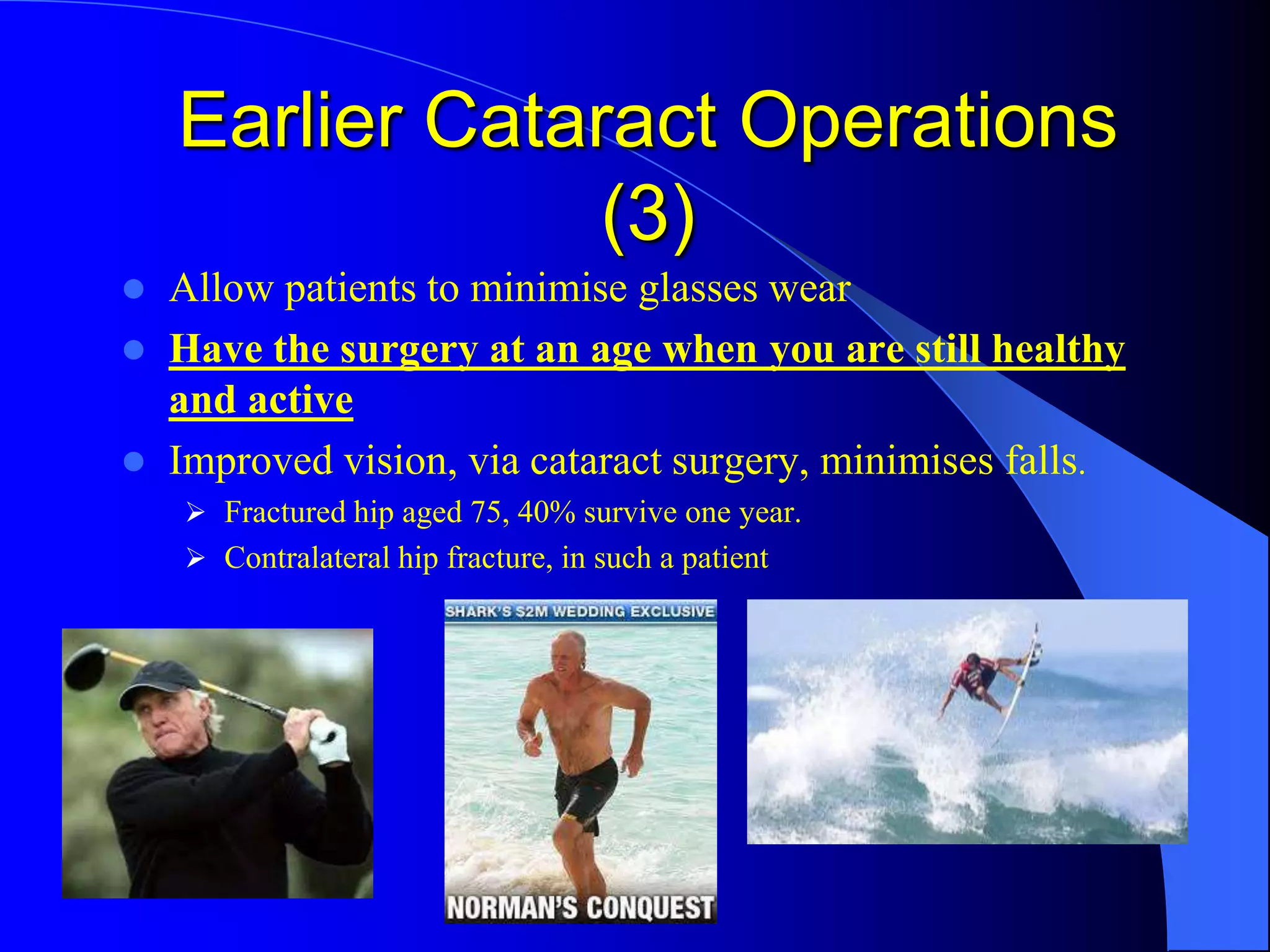
 Allow patients to minimise glasses wear
 Have the surgery at an age when you are still healthy
and active
 Improved vision, via cataract surgery, minimises falls.
 Fractured hip aged 75, 40% survive one year.
 Contralateral hip fracture, in such a patient
Earlier Cataract Operations
(4)
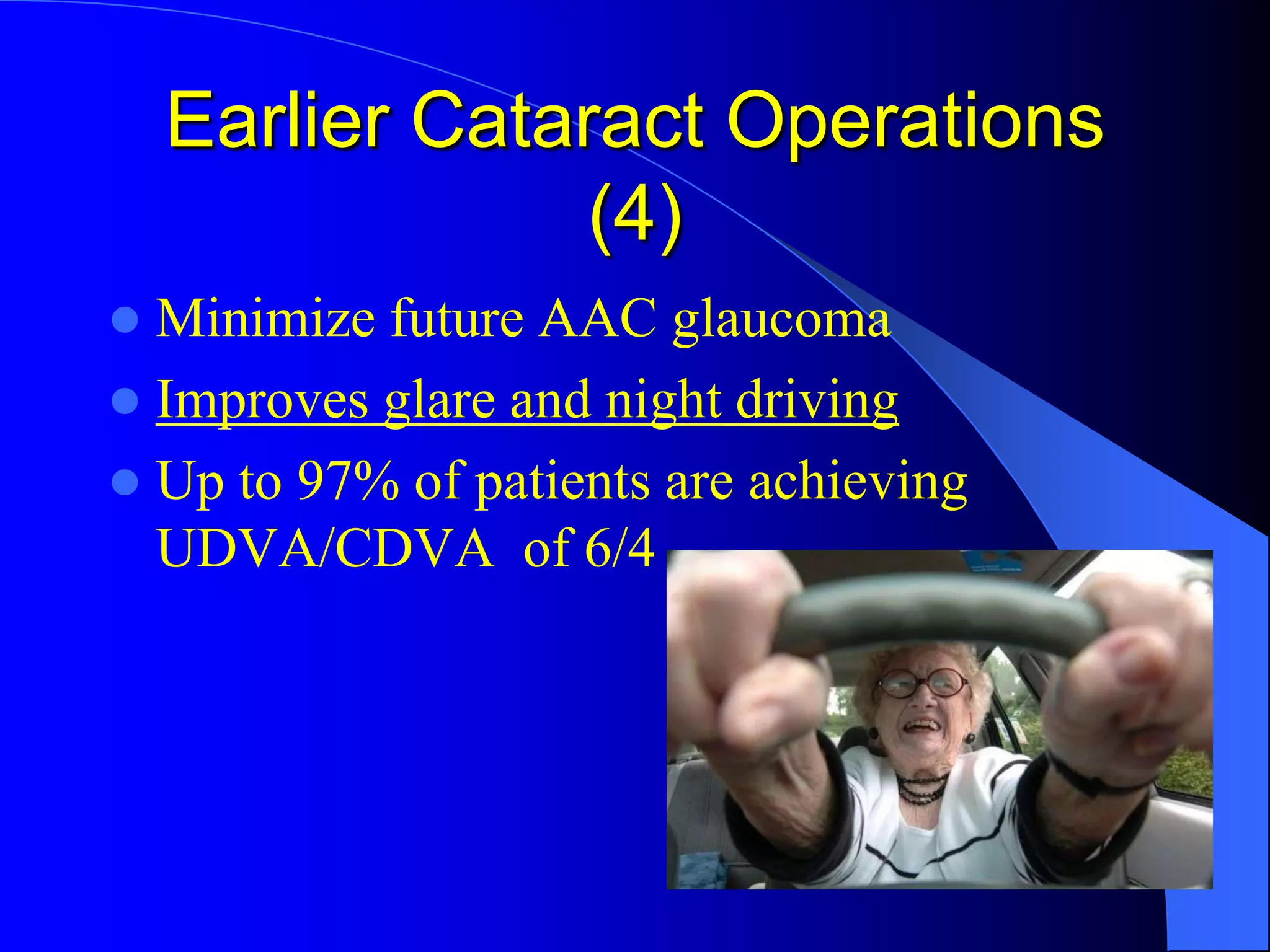
 Minimize future AAC glaucoma
 Improves glare and night driving
 Up to 97% of patients are achieving
UDVA/CDVA of 6/4
Visual Function Test- VF7
 Reading signs – traffic,street,store
 Seeing steps,stairs,or curbs
 Watching TV
 Night driving
 Reading small print
 Doing fine handiwork
 Cooking
The Unhappy Patient
 Ocular Co-morbidities
 Refractive surprises
 Astigmatism
 Amblyopia
FOCUS Autumn 2010
Pt. Expectations
 The success of refractive cataract surgery depends on
 achieving a predictable refractive outcome for defocus
 (spherical equivalent) and astigmatism.
 Refractive surprises can seriously compromise patient
satisfaction and also give rise to potential problems of
anisometropia, dominance switch in which the dominant
eye ends up with the weaker uncorrected vision and, above
all, give rise a sense of failure in patients expecting good
uncorrected visual acuity.
FOCUS – Autumn 2010
Ocular comorbidities
 Small hyperopic eyes, large myopic eyes, eyes with very
 steep or flat corneas, shallow anterior chamber depths,
 history of refractive surgery, vitrectomy, corneal ectasia,
 peripheral corneal melt syndromes and contact lens use
 (when measured without an adequate contact lens holiday)
 are at significant risk of refractive surprises. It is important
 to warn these patients of the increased risk of refractive
 surprise as part of the informed consent process and prepare
 the patients for a second stage enhancement procedure
Refractive Surprise
Refractive Cataract
Surgery
 Restore transparency of
ocular media +correct any
refractive aberrations of the
eye (ametropia,astigmatism)
 Reduce spec dependence
 QOL and economic benefits
Refractive Surprise
 Anisometropia
 Dominance switch
 Sense of failure in pts
expecting good
uncorrected va
Refractive Surprise - Sources of Error
Norrby,S. JCRS 34/3 March 2008
 IOL power calculations- SRKT, HofferQ, Haigis,HolladayII,
 Post op Effective Lens position(36%) ( Optimising IOL constant
most important factor,Anstodemon,JCRS Jan 2011)
 Error in post op refraction(27%)
 AXL Measurements(17%)
 Pupil Size(8%) – only if there is spherical aberration
 Keratometry(10%)- ant curvature with keratometer,topographers;post
curvature
 IOL Power –very small variability,(desired outcome deviation =max
0.18D)
 Other Sources of error- corneal thickness,post surface
asphericity,higher order,chromatic aberrations,change in corneal power
(Norrby,S JCRS 34/3 March 2008)
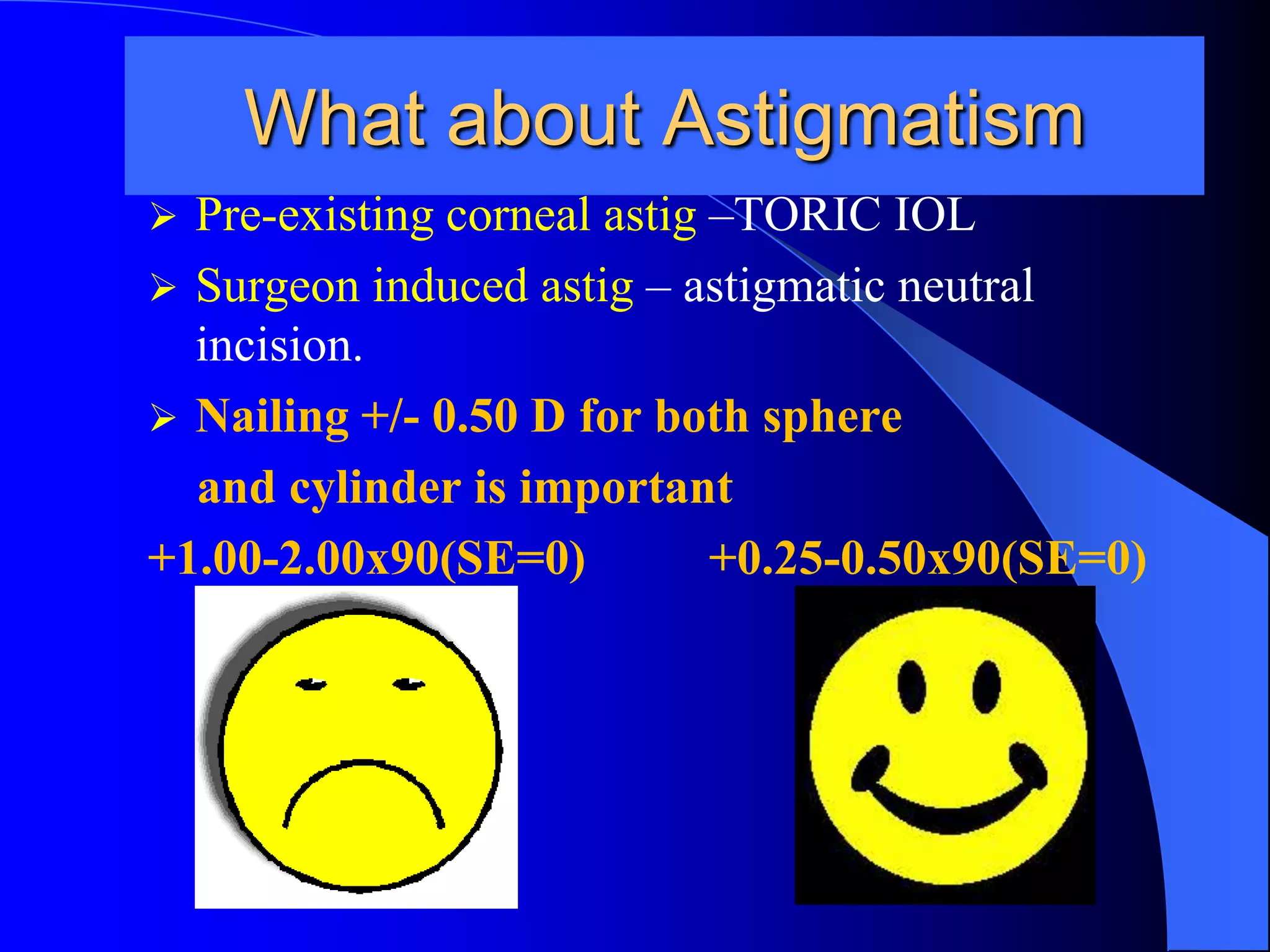
What about Astigmatism
 Pre-existing corneal astig –TORIC IOL
 Surgeon induced astig – astigmatic neutral
incision.
 Nailing +/- 0.50 D for both sphere
and cylinder is important
+1.00-2.00x90(SE=0) +0.25-0.50x90(SE=0)
Ferrer-Blasco T,Montés-Micó R,Peixoto-de-Matos SC,González-
Méijome JM,Cerviño A.Prevalence of corneal astigmatism before
cataract surgery.J Cataract Refract Surg.2009;35(1):70-75. N =
4540 eyes.
 87% of cataract surgery patients have
preoperative astigmatism
 64% of patients fall within 0.50 to 1.25
 36% of patients having greater than 1.26 D
ASTIGMATISM (contd)
 16% of all eyes had astig of 1.5D or more
 46.8% WTR(minus cyl @180) , 34.3% ATR
 Temp clear corneal incision will reduce
astig in 34% of pts but worsen for 47%
 Corneal astig did not increase with age
 Correlations -AXL,Ks,ACD,WTW-normal
and abnormal eyes – effect on effective
IOL position
TORIC IOLs- New Standard of care
Wolffsohn,JCRS,Effect of uncorrected astigmatism on
vision March 2011
 Modest amounts of astigmatism can have
major effect on vision
 Effect independence – night,rain driving
 Quality of life, well being – reading speed
 Higher risks of falls
 Worse with WTR
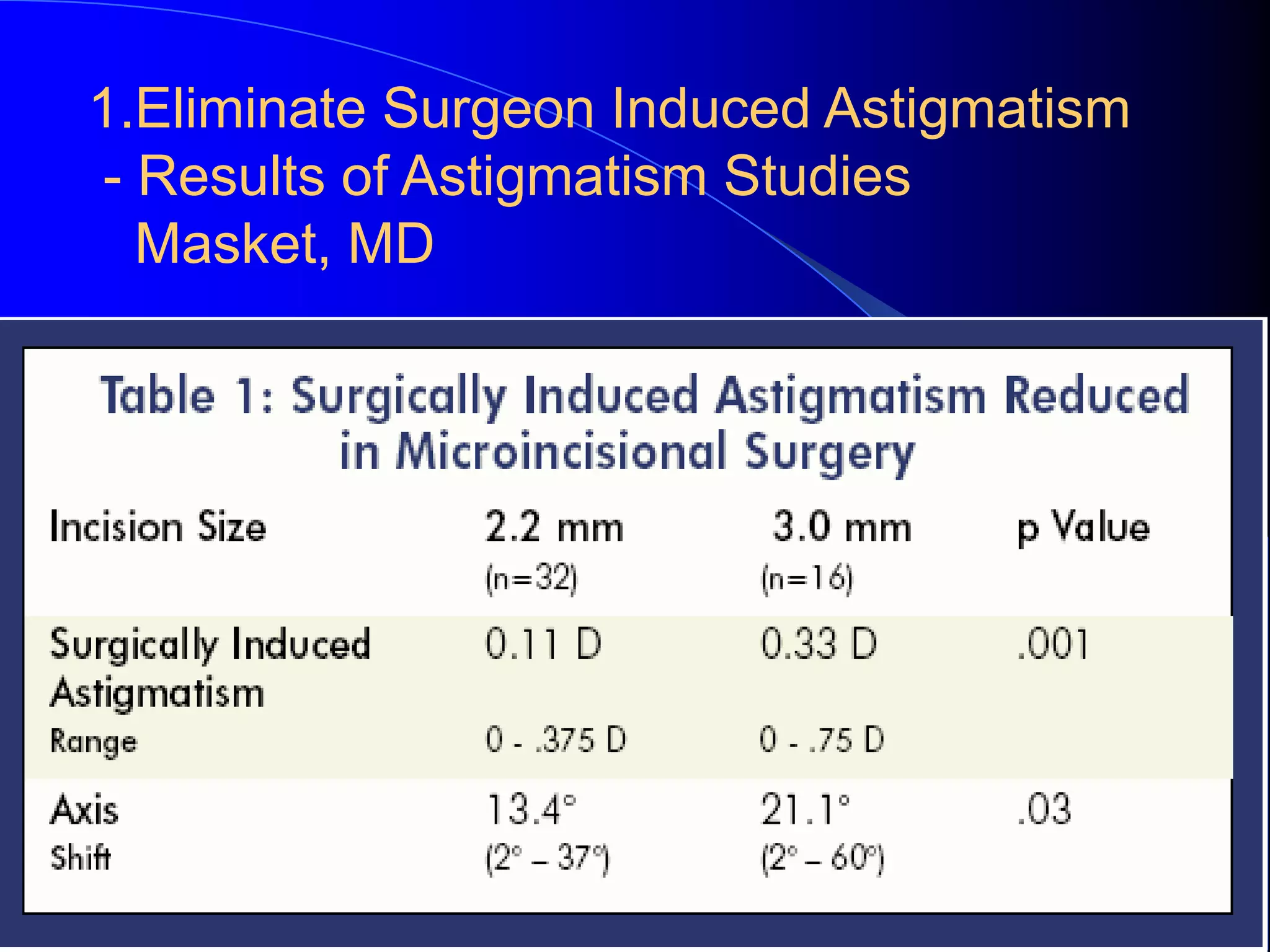
1.Eliminate Surgeon Induced Astigmatism
- Results of Astigmatism Studies
Masket, MD
Surgeon Factor
 The surgically induced astigmatic factor is usually in the
range between 0.25 and 0.50 D when a 2.2- to 2.4-mm
incision is used. Ideally, a surgeon should review the
outcomes of one’s previous 20 or more cases, comparing
preoperative keratometric measurements with
postoperative readings. Routinely reexamining one’s
surgically induced astigmatic factor to monitor for any
changes can also be beneficial.
Astigmatism
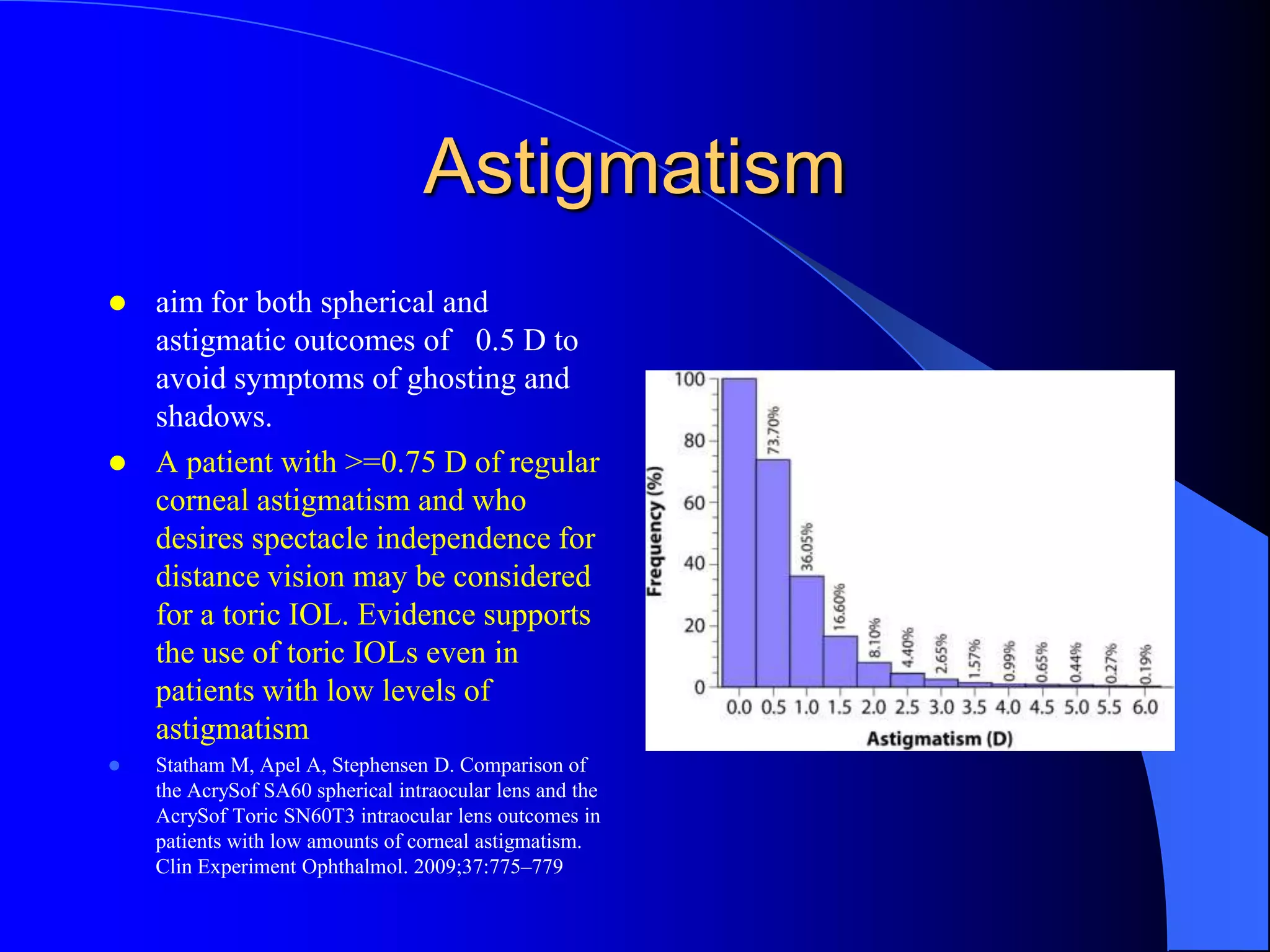
 aim for both spherical and
astigmatic outcomes of 0.5 D to
avoid symptoms of ghosting and
shadows.
 A patient with >=0.75 D of regular
corneal astigmatism and who
desires spectacle independence for
distance vision may be considered
for a toric IOL. Evidence supports
the use of toric IOLs even in
patients with low levels of
astigmatism
 Statham M, Apel A, Stephensen D. Comparison of
the AcrySof SA60 spherical intraocular lens and the
AcrySof Toric SN60T3 intraocular lens outcomes in
patients with low amounts of corneal astigmatism.
Clin Experiment Ophthalmol. 2009;37:775–779
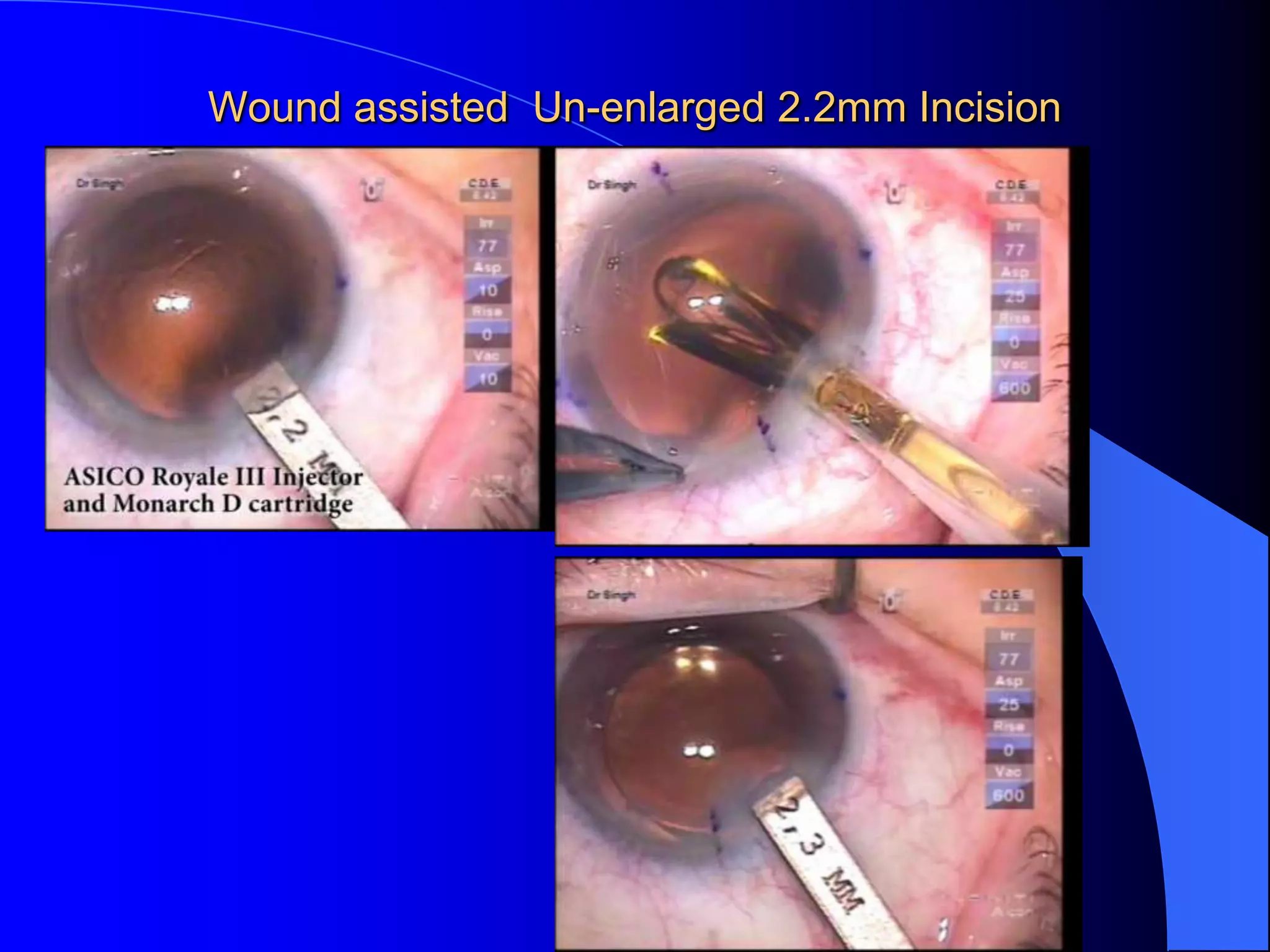
Wound assisted Un-enlarged 2.2mm Incision
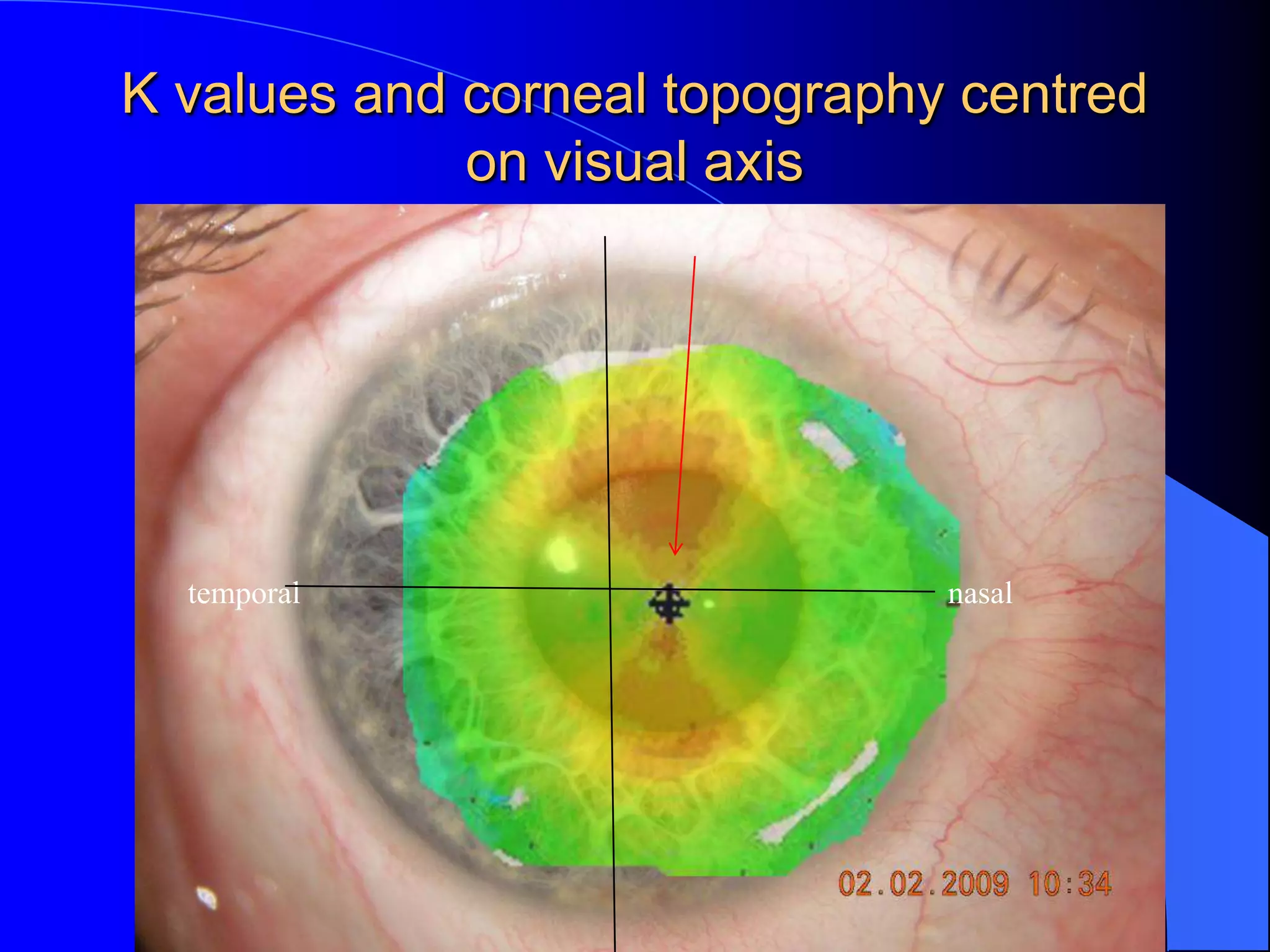
K values and corneal topography centred
on visual axis
nasaltemporal
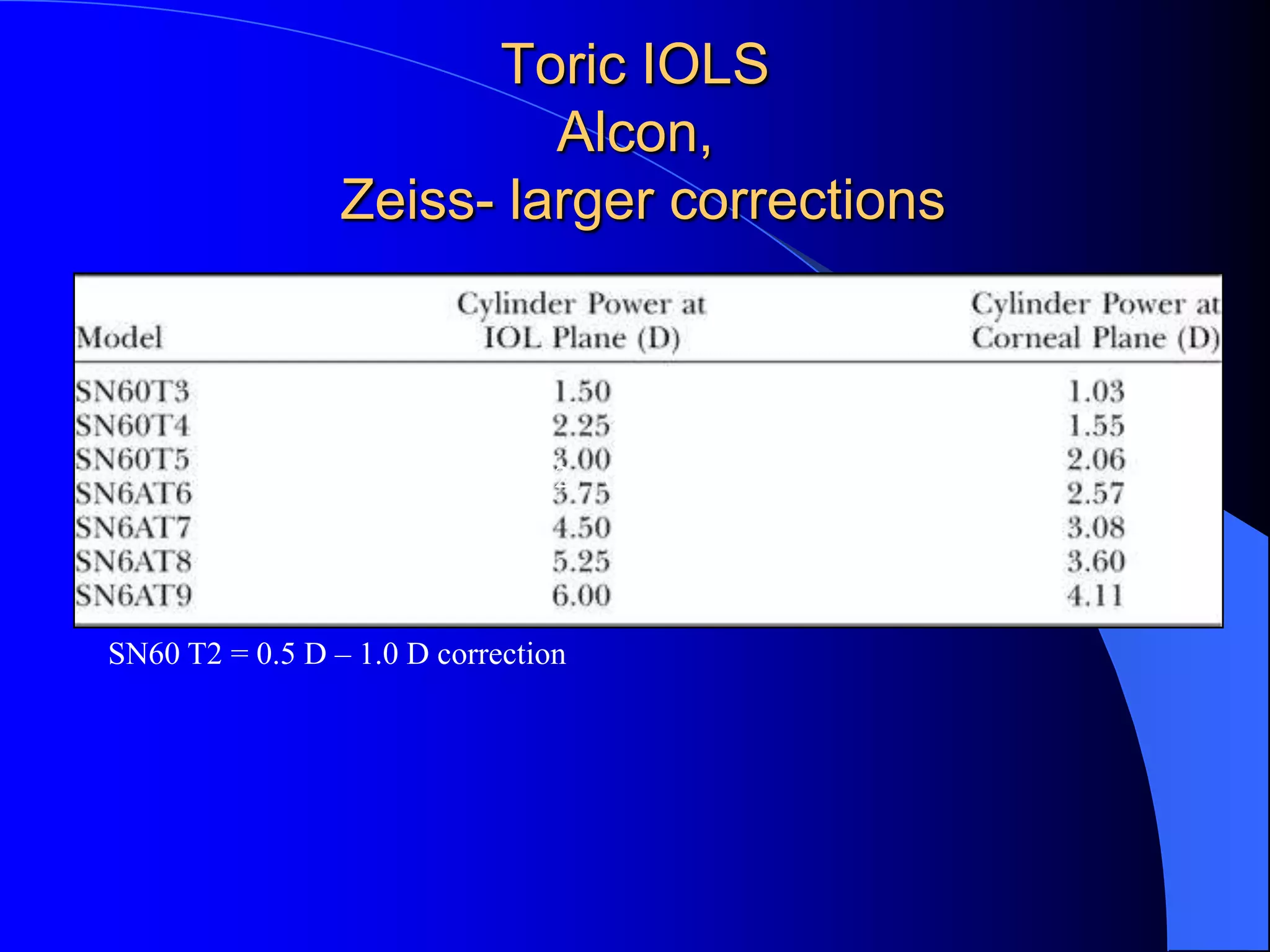
Toric IOLS
Alcon,
Zeiss- larger corrections
SN60 T2 = 0.5 D correction
SN60 T2 = 0.5 D – 1.0 D correction
Toric IOLs
 2.2mm incision at mark
 5-5.5mm CCC
 Cohesive viscoelastic (provisc) for easy and
complete removal from behind IOL
 Precise alighnment using I/A tip
 start 10-20 shy of markings
Other Factors affecting postop astig-
IOL Tilt and Shift
 Small rhexis- hyperopic shift
 Post capsule debris (viscoelastic) and
fibrotic bands-myopic shift and cyl
 Irregular rhexis
 One loop in bag only
Toric IOLS
(140 eyes )
 Stable IOL in the bag
 After 1yr.- 100% within 10*
96% within 5*
 Markings can be 5* off
 > 10* from axis reduces effect by 1/3
 > 30* from axis causes increased astig
Toric IOLs-Pre Op Prep
 Accurate Ks and Axl
 Contact Lens wearers - 1-3 weeks
 Measure undisturbed corneas
 Get pt to blink often whilst measuring Ks
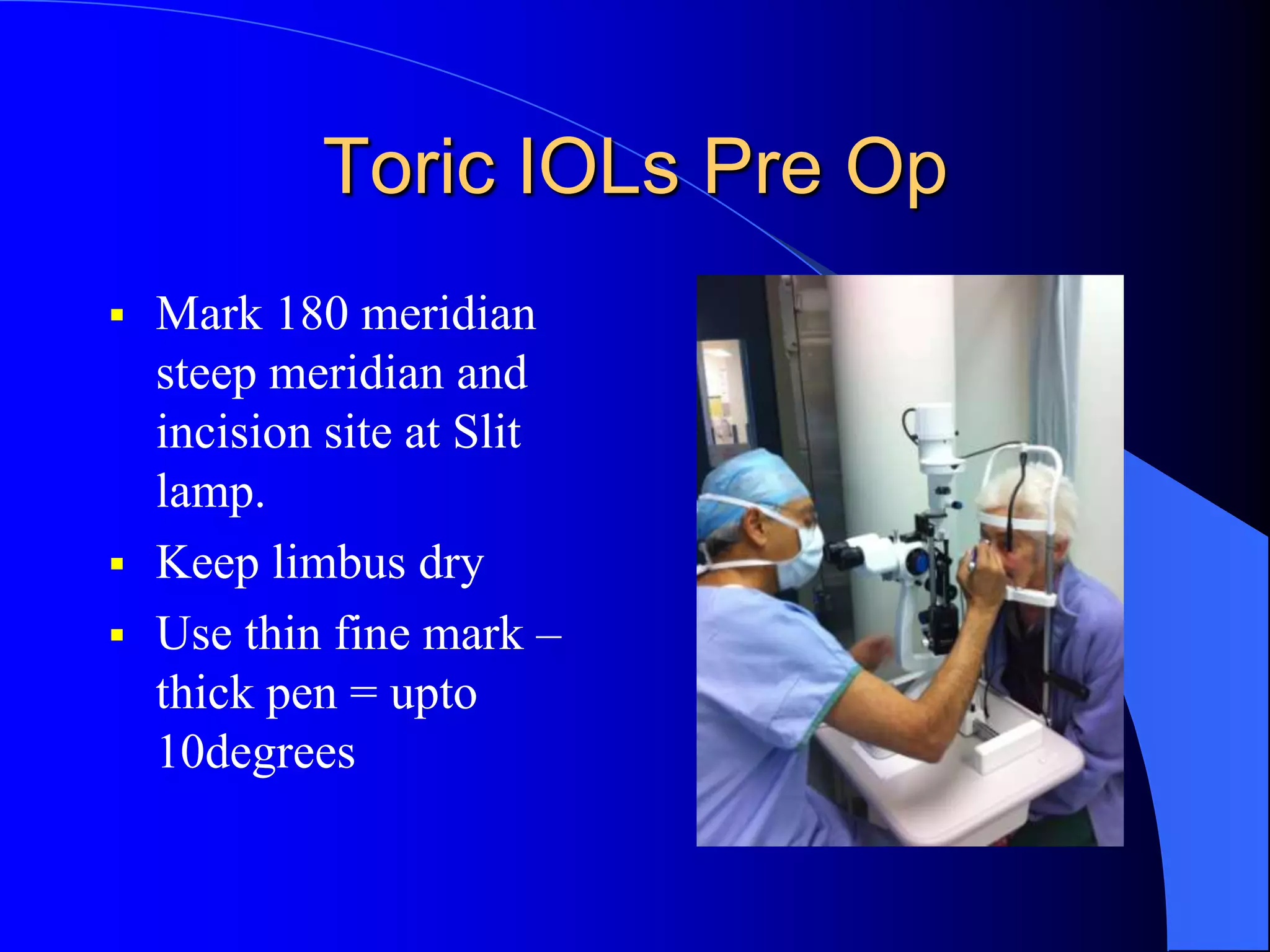
Toric IOLs Pre Op
 Mark 180 meridian
steep meridian and
incision site at Slit
lamp.
 Keep limbus dry
 Use thin fine mark –
thick pen = upto
10degrees
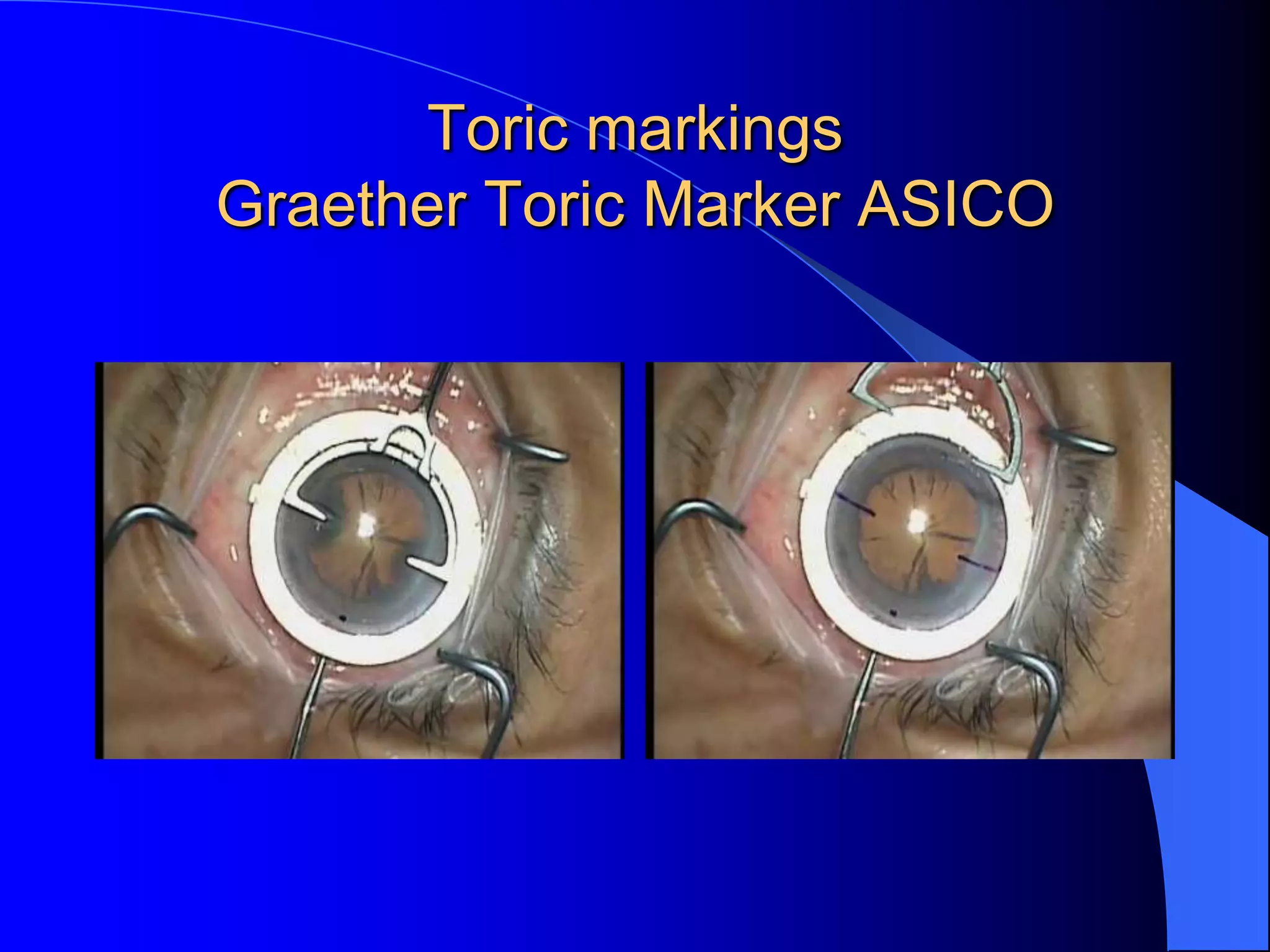
Toric markings
Graether Toric Marker ASICO
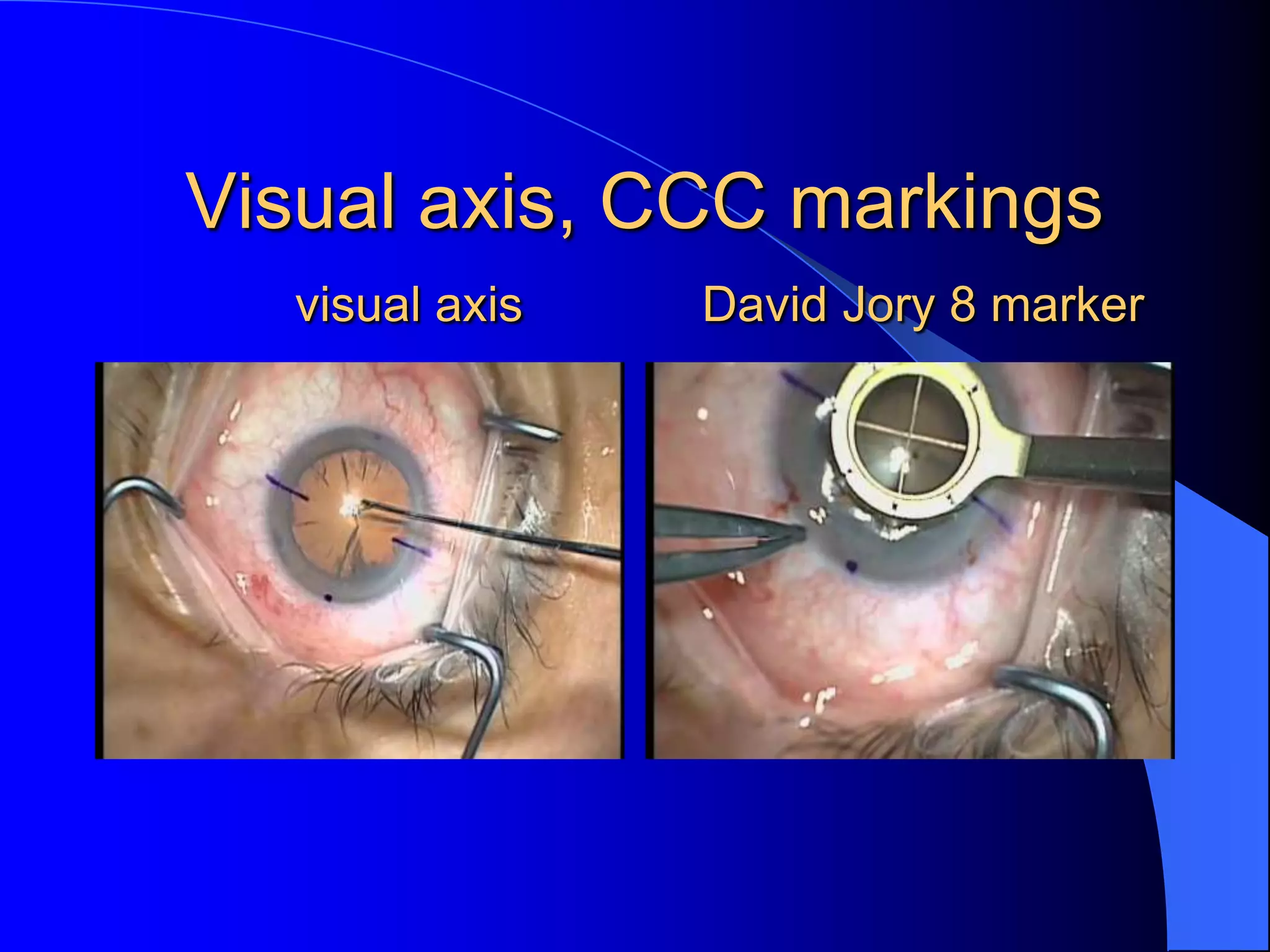
Visual axis, CCC markings
visual axis David Jory 8 marker
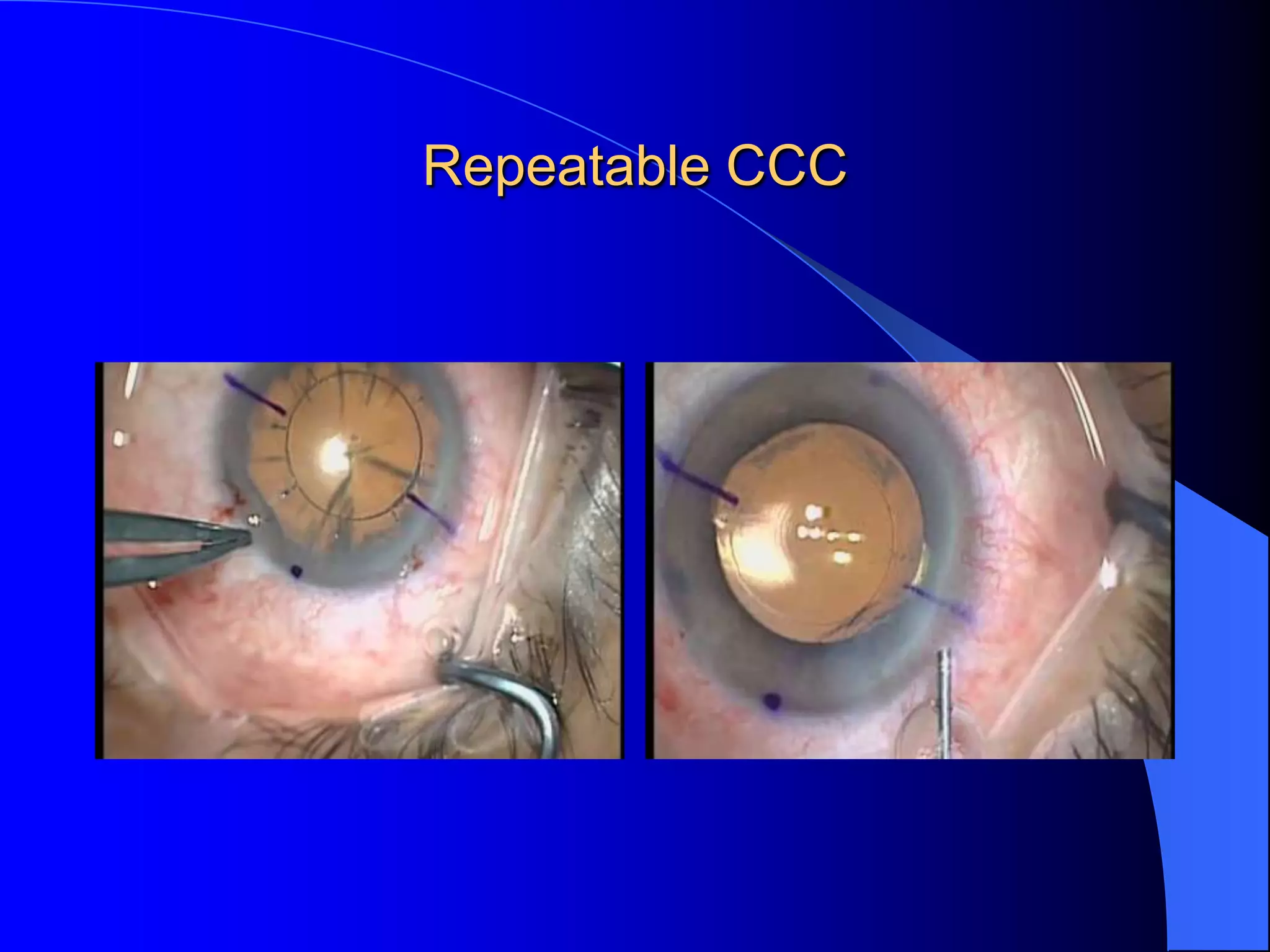
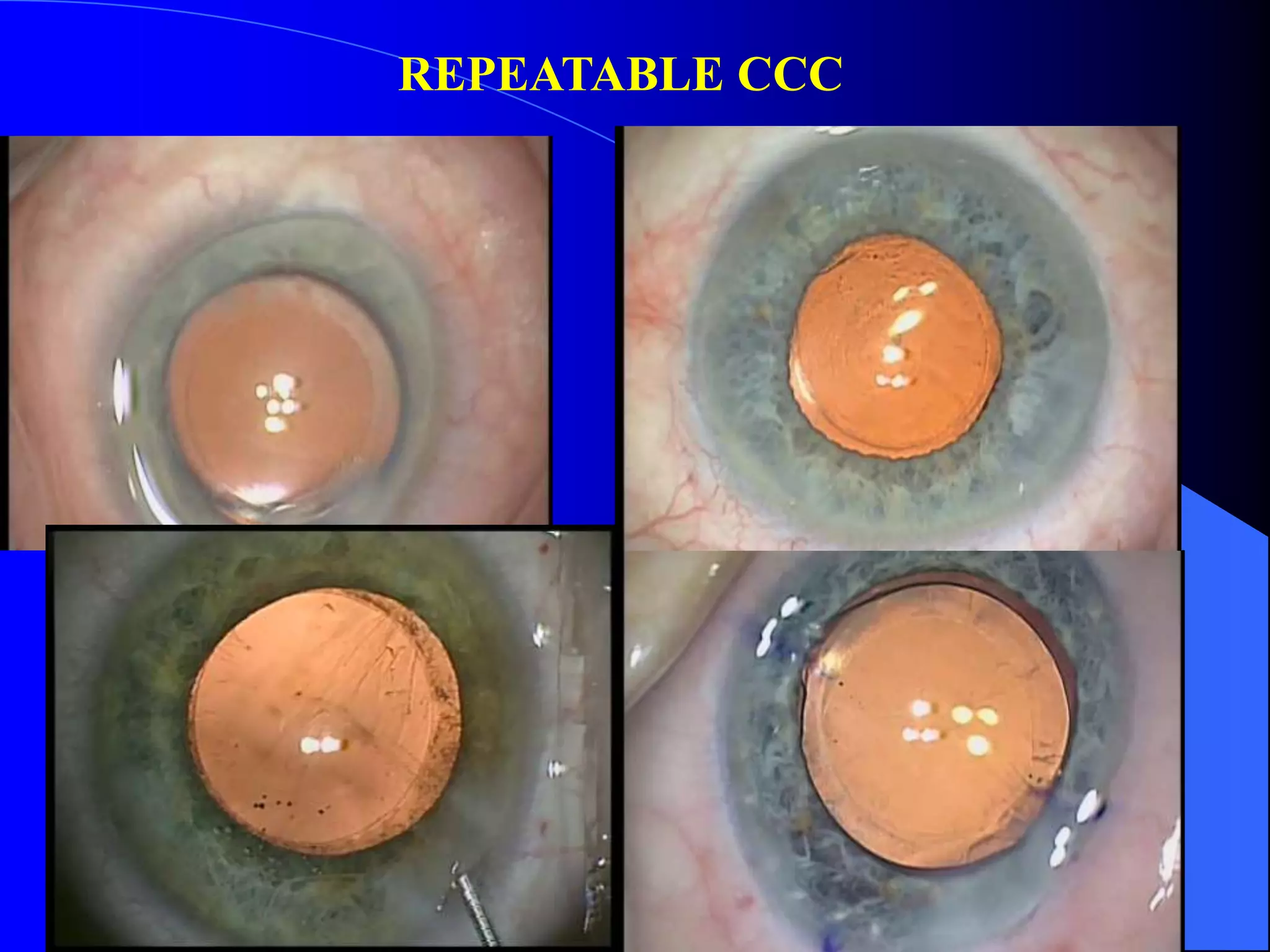
Repeatable CCC
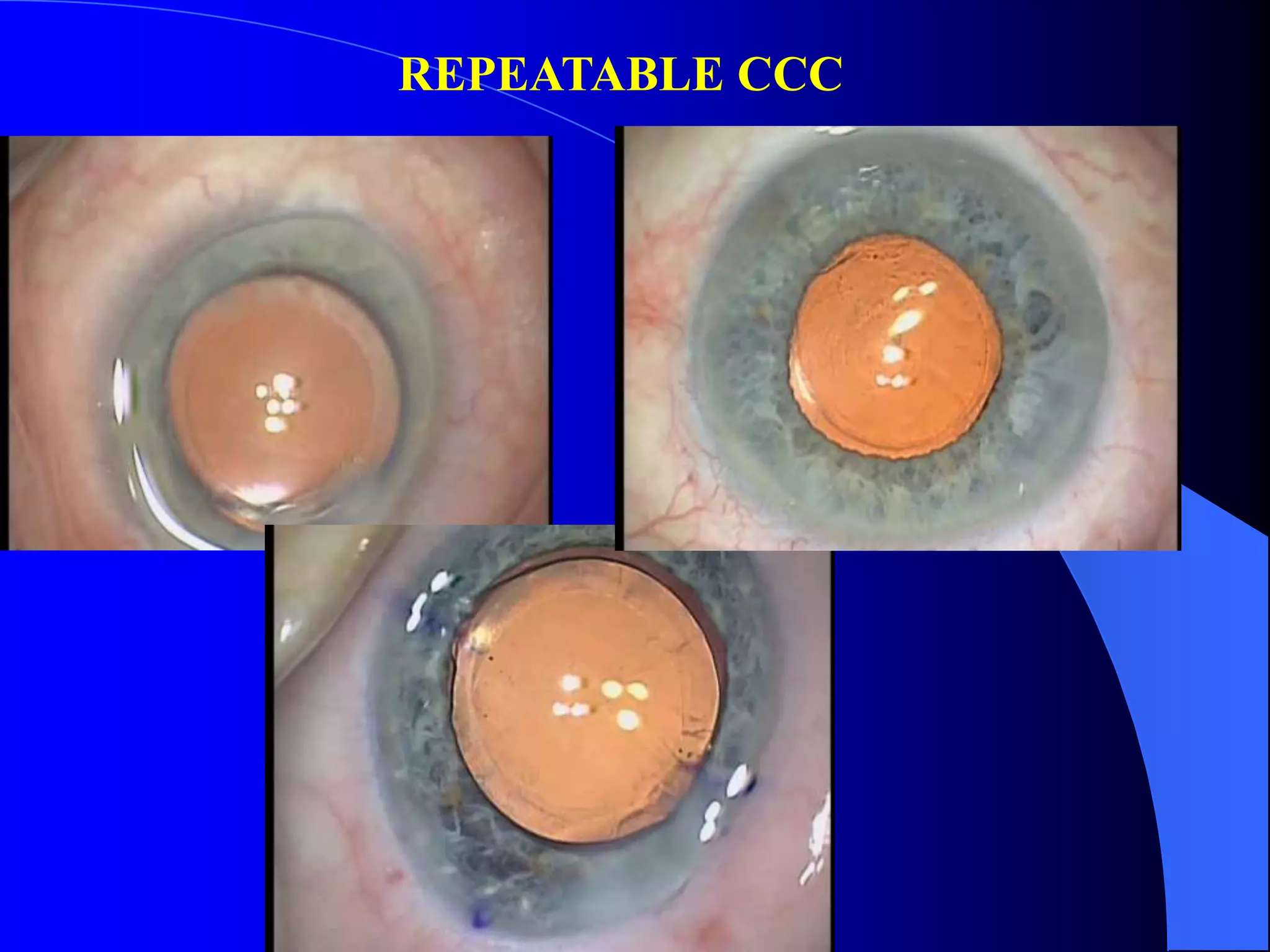
REPEATABLE CCC
REPEATABLE CCC
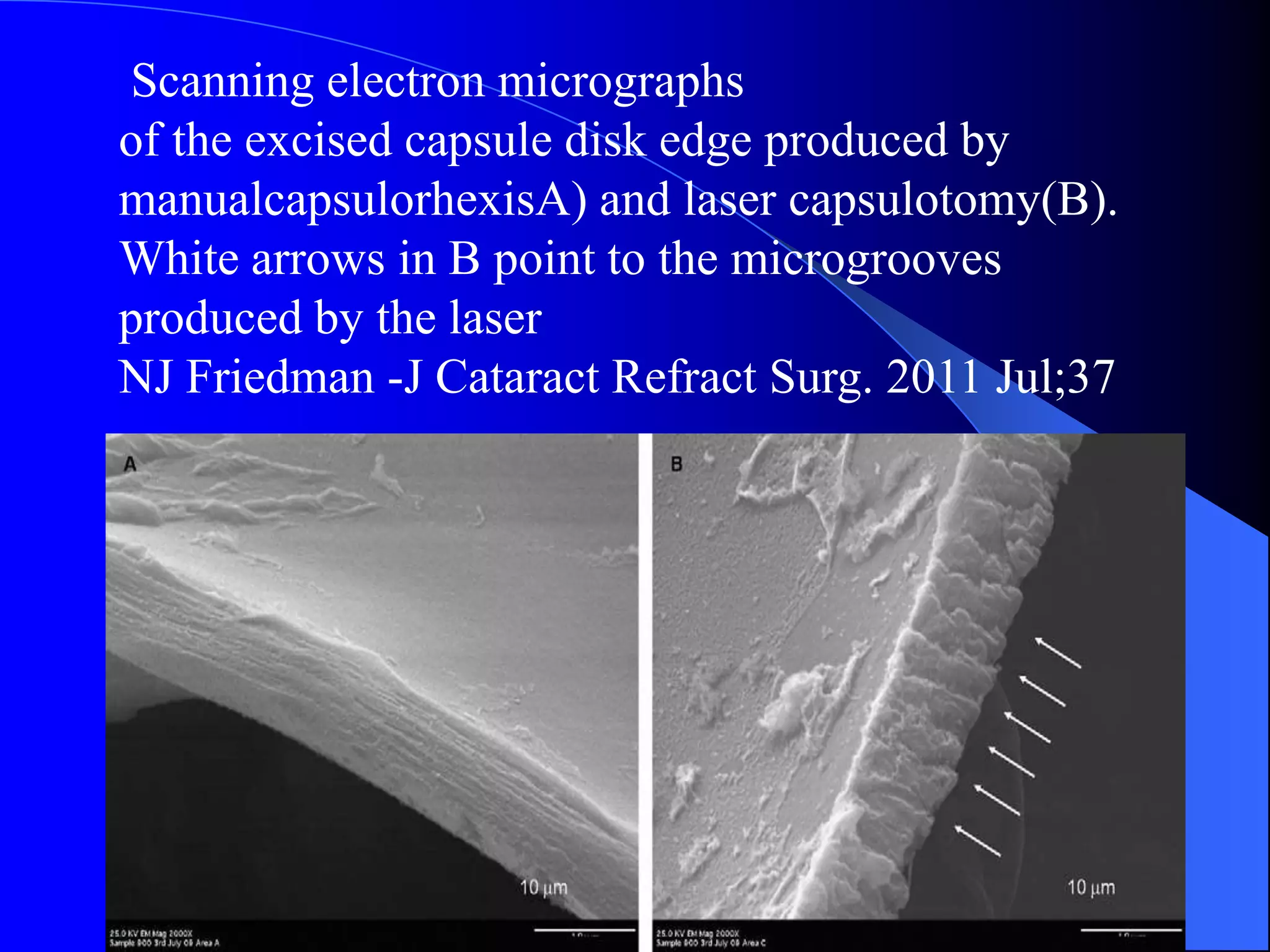
Scanning electron micrographs
of the excised capsule disk edge produced by
manualcapsulorhexisA) and laser capsulotomy(B).
White arrows in B point to the microgrooves
produced by the laser
NJ Friedman -J Cataract Refract Surg. 2011 Jul;37
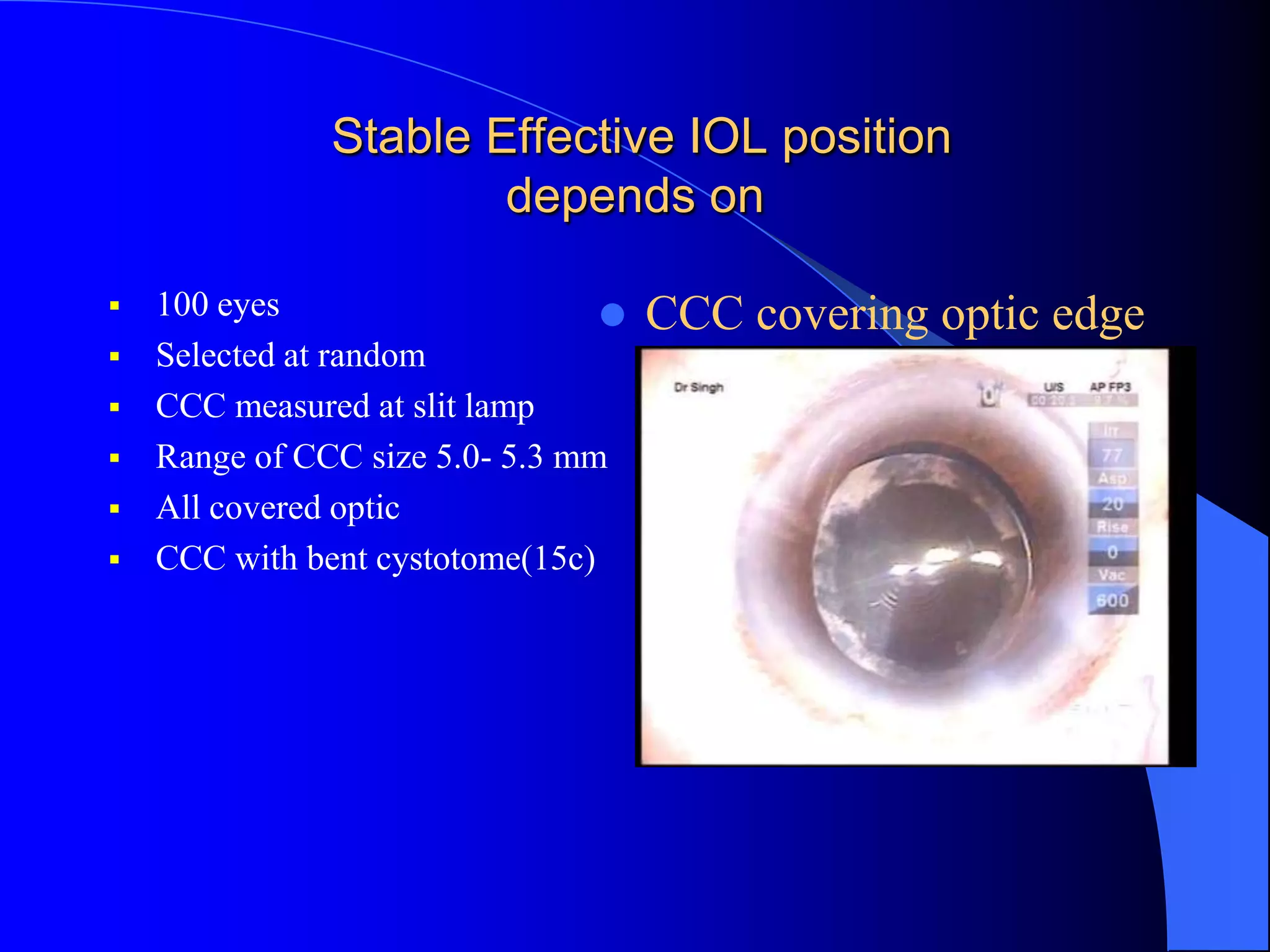
Stable Effective IOL position
depends on
 100 eyes
 Selected at random
 CCC measured at slit lamp
 Range of CCC size 5.0- 5.3 mm
 All covered optic
 CCC with bent cystotome(15c)
 CCC covering optic edge
Toric IOLS
(140 eyes )
 Stable IOL in the bag
 After 1yr.- 100% within 10*
96% within 5*
 Markings can be 5* off
 > 10* from axis reduces effect by 1/3
 > 30* from axis causes increased astig
Refractive cataract surgery
 1.astigmatism can be corrected
 2.repeatable sized CCC = stable effective
lens position
 3.small astig neutral incision
 1 + 2 + 3 = predictable stable refrective
outcome.
 BUT WHAT ABOUT NEAR VISION ?
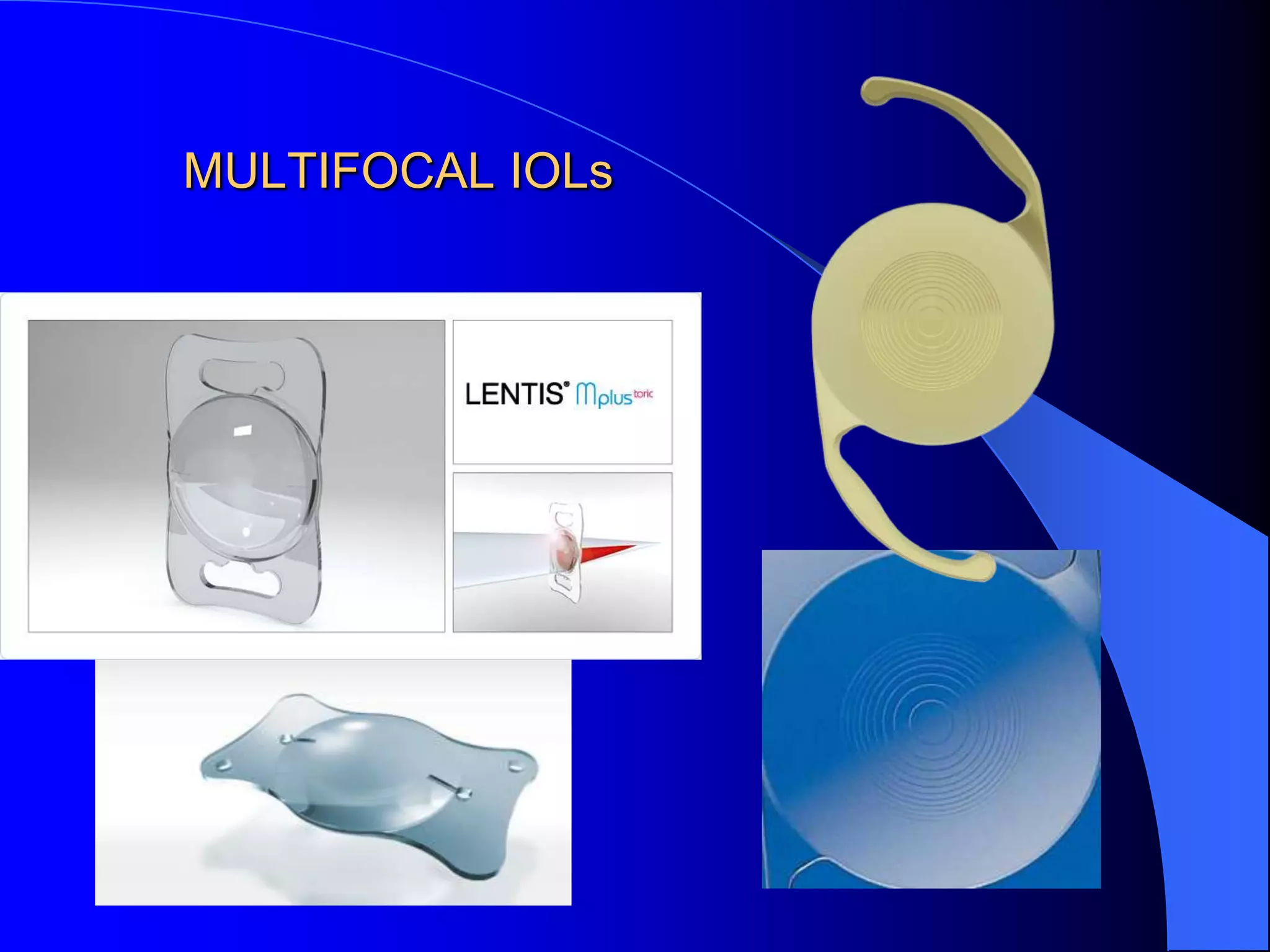
MULTIFOCAL IOLs
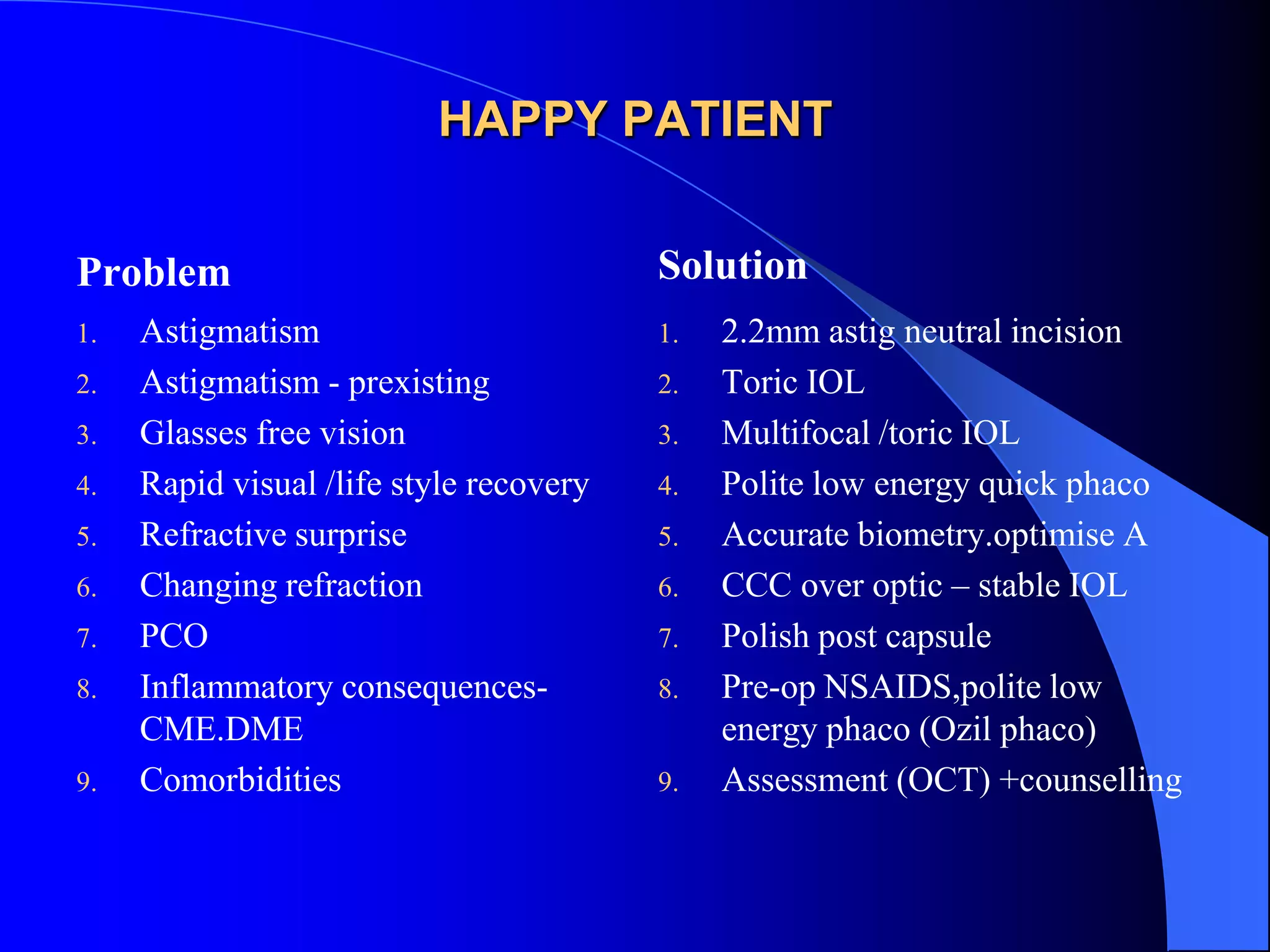
HAPPY PATIENT
Problem
1. Astigmatism
2. Astigmatism - prexisting
3. Glasses free vision
4. Rapid visual /life style recovery
5. Refractive surprise
6. Changing refraction
7. PCO
8. Inflammatory consequences-
CME.DME
9. Comorbidities
Solution
1. 2.2mm astig neutral incision
2. Toric IOL
3. Multifocal /toric IOL
4. Polite low energy quick phaco
5. Accurate biometry.optimise A
6. CCC over optic – stable IOL
7. Polish post capsule
8. Pre-op NSAIDS,polite low
energy phaco (Ozil phaco)
9. Assessment (OCT) +counselling
End Points for
Successful Cataract Surgery
=quality of vision
 High contrast va maintained long term
Aspheric IOL
 Residual refraction defecit = 0.50 for both
SE and astig – Aspheric Toric and
Multifocal Toric

Premier IOL choices-Technique & Decision Making

  • 1.
    Premier IOL choices Technique& Decision Making or earlier cataract surgery or do we really need femtosec laser cataract surgery Dr. Inderjit Singh FRCS(E)., FRCOphth., FRANZCO Chatswood , Sydney
  • 2.
    Aim of moderncataract Surgery Royal College of Ophthalmologists  Restoration of vision  Achievement of desired refractive outcome  Improvement QOL  Ensuring safety and satisfaction  A VA is not mentioned  Meticulous pre-op;intra-op;post op mng
  • 3.
    Earlier Cataract Operations (1) Outcomes in small incision is more predictable  Glasses free vision-Toric and Multifocal IOLs  Safer operation because of smaller incisions  Meet the visual demands that patient expects  Short recovery period
  • 4.
    Earlier Cataract Operations (2) Surgery should be performed for symptoms rather than a number on a vision chart – Influenced by a variety of cataracts
  • 5.
    Earlier Cataract Operations (3) Allow patients to minimise glasses wear  Have the surgery at an age when you are still healthy and active  Improved vision, via cataract surgery, minimises falls.  Fractured hip aged 75, 40% survive one year.  Contralateral hip fracture, in such a patient
  • 6.
    Earlier Cataract Operations (4) Minimize future AAC glaucoma  Improves glare and night driving  Up to 97% of patients are achieving UDVA/CDVA of 6/4
  • 8.
    Visual Function Test-VF7  Reading signs – traffic,street,store  Seeing steps,stairs,or curbs  Watching TV  Night driving  Reading small print  Doing fine handiwork  Cooking
  • 9.
    The Unhappy Patient Ocular Co-morbidities  Refractive surprises  Astigmatism  Amblyopia
  • 10.
    FOCUS Autumn 2010 Pt.Expectations  The success of refractive cataract surgery depends on  achieving a predictable refractive outcome for defocus  (spherical equivalent) and astigmatism.  Refractive surprises can seriously compromise patient satisfaction and also give rise to potential problems of anisometropia, dominance switch in which the dominant eye ends up with the weaker uncorrected vision and, above all, give rise a sense of failure in patients expecting good uncorrected visual acuity.
  • 11.
    FOCUS – Autumn2010 Ocular comorbidities  Small hyperopic eyes, large myopic eyes, eyes with very  steep or flat corneas, shallow anterior chamber depths,  history of refractive surgery, vitrectomy, corneal ectasia,  peripheral corneal melt syndromes and contact lens use  (when measured without an adequate contact lens holiday)  are at significant risk of refractive surprises. It is important  to warn these patients of the increased risk of refractive  surprise as part of the informed consent process and prepare  the patients for a second stage enhancement procedure
  • 12.
    Refractive Surprise Refractive Cataract Surgery Restore transparency of ocular media +correct any refractive aberrations of the eye (ametropia,astigmatism)  Reduce spec dependence  QOL and economic benefits Refractive Surprise  Anisometropia  Dominance switch  Sense of failure in pts expecting good uncorrected va
  • 13.
    Refractive Surprise -Sources of Error Norrby,S. JCRS 34/3 March 2008  IOL power calculations- SRKT, HofferQ, Haigis,HolladayII,  Post op Effective Lens position(36%) ( Optimising IOL constant most important factor,Anstodemon,JCRS Jan 2011)  Error in post op refraction(27%)  AXL Measurements(17%)  Pupil Size(8%) – only if there is spherical aberration  Keratometry(10%)- ant curvature with keratometer,topographers;post curvature  IOL Power –very small variability,(desired outcome deviation =max 0.18D)  Other Sources of error- corneal thickness,post surface asphericity,higher order,chromatic aberrations,change in corneal power (Norrby,S JCRS 34/3 March 2008)
  • 14.
    What about Astigmatism Pre-existing corneal astig –TORIC IOL  Surgeon induced astig – astigmatic neutral incision.  Nailing +/- 0.50 D for both sphere and cylinder is important +1.00-2.00x90(SE=0) +0.25-0.50x90(SE=0)
  • 15.
    Ferrer-Blasco T,Montés-Micó R,Peixoto-de-MatosSC,González- Méijome JM,Cerviño A.Prevalence of corneal astigmatism before cataract surgery.J Cataract Refract Surg.2009;35(1):70-75. N = 4540 eyes.  87% of cataract surgery patients have preoperative astigmatism  64% of patients fall within 0.50 to 1.25  36% of patients having greater than 1.26 D
  • 16.
    ASTIGMATISM (contd)  16%of all eyes had astig of 1.5D or more  46.8% WTR(minus cyl @180) , 34.3% ATR  Temp clear corneal incision will reduce astig in 34% of pts but worsen for 47%  Corneal astig did not increase with age  Correlations -AXL,Ks,ACD,WTW-normal and abnormal eyes – effect on effective IOL position
  • 17.
    TORIC IOLs- NewStandard of care Wolffsohn,JCRS,Effect of uncorrected astigmatism on vision March 2011  Modest amounts of astigmatism can have major effect on vision  Effect independence – night,rain driving  Quality of life, well being – reading speed  Higher risks of falls  Worse with WTR
  • 18.
    1.Eliminate Surgeon InducedAstigmatism - Results of Astigmatism Studies Masket, MD
  • 19.
    Surgeon Factor  Thesurgically induced astigmatic factor is usually in the range between 0.25 and 0.50 D when a 2.2- to 2.4-mm incision is used. Ideally, a surgeon should review the outcomes of one’s previous 20 or more cases, comparing preoperative keratometric measurements with postoperative readings. Routinely reexamining one’s surgically induced astigmatic factor to monitor for any changes can also be beneficial.
  • 20.
    Astigmatism  aim forboth spherical and astigmatic outcomes of 0.5 D to avoid symptoms of ghosting and shadows.  A patient with >=0.75 D of regular corneal astigmatism and who desires spectacle independence for distance vision may be considered for a toric IOL. Evidence supports the use of toric IOLs even in patients with low levels of astigmatism  Statham M, Apel A, Stephensen D. Comparison of the AcrySof SA60 spherical intraocular lens and the AcrySof Toric SN60T3 intraocular lens outcomes in patients with low amounts of corneal astigmatism. Clin Experiment Ophthalmol. 2009;37:775–779
  • 21.
  • 22.
    K values andcorneal topography centred on visual axis nasaltemporal
  • 23.
    Toric IOLS Alcon, Zeiss- largercorrections SN60 T2 = 0.5 D correction SN60 T2 = 0.5 D – 1.0 D correction
  • 24.
    Toric IOLs  2.2mmincision at mark  5-5.5mm CCC  Cohesive viscoelastic (provisc) for easy and complete removal from behind IOL  Precise alighnment using I/A tip  start 10-20 shy of markings
  • 25.
    Other Factors affectingpostop astig- IOL Tilt and Shift  Small rhexis- hyperopic shift  Post capsule debris (viscoelastic) and fibrotic bands-myopic shift and cyl  Irregular rhexis  One loop in bag only
  • 26.
    Toric IOLS (140 eyes)  Stable IOL in the bag  After 1yr.- 100% within 10* 96% within 5*  Markings can be 5* off  > 10* from axis reduces effect by 1/3  > 30* from axis causes increased astig
  • 27.
    Toric IOLs-Pre OpPrep  Accurate Ks and Axl  Contact Lens wearers - 1-3 weeks  Measure undisturbed corneas  Get pt to blink often whilst measuring Ks
  • 28.
    Toric IOLs PreOp  Mark 180 meridian steep meridian and incision site at Slit lamp.  Keep limbus dry  Use thin fine mark – thick pen = upto 10degrees
  • 29.
  • 30.
    Visual axis, CCCmarkings visual axis David Jory 8 marker
  • 31.
  • 32.
  • 33.
  • 34.
    Scanning electron micrographs ofthe excised capsule disk edge produced by manualcapsulorhexisA) and laser capsulotomy(B). White arrows in B point to the microgrooves produced by the laser NJ Friedman -J Cataract Refract Surg. 2011 Jul;37
  • 35.
    Stable Effective IOLposition depends on  100 eyes  Selected at random  CCC measured at slit lamp  Range of CCC size 5.0- 5.3 mm  All covered optic  CCC with bent cystotome(15c)  CCC covering optic edge
  • 36.
    Toric IOLS (140 eyes)  Stable IOL in the bag  After 1yr.- 100% within 10* 96% within 5*  Markings can be 5* off  > 10* from axis reduces effect by 1/3  > 30* from axis causes increased astig
  • 37.
    Refractive cataract surgery 1.astigmatism can be corrected  2.repeatable sized CCC = stable effective lens position  3.small astig neutral incision  1 + 2 + 3 = predictable stable refrective outcome.  BUT WHAT ABOUT NEAR VISION ?
  • 38.
  • 39.
    HAPPY PATIENT Problem 1. Astigmatism 2.Astigmatism - prexisting 3. Glasses free vision 4. Rapid visual /life style recovery 5. Refractive surprise 6. Changing refraction 7. PCO 8. Inflammatory consequences- CME.DME 9. Comorbidities Solution 1. 2.2mm astig neutral incision 2. Toric IOL 3. Multifocal /toric IOL 4. Polite low energy quick phaco 5. Accurate biometry.optimise A 6. CCC over optic – stable IOL 7. Polish post capsule 8. Pre-op NSAIDS,polite low energy phaco (Ozil phaco) 9. Assessment (OCT) +counselling
  • 40.
    End Points for SuccessfulCataract Surgery =quality of vision  High contrast va maintained long term Aspheric IOL  Residual refraction defecit = 0.50 for both SE and astig – Aspheric Toric and Multifocal Toric