
Kristopher R. Maday, MS, PA-C, CNSC
University of Alabama at Birmingham
Department of Nutritional Sciences
Surgical Physician Assistant Program
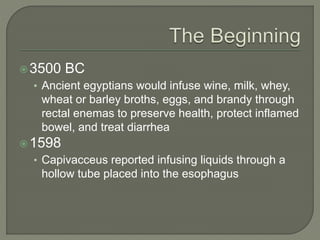
3500 BC
• Ancient egyptians would infuse wine, milk, whey,
wheat or barley broths, eggs, and brandy through
rectal enemas to preserve health, protect inflamed
bowel, and treat diarrhea
1598
• Capivacceus reported infusing liquids through a
hollow tube placed into the esophagus
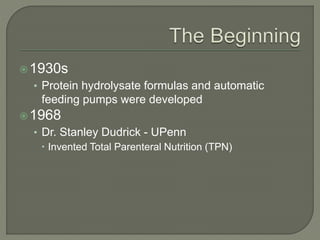
1930s
• Protein hydrolysate formulas and automatic
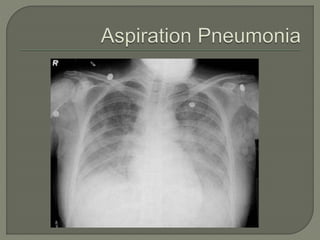
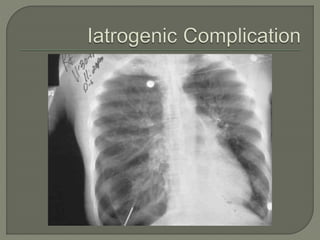
feeding pumps were developed
1968
• Dr. Stanley Dudrick - UPenn
 Invented Total Parenteral Nutrition (TPN)
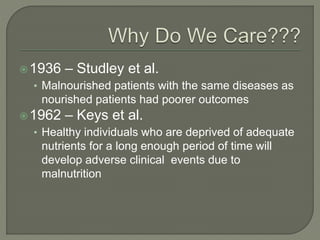
1936 – Studley et al.
• Malnourished patients with the same diseases as
nourished patients had poorer outcomes
1962 – Keys et al.
• Healthy individuals who are deprived of adequate
nutrients for a long enough period of time will
develop adverse clinical events due to
malnutrition
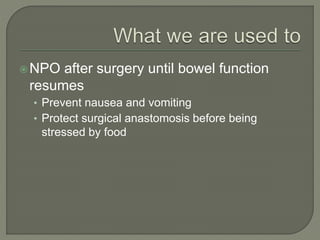
NPO after surgery until bowel function
resumes
• Prevent nausea and vomiting
• Protect surgical anastomosis before being
stressed by food
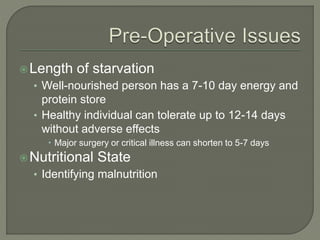
Length of starvation
• Well-nourished person has a 7-10 day energy and
protein store
• Healthy individual can tolerate up to 12-14 days
without adverse effects
 Major surgery or critical illness can shorten to 5-7 days
Nutritional State
• Identifying malnutrition
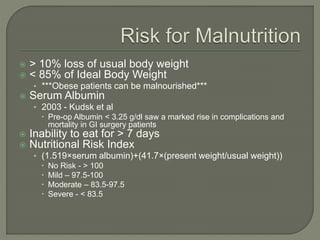
 > 10% loss of usual body weight
 < 85% of Ideal Body Weight
• ***Obese patients can be malnourished***
 Serum Albumin
• 2003 - Kudsk et al
 Pre-op Albumin < 3.25 g/dl saw a marked rise in complications and
mortality in GI surgery patients
 Inability to eat for > 7 days
 Nutritional Risk Index
• (1.519×serum albumin)+(41.7×(present weight/usual weight))
 No Risk - > 100
 Mild – 97.5-100
 Moderate – 83.5-97.5
 Severe - < 83.5
 Acute Phase Proteins
• Albumin and Prealbumin
 Energy Needs
• Harris Benedict, Ireton-Jones, Indirect Calorimetry,
22-25kcal/kg
• Permissive Underfeeding
 50-70% of caloric goals
 ***only need 400kcal to needing for “protein sparing”***
 Indirect Calorimetry
 Protein Needs
• 0.5-2 g/kg
• 24hr Urine Urea Nitrogen collection
 Nitrogen Balance
Provide support consistent with the
patients medical condition and nutritional
status
Prevent or treat macronutrient and
micronutrient deficiencies
Provide doses of nutrients compatible with
existing metabolism
Avoid complications related to dietary
delivery
Improve patient outcome
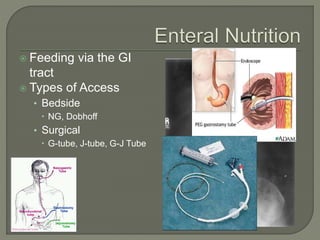
 Feeding via the GI
tract
 Types of Access
• Bedside
 NG, Dobhoff
• Surgical
 G-tube, J-tube, G-J Tube
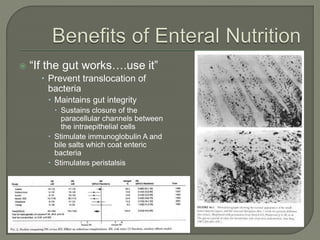
 “If the gut works….use it”
 Prevent translocation of
bacteria
 Maintains gut integrity
 Sustains closure of the
paracellular channels between
the intraepithelial cells
 Stimulate immunoglobulin A and
bile salts which coat enteric
bacteria
 Stimulates peristalsis
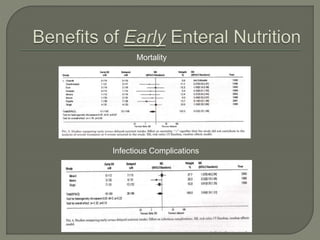
Infectious Complications
Mortality
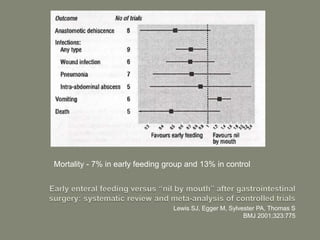
Lewis SJ, Egger M, Sylvester PA, Thomas S
BMJ 2001;323:775
Mortality - 7% in early feeding group and 13% in control
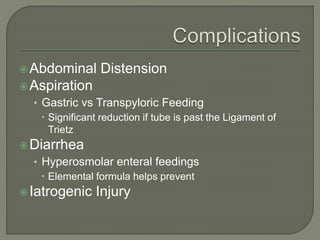
Abdominal Distension
Aspiration
• Gastric vs Transpyloric Feeding
 Significant reduction if tube is past the Ligament of
Trietz
Diarrhea
• Hyperosmolar enteral feedings
 Elemental formula helps prevent
Iatrogenic Injury
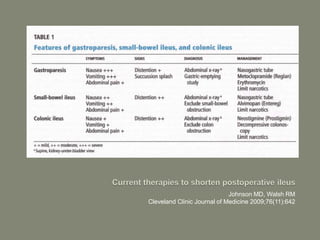
Johnson MD, Walsh RM
Cleveland Clinic Journal of Medicine 2009;76(11):642
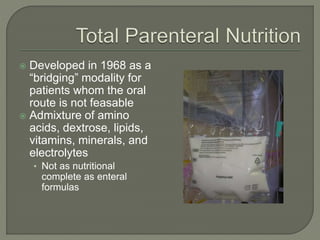
 Developed in 1968 as a
“bridging” modality for
patients whom the oral
route is not feasable
 Admixture of amino
acids, dextrose, lipids,
vitamins, minerals, and
electrolytes
• Not as nutritional
complete as enteral
formulas
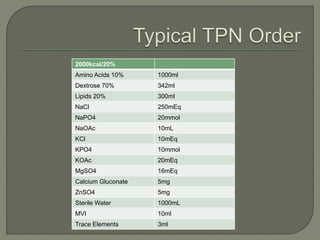
2000kcal/20%
Amino Acids 10% 1000ml
Dextrose 70% 342ml
Lipids 20% 300ml
NaCl 250mEq
NaPO4 20mmol
NaOAc 10mL
KCl 10mEq
KPO4 10mmol
KOAc 20mEq
MgSO4 16mEq
Calcium Gluconate 5mg
ZnSO4 5mg
Sterile Water 1000mL
MVI 10ml
Trace Elements 3ml
Non-stressed patient undergoing surgery
who has severe protein-calorie malnutrition
Patient who has a nonfunctional GI tract
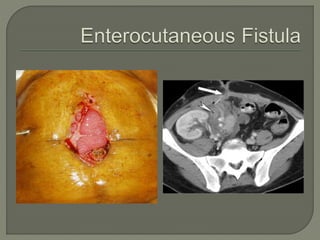
• Short gut Syndrome, High output fistulae,
obstruction, chronic mesenteric ischemia
Patient who fails oral/enteral intake
• Intractable vomiting or diarrhea
• +/- Pancreatitis
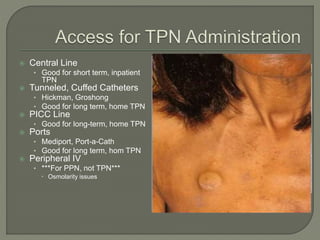
 Central Line
• Good for short term, inpatient
TPN
 Tunneled, Cuffed Catheters
• Hickman, Groshong
• Good for long term, home TPN
 PICC Line
• Good for long-term, home TPN
 Ports
• Mediport, Port-a-Cath
• Good for long term, hom TPN
 Peripheral IV
• ***For PPN, not TPN***
 Osmolarity issues
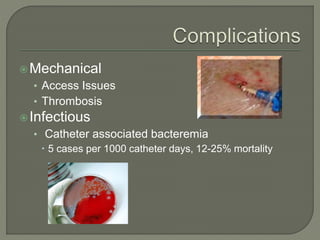
Mechanical
• Access Issues
• Thrombosis
Infectious
• Catheter associated bacteremia
 5 cases per 1000 catheter days, 12-25% mortality
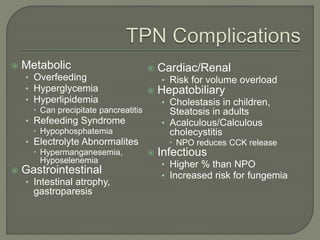
 Metabolic
• Overfeeding
• Hyperglycemia
• Hyperlipidemia
 Can precipitate pancreatitis
• Refeeding Syndrome
 Hypophosphatemia
• Electrolyte Abnormalites
 Hypermanganesemia,
Hyposelenemia
 Gastrointestinal
• Intestinal atrophy,
gastroparesis
 Cardiac/Renal
• Risk for volume overload
 Hepatobiliary
• Cholestasis in children,
Steatosis in adults
• Acalculous/Calculous
cholecystitis
 NPO reduces CCK release
 Infectious
• Higher % than NPO
• Increased risk for fungemia
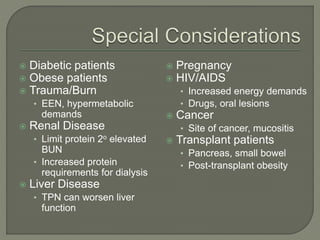
 Diabetic patients
 Obese patients
 Trauma/Burn
• EEN, hypermetabolic
demands
 Renal Disease
• Limit protein 2o elevated
BUN
• Increased protein
requirements for dialysis
 Liver Disease
• TPN can worsen liver
function
 Pregnancy
 HIV/AIDS
• Increased energy demands
• Drugs, oral lesions
 Cancer
• Site of cancer, mucositis
 Transplant patients
• Pancreas, small bowel
• Post-transplant obesity
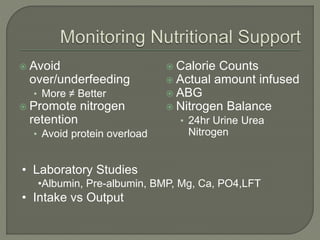
 Avoid
over/underfeeding
• More ≠ Better
 Promote nitrogen
retention
• Avoid protein overload
 Calorie Counts
 Actual amount infused
 ABG
 Nitrogen Balance
• 24hr Urine Urea
Nitrogen
• Laboratory Studies
•Albumin, Pre-albumin, BMP, Mg, Ca, PO4,LFT
• Intake vs Output
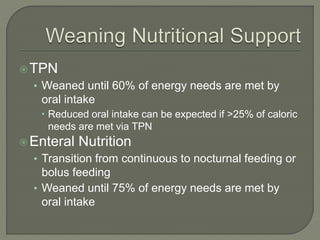
TPN
• Weaned until 60% of energy needs are met by
oral intake
 Reduced oral intake can be expected if >25% of caloric
needs are met via TPN
Enteral Nutrition
• Transition from continuous to nocturnal feeding or
bolus feeding
• Weaned until 75% of energy needs are met by
oral intake
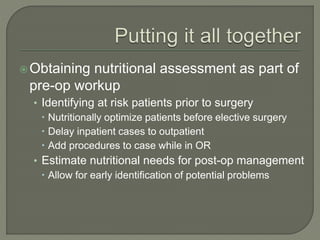
Obtaining nutritional assessment as part of
pre-op workup
• Identifying at risk patients prior to surgery
 Nutritionally optimize patients before elective surgery
 Delay inpatient cases to outpatient
 Add procedures to case while in OR
• Estimate nutritional needs for post-op management
 Allow for early identification of potential problems
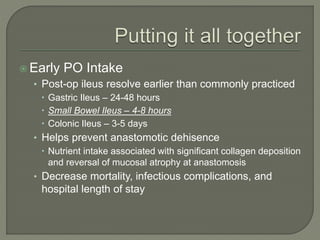
 Early PO Intake
• Post-op ileus resolve earlier than commonly practiced
 Gastric Ileus – 24-48 hours
 Small Bowel Ileus – 4-8 hours
 Colonic Ileus – 3-5 days
• Helps prevent anastomotic dehisence
 Nutrient intake associated with significant collagen deposition
and reversal of mucosal atrophy at anastomosis
• Decrease mortality, infectious complications, and
hospital length of stay
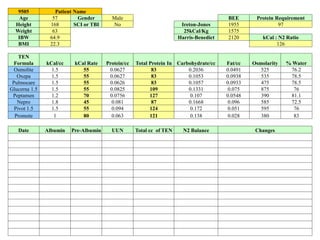
9505 Patient Name
Age 57 Gender Male BEE Protein Requirement
Height 168 SCI or TBI No Ireton-Jones 1955 97
Weight 63 25kCal/Kg 1575
IBW 64.9 Harris-Benedict 2120 kCal : N2 Ratio
BMI 22.3 126
TEN
Formula kCal/cc kCal Rate Protein/cc Total Protein In Carbohydrate/cc Fat/cc Osmolarity % Water
Osmolite 1.5 55 0.0627 83 0.2036 0.0491 525 76.2
Oxepa 1.5 55 0.0627 83 0.1053 0.0938 535 78.5
Pulmocare 1.5 55 0.0626 83 0.1057 0.0933 475 78.5
Glucerna 1.5 1.5 55 0.0825 109 0.1331 0.075 875 76
Peptamen 1.2 70 0.0756 127 0.107 0.0548 390 81.1
Nepro 1.8 45 0.081 87 0.1668 0.096 585 72.5
Pivot 1.5 1.5 55 0.094 124 0.172 0.051 595 76
Promote 1 80 0.063 121 0.138 0.028 380 83
Date Albumin Pre-Albumin UUN Total cc of TEN N2 Balance Changes
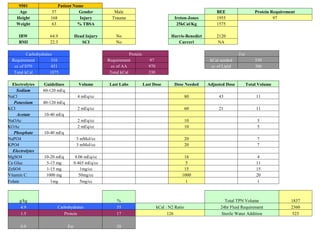
9501 Patient Name
Age 57 Gender Male BEE Protein Requirement
Height 168 Injury Trauma Ireton-Jones 1955 97
Weight 63 % TBSA 25kCal/Kg 1575
IBW 64.9 Head Injury No Harris-Benedict 2120
BMI 22.3 SCI No Curreri NA
Carbohydrates Protein Fat
Requirement 316 Requirement 97 kCal needed 550
cc of D70 451 cc of AA 970 cc of Lipid 306
Total kCal 1075 Total kCal 330
Electrolytes Guidelines Volume Last Labs Last Dose Dose Needed Adjusted Dose Total Volume
Sodium 60-120 mEq
NaCl 4 mEq/cc 80 43 11
Potassium 40-120 mEq
KCl 2 mEq/cc 60 21 11
Acetate 10-40 mEq
NaOAc 2 mEq/cc 10 5
KOAc 2 mEq/cc 10 5
Phosphate 10-40 mEq
NaPO4 3 mMol/cc 20 7
KPO4 3 mMol/cc 20 7
Electrolytes
MgSO4 10-20 mEq 4.06 mEq/cc 16 4
Ca Gluc 5-15 mg 0.465 mEq/cc 5 11
ZnSO4 1-15 mg 1mg/cc 15 15
Vitamin C 1000 mg 50mg/cc 1000 20
Folate 1mg 5mg/cc 1 1
g/kg % Total TPN Volume 1837
4.9 Carbohydrates 55 kCal : N2 Ratio 24hr Fluid Requirement 2360
1.5 Protein 17 126 Sterile Water Addition 523
0.9 Fat 28
American Society for Parenteral and
Enteral Nutrition (ASPEN)
• 2009 Clinical Guidelines
Charney P, Malone A, ADA Pocket Guide
to Nutrition Assessment. Published by:
American Dietetic Association (2004)
Kristopher R. Maday, MS, PA-C, CNSC
Assistant Professor
University of Alabama at Birmingham
Surgical Physician Assistant Program
1530 3rd Ave South, SHPB 466
Birmingham, AL 35294-1212
Telephone: 205-996-2656
maday@uab.edu
Topics on Surgical Nutrition

Topics on Surgical Nutrition

  • 1.
    Kristopher R. Maday,MS, PA-C, CNSC University of Alabama at Birmingham Department of Nutritional Sciences Surgical Physician Assistant Program
  • 2.
    3500 BC • Ancientegyptians would infuse wine, milk, whey, wheat or barley broths, eggs, and brandy through rectal enemas to preserve health, protect inflamed bowel, and treat diarrhea 1598 • Capivacceus reported infusing liquids through a hollow tube placed into the esophagus
  • 3.
    1930s • Protein hydrolysateformulas and automatic feeding pumps were developed 1968 • Dr. Stanley Dudrick - UPenn  Invented Total Parenteral Nutrition (TPN)
  • 4.
    1936 – Studleyet al. • Malnourished patients with the same diseases as nourished patients had poorer outcomes 1962 – Keys et al. • Healthy individuals who are deprived of adequate nutrients for a long enough period of time will develop adverse clinical events due to malnutrition
  • 5.
    NPO after surgeryuntil bowel function resumes • Prevent nausea and vomiting • Protect surgical anastomosis before being stressed by food
  • 6.
    Length of starvation •Well-nourished person has a 7-10 day energy and protein store • Healthy individual can tolerate up to 12-14 days without adverse effects  Major surgery or critical illness can shorten to 5-7 days Nutritional State • Identifying malnutrition
  • 7.
     > 10%loss of usual body weight  < 85% of Ideal Body Weight • ***Obese patients can be malnourished***  Serum Albumin • 2003 - Kudsk et al  Pre-op Albumin < 3.25 g/dl saw a marked rise in complications and mortality in GI surgery patients  Inability to eat for > 7 days  Nutritional Risk Index • (1.519×serum albumin)+(41.7×(present weight/usual weight))  No Risk - > 100  Mild – 97.5-100  Moderate – 83.5-97.5  Severe - < 83.5
  • 8.
     Acute PhaseProteins • Albumin and Prealbumin  Energy Needs • Harris Benedict, Ireton-Jones, Indirect Calorimetry, 22-25kcal/kg • Permissive Underfeeding  50-70% of caloric goals  ***only need 400kcal to needing for “protein sparing”***  Indirect Calorimetry  Protein Needs • 0.5-2 g/kg • 24hr Urine Urea Nitrogen collection  Nitrogen Balance
  • 9.
    Provide support consistentwith the patients medical condition and nutritional status Prevent or treat macronutrient and micronutrient deficiencies Provide doses of nutrients compatible with existing metabolism Avoid complications related to dietary delivery Improve patient outcome
  • 10.
     Feeding viathe GI tract  Types of Access • Bedside  NG, Dobhoff • Surgical  G-tube, J-tube, G-J Tube
  • 11.
     “If thegut works….use it”  Prevent translocation of bacteria  Maintains gut integrity  Sustains closure of the paracellular channels between the intraepithelial cells  Stimulate immunoglobulin A and bile salts which coat enteric bacteria  Stimulates peristalsis
  • 12.
  • 13.
    Lewis SJ, EggerM, Sylvester PA, Thomas S BMJ 2001;323:775 Mortality - 7% in early feeding group and 13% in control
  • 14.
    Abdominal Distension Aspiration • Gastricvs Transpyloric Feeding  Significant reduction if tube is past the Ligament of Trietz Diarrhea • Hyperosmolar enteral feedings  Elemental formula helps prevent Iatrogenic Injury
  • 15.
    Johnson MD, WalshRM Cleveland Clinic Journal of Medicine 2009;76(11):642
  • 18.
     Developed in1968 as a “bridging” modality for patients whom the oral route is not feasable  Admixture of amino acids, dextrose, lipids, vitamins, minerals, and electrolytes • Not as nutritional complete as enteral formulas
  • 19.
    2000kcal/20% Amino Acids 10%1000ml Dextrose 70% 342ml Lipids 20% 300ml NaCl 250mEq NaPO4 20mmol NaOAc 10mL KCl 10mEq KPO4 10mmol KOAc 20mEq MgSO4 16mEq Calcium Gluconate 5mg ZnSO4 5mg Sterile Water 1000mL MVI 10ml Trace Elements 3ml
  • 20.
    Non-stressed patient undergoingsurgery who has severe protein-calorie malnutrition Patient who has a nonfunctional GI tract • Short gut Syndrome, High output fistulae, obstruction, chronic mesenteric ischemia Patient who fails oral/enteral intake • Intractable vomiting or diarrhea • +/- Pancreatitis
  • 22.
     Central Line •Good for short term, inpatient TPN  Tunneled, Cuffed Catheters • Hickman, Groshong • Good for long term, home TPN  PICC Line • Good for long-term, home TPN  Ports • Mediport, Port-a-Cath • Good for long term, hom TPN  Peripheral IV • ***For PPN, not TPN***  Osmolarity issues
  • 23.
    Mechanical • Access Issues •Thrombosis Infectious • Catheter associated bacteremia  5 cases per 1000 catheter days, 12-25% mortality
  • 24.
     Metabolic • Overfeeding •Hyperglycemia • Hyperlipidemia  Can precipitate pancreatitis • Refeeding Syndrome  Hypophosphatemia • Electrolyte Abnormalites  Hypermanganesemia, Hyposelenemia  Gastrointestinal • Intestinal atrophy, gastroparesis  Cardiac/Renal • Risk for volume overload  Hepatobiliary • Cholestasis in children, Steatosis in adults • Acalculous/Calculous cholecystitis  NPO reduces CCK release  Infectious • Higher % than NPO • Increased risk for fungemia
  • 25.
     Diabetic patients Obese patients  Trauma/Burn • EEN, hypermetabolic demands  Renal Disease • Limit protein 2o elevated BUN • Increased protein requirements for dialysis  Liver Disease • TPN can worsen liver function  Pregnancy  HIV/AIDS • Increased energy demands • Drugs, oral lesions  Cancer • Site of cancer, mucositis  Transplant patients • Pancreas, small bowel • Post-transplant obesity
  • 26.
     Avoid over/underfeeding • More≠ Better  Promote nitrogen retention • Avoid protein overload  Calorie Counts  Actual amount infused  ABG  Nitrogen Balance • 24hr Urine Urea Nitrogen • Laboratory Studies •Albumin, Pre-albumin, BMP, Mg, Ca, PO4,LFT • Intake vs Output
  • 27.
    TPN • Weaned until60% of energy needs are met by oral intake  Reduced oral intake can be expected if >25% of caloric needs are met via TPN Enteral Nutrition • Transition from continuous to nocturnal feeding or bolus feeding • Weaned until 75% of energy needs are met by oral intake
  • 28.
    Obtaining nutritional assessmentas part of pre-op workup • Identifying at risk patients prior to surgery  Nutritionally optimize patients before elective surgery  Delay inpatient cases to outpatient  Add procedures to case while in OR • Estimate nutritional needs for post-op management  Allow for early identification of potential problems
  • 29.
     Early POIntake • Post-op ileus resolve earlier than commonly practiced  Gastric Ileus – 24-48 hours  Small Bowel Ileus – 4-8 hours  Colonic Ileus – 3-5 days • Helps prevent anastomotic dehisence  Nutrient intake associated with significant collagen deposition and reversal of mucosal atrophy at anastomosis • Decrease mortality, infectious complications, and hospital length of stay
  • 30.
    9505 Patient Name Age57 Gender Male BEE Protein Requirement Height 168 SCI or TBI No Ireton-Jones 1955 97 Weight 63 25kCal/Kg 1575 IBW 64.9 Harris-Benedict 2120 kCal : N2 Ratio BMI 22.3 126 TEN Formula kCal/cc kCal Rate Protein/cc Total Protein In Carbohydrate/cc Fat/cc Osmolarity % Water Osmolite 1.5 55 0.0627 83 0.2036 0.0491 525 76.2 Oxepa 1.5 55 0.0627 83 0.1053 0.0938 535 78.5 Pulmocare 1.5 55 0.0626 83 0.1057 0.0933 475 78.5 Glucerna 1.5 1.5 55 0.0825 109 0.1331 0.075 875 76 Peptamen 1.2 70 0.0756 127 0.107 0.0548 390 81.1 Nepro 1.8 45 0.081 87 0.1668 0.096 585 72.5 Pivot 1.5 1.5 55 0.094 124 0.172 0.051 595 76 Promote 1 80 0.063 121 0.138 0.028 380 83 Date Albumin Pre-Albumin UUN Total cc of TEN N2 Balance Changes
  • 31.
    9501 Patient Name Age57 Gender Male BEE Protein Requirement Height 168 Injury Trauma Ireton-Jones 1955 97 Weight 63 % TBSA 25kCal/Kg 1575 IBW 64.9 Head Injury No Harris-Benedict 2120 BMI 22.3 SCI No Curreri NA Carbohydrates Protein Fat Requirement 316 Requirement 97 kCal needed 550 cc of D70 451 cc of AA 970 cc of Lipid 306 Total kCal 1075 Total kCal 330 Electrolytes Guidelines Volume Last Labs Last Dose Dose Needed Adjusted Dose Total Volume Sodium 60-120 mEq NaCl 4 mEq/cc 80 43 11 Potassium 40-120 mEq KCl 2 mEq/cc 60 21 11 Acetate 10-40 mEq NaOAc 2 mEq/cc 10 5 KOAc 2 mEq/cc 10 5 Phosphate 10-40 mEq NaPO4 3 mMol/cc 20 7 KPO4 3 mMol/cc 20 7 Electrolytes MgSO4 10-20 mEq 4.06 mEq/cc 16 4 Ca Gluc 5-15 mg 0.465 mEq/cc 5 11 ZnSO4 1-15 mg 1mg/cc 15 15 Vitamin C 1000 mg 50mg/cc 1000 20 Folate 1mg 5mg/cc 1 1 g/kg % Total TPN Volume 1837 4.9 Carbohydrates 55 kCal : N2 Ratio 24hr Fluid Requirement 2360 1.5 Protein 17 126 Sterile Water Addition 523 0.9 Fat 28
  • 32.
    American Society forParenteral and Enteral Nutrition (ASPEN) • 2009 Clinical Guidelines Charney P, Malone A, ADA Pocket Guide to Nutrition Assessment. Published by: American Dietetic Association (2004)
  • 33.
    Kristopher R. Maday,MS, PA-C, CNSC Assistant Professor University of Alabama at Birmingham Surgical Physician Assistant Program 1530 3rd Ave South, SHPB 466 Birmingham, AL 35294-1212 Telephone: 205-996-2656 maday@uab.edu

Editor's Notes

  • #3 Presdient Garfield was treated this way in 1882 q4 x 79d - Continued through 1940s
  • #14 Starvation reduces the collagen content in anastomotic scar tissue diminishes the quality of healing
  • #19 Prior to this patients were essentially condemned to die of malnutrition
  • #26 Diabetes – treat malnutrition, gastroparesis HIV – increased energy requirement, drugs alter metabolism, oral lesions and PO intake Cancer – mucositis from radiation/chemo Trasnplant – pancreas 3-5 days, SB 1-2 weeks, post-transplant obesity – steroids,