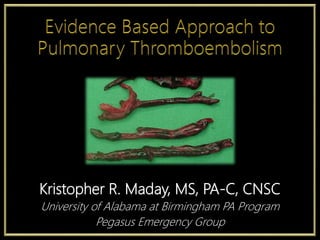











Kristopher R. Maday, MS, PA-C, CNSC
University of Alabama at Birmingham PA Program
Pegasus Emergency Group
Positive Predictive Value
Relative Risk Reduction
Number Needed to Treat
Likelihood Ratio
Confidence Intervals
Odds Ratio
Pre-test Probability
Sensitivity/Specificity
Medicine Masturbatio
n
• Discuss landmark and most recent
publications that have led to current
recommendations in PTE management
• Evaluate pre-test probability decision tools
• Compare diagnostic modalities
• Appraise current literature regarding
treatment
• Develop comprehensive decision algorithm
• 300,000-600,000 cases per year
– 1 to 2 cases per 1000 of the population
– 1/3rd will have recurrence within 10 years
• 30-50% will have chronic post-thrombotic
syndromes
Beckman MG. Am J Prev Med. 2010;38(4S):S495-S501
• 10-20% have no identified risk factor
• 10-30% die in 1st 30 days
– 20-25% as sudden death
• Up to 50% miss rate by clinicians
• 32% of patients with DVT have “Silent” PTE
• Fear of litigation is #1 reason clinicians
work-up low-risk patients
Beckman MG. Am J Prev Med. 2010;38(4S):S495-S501 Calder KK. Ann Emerg Med. 2005;45(3):302-310 Stein PD. Am J Med. 2010;123:426-431
Newman DH. Ann Emerg Med. 2011;57:622-627 Spyropoulous A. J Manag Care Pharm. 2007;13(6):475-486
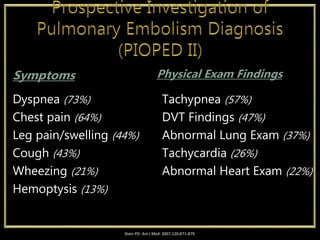
PIOPED Study
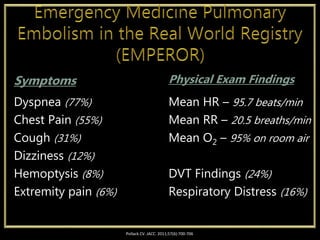
EMPEROR Registry
Dyspnea (73%)
Chest pain (64%)
Leg pain/swelling (44%)
Cough (43%)
Wheezing (21%)
Hemoptysis (13%)
Symptoms
Tachypnea (57%)
DVT Findings (47%)
Abnormal Lung Exam (37%)
Tachycardia (26%)
Abnormal Heart Exam (22%)
Physical Exam Findings
Stein PD. Am J Med. 2007;120:871-879
Dyspnea (77%)
Chest Pain (55%)
Cough (31%)
Dizziness (12%)
Hemoptysis (8%)
Extremity pain (6%)
Symptoms
Mean HR – 95.7 beats/min
Mean RR – 20.5 breaths/min
Mean O2 – 95% on room air
DVT Findings (24%)
Respiratory Distress (16%)
Physical Exam Findings
Pollack CV. JACC. 2011;57(6):700-706
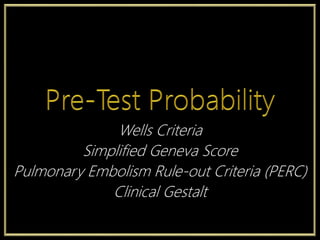
Wells Criteria
Simplified Geneva Score
Pulmonary Embolism Rule-out Criteria (PERC)
Clinical Gestalt
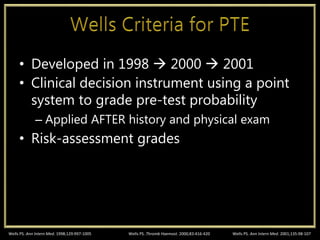
• Developed in 1998  2000  2001
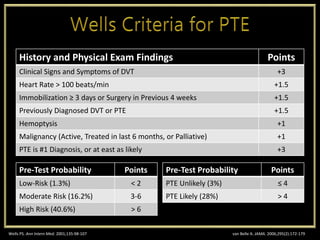
• Clinical decision instrument using a point
system to grade pre-test probability
– Applied AFTER history and physical exam
• Risk-assessment grades
Wells PS. Ann Intern Med. 2001;135:98-107Wells PS. Ann Intern Med. 1998;129:997-1005 Wells PS. Thromb Haemost. 2000;83:416-420
History and Physical Exam Findings Points
Clinical Signs and Symptoms of DVT +3
Heart Rate > 100 beats/min +1.5
Immobilization ≥ 3 days or Surgery in Previous 4 weeks +1.5
Previously Diagnosed DVT or PTE +1.5
Hemoptysis +1
Malignancy (Active, Treated in last 6 months, or Palliative) +1
PTE is #1 Diagnosis, or at east as likely +3
Pre-Test Probability Points
Low-Risk (1.3%) < 2
Moderate Risk (16.2%) 3-6
High Risk (40.6%) > 6
Wells PS. Ann Intern Med. 2001;135:98-107
Pre-Test Probability Points
PTE Unlikely (3%) ≤ 4
PTE Likely (28%) > 4
van Belle A. JAMA. 2006;295(2):172-179
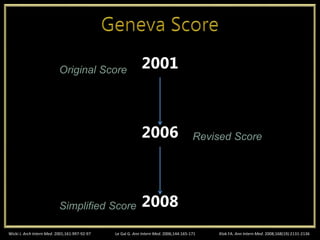
2001
2006
2008
Klok FA. Ann Intern Med. 2008;168(19):2131-2136Wicki J. Arch Intern Med. 2001;161:997-92-97 Le Gal G. Ann Intern Med. 2006;144:165-171
Original Score
Revised Score
Simplified Score
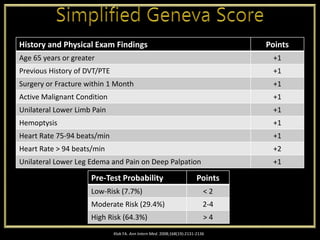
History and Physical Exam Findings Points
Age 65 years or greater +1
Previous History of DVT/PTE +1
Surgery or Fracture within 1 Month +1
Active Malignant Condition +1
Unilateral Lower Limb Pain +1
Hemoptysis +1
Heart Rate 75-94 beats/min +1
Heart Rate > 94 beats/min +2
Unilateral Lower Leg Edema and Pain on Deep Palpation +1
Pre-Test Probability Points
Low-Risk (7.7%) < 2
Moderate Risk (29.4%) 2-4
High Risk (64.3%) > 4
Klok FA. Ann Intern Med. 2008;168(19):2131-2136
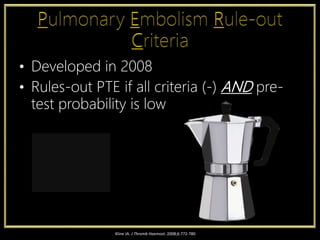
• Developed in 2008
• Rules-out PTE if all criteria (-) AND pre-
test probability is low
Kline JA. J Thromb Haemost. 2008;6:772-780
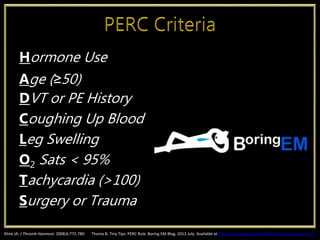
Hormone Use
Age (≥50)
DVT or PE History
Coughing Up Blood
Leg Swelling
O2 Sats < 95%
Tachycardia (>100)
Surgery or Trauma
Thoma B. Tiny Tips: PERC Rule. Boring EM Blog. 2013 July. Available at http://boringem.org/2013/07/02/tiny-tips-perc-rule/Kline JA. J Thromb Haemost. 2008;6:772-780
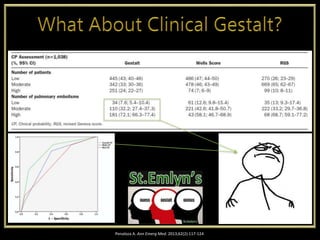
Penaloza A. Ann Emerg Med. 2013;62(2):117-124
EKG
D-Dimer
Computed Tomography
Ventilation / Perfusion Scan
• High sensitivity, Low specificity
• False Negatives
– Small clot, impaired fibrinolytic activity
• False Positives
– Age, smoking, functional impairment
***Should only be used AFTER pre-test
probability***
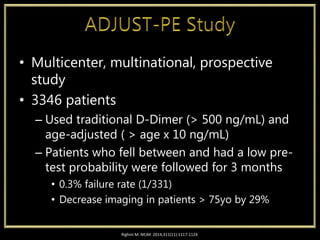
• Multicenter, multinational, prospective
study
• 3346 patients
– Used traditional D-Dimer (> 500 ng/mL) and
age-adjusted ( > age x 10 ng/mL)
– Patients who fell between and had a low pre-
test probability were followed for 3 months
• 0.3% failure rate (1/331)
• Decrease imaging in patients > 75yo by 29%
Righini M. NEJM. 2014;311(11):1117-1124
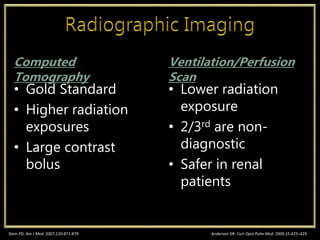
• Gold Standard
• Higher radiation
exposures
• Large contrast
bolus
Computed
Tomography
• Lower radiation
exposure
• 2/3rd are non-
diagnostic
• Safer in renal
patients
Ventilation/Perfusion
Scan
Stein PD. Am J Med. 2007;120:871-879 Anderson DR. Curr Opin Pulm Med. 2009;15:425–429
Echocardiography
Biomarkers
Pulmonary Embolism Severity Index (PESI)
• Increasingly utilized at bedside by
clinicians
• Helps with determining severity of clot
burden
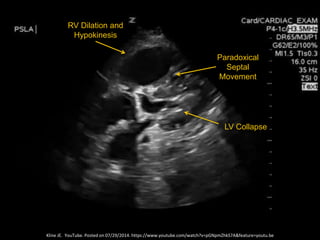
– RV Strain
• RV:LV ≥ 1
• RV hypokinesis
• Paradoxical septal movement
• Tricuspid regurgitation
Rudoni RR. J Emerg Med. 1998;16(1):5-8 Taylor RA. J Emerg Med. 2013;45(3):392-399
Kline JE. YouTube. Posted on 07/29/2014. https://www.youtube.com/watch?v=pGNpmZhkS7A&feature=youtu.be
RV Dilation and
Hypokinesis
LV Collapse
Paradoxical
Septal
Movement
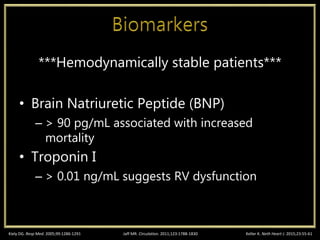
***Hemodynamically stable patients***
• Brain Natriuretic Peptide (BNP)
– > 90 pg/mL associated with increased
mortality
• Troponin I
– > 0.01 ng/mL suggests RV dysfunction
Kiely DG. Resp Med. 2005;99:1286-1291 Keller K. Neth Heart J. 2015;23:55-61Jaff MR. Circulation. 2011;123:1788-1830
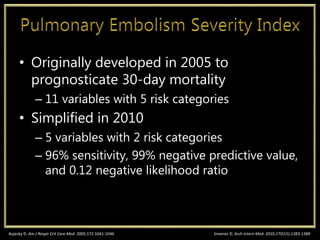
• Originally developed in 2005 to
prognosticate 30-day mortality
– 11 variables with 5 risk categories
• Simplified in 2010
– 5 variables with 2 risk categories
– 96% sensitivity, 99% negative predictive value,
and 0.12 negative likelihood ratio
Jimenez D. Arch Intern Med. 2010;170(15):1383-1389Aujesky D. Am J Respir Crit Care Med. 2005;172:1041-1046
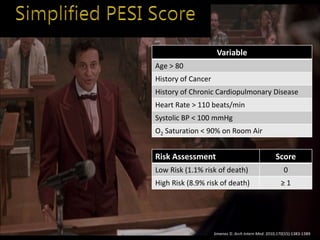
Jimenez D. Arch Intern Med. 2010;170(15):1383-1389
Variable
Age > 80
History of Cancer
History of Chronic Cardiopulmonary Disease
Heart Rate > 110 beats/min
Systolic BP < 100 mmHg
O2 Saturation < 90% on Room Air
Risk Assessment Score
Low Risk (1.1% risk of death) 0
High Risk (8.9% risk of death) ≥ 1
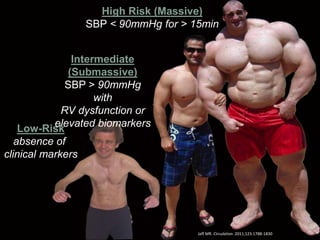
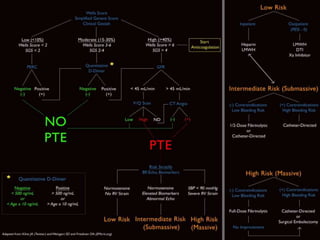
Low-Risk
Intermediate (Submassive)
High Risk (Massive)
High Risk (Massive)
SBP < 90mmHg for > 15min
Intermediate
(Submassive)
SBP > 90mmHg
with
RV dysfunction or
elevated biomarkersLow-Risk
absence of
clinical markers
Jaff MR. Circulation. 2011;123:1788-1830
Anticoagulation
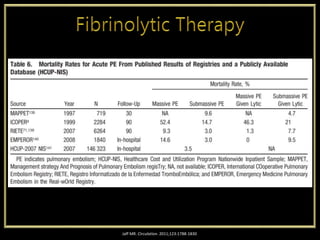
Fibrinolytic Therapy
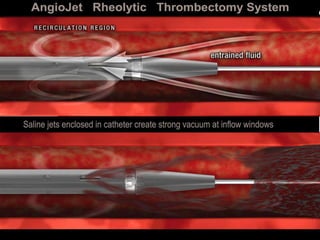
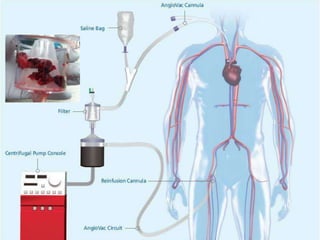
Catheter-Directed Therapy
Surgical Embolectomy
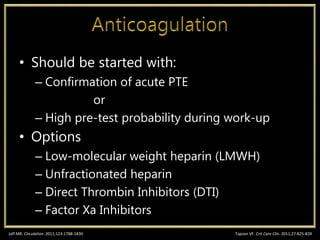
• Should be started with:
– Confirmation of acute PTE
or
– High pre-test probability during work-up
• Options
– Low-molecular weight heparin (LMWH)
– Unfractionated heparin
– Direct Thrombin Inhibitors (DTI)
– Factor Xa Inhibitors
Tapson VF. Crit Care Clin. 2011;27:825-839Jaff MR. Circulation. 2011;123:1788-1830
Jaff MR. Circulation. 2011;123:1788-1830
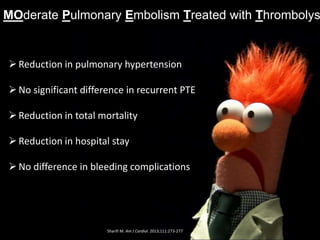
MOderate Pulmonary Embolism Treated with Thrombolys
Sharifi M. Am J Cardiol. 2013;111:273-277
Reduction in pulmonary hypertension
No significant difference in recurrent PTE
Reduction in total mortality
Reduction in hospital stay
No difference in bleeding complications
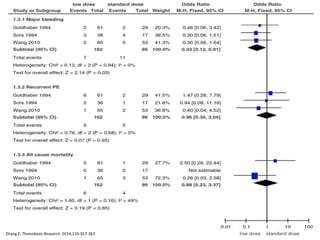
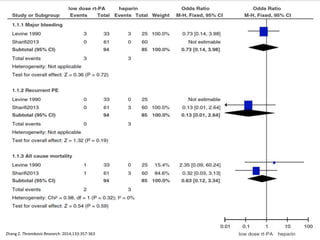
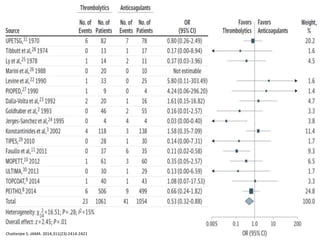
Zhang Z. Thrombosis Research. 2014;133:357-363
Peitho – The Greek Goddess of Persuas
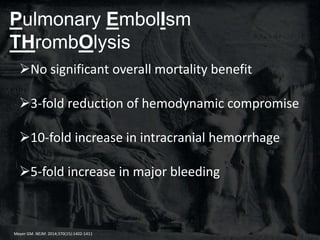
Pulmonary EmbolIsm
THrombOlysis
Meyer GM. NEJM. 2014;370(15):1402-1411
No significant overall mortality benefit
3-fold reduction of hemodynamic compromise
10-fold increase in intracranial hemorrhage
5-fold increase in major bleeding
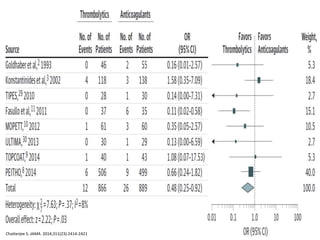
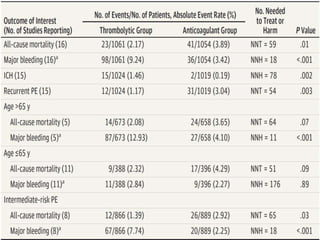
Chatterjee S. JAMA. 2014;311(23):2414-2421
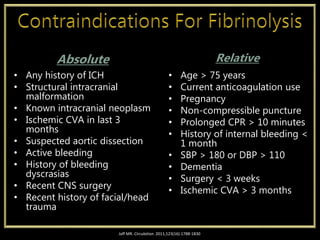
• Any history of ICH
• Structural intracranial
malformation
• Known intracranial neoplasm
• Ischemic CVA in last 3
months
• Suspected aortic dissection
• Active bleeding
• History of bleeding
dyscrasias
• Recent CNS surgery
• Recent history of facial/head
trauma
Absolute
• Age > 75 years
• Current anticoagulation use
• Pregnancy
• Non-compressible puncture
• Prolonged CPR > 10 minutes
• History of internal bleeding <
1 month
• SBP > 180 or DBP > 110
• Dementia
• Surgery < 3 weeks
• Ischemic CVA > 3 months
Relative
Jaff MR. Circulation. 2011;123(16):1788-1830
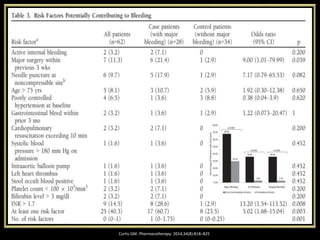
Curtis GM. Pharmacotherapy. 2014;34(8):818–825
Increased Risk of Bleeding?
He Ain’t Got
Time To Bleed
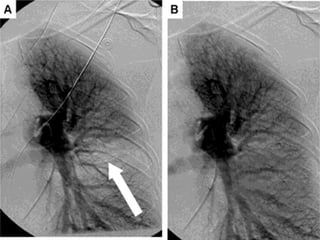
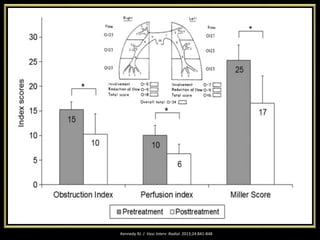
Kennedy RJ. J Vasc Interv Radiol. 2013;24:841-848
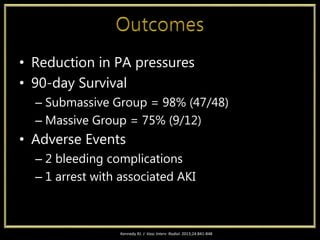
• Reduction in PA pressures
• 90-day Survival
– Submassive Group = 98% (47/48)
– Massive Group = 75% (9/12)
• Adverse Events
– 2 bleeding complications
– 1 arrest with associated AKI
Kennedy RJ. J Vasc Interv Radiol. 2013;24:841-848
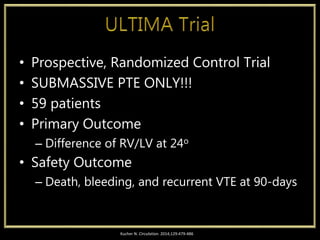
• Prospective, Randomized Control Trial
• SUBMASSIVE PTE ONLY!!!
• 59 patients
• Primary Outcome
– Difference of RV/LV at 24o
• Safety Outcome
– Death, bleeding, and recurrent VTE at 90-days
Kucher N. Circulation. 2014;129:479-486
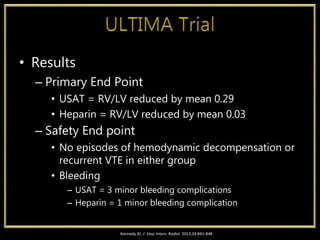
• Results
– Primary End Point
• USAT = RV/LV reduced by mean 0.29
• Heparin = RV/LV reduced by mean 0.03
– Safety End point
• No episodes of hemodynamic decompensation or
recurrent VTE in either group
• Bleeding
– USAT = 3 minor bleeding complications
– Heparin = 1 minor bleeding complication
Kennedy RJ. J Vasc Interv Radiol. 2013;24:841-848
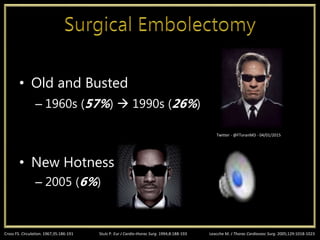
• Old and Busted
– 1960s (57%)  1990s (26%)
• New Hotness
– 2005 (6%)
Cross FS. Circulation. 1967;35:186-191 Stulz P. Eur J Cardio-thorac Surg. 1994;8:188-193 Leacche M. J Thorac Cardiovasc Surg. 2005;129:1018-1023
Twitter - @FToranMD - 04/01/2015
maday@uab.edu
@PA_Maday
www.pamaday.net

Evidence Based Approach to PTE

  • 1.
    Kristopher R. Maday,MS, PA-C, CNSC University of Alabama at Birmingham PA Program Pegasus Emergency Group
  • 4.
    Positive Predictive Value RelativeRisk Reduction Number Needed to Treat Likelihood Ratio Confidence Intervals Odds Ratio Pre-test Probability Sensitivity/Specificity Medicine Masturbatio n
  • 5.
    • Discuss landmarkand most recent publications that have led to current recommendations in PTE management • Evaluate pre-test probability decision tools • Compare diagnostic modalities • Appraise current literature regarding treatment • Develop comprehensive decision algorithm
  • 6.
    • 300,000-600,000 casesper year – 1 to 2 cases per 1000 of the population – 1/3rd will have recurrence within 10 years • 30-50% will have chronic post-thrombotic syndromes Beckman MG. Am J Prev Med. 2010;38(4S):S495-S501
  • 7.
    • 10-20% haveno identified risk factor • 10-30% die in 1st 30 days – 20-25% as sudden death • Up to 50% miss rate by clinicians • 32% of patients with DVT have “Silent” PTE • Fear of litigation is #1 reason clinicians work-up low-risk patients Beckman MG. Am J Prev Med. 2010;38(4S):S495-S501 Calder KK. Ann Emerg Med. 2005;45(3):302-310 Stein PD. Am J Med. 2010;123:426-431
  • 8.
    Newman DH. AnnEmerg Med. 2011;57:622-627 Spyropoulous A. J Manag Care Pharm. 2007;13(6):475-486
  • 9.
  • 10.
    Dyspnea (73%) Chest pain(64%) Leg pain/swelling (44%) Cough (43%) Wheezing (21%) Hemoptysis (13%) Symptoms Tachypnea (57%) DVT Findings (47%) Abnormal Lung Exam (37%) Tachycardia (26%) Abnormal Heart Exam (22%) Physical Exam Findings Stein PD. Am J Med. 2007;120:871-879
  • 11.
    Dyspnea (77%) Chest Pain(55%) Cough (31%) Dizziness (12%) Hemoptysis (8%) Extremity pain (6%) Symptoms Mean HR – 95.7 beats/min Mean RR – 20.5 breaths/min Mean O2 – 95% on room air DVT Findings (24%) Respiratory Distress (16%) Physical Exam Findings Pollack CV. JACC. 2011;57(6):700-706
  • 12.
    Wells Criteria Simplified GenevaScore Pulmonary Embolism Rule-out Criteria (PERC) Clinical Gestalt
  • 13.
    • Developed in1998  2000  2001 • Clinical decision instrument using a point system to grade pre-test probability – Applied AFTER history and physical exam • Risk-assessment grades Wells PS. Ann Intern Med. 2001;135:98-107Wells PS. Ann Intern Med. 1998;129:997-1005 Wells PS. Thromb Haemost. 2000;83:416-420
  • 14.
    History and PhysicalExam Findings Points Clinical Signs and Symptoms of DVT +3 Heart Rate > 100 beats/min +1.5 Immobilization ≥ 3 days or Surgery in Previous 4 weeks +1.5 Previously Diagnosed DVT or PTE +1.5 Hemoptysis +1 Malignancy (Active, Treated in last 6 months, or Palliative) +1 PTE is #1 Diagnosis, or at east as likely +3 Pre-Test Probability Points Low-Risk (1.3%) < 2 Moderate Risk (16.2%) 3-6 High Risk (40.6%) > 6 Wells PS. Ann Intern Med. 2001;135:98-107 Pre-Test Probability Points PTE Unlikely (3%) ≤ 4 PTE Likely (28%) > 4 van Belle A. JAMA. 2006;295(2):172-179
  • 15.
    2001 2006 2008 Klok FA. AnnIntern Med. 2008;168(19):2131-2136Wicki J. Arch Intern Med. 2001;161:997-92-97 Le Gal G. Ann Intern Med. 2006;144:165-171 Original Score Revised Score Simplified Score
  • 16.
    History and PhysicalExam Findings Points Age 65 years or greater +1 Previous History of DVT/PTE +1 Surgery or Fracture within 1 Month +1 Active Malignant Condition +1 Unilateral Lower Limb Pain +1 Hemoptysis +1 Heart Rate 75-94 beats/min +1 Heart Rate > 94 beats/min +2 Unilateral Lower Leg Edema and Pain on Deep Palpation +1 Pre-Test Probability Points Low-Risk (7.7%) < 2 Moderate Risk (29.4%) 2-4 High Risk (64.3%) > 4 Klok FA. Ann Intern Med. 2008;168(19):2131-2136
  • 17.
    • Developed in2008 • Rules-out PTE if all criteria (-) AND pre- test probability is low Kline JA. J Thromb Haemost. 2008;6:772-780
  • 18.
    Hormone Use Age (≥50) DVTor PE History Coughing Up Blood Leg Swelling O2 Sats < 95% Tachycardia (>100) Surgery or Trauma Thoma B. Tiny Tips: PERC Rule. Boring EM Blog. 2013 July. Available at http://boringem.org/2013/07/02/tiny-tips-perc-rule/Kline JA. J Thromb Haemost. 2008;6:772-780
  • 19.
    Penaloza A. AnnEmerg Med. 2013;62(2):117-124
  • 20.
  • 22.
    • High sensitivity,Low specificity • False Negatives – Small clot, impaired fibrinolytic activity • False Positives – Age, smoking, functional impairment ***Should only be used AFTER pre-test probability***
  • 23.
    • Multicenter, multinational,prospective study • 3346 patients – Used traditional D-Dimer (> 500 ng/mL) and age-adjusted ( > age x 10 ng/mL) – Patients who fell between and had a low pre- test probability were followed for 3 months • 0.3% failure rate (1/331) • Decrease imaging in patients > 75yo by 29% Righini M. NEJM. 2014;311(11):1117-1124
  • 24.
    • Gold Standard •Higher radiation exposures • Large contrast bolus Computed Tomography • Lower radiation exposure • 2/3rd are non- diagnostic • Safer in renal patients Ventilation/Perfusion Scan Stein PD. Am J Med. 2007;120:871-879 Anderson DR. Curr Opin Pulm Med. 2009;15:425–429
  • 25.
  • 26.
    • Increasingly utilizedat bedside by clinicians • Helps with determining severity of clot burden – RV Strain • RV:LV ≥ 1 • RV hypokinesis • Paradoxical septal movement • Tricuspid regurgitation Rudoni RR. J Emerg Med. 1998;16(1):5-8 Taylor RA. J Emerg Med. 2013;45(3):392-399
  • 27.
    Kline JE. YouTube.Posted on 07/29/2014. https://www.youtube.com/watch?v=pGNpmZhkS7A&feature=youtu.be RV Dilation and Hypokinesis LV Collapse Paradoxical Septal Movement
  • 28.
    ***Hemodynamically stable patients*** •Brain Natriuretic Peptide (BNP) – > 90 pg/mL associated with increased mortality • Troponin I – > 0.01 ng/mL suggests RV dysfunction Kiely DG. Resp Med. 2005;99:1286-1291 Keller K. Neth Heart J. 2015;23:55-61Jaff MR. Circulation. 2011;123:1788-1830
  • 29.
    • Originally developedin 2005 to prognosticate 30-day mortality – 11 variables with 5 risk categories • Simplified in 2010 – 5 variables with 2 risk categories – 96% sensitivity, 99% negative predictive value, and 0.12 negative likelihood ratio Jimenez D. Arch Intern Med. 2010;170(15):1383-1389Aujesky D. Am J Respir Crit Care Med. 2005;172:1041-1046
  • 30.
    Jimenez D. ArchIntern Med. 2010;170(15):1383-1389 Variable Age > 80 History of Cancer History of Chronic Cardiopulmonary Disease Heart Rate > 110 beats/min Systolic BP < 100 mmHg O2 Saturation < 90% on Room Air Risk Assessment Score Low Risk (1.1% risk of death) 0 High Risk (8.9% risk of death) ≥ 1
  • 31.
  • 32.
    High Risk (Massive) SBP< 90mmHg for > 15min Intermediate (Submassive) SBP > 90mmHg with RV dysfunction or elevated biomarkersLow-Risk absence of clinical markers Jaff MR. Circulation. 2011;123:1788-1830
  • 33.
  • 34.
    • Should bestarted with: – Confirmation of acute PTE or – High pre-test probability during work-up • Options – Low-molecular weight heparin (LMWH) – Unfractionated heparin – Direct Thrombin Inhibitors (DTI) – Factor Xa Inhibitors Tapson VF. Crit Care Clin. 2011;27:825-839Jaff MR. Circulation. 2011;123:1788-1830
  • 35.
    Jaff MR. Circulation.2011;123:1788-1830
  • 36.
    MOderate Pulmonary EmbolismTreated with Thrombolys Sharifi M. Am J Cardiol. 2013;111:273-277 Reduction in pulmonary hypertension No significant difference in recurrent PTE Reduction in total mortality Reduction in hospital stay No difference in bleeding complications
  • 37.
    Zhang Z. ThrombosisResearch. 2014;133:357-363
  • 38.
    Zhang Z. ThrombosisResearch. 2014;133:357-363
  • 39.
    Peitho – TheGreek Goddess of Persuas
  • 40.
    Pulmonary EmbolIsm THrombOlysis Meyer GM.NEJM. 2014;370(15):1402-1411 No significant overall mortality benefit 3-fold reduction of hemodynamic compromise 10-fold increase in intracranial hemorrhage 5-fold increase in major bleeding
  • 41.
    Chatterjee S. JAMA.2014;311(23):2414-2421
  • 42.
    Chatterjee S. JAMA.2014;311(23):2414-2421
  • 44.
    • Any historyof ICH • Structural intracranial malformation • Known intracranial neoplasm • Ischemic CVA in last 3 months • Suspected aortic dissection • Active bleeding • History of bleeding dyscrasias • Recent CNS surgery • Recent history of facial/head trauma Absolute • Age > 75 years • Current anticoagulation use • Pregnancy • Non-compressible puncture • Prolonged CPR > 10 minutes • History of internal bleeding < 1 month • SBP > 180 or DBP > 110 • Dementia • Surgery < 3 weeks • Ischemic CVA > 3 months Relative Jaff MR. Circulation. 2011;123(16):1788-1830
  • 45.
    Curtis GM. Pharmacotherapy.2014;34(8):818–825
  • 46.
    Increased Risk ofBleeding? He Ain’t Got Time To Bleed
  • 51.
    Kennedy RJ. JVasc Interv Radiol. 2013;24:841-848
  • 52.
    • Reduction inPA pressures • 90-day Survival – Submassive Group = 98% (47/48) – Massive Group = 75% (9/12) • Adverse Events – 2 bleeding complications – 1 arrest with associated AKI Kennedy RJ. J Vasc Interv Radiol. 2013;24:841-848
  • 53.
    • Prospective, RandomizedControl Trial • SUBMASSIVE PTE ONLY!!! • 59 patients • Primary Outcome – Difference of RV/LV at 24o • Safety Outcome – Death, bleeding, and recurrent VTE at 90-days Kucher N. Circulation. 2014;129:479-486
  • 54.
    • Results – PrimaryEnd Point • USAT = RV/LV reduced by mean 0.29 • Heparin = RV/LV reduced by mean 0.03 – Safety End point • No episodes of hemodynamic decompensation or recurrent VTE in either group • Bleeding – USAT = 3 minor bleeding complications – Heparin = 1 minor bleeding complication Kennedy RJ. J Vasc Interv Radiol. 2013;24:841-848
  • 55.
    • Old andBusted – 1960s (57%)  1990s (26%) • New Hotness – 2005 (6%) Cross FS. Circulation. 1967;35:186-191 Stulz P. Eur J Cardio-thorac Surg. 1994;8:188-193 Leacche M. J Thorac Cardiovasc Surg. 2005;129:1018-1023 Twitter - @FToranMD - 04/01/2015
  • 58.

Editor's Notes

  • #7 Incidence rates vary greatly between age, gender, and race (worse in old, blacks/whites, men overal but women during childbearing years) Highest risk is within the 1st year  why we treat for so long Equates to $2-10 billion in total annual health care costs
  • #8 1. 50% miss rate  highly debated but published  non-textbook/variable presentations, occur with other easily explainable but less deadly diseases
  • #9 $7,500-16,000 per patient in total health care cost 6x more deaths with testing  ATN
  • #10 We need to talk about common S&S in order to put the clinical decision instruments into context
  • #11 Started in 1990 and in 3rd installment looking at radiographic modalities in diagnosis of PTE – 824 patients PIOPED II (2007) is most cited in regards to S&S of PTE Dyspnea is both exertion or at rest Chest Pain includes pleuritic and non-pleuritic Tachypnea = > 20/min and Tachycardia = >100/min DVT findings = Calf or thigh swelling, erythema, edema, tenderness, palpable cords Abnormal lung exam = rales, crackles, wheezes, rhonchi, decreased BS, pleural friction rub Abnormal cardiac exam = increased S2, right ventricular lift, JVD Combination S&S – dyspnea or tachypnea (86%) and dyspnea,tachypne, or CP (92%)
  • #12 National, multicenter, observational registry Designed to establish more definitively the presentation S&S of PTE presenting to the ED 22 community and academic EDs – 1880 patients Dyspnea – with exertion or at rest Chest pain – pleuritic or substernal
  • #14 Some may use a newer 2 grade approach
  • #16 Original Score used CXR and ABG  needed studies to use Simplified Score  made all criteria 1 point to decrease liklihood or error
  • #18 1% false negative rate…..98% sensitivity
  • #20 http://stemlynsblog.org/gestalt-st-emlyns/
  • #23 D-dimers are specific cross-linked fibrin derivatives that are the product of plasmin-mediated fibrinolytic degradation. They are an excellent marker of fibrinolytic activity. The fact that a normal D-dimer has a lower LR(-) [~0.07-0.12] than CTPA [0.10-0.20] still seems to surprise a lot of clinicians.
  • #25 PIOPED II subgroup analysis showed increased rate of false abnormality when compared to CTPA
  • #28 Severe PE dilating the right ventricle (top) and compressing the left ventricle (bottom)
  • #29 0.01 ng/mL had OR 3.954 (1.949–8.024) 0.00014 and NPV of 73% CHEST 2015 – negative high sensitive cTnI assay has excellent negative predictive value
  • #30 96%/99%/0.12 shows that low risk patients may be managed outpatient
  • #35 LMWH – enoxaparin (1mg/kg BID or 1.5mg/kg daily) or fondaparinux (5mg if <50kg or 7.5mg if 50-100, or 10mg if >100kg) Heparin – 5000unit bolus followed by drip with PTT monitoring DTI– lepirudin, bivalirudin, argatroban, dabigatran Factor Xa - rivaroxaban
  • #36 This is with FULL DOSE therapy and this was not a randomized control trial
  • #37 Safe dose = < 50% of standard dosing 121 patients with submassive PTE “Safe Dose” tPA vs Placebo Primary Outcome Pulmonary hypertension and recurrent PTE at 28 months Secondary Outcome Total mortality, duration of hospital stay, bleeding, and recurrent PTE
  • #38 2014 Meta-Analysis 5 studies – 440 patients
  • #39 2014 Meta-Analysis 5 studies – 440 patients
  • #40 Peitho on a pillar overseeing a scene of persuasion: Helen of Troy is below Peitho’s dangling feet while Aphrodite speaks to her; Paris, at the far right, is also receiving a “talking to”—by winged Eros
  • #41 1005 patients Randomized to anticoagluation only vs tenecteplase Primary outcomes – death or hemodynamic decompensation within 7 days Safety Outcomes – extracranial major bleeding within 7 days, ischemic or hemorrhagic stroke within 7 days Results 1.2% (lytic) vs 1.8% (heparin) mortality reduction with p-value 0.42 1.6% vs 5.0% reduction in hemodynamic compromise 6.3% vs 1.2% extracranial bleeding 2.4% vs 0.2% stroke
  • #42 2014 Meta-Analysis JAMA ALL PTEs Full dose lytics vs heparin alone Overall mortality
  • #43 Same 2014 meta-analysis Submassive group Full dose lytics vs heparin Overall mortality
  • #44 Same 2014 meta-analysis Absolute risk metrics of outcomes ALL PTE Full dose lytics
  • #46 At least 1 RF increased risk of bleeding after tPA 5-fold Patients with one or more bleeding risk factors compared with patients without any bleeding risk factors had a significantly higher incidence of: major bleeding (68.0% vs 29.7%, p=0.003) ICU mortality (36.0% vs 2.8%, p=0.001) hospital mortality (36.0% vs 2.7%, p=0.001)
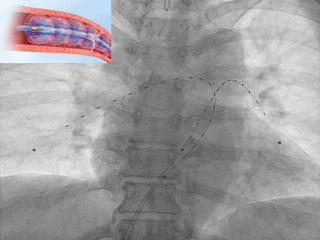
  • #49 AngioJet-a catheter that breaks up the clot with a high speed jet of saline, heparin, or tPA that then sucks up clot using Bernoulli physics. Very little systemic drug is delivered. Oren’s center doesn’t like the device; other centers use it.
  • #50 http://www.angiodynamics.com/products/angiovac
  • #51 Catheter inserted in affected throbus and left in place for a period of time (15hr). US is then delivered to to promote dissociation of the fibrin matrix and increase penetration of locally delivered fibrinolytic
  • #52 Obstruction Index – characterizes the anatomic distribution of emboli in the segmental PA Only 60 patients, retrospective Perfusion Index – grades the degree of perfusion to each lung Miller Score – Aggregate of the the two
  • #53 Two of the 3 massive patients had evidnce of MODS
  • #54 Ultrasound Accelerated Thrombolysis of Pulmonary Embolism Randomized to US assistaed thrombolysis + heparin or heparin alone Placement of US catheter into clot with local fibrinolytics for 15hr RV/LV ratio measured via ECHO
  • #55 At 90-days though the RV/LV difference between groups was only 0.04 USAT Bleeding – 2 transient episodes of hemoptysis and 1 groin hematoma Heparin Bleeding – 1 muscular hematoma and anal bleeding after endoscopic colonic polyp removal at 80-day
  • #56 Often thought of as last resort Retrospective review of 47 patients who underwent surgical embolectomy Indications – Contraindications for thrombolysis, failed therapy (thrombolytics/catheter), RV dysfunction, large RV/RA thrombus Improvement due to advances in surgical technique, anesthesia, and more aggressive initial identificaiton and maagement